Showing posts with label South East Asia. Show all posts

Sunday, 13 December 2015

Phoxocephalus tiomanensis: A new species of Phoxocephalid Amphipod from Pulau Tioman, Malaysia.

Phoxocephalid Amphipods are small, Shrimp-like Amphipod Crustaceans found throughout the worlds oceans. They are predominantly benthic (living on the seafloor rather than in the water column), and are found from the intertidal zones to the deep oceans. The group has a global distribution, bu reaches its maximum diversity in the waters around Australia.

In a paper published in the Raffles Bulletin of Zoology on 6 November 2015, Myung-Hwa Shin of the National Marine Biodiversity Institute of Korea, Abdul Rahim Azman of the Marine Ecosystem Research Centre at the Universiti Kebangsaan Malaysia and Won Kim of the School of Biological Sciences at Seoul National University describe a new species of Phoxocephalid Amphipod from Pulau Tioman, an island off the east coast of Peninsula Malaysia.

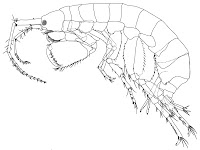
The new species is placed in the genus Phoxocephalus and given the specific name tiomanensis, meaning 'from Tioman'. The species is described from fourteen male specimens collected with light traps on Abect’s House Reef, on the northwest shore of the island at a depth of eight meters. These are between 2.7 and 3.03 mm in length, and have heads that comprise about 15% of their snouts, downward curving snouts, large subcircular eyes, slender mandibles and two pairs of antennae, the first being short and stout the second long and thin.

Phoxocephalus tiomanensis, male specimen in lateral view. Scale bar is 0.2 mm. Shin et al. (2015).

This is the first species of the genus  Phoxacephalus described from South East Asia, although as the genus is known from Australasian and East Asian waters this is not a great surprise. 

See also...

http://sciencythoughts.blogspot.co.uk/2014/11/a-new-species-of-wormshrimp-from-gura.htmlA new species of Wormshrimp from the Gura Ici Islands.                                                              Wormshrimps, Ingolfiellidae, are small Amphipod Crustaceans with elongate Worm-like bodies. They seldom exceed 3 mm in length and typically live in interstitial spaces (i.e. spaces between particles)...
http://sciencythoughts.blogspot.co.uk/2014/11/a-new-species-of-wormshrimp-from.htmlA new species of Wormshrimp from the Maldives.                                              Wormshrimps are a poorly understood group of Amphipod Crustaceans found living in a variety of subterranean environments, including the interstitial spaces in sandy sediments from beaches to the deep ocean floors, to cave systems and fresh and brackish...
Amphipods are (mostly) small, laterally compressed Crustaceans with differentiated legs (i.e. not all their legs are the same). Female Amphipods carry their eggs in brood pouches till they hatch; the young resemble the adults and typically reach maturity after about six molts. 


Follow Sciency Thoughts on Facebook.
 

Sunday, 29 November 2015

Magnitude 5.5 Earthquake in Sagaing Region, Myanmar.

The United States Geological Survey recorded a Magnitude 5.5 Earthquake at a depth of 22 km about 50 km to the north of Monywa in the Sagaing Region, Myanmar, slightly before 3.05 pm local time (slightly before 8.35 am GMT) on Friday 27 November 2015. There are no reports of any casualties arising from this event,but damage to numerous pagodas (religious shrines) has been reported in the area.

Damage to a pagoda in Sagaing Region, Myanmar, following the 27 November 2015 Earthquake. Earthquake Report.

Northern Myanmar is an area fairly prone to Earthquakes Much of Myanmar lies on the Burma Plate, a small tectonic plate caught between  the Eurasian Plate to the northeast, the Indian Plate to the west and southwest and the Sunda Plate to the southeast. As these larger plates move together the Burma Plate is being squeezed and fractured, with a major fault line, the Kabaw Fault, having formed across much of the north of the country, along which the Burma Plate is slowly splitting. Most Earthquakes in the region are caused by movement on this fault.

 The approximate location of the 27 November 2015 Sagaing Earthquake. Google Maps.

Witness accounts of Earthquakes can help geologists to understand these events, and the structures that cause them. The international non-profit organization Earthquake Report is interested in hearing from people who may have felt this event; if you felt this quake then you can report it to Earthquake Report here.

See also...

http://sciencythoughts.blogspot.co.uk/2015/11/hundreds-feared-dead-following.htmlHundreds feared dead following landslide at Myanmar jade mine                                     One hundred and five people have now been confirmed dead and over a hundred are still thought to be missing following a landslide at a jade mine at Hpakant in Kachin State, Myanmar on Saturday 21 November 2015...
http://sciencythoughts.blogspot.co.uk/2015/10/landslide-injures-four-in-magwe-region.htmlLandslide injures four in Magwe Region, Myanmar.                                                    Four people have been injured following a landslide at the Ayeyarwady Bridge in the Magwe Region of Myanmar on Thursday 15 October. The incident happened at about 10.00 am local time on the Minbu...
http://sciencythoughts.blogspot.co.uk/2015/06/eruption-on-barren-island.htmlEruption on Barren Island.                   The Darwin Volcanic Ash Advisory Center issued a warning to aviation after an ash column was spotted over Barren Island, an active volcano in the Andaman Islands, by the Japan Meteorological Agency's MTSAT-2 satellite on Saturday 6 June 2015. The ash column rose about 3 km above the volcano and drifted about 35 km to the east. Observations in infra-red also spotted a hotspot on the island, which may indicate hot lava on...
Follow Sciency Thoughts on Facebook.


Monday, 16 November 2015

A new species of Diapherid Snail from Son La Province in northwestern Vietnam.

Diapherid Snails are small terrestrial Snails found in India, China, Japan, South Korea, Thailand, Malaysia, Indonesia, Myanmar, Philippines, and Vietnam. There are about 100 species, which can be cylindrical, ovoid or hire spired, and are split into two genera, Diaphera, in which the final whorl is partially detached, and Sinoennea in which it is fully attached.

In a paper published in the Raffles Bulletin of Zoology on 23 October 2015 Do Duc Sang of the Department of Zoology at Tay Bac University and Do Van Nhuong of the Faculty of Biology at Hanoi National University of Education, describe a new species of Sinoennea from Son La Province in northwestern Vietnam.

The new species is named Sinoennea copiaensis, meaning 'from Copia' in reference to the Copia Natural Reserve where the species was first collected, though it was subsequently discovered on limestone karst outcrops at a number of locations across the province. The collected shells of the species are 11.0 to 14.6 mm in height, cylindrical with regular ribs and pearly white in colour.

Sinoennea copiaensis: (A) Apertural view; (B) and (D) side view; (C) dorsal view; (E) close up view of the aperture. Abbreviations: P, parietal tooth; pC, plate-like tooth; b, basal tooth. Do & Do (2015).

See also...

http://sciencythoughts.blogspot.co.uk/2015/08/pearsonia-lamphunensis-new-species-of.htmlPearsonia lamphunensis: A new species of Cyclophorid Land Snail from Thailand. Cyclophorid Land Snails are the most abundant group of terrestrial operculate Gastropods (Land Snails having an operculum, a lid which can be used to plug the shell opening) in Africa, Asia and Australia, and comprise...
http://sciencythoughts.blogspot.co.uk/2015/05/tryonia-infernalis-new-species-of.htmlTryonia infernalis: A new species of Cochliopid Snail from a hot spring in the southern Nevada Desert.                                      The deserts of southeast California and southwest Nevada have been shown to host a distinctive fauna of...
http://sciencythoughts.blogspot.co.uk/2015/02/a-new-subspecies-of-polygyrid-snail.htmlA new subspecies of Polygyrid Snail from West Virginia.                                               The Appalachian Mountain of eastern North America are considered to be a hotspot for Land Snail biodiversity. There are currently at least ten described species of Polygyrid Snails in the genus Triodopsis in West Virginia alone, although there is considerable doubt about the validity of some of these species. The species Triodopsis juxtidens, Triodopsis discoidea...

Follow Sciency Thoughts on Facebook.

Friday, 4 January 2013

A new species of Corythoderine Scarab Beetle from Cambodia.

Scarabs of the Tribe Corythoderini are small Beetles found living in the nests of Termites, found across much of Africa and south Asia. They are tolerated by the Termites, and apparently produce secretions which the Termites use in some way, though the relationship is not well understood.

In a paper published in the journal Zootaxa on 20 November 2012, Munetoshi Maruyama of the Kyushu University Museum describes a new species of Corythoderine Scarab Beetle from Angkor Wat in Cambodia, the first time a member of the group has been found in the country.

The new species is named Eocorythoderus incredibilis, meaning the Incredible Dawn-Corythoderine (dawn because this is the furthest east any member of the group has been found. It is a millimeter long, flightless brown Beetle, found living in the fungus-gardens of the Termite Macrotermes gilvus, the first time a Corythoderine has been found living with a Termite in the genus Macrotermes; they are more usually associated with the genus Odontotermes.

Eocorythoderus incredibilis in dorsal view. Maruyama (2012).

Eocorythoderus incredibilis (Top) being carried by a Termite. The Beetle retracts its legs while being carried, and the Termite caries it by a projection on its back, similar to one found on Termite nymphs, (Bottom) in lateral view, with arrow indicating the projection by which the Termite carries it. Maruyama (2012).


Follow Sciency Thoughts on Facebook.

Thursday, 8 November 2012

Four new species of Katydid from Singapore and Malaysia.

Katydids (or Bush Crickets) are members of the Cricket and Grasshopper Order, Orthoptera, noted for their exceptionally long antennae and the way in which they produce their 'song' by rubbing stridulatory files on their wings together, something which fossil Katydid's from the Jurassic were already doing this. Katydids are found throughout the world, though they are most abundant in the tropics and North America.

In a paper published in The Raffles Bulletin of Zoology on 29 February 2012, Sigfrid Ingrisch of the Alexander Koenig Zoological Research Museum and Ming Kai Tan of the Department of Biological Sciences at the National University of Singapore describe four new species of Katydid from Singapore and Malaysia, based upon previously undescribed specimens from museums and recently collected material.

The first new species described is placed in the previously described genus Nahlaksia, and given the specific name bidadari, named after the exhumed Bidadari cemetery, a multi-faith burial ground in use from 1901 till 1973, which was redeveloped in 2001-6. The species is described on the basis of specimens collected at the Mandai Reservoir in 1967, as well as more recent material from both Singapore and Malaysia.

Nahlaksia bidadari is an 18-22 mm ochre or brown Katydid, sometimes with green spots. The males are slightly larger than the females. The recent specimens were collected living on dead branches of felled trees and climbers.

Nahlaksia bidadari (Top) adult male, (Bottom) nymph. Ingrisch & Tan (2012).

Nahlaksia bidadari nymph hiding within hollow twig. Ingrisch & Tan (2012).

The second new species described is placed in the genus Oxylakis, and given the specific name singaporensis, meaning 'coming from Singapore'. The description is based upon two specimens, a 15 mm male collected at the Tenga airbase in 1958 and a 22 mm female collected at an unspecified location in Singapore in 1901. The male has an exceptionally dense stridulatory file, suggesting that it's call would be quite distinctive.

Oxylakis singaporensis, male specimen. Scale bar is 10 mm. Ingrisch & Tan (2012).

The remaining two species are both placed in the genus Jambiliara. The first of these species is named Jambiliara selita, Selita being the locality in Singapore where the earliest of the specimens used in describing the species was found, in 1871. The species is described from this as well as a specimen collected in 1901, and more recent specimens from Singapore, as well as an undated specimen from a collection made in Malaysia. Jambiliara selita is a brown and black Insect, similar to other species in the same genus, but with a distinctive stridulatory file.

Jambiliara selita, male (top) and female (bottom). Scale bars are 10 mm. Ingrisch & Tan (2012).

The second species of Jambiliara described is Jambiliara angula, described from a single male specimen that landed on a jungle path in front of a collector in Malaysia in 1956. It is a 27 mm brown and yellow Katydid.

Jambiliara angula, male. Scale bar 10 mm. Ingrisch & Tan (2012).

See also New species of Bush Cricket from the Eastern Carpathian MountainsAn early Cricket from southeast India and What Jurassic Katydids did.

Follow Sciency Thoughts on Facebook.

Saturday, 25 February 2012

New species of Bat discovered in Vietnam.

Bats are the second largest group of mammals, with about 1240 known extant species; 20% of all named mammal species are bats. They are at their most diverse in the tropics, and tend to be small, which makes it likely that there are many more species yet to be discovered, though it is also likely that many of these unnamed bats may be at risk due to habitat loss.

In a paper in the February edition of the Journal of Mammalogy a team of scientists lead by Vu Dinh Thong of the Institute of Ecology and Biological Resources in Hanoi describe the discovery of a new species of Leaf-nosed Bat from Vietnam.

The new species has been named as Hipposideros griffini, or Griffin's Leaf-nosed bat (in Vietnamese Dơi nếp mũi Grip-phin) in honour of the late Donald Redfield Griffin of Rockefeller University in New York, a noted bat researcher.

Griffin's Leaf-nosed Bat, Hipposideros griffini. Thong et al. (2012).

The new bat is not described from newly discovered populations, but rather from populations formerly attributed to another species, Hipposideros armiger (Armiger's Leaf-nosed bat), which it closely resembles, although H. griffini is somewhat smaller, and has a distinct call. DNA analysis confirmed that it was a distinct species, separate from H. armiger and other species of Leaf-nosed Bat.

H. griffini was found at a number of locations, including both primary rainforest, disturbed/secondary rainforest, mountains, karst (eroded limestone terrain), and on an off-shore island, Cat Ba in Ha Long Bay. As such the species seems highly adaptable, and not in any immediate threat due to human activity. Thong et al. suggest that the species is likely to be found in Cambodia, China, Lao People’s Democratic Republic, Myanmar and Thailand as well as in Vietnam, although they are unable to confirm this without further research.