Showing posts with label butterflies. Show all posts

Wednesday, 17 January 2024

Cigaritis meghamalaiensis: A new species of Lycaenid Butterfly from the southern Western Ghats of India.

Lycaenid Butterflies or 'Blues' are a widespread and highly successful group of Lepidopteran Insects, noted for their blue or metallic colouring. With about 6000 known species, Lycaenids are found on all continents and comprise about 30% of all described Butterfly species. The group is particularly notable for its relationship with Ants, with the females of many species laying their eggs in or near to Ant nests, and the young of many species being able to induce the Ants to feed them while they mature within the nest. This relationship appears to have mutualistic roots, with some members of the group having larvae which are guarded by the Ants while they feed, and which produce a sugar-rich honeydew which the Ants consume. Silverlines, Cigaritis spp., are a genus of Lycaenid Butterflies found across Africa, South and Southeast Asia.

In a paper published in the journal Entomon on 31 December 2023,  Ramasamy Kamaya Naicker of  Saptur Palace and the Vanam Trust, Sujitha Prabhakaran Chandrika of the Department of Zoology at the University of Kerala, Baiju Kochunarayanan of Sreerangam, Jebine Jose of Kaduvathookil House, Manoj Kripakaran of Shyladhri, Rajkumar Chidambaram Palaniappan, also of the Vanam Trust, Vinayan Padmanabhan Nair of Nethaji Housing Colony, Kalesh Sadasivan of Greeshmam and the Travancore Nature History Society describe a new species of Cigaritis from the southern Western Ghats of India.

The new species is named Cigaritis meghamalaiensis, where 'meghamalaiensis' means 'from Meghamalai' , in reference to the region where it was discovered; the name 'Meghamalai' means 'cloud mountain', so the name also refers to the subtropical montane cloud forests where the species is found. The species was first observed at high elevations within the Periyar Tiger Reserve in Kerala State, and subsequently also found in the adjoining Meghamalai Mountain Range of Tamil Nadu.

Cigaritis meghamalaiensis Field images of males, females and seasonal forms. (A) Male, typical colouration; (B( female, typical colouration; (C) male upperside; (D) female upperside; (E) dry season male underside; (F) dry season female underside; (G) mating; (H) oviposition. Ramasamy Naicker in Naicker et al. (2023).

Males of Cigaritis meghamalaiensis have forewings that are black on the upper side with extensive metallic blue markings, and hindwings that are grey with blue markings. In females the forewings are grey with metallic blue markings and the hindwings are a lighter grey with blue markings. In both sexes the undersides of the wings in both sexes are a pale pinkish brown with pinkish orange markings.

Cigaritis meghamalaiensis. Early stages, larval pens, and attending Ants. (A) Freshly laid egg; (B) larvae being attended by Crematogaster Ants inside the larval pen; (C) intermediate instar larvae and its attending Ant; (D) larval pen under the bark of a shola tree opened to reveal the walls (white arrows), and two larvae inside it marked 1 and 2  (blue arrows). Kalesh Sadasivan & Jebin Jose in Naicker et al. (2023).

Butterflies were observed flying between December and June, although they were surprisingly reluctant to the wing, making them easy prey to Spiney Lizards and other predators. They were found only on the fringes of subtropical evergreen forests. Females were observed to fly around trees with populations of predatory Acrobat Ants, Crematogaster spp.. Mating was observed in April, and eggs were laid between April and December, on the bark of trees and shrubs such as Neolitsea spp. and  Clerodendrum infortunatum, always in the presence of Crematogaster wroughtonii Ants, either in dark crevices on the stems or directly in the Ants' nests.

Cigaritis meghamalaiensis, habitat and host plants. (A) Sub-tropical Evergreen forests of Meghamalais (1400m above sealevel); (B) Neolitsea cassia, a host tree; (C) typical climate inside the misty cloud forests; (D) female ovipositing inside Crematogaster nest on Clerodendrum infortunatum. Ramasamy Naicker, Kalesh Sadasivan, & Jebin Jose in Naicker et al. (2023).

Larvae were observed in 'pens' under the bark of the trees, where they were tended by Crematogaster wroughtonii Ants. These pens each contained 3-4 larvae, and appeared to be constructed specifically by the Ants, away from their own nests. This suggests that the relationship is mutual rather than parasitic, with the Ants gaining some benefit from the relationship, possibly consuming some product produced by the caterpillars. 

See also...


Sunday, 25 November 2018

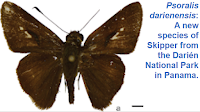
Psoralis darienensis: A new species of Skipper from the Darién National Park in Panama.

Skippers, Hesperiidae, are a large group of Butterflies named for their quick darting flights. They are global in distribution, but reach their maximum diversity in the tropical regions of Central and South America.

In a paper published in the journal Tropical Lepidoptera Reasearch on 31 May 2018, Fabian Gaviria, Ricardo Siewert, Olaf Mielke, and Mirna Casagrande of the Laboratório de Estudos de Lepidoptera Neotropical at the Universidade Federal do Paraná, describe a new species of Skipper from the Darién National Park in Panama.

The new species is placed in the genus Psoralis, which currently contains 12 species from South America, and given the specific name darienensis, meaning 'from Darién'. The species is described from two male specimens collected from an abandoned mine site within the Darién National Park, at an altitude of about 1500 m above sealevel. These are brown in colour with yellow and black markings and a forewing length of 19 mm.

Psoralis darienensis. Male from Darién National Park, Darién Province, Panama, dorsal (a) and ventral (b) views. Gaviria et al. (2018).

See also...

https://sciencythoughts.blogspot.com/2016/08/lepidochrysops-liberti-ceratrichia-fako.htmlhttps://sciencythoughts.blogspot.com/2015/01/a-new-species-of-giant-swallowtail.html
https://sciencythoughts.blogspot.com/2014/11/a-new-species-of-satyrine-butterfly.htmlhttps://sciencythoughts.blogspot.com/2013/03/the-taxonomic-implications-of-host.html
Follow Sciency Thoughts on Facebook.

Monday, 22 August 2016

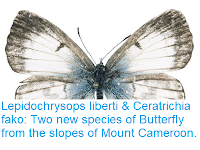
Lepidochrysops liberti & Ceratrichia fako: Two new species of Butterfly from the slopes of Mount Cameroon.

Mount Cameroon is a 4095 m high stratovolcano (cone shaped volcano made up of successive layers of ash and lava) on the coast of Cameroon, about 80 km northwest of the capital, Douala. The volcano sits slightly to the north of the Central African Shear Zone, which cuts though the country from southwest to northeast. The slopes of Mount Cameroon are considered an important biodiversity hotspot, having formed part of the Gulf of Guinea Highlands forest refugium during the Pleistocene glacial maximums when the surrounding lowlands were an arid grassland, enabling forest species to survive here that were wiped out in the lowlands.

In a paper published in the journal Zootaxa on 11 August 2016, Szabolcs Sáfián of the Institute of Silviculture and Forest Protection at the University of West Hungary and the Faculty of Science at the University of South Bohemia and Robert Tropek of the Faculty of Science at Charles University in Prague and the Institute of Entomology of the Czech Academy of Science describe two new species of Butterfly from the slopes of Mount Cameroon discovered during expeditions to the area, in 2014-15.

The first species is assigned to the Polyommatinae (Blues), being placed in the genus Lepidochrysops, and given the specific name liberti, in honour of the lepidopterist Michel Libert, who devoted his life to studying the Butterflies of Africa. The species was found in Elephant-disturbed mosaic forest on the southwestern slopes of Mount Cameroon, at altitudes of between 1100 m and 1200 m. 

Male specimen of Lepidochrysops liberti in dorsal view. Sáfián & Tropek (2016).

Male specimens of Lepidochrysops liberti had wingspans of slightly over 30 mm across and had white wings with blue colouring around the bases and black on the tips of the forewings as well as a single black spot on each hindwing. The single female found had a wingspan of 40.5 mm, with stronger black markings.

Female specimen of Lepidochrysops liberti in dorsal view. Sáfián & Tropek (2016).

The second new species described is assigned to the Hesperiidae (Skippers), being placed in the genus Ceratrichia and given the specific name fako, from 'Fako' the local name for Mount Cameroon.  The species was first discovered in sub-montane forest at an altitude of about 1700 m, above the town of Bokwaongo-Buea, then later at a number of other localities on the southwestern slopes of the mountain between 1100 m and 1500 m.

Male specimen of Ceratrichia fako in dorsal view. Sáfián & Tropek (2016).

These Butterflies had wingspans of slightly over 25 mm and were chocolate brown in colour with a scattering of gold scales on their wings. The underside of the hind wing is yellow, with a pattern of spots. Females are similar to the males, but with spots on both sides of the forewings.

Female specimen of Ceratrichia fako in dorsal view. Sáfián & Tropek (2016).

See also...

Notomela joliveti: A new species of Flea Beetle from Principe Island.

Flea Beetles, Alticini, are highly specialized Leaf Beetles, Chrysomelidae, which get their common name from their highly modified rear legs, which enable them to make sudden long jumps when threatened. They are small for Leaf Beetles, though not exceptionally so, and are herbivorous, with each species favoring...


A new species of Arctiid Moth from southwest Cameroon.                                                 Lichen Moths, Wasp Moths and Footmen. They are unusual for Moths in that they have sound producing organs used to communicate (though not at any frequency Humans can hear). Their caterpillars are typically extremely hairy, and often absorb toxins...

Explosions on Mount Cameroon.

An explosion on Mount Cameroon is said to have injured two tourist guides working on the mountain on Friday 3 February 2012. Local people also reported seeing bursts of flame and clouds of ash. Residents close to the mountain have reportedly been voluntarily moving away from the volcano, which has a history...

Follow Sciency Thoughts on Facebook.

Wednesday, 28 January 2015

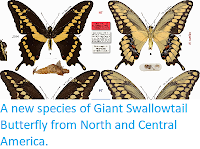
A new species of Giant Swallowtail Butterfly from North and Central America.


Swallowtails, Papilionidae, are among the most conspicuous of American Butterflies, due to their large size and conspicuous colouration. The group has been extensively studied by taxonomists and evolutionary biologists, revealing a complex biological history, with widespread mimicry leading to a large number of cryptic species (species which resemble one-another closely, making it hard for even specialists to tell them apart) and many species that have apparently arisen through hybridization. However within the group the Tiger Swallowtails, Pterourus spp., have been the most extensively studied, with the related Giant Swallowtails, Heraclides spp., being relatively less well known.

In a paper published in the journal ZooKeys on 23 December 2014, Kojiro Shiraiwa of San Diego in California, Qian Cong of the Departments of Biophysics and Biochemistry at the University of Texas Southwestern Medical Center and Nick Grishin of the Howard Hughes Medical Institute and the Departments of Biophysics and Biochemistry at the University of Texas Southwestern Medical Center, describe a new species of Giant Swallowtail Butterfly from the southwest United States, Mexico and Central America.

The new species is named Heraclides rumiko, in honour of the wife of Kojiro Shiraiwa. The species is not described from any newly discovered populations, but rather the realization that the widespread Heraclides cresphontes, which is known from Canada to Panama, is in fact a complex of (at least) two closely related cryptic species.

Heraclide srumiko type specimens: 7–8 holotype ♂ 9–10 paratype ♀. Dorsal/ventral surfaces are in odd/even-numbered figures. Labels areshown between the images of the same specimen, exuvia and head capsules in a gelatin capsule are below,and 3-fold magnified segment of head, neck and thorax is on the left. All images are to scale (includinglabels), except the magnified insets. Shiraiwa et al. (2014).

The discovery came about following an examination of specimens from California and Indiana, which revealed differences in the patterns between the two populations. This was followed by an examination of DNA from specimens from the northeastern United States and Costa Rica, which revealed a 3% difference in genetic structure. This is not in itself enough to justify the erection of a new species, particularly in widespread species where genetic patterns are likely to vary over distance, however it did provoke a wider study in which 200 specimens from across the range of the species were examined, revealing two distinct population groups, separated by a genetic distance of 3%, but with very little difference within populations. Notably in parts of Texas both species were found living alongside one-another, suggesting that these are true species.

Facies differences between Heraclides rumiko (left, r) Heraclides cresphontes (right, c) indicated by red trianglesand lines. These differences are as follows. (1) Dark spot on forewing: (r) almost always large; (c) variable,but often weak and sometimes absent (2) Forewing margin: (r) often straight with smaller or absentmarginal spots; (c) strongly scalloped with yellow marginal spots at dips between veins (3) Forewing submarginalyellow spots: (r) smaller rarely more than three; (c) frequently larger, more than three (4) Thoraxwith: (r) yellow line running from head through patagia to tegulae; (c) spots instead of the line, or just fewyellow scales. (5) Abdomen: (r) usually with a fainter dark band; (c) often with solid dark band (6) Inneredge of black discal band on ventral hindwing: (r) mostly straight; (c) usually curved (7) Tail: (r) mostlynarrow and relatively longer; (c) typically rounder and wide, shorter. Heraclides rumikois usually smaller than Heraclides cresphontes, despite being a southern taxon. Due to significant seasonal and individual variation, noneof these characters is fully reliable and exceptions exist. The head-neck-thorax line vs. spots might be the strongest single character. A combination of characters should be used for reliable identification. Many specimens in central Texas exhibit intermediate characters, a typical character combinations, and possible hybrids can be found. Shiraiwa et al. (2014).

The original species Heraclides cresphontes is now thought to be found in southeast Canada, and the north and west of the United States, while the new species is found in Texas, New Mexico, Arizona, California and Colorado, plus across Mexico and in El Salvador, Honduras, Costa Rica and Panama, though it is possible that other cryptic species are hidden within these distributions.

Localities of Heraclides cresphontes and Heraclides rumiko specimens with available DNA barcode information. Colour of circles corresponds to species: Heraclides cresphontes - blue (based on 112 DNA COI barcode sequences, 103 obtained in this work); Heraclides rumiko - red (based on 183 barcodes, 146 obtained in this work), split red/blue circles mark localities where both Heraclides cresphontes and Heraclides rumiko were recorded. Type localities for taxa with available names are indicated with a corresponding name followed by “TL”. Papilio cresphontes var. maxwelli & Papilio cresphontes pennsylvanicus are treated as junior subjective synonyms of Heraclides cresphontes. Countries and states (for USA andMexico) with records are labeled. Shiraiwa et al. (2014).

The eggs of Heraclides rumiko were laid singularly on young leaves of trees and shrubs from the family Rutaceae in California and Texas, the only places where the life-cycle has been observed to date. Host plants included Zanthoxylum fagara, Ptelea trifoliata, Amyris texana, Ruta graveolens, Citrus spp. and Geijera parviflora, and the species probably utilizes other plants that have not been observed. The species is particularly numerous in urban areas where widespread ornamental citruses are planted. The eggs are 1.1–1.6 mm in diameter, round and have a granular surface. They are yellowish when laid, but turn orange as they mature.

Eggs of Heraclides rumiko. Shiraiwa et al. (2014).

The eggs hatch 7-10 days after being laid, the larva eating the egg after hatching. The first instar (an instar is a stage in the life of an Insect, separated from other instars by moults) is 3-5 mm long, hairy, glossy and mottled brown, generally resembling a Bird dropping. The second instar is 5-11 mm long, the third 11-16 mm, the fourth 16-30 mm, the fifth instar 30-50 mm. The fifth instar is matt rather than glossy in appearance, and is followed by pupation. Under ideal conditions the caterpillar can progress from hatching to pupation in about nine days.

Fifth instar caterpillars of Heraclides rumiko. Shiraiwa et al. (2014).

While the caterpillars of Heraclides rumiko are primarily protected by camouflage, resembling a Bird dropping, they also have a pair of eyespots on their meta-thoraxes, which can be revealed suddenly by raising the head and inflating the thorax, a defensive strategy employed when the caterpillar is startled.

Defensive posture of a caterpillar of Heraclides rumiko. Shiraiwa et al. (2014).
 
Towards the end of its fifth instar the caterpillar changes colour, becoming paler and more uniform. This apparently improves the camoflage as it leaves the leafy parts of the plant and travels on woody branches, looking for a suitable place to pupate. The pupae are 26-36 mm in length, and mottled greyish or dark brown, mimicking the colour of the branch on which they rest to some extent (i.e. pupae on greenish branches are greener, on dark-coloured branches are darker, etc.). Adults can emerge in one to two weeks, but the pupae can also act as the overwintering stage, going into diapause (hybernation) for several months.

Pupae of Heraclides rumiko on different coloured stems. Shiraiwa et al. (2014).

Adults of Heraclides rumiko are present throughout most of the year, being absent only in the coldest months. In southern Texas they are seen on the wing from April till September, going through emergence peaks every 1.5 months, though this can be affected by the severity of the winter or variations in rainfall. In southern California the adults are present from February till mid November, being most abundant in August and September.

See also…

http://sciencythoughts.blogspot.co.uk/2014/11/a-new-species-of-satyrine-butterfly.htmlA new species of Satyrine Butterfly from the Pantepui Tablelands of western Guyana.        The Pantepui Tablelands are an area of sandstone tabletop mountains mainly located within southeastern...

Tortrix Moths, Tortricidae,  are predominantly small Moths with feathery wings found across much of the globe. They are ubiquitous members of the Insect fauna, but despite this have not been extensively...
Stem-mining Moths of the family Nepticulidae are found across the world, but are at their most numerous and diverse in Southern Europe. The larvae feed on...
Follow Sciency Thoughts on Facebook.

Thursday, 20 November 2014

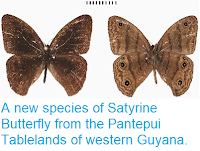
A new species of Satyrine Butterfly from the Pantepui Tablelands of western Guyana.


The Pantepui Tablelands are an area of sandstone tabletop mountains mainly located within southeastern Venezuela, but also extending into Guyana and Brazil. The area is poorly explored, but is thought to be a biodiversity hotspot, with a distinct flora and fauna of its own. Three new Butterfly species have been described from the area in the past decade, and it is thought that the Pantepui could be home to a large number of endemic species.

In a paper published in the journal Zootaxa on 5 November 2014, Shinichi Nakahara of the McGuire Center for Lepidoptera and Biodiversity at the Florida Museum of Natural History at the University of Florida, Steven Fratello of West Islip in New York and Donald Harvey of the Department of Entomology at the Smithsonian Institution describe a new species of Satyrine Butterfly from the Guyanan side of Mount Roraima, which lies on the border between Guyana, Venezuela and Brazil in the Pantepui Tablelands.

The new species is placed in the genus Euptychia and given the specific name roraima, in reference to the area where it was found. The species is described from a single male specimen collected in April 2001 at an altitude of 800 m on the north slope of Mount Roraima, by Romeo Williams and Wiltshire Hinds during a joint expedition by the Smithsonian Institution and the University of Guyana.

Male of Euptychia roraima from Mount Roraima, Guyana; left, dorsum, right, venter. Scale bar is 10 mm. Nakahara et al. (2014).

The single specimen of Euptychia roraima has a forewing length of 16 mm and is dark brown in colour with spots on its wings and a hairy body.

The northeast slope of Mt. Roraimataken from a clearing at approximately 1300m. Nakahara et al. (2014).

See also…

Tortrix Moths, Tortricidae,  are predominantly small Moths with feathery wings found across much of the globe. They are ubiquitous members of the Insect fauna, but despite this have not been extensively...


Stem-mining Moths of the family Nepticulidae are found across the world, but are at their most numerous and diverse in Southern Europe. The larvae feed on...


The Lepidoptera (Butterflies and Moths) first appear in...


Follow Sciency Thoughts on Facebook.

Saturday, 23 March 2013

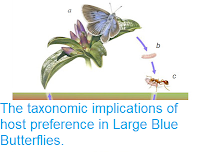
The taxonomic implications of host preference in Large Blue Butterflies.

Butterflies of the genus Maculinea (Large Blues) are social parasites targeting Ants of the genus Myrmica. The Butterflies lay their eggs on Gentian Flowers (Gentiana spp.) where the caterpillars emerge and pass through a number of instars (growth phases separated by molting events), before reaching a final larval stage, which secretes chemicals attractive to the host Ants, which then cary them back to their nests and feed them as they would their own larvae. 

The life cycle of Large Blue Butterflies. (a) The adult female, living about 5 days, lays 50-100 white eggs on the leaves and flower buds of Gentiana spp. (b) The young caterpillar bores into the plant, where it feeds on the developing seeds for 10-15 days, reaching 2% of its adult biomass. (c) The caterpillar emerges and falls to the ground, where it secretes chemicals attractive to ants of the genus Myrmica, who carry the caterpillar back to their nest. (d) The caterpillar competes with the ant larvae in the nest. Each species is capable of secreting chemicals specific to one species of ant; if carried to the wrong sort of nest it stops secreting chemicals, relying on the general smell of the nest to provoke the ants to feed it, however this is much less reliable and frequently results in the death of the caterpillar. (e) The growing ant makes vocalizations similar to the ants' queen, causing it to be fed in preference to the ants' own larvae. It feeds this way for 10-22 months before emerging as an adult and repeating the life-cycle. Thomas et al. (2013).


The taxonomy of Large Blue Butterflies is notoriously hard to unravel. The genus is currently split into six morphospecies (species differentiated by their appearance) but it is thought likely that each of these is made up of a number of different cryptic species. In order to test this a team of scientists led by Jeremy Thomas of the Department of Zoology at the University of Oxford and the Centre for Ecology and Hydrology carried out an experiment in which Butterflies of the species Maculinea rebeli from Poland and Spain were raised under laboratory conditions, along with their respective hosts. The results of the study were published in a paper in the Proceedings of the Royal Society Series B on 22 January 2013.

Thomas et al. found that the Butterflies from Poland used Ants of the species Myrmica sabuleti, while those from Spain used Myrmica schencki. Neither group of Butterflies were capable of surviving with the host of the other, suggesting that they are reproductively isolated, and should be regarded as separate species. 

This has important conservation implications. All Large Blue Butterflies are considered to be threatened by habitat loss. If the known morphospecies are all made up of a number of different cryptic species, as seems likely, then the reproductive populations of each of these populations will be much lower than is currently thought, and the species will be at greater risk of extinction.


Follow Sciency Thoughts on Facebook.