Showing posts with label Cattle. Show all posts

Monday, 27 May 2024

Rancher and 34 Cattle killed by lightning in Colorado.

A rancher and 34 Cattle have been killed by a lightning strike in Jackson County, Colorado. Mike Morgan (51) was unloading bales of hay from a trailer, when the vehicle was hit by the lightning bolt, at about 2.00 pm local time on Saturday 25 May 2024. The incident was witnessed by Morgan's wife and father-in-law, who reported that the strike knocked over about a hundred Cattle that were surrounding the trailer at the time of the incident, the majority of these got back up almost immediately, but 34 were found to have died, along with Mr Morgan.

Cattle killed by a lightning strike in Jackson County, Colorado, on 25 May 2024. Shannon Lukens/Denver Visitor.

The Earth's surface is struck by lightning about 40 million times each year, but it is extremely rare for people to be hit. The average Human has a roughly one in 15 000 chance of being hit by lightning during their lifetime, with 90% of those who are hit surviving.

Thunderstorms occur when warm, moist bodies of air encounter cooler, drier air packages. The warm air rises over the cooler air until it rises above its dew point (the point where it cools too far to retain its water content as vapor), and the water precipitates out, falling as rain, sleet, or hail.

Warm moist air passing over the surface of the Earth acts as an electrical generator, creating a negative charge in the cloud tops and a positive charge at the ground (or occasionally in a second cloud layer). The atmosphere acts as an electrical insulator, allowing this potential to build up, until water begins to precipitate out. This allows a channel of ionized air to form, carrying a current between the clouds and the ground, which we perceive as lightning.

See also...

Sunday, 10 December 2023

Four confirmed Human deaths in Anthrax outbreak in Zambia.

On 1 November 2023, the International Health Regulations National Focal Point for Zambia notified the World Health Organization of an Anthrax outbreak in Humans, according to a press release issued by the World Health Organization on 8 December 2023. The first Human cases were reported from the Dengeza Health Post in the Sinazongwe District of the Southern Province on 5 May 2023. Around the same period, domestic (Cattle and Goats) and wild Animals (Hippopotami) were reportedly dying from an unknown cause in the surrounding areas. While Zambia typically reports sporadic cases of Anthrax annually, the investigation revealed that from September 2022 to January 2023, 42 suspected cases of Anthrax in Humans had been recorded at the Dengeza Health Post. All the cases presented at health facilities with skin sores and ulcers, and some of them developed nonspecific symptoms (e.g., nausea, vomiting, difficulty in breathing). Human specimens were collected during the investigation and sent to the Lusaka Central Veterinary Research Institute for testing. The initial samples collected and tested by culture returned negative for Anthrax.

In June 2023, Human and Animal cases were reported in the Kanchindu and Siameja veterinary camps of Sinazongwe district.  Twenty-six Human cases developed sores on their face, arms, and fingers after consuming meat from three wild Hippopotamus carcasses. The first human case was reported on 16 June 2023 and laboratory confirmed by culture at the Lusaka Central Veterinary Research Institute. On the Animal side, 13 domestic Animals including Cattle (10) and Goats (3) out of Sinazongwe district susceptible population of 65 000 (30 000 Cattle and 35 000 Goats), under free range extensive traditional management, died of suspected anthrax. Cattle and Goat specimens tested by culture at the Lusaka Central Veterinary Research Institute returned positive for Anthrax on 17 July 2023. Until 1 November, Anthrax outbreaks affecting Animals and Humans were reported in other Southern, Northwestern, and Western provinces.

As of 20 November 2023, 684 suspected Human cases, including four deaths (a case fatality rate of 0.6%) were reported from 44 out of 116 districts in nine of Zambia’s 10 provinces. Sinazongwe District is the epicentre, accounting for 287 cases (42% of total 684 cases) and two deaths (50% of total the four deaths).  The most affected provinces are the Southern (370 cases), Western (84 cases), Lusaka (82 cases), Eastern (66 cases) and Muchinga (47 cases) provinces. Most symptomatic cases were epidemiologically linked to confirmed cases and not tested.

On the Animal side, as of 21 November 2023, 568 domestic and wild Animal cases were reported across 11 districts in Eastern, Southern, and Western provinces, with 344 cases occurring in the Southern Province, 132 in the Muchinga Province and 62 in the Western Province. Cases in wildlife, primarily Hippos, were reported in the Eastern and Southern provinces.

This outbreak marks the first major occurrence spanning nine out of 10 provinces of Zambia. Previous outbreaks were confined to Northwest and Western provinces, with sporadic cases over the years. Of note, Zambia reported Anthrax outbreaks in both Humans and Animals in Western Province in 2017 and in Eastern Province in 2016 and 2011.

Distribution of anthrax cases by province, Zambia, as of 20 November 2023. World Health Organization.

Anthrax is a disease caused by a spore-forming Bacterium called Bacillus anthracis. It is a zoonosis (disease transmissible from animals to humans) that affects Ruminants (such as Cows, Sheep, and Goats). Anthrax does not typically spread from Animal to Animal or Human to Human.  When Anthrax spores are ingested from contaminated Animal products, inhaled, or enter the body through skin abrasions or cuts, they can germinate, multiply and produce toxins.

Depending on the type of exposure, within a few hours to three weeks, individuals may present one of the three clinical presentations of Anthrax. Cutaneous or skin Anthrax is the most common presenting with an itchy bump in the exposed area that rapidly develops into a black sore. Some people then develop headaches, muscle aches, fever, and vomiting. Gastrointestinal Anthrax causes initial symptoms similar to food poisoning, but can worsen to produce severe abdominal pain, vomiting of blood and severe diarrhoea. Pulmonary Anthrax, the most severe presentation, has initial symptomatology of a common cold but can rapidly progress to severe breathing difficulties and shock. Diagnosis can be made through polychrome methylene blue-stained blood smears, polymerase chain reaction or enzyme-linked immunosorbent assay. Hospitalization is required for all Human cases identified. Individuals exposed may receive prophylactic treatment. Antibiotics, particularly penicillin, are effective against this disease. Prompt treatment can reduce case-fatality rate to below 1%. Vaccines are also available for livestock and Humans in limited supply.  Human vaccines are limited to those with possible occupational exposure.

With the support of the Food and Agriculture Organization of the United Nations, livestock vaccination is ongoing in Zambia. In total 338 000 doses of Anthrax vaccine have been distributed up to 19 November 2023. Vaccination campaigns have been initiated at the outbreak epicentre, Sinazongwe District, and is extended to other affected districts. A joint One Health task force comprising the Ministry of Health and the Ministry of Local Government has been conducting case finding in animals and Humans. Meat inspection is enhanced by the veterinary department.  Additionally, the Department of Wildlife and Parks has been actively involved, conducting patrols to monitor illegal Animal movements and ensuring proper disposal of carcasses. The World Health Organization is working closely with the Food and Agriculture Organization and the Ministry of Agriculture on Animal health activities like vaccination.

For case management, health workers have undergone orientation to enhance their capacities to identify potential cases early on. Efforts have been made to strengthen event-based surveillance and early detection mechanisms. Provision of essential medical supplies has been prioritized, in addition to public sensitization. Active surveillance is ongoing across healthcare facilities and within communities, including contact tracing.

Meat inspections are being conducted in abattoirs and butcher shops. Preparedness plans are in place, including the mobilization of additional healthcare personnel to districts, foreseeing a potential surge in Anthrax cases. Moreover, specialized training sessions for provincial practitioners aim to improve case management proficiency in the provinces.

The laboratory continues to operate under a unified One Health approach for diagnostics. Procurement efforts for laboratory reagents are underway due to shortages. Strict protocols for disinfection and decontamination remain ongoing to ensure safety.

Extensive health promotion and Risk Communication and Community Engagement activities are ongoing, including press briefings by Ministry of Health, social media campaigns, radio broadcasts, and the distribution of informative brochures and posters.

Anthrax is endemic in Zambia, usually occurring between May and January, with a peak toward the end of the dry season (between October and November). Although sporadic cases are reported yearly in Animals and Humans across the country, a large-scale outbreak like the current one has not been reported since 2011, when there were 511 suspected Human cases.

The epidemic is spreading along the provinces located along the basin of the Zambezi, Kafue, and Luangwa rivers, which is an additional problem because these rivers also flow into Lake Kariba in Zimbabwe, Kahora Bassa in Mozambique and Lake Malawi, and the risk of Anthrax transmission to neighbouring countries is increased.

Other affected districts and provinces of Zambia have reported sporadic suspected cases and deaths since June 2023. In addition, the Bacillus anthracis Bacteria can form highly resistant spores that survive in the environment for decades.

The risk for Human health is high given the known population’s multiple exposures from handling the carcasses of Animals that had died suddenly and eating meat from infected Animals with resultant associated cutaneous and gastrointestinal Anthrax.

The risk of the event spreading within Zambia has increased due to the unrestricted Animal movement and carcasses within and between provinces. Since September 2023, there has been a significant rise in the number of affected districts. Moreover, a low index of suspicion, socio-cultural norms, community resistance, limited community knowledge regarding Anthrax transmission, high levels of poverty and food insecurity, a shortage of available vaccines and laboratory reagents, inadequate carcass disposal and decontamination practices significantly contribute to hampering the containment of the Anthrax outbreak.

There is an absence of robust engagement with local communities involved in breeding and handling Cattle and livestock, including farmers, heads of Cattle markets, and butchers. Among these communities, the fear of losing livelihoods often outweighs concerns about contracting Anthrax. The risk of insufficient control capacities is considered high in Zambia due to concurrent public health emergencies in the country (Cholera, Measles, COVID-19) that limit the country’s Human and financial capacities to respond to the current Anthrax outbreak adequately.

The risk at the regional level is also considered high due to the frequent movement of both Animals and people between Zambia and its neighbouring countries (such as Angola, Botswana, the Democratic Republic of the Congo, Malawi, Mozambique, Namibia, Tanzania, Uganda and Zimbabwe). This is compounded by the confirmed cases of Anthrax spreading in provinces located along the basin of the Zambezi, Kafue, and Luangwa rivers. These rivers ultimately flow into Lake Kariba in Zimbabwe, the Kahora Bassa lake in Mozambique, and Lake Malawi.

Unburied carcasses of wild Animals that float on the river increase the risk of international spread to neighbouring countries. They can spread the Bacterium and infections to other regions, including neighbouring countries, and be eaten by other Animals, which can further perpetuate the spread.

Humans usually acquire the infection after exposure to infected Animals, carcasses, or Animal products. More than 95% of Human Anthrax cases take the cutaneous form and result from handling infected carcasses or hides, hair, meat or bones from such carcasses. The public should avoid handling and consumption of meat from Animals that died suddenly, meat obtained via emergency slaughter, and meat of uncertain origin. Anthrax can also be an occupational hazard for veterinarians, agriculture and wildlife workers, or workers who butcher Animals or process meat, hides, hair, and wool and should wear preventive clothing and gloves or personal protection equipment.

In health-care settings, it is crucial to enhance screening procedures specifically in areas where there is a known epidemiological risk of Anthrax. It is imperative to anticipate and implement infection prevention and control measures promptly when cases are suspected. When caring for patients with draining Anthrax lesions, implementing contact precautions is vital. This includes placing the patient in a private room and the use of personal protection equipment (such as examination gloves and a fluid resistant gown). Additionally, dressings may be used to contain drainage and reduce the risk of environmental contamination. These dressings should be disposed of as infectious waste after use. The World Health Organization’s 5 Moments for hand hygiene should be practiced using soap and water when caring for suspected and confirmed cases, as alcohol-based hand rub has weakened effect against spores. For areas where patients with suspected or confirmed exposure to Anthrax spores are being cared for, it is recommended to implement enhanced cleaning and disinfection protocols.

Individuals potentially exposed to Anthrax spores should receive prophylactic treatment. Anthrax responds well to antibiotics, which need to be prescribed by a medical professional. Strict adherence to the full course of treatment is vital. Human vaccines are in limited supply and used primarily for the protection of selected individuals with possible occupational exposure to Anthrax.

International travellers to Anthrax endemic countries should be aware of regulations concerning the importation of prohibited Animal products, trophies, and souvenirs.

Anthrax is controlled through Animal vaccination programs, rapid detection and reporting, quarantine, treatment of sub clinically affected Animals (postexposure prophylaxis) and burning or burial of suspect and confirmed animal cases. The carcass should not be opened since exposure to oxygen will allow the Bacteria to form spores. The general public and at-risk individuals should immediately report instances of sick or unexpected deaths in Animals to veterinary authorities. Veterinary vaccines are used for control of Anthrax in livestock. Vaccination protocols for livestock should be strictly followed to curb Anthrax spread. Preventing the disease in Animals will protect Human health.

The World Health Organization advises against implementing any travel or trade restrictions based on the current information available on this event.

See also...

Follow Sciency Thoughts on Facebook.

Follow Sciency Thoughts on Twitter.


Monday, 31 July 2023

Cattle in the rock art of Wadi Bajdha, Saudi Arabia.

Saudi Arabia covers an area of about 2 million km² with rock art known from every area of the country. A comprehensive survey of the rock art of Saudi Arabia begun in 1981 took over 15 years to complete, and recorded over 2000 sites with pre-Arabic and early Arabic inscriptions, as well as thousands of petroglyphs (images made by inscribing into a rock surface).

In a paper published in the Journal of Historical Archaeology and Anthropological Sciences on 3 July 2023, Majeed Khan and Faisal Al-Jabrin of the Antiquities Sector of the Saudi Ministry of Culture, describe a newly discovered rock art site at Wadi Bajdha in the Tabuk Region of Saudi Arabia, and discuss the implications of the images discovered there.

The art is located in a deep valley surrounded by mountains to the northwest of the city of Tabuk, where water collected during the rainy season. The site has historically been visited seasonally by Bedouin herders, and may have, at times, hosted permanent settlements.

The rock art is located on a vertical rock face on the side of a hill, which appears to contain images from different periods. The oldest figures on this panel appear to be a group of Cattle with short horns and flat humps. These Cows appear to be different from both the long-horned Oxen depicted at the Neolithic sites of Jubbah and Shuwaymis, and the high-humped Indian Zebu-like Cattle depicted in the Najran area of southern Saudi Arabia. Khan and Al-Jabrin suggest that this art represents the second phase of Cattle domestication in Saudi Arabia, following the Neolithic long-horned Oxen phase.

The rock art gallery at Wadi Bajdha in the Tabuk Region, in north of Saudi Arabia. Khan & Al-Jabrin (2023).

The rock art of Saudi Arabia is highly diverse, and appears to have been produced in a range of contexts with different purposes and meanings. Neolithic images appear to show Oxen as both Animals hunted as prey, and as sacred or possibly Divine Animals. Chalcolithic images have been interpreted to show Oxen as mythical creatures, deities, and sacrificial Animals. With this in mind, Khan and Al-Jabrin are careful to compare the Wadi Bajdha rock art to rock art from other locations, before drawing any conclusions about its meaning.

An open air temple, where Cows are depicted with idoliform images possibly deities or gods, located in Wadi Damm northwest of Tabuk. Believed to be evidence of Cow worship in Arabia. Khan & Al-Jabrin (2023).

Archaeological evidence and rock art depictions both suggest that Wild Cattle, Bos primigenius, were present in Arabia as both wild and domestic Animals during the Neolithic. At sites such as Shuwaymis, Jubbah, Hanakiya, large numbers of Oxen are depicted, with flat backs and exaggerated horns. These resemble European Wild Cattle, Bos primigenius, an Animal not known after the Neolithic climate shift, which occurred about 7900 years ago in northern Arabia, and led to a shift from a cool, humid climate to a hot, arid one.

Long-horned flat-back Oxen from the  Neolithic Shuwaymis site in the north of Saudi Arabia. Evidence of the presence of Wild Oxen in Arabia. Khan & Al-Jabrin (2023).

Petroglyphs of Cattle in Saudi Arabia represent at least three separate climatic phases, which each phase associated with images of different sizes, styles, and execution techniques, which has enabled the development of a chronology for such art, which links Animal type to climate shifts.

Earliest known image of Long-horned Cow, Bos primigenius, from Saudi Arabia dated to about 9000 BC. This image located at the Neolithic Jubbah, site in the north of the country. Superimposed on the Cow is a Camel figure of much later period. There is a difference of several thousand years between the two Animals; representing two climatic phases; cool and humid (Cow) and hot and dry conditions (Camel). Khan & Al-Jabrin (2023).

The style of the rock petroglyphs at Wadi Bajdha suggests that the art dates from the Chalcolithic Period, about 3500 BC. At this time people in the area had domesticated Cows and Goats, and engaged in small-scale hunting along with the hunting of Ibex. Camels did not appear in Arabia until the Bronze Age (along with Date Palms), and are absent from the Wadi Bajdha art. 

A pregnant Cow. A small baby can be seen inside the mother Cow, a firm indication of a domesticated Cow. Domesticated small horned and flat back Cattle are found on several sites in northern and southern Arabia representing the middle phase of Chalcolithic domesticated Cows, around 3500 BC. Khan & Al-Jabrin (2023).

The left corner of the Wadi Bajdha panel depicts a number of large, Chalcolithic-style Cows, as well as several Ibex, and some Horse riders with lances. These appear to have been made by artists from different periods, who took care not to overlap the art, as well as some tribal symbols. Battles between riders armed with lances was common among Bedouin tribes into the recent past.

The third phase in the art gallery represented by Camel and pre-Arabic Thamudic inscriptions in addition to Horse riders with long lances in fighting attitude drawn by the people representing the last phase of rock art in this gallery. Khan & Al-Jabrin (2023).

The Wadi Bajdha art shows apparently domesticated Cattle, including a pregnant female with a baby inside, but no images of Camels, suggesting that this art is Chalcolithic in origin. The site is likely to have has good living conditions during this interval, supporting a permanent or semi-permanent population, who presumably left as the climate continued to get hotter and drier. Many other rock art sites in Saudi Arabia show similar combinations of Human and Animal figures, and appear to have been abandoned after short periods of occupation. This suggests that the population of Saudi Arabia has been largely nomadic for much of its history, inhabited by groups who moved regularly depending on the availability of water. 

See also...

Follow Sciency Thoughts on Facebook.

Follow Sciency Thoughts on Twitter.


Wednesday, 29 December 2021

Tracking the feeding habits of Dholes in the Ujung Kulon National Park, southwestern Java.

Dholes, or Asian Wild Dogs, Cuon alpinus, were once found across a wide swath of South, Central, East, and Southeast Asia, from Bangladesh, Bhutan, India, Nepal, and Pakistan north to Kazakhstan, and east to China, the Korean Peninsula, and the Russian Far East, and south to Cambodia, Laos, Malaysia, Myanmar, Thailand, Vietnam, and the Indonesian islands of Java and Sumatra. However, habitat fragmentation across this range has badly impacted the species, and Dholes are now thought to occupy less than 25% of their former range, and are considered to be Endangered under the terms of the International Union for the Conservation of Nature’s Red List of Threatened Species.

In Indonesia Dholes are protected by law, and are thought to have a widespread but fragmented distribution. A limited number of studies have been carried out on the distribution and habits of Dholes, and while potential prey species have been identified in two national parks where they are known to occur (Baluran National Park and Ujung Kulon National Park, both on the island of Java), but direct evidence of prey selection or feeding has been sparse.

In a paper published in the Journal of Threatened Taxa on 26 December 2021, Dede Aulia Rahman of the Department of Forest Resources Conservation and Ecotourism at Bogor Agricultural University, and Mochamad Syamsudin, Asep Yayus Firdaus, Herry Trisna Afriandi, and Anggodo of the Ujung Kulon National Park, present the results of a camera-trap experiment intended to reveal the hunting preferences of Dholes in the Ujung Kulon National Park.

Rahman et al. divided the park into 329 one kilometre square grid sections, and placed camera traps in 108 of these, positioned so that each was at least 300-500 m from the next. These were left in place from January to December 2013, being checked every 28-30 days to ensure they were functioning, and repositioning if they had sighted no Animals after two or three checks.

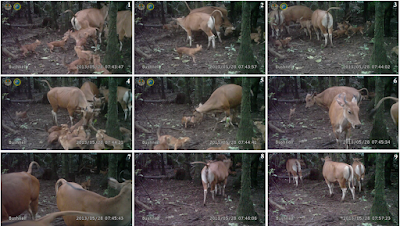
The first Dhole predation event was recorded on 28 May 2013, when a pack of 15 adult Dholes was seen to attack a Banteng, Bos javanicus, calf, which was accompanied by three adult females, between 7.43 and 7.57 am. 

 
Photographs of predation on a young Banteng by a pack of Dholes on 28 May 2013: (1) A Dhole bites the neck of a young Banteng. (2)–(4) An adult female Banteng tries to protect the young Banteng. (5) Several members of the Dhole pack try to separate the young Banteng from an adult female Banteng. (6)–(7) Dholes kill a young Banteng on the far side of picture. (8) Adult female Bantengs come back to try and save the young Banteng. (9) The process of predation by Dholes is complete which is marked by several pack members resting. Rahman et al. (2021).

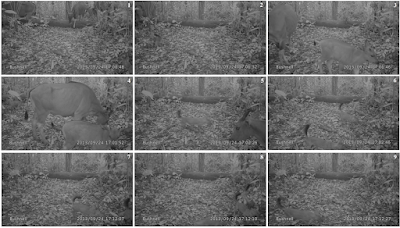
A second predation attempt was recorded on 24 September 2013, between 5.00 and 5.12 pm, when a group of six adult Dholes attempted to predate another young Banteng, again accompanied by three adult females.

 
Photographs of predation on a young Banteng by a pack of Dholes on 24 September 2013: (1) Young Banteng accompanied by three adult females. (2) One individual Dhole starts attacking the Banteng. (3)–(5) An adult female Banteng tries to protect the young Banteng. (6)–(8) Three Dholes are moving forward and attacking Banteng on the far side of picture. (9) Another individual Dhole running moving forward on the same side. Rahman et al. (2021).

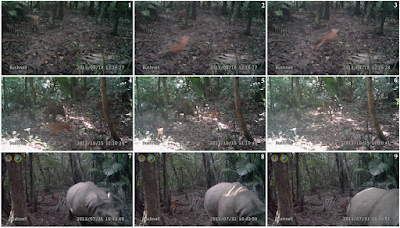
In addition to these attacks on Bateng, five adult Dhole were observed chasing a Java Mouse-deer, Tragulus javanicus, on 18 April 2013, two adult Dholes were seen attacking a Wild Pig on 15 October 2013, and three adult Dholes were observed following an adult male Javan Rhinoceros, Rhinoceros sondaicus, on 31 July 2013.

 
(1)–(3) a Java Mouse-deer being chased by five adult Dholes. (4)–(6) Wild Pig attacked by two adult Dholes. (7)–(9) An adult male Javan Rhinoceros followed by three Dholes. Rahman et al. (2021).

The captured images show clear evidence of Dholes targeting Banteng, a type of wild Cattle, in the Ujung Kulon National Park. Although they appear to specialise in taking young members of the herd, Bateng might at first seem like quite a large prey item for a small Canid, but this is not out of keeping with the prey preferences observed for the species elsewhere. In India Dholes have been shown to mostly predate Chital Deer, Axis axis, and Sambar Deer, Rusa unicolor, both medium sized Deer, but will occasionaly hunt Gaur, Bos gaurus, the largest extant Bovid species. In Cambodia, Dholes primarily hunt Muntjac Deer, Muntiacus spp., but alto hunt Banteng, which make up about 18% of their diet. Finally, analysis of droppings left by Dholes in the Baluran National Park, East Java, has suggested that their diet there included Banteng and Water Buffalo, Bubalus bubalis.

Dholes are variable in their approach to hunting, and will hunt on their own, in pairs, or in packs of varying size, with larger groups tending to tackle larger prey. This is roughly in line with Rahman et al.'s findings, with one attack on a Bantang being carried out by 15 Dholes. However, observed hunts by Dholes on Cattle and other large prey in other areas have typically involved the pack attempting to spook and then chase the herd, separating calves from the adults in the confusion, whereas both attacks observed in the Ujung Kulon National Park began with a direct attack on calves that were close to adults.

Rahman et al. do not believe that the Dholes observed following a Rhinoceros were engaged in a hunting attmept, reasoning that at 1000-2000 kg such an Animal is likely to be considerably outside of their range, and that a group of three is probably to small would be too small for the attmept if they were to make it. Rather, they suggest, the Dholes may have been escorting the Rhinoceros away from a den site in order to ensure the safety of their young.

See also...


Follow Sciency Thoughts on Facebook.

Follow Sciency Thoughts on Twitter.


Sunday, 19 September 2021

Production of dairy products drove the expansion of the Yamnaya peoples of the Eurasian Steppes in the Early Bronze Age.

The nomadic peoples of the Eurasian Steppes have long been a source of fascination to both archaeologists and the general public, with, sometimes less than flattering, fictionalised versions appearing in popular fantasy novels such as JRR Tolkien's Lord of the Rings and GRR Martin's Game of Thrones. The later phases of these groups, such as the Xiongnu and Mongol Empires are relatively familiar, but the origins of these groups in the Eneolithic (the Late Neolithic plus the Chalcolithic, or 'Copper Age') are rather more obscure. The archaeology of these groups has been studied for a long time, but new technologies have recently shed new light on the field. For example, it has been demonstrated that European populations had a significant influx of DNA from steppe-dwelling groups during the late Neolithic. The same Neolithic steppe populations (referred to as Yamnaya by archaeologists) also have also been shown to have genetic links to the Afanasievo people of the Altai Mountains and even the peoples of Mongolia. Both archaeological and genetic data suggest extensive population movements in this area during the Early Bronze Age (roughly 3300 to 2500 BC), with links being established between the Yamnaya peoples of the Pontic–Caspian steppe and the peoples of Siberia and Scandinavia.

Thus, it is understood that the Yamnaya peoples underwent a significant expansion of their geographical range during this period, but the drivers of this expansion are less certain. One popular explanation is that innovations such as the use of Horses and wagons enabled the rapid spread of a pastoralist lifestyle across large swaths of Eurasia, and that this, combined with the consumption of dairy products, made large areas of the Eurasian steppes previously unoccupiable open to Human habitation. However, while this model provides a plausible explanation for the successes of the Yamnaya peoples, it is not, at the current time, very well supported by the available evidence. There is archaeological evidence for the use of carts and bridles in the Eneolithic and Early Bronze Age, but not for the use of Horses or dairy products.

The story of Horse domestication has long been a controversial subject in archaeology. Horse remains are known from the Eneolithic of Botai in northern Kazakhstan, but these have recently been shown to have been Przewalski's (or Mongolian) Wild Horses, Equus przewalskii, not the modern domestic Horse, Equus caballus, a species which has not confidently been found in association with Humans at sites older than the Early Bronze Age, and which cannot be confidently asserted to have been used as a riding Animal or even a beast of burden, rather than something which was being hunted, at Early Bronze Age sites. It is currently thought that Horses were not ridden, or milked, on the Eastern European steppes before about 1200 BC, and they may not have been an Animal used much by the pastorialist peoples of the period at all. 

Data on the early consumption of milk is equally lacking. Isotopic studies of Human remains have been used to suggest that dairy products were being consumed, but cannot confirm this. Palaeoproteomics (the analysis of ancient sets of proteins) could potentially be used to identify dairy consumption, but so far has only been applied to a very limited number of sites on the Eurasian steppes. Studies of the Yamnaya and Afanasievo peoples have only, to date, shown evidence of dairy consumption among a few individuals from the Eastern Steppes, and was only able to give a very ambiguous result on the producer of the peptides (short amino acid chains, or fragments of proteins) found, which was probably a Sheep or Cow.

In a paper published in the journal Nature on 15 September 2021, a group of scientists led by Shevan Wilkin of the Department of Archaeology at the Max Planck Institute for the Science of Human History, and the Institute for Evolutionary Medicine at the University of Zürich, present the results of a study which examined palaeoproteonomic evidence from dental calculus from 56 Humans from across the Eurasian steppes, dated to between 4600 and 1700 BC.

Wilkin et al. collected data from 19 Eneolithic idividuals; six from Murzikha 2, nine from Khvalynsk 1 and Khvalynsk 2, one from Ekaterinovka Mys, one from Lebyazhinka 5, and two from Khlopkov Bugor. Studies of Ancient DNA obtained from Khvalynsk and othe Eneolithic burrials in this area of the the Volga and northern Caucasus, suggest that the local population was related to the Yamnaya Peoples, but lacked the input of genetic materials from Anatolian farmers seen in the later. 
Studies based upon archaeological evidence and stable isotope analysis have suggested this population had a diet based upon the gathering of local plants, fishing, and the consumption of domestic Animals. Wilkin et al. also extracted dental calculus from two individuals from Botai in northern Kazakhstan, a site dating to about 3500 BC, where faunal remains are dominated by domestic Horses, and proteins extracted from ceramics have suggested Horses were being milked.


Map showing sites that yielded individuals with preserved ancient proteins. (a) Eneolithic, (b) Early Bronze Age and (c) Middle–Late Bronze Age sites in the Pontic–Caspian region, showing the number of individuals with a positive dairy identification out of the total number of individuals with preserved ancient proteins for each site. Strong evidence of preservation of Equine or Ruminant milk protein identifiers are depicted with black Animal icons; the single individual with equivocally identified casein peptides is shown with a grey icon. Wilkin et al. (2021).

In addition, Wilkin et al. sampled 35 Bronze Age Humans from 20 sites. These include sixteen Early Bronze Age individuals; two from Krasikovskyi 1, one from Krasnokholm 3, two from Krivyanskiy 9, two from Kutuluk 1, one from Leshchevskoe 1, one from Lopatino 1, two from Mustayevo 5, one from Nizhnaya Pavlovka, one from Panitskoe, one from Podlesnoe, one from Pyatiletka, and one from Trudovoy; as well as fourteen individuals the Middle–Late Bronze Age transition; one from Bolshekaraganskyi, two from Kalinovsky 1, three from Kamennyi Ambar 5, one from Krasikovskyi I, three from Krivyanskiy 9, one each from Lopatino 1 and Lopatino 2, one from Potapovka 1, one from Shumayevo 2, and five from Utevka 6.

 
Maps of all sites and individuals included in this study from the (A) Eneolithic; (B) Early Bronze Age; and (C) Middle and Late Bronze Age. Wilkin et al. (2021).

Previous archaeological isotopic studies of Early Bronze Age Yamnaya sites have suggested a diet strongly focused on herd Animals, including Cattle, Sheep and Goats. Horse remains have also been found at Early Bronze Age Yamnaya sites, but whether these were domestic Animals or wild Horses hunted for their meat is unclear. The Middle–Late Bronze Age transition was marked by an increased use of Horse-based technologies, such as chariots, which clearly indicates these people were using domestic Horses.
Fifty five of the fifty six dental calculus samples tested yielded identifiable protein data, and forty eight of those produced strong enough signals of proteins commonly found in the oral cavity that they were included in the study. 

The nineteen oldest individuals examined, all dated to between 4600 and 4000 BC, came from five Eneolithic sites close to the Volga River, or tributaries of that river, in southwestern Russia. Of these nineteen, eleven yielded good enough data to be included in the final study, with ten showing no evidence for the consumption of dairy products. The remaining individual yielded to peptides associated with Bovine α-S1-casein milk curd protein, although Wilkin et al. do not take this as absolute proof of milk consumption, as the most common dairy protein, β-lactoglobulin, was not recovered. Neither of the Botai individuals returned any evidence for dairy consumption. 

Fifteen of the sixteen Early Bronze Age individuals included in the study yielded multiple Ruminant dairy peptides including β-lactoglobulin, with some also producing α-S1 casein, α-S2-casein or both. Many of these peptides were identifiable to genus level, with the most common genera being Ovis (Sheep), Capra (Goats), and Bos (Cattle, Buffalo, Bison, and Yaks, although presumably Cattle were the most likely milk-producers). Interestingly, two individuals, both from Krivyanskiy 9, on the southwestern fringe of the study area, yielded Equus (Horse, Donkey and Kiang, although only Horses would have been present in the study area) β-lactoglobulin. These individuals were estimated to have died between 3305 and 2633 BC.


Histogram of taxonomic specificity of dairy peptide spectral matches per individual. Histograms for individuals with evidence for consumption of dairy, from the Eneolithic (a), Early Bronze Age (b) and Middle and Late Bronze Age (c). PSM, peptide spectral match. Wilson et al. (2021).

Fifteen of the nineteen Middle–Late Bronze Age transition yielded positive evidence for the consumption of Bovine milk products, including peptides from β-lactoglobulin, α-S1-casein and α-S2-casein, and the whey protein α-lactalbumin. It was possible to identify some of these peptides as being Ovis or Bos, but both Capra and Equus were absent from the sample.

Wikin et al.'s results point to a clear shift towards milk consumption between the Eneolithic and Early Bronze Age, with 10 of 11 Eneolithic individuals showing no evidence of dairy consumption, whereas 15 of 16 Early Bronze Age individuals showed such evidence. A single Eneolithic individual, from Khvalynsk, showed possible evidence of dairy consumption, but this result cannot be taken with any confidence. This strongly suggests that the widespread adoption of dairy products as part of the Human diet was associated with the Eneolithic-Early Bronze Age transition on the Pontic–Caspian Steppe. This is in contrast to the situation to the west, where settled European farmers were clearly consuming dairy products in the Eneolithic. This in turn suggests a cultural frontier between the European farmers and the Steppe herders. 

The ability of proteonomics to identify the Animals producing the milk used for Human consumption sheds light on the Animals being kept by these peoples. The Pontic–Caspian Steppe provides a rich environment capable of supporting a range of herd Animals, including Cattle, with a relatively high water-demand, and Sheep and Goats, which favour more arid conditions. Interestingly, a recent study of Early Bronze Age individuals from the steppes suggests that the persistence of lactase (the enzyme that allows digestion of whole milk) production into adulthood in these individuals was rare, but this does not rule out the production of milk-derived products such as yogurts, cheeses or fermented milk beverages.

The milking of Horses has previously been suggested for the Botai culture of Kazakhstan, but Wilkin et al. found no evidence of this (although their sample size, two individuals, was quite small). Horse milk was apparently consumed by two individuals from the Early Bronze Age of the Pontic–Caspian Steppe. These findings, combined with the discovery that the Horses of Botai were not the Domestic Horse, Equus caballus, supports the idea that Horse domestication originated on the Pontic-Caspian Steppe rather than with the peoples of Central Asia. The oldest Horse remains shown to contain genetic markers for modern domestic lineages date from between 2074 and 1625, and come from sites in Russia, Romania and Georgia. The discovery of the oldest known evidence in the Pontic-Caspian Steppe region, which also saw the first appearance of Horse-drawn chariots around 2000 BC, contributes further evidence to this hypothesis.

Wilkin et al.'s findings contribute to the growing understanding of a significant cultural and technological revolution associated with the Eneolithic-Early Bronze Age transition on the Pontic-Caspian Steppe. As well as the, obvious, adoption of bronze as a metal for making tools and weapons, this shift included the abandonment of riverine settlement sites, the appearance of kurgan cemeteries on formerly uninhabited arid plateaus, the appearance of wheeled vehicles, and the occasional placement of Horse bones in Yamnaya burials. This was accompanied by a rapid expansion of the range of these peoples, both to the west into Europe and to the east into the Altai Mountains. Wilkin et al.'s findings shed no direct light upon the role of Horses in this expansion, but evidence for the consumption of Horse milk is clearly evidence for Horse domestication, which is likely to also imply Horses were being used for other purposes. The combination of a dietsry shift to include nutritionally rich dairy products, the adoption of Animal-drawn vehicles as a means to transport greated loads, and the domestication of highly versatile Horses is likely to have significantly transformed the cultural and economic environment of the Pontic-Caspian Steppe, enabling Humans to venture into previously uninhabitable areas, and thereby access further new resources, such as seasonally snow-covered upland pastures. It is, of course, possible that all of these elements were present to some extent before the Eneolithic-Early Bronze Age transition, but that transition clearly shows the widespread adoption of all these technologies by populations over a wide geographical area.

See also...


Follow Sciency Thoughts on Facebook.

Follow Sciency Thoughts on Twitter.