Showing posts with label Jamaica. Show all posts

Friday, 31 October 2025

At least 56 dead after Hurricane Melissa sweeps across Jamaica, Cuba, and Haiti.

At least 56 people have died in Jamaica and Haiti after Hurricane Melissa swept across the Greater Antilles between 25 and 29 October 2025. The storm first appeared as a tropical depression off the coast of West Africa around 16 October, moving across the Atlantic Ocean, then passing through the Windward Islands on 19 October, before continuing to move westwards across the Caribbean Sea. The weather system began to intensify on 21 October, provoking meteorologists to give it the name Tropical Storm Melissa. On 25 October it began to intensify further, becoming a Category 5 storm early on 27 October. At the same time it changed its direction of movement sweeping northward towards Jamaica, where it made landfall near New Hope about midday on 28 October.

The path and strength of Hurricane Melissa. Thick line indicates the past path of the storm (till 3.00 pm GMT on Friday 31 October 2025), while the thin line indicates the predicted future path of the storm, and the dotted circles the margin of error at 9, 21, 33, 45, 69, and 93 hours ahead. Colour indicated the severity of the storm. Tropical Storm Risk.

Hurricane Melissa reached Jamaica as the joint most intense Hurricane ever to make land, tying with the Labor Day Hurricane of 1935 in having a pressure of only 892 millibars, and a maximum recorded windspeed of 406 km per hour - the highest ever recorded for a storm on Earth. Flooding was reported in the town of Old Harbour ahead of the storm, with much of the parish of Saint Elizabeth under water when it hit. Several villages in the parish are described as being obliterated by the combination of flood waters and high winds, as was the town of Mandeville in neighbouring Manchester Parish. Flooding was also reported in Montego Bay and Kingston, buildings collapsed in Falmouth, and a landslide was reported in Gordon Town. At least 19 people died on the island, including eight in Saint Elizabeth Parish, two (including an infant) in Saint James Parish, nine in Westemoreland Parish, and a pregnant woman in Petersfield.

Storm damage around  St. John's Anglican Church in Black River, Saint Elizabeth Parish, Jamaica, following the passage of Hurricane Melissa. Ricardo Makyn/AFP/Getty Images.

From Jamaica, the storm moved northward to Cuba, where it caused widespread flooding and damage to buildings in Santiago de Cuba Province, although there are no reports of any fatalities there. However, high rainfall associated with the the storm caused several rivers to bust their banks in neighbouring Haiti, where at least 30 people have died and about 20 more are still missing. Four people are also reported to have died in the Dominican Republic, again due to flooding.

Vehicles buried in mud after a river burst its banks in  Petit-GoĆ¢ve, Haiti, following rains associated with Hurricane Melissa. Clarens Siffroy/AFP/Getty Images.

Tropical storms are caused by the warming effect of the Sun over tropical seas. As the air warms it expands, causing a drop in air pressure, and rises, causing air from outside the area to rush in to replace it. If this happens over a sufficiently wide area then the inrushing winds will be affected by centrifugal forces caused by the Earth's rotation (the Coriolis effect). This means that winds will be deflected clockwise in the northern hemisphere and anti-clockwise in the southern hemisphere, eventually creating a large, rotating Tropical Storm. They have different names in different parts of the world, with those in the northwest Atlantic and eastern Pacific being referred to as hurricanes.

The formation of a tropical cyclone. Natural Disaster Management.

Despite the obvious danger of winds of this speed, which can physically blow people, and other large objects, away as well as damaging buildings and uprooting trees, the real danger from these storms comes from the flooding they bring. Each drop millibar drop in air-pressure leads to an approximate 1 cm rise in sea level, with big tropical storms capable of causing a storm surge of several meters. This is always accompanied by heavy rainfall, since warm air over the ocean leads to evaporation of sea water, which is then carried with the storm. These combined often lead to catastrophic flooding in areas hit by tropical storms.

The formation and impact of a storm surge. eSchoolToday.

Hurricane Melissa was the thirteenth named storm in the tropical Atlantic in 2025, the fifth storm to be elevated to hurricane status, and the third Category 5 hurricane of the season. It was also the strongest tropical storm measured anywhere on Earth in 2025, the joint most powerful storm ever to have made land, and produced the highest windspeed ever recorded from a storm on Earth. The size and frequency of such storms is directly linked to the temperature of the sea and the air above it, with rising global temperatures subsequently fuelling more and larger storms, and other extreme weather events in the Caribbean and other tropical regions.

See also...


Saturday, 24 October 2020

Landslide kills two in Jamaica.

Two people have after their home was destroyed by a landslide at Shooters Hill in St Andrew Parish, Jamaica, on Friday 23 October 2020. The body of Romeo Leechman, 42, was recovered following the incident, which happened at about 8.00 am local time, his daughter Saneeka Leechman, 15, was found the following day. The incident is reported to have happened following days of heavy rain in the area, associated with a low trough over the western Caribbean. Landslides are a common problem after severe weather events, as excess pore water pressure can overcome cohesion in soil and sediments, allowing them to flow like liquids. Approximately 90% of all landslides are caused by heavy rainfall. A second home was also damaged during the incident.

 
Residents of Shooters Hill, Jamaica, searching for a missing teenage girl following a landslide on 23 October 2020. Nicholas Nunes/The Gleaner.

Low pressure systems over oceans are caused by warming of the air over the ocean, which causes the air over the affected area to rise, while fresh air is drawn in from elsewhere and in turn be warmed and rise. At the same time the heat causes high levels of evaporation from the ocean, so that the rising air is also waterlogged. Eventually this air rises high enough in the atmosphere that it matches the pressure of the air around it, at which point it stops rising and drifts with the prevalent wind. Eventually it passes into cooler areas, where it starts to lose its water as precipitation (rain), as cooler air cannot hold as much evaporated water as warmer air. As land has different thermal properties to water, this often means that the cooler areas encountered by the warm, waterlogged air are over land, leading to high rainfall in coastal areas.

Jamaica has a tropical climate, with a rainy season that lasts from May to November, with peak rainfall typically falling October, when the St Andrews Parish area typically receives about 175 mm of rain. This is driven by winds from the southeast, which bring warm, water-laden air packages from the equatorial Atlantic Ocean over the islands of the Greater Antilles. During the remaining months of the year the climate is driven by winds from the northwest, brining dry air from the North American continent.

See also...


Follow Sciency Thoughts on Facebook.

Follow Sciency Thoughts on Twitter.
 

Wednesday, 23 September 2020

Crocodile found dead in Jamaica with 22 plastic bags in its stomach.

A Crocodile found dead in Jamaica has been found to have had 22 plastic bags in its stomach when it died. The Crocodile was found by members of the National Environment and Planning Agency, who took it to Hope Zoo in Kingston for a post-mortem examination. When conservation biologist and Crocodile expert Joey Brown cut open the Animal he found the plastic in its stomach, which he believes may once have contained meat, leading the Crocodile to swallow them while scavenging for food, resulting in its death.

 
Plastic bags from inside the stomach of a Crocodile found dead in Jamaica this week. Joey Brown/Twitter.

Only a single species of Crocodilian is found in Jamaica, the American Crocodile, Crocodylus acutus, a species found throughout the Caribbean, Central America, and parts of northern South America, southern and western Mexico, and parts of Florida. American Crocodiles are unusual in that, while they will enter freshwater environments, their favoured habitat is saltwater lagoons, mangroves, and small islands, a habit they share with only one other Crocodile species, the Indo-Pacific Saltwater Crocodile, Crocodylus porosus. The species can grow quite large, with mature males often exceeding 4 m in length and the largest measuring slightly over 6 m, but are not particularly agresive towards Humans as long as they are left alone. They predominantly feed on small Mammals, Birds, Fish, and Turtles, but have been known to take larger prey on occasion, including Cattle. American Crocodiles are classified as Vulnerable under the terms of the International Union for the Conservation of Nature's Red List of Threatened Species, with the Jamaican population considered to be particularly at risk due to destruction of wetlands and hunting for food.

See also...


Follow Sciency Thoughts on Facebook.

Follow Sciency Thoughts on Twitter. 


Thursday, 30 January 2020

Magnitude 7.7 Earthquake between Cuba and Jamaica.

The United States Geological Survey recorded a Magnitude 7.7 Earthquake at a depth of 10 km roughly half way between the islands of Cuba and Jamaica in the Greater Antilles, at about 2.10 pm local time (about 7.10 pm GMT) on Tuesday 28 January 2020. Remarkably there are no reports of any damage or injuries associated with this event, however people have reported felling it across Jamaica, Cuba, the Cayman Islands, Haiti, Peurto Rica, Florida and western Mexico.

The approximate location of the 28 January 2020 Greater Antilles Earthquake. USGS.

Cuba lies on the southern portion of the North American Plate, to the north of the Septentrional Fault Zone, which forms the boundary with the GonĆ¢ve Microplate, a small tectonic plate underlying northern Jamaica and most of the island of Hispaniola. The GonĆ¢ve Microplate is moving east relative to the North American Plate, pushed by the Mid-Cayman Spreading centre to the west of Jamaica.

To the south the Gonâve Microplate is separated from the Caribbean Plate by the Enriquilo-Plantain Garden Fault Zone, which runs across Southern Haiti and the Dominican Republic. To the west the fault runs through central Jamaica. The Caribbean Plate is rotating clockwise, effectively moving east relative to the Gonâve Microplate.

Plate movements and fault zones around the Gonâve Microplate. Mike Norton/Wikimedia Commons.

None of these movements are smooth, with rock formations at the boundaries of the plates constantly sticking together then breaking apart as the pressure from the plate movement builds up, triggering Earthquakes in the process.

Witness accounts of Earthquakes can help geologists to understand these events, and the structures that cause them. The international non-profit organisation Earthquake Report is interested in hearing from people who may have felt this event; if you felt this quake then you can report it to Earthquake Report here.

See also...

https://sciencythoughts.blogspot.com/2019/02/meteorites-fall-on-cuban-town-after.htmlhttps://sciencythoughts.blogspot.com/2017/09/hurricane-irma-kills-forty-two-in.html
https://sciencythoughts.blogspot.com/2016/01/magnitude-51-earthquake-off-south-coast.htmlhttps://sciencythoughts.blogspot.com/2015/10/underground-fire-in-trinityville.html
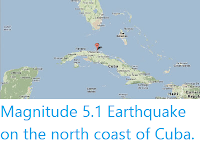
https://sciencythoughts.blogspot.com/2015/08/tropical-storm-erika-kills-at-least-25.htmlhttps://sciencythoughts.blogspot.com/2014/01/magnitude-51-earthquake-on-north-coast.html


Follow Sciency Thoughts on Facebook.

Monday, 12 October 2015

Underground fire in Trinityville, Jamaica, not volcanic.

Residents of the rural community of Trinityville in St Thomas Parish, Jamaica, have raised alarms about the possibility of a volcanic eruption in the area after smoke began rising from beneath the ground on a Coffee farm at Mount Vernon in the west of the community. No visible fire could be seen at the site, but digging beneath the ground rapidly resulted in an increase in smoke accompanied by flames. Jamaica is of volcanic origin, and while it does not currently suffer any volcanic activity, it is located on the boundary between the Caribbean Plate to the south and the GonĆ¢ve Microplate to the north, with the boundary between the two tectonic plates running east-to-west across the center of the isand, so the possibility of a volcanic eruption there is not to far fetched. However Simon Mitchell of the Department of Geology and Geography at the University of the West Indies does not believe this fire is of volcanic origin, suggesting instead that buried woody remains under the hillside have somehow ignited, and that the resultant smoke is a result of slow burning of this buried wood in a low-oxygen environment.

Lesley Williams, a resident of Mount Vernon, investigates the underground fire burning on a Coffee farm there. Ricardo Makyn/Jamaica Gleaner.

Underground fires can burn at a low level for very long periods of time. Where oxygen is limited but available the fuel is not consumed rapidly as in a fire at the surface, and as long as the oxygen remains available it will continue to survive. A coal fire which started at Planitz in Germany in 1476 was not extinguished until 1860, while a fire at Emalahleni in Mpumalanga has been burning since 1953 and one in Columbia County, Pennsylvania since 1962. A fire at Burning Mountain, Australia is thought to have been burning for about 6000 years.

The approximate location of the Mount Vernon Fire. Google Maps.

See also...

The United States Geological Survey recorded a Magnitude 4.7 Earthquake at a depth of 20.8 km off the south coast of the Dominican Republic, slightly...


The Tyne and Wear Fire service are investigating a possible underground fire at the site of the former Clara Vale mine workings. The fire is not thought to present any hazard to the public, but part of a local...


The United States Geological Survey recorded a Magnitude 4.8 Earthquake at a depth of 10 km in San Cristóbal Province in the southwest of the...


Follow Sciency Thoughts on Facebook.

Monday, 13 October 2014

Fossil Land Snails from the Late Pleistocene of south central Jamaica.


Jamaica is considered to be a biodiversity hotspot for Land Snails, with over 505 species considered to be endemic to the island (i.e. coming from the island and not found anywhere else) and 562 species found on the island in total. This is despite the island having a surface area of only 11 500 km2, and having been exposed above the ocean only since the Middle Miocene, about 11.6 million years ago. The neighbouring islands of Cuba and Hispaniola are also thought to be hotspots for Land Snail diversity, but reliable lists of species from these islands are not available. Puerto Rico is considered to have an impoverished Land Snail fauna (i.e. very few species are found here).

This makes the history of Snails on Jamaica of particular interest to Malacologists (scientists that study Molluscs), but unfortunately only a single site on the island, the late Pliocene Bowden Shell Bed, has yielded Snails from before the Late Pleistocene, and this contains highly mixed mass flow (landslip) deposits containing a mixture of terrestrial and marine fauna, from which only six species of Land Snail have been recovered. The situation for the Late Pleistocene is considerably better, with eleven previously recorded sites that have yielded over a hundred species of Snails. However, like the Bowden Shell Bed, the majority of these are mass flow deposits containing Snails that have been swept out to sea in landslides, and the majority of the remainder are cave deposits, which also yield Snails that are likely to have been moved from their native environment.

To date only a single site, Great Pedro Bluff, has been found which appears to contain Snails preserved at the location where they were living, in this case a lithified sand dune deposit in St. Elizabeth Parish in south central Jamaica.

In a paper published in the journal Alcheringa on 21 January 2013, Stephen Donovan of the Department of Geology at the Naturalis BiodiversityCenter in Leiden and Christopher Paul of the Department of Earth Sciences at the University of Bristol, describe a second site yielding Land Snails in situ from the Late Pleistocene of south central Jamaica. This site, Round Hill on Farquhar’s Beach, is 35 km east of Great Pedro Bluff, in Clarendon Parish.

The deposits at Farquhar’s Beach are conglomeritic (contain rocks of mixed types and sizes), with large boulders, cobbles and pebbles of white limestone mixed in with calcarious mudstones, sandstones and paleaosols (lithified soils) which have yielded numerous root casts and fossil Snails. The precise age of the beds has not been determined, but it is thought to be of roughly equivalent age to the Great Pedro Bluff site, and certainly less than 100 000 years old.

Bedding surface of a fallen boulder in the Farquhar’s Beachred beds to show the common association of white limestone cobbles in a matrix-supported red sandstone and with common terrestrial snails. Length of hammer is about 410 mm. Donovan & Paul (2013).

The first specimen described from Round Hill is assigned to the species Alcadia citrinolabris, which has previously been recorded from the Late Pleistocene of Clarendon and Manchester Counties, and is still found living in the area. It is a globular Snail shell, 13 mm in diameter by 10 mm high, and not well preserved.

Alcadia citrinolabris in (C) apertural view and (D) lateral view. Scale bar is 5 mm. Donovan & Paul (2013).

The second specimen described is assigned to the species Lucidella yallahsensis, which is still found in southeast Jamaica, but is no longer found as far west as Farquhar’s Beach. Previous members of this genus, some of which may be assignable to this species, have been recorded from the Red Hills Road Cave deposits, which have been dated to about 30 000 years old, and other members of the genus have been found at other Pleistocene sites and the Pliocene Bowden Shell Bed. This is the smallest and most delicate specimen recorded from Round Hill, and was preserved inside the shell of another, larger Snail. It is a low, conical shell 3.0 mm in diameter and 1.8 mm high.

Lucidella yallahsensis in (left) umbilical view and (right) apical view. Donovan & Paul (2013).

Forty four specimens are assigned to the genus Poteria, though poor preservation prevents the assignment of these to a specific genus; Donovan and Paul are unable to even determine whether the sample represents one or more species. Members of the genus have previously been recorded from the Pliocene Bowden Shell Beds and most of the Pleistocene Snail-yielding deposits on Jamaica, and are still found living on the island, including close to Round Hill. These are low conical shells with 4.5-4.75 whorls reaching up to 21 mm in diameter and 15 mm high.

Poteria sp. in (F) apical view and (G) apertural view. Scale bar is 5 mm. Donovan & Paul (2013).

A single shell is assigned to the genus Adamsiella, but not to a specific species. This is well preserved, even retaining some traces of pigmentation, however it does not conform closely to any known species form Jamaica, and as these tend to be quite variable, and only a single specimen was found, Donovan and Paul refrain from assigning it to a species. Members of the genus have been recorded from several Pleistocene cave deposits on Jamaica and are still found on the island, but not in the area around Farquhar’s Beach.

Adamsiella sp. in (K) apertural view and (J) lateral view. Scale bar is 5 mm. Donovan & Paul (2013).

Nine specimens are assigned to the species Annularia mitis, which is still found in the area, apparently being restricted to St. Andrew, St. Catherine and Clarendon Parishes on Jamaica. Member of the same genus have previously been described from Pleistocene deposits in Coco Reef Cave and Sheep Pen Cave. These are broad, high shells with delicate decoration, reaching 19 mm high and 16 mm wide.

Annularia mitis in apertural view. Scale bar is 5 mm. Donovan & Paul (2013).

Eight specimens are assigned to the species Parachondria crenulosa, which is still found in Manchester, Westmoreland and Clarendon Parishes, and which has previously been recorded as a fossil from Clarendon Parish. Members of the same genus have been recorded from the Pliocene Bowden Shell Beds as well as several Pleistocene sites.

Parachondria crenulosa, two shells in a chip of lithified rock. Scale bar is 5 mm. Donovan & Paul (2013).

Twenty-one specimens are assigned to the species Urocoptis brevis, which is still common in dry limestone habitats along the south coast of Jamaica. Members of the same genus have been found in most Snail-yielding Pleistocene deposits from Jamaica. These are small cylindrical shells with 8.25-9 whorls, reaching 16-20 mm in height.

Urocoptis brevis in (M) apertural view (aperture damaged), (N) lateral view and (O) apertural view. Scale bar is 5 mm. Donovan & Paul (2013).

Three specimens are assigned to Pleurodonte sp. cf. Pleurodonte sinuata (i.e. Donovan and Paul think they are probably Pleurodonte sinuata,but are not completely certain). Pleurodonte sinuatais common and widespread on Jamaica today, but the Round Hill specimens are lower spired and more lenticular than modern specimens, and in addition have more evenly spaced basal teeth and a sharper keel on the body whorl, so Donovan and Paul are not completely sure these specimens are the same species, however they do not feel that three specimens is enough of a sample to erect a new species. Members of the genus Pleurodonte have been recovered from all Snail-yielding Pleistocene deposits on Jamaica, as well as the Pliocene Bowden Shell Bed.

Pleurodonte sp. cf. Pleurodonte sinuatain (H) umbilical view, (I) apical view and (J) apertural view. Scale bar is 5 mm. Donovan & Paul (2013).

Eighteen specimens are assigned to a second species of Pleurodonte, Pleurodonte sublucerna. This species is common throughout southern and eastern Jamaica today. These are large lenticular snails with five flat whorls, reaching 27-34 mm in diameter and 15-17 mm in height.

Pleurodonte sublucernain (E) umbilical view and (F) apical view. Scale bar is 5 mm. Donovan & Paul (2013).

Fifty-eight specimens, one of which has four juveniles of the same species preserved internally, are ascribed to the species Sagda centralis. This species is still found in the area, and members of the same genus have been recorded from every Snail-yielding Pleistocene deposit on Jamaica. These are high, conical, come-shaped shells with 8-9 whorls, reaching 19 mm high and 21 mm in diameter.

Sagda centralis in (G) umbilical view, (H) apical view, (I) apertural view and (J) lateral view. (K) Shell opened to reveal internal lamellae. Scale bar is 5 mm. Donovan & Paul (2013).

Finally two shells are assigned to Sagda sp. cf. Sagnda pila(i.e. probably but not certainly Sagnda pila), a smaller species in the genus Sagda, and two more shells are assigned to the genus Sagnda but assigned to a species. These are smaller shells than those assigned to Sagda centralis, but do not appear to be juveniles of that species.

See also…

http://sciencythoughts.blogspot.co.uk/2014/08/two-new-species-of-cyclophoroid-land.html Two new species of Cyclophoroid Land Snails from Thailand and Peninsula Malaysia. The Cyclophoroidea are a large and diverse group of terrestrial Gastropods, occupying a range of ecological niches from species that live entirely below the soil surface to species that spend their entire life cycles within the tree canopy. The Snails are disk or...

Abalones (Haliotidae) are large, flattened marine Gastropods with distinctive shells. They have a row of small circular openings on their shells used for breathing, and a mother-of-pearl interior. They are widely eaten, and farmed in many areas, though in...

Vetigastropods are considered to be the most ancient, and primative, group of Snails. They are exclusively marine, but found in almost all marine environments, from the intertidal zones to the deepest abysal depths...

Follow Sciency Thoughts on Facebook.