Showing posts with label Pinnipedia. Show all posts

Sunday, 16 November 2025

Assessing the impact of a Highly Pathogenic Avian Influenza Virus upon the Elephant Seal population of South Georgia.

The Southern Elephant Seal, Mirounga leonina, is the largest species of Pinniped (the group which includes Seals, Sea Lions, and Walruses) and an important predator in the circumpolar Southern Ocean. They breed annually, coming ashore on Sub-Antarctic islands in the southern summer. The males emerge first, carving out territories in bouts of competitive fighting, which they then defend for the rest of the season. The pregnant females emerge later, settling in the territories of one of the males, to form harems, groups of females defended by a male. Here they give birth, wean their cub, and finally, at the end of the season, come into oestrus, allowing the male to mate with them before they return to the sea.

Elephant Seals on a beach on South Georgia Island. George Lemann/South Georgia Museum.

There are four genetically distinct populations of Southern Elephant Seals, the  Peninsula Valdés Population, which breeds on the Argentinian coast, the South Georgia Population, which breeds on the islands of the South Atlantic, including South Georgia, South Sandwich Island, and the Falkland Islands, the Macquarie Population, which breeds on the Islands of the South Pacific, and the Heard and Kerguelen Population, which breeds on the islands of the southern Indian Ocean, including the Crozet and Prince Edward archipelagos. Of these populations, the South Georgia Population is thought to be the largest, containing about 54% of the global population.

Because Southern Elephant Seals live in remote locations, data on their populations is difficult to gather, making it difficult to compare populations directly. The Peninsula Valdés Population, possibly the easiest to monitor, is known to have grown by between 1 and 3.4% each year for the past five decades. The South Georgia Population is thought to be stable. The Macquarie Population is thought to have shrunk throughout the twentieth century, going through a slight recovery in the early twenty first century, before starting to shrink again more recently. In the Indian Ocean, the sub-population on Marion Island, in the Prince Edward Archipelago, has declined by 83% since 1950, which represents an annual decline of 5.8%, the Îles Crozet sub-population shrank by 5.4% per year between 1970 and 1990, but more recently have been growing at about 5.1, while the Îles Kerguelen sub-population shrank by 47% between 1952 and 1987, then rose by almost 1% per year between 1987 and 2009, and has been rising at about 1.6% annually more recently.

Influenza A Viruses are Negative-strand RNA Viruses which circulate naturally in both Animal and Human populations, causing seasonal flu. Occasionally a particularly more virulent strains of Influenza A appear, causing large mortality rates among affected species, such as the notorious Spanish Flu, which may have killed over 100 million people between 1918 and 1920. Avian Influenza is a form of Influenza A Virus which first appeared on poultry farms in China in late 2003, rapidly spreading to other farms across East Asia during 2004, causing mass deaths of poultry everywhere it reached. In 2005 it caused a mass death of wild Birds on Qinghai Lake in central China, a lake which is used as a stopover for many migratory Bird species. Later that year cases began to appear in Europe and Africa. While mainly affecting Birds, Avian Influenza can infect Mammals, including Humans, however, although it can be fatal, it seldom spreads between members of most Mammal species, limiting the size of any outbreaks. However, some Mammals appear to be more vulnerable than others with the Virus spreading without the need for further contact with Birds. Such vulnerable Mammals include Cows and Seals.

Negative stained transmission electron micrograph showing  recreated 1918 influenza Virions that were collected from supernatants of 1918-infected Madin-Darby Canine Kidney cells cultures 18 hours after infection. Centres for Disease Control and Prevention/Wikimedia Commons.

Since this time several strains of Avian Influenza have appeared, which have been loosely divided into Highly Pathogenic Avian Influenza Viruses, which typically kill more than 75%  of the Birds in any infected population, and Low Pathogenic Avian Influenza Viruses, which typically kill less than 75%. The 2.3.4.4b clade is a Highly Pathogenic Avian Influenza Virus which first appeared in Europe in 2020, and has subsequently spread to North and South America, where it caused mass deaths among Seabirds and Marine Mammals in 2022. In September 2023, a Brown Skua, Stercorarius antarcticus, on Bird Island, South Georgia, was found to have died as a result of infection with Highly Pathogenic Avian Influenza Virus, with the infection subsequently spreading to Gentoo Penguins, Pygoscelis papua, Snowy Albatrosses, Diomedea exulans,Antarctic Fur Seals, Arctocephalus gazella, and Southern Elephant Seals. In 2024, the Virus was also confirmed on Îles Crozet and Îles Kerguelen in the southern Indian Ocean.

During the 2023/4 breeding season, Southern Elephant Seals on South Georgia were monitored for Highly Pathogenic Avian Influenza Virus via sample collecting at sites which could be accessed from the sea, in combination with observations made from research vessels and cruise ships, suggested that the colony could have lost as many as 97% of its pups.

In a paper published in the journal Communications Biology on 13 November 2025, Connor. Bamford, Nathan Fenney, Jamie Coleman, Cameron Fox-Clarke, and John Dickens of the British Antarctic Survey, Mike Fedak of the Sea Mammal Research Unit at University of St Andrews, Peter Fretwell, also of the British Antarctic Survey, Luis Hückstädt of the Centre for Ecology and Conservation at the University of Exeter, and Phil Hollyman, again of the British Antarctic Survey, and of the School of Ocean Sciences at Bangor University, present a study of the three largest Southern Elephant Seal numbers on South Georgia, based upon photographic data collected by an uncrewed aerial vehicle.

In October 2024, 4373 female Southern Elephant Seals were observed at St Andrews Bay, whereas 6305 were recorded in October 2022. At Hound Bay, 1154 females were observed in 2024, compared to 1901 in 2022. This represents a 47% decline in the number of breeding females at these two sights between 2022 and 2024, and a 33.7% decline compared the long term population average (taken between 1958 and 2022). Bamford et al. extrapolate for that this would represent in a total fall in the number of breeding females across South Georgia of about 55 000.

Locations of the largest breeding colonies of Southern Elephant Seals, Mirounga leonina, on South Georgia. Sites of the three largest breeding colony beaches of Southern Elephant Seals, Mirounga leonina, on South Georgia (by total number of breeding females from the 1995 census where aerial imagery was collected in 2022 and 2024, Bamford et al. (2025).

Bamford et al. note that there are gaps in our knowledge of Elephant Seal breeding, which affect how their data should be interpreted. It is possible that the reduction in the number of breeding females represents a direct measure of the rate of adult mortality suffered by Southern Elephant Seals on South Georgia as a result of Highly Pathogenic Avian Influenza Virus infection. However, female Seals whose pups die tend to leave the breeding beaches fairly quickly, and it is therefore possible that many Seals left beaches in 2023 before coming into oestrus and mating, and therefore did not return in 2024 to raise pups. It is unclear how female Elephant Seals return to the breeding population after losing a pup, although it seems unlikely that they simply stop breeding altogether. 

Another potential disruption to Elephant Seal breeding behaviour comes from sea ice. In 2023 sea ice in the Southern Atlantic cover was the lowest ever recorded at that time (2024 subsequently produced even lower ice levels). This potentially had an impact on the Elephant Seals, as sea ice has a stabilising effect on the Southern Ocean, tending to suppress the formation of storms, as well has having an impact on the ecology of many prey species. However, Bamford et al. do not believe that this is likely to have caused a sufficient disruption to the Seals to explain the observed population drop, given the wide area over which they typically forage.

See also...


Tuesday, 3 January 2023

Walrus sighted in English coastal town.

A Walrus, Odobenus rosmarus,  spent a day resting on a harbour in the town of Scarborough in North Yorkshire, England. The Animal first appeared at about 11.30 on Friday 30 December 2022, returning to the sea at about 4.00 pm on Saturday 31 December, by which time the town had cancelled it's annual New Year Eve firework display to avoid distressing the Marine Mammal on the advice of the wildlife charity British Divers Marine Life Rescue; although as a way of attracting visitors to the town, Walruses proved to be rather more successful than fireworks, with thousands of people arriving to witness the event. The Walrus is believed to be the same Animal spotted on the coast of Hampshire earlier in December, where he was given the nickname 'Thor'. It was spotted again on a wooden pontoon at Blythe on the coast of Northumberland, about 160 km north of Scarborough, on Monday 2 January 2022.

Walrus resting on the harbour at Scarborough in North Yorkshire, England, on 31 December 2022. James Spencer/BBC.

Walruses are the third largest species of Seal, exceeded only by Northern and Southern Elephant Seals (Mirounga angustirostris and Mirounga leonina), and are armed with a large and impressive set of tusks. As such they have few natural enemies, giving them a degree of self confidence surprising compared to most wild Mammals in the UK. Both Polar Bears (Ursus maritimus) and Orca (Orcinas orca) will on occasion hunt Walrus, but they are the preferred prey of neither species, due to their large and potentially dangerous nature. Walruses are also hunted by Humans to some extent, although today this activity is tightly regulated and Walrus products are listed on Appendix 3 of the CITES convention.

Walrus resting on a pontoon dock at Blythe in Northumberland, England, on Monday 2 January 2022. The Guardian.

Walruses are, however still considered to be Vulnerable under the terms of the International Union for the Conservation of Nature's Red List of Threatened Species, due to the potential threat they face from a warming climate. The species is naturally found in the waters of the Arctic Ocean, around Greenland and Svalbard Island, and the northern coasts of Russia, Alaska, and Canada, where they feed on a wide variety of marine invertebrates, with a strong preference for Clams. These environments are considered to be particularly vulnerable to warming climates, which cause loss of the seasonal ice cover, lower the oxygen content of the water (cooler water can absorb and retain more dissolved oxygen than warmer water), and enable invasions by species from warmer climates. While occasional lone Walruses may venture southward (two Walruses where seen on the coasts of Europe in 2021, one in the Irish Sea and the other in the Baltic), it is doubtful that these environments produce enough food to feed a breeding population of these large Mammals, and doing so would almost certainly bring them into conflict with Human shellfish farmers and harvesters (notably, the Walrus seen in the Baltic in 2021 starved to death on the coast of Finland, despite efforts to rescue it).

Distribution map for Walrus, Odobenus rosmarus, populations. ICUN Red List.

See also...

Follow Sciency Thoughts on Facebook.

Follow Sciency Thoughts on Twitter.


Sunday, 10 April 2022

Canadian Salmon farm invaded by Sea Lions.

A Salmon farm on the coast of British Columbia has been invaded by a group of Sea Lions, raising alarm among conservation groups, who fear they may become habituated to the environment. The Rant Point Salmon Farm near Tofino was the subject of an 'invasion event' in mid-March, according to Cermaq, the Norwegian multinational that runs the site, along with several others on the coast of British Columbia, and at other sites in Norway and Chile. However, conservation groups were not informed of the event until Sunday 3 April, when a Whale-watching trip observed the Sea Lions moving in and out of pens.

 
A Sea Lion consuming a Salmon at the Rant Point Salmon Farm in British Columbia. Jérémy Mathieu/Clayoquot Action.

Several previous Sea Lion invasions have been recorded at Salmon Farms in British Columbia, resulting in heavy losses of Fish stocks (Sea Lions can consume up to three times their own bodymass in Fish each day, piling on fat which enables them to survive seasonal food shortages), and numerous Sea Lion deaths through entanglement. During a previous invasion at Rant Point in 2016, the Canadian Department of Fisheries allowed the company to shoot the offending Sea Lions, but this stance has not been repeated in 2022, with the same body insisting that only methods which remove the Animals without hurting them can be used. This is part of a wider change in policy on Salmon farming in Canada, which now wants to see the practice phased out by 2025, following years of campaigning by conservation and indigenous rights groups.

 
Sea Lions inside and outside Salmon Pens at the Rant Point Salmon Farm in British Columbia. Jérémy Mathieu/Clayoquot Action.

Salmon farming on the coast of British Columbia brings employment to the area, and enables farmers to access lucrative US markets easily, but, as in other areas where it is practiced, is strongly opposed by environmental groups. Farmed Salmon, which live at far higher densities than would naturally be the case, are seen as a reserve for Salmon diseases, which can go on to infect wild Salmon, with potentially devastating effects on wild populations. This has potential knock-on effects for many other species, including marine predators such as Sea Lions which rely upon them for food, but also Bears and even forest trees far from the shore. This is due to the complex life cycle of the Salmon, which spend much of their lives at sea, acquiring nutrients from marine sources, before swimming back up the rivers where they were born to mate, spawn, and die. Since most natural processes tend to wash nutrients downstream from the land to the sea, this makes Salmon important ecosystem engineers in British Colombia and other areas of natural temperate rainforests. 

Salmon farms are also seen as highly poluting. This is because Salmon are predatory Fish, requiring farmed Salmon to be fed with Fish meal (generally made from wild-caught Fish species not favoured as food by Humans, raising further concerns about links between Salmon farming and overfishing), with the effect that both waste food and Salmon droppings are potential environment-changing pollutants. Furthermore, the problem of infections spreading easily within Salmon farms often results in farmers dosing the water with antibiotics and other medications, causing further environmental problems, and potentially leading to the spread of anti-biotic resistance in marine pathogens.

See also...


Follow Sciency Thoughts on Facebook.

Follow Sciency Thoughts on Twitter. 


Friday, 21 August 2020

Tourist requires hospital treatment after being bitten by Grey Seal on Devon beach.

A tourist has been treated at Torbay Hospital after being bitten by a Seal on a Babbacombe Beach. Mark Tarpey, from Lancashire, encountered the Grey Seal, Halichoerus grypus, known locally as 'Sammy' who locals report is habituated to Humans, while walking on the beach, and was able to pose with her for a photograph. He then tried to touch the Animal, and was bitten on the hand, resulting in a trip to the hospital's accident and emergency department. Local charity Seal Watch, which monitors Seals in the Babbacombe and Brixham area, report that Sammy is one of several Seals in the area that have become habituated to Human behaviour, and do not respond to being approached by retreating. They advise against to close a contact with these animals however, as they are still wild and may respond aggressively if they feel they are being encroached upon to much.

Tourist Mark Tarpey approaching a Grey Seal known as 'Sammy' (who apparently does not like to be petted on a Babbacombe Beach in the Torbay area of Devon, England. Joanne Tarpey/Devon Live.

Grey Seals are found on both sites of the North Atlantic, with large breeding colonies at several sites around the UK and Ireland. They were heavily hunted in the nineteenth and early twentieth centuries, which caused their populations to drop significantly, but have recovered well since the practice was banned in most areas, and are now considered to be of Least Concern under the terms of the International Union for the Conservation of Nature's Red List of Threatened Species. In the UK (excluding Northern Ireland) they are protected by the Conservation of Seals Act 1970, and while there are occasional calls for their numbers to be reduced by commercial fishermen, they are generally popular Animals, with their status as one of the few large Mammals that can be seen in the wild adding to their natural charisma.

Seals are Carnivorans, related to Mustelids (Weasels and Badgers, etc.), Bears, and Canids, and often have faces which appear Dog-like. This can on occasion prove deceptive to Humans who are familiar with Dogs, as Seals to not express displeasure in the same ways, tending to bite without giving the warning of snarling or barking, which can mislead people into thinking they are friendlier than they actually are.

See also...


Follow Sciency Thoughts on Facebook.


Sunday, 24 June 2018

Allodesmus uraiporensis: A new species of Allodesmine Seal from the Miocene of Hokkaido.

The Allodesmines are an extinct group of Pinnipeds thought to have been closely related to the True Seals, which are known from the Middle-to-Late Miocene of Japan and the Pacific Coast of North America. They were large animals, reaching about 2.5 m in length, and showed sexual dimorphism, with males bigger than the females and having enlarged canine teeth, presumed to have been used in combat with one-another over mating rights. The taxonomy of Allodesmines is somewhat controversial, with some palaeontologists claiming as many as eight species in four genera, while others recognise only five species in a single genus, Allodesmus.

In a paper published in the journal Royal Society Open Science on 16 May 2018, Wataru Tonomori of the Graduate School of Life and Environmental Sciences at the University of Tsukuba, Hiroshi Sawamura of the Ashoro Museum of Paleontology, Tamaki Sato of the Department of Astronomy and Earth Sciences at the Tokyo Gakugei University, and Naoki Kohno, also of the Graduate School of Life and Environmental Sciences at the University of Tsukuba, and of the Department of Geology and Paleontology at the National Museum of Nature and Science, describe a new species of Allodesmine Seal from the middle Miocene Atsunai Formation of Urahoro, on Hokkaido Island, Japan.

The new species is placed in the genus Allodesmus (Tonomori et al. recognise two genera of Allodesmines, Atopotarus), and given the specific name uraiporensis, meaning 'from Urahoro' (Uraiporo is an old form of Urahoro, itself meaning 'place where big Fish gather' in the Ainu language. The species is described from a single disarticulated but largely complete male specimen, differentiated from all other members of genus by its dentition and structure of the skull. 

Reconstruction of Allodesmus uraiporensis skeleton. Blue parts indicate preserved bones. Tonomori et al. (2018).

With an estimated age of between 16.3 and 13.5 million years old, Allodesmus uraiporensis, is the oldest known member of the genus from the West Pacific, and may represent the earliest arrival of the genus on this side of the ocean, during the Miocene Climatic Optimum (a period of warmth and stability lasting from about 18.0 million years ago till about 14.8 million years ago), which then resulted in an adaptive radiation in the West Pacific, which resulted in several new species.

See also...

http://sciencythoughts.blogspot.com/2015/11/predation-of-cape-fur-seals-by-kelp.htmlhttp://sciencythoughts.blogspot.com/2015/08/archaeodobenus-akamatsui-fossil-walrus.html
http://sciencythoughts.blogspot.com/2014/05/the-origin-and-diversification-of-monk.htmlhttp://sciencythoughts.blogspot.com/2014/04/an-enigmatic-walrus-from-miocene-of.html
Follow Sciency Thoughts on Facebook.

Thursday, 12 November 2015

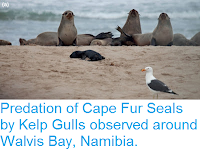
Predation of Cape Fur Seals by Kelp Gulls observed around Walvis Bay, Namibia.

Gulls, Larifdae, are exceptionally flexible predators found in coastal, inland and open marine habitats throughout the world. They are highly opportunistic, typically having diets that alter throughout the year as different food sources become available, and adapt rapidly to new food sources when they become available. The Kelp Gull, Larus dominicanus, is considered particularly flexible even for a Gull, being found across most of the Southern Hemisphere from the shores of Antarctica to the southern tropics, and being able to consume a diet that ranges from small invertebrates to beached Sharks and Whales; there have even been reports of them attacking surfacing Southern Right Whales Eubalena australis, tearing chunks of flesh from the Whales and consuming it.

In a paper published in the African Journal of Marine Science on 14 August 2015, Austen Gallagher of the Leonard and Jayne Abess Center for Ecosystem Science and Policy at the University of Miami, the Rosenstiel School of Marine and Atmospheric Sciences and Beneath the Waves Incorporated, Erica Staaterman of the Rosenstiel School of Marine and Atmospheric Sciences and Beneath the Waves Incorporated and Naude Dreyer of Sandwich Harbour 4×4 report the first recorded instance of predation by Kelp Gulls of the pups of Cape Fur Seals, Arctocephalus pusillus pusillus.

The Seals observed were at a breeding colony at Pelican Point in the Dorob National Park to the west of Walvis Bay. This colony was reduced by hunting to under 100 individuals in 1995, but since then the species has been protected, and a successful ecotourism industry developed, and between 20 000 and 80 000 individuals can be found at the site each breeding season.

The Gulls targeted newborn pups that had strayed from their parents, or older juveniles that were sleeping, initially attempting to remove and consume the eyeballs. In about 50% of observed attacks this initial assault was successful, and followed up by further attacks on other areas of soft tissue, such as the underside and anus region, invariably leading to the death of the Seal. In the remaining 50% of instances the Seal was able to escape, sometimes with the assistance of other Seals.

 Eamples of Kelp Gull predatory behavior on Cape Fur Seals in southern Namibia: (a) Gulls approach small, weak, or wandering juvenile or newborn Seals; (b) gulls first target the ocular regions of live or dying Seals; (c) still-alive Seal pup with its right eye ripped out by a Gull attack. Naude Dreyer in Gallagher et al. (2015).

Over the course of 15 years about 500 attacks on Seals by Gulls were observed at Pelican Point; many more dead Seals were observed with their eyes pecked out, including newborn pups, juveniles and adults, however Gulls will also feed on Seals that have died of other causes, with the eyeball being a preferred item, and have also on occasion been seen feeding on Seals that have survived Shark attacks but been badly wounded. Nevertheless the attacks appear to be a new form of behavior, having not been observed at the site before 1998 and recorded nowhere else in the shared range of the two species. The behavior has apparently been driven by the recovery of the Seal colony, which has provided a new food source for the Gulls in the form of Seal cubs, though the Gull population has also risen sharply in recent years, which would be predicted to drive the Gulls to seek novel food sources.

See also...

http://sciencythoughts.blogspot.co.uk/2015/08/archaeodobenus-akamatsui-fossil-walrus.html

Archaeodobenus akamatsui: A fossil Walrus from the early Late Miocene of Hokkaido.                                              Walruses, Odobenidae, have a good fossil record from the middle Late Miocene (about 8 million years ago) onwards, and appear to have...

http://sciencythoughts.blogspot.co.uk/2015/03/methyl-mercury-levels-in-feathers-of.htmlMethyl mercury levels in the feathers of Ivory Gulls,                                                             Ivory Gulls, Pagophila eburnean, are scavenging Seabirds found across the High Arctic. Their population in Canada has declined by 80-85% since the 1980s (the earliest dates for which records of the species...

http://sciencythoughts.blogspot.co.uk/2014/05/the-origin-and-diversification-of-monk.htmlThe origin and diversification of Monk Seals.                                                        The Caribbean Monk Seal, Monachus tropicalis, has not been seen in the wild since 1952, and is now generally...

Follow Sciency Thoughts on Facebook.

Thursday, 13 August 2015

Archaeodobenus akamatsui: A fossil Walrus from the early Late Miocene of Hokkaido.


Walruses, Odobenidae, have a good fossil record from the middle Late Miocene (about 8 million years ago) onwards, and appear to have been a fairly diverse group of large Seals for much of that time, with the single surviving modern species, Odobenus rosmarus, being a rather modified and specialized member of the group. Fossil Walruses older than about 8 million years are rare, though the group was clearly present before this time, as the group was already quite diverse when it became abundant in the fossil record; older fossil Walruses are therefore key to understanding diversity within the group.

In a paper published in the journal PLoS One on 5 August 2015, Yoshihiro Tanaka of the Hokkaido University Museum, the Department of Geology at the University of Otago and the Numata Fossil Museum and Naoki Kohno of the Department of Geology and Paleontology at the National Museum of Nature and Science and the Graduate School of Life and Environmental Sciences at the University of Tsukuba describe a new species of fossil Walrus from a partial skull and skeleton from the 10.0-9.5 million-year-old Ichibangawa Formation of Tobetsu Town in Hokkaido.

The new species is named Archaeodobenus akamatsui, where ‘Archaeodobenus’means ‘ancient Walrus’ and ‘akamatsui’ honours Morio Akamatsu of the Hokkaido Museum for his longstanding contributions to the geology and palaeontology of Hokkaido. The species is described from a single specimen comprising a partial skull with most of the left side preserved, as well as the left mandible and several teeth, several vertebrae and ribs and an incomplete sternebra, a partial scapulae, and a nearly complete right humerus. The specimen is thought to have been a male animal between about 2.8 and 3 meters in length, and weighing about 390–473 kg.

Cranium of Archaeodobenus akamatsui, in (A) dorsal view, (B) left lateral view, (C) ventral view. Tanaka & Kohno (2015).

Archaeodobenus akamatsui clearly belongs to the Odobenidae, having a number of traits only found in Walruses, notably a laterally expanded pterygoid strut (supporting structure on the upper jaw which forms part of the palate), a bony tentorium that is closely appressed to the petrosal (part of the structure of the ear) and well developed first and second premolars. However it is otherwise distinct from other members of the group, suggesting that it represents a distinct lineage.

Reconstructed cranium of Archaeodobenus akamatsui, in (A) dorsal view, (B) left lateral view, (C) ventral view. Tanaka & Kohno (2015).

Archaeodobenus akamatsui was derived from a distinctive glauconitic (green sandstone, typically deposited in a marine environment with low oxygen levels) layer within the Ichibangawa Formation. It is the second Walrus species described from this layer, implying that two separate Walrus lineages were already present in the area at this time, and that therefore that the rapid diversification of the group had already begun. This glauconite layer is thought to represent a deposits laid down following a sudden transgression (rapid deepening of the sea) covering part of a delta environment following a period of receding sea levels over the previous million-and-a-half years.

Tanaka and Kohno reason that the falling sea levels between 12 and 10.5 million years ago would have reduced the number of coastal environments suitable for Seals on the East Asian coastline as the waters drew towards the continental shelf, leading to seas that increased in depth rapidly close to the shore. This would have caused reproductive isolation between groups of Early Walruses, with small isolated populations beginning the process of diversifying away from one-another. The sudden transgression after 10.5 million years ago would have flooded many coastal areas, creating many new shallow marine coastal environments, allowing these isolated Walrus species to greatly expand their ranges, bringing them into contact with other, now reproductively isolated, populations and triggering competition between these groups, pushing further morphological diversification within the group.

The role of eustasy in early late Miocene odobenid diversification in Hokkaido, Japan. Tanaka & Kohno (2015).

Such sea-level change events have been linked to events in Seal evolution elsewhere, most notably in South America where a sudden transgression in the Late Pliocene is thought to have triggered an extinction event among Phocids ('True' or Earless Seals) by replacing broad shallow seas covering much of what is now the Atacama Desert with deeper water environments less suitable for these animals.

Reconstruction of Archaeodobenus akamatsui. Tatsuya Shinmura/Ashoro Museum of Paleontology, in Tanaka & Kohno (2015).

See also…

The Caribbean Monk Seal, Monachus tropicalis, has not been seen in the wild since 1952, and is now generally excepted as being extinct. Its two surviving...

Walruses (Odobenidae) are large Seals (Pinnipedia) related to Sea Lions and Fur Seals (Otariidae). The group first appears in the fossil record about 16 million years ago towards the end of the Early Miocene. The modern Walrus (Odobenus rosmarus) is one of the largest living Seals, and is a specialized shellfish eater, with well-developed tusks used to root out Clams...


Follow Sciency Thoughts on Facebook.