Showing posts with label Ophiuroids. Show all posts

Sunday, 12 February 2023

Ophiuroids (Brittle Stars) from the Carboniferous of Oklahoma.

Determining when groups of organisms first originated is one of the great challenges faced by evolutionary biologists. Traditionally, the fossil record has been the only way to determine when such groups first appeared, although since the 1960s molecular clock techniques, which use mutation rates to determine when groups of organisms diverged, have also been employed. Modern studies typically use a combination of the two techniques to achieve better results, but the accuracy of any study is still dependent on the quality of the available data.

The fossil record is not complete. Organisms stand a far better chance of being preserved in some environments that others, and organisms themselves differ greatly in their potential to leave fossil remains. Furthermore, Humans are often selective in both where they look for fossils, and in the types of fossils they collect, concentrating on larger, more eye-catching fossils, and often overlooking unconventional deposits which do not produce abundant, obvious fossils completely. Fossil groups which have skeletons made up of large numbers of small sections, such as small Vertebrates and Echinoderms, are often overlooked in environments which do not produce articulated skeletons, leaving gaps in our knowledge of their histories, even though their fossils are both numerous and widespread. Deposits from environments where articulated skeletons are unlikely to be preserved, such as the deep marine seafloor (where sedimentation rates are very low, and storm events never rapidly cover organisms) are often overlooked in palaeontological studies. These environments, however, often contain numerous disarticulated skeletal elements, which can potentially tell us a great deal about the history of traditionally undersampled groups.

Ophiuroids, or Brittle Stars, are the most specious of the five extant classes of Echinoderms, and a well resolved phylogeny, based upon molecular data. However, the skeleton of Ophiuroids typically disaggregates into a large number of sand-sized particles within a few hours of death, with the result that fossils of entire Ophiuroids are very rare. The plates which make up the skeletons of Ophiuroids are actually very distinctive, making it possible to identify individual plates to the species level, and a great deal of work has been done on Mesozoic and Cainozoic Ophiuroids using individual plates, but the Palaeozoic Ophiuroid fossil record has been largely overlooked to date.

In a paper published in the journal Geology on 3 January 2023, Ben Thuy of the Department of Palaeontology at the Natural History Museum Luxembourg, Larry Knox of Earth Sciences at  Tennessee Tech University, Lea Numberger-Thuy, also of the Department of Palaeontology at the Natural History Museum Luxembourg, and Nicholas Smith and Colin Sumrall of the Department of Earth and Planetary Sciences at the University of Tennessee, present the results of a study of Ophiuroid elements from deep water sediments from the Carboniferous of Oklahoma.

Thuy et al. examined 81 sieved micropalaeontological assemblages, obtained from bulk samples collected at Dutton Ranch in central southern Oklahoma for Ophiuroid samples. One of these, collected in 1981 from a blue-to-olive-grey shale identified as Unit 9BC, which is considered to be roughly equivalent to the Bostwick Member of the Lake Murray Formation, which dates to the latest Bashkirian (about 315 million years ago) proved to be particularly rich in Ophiuroid fossils. This unit was deposited in the northern Ardmore Basin, a northwestern extension of the Panthalassic Ocean. Based upon grain size, mineralogy, and Ostracod fauna, this deposit is thought to have been laid down in a deep slope or upper continental shelf environment.

Paleogeographic map of the southern United States during the Early Pennsylvanian, with sampled locality marked by the star.  Deep Time Maps in Thuy et al. (2023). 

In total, the samples produced about 400 Ophiuroid microfossils, including various types of arm plates (single ambulacrals and pairs fused into vertebrae; and lateral, ventral, and dorsal arm plates) as well as disc plates (radial shields and oral plates). From these lateral arm plates were chosen for further examination, as these are considered to show the greatest complexity, and are therefore the most useful taxonomically. Five distinct types of lateral arm plate were present in the sample, which Thuy et al. believe represent five separate species. Furthermore, two of these five species appear to be crown group Ophiuroids (the 'crown-group' of a group of organisms includes all living species within that group, their most recent common ancestor, and everything descended from that ancestor), assignable to extant orders, which Thuy et al. refer to as types A and B.

Brittle Star microfossils from the latest Bashkirian (Atokan, Upper Carboniferous), of Dutton Ranch, Oklahoma, USA. (A)–(G) Lateral arm plate type B (A)–(C) and associated skeletal remains (E)–(G), corresponding to unnamed Amphilepidid, with median (A) and proximal (B) lateral arm plates in external (A1), (B1) and internal (A2), (B2) views and with details of spine articulations (C), proximal vertebra (D) in lateral view, proximal ventral arm plate (E) in external view, radial shield (F) in external view, and oral plate in adradial view (G). All plates are shown with their respective position in a typical modern ophiuroid skeleton. (H) Lateral arm plate type A, corresponding to an unnamed Ophioscolecid, with proximal lateral arm plate shown in external (H1) and internal (H2) views. Abbreviations: di, distal; do, dorsal. Thuy et al. (2023).

Type A lateral arm plates are elongate with coarsely reticulate stereom on the outer surface and a vertical row of large, freestanding spine articulations on an elevated distal edge. The spine articulations are composed of a single opening encompassed by a pair of arched dorsal and ventral lobes forming a lens-shaped elevation. The inner side has a low and poorly defined vertebral articular knob and a large tentacle notch. The general shape of these plates, as well as the shape of their arm articulations and the presence of coarse reticulation on their outer surfaces is consistent with the modern Ophiuroid order Ophioscolecida, and possibly with the genus Ophioscolex, although Thuy et al. do not go as far as assigning the specimens to genus level.

Type B lateral arm plates are by far the most common in the assemblage, making up about 90% of all the lateral arm plates collected. These are robust and strongly arched, and it appears likely that a pair of them would have been capable of completely enclosing the vertebrae of the arm. The outer surface ornamentation comprises a fine tuberculation, proximally bordered by a band of more coarsely meshed stereom including a central area with a fine horizontal striation and two spurs that establish the position of articulation with the overlapping adjacent lateral arm plate. The inner side of the lateral arm plate has a single, vertical ridge-shaped vertebral articular structure and a deep tentacle notch. The outer distal edge of the lateral arm plates bears a vertical row of small, freestanding spine articulations, each comprising a pair of parallel, horizontal dorsal and ventral lobes encompassing a small nerve opening and a slightly larger muscle opening. The type of spine articulation seen in these plates is exclusively seen in members of the Order Amphilepidida, which again is still extant today.

On the basis of their numeric domination of the sample, other plates found in the Dutton Ranch assemblage can be assumed to have come from the same species as the Type B lateral arm plates. These include ventral arm plates (which show similar ornamentation to the lateral arm plates) and radial shields, although Thuy et al. caution that, although the ventral arm plates appear to be consistent with the lateral arm plates, they would not, in themselves, be sufficient to assign a fossil to the Order Amphilepidida.

The placement of at least two species of Ophiuroids from the Dutton Ranch assemblage within modern orders is surprising, as this implies that these modern orders had emerged considerably before the theoretical date given for the emergence of the crown group Ophiuroids by molecular clock analysis. To test this hypothesis, Thuy et al. performed a Bayesian phylogenetic analysis using a previously established list of significant characters for the group, and using the early Carboniferous stem-group Ophiuroid Aganaster gregarius as an outgroup. This phylogeny confirmed the Type A lateral arm plates as having come from a member of the Order Ophioscolecida, which was close to the modern genera Ophioscolex and Ophiolycus, while the Type B lateral arm plates as having come from a basal member of the Order Amphilepidida.

Evolutionary tree of the crown-group Ophiuroidea, based on Bayesian inference analysis, showing positions of lateral arm plate (LAP) types A and B. Abbreviations: Ceno., Cainozoic; Devon., Devonian; Pennsylv., Pennsylvanian; Guadal., Guadalupian; Lop., Lopingian; L., Lower; Mid., Middle. Thuy et al. (2023).

This phylogenetic analysis confirms that lateral arm plate types A and B represent the earliest known examples of the orders Ophioscolecida and Amphilepidida, as well as (collectively) the oldest known examples of the Superorder  Ophintegrida. This in turn implies that not only had the crown group Ophiuroida arisen by 315 million years ago, it had had time to split into the two superorders, Ophintegrida and Euryophiurida, and that the Superorder Ophintegrida had time to split into the orders Ophioscolecida and Amphilepidida. It has previously generally been assumed that the modern Ophiuroid orders arose during the period of high biotic turnover following the End Permia extinction, which appears to be the case with other Echinoderm groups. Although a pre-End Permian radiation of modern Ophiuroids has been suggested previously, Thuy et al.'s study presents the first direct evidence of this. 

As well as providing evidence for an earlier origin of the crown group Ophiuroids than has previously been expected, Thuy et al.'s study also challenges the generally held assumption that shallow shelf environments are the major driver of biological innovation in the oceans, with some groups subsequently spreading into deep-water environments, and instead adds to a growing body of evidence that deep marine environments can themselves be a source of innovation, producing groups of organisms that go on to invade the shallow seas. 

The assumption that little biological innovation occurs in the deep marine environment may be linked to the paucity of fossil-producing deep-water sediments in the fossil record. This is partly because of the low sedimentation rates in these environments, which leaves the remains of any Animals which die there exposed on the surface for long periods, but is also linked to the recycling of the ocean seafloor, which makes unaltered pre-Mesozoic deep-water deposits extremely rare. Thuy et al.'s study also demonstrates that these obstacles can also be overcome, and that careful sampling of those deposits which have been preserved can uncover ghost-lineages of modern groups, adding to our understanding of evolution in deep time as well as deep marine environments.

See also...

Follow Sciency Thoughts on Facebook.

Follow Sciency Thoughts on Twitter. 


Tuesday, 30 June 2020

Ophiambix kagutsuchi & Ophiambix macrodonta: Two new species of Brittle Stars from Japanese hot vents and cold seeps.

Brittle Stars, Ophiuroidea, contains the largest number of species within the Echinodermata and occurs in a great variety of marine habitats, such as muddy substrates, living infaunally in sediments, under rocks, in the interstices of Sponges and Hard Corals, and on surfaces of various Animals such as Soft Corals. They are globally one of the dominant deep-sea megafaunal groups, but diversity in chemosynthetic ecosystems such as hydrothermal vents and hydrocarbon seeps remains poorly understood. Since 1985, 10 species of Ophiuroids, including Ophiacantha longispina, Ophiactis tyleri, Ophienigma spinilimbatum, Ophiocten centobi, Ophioctenella acies, Ophiolamina epraewas, Ophiomitra spinea, Ophioplinthaca chelys, Ophiotreta valenciennesi rufescens, and Spinophiura jolliveti, have been collected from chemosynthetic ecosystems. As our knowledge grows, we have gained better understanding of Ophiuroids within these settings, and it appears Ophiuroid diversity has likely been underestimated. In Japanese waters, surveys of Ophiuroids have recorded 346 species, which represent approximately three-quarters of the North Pacific Ocean Ophiuroid fauna. However, no Ophiuroid species have been recorded from chemosynthetic habitats around Japan to date.

In a paper published in the journal Raffles Bulletin of Zoology on 17 April 2020, Masanori Okanishi of the Misaki Marine Biological Station of the University of Tokyo, Moe Kato of the School of Natural System at Kanazawa University, Hiromi Kayama Watanabe and Chong Chen of the Japan Agency for Marine-Earth Science and Technology, and Toshihiko Fujita of the National Museum of Nature and Science, describe two new species of Ophiuroids from chemosynthetic ecosystems in Japanese waters.

Both new species are placed in the enigmatic Ophiuroid genus Ophiambix, which was originally erected by Edward Lyman in 1880 for the monotypic Ophiambix aculeatus, and is known from the deep waters (146–5,315 m) of the Pacific and Atlantic Oceans. Out of the four species of Ophiambix currently considered to be valid, only Ophiambix aculeatus has been recorded from Japanese waters. Ophiambix has a characteristically flat body and their arms are well differentiated from the disc in a manner superficially similar to that of Asteroids.

The first new species is named Ophiambix kagutsuchi, in reference to Kagutsuchi, the god of fire in ancient Japanese mythology, referring to the hot-vent habit of the new species. The species was found at a series of hydrothermal vents in the Okinawa Trough, as well as on sunken wood found in the Ryukyu Trench, southwest of Japan, at a depth range of 276–1,979 m.

Ophiambix kagutsuchi, holotype (NSMT E-13071). (A) Aboral body; (B) aboral disc and proximal portion of arm; (C) oral disc and proximal portion of arms, arrow heads indicate oral papillae; (D) proximal portion of aboral surface of arm; (E) proximal portion of oral surface of arm; (F) distal portion of aboral surface of arm; (G) distal portion of oral surface of arm. Abbreviations: ASh, adoral shield; ASp, arm spine; D, dorsal arm plate; GS, genital slit; L, lateral arm plate; OP, oral plate; OS, oral shield; RS, radial shield; SD, supplementary dorsal plate; Te, tentacle scale; V, ventral arm plate. Scale bars 1 mm. Okanishi et al. (2020).

The disk of Ophiambix kagutsuchi is pentagonal, and about 4 mm in diameter. The aboral surface covered by small granules of almost uniform size, separated from each other, approximately 50–70 μm in diameter. Removal of granules shows underlying plates are scalar, circular in outline, and imbricating, each approximately 250–350 μm in diameter. Radial shields are triangular, distally wider, 350 μm in width, and 350 μm in length, sharpen towards the centre, and completely concealed by the granules. On the oral surface, the adoral shields are parallelogram-shaped, wider than long, approximately 250 μm in width, and 120 μm in length, one overlapping the other. The oral plates are trapezoidal, approximately 250 μm in width, and 180 μm in length at the radial edge, 250 μm in length at the abradial edge, and in contact with each other. The oral shields are pentagonal, slightly rounded, with a convex distal edge, approximately 360 μm in width, and 60–260 μm in length. The interradial oral disc area is narrow, covered by scales under thick skin, and approximately 200–300 μm in length. The genital slits are narrow, almost extending from the edge of the oral shield to two-thirds the height of the oral interradial disc, and 0.1 mm in width. The oral papillae and teeth are rudimentary, very thin, narrow and flat ossicles, approximately 10 μm in length, forming a continuous horizontal row on oral edge of dental and oral plates. The teeth and oral papillae quite similar in shape but for descriptive purposes, the ossicles on top of the dental plate are called teeth and ossicles on oral edge of oral plate are called oral papillae. With the exception of the oral-most row of papillae, there are 6 to 7 thin and fan-shaped teeth forming vertical row on the dental plate. There is a second tentacle pore inside the mouth slit.

Ophiambix kagutsuchi, paratype (NSMT E-13070), scaning electron microscope images of ossicles. (A)–(D) Vertebrae from proximal portion of arm, distal view (A), proximal view (B), oral view (C), aboral view, green illustration indicates 'T'-shaped groove (D); (E)–(G) lateral arm plates from proximal portion of arms, oral view (E), adoral view (F), inner view (G) an arrow head indicates a perforation; (H) ventral arm plates from proximal portion of arm, inner view; (I), (J) arm spines from distal (I) and proximal (J) portion of arm, arrow heads indicate secondary teeth. Orientations: ab, aboral side; ba, basal side; dis, distal side; ex, external side; in, inner side; o, oral side; pro, proximal side. Abbreviations: AF, aboral muscle fossae; DL, dorsal lobe; ES, elongated structure; LAC, lateral ambulacral canal; MO, muscle opening; NO, nerve opening; OF, oral muscle fossae; VL, ventral lobe. Okanishi et al. (2020).

On the proximally arm, theaboral surface is covered by small granules the same as those on the aboral disc, these decrease in number and disappearing on arm tip. After removal of the granules, the exposed dorsal arm plates are oblong, longer than wide, the proximal edge is slightly wider than the distal edge. There is a pair of fan-shaped supplementary dorsal arm plates on both lateral sides of each dorsal arm plate and irregularly shaped smaller supplementary plates on the distal side of the dorsal arm plates separating them from each other. On the middle portion of the arm, these supplementary plates disappear and the dorsal arm plates are in contact, gradually decreasing in size toward the arm tip. The lateral arm plates are thin, and widely separated from each other throughout the arm. The tentacle pore forms a large hole. On the proximal portion of the arm, the ventral arm plates are almost square with a concave distal edge, and toward the arm tip, become oblong, longer than wide, with a distal concave edge, contiguous throughout the arms. There are three flat and pointed arm spines on the proximal portion of each arm, the middle one is longest, the same length as the corresponding arm segment, the aboral-most half length of the middle spine, and the oral-most spine is shortest, approximately one-fifth length of the middle spine. The arm spines decrease in number to one toward the arm tip, transforming into a hook-shape, approximately the same length as the corresponding arm segment. There is one small, rudimentary tentacle scale at each tentacle pore, although small, tentacle scales present on the distal portion of each arm.

Ophiambix kagutsuchi, paratype (NSMT E-13050), scanning electron microscope images of ossicles. (A), (B) oral plates of abradial side (A) and adradial side (B), partly cracking, arrows indicate neural grooves; (C), (D) adradial genital plates, aboral view (C) and oral view, partly cracking (D); (E) inner view of a radial shield; (F) external view of a dental plate. Orientations: ab, aboral side; cen, centre of disc; o, oral side; per, periphery of disc. Abbreviations: AbMA, abradial muscle attachment area; AdMA, adradial muscle attachment area; AG, articulation for genital plate; DAT, depression for aboral tentacle; DOT, depression for oral tentacle; DW, presumable depression for water ring canal. Scale bars 100 μm. Okanishi et al. (2020).

The second new species is named Ophiambix macrodonta, which is a Latin adjective which means to have large teeth, referring to the flat, wide teeth of the species. The species is known only from a hydrocarbon seep site on Kuroshima Knoll, southeast of the Yaeyama Islands, part of the Ryukyu Island chain, southwest of Japan, at a depth range of 638–644 m.

Ophiambix macrodonta, holotype (NSMT E-13059). (A) Aboral body; (B) oral body; (C) aboral disc and proximal portion of arm; (D) aboral periphery of disc and proximal portion of arm; (E) oral disc and proximal portion of arms; (F) oral periphery of disc and proximal portion of arm; (G) a jaw; (H) top of a jaw, arrow heads indicate teeth and oral papillae. Abbreviations: ASh, adoral shield; DP, dental plate; GS, genital slit; L, lateral arm plate; OP, oral plate; OS, oral shield; RS, radial shield; Te, tentacle scale; V, ventral arm plate. Scale bars 1 mm. Okanishi et al. (2020).

The disc of Ophiambix macrodonta is pentagonal, and 6 mm in diameter. The aboral surface is covered by polygonal scales, approximately 250–350 μm in diameter, arranged in a mosaic pattern. Each scale is covered by small granules of uniform size, approximately 40–60 μm in diameter, in contact with each other and forming two or three circular rows on the periphery of each scale. The radial shields are oval, 850 μm in length and 500 μm in width, and almost completely concealed by granules except on the margins. The adoral shields are curved, bar-like, wider than long, approximately 500 μm in length and 150 μm in width, and separated from each other. The visible part of the jaws is trapezoid, approximately 500 μm in length and 250 μm in width, and contiguous. The oral shields are elliptical in shape, longer than wide, slightly acute on both adradial edges, and approximately 300 μm in length and 650 μm in width. The interradial oral disc area is narrow, covered by polygonal and mosaic scales, approximately 200–300 μm in length as those on aboral disc. The genital slits are long and wide, almost extending to the disc edge from distal edge of the oral shield, and 0.3 mm in width. The oral papillae and teeth are rudimentary, very thin, narrow and flat ossicles, approximately 10 μm in width, forming a horizontal row on the oral edge of the dental plate and oral plate. The second tentacle pore is inside the mouth slit.

Ophiambix macrodonta, holotype (NSMT E-13059) (A)–(E), (G), (H) and a paratype (NSMT E-13060) (F), scanning electron microscope images. (A) Aboral disc and proximal portion of arm; (B) aboral periphery of disc and proximal portion of arm; (C) granules (arrow heads) on aboral disc; (D) oral disc and proximal portion of arms; (E) jaws, an arrow head indicates teeth or oral papillae; (F) a jaw from lateral view, arrow heads indicate teeth and oral papillae; (G) proximal portion of aboral surface of arm, arrow heads indicate supplementary plates; (H) proximal portion of oral surface of arm. Abbreviations: ASh, adoral shield; ASp, arm spine; D, dorsal arm plate; GS, genital slit; RS, radial shield; V, ventral arm plate. Okanishi et al. (2020).

The hollowtype of Ophiambix macrodonta has two complete arms 25 mm and 26 mm, while the other three arms have lost their tips. The proximal portion of the arms is 1.5 mm wide and 1 mm high, and eliptical in cross section. The arms taper gradually towards the tip. The aboral surface is covered by dorsal arm plates and supplementary dorsal arm plates, with no granules. On the proximal portion of the arm, the dorsal arm plates are semicircular, and wider than long; the proximal edge is straight. There is one large, fan-shaped supplementary dorsal arm plate on both lateral sides of the dorsal arm plate. Three smaller, polygonal plates are at the distal edges of the dorsal arm plates and the two larger supplementary dorsal plates. Toward the arm tip, these supplementary plates decrease in size and gradually disappear with the dorsal arm plates becoming contiguous. The lateral arm plates are thin, and widely separated throughout the arm. On the proximal portion of the arm, the ventral arm plates are almost square, with slightly concave lateral edges and oblong. On the distal portion of the arm, the ventral arm plates are longer than wide, concave, and the lateral edges more pronounced. The ventral arm plates are contiguous throughout the arms. There are three flat arm spines on the proximal portion of arms, the aboral-most and middlevspines are flat and leaf-like, and the oral-most spine is cylindrical, narrow, and pointed. All three spines are equal in length to the corresponding arm segment. Toward the tip, the aboral-most and middle arm spines transform to a cylindrical and pointed shape, and the oral-most one transforms into a hook, approximately the same length as the corresponding arm segment. There is one small, triangular tentacle scale at each tentacle pore, although small, tentacle scales are present on distal portion of the arm.

Ophiambix macrodonta, holotype (NSMT E-13059). (A) Proximal portion of aboral surface of arm, a part enlarged in (B), arrow heads indicate supplementary plates; (C) distal portion of aboral surface of arm; (D) proximal portion of oral surface of arm; (E) distal portion of oral surface of arm; (F) distal portion of lateral surface of arm. Abbreviations: ASp, arm spine; D, dorsal arm plate; L, lateral arm plate; Te, tentacle scale; V, ventral arm plate. Scale bars 1 mm. Okanishi et al. (2020).

The difference in body size of the two new species Ophiambix macrodonta (3.3 to 7.0 mm in disc diameter) and Ophiambix kagutsuchi (0.8 to 3.2 mm in disc diameter) suggests that these could be interpreted as different sizes of the same species. However, the smallest specimen of Ophiambix macrodonta (3.3 mm in disc diameter), and the largest specimen of Ophiambix kagutsuchi (3.2 mm in disc diameter), were similar in size but exhibited the full set of respective diagnostic characters. All examined specimens of Ophiambix kagutsuchi, were collected from hydrothermal vents or sunken wood environments, whereas those of Ophiambix macrodonta, new species, were collected only from hydrocarbon seeps. Therefore, Okanishi et al. consider that these two taxa are indeed separate new species that can be distinguished from each other by morphological characters and by different environmental preferences.

See also...

https://sciencythoughts.blogspot.com/2019/10/ophiopsila-xmasilluminans.htmlhttps://sciencythoughts.blogspot.com/2019/08/ophiacantha-scissionis-fissiparous-six.html
https://sciencythoughts.blogspot.com/2014/12/a-new-species-of-brittle-star-from.htmlhttps://sciencythoughts.blogspot.com/2014/06/a-new-species-of-brittle-star-from.html
https://sciencythoughts.blogspot.com/2012/06/brittle-star-from-late-jurassic-of.html
Follow Sciency Thoughts on Facebook.

Sunday, 13 October 2019

Ophiopsila xmasilluminans: A bioluminescent, cave-dwelling Brittle Star from Christmas Island.

Brittle Stars, Ophiuroidea, are five-limbed Echinoderms related to Starfish and having a similar body-plan. However while the five limbs of the Starfish are rigid extensions of the central disk, and movement is achieved by means of tube-feet on the underside of the animal, the limbs of Brittle Stars are fully articulated and used for locomotion. The fossil record of Brittle Stars goes back to at least the Early Ordovician, though these Palaeozoic Brittle Stars have not been extensively studied. Recent studies in the Ryukyu Islands of southwestern Japan have suggested that submarine caves may be an important, and underexplored habitat for Brittle Stars, with explotation teams visiting cave systems on Christmas Island, an Australian terretory to the south of Java, from 2010 to 2012 also reporting seeing Brittle Stars.

In a paper published in the Raffles Bulletin of Zoology on 5 August 2019, Masanori Okanishi of the Misaki Marine Biological Station of the University of Tokyo, Yuichi Oba of the Department of Environmental Biology at Chubu University, and Yoshihisa Fujita of the Okinawa Prefectural University of Arts, describe a new species of bioluminescent, cave-dwelling Brittle Star from Thunderdome Cave on the north coast of Christmas Island.

Thunderdome cave is located on the central part of the north shore of Christmas Island, about 17 m bellow sea level. It has a wide entrance, 10-15 m across, leading to a cave that extends 20-30 m to the left of the entrance, and a few metres to the right. The left hand cave opens into an airpocket.

The location of Thunderdome Cave. Okanishi et al. (2019).

The new species is placed in the genus Ophiopsila, and given the specific name xmasilluminans, implying that it is bioluminescent, and comes from Christmas Island. The examined specimens of the species had cenral disks 5.0 to 6.3 mm across, and arms up to 85 mm in length. The disc surface is entirely covered by thick skin with embedded small and delicate scales and granules. Ophiopsila xmasilluminans was found living burried beneath the sand at the bottom of the cave, with its disk and the inner part of its tentacles covered, and only the outer parts of its tentacles exposed. The tentacles have bands of bioluminescent material on every fourth to sixth tentacle, which flash when the tentacle is touched. Quite how this is useful is unclear, as the cave is also home to numerous sighted Fish and Crustaceans, which might be expected to be attracted to such flashing, and which would be far more capable of consuming a Brittle Star than the other way around.

Ophiopsila xmasilluminans, anesthetised (A) paratype, RUMF-ZE-00152, aboral view (B) with buried disc and extended arms, specimen not collected. (C) an excavated specimen, also not collected. Okanishi et al. (2019).

See also...

https://sciencythoughts.blogspot.com/2014/12/a-new-species-of-brittle-star-from.html
https://sciencythoughts.blogspot.com/2014/06/a-new-species-of-brittle-star-from.htmlhttps://sciencythoughts.blogspot.com/2012/09/two-new-species-of-cave-crab-from.html
https://sciencythoughts.blogspot.com/2012/08/the-christmas-island-blue-crab.htmlhttps://sciencythoughts.blogspot.com/2012/06/brittle-star-from-late-jurassic-of.html


Follow Sciency Thoughts on Facebook.

Thursday, 1 August 2019

Ophiacantha scissionis: A fissiparous six-armed Brittle Star from from Jeju Island, Korea.und

Brittle Stars, Ophiuroidea, are five-limbed Echinoderms related to Starfish and having a similar body-plan. However while the five limbs of the Starfish are rigid extensions of the central disk, and movement is achieved by means of tube-feet on the underside of the animal, the limbs of Brittle Stars are fully articulated and used for locomotion. The fossil record of Brittle Stars goes back to at least the Early Ordovician, though these Palaeozoic Brittle Stars have not been extensively studied. Brittle Stars are the largest extant Echinoderm group, with over 2100 described species, 131 of which are placed in a single genus, Ophiacantha, though it is likely that some of these species should be separated out to form new genera.

In a paper published in the journal Zoological Studies on 24 May 2019, Taekjun Lee of the Department of Life Sciences at Korea University, Sabine Stöhr of the Department of Invertebrate Zoology at the Swedish Museum of Natural History, Yeon Jae Bae of the Department of Environmental Science and Ecological Engineering at Korea University, and Sook Shin of the Department of Chemistry Life Science at Sahmyook University, describe a new species of Ophiacantha from Jeju Island, Korea.

The new species is named Ophiacantha scissionis, where 'scissionis' derives from the Latin term scissio, meaning 'split'. The central disks of the observed specimens of this species are 1.3–2.2 mm in diameter, the arms generally less than 10 mm in length. Almost all of the specimens examined had six limbs, rather than five, with the majority having an incomplete central disk, three fully developed arms, and three arms at the same stage of regrowth. This is taken by Lee et al. to indicate that this species reproduces primarily by fission, splitting in two, rather than sexually.

Ophiacantha scissionis in (top) dorsal, and (bottom) ventral views. Lee et al. (2019).

Ophiacantha scissionis was found at depths of between 32.8 and 35.7 m in the waters around Munseom Island, a small island of the southern coast of Jeju Island, Korea. All specimens found were living on the colonial Bryozoan Bantariella bocki. This Bryozoan is currently found from the Bonin Islands of Japan (near Taiwan) in the south, north as far as Jeju Island, but is apparently spreading further north as the climate warms.

Ophiacantha scissionis, regenerating specimens with six arms, stereo-microscopic images. Arrow mark, split points for disk division. Lee et al. (2019).

See also...

https://sciencythoughts.blogspot.com/2014/12/a-new-species-of-brittle-star-from.htmlhttps://sciencythoughts.blogspot.com/2019/01/sertulaster-keslingi-and-delicaster.html
https://sciencythoughts.blogspot.com/2018/03/thousands-of-starfish-wash-up-on.htmlhttps://sciencythoughts.blogspot.com/2016/02/estimating-role-of-temperature-in-sea.html
https://sciencythoughts.blogspot.com/2014/12/a-new-species-of-brittle-star-from.htmlhttps://sciencythoughts.blogspot.com/2014/06/a-new-species-of-brittle-star-from.html
Follow Sciency Thoughts on Facebook.

Tuesday, 9 December 2014

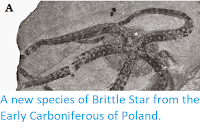
A new species of Brittle Star from the Early Carboniferous of Poland.

Brittle Stars, Ophiuroidea, are five-limbed Echinoderms related to Starfish and having a similar body-plan. However while the five limbs of the Starfish are rigid extensions of the central disk, and movement is achieved by means of tube-feet on the underside of the animal, the limbs of Brittle Stars are fully articulated and used for locomotion. The fossil record of Brittle Stars goes back to at least the Early Ordovician, though these Palaeozoic Brittle Stars have not been extensively studied.

In a forthcoming paper in the journal Acta Palaeontologica Polonica available online from 26 November 2014, Ben Thuy of the Department of Palaeontology at the Natural History Museum of Luxembourg, Manfred Kutscher of Sassnitz in Germant and Bartosz Płachno of the Department of Plant Cytology and Embryology at Jagiellonian University describe a new species of Brittle Star from the Early Carboniferous Mazurowe Doły Formation at Czatkowice Quarry on the Dębnik Massif in southern Poland.

The new species is placed in the genus Aganaster and given the specific name jagiellonicus, in honour of Jagiellonian University, which is the oldest in Poland and one of the oldest in Europe, and of the Jagiellonian Dynasty of Polish Kings. The species is described from a single specimen preserved on a slab of limestone, with a central disk 9 mm in diameter, and all five arms preserved, though most have their tips missing the longest arm being 45 mm in length.

Aganaster jagiellonicus from the upper Tournaisian to lower Visean (Lower Carboniferous) Mazurowe Doły Formation, Rudawa Group of Czatkowice Quarry, Dębnik Massif, southern Poland. General view of the specimen,exposing the ventral side. Thuy et al. (2014).

The genus Aganaster is previously known from the Carboniferous of North America and the Permian of China. It is thought to be closely related to the genus Archaeophiomusium, which is known from the Permian of North and South America. A review of Palaeozoic Brittle Stars in 2004 suggested that these two genera should be placed in the modern group Ophiolepididae, though this group has since been shown to be polyphyletic (i.e. not all its members were more closely related to one-another than they were to anything else). However Thuyet al. contend that a fresh review of the group would still place them within a modern family, and that therefore the diversification of Brittle Stars into modern groups must have happened before the Carboniferous.

See also…

Brittle Stars (Ophiuroidea) are five-limbed Echinoderms superficially resembling Starfish (Asteroidea). Like Starfish they posses (usually) five limbs arranged around a central disk which houses the mouth and anus, but the limbs of Brittle Stars are clearly...


Follow Sciency Thoughts on Facebook.

Thursday, 26 June 2014

A new species of Brittle Star from the coast of northern Peru.

Brittle Stars (Ophiuroidea) are five-limbed Echinoderms superficially resembling Starfish (Asteroidea). Like Starfish they posses (usually) five limbs arranged around a central disk which houses the mouth and anus, but the limbs of Brittle Stars are clearly differentiated from the central disk and are articulated and used in movement, while those of a Starfish are nearly immobile, effectively forming rigid extensions of the central disk, and movement is achieved using tube feet on the underside of the animal.

In a paper published in the journal ZooKeys on 2 December 2013, Tania Pineda-Enríquez and Francisco Solís-Marín of the Laboratorio de Sistemática y Ecología de Equinodermos at the Instituto de Ciencias del Mar y Limnología at the Universidad Nacional Autónoma de México, Yuri Hooker of the Laboratorio de Biología Marina at the Universidad Peruana Caytano Heredia and Alfredo Laguarda-Figueras, also of the Laboratorio de Sistemática y Ecología de Equinodermos, describe a new species of Brittle Star from the coast of northern Peru.

The new species is placed in the genus Ophioderma and given the specific name peruana, meaning ‘from Peru’. It has a central disk reaching 42 mm in diameter on the largest specimens, and arms exceeding 120 mm in length. The central disk is covered in granular scales. The arms have larger scales, however these scales fragment into smaller, irregular portions, the underside of the arms are covered in conical, flattened, blunt-tipped spines.

Ophioderma peruana in life. Pineda-Enríquez et al. (2013).

Ophioderma peruana was found in the intertidal zone on Lobos de Afuera Island in Lambayeque, at a depth of 9 m off Quebrada Verde in El Ñuro and at a depth of 14 m on Hooker Reef off Punta Sal. 

Ophioderma peruana (C) aboral disc and basal portion of the arms (D) oral disc and basal portion of the arms (E) jaws (F) oral portion of the disc and pair of genital slits. Pineda-Enríquez et al. (2013).

Ophioderma peruana (A) basal portion of the arms with fragmented dorsal arm plates (B) dorsal arm plates fragmented in several pieces (C) ventral arm plates and tentacle scales (D) lateral view of the arm spines. Pineda-Enríquez et al. (2013).

See also…


Starfish (Asteroidea) are benthic marine Echinoderms found across the globe. They have a simple bodyplan, with a central disk that has the mouth on the underside, surrounded by (usually) five arms, each with a double row of tube feet underneath. The upper surface of the Starfish is covered by an articulated armoured exoskeleton made up of thousands of...


Sea Cucumbers (Holothuroidea) are a class of Echinoderms that have become elongated and worm-like, effectively becoming secondarily bilaterally symmetrical. Like all Echinoderms they have a calcareous exoskeleton, but this is greatly reduced, typically only occurring as ossicles within the epidermis. The muscle structure of Sea Cucumbers is instead supported by a layer of modified collegen that can be stiffened...


Crinoids are stalked Echinoderms, related to Starfish and Sea Urchins, but with a very different morphology. They are attached to by either by a stalk with a holdfast cemented to some hard substrate, of by a flexible stalk able to wrap itself around some object, typically a Coral or a Sponge. Above this grows an animal with a cup-like central body known as the calyx, surrounded by five branching arms, covered in long, flexible, tube feet which catch plankton and marine detritus and pass them to the mouth...


Follow Sciency Thoughts on Facebook.

Saturday, 23 June 2012

A Brittle Star from the Late Jurassic of Southern Germany.

Brittle Stars (Ophiuroids) are Echinoderms superficially resembling Starfish, with five arms arranged radially around a central hub that contains the mouth and other organs, but structurally somewhat different. The arms of Starfish are essentially rigid, with the animal relying on tube feet on its underside to move it about. In Brittle Stars the arms are articulated and used for locomotion, the tube feet are still present, but used primarily for food gathering. The group have a long fossil record, first appearing in the Early Ordovician about 500 million years ago,  but they are seldom abundant in the fossil record, probably because their remains are easily disarticulated (brittle) and therefore do not enter the fossil record in large numbers. Most modern Brittle Stars are deepwater dwellers, but in the past shallow water forms appear to have been more common.

In a forthcoming paper in the journal Acta Palaeontologica Polonica, Ben Thuy of the Department of Geobiology at the Geoscience Institute at the University of Göttingen and Hartmut Schulz of the Paleobiology Work Group at the Department of Geosciences at the University of Tübingen redescribe a Brittle Star from the Late Jurassic of Steinenfeld in southern Germany, first described by the nineteenth century German Palaeontologist Friedrich August von Quenstedt in 1876.

Quenstedt originally described the Brittle Star under the name Ophiurites crinitus, however the genus name Ophiurites is now considered invalid, so Thuy and Schulz place it in the new genus Ophiosternle, from 'stern' the Swabian (southern German) for 'star'. It shows close affinities to a number of modern, deepwater Brittle Stars, but the deposits in which it was discovered are interpreted as having originated on a shallow, storm disturbed, coral reef, suggesting that the move into deepwater has happened since the Jurassic. There are a number of other known Brittle Star fossils from the Late Jurassic of southern Germany and France, most of which are from fine-grained mudstones (i.e. low energy environments). Brittle Stars may have been an abundant part of the fauna of Jurassic reefs, but their poor preservational potential in this environment would hide this from us.

Ophiosternle crinitus, complete specimen in dorsal view. Scale bar is 5 mm. Thuy & Schulz (2012).


Follow Sciency Thoughts on Facebook.