Showing posts with label Orange County. Show all posts

Monday, 2 October 2017

Sewage spill closes beaches in Orange County, California.

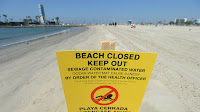
Several beaches in the area around Sunset Aquatic Marina and Portofino Cove in Huntington Beach, Orange County, California have been closed off following a sewage spill caused by a blockage in Anaheim, on Friday 29 September 2017. Around 13 600 lites of sewage were released. The beaches will remain closed to swimmers and divers until water quality tests confirm that quality has returned to an acceptable level.

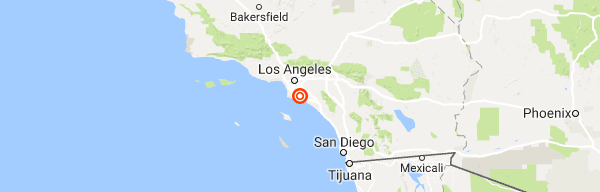
The approximate location of the 29 September 2017 Orange County sewage spill. Google Maps.

As well as the obvious dangers to health presented by sewage, which is likely to contain a variety of Bacteria and other micro-organisms harmful to Human health, sewage provides a source of nutrients which can lead to eutrophication and the rapid growth of blooms of Algae, Bacteria or other micro-organisms, which absorb oxygen from the water leading Fish and other aquatic organisms to asphyxiate.

See also...

http://sciencythoughts.blogspot.co.uk/2017/09/british-tourist-killed-by-rockfall-on.htmlhttp://sciencythoughts.blogspot.co.uk/2017/09/state-of-emergency-declared-in-san.html
http://sciencythoughts.blogspot.co.uk/2017/07/magnitude-51-earthquake-off-coast-of.htmlhttp://sciencythoughts.blogspot.co.uk/2017/04/evacuations-following-landslide-in.html
http://sciencythoughts.blogspot.co.uk/2017/02/sinkhole-swallows-two-cars-in-studio.htmlhttp://sciencythoughts.blogspot.co.uk/2017/02/damage-to-lake-oroville-dam-leads-to.html
Follow Sciency Thoughts on Facebook.


Saturday, 8 October 2016

Magnitude 2.9 Earthquake in Orange County, California.

The United States Geological Survey recorded a Magnitude 2.9 Earthquake at a depth of about 14.5 km about 3 km to the northwest of Seal Beach in Orange County, California,slightly before 1.55 pm local time (slightly before 8.55 pm GMT) on Thursday 6 October 2016. There are no reports of any damage or injuries relating to this quake, but people have reported feeling it across much of northern California.

The approximate location of the 6 October 2016 Orange County Earthquake. Google.

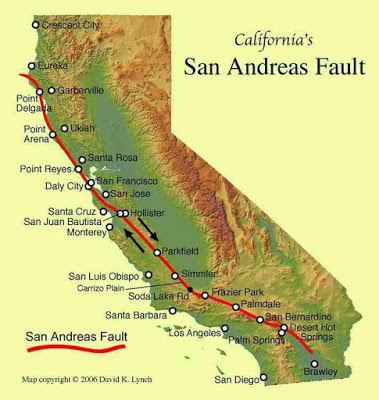
California is extremely prone to Earthquakes due to the presence of the San Andreas Fault, a tectonic plate margin that effectively bisects the state. The west of California, including Santa Barbara and Los Angeles, is located on the Pacific Plate, and is moving to the northwest. The east of California, including Fresno and Bakersfield is on the North American Plate, and is moving to the southeast. The plates do not move smoothly past one-another, but constantly stick together then break apart as the pressure builds up. This has led to a network of smaller faults that criss-cross the state, so that Earthquakes can effectively occur anywhere.

 The extent of and movement on the San Andreas Fault. Geology.

Witness accounts of Earthquakes can help geologists to understand these events and the underlying structures that cause them. If you felt this quake (or if you were in the area but did not, which is also useful information) then you can report it to the United States Geological Survey here.

See also...

http://sciencythoughts.blogspot.co.uk/2016/07/sewage-spill-closes-long-beech.htmlSewage spill closes waterfront at Long Beech, California.                                       Parts of the harbour in Long Beech, Los Angeles, had to be closed off after a collapsed pipeline leaked about nine million liters of sewage into the Los Angeles...
http://sciencythoughts.blogspot.co.uk/2015/11/magnitude-35-qrthquake-beneath-northern.htmlMagnitude 3.5 £qrthquake beneath northern Los Angeles.                                      The United States Geological Survey recorded a Magnitude 3.5 Earthquake at a depth of about 3 km beneath the Pacoima district of Los...
http://sciencythoughts.blogspot.co.uk/2015/10/flash-flooding-brings-chaos-to-south.htmlFlash flooding brings chaos to South California.                                                    Many areas of southern California are recovering after a series of thunderstorms caused flash flooding across parts of Los Angeles, San Luis Obispo, Santa...
Follow Sciency Thoughts on Facebook.

Tuesday, 29 April 2014

An enigmatic Walrus from the Miocene of California.

Walruses (Odobenidae) are large Seals (Pinnipedia) related to Sea Lions and Fur Seals (Otariidae). The group first appears in the fossil record about 16 million years ago towards the end of the Early Miocene. The modern Walrus (Odobenus rosmarus) is one of the largest living Seals, and is a specialized shellfish eater, with well-developed tusks used to root out Clams, a thick moustache used to probe muddy sediments and a highly developed feeding system capable of sucking large Clams from their shells. Fossil Walruses, of which numerous species have been documented from the North Pacific region, apparently pursued a more diverse range of diets, with suction-feeding, specialist Fish eaters and generalist species all recorded.

Pelagiarctos thomasi is a large fossil Walrus described from partial remains from the Middle Miocene Sharktooth Hill Bonebed of Kern County, California in 1988. This has been identified as a large predatory Walrus, possibly a top-predator specializing in hunting other Marine Mammals, though it was initially described only from a partial lower jaw with most of the teeth missing.

In a paper published in the journal PLoS One on 16 January 2013, Robert Boessenecker of the Department of Geology at the University of Otago and the University of California Museum of Paleontology and Morgan Churchill of the Department of Geology and Geophysics and the Program in Ecology at the University of Wyoming, describe a second specimen of Pelagiarctos from the Middle Miocene ‘Topanga’ Formation of Orange County, California. The new specimen differs enough from the original that it is not placed within the species Pelagiarctos thomasi, but since modern Walruses are known to be somewhat morphologically variable, Boessenecker & Churchill refine from erecting a new species to describe it, instead referring to it as Pelagiarctos sp.

Mandibles of Pelagiarctos. Comparison of (A) Pelagiarctos sp. in dorsal aspect, and Pelagiarctos thomasi in (B) dorsal and (C) lateral aspect. Boessenecker & Churchill (2013).

The new specimen comprises the partial lower jaw of an animal similar to the first specimen, but this time with most of the teeth intact. Based upon comparison of these teeth to those of other large marine and predatory Mammals, Boessenecker & Churchill reject the idea that Pelagiarctos was a specialized predator hunting other large Marine Mammals. It was certainly a large animal, probably comparable to a Sea Lion in size, but its teeth were not exceptionally large and do not appear specialized for a subduing large prey, as its jaw structure, with robust strongly fused mandibles, while clearly strong, does not appear well suited to subduing large struggling prey or cracking the bones such animals, tasks which require a degree of flexibility apparently absent in the jaw of Pelagiarctos. Instead Boessenecker & Churchill suggest that Pelagiarctos was probably a more generalist feeder, which would have consumed the meat of large prey should this be available, but which principally ate fish or even foraged for shellfish.

See also…


Follow Sciency Thoughts on Facebook.

Saturday, 21 December 2013

A new species of Desmostylian Mammal from the Late Miocene of Orange County, California.

Desmostylians were an order of large, quadruped marine Mammals known from the Oligocene and Miocene margins of the northern Pacific Ocean. They were related to Elephants and Sea Cows, and were thought to have led a lifestyle similar to that of Hippopotamuses, though in marine rather than fresh water. The order is divided into two families, the Paleoparadoxiidae with larger heads and feet and low crowned rounded molars, and the Desmostylidae with smaller heads and feet and higher, more pointed molars.

In a paper published in the journal Contributions in Science on 11 September 2013, Lawrence Barnes of the Department of Vertebrate Paleontology at the Natural History Museum of Los Angeles County, describes a new species of Paleoparadoxiid Desmostylian from the Late Miocene of Orange County California.

The new species is named Neoparadoxia cecilialina, where 'Neoparadoxia' means 'New Paradoxia' (there are also genera named Archaeoparadoxia, Old Paradoxia, and Paleoparadoxia, Ancient Paradoxia; the groups being named after this latter genus), and 'cecilialina' honours Cecilia Perlstein and Alina Perlstein, the daughters of Ron and Judy Perlstein, long term supporters of the Natural History Museum of Los Angeles County. 

The species is described from an almost complete skeleton (only the second such ever found of a Desmostylian in North America), though this was only partially articulated at the time of discovery, and showed signs damage to some bones by scavenging animals (probably Sharks, a number of Shark teeth being found with the remains), and was, in addition, partially damaged at the time of its discovery, which was inadvertent, and came during the excavation a site at Laguna Niguel for construction purposes. The specimen is thought to be a subadult, and to have been about 2.44 m long when alive.

The specimen was found within the upper part of the Monterey Shale, and is thought to be early Late Miocene in age, making it 10-11 million years old. This makes it the youngest known Desmostylian.

Neoparadoxia cecilialina as mounted on display in the Age of Mammals Hall at the Natural History Museum of Los Angeles County. Barnes (2013).

Digital image of Neoparadoxia cecilialina as mounted, but with the background removed. Barnes (2013).

Reconstructive line drawing of the skeleton of Neoparadoxia cecilialina as mounted. Barnes (2013).

Reconstructive line drawing of the skeleton of Neoparadoxia cecilialina as mounted, with estimated body outline added. Barnes (2013).

Reconstructive drawing of Neoparadoxia cecilialina in life. Doyle Trankina in Barnes (2013).


Follow Sciency Thoughts on Facebook.

Sunday, 6 October 2013

Magnitude 3.0 Earthquake in Orange County, California.

The United States Geological Survey recoded a Magnitude 3.0 Earthquake at a depth of 6.7 km in Orange County, California, roughly 40 km east of Los Angeles, at about 1.55 pm local time (about 8.55 am GMT) on Friday 4 October 2013. There are no reports of any damage or injuries arising from this quake, though it was felt as far away as Palmdale, 100 km to the northwest.

The approximate location of the 4 October 2013 Orange County Earthquake. Google Maps.

California is extremely prone to Earthquakes due to the presence of the San Andreas Fault, a tectonic plate margin that effectively bisects the state. The west of California, including Santa Barbara and Los Angeles, is located on the Pacific Plate, and is moving to the northwest. The east of California, including Fresno and Bakersfield is on the North American Plate, and is moving to the southeast. The plates do not move smoothly past one-another, but constantly stick together then break apart as the pressure builds up. This has led to a network of smaller faults that criss-cross the state, so that Earthquakes can effectively occur anywhere.

Witness accounts of Earthquakes can help geologists to understand these events and the underlying structures that cause them. If you felt this quake (or if you were in the area but did not, which is also useful information) then you can report it to the United States Geological Survey here.


Follow Sciency Thoughts on Facebook.