Showing posts with label New Caledonia. Show all posts

Monday, 1 January 2024

Assessing the impact of predation on birth size in marine Snakes.

Moving from one environment to another exposes organisms to new selective pressures on life histories, and where multiple organisms from related lineages make the same transition, it presents an opportunity for biologists to analyse these pressures. For example, Squamates (Snakes and Lizards) which migrate from warm environments to cooler ones frequently switch from egg-laying to bearing live young, while Birds making the same transition tend to produce smaller clutches of eggs.

Birth size is considered to be a fundamental life-history trait, subject to a number of evolutionary pressures. Where intraspecific competition is low, smaller birth sizes are often a result, as offspring survival is not dependent on size at birth. Conversely, larger birth size can be driven by a number of factors, for example a lack of small prey can drive up birth size in species where the young must hunt for themselves, as only larger neonates are able to capture enough prey to survive. 

The shift from a terrestrial habitat to a marine one presents organisms with a variety of different challenges, including thermal regimes, oxygen availability, light levels, ocean currents, types of predators, prey, competitors and pathogens. Nevertheless, the marine environment clearly presents opportunities for terrestrial Tetrapods, with numerous lineages of Mammals, Reptiles, and even Birds having made the transition. Elapid (Front-fanged) Snakes have made this transition at least three times, with the Sea Kraits, Laticaudinae, having split from terrestrial relatives in Asia about 16 million years ago, while at least two lineages within the Australian subfamily Hydrophiinae (together referred to as Sea Snakes) switched to a marine habit more recently. The three lineages show convergent evolution for a number of traits, including the development of laterally compressed bodies with paddle-like tails, the appearance of salt-excreting glands, and common life-history traits. A fourth group of (non-Elapid) Snakes, the Acrochordidae, are semi-aquatic, and often semi-marine in habit, and show some of these traits.

Marine Snakes typically produce fewer young than terrestrial Snakes, which has been linked to a need for gravid females to retain a hydrodynamic shape. Nevertheless, the offspring are typically larger at birth than those of their terrestrial relatives, which would seem to work against this.

In a paper published in the journal Royal Society Open Science on 13 December 2023, Richard Shine of the School of Natural Sciences at Macquarie UniversityShai Meiri of the School of Zoology and Steinhardt Museum of Natural History at Tel-Aviv University, Terri Shine and Gregory Brown, also of the School of Natural Sciences at Macquarie University, and Claire Goiran of LabEx Corail and  Institut de sciences exactes et appliquées at the Université de la Nouvelle-Calédonie, examine the possibility that size-selective predation on young Snakes could be the driver of increased neonatal size in Marine Snakes.

Smaller terrestrial Snakes are known to be vulnerable to a wider range of predators than larger Snakes, with many predators targeting smaller Snakes while actively avoiding larger ones. However, predation rates on smaller Snakes can be lower than on larger individuals, due to the ability of small Snakes to remain inactive in well-hidden retreats.

Marine Snakes are less able to do this, as they must ascend to the surface to breath. This means that Snakes must leave their protective shelters and cross open water, where they are vulnerable to predation, several times per day. Predation of Snakes by large Fish during these crossings is well-documented, supporting the hypothesis that this is a risky endeavour for marine Snakes.

In order to test the hypothesis, Shine et al. first examined records of birth sizes in both marine and terrestrial Snakes, to confirm that the perceived trend was in fact real, then carried out experimental trials with model Snakes of different sizes to see if smaller Snakes were in fact more vulnerable to predation.

Shine et al. obtained data on hatchling and neonate sizes (Snakes can lay eggs or bear live young, but this does not appear to affect infant size much) and snout-vent lengths of adult females of 166 species of terrestrial, semi-aquatic, and marine Snakes, from published literature and the collection of the Steinhardt Museum. Semi-aquatic Snakes were found to produce slightly smaller offspring than terrestrial Snakes on average. However, the sample size for these Snakes was very small, and the subject was not investigated further. The adult snout-vent length for female Snakes in the study averaged at 800 mm, with the offspring of terrestrial Snakes having an average length of 200 mm, and the average length of new-born marine Snakes being 300 mm. 

Based upon this, Shine et al. hypothesised that a 200 mm Snake would be at significantly higher risk of predation in a typical marine Snake environment than a 300 mm Snake. To test this, an experiment was devised in which commercially available fibreglass fishing lures designed to resemble Snakes had their hooks removed and additional weights added to ensure they retained negative buoyancy, and were painted black to resemble the most common colour morph of the locally abundant Turtlehead Sea Snake, Emydocephalus  annulatus. These were then dragged by a snorkeler, Claire Goiran, over Coral reefs off the island of Ile aux Canards in New Caledonia, while a second snorkeler, Richard Shine, followed and recorded the reaction of large predatory Fish to the lures. 

A Camouflage Grouper, Epinephelus polyphekadion, following a black Snake-shaped lure, immediately prior to launching an attack. Teri Shine in Shine et al. (2023).

During 47 trials, Shine et al. recorded 114 responses. These included 38 attacks, and 76 encounters in which Fish followed the lure but did not attack. The size of the lure did not appear to influence whether or not Fish followed it, but they were significantly more likely to attack the smaller lures. Similarly, larger Fish were more likely to attack the lures, while smaller Fish tended to break off following without attacking. Thus, the majority of attacks were by large Fish on small lures.

Multiple lineages of Snakes which have invaded marine habitats have had an increase in neonatal size, combined with a reduced brood size (which are probably connected). Shine et al.'s study suggests that increased predation on smaller Snakes is a plausible explanation for this (although they stress that the results of their study cannot be taken as an absolute proof).

Shine et al. also note that larger Snakes are more likely to survive attacks by Fish, noting that two incidents of Snakes being seized by Fish and then released because the Fish was unable to overpower the Snake have been recorded on reefs close to their study area. In one of these incidents a Chocolate Grouper, Cephalopholis  boenak, unsuccessfully attacked a Turtlehead Sea Snake, Emydocephalus  annulatus, and in the other a Reef Stonefish, Synanceia verrucosa, was forced to break off an attack on a Blue Lipped Sea Krait, Laticauda  laticaudata, suggesting that larger size may present an advantage to young Snakes in surviving attacks, even if Fish do not discriminate against larger Snakes when choosing whether to attack.

Reef Stonefish, Synanceia verrucosa, making an unsuccessful attack on a Blue Lipped Sea Krait, Laticauda  laticaudata, off the coast of Ile aux Canards in October 2022. Richard Fish/iNaturalist.

Predation is often cited as a likely cause of evolutionary pressure, influencing traits such as size and colouration. However, direct evidence of such impacts is difficult to gather accurate information on this unless predation rates are extremely high. Furthermore, it is difficult to design experiments looking at predatory behaviour for larger Animals without running into ethical and logistical constraints.

Predation is not the only driver of larger size in young marine Snakes which has been made, but it does seem to be the best supported by the available evidence. 

It has been suggested that larger size may provide an advantage when swimming, with smaller Snakes potentially being less efficient swimmers, using more energy to go slower. However, research into Sea Kraits has shown that smaller individuals have a higher swimming speed relative to crawling speed than larger individuals, suggesting that in these marine Snakes smaller size produces an advantage when swimming. 

Another possibility is that larger size in neonatal marine Snakes might be driven by prey size, with a shortage of suitable prey capturable by smaller Snakes creating a need for infant Snakes to be as large as possible. However, many Sea Snakes feed on smaller prey, notably members of the genus Emydocephalus are specialist feeders on Fish eggs, and several members of the genus Hydrophis have miniaturized heads and slender forebodies that enable them to penetrate the burrows of the small Fish upon which they prey.

Another possibility is that intraspecific competition drives larger size in young marine Snakes, with larger individuals excluding smaller individuals from better territories or access to prey. However, aggressive behaviour between members of the same species has never been observed in marine Snakes, making this unlikely.

Finally, larger size can act as a buffer against temperature changes, with larger bodies taking longer to either warm up or cool down that smaller bodies, thereby giving the Snakes more time to react to changes in conditions. However, marine environments offer much more protection against such temperature fluctuations than terrestrial ones, due to the high conductivity of water, making this highly unlikely as a driver of size in marine Snakes.

See also...

Follow Sciency Thoughts on Facebook.

Follow Sciency Thoughts on Twitter.


Sunday, 29 March 2015

A new species of Capillariid Nematode from New Caledonia.


Capillariid Nematodes are parasitic worms infecting a variety of different Vertebrate hosts. The group is split into 22 genera, of which nine are parasites of Fish. Members of the genus Capillaria cause infections in a wide range of Mammals, Birds, Amphibians, Fish and Sharks, though those infecting marine Fish are poorly known.

In a paper published in the journal Parasite on 23 December 2014, František Moravec of the Institute of Parasitology at the Biology Centre of the Academy of Sciences of the Czech Republic and Jean-Lou Justine of the Institut Systématique, Évolution, Biodiversité at the Muséum National d’Histoire Naturelle describe a new species of Capillaria from a Leopard Coral Grouper, Plectropomus leopardus, caught off Baie de Koutio, on Nouméa Island, New Caledonia.

The new species is named Capillaria plectropomi, in reference to the host species. Nineteen specimens of both sexes were collected from the intestine of a single Fish; 23 other Leopard Coral Grouper’s inspected yielded no further specimens. The males ranged from 7.52-10.00 mm in length, the females from 9.57–14.24 mm. The cuticle of the Worms were finely striated. The distribution of the species is unknown, but the host is found in the Western Pacific from southern Japan to Australia and eastwards to the Caroline Islands, Fiji and Tonga.

Capillaria plectropomi from Plectropomus leopardus. (A) Anterior end of male, lateral view. (B) Stichocyte in middle part of stichosome. (C) posterior end of male, lateral view. Moravec & Justine (2015).

See also…

Pinworms, Oxyuridae, are parasitic Nematodes infecting the digestive tracts of Mammals. They have short life cycles, typically undergoing several generations in a year, with eggs being released in the host’s faecal matter to infect new hosts. Some species of Pinworm appear to be quite cosmopolitan, infecting...


Parasitic Nematodes of the superfamily Heterakoidea are typified by having three lips, an esophagus with a valved bulb, thick shelled eggs and a pre-anal sucker on the males. They are typically parasites of the digestive tracts of small vertebrates, which do not require an intermediate host (i.e. the species only needs to infect one species of hosts, rather than...

Parasite infections in German soldiers from the Kilianstollen First World War archaeological site.
The science of palaeoparasitology involves the study of parasite remains from palaeontological and archaeological sites. This rarely involves the recovery...


Follow Sciency Thoughts on Facebook.

Tuesday, 14 January 2014

A new species of Skink from southern New Caledonia.

Skinks are smallish lizards with elongate bodies and reduced legs and necks. They are an ancient and successful group, found throughout the tropical, subtropical and warm temperate regions of the world, though individual species (of which there are over 12 000) may be threatened. Skinks can either lay eggs or bear live young (depending on species) and can be divided into tree-dwelling and ground-dwelling species, though this is an ecological rather than a taxonomic distinction; ground-dwelling species tend to have much more reduced limbs than tree-dwelling species, often being quite snake-like. Most skinks are insectivorous, but some will eat vegetable matter, or small rodents.

In a paper published in the journal Zootaxa on 8 August 2013, a team of scientists led by Ross Sadler of the Section of Herpetology at the Australian Museum in Sydney describe a new species of Skink from the southern Highlands of New Caledonia.

The new species is placed in the genus Caledoniscincus, which is native to New Caledonia and already contains 13 species, and given the specific name notialis, meaning 'southern'. Caledoniscincus notialis is a cryptic species (one that cannot be distinguished on morphological traits alone, but which has been shown to be distinct genetically) discovered as a result of a genetic study into the systematics of the genus. It closely resembles the widespread Caledoniscincus atropunctatus, and the populations referred to the new species were formerly classified as belonging to this species. The adult males, on close inspection, have pale marking on their dorsal scales not seen in Caledoniscincus atropunctatus, but the juveniles and females could only be differentiated by genetic analysis.

Caledoniscincus notialis. Top and bottom, males, center, female. Sadler et al. (2013).

Caledoniscincus notialis is only known from scattered locations on the Goro Plateau and Grand Terre in far southern New Caledonia. It lives in humid forests and tall maquis (shrubland) on ultramafic soils (soils derived from low silica volcanic rocks, which tend to be low in calcium and phosphorus but high in metal content). Due to its limited range and subsequent low population, Sadler et al. recommend that Caledoniscincus notialis be classified as Vulnerable on the ICUN's Red List of Threatened Species.

Humid forest (a) and maquis preforest (b) on ultramafic surfaces of the Goro Plateau, typical habitat for Caledoniscincus notialisSadler et al. (2013).


Follow Sciency Thoughts on Facebook.

Saturday, 16 June 2012

Thirteen new species of interstitial Gastropods from New Zealand.

Interstitial organisms are organisms that live between the grains in sediments. Such organisms include bacteria, protists, algae, fungi and small animals. Whilst interstitial ecosystems are not as spectacular as the rain-forests or coral reefs, they are vast, covering not just the soils of the continents, but the sediments that cover the floors of the oceans. This vast space supports an equally vast number of tiny organisms, including several phyla of animals with no known relatives in other environments. Molluscs are an important part of interstitial marine environments, and Gastropods from marine sediments are now thought by some scientists to be the most diverse and abundant group of animals on Earth with many more species than there are of Insects, and possibly a greater total biomass.

In a paper published in the journal Zootaxa on 13 June 2012, Daniel Geiger of the Invertebrate Zoology Department at the Santa Barbara Museum of Natural History and Bruce Marshall of the Museum of New Zealand Te Papa Tongarewa describe 13 new species of Gastropod from the waters around New Zealand.

Scissurella regalis. From the Three King Rise, a submarine extension of the Auckland Peninsula. Scale bar is 1 mm. Geiger & Marshall (2012).

Sinezona enigmatica. From Whangarei Harbour. Inset is the protoconch, the earliest growth stage in a Gastropod shell, since marine Gastropods often have a planktonic larval stage this can be quite different from the rest of the shell, making it useful taxonomically. Scale bar is 1 mm. Inset scale bar is 100 μm. Geiger & Marshall (2012).

Sinezona mechanica. From Ocean Bay on Chatham Island. Scale bar is 1 mm. Geiger & Marshall (2012).

The radula (tongue) of Sinezona mechanica. The radulae of Gastropods are covered in chitinous teeth, which are used to scrape up food. The pattern of these teeth is unique to each species, making this an important feature taxonomically. (A) Entire radula. Scale bar = 100 μm. (B) Full width of radula. Scale bar = 20 μm. (C) Central field enlarged. Scale bar = 10 μm. (D) Lateral tooth 4 (arrow). Scale bar = 10 μm. (E) Marginal teeth. Scale bar = 10 μm. Geiger & Marshall (2012).

Sinezona platyspira. From West Norfolk Ridge, West of Cape Reinga. Scale bar is 1 mm. Geiger & Marshall (2012).

Sinezona wanganellica. From Wanganella Bank on the West Norfolk Ridge, about 900 km to the northwest of Auckland. Protoconch inset. Scale bar is 0.5 mm. Inset scale bar is 100 μm. Geiger & Marshall (2012).

Satondella azonataFrom Wanganella Bank on the West Norfolk Ridge, about 900 km to the northwest of Auckland. Protoconch inset. Scale bar is 0.5 mm. Inset scale bar is 100 μm. Geiger & Marshall (2012).

Satondella bicristata. From a seamount 130 km south of L'Esperance Rock in the Kermadoc Islands. Scale bar is 0.5 mm. Geiger & Marshall (2012).

Anatoma amydra. From north of New Caledonia. Protoconch inset. Scale bar is 1 mm. Inset scale bar is 100 μm. Geiger & Marshall (2012).

Anatoma amydra. (A) Full width of radula with central field. Scale bar = 10 μm. (B) Marginal teeth. Scale bar = 10 μm. (C) Jaw. Scale bar = 100 μm. (D) Operculum (the closable covering for the entrance hole on some Gastropods). Scale bar = 1 mm. Geiger & Marshall (2012).

Antoma kopua. From off the coast of Sydney. Scale bar = 1 mm. Geiger & Marshall (2012).

Anatoma megascutula. From east of Rapa in French Polynesia. Protoconch inset. Scale bar is 1 mm. Inset scale bar is 100 μm. Geiger & Marshall (2012).

Anatoma tangaroa. From northwest of the Three Kings Islands. Protoconch inset. Scale bar is 1 mm. Inset scale bar is 100 μm. Geiger & Marshall (2012).

Larochea spirata. From the West Norfolk Ridge, west of Cape Reinga. Scale bars shell A–B = 1 mm. Scale bars shell C = 0.5 mm. Geiger & Marshall (2012).

Larocheopsis macrostoma. From a seamount 130 km south of L'Esperance Rock in the Kermadoc Islands. Protoconch inset. Scale bar is 1 mm. Inset scale bar is 100 μm. Geiger & Marshall (2012).

See also A new species of Scallop from Western Australia and The Snail that eats Crabs.

Follow Sciency Thoughts on Facebook.

Saturday, 26 May 2012

Earthquake in the Loyalty Islands.

On Saturday 26 May 2012, slightly after 11.50 am local time (slightly after 0.50 GMT) the United States Geological Survey recorded an Earthquake in the Loyalty Islands (part of the French territory of New Caledonia) roughly 102 km northeast of Máre Island, at a depth of 10.1 km and measuring 5.1 on the Richter Scale. This far from any inhabited area the quake is unlikely to have caused any damage or injuries, and may not have been noticed by anyone.

The location of the 26 May 2012 Earthquake. USGS.

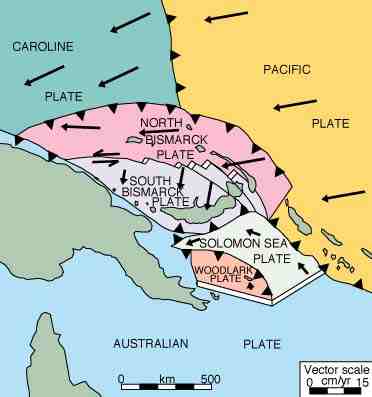
New Caledonia is located on the North Bismarck Plate, one of a series of microplates caught between the Australian and Pacific Plates. To the north of the islands the Pacific Plate is being subducted beneath the North Bismark Plate, causing friction that can cause Earthquakes. As it sinks further into the planet the friction and the heat of the Earth's interior combine to melt the plate, some of the melted material rising through the overlying North Bismarck Plate to feed the volcanoes of the Loyalty Islands.

The location and movement of the North Bismarck and surrounding Plates. Oregon State University.


Follow Sciency Thoughts on Facebook.

Monday, 12 March 2012

New species of Skink from northwest New Caledonia.

Skinks are smallish lizards with elongate bodies and reduced legs and necks. They are an ancient and successful group, found throughout the tropical, subtropical and warm temperate regions of the world, though individual species (of which there are over 12 000) may be threatened. Skinks can either lay eggs or bear live young (depending on species) and can be divided into tree-dwelling and ground-dwelling species, though this is an ecological rather than a taxonomic distinction; ground-dwelling species tend to have much more reduced limbs than tree-dwelling species, often being quite snake-like. Most skinks are insectivorous, but some will eat vegetable matter, or small rodents.

On 9 March 2012, in a paper in the journal Zootaxa, a team of biologists led by Ross Sadlier of the Section of Herpetology at the Australian Museum, describe the discovery of a new species of skink from the woodlands of northwest New Caladonia.

The species is described as Caledoniscincus constellatus, the Star-studded Caledonian Skink. It is a brown skink with a yellow underside and a white lateral stripe (stripe along its side), the adults of which are 46-57 mm in length. It is a tree-dwelling species found in Acacia Scrub and Mediterranean Woodland. Reproductive and feeding behavior were not recorded.

Male Star-studded Caledonian Skink, Caledoniscincus constellatus. From Sadlier et al. (2012).

There are two other species of Caladonian Skink with white lateral stripes, both of which share at least part of their range with C. constellatus. C. haplorhinus and C. austrocaledonicus. In C. constellatus the lateral stripe is broad and solid when it reaches the ear opening, but in C. haplorhinus, it is narrow and starting to break up. C. austrocaledonicus does not always have a lateral stripe, and where it does this does not reach the ear. Genetic studies have confirmed these are three separate species.

The heads of (A) C. constellatus, (B) C. haplorhinus, and (C) C. austrocaledonicus, showing the position of the lateral stripe at the head. From Sadlier et al. (2012).

C. constellatus is known only from two sites in the northwest of New Caledonia. These are threatened by deforestation by expanding agriculture and ranching, which fragments the landscape and makes it vulnerable to forrest fires, habitat loss due to nickel mining at the Koniambo Mine, and the harmful effects of the invasive Little Red Fire Ant (Wasmannia auropunctata). If these turn out to be the only places where it lives, then C. constellatus would meet the criteria for inclusion in the Critically Endangered category on the IUCN Red List.

Map of northern New Caledonia, showing the two locations where C. constellatus was found. From Sadlier et al. (2012).

The localities where C. constellatuswas found. (A) Acacia scrubland at Pointe de Vavouto. (B) Mediterranean Forrest on Massif Ouazangou. From Sadlier et al. (2012).

Saturday, 3 March 2012

Earthquake shakes New Caledonia.

On Saturday 3 March 2012 at about 23.20 local time (12.20 GMT) the French Overseas Territory of New Caledonia was hit by an Earthquake roughly 175 km southeast of the Loyalty Islands. The quake was measured as 6.6 on the Richer Scale at a depth of 15.2 km by the United States Geological Survey and 6.7 on the Richter Scale at a depth of 46 km by Geoscience Australia. No tsunami warning has been issued and it is unlikely that there will be any serious damage or casualties, but the quake was probably felt from some of the neighboring islands.

Map showing the location of the quake, and the areas where it might have been felt. United States Geological Survey.

The Loyalty Islands are an island arc sitting above the New Hebrides Trench. The New Hebrides Plate is being subducted beneath the Australian Plate in the trench. As it sinks below the Australian Plate it creates friction, which is felt as Earthquakes. Such plate margins are typically associated with volcanic activity, as material from the subducted plate melts and rises up through the overlying plates as magma, forming volcanoes at the surface. The Loyalty Islands are volcanic in origin, but do not have any current volcanoes, indeed the islands are quite ancient by volcanic island standards, with some rocks dated to the Permian (225-280 million years ago.