Showing posts with label Sea Snakes. Show all posts

Monday, 1 January 2024

Assessing the impact of predation on birth size in marine Snakes.

Moving from one environment to another exposes organisms to new selective pressures on life histories, and where multiple organisms from related lineages make the same transition, it presents an opportunity for biologists to analyse these pressures. For example, Squamates (Snakes and Lizards) which migrate from warm environments to cooler ones frequently switch from egg-laying to bearing live young, while Birds making the same transition tend to produce smaller clutches of eggs.

Birth size is considered to be a fundamental life-history trait, subject to a number of evolutionary pressures. Where intraspecific competition is low, smaller birth sizes are often a result, as offspring survival is not dependent on size at birth. Conversely, larger birth size can be driven by a number of factors, for example a lack of small prey can drive up birth size in species where the young must hunt for themselves, as only larger neonates are able to capture enough prey to survive. 

The shift from a terrestrial habitat to a marine one presents organisms with a variety of different challenges, including thermal regimes, oxygen availability, light levels, ocean currents, types of predators, prey, competitors and pathogens. Nevertheless, the marine environment clearly presents opportunities for terrestrial Tetrapods, with numerous lineages of Mammals, Reptiles, and even Birds having made the transition. Elapid (Front-fanged) Snakes have made this transition at least three times, with the Sea Kraits, Laticaudinae, having split from terrestrial relatives in Asia about 16 million years ago, while at least two lineages within the Australian subfamily Hydrophiinae (together referred to as Sea Snakes) switched to a marine habit more recently. The three lineages show convergent evolution for a number of traits, including the development of laterally compressed bodies with paddle-like tails, the appearance of salt-excreting glands, and common life-history traits. A fourth group of (non-Elapid) Snakes, the Acrochordidae, are semi-aquatic, and often semi-marine in habit, and show some of these traits.

Marine Snakes typically produce fewer young than terrestrial Snakes, which has been linked to a need for gravid females to retain a hydrodynamic shape. Nevertheless, the offspring are typically larger at birth than those of their terrestrial relatives, which would seem to work against this.

In a paper published in the journal Royal Society Open Science on 13 December 2023, Richard Shine of the School of Natural Sciences at Macquarie UniversityShai Meiri of the School of Zoology and Steinhardt Museum of Natural History at Tel-Aviv University, Terri Shine and Gregory Brown, also of the School of Natural Sciences at Macquarie University, and Claire Goiran of LabEx Corail and  Institut de sciences exactes et appliquées at the Université de la Nouvelle-Calédonie, examine the possibility that size-selective predation on young Snakes could be the driver of increased neonatal size in Marine Snakes.

Smaller terrestrial Snakes are known to be vulnerable to a wider range of predators than larger Snakes, with many predators targeting smaller Snakes while actively avoiding larger ones. However, predation rates on smaller Snakes can be lower than on larger individuals, due to the ability of small Snakes to remain inactive in well-hidden retreats.

Marine Snakes are less able to do this, as they must ascend to the surface to breath. This means that Snakes must leave their protective shelters and cross open water, where they are vulnerable to predation, several times per day. Predation of Snakes by large Fish during these crossings is well-documented, supporting the hypothesis that this is a risky endeavour for marine Snakes.

In order to test the hypothesis, Shine et al. first examined records of birth sizes in both marine and terrestrial Snakes, to confirm that the perceived trend was in fact real, then carried out experimental trials with model Snakes of different sizes to see if smaller Snakes were in fact more vulnerable to predation.

Shine et al. obtained data on hatchling and neonate sizes (Snakes can lay eggs or bear live young, but this does not appear to affect infant size much) and snout-vent lengths of adult females of 166 species of terrestrial, semi-aquatic, and marine Snakes, from published literature and the collection of the Steinhardt Museum. Semi-aquatic Snakes were found to produce slightly smaller offspring than terrestrial Snakes on average. However, the sample size for these Snakes was very small, and the subject was not investigated further. The adult snout-vent length for female Snakes in the study averaged at 800 mm, with the offspring of terrestrial Snakes having an average length of 200 mm, and the average length of new-born marine Snakes being 300 mm. 

Based upon this, Shine et al. hypothesised that a 200 mm Snake would be at significantly higher risk of predation in a typical marine Snake environment than a 300 mm Snake. To test this, an experiment was devised in which commercially available fibreglass fishing lures designed to resemble Snakes had their hooks removed and additional weights added to ensure they retained negative buoyancy, and were painted black to resemble the most common colour morph of the locally abundant Turtlehead Sea Snake, Emydocephalus  annulatus. These were then dragged by a snorkeler, Claire Goiran, over Coral reefs off the island of Ile aux Canards in New Caledonia, while a second snorkeler, Richard Shine, followed and recorded the reaction of large predatory Fish to the lures. 

A Camouflage Grouper, Epinephelus polyphekadion, following a black Snake-shaped lure, immediately prior to launching an attack. Teri Shine in Shine et al. (2023).

During 47 trials, Shine et al. recorded 114 responses. These included 38 attacks, and 76 encounters in which Fish followed the lure but did not attack. The size of the lure did not appear to influence whether or not Fish followed it, but they were significantly more likely to attack the smaller lures. Similarly, larger Fish were more likely to attack the lures, while smaller Fish tended to break off following without attacking. Thus, the majority of attacks were by large Fish on small lures.

Multiple lineages of Snakes which have invaded marine habitats have had an increase in neonatal size, combined with a reduced brood size (which are probably connected). Shine et al.'s study suggests that increased predation on smaller Snakes is a plausible explanation for this (although they stress that the results of their study cannot be taken as an absolute proof).

Shine et al. also note that larger Snakes are more likely to survive attacks by Fish, noting that two incidents of Snakes being seized by Fish and then released because the Fish was unable to overpower the Snake have been recorded on reefs close to their study area. In one of these incidents a Chocolate Grouper, Cephalopholis  boenak, unsuccessfully attacked a Turtlehead Sea Snake, Emydocephalus  annulatus, and in the other a Reef Stonefish, Synanceia verrucosa, was forced to break off an attack on a Blue Lipped Sea Krait, Laticauda  laticaudata, suggesting that larger size may present an advantage to young Snakes in surviving attacks, even if Fish do not discriminate against larger Snakes when choosing whether to attack.

Reef Stonefish, Synanceia verrucosa, making an unsuccessful attack on a Blue Lipped Sea Krait, Laticauda  laticaudata, off the coast of Ile aux Canards in October 2022. Richard Fish/iNaturalist.

Predation is often cited as a likely cause of evolutionary pressure, influencing traits such as size and colouration. However, direct evidence of such impacts is difficult to gather accurate information on this unless predation rates are extremely high. Furthermore, it is difficult to design experiments looking at predatory behaviour for larger Animals without running into ethical and logistical constraints.

Predation is not the only driver of larger size in young marine Snakes which has been made, but it does seem to be the best supported by the available evidence. 

It has been suggested that larger size may provide an advantage when swimming, with smaller Snakes potentially being less efficient swimmers, using more energy to go slower. However, research into Sea Kraits has shown that smaller individuals have a higher swimming speed relative to crawling speed than larger individuals, suggesting that in these marine Snakes smaller size produces an advantage when swimming. 

Another possibility is that larger size in neonatal marine Snakes might be driven by prey size, with a shortage of suitable prey capturable by smaller Snakes creating a need for infant Snakes to be as large as possible. However, many Sea Snakes feed on smaller prey, notably members of the genus Emydocephalus are specialist feeders on Fish eggs, and several members of the genus Hydrophis have miniaturized heads and slender forebodies that enable them to penetrate the burrows of the small Fish upon which they prey.

Another possibility is that intraspecific competition drives larger size in young marine Snakes, with larger individuals excluding smaller individuals from better territories or access to prey. However, aggressive behaviour between members of the same species has never been observed in marine Snakes, making this unlikely.

Finally, larger size can act as a buffer against temperature changes, with larger bodies taking longer to either warm up or cool down that smaller bodies, thereby giving the Snakes more time to react to changes in conditions. However, marine environments offer much more protection against such temperature fluctuations than terrestrial ones, due to the high conductivity of water, making this highly unlikely as a driver of size in marine Snakes.

See also...

Follow Sciency Thoughts on Facebook.

Follow Sciency Thoughts on Twitter.


Friday, 25 September 2020

Warning issued to bathers in Western Cape, South Africa, after Yellow Bellied Sea Snake found on beach.

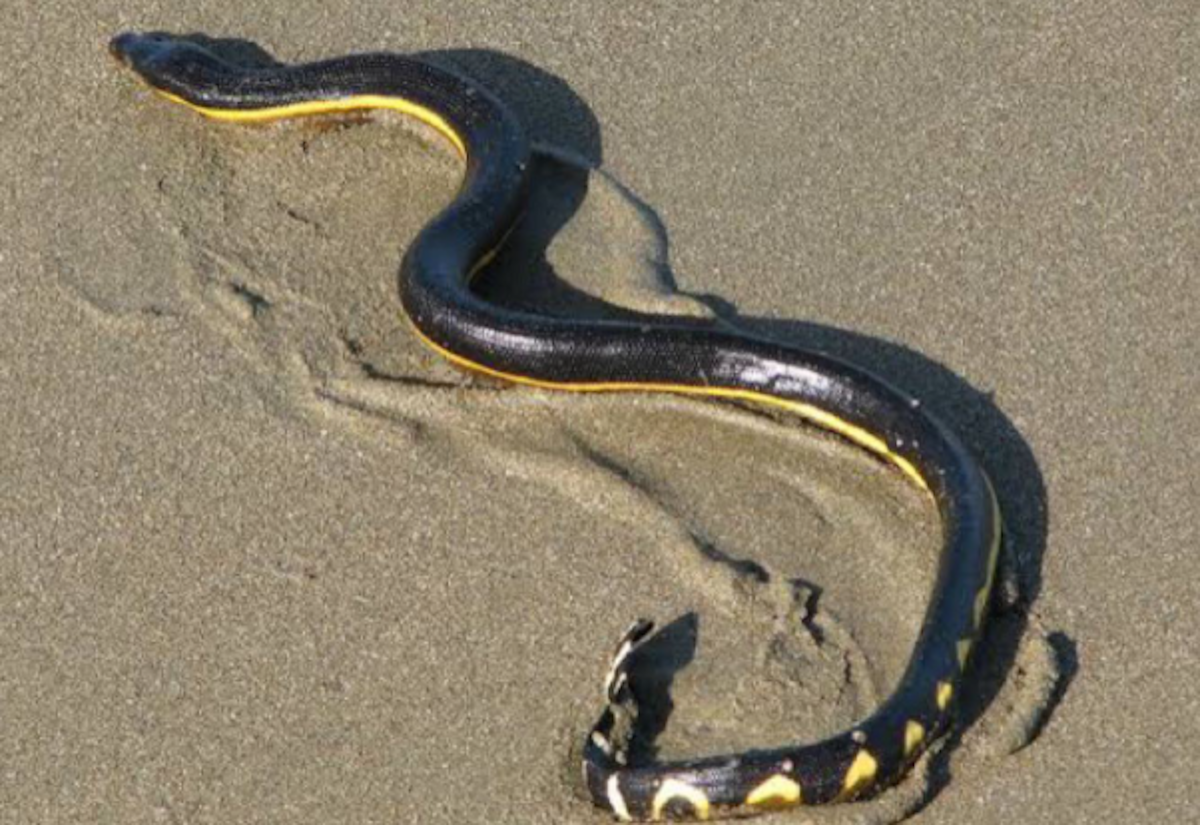
Environmental charity Ocean Pledge has  issued a warning to beachgoers in Western Cape Province, South Africa, after a highly venomous Yellow Bellied Sea Snake, Hydrophis platurus, was found on a beach at Fish Hoek, near Cape Town. Yellow Bellied Sea Snakes are not native to the Western Cape, but are sometimes carried there by the Agulhas Current, which runs southeastward along the eastern coast of South Africa, occasionally pushing packages of warm waters from the Indian Ocean into the South Atlantic. When this happens, it can carry organisms from the southern Indian Ocean, such as Sea Snakes, with it. Because such occurrences are rare antivenoms for Sea Snakes (which have a limited shelf life) are not kept in hospitals in the Western Cape, meaning that a bite from one of these venomous Snakes is likely to have severe, even fatal consequences. Sea Snake incursions into the Southern Atlantic will often involve muiltple Animals carried from the warm water around Madagascar and the Comoros Islands reaching the coast of the Western Cape, with such Snakes having been found as far north as the southern coast of Namibia.

 
A Yellow Bellied Sea Snake, Hydrophis platurus, on a beach in Costa Rica. Wikimedia Commons.

Sea Snakes, Hydrophiinae, are thought to have diverged from their nearest relatives, Australian Tiger Snakes of the genus Notechis, about 10 million years ago during the Late Miocene. They have become entirely marine in nature, bearing live young in the water, and most species are unable to survive on land for any length of time. Most Sea Snakes are entirely tropical in distribution, dwelling on Coral Reefs in the Indian and Pacific Oceans, but the Yellow Bellied Sea Snake has a broader distribution, and is able to survive in the cooler waters around New Zealand, Tasmania, and southern California. It is this environmental tolerance that enables them to be carried into the Southern Atlantic on occasion, although the waters are far to cold for them to survive for any length of time. However, one possible outcome of a warming global climate is that the waters of the Southern Atlantic become warm enough for Yellow Bellied Sea Snakes to survive there for at least part of the year, enabling them to enter the warmer waters of the Central Atlantic and Caribbean, where both marine life and Human populations would be naïve to them, and should they reach these waters they would be likely to have a significant ecological impact.

The Benguela and Aghulas currents around South Africa. Packages of warmer water from the Aghulas Current occasionally enter the South Atlantic and pass up the coast of the Western Cape, carrying with them exotic warm-water wildlife from the Indian Ocean, but such incursions are typically short-lived. Wikimedia Commons.

Anyone encountering a Sea Snake on a beach in the Western Cape is strongly advised not to touch it, even if it appears to be dead, and never to attempt to move it. Instead it is recomended that sightings of Sea Snakes oe exotic marine life be reported to the Two Oceans Aquarium in Cape Town be contacted, as they will be capable of sending experts to help or recover the Animal.

See also...


Follow Sciency Thoughts on Facebook.

Follow Sciency Thoughts on Twitter. 


Sunday, 5 August 2018

Palaeophis colossaeus and Amananulam sanogoi: Giant Snakes from the Palaeocene and Eocene of Mali.

Snakes are one of the most successful groups of living vertebrates, with over 3000 living species found in all but the very coldest environments on Earth. However their maximum diversity is thought to have occurred between the Late Cretaceous and  end of the Eocene, when many Snake groups, some still living, but many extinct, spread around the margins of the tropical Tethys Ocean. Among these Snakes were two groups of large aquatic Snakes, the Palaeophiidae, a group thought to have produced the largest Snakes ever to have lived, and the slightly smaller Nigerophiidae.

In a paper published in the journal Acta Palaeontologica Polonica on 7 May 2018, Jacob McCartney of the Department of Biology at the State University of New York College at Geneseo, Eric Roberts of the Department of Earth and Oceans at James Cook University, Leif Tapanila of the Department of Geosciences and Idaho Museum of Natural History at Idaho State University, and Maureen O’Leary of the Department of Anatomical Sciences at Stony Brook University, describe a series of new Palaeophiid and Nigerophiid Snake remains from deposits in Mali associated with the Trans-Saharan Seaway, a subtropical epeiric sea that episodically connected the Tehtys Ocean (to the north) to the Gulf of Guinea (to the south), which were excavated during two expeditions conducted jointly by Stony Brook University and the Centre National de Recherche Scientifique et Technologique of Mali in 1999 and 2003.

Firstly McCartney et al. describe new material which they attribute to the Early Eocene species Palaeophis colossaeus, which has been previously described from phosphate deposits of the Tamaguilelt Formation. The species is known only from isolated vertebrae, even with the new material involved, though McCartney et al. are able to use the new material to revise size estimates of this species, though they do this with some caution as it is difficult to estimate the size of an animal when no even partially articulated specimen is known of it or any close relative, estimating that, the species reached somewhere between 8.1 and 12.3 m in length. Even the lower estimate for the length of Palaeophis colossaeus is considerably larger than any living Snake species, and matched only by the extinct Gigantophis garstini from the upper Eocene of Egypt, estimated to have reached 9.3 to 10.7 m, and Titanoboa cerrejonensis from the Paleocene of Colombia, which is estimated to have reached a maximum length of 12.8 m.

Mid-trunk vertebrae of Palaeophiid Snake Palaeophis colossaeus from the Eocene of Tamaguélelt Formation, Mali. (A) Specimen CNRST-SUNY 310; in anterior (A₁), lateral (A₂), posterior (A₃), dorsal (A₄), and ventral (A₅) views. (B) Specimen CNRST-SUNY 325; in anterior (B₁) and lateral (B₂, reversed to facilitate comparisons) views. (C) Specimen CNRST-SUNY 290; in anterior (C₁), lateral (C₂), and ventral (C₃) views. McCartney et al. (2018).

Secondly McCartney et al. describe a new species of Nigerophiid Snake from the Palaeocene Teberemt Formation of northeastern Mali. This is named Amananulam sanogoi, where 'Amananulam' means 'Water Snake' in the Tuareg language Tamasheq, and 'sanogoi' honours Mamadou Sanogo, for his contributions to the Stony Brook University/Centre National de Recherche Scientifique et Technologique expditions. The species is described from a single, damaged mid-trunk vertebra, 10 mm in length (though this is slightly less than it would have been in life, due to the damage to the specimen). This is estimated to have come from a Snake about 2.1 m in length, comparable to the largest living Sea Snakes.

Vertebra of the Nigerophiid Snake Amananulam sanogoi from the Paleocene Teberemt Formation; in anterior (A), lateral (B), posterior (C), dorsal (D), and ventral (E) views. McCartney et al. (2018).

Finally McCartney et al. describe a possible anterior trunk vertebra from an unknown Snake from the Early Eocene Tamaguilelt Formation. This is not well enough preserved to assign to a species or even family, but is notably due to its size, with a width of 13.7 mm, and it is estimated to have come from a Snake around 5.4 m in length, comparable to the largest Boas and Pythons today.

Vertebra of an indeterminate Snake from the Eocene Tamaguélelt Formation, Mali; in anterior (A), lateral (B), posterior (C), and ventral (D) views. McCartney et al. (2018).

See also...

https://sciencythoughts.blogspot.com/2018/07/xiaophis-myanmarensis-embryonic-to.htmlhttps://sciencythoughts.blogspot.com/2016/04/preserved-pigment-cells-reveal-colour.html
https://sciencythoughts.blogspot.com/2015/11/ancestor-of-all-modern-snakes-more.htmlhttp://sciencythoughts.blogspot.com/2015/02/subfossil-reptile-remains-from-garbage.html
https://sciencythoughts.blogspot.com/2013/08/giant-fossil-sea-snakes-from-early.htmlhttps://sciencythoughts.blogspot.com/2013/06/a-fossil-snake-from-cretaceous-of-brazil.html
Follow Sciency Thoughts on Facebook.

Tuesday, 20 August 2013

Giant fossil Sea Snakes from the early Eocene of Morocco.

The Sea Snake Palaeophis maghrebianus was first described by Camille Arambourg from the early Eocene phosphate beds of Morocco in 1952, though like many fossil Snakes it has been known only from disarticulated vertebrae. This is due to the lightly mineralized, easily disarticulated skeletons of Snakes, which tends to result in fossil Snakes, where they are found at all, being poorly preserved and fragmentary.

In a paper published in the journal Palaeontology on 13 February 2013, a team of scientists led by Alexandra Houssaye of the Département Histoire de la Terre at the Muséum National d’Histoire Naturelle in Paris and the Steinmann Institut für Geologie, Paläontologie und Mineralogie at Universität Bonn describe several new specimens assigned to Palaeophis maghrebianus, including two incomplete skeletons, and inferences about the living animal made from these.

Partially articulated fossil Palaeophis maghrebianus from the Grand Daoui area in the Oulad Abdoun basin of Morocco. Hossaye et al. (2013).

These new specimens are considerably larger than the previous material, suggesting that Palaeophis maghrebianus may have been larger than any living Snake. The largest vertebrae from the new specimens are around 3.3 cm in length, compared to around 1.9 cm in a 5.9 m Reticulated Python (Python reticulatus). In addition the vertebrae show signs of a denser vascular network than that seen in either Green Anacondas (Eunectes murinus), which can reach 7 m, or Reticulated Pythons, which can reach 9 m, suggesting that Palaeophis maghrebianus was able to grow faster, and larger, than either of these Snakes.

Second specimen of Palaeophis maghrebianus from the Grand Daoui area in the Oulad Abdoun basin of Morocco. Hossaye et al. (2013).

In addition Palaeophis maghrebianus appears to be less flattened ventrally than modern Sea Snakes, and shows poor development of other adaptations to an aquatic lifestyle, suggesting that it was less well adapted to fully marine environments, probably living closer to shore and spending at least some of its time on land. The deposits where the fossils were found are interpreted as having been laid down in an estuarine or shallow marine environment, possibly with the presence of mangrove swamps.


Follow Sciency Thoughts on Facebook.

Saturday, 8 December 2012

A cryptic Sea Snake from Australia.

The Beaked Sea Snake Enhydrina schistosa is known from the Arabian Gulf to Southeast Asia and south to Australia and Papua New Guinea. It is distinctive, with an elongated central scale on its lower jaw, overlapping the upper jaw to form a sort of beak, used to tackle spiney Fish. The Snake has a bad reputation; its habits lead to it frequently being caught in fishing nets, where it is hard to detect. To make matters worse it is notoriously bad tempered, and has an extremely venomous bite. About 50% of all Sea Snake bites are the work of Enhydrina schistosa, and around 90% of fatalities.

The Beaked Sea Snake, Enhydrina schistosa. Avinash Shanbhag/Indian Snakes.

In a paper published in the journal Molecular Phylogenetics and Evolution on 5 October 2012, a team of scientists led by Kanishka Ukuwela of the School of Earth and Environmental Sciences at the University of Adelaide publish a study of the population genetics of Enhydrina schistosa, which suggests that the Snake is in fact two sepperate, convergently evolved species, that arose within the morphologically disticnt genus Hydrophis, the two Snakes having apparently setttled on the same form due to similar ecologies (convergent evolution).

This is an important discovery, and not just from a taxonomic point of view; there is no reason to suppose that two Snakes that have evolved similar morphologies will have evolved similar venoms, and therefore an antivenom developed to counter the venom of one Snake is unlikely to have any effect on the venom of the other. Fortunately the Snakes do not seem to have overlapping ranges, with one species found in Australian waters and the other around the coast of South Asia.

The taxonomic position of the snakes is now complicated; Ukuwela et al. report the early description of a second species in the genus Enhydrina, Enhydrina zweifeli, described from a single specimen from Papua New Guinea in 1985, but not generally recognised as a valid species by herpetologists. The Australian population of Enhydrina schistosa is reported to have fewer bands on the body than the Asian population, and lower but broadly overlapping ventral scale count; a description matching that of Enhydrina zweifeli, and Ukuwela et al. suggest this name should be used to describe the Australian population. 

However this would make the genus Enhydrina polyphyletic (having more than one origin) and the genus Hydrophis paraphyletic (not including all the species descended from the last common ancestor of the group) whereas modern taxonomy usually requires that taxomic groups be monophyletic (all descended from a common ancestor, and including all the species descended from that ancestor), so it is likely that this taxonomy will change.

The multiple origins of Enhydrina schistosa within the genus Hydrophis. Ukuwela et al. (2012).