Showing posts with label Worms. Show all posts

Friday, 13 December 2019

Urechis caupo: Thousands of Fat Innkeeper Worms wash up on Point Reyes National Seashore. California.

Thousands of Fat Innkeeper Worms, Urechis caupo, have been found washed up on beaches in the Drakes Bay area of the Point Reyes National Seashore in northern California. The Worms, which are also known as 'Penis Fish', due to their somewhat distinctive appearance, appeared on he morning of Wednesday 11 December 2019, having apparently been scoured from burrows in the intertidal zone by a strong storm. This is a common phenomenon in the area during El Niño years, when packages of warm, wet air bring stormy conditions to the east coast of North America, but not other wise, with the effect that large numbers of Worms will appear on beaches mysteriously after several years of not being seen at all.

Thousands of Fat Innkeeper Worms, Urechis caupo, washed up on a beach in the Drake's Bay area of northern California this week. David Ford/Bay Nature.

Fat Innkeeper Worms, Urechis caupo, are a type of Spoon Worm, Echiura, a form of unsegmented marine Worm formerly thought to have been a separate phylum, but which have now been shown to be a type of Polychaete Annelid that have lost their segmentation. These Worms have a large fleshy proboscis which can be flattened into a scoop when burrowing, giving them the name 'Spoon Worms', and in the case of the large Fat Innkeeper, a rather phallic appearance.

A Fat Innkeeper Worm, Urechis caupo, found on a beach in the Bodega Bay  area of northern California in June 2019. Kate Montana/iNaturalist.

Most Spoon Worms are confined to deepwater environments, predominantly in the Atlantic Ocean. Only two species are known from the West Coast of North America, the Fat Innkeeper, and the smaller Listriolobus pelodes, which is found in deeper environments (18-155 m) off the coast of California and Baja California. The Fat Innkeeper is found in intertidal waters between Oregon and Baja California , and is an important part of the local ecology, excavating large, u-shaped burrows around a meter in length. which are shared by many other species, including the Clam, Cryptomya californica, the Sequined Scale-worm, Hesperonoe advento, the Pea Craba, Scleroplax granulata and Pinnixa franciscana, the Hooded Shrimp, Betaeus longidactylus, and the Arrow Goby, Clevelandia ios. It is the provision of large burrows shared with a community of other animals which gives the worm the common name Fat Innkeeper/ The Worms are also an important prey species for many other animals, including Sea Otters, Enhydra lutris, a wide range of Fish, Sharks, and Rays, and Humans.

The El Niño is the warm phase of a long-term climatic oscillation affecting the southern Pacific, which can influence the climate around the world. The onset of El Niño conditions is marked by a sharp rise in temperature and pressure over the southern Indian Ocean, which then moves eastward over the southern Pacific. This pulls rainfall with it, leading to higher rainfall over the Pacific and lower rainfall over South Asia. This reduced rainfall during the already hot and dry summer leads to soaring temperatures in southern Asia, followed by a rise in rainfall that often causes flooding in the Americas and sometimes Africa. Worryingly climatic predictions for the next century suggest that global warming could lead to more frequent and severe El Niño conditions, extreme weather conditions a common occurrence.

Predicted changes to North American weather patterns during an El Niño event. NWS/NCEP Climate Prediction Center/NOAA.

The relationship between storm conditions and inshore sedimentary environments is complicated, as such events can scour sediments from shallow environments and shift them into deeper ones, move large volumes of sediment from terrestrial environments to shallow marine ones, or simply move sediments from beach to beach. For smaller infaunal species with shorter life-spans, such changes are not a problem, but for long-lived species such as Fat Innkeepers, which can live for around 25 years, this is a major problem as it means fewer Worms live out their full life-cycle, and that each worm therefore produced fewer offspring during its life. Even if the Worms are able to maintain a population during such a crisis, with Worms producing enough larvae during their shorter lives to keep colonising new suitable sites as they appear, this would be a major problem for the species that share the Worms' burrows, as fewer Worms would reach their full potential size, leading to fewer, and smaller burrows being available.

See also...

https://sciencythoughts.blogspot.com/2019/10/chloeia-parva-chloeia-bimaculata.htmlhttps://sciencythoughts.blogspot.com/2017/06/lepidocoleus-kuangguoduni-machaeridian.html
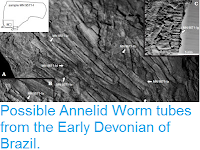
https://sciencythoughts.blogspot.com/2016/01/possible-annelid-worm-tubes-from-early.htmlhttps://sciencythoughts.blogspot.com/2015/11/neosabellides-lizae-new-species-of.html
https://sciencythoughts.blogspot.com/2015/04/cretaceous-bone-eating-worms-from.htmlhttps://sciencythoughts.blogspot.com/2015/01/a-new-species-of-serpulid-worm-from.html
Follow Sciency Thoughts on Facebook.

Sunday, 27 January 2019

Priapulid-like Scalidophoran Worms preserved within burrows from the Early Cambrian of southern Sweden.

The first Worm-burrows appear in the Late Ediacaran Period, about 560 million years ago. These burrows are two-dimensional in form, apparently made by creatures that burrowed a few millimetres beneath the surface but did not venture deeper into the sediment. The onset of the Cambrian is marked by a dramatic increase in burrowing activity, with burrows dug three-dimensionally into the substrate, and the bioturbated sediments, previously unknown, becoming widespread in the rock record. However, while these burrows have been widely used as a way of dating the beginning of the Cambrian, the identity of the burrow makers has remained unclear, though many palaeontologists have speculated that it might be a Priapulid-like Scalidophoran Worm. The Scalidophora is the wider group comprised of Priapulids, Kinorinches and Loriciferans, phyla united by a chitinous cuticle which is periodically moulted and denticle-covered pharynxes which can be everted to form proboscises; the Scalidophorans along with the Panrthropods (Arthropods, Tardigrades and Velvet Worms), the Nematodes and the Nematomorphs (Horsehair Worms) make up the Ecdysozoa. Numerous Scalidophoran Worms are known from the Burgess Shale and other similar Cambrian Lagerstätten, but these deposits do not record the Earliest Cambrian, where their presence has been inferred from sclerites (fragments of exoskeleton) which appear to be of Scalidophoran origin.

In a paper published in the journal Proceedings of the Royal Society Series B: Biological Sciences on 16 January 2019, Giannis Kesidis and Ben Slater of the Department of Earth Sciences (Palaeobiology) at Uppsala University, Sören Jensen of the Área de Paleontologıá at the Universidad de Extremadura, and Graham Budd, also of the Department of Earth Sciences (Palaeobiology) at Uppsala University, describe a series of exceptionally preserved trace and body fossils from sandstones of the Early Cambrian File Haidar Formation of southern Sweden that can unequivocally be assigned to a Scalidophoran producer.

Kesidis et al. report a series of fossils in positive semirelief on the base of a sandstone bed within the Mickwitzia Sandstone Member of the File Haidar Formation. These are associated with burrow systems, but show details of the structure of the surface of an animal of clear Scalidophoran affinities, which appear to be casts of the actual animals. These have bulbous protrusions with longitudinal striations, which appear remarkably similar to modern Priapulids.

(a) Close-up of specimen detailing lateral bulbous protrusions (aborted probes). (b), (c) Anterior details of bulb-like terminations in specimen, illustrating 20 radiating longitudinal striations. Note that striations bifurcate distally, indicating rotation of the worm’s prosoma during excavation. (d ) Schematic of morphology observed in (b), (c). Scale bars: 5 mm (a) 2 mm (b), (c). Kesidis et al. (2019).

In order to try to understand the formation of these fossils, Kesidis et al. tried experimentally placing specimens of the modern Priapulid Priapulus caudatus, which appears similar in size and morphology to the specimens, in tanks where mud has been allowed to settle and then topped off with a layer of fine sand (this is unlike the typical environment of Priapulus caudatus, a species which typically dwells in soupy mud where any tunnels will collapse behind it as it moves). The activities of the Worms drew the sand into the burrows, and prising the burrows apart showed striated marks left by the sclerites of the Worms, which appeared similar to the striations in the Mickwitzia Sandstone burrows. Subsequent filling of some burrows with Plaster of Paris produced structures almost identical to the Cambrian material.

(a) Specimen A, discrete cylindrical structure interpreted as a mouldic Priapulid body fossil. (b) Specimen B, elongated burrow, with bulb-shaped aborted probes emanating from the main burrow. (c), (d) Plaster of Paris casts of extant Priapulus caudatus burrows exhibiting strikingly similar wall ornamentation to that of Specimens A and B. Scale bars: 5 mm (a), (b), 10 mm (c), 8 mm (d ).  Kesidis et al. (2019).

See also...

https://sciencythoughts.blogspot.com/2016/04/three-new-species-of-kinorhynchs-from.htmlhttps://sciencythoughts.blogspot.com/2016/01/scathascolex-minor-palaeoscolecid-worm.html
https://sciencythoughts.blogspot.com/2015/12/eokinorhynchus-rarus-kinorhynch-from.htmlhttps://sciencythoughts.blogspot.com/2015/05/priapulid-worms-from-middle-cambrian-of.html
Follow Sciency Thoughts on Facebook.

Saturday, 13 January 2018

Xenoturbella japonica: A new species of Xenoturbellid Flatworm from the Pacific coast of Honshū Island, Japan.

Flatworms are simple animals that lack through guts or a body cavity in which the organs are held. They have long been thought to be most primitive group of Bilaterians (all animals other than Sponges, Cnidarians and Ctenaphores), though they have been shown by genetic studies to be a polyphyletic group (similar animals with different origins), with several types of Flatworms apparently having evolved from more complex animals. However two groups of Flatworms do appear to have diversified from the Bilatarians before the development of through guts and body cavities, the Xenoturbellids and the Acoelomorphs (together the Xenacoelomorphs) which have been shown by genetic analysis to be related to one-another and to have a sister-group relationship to all other Bilaterians. There are currently five described species of Xenoturbellids, all placed in a single genus, Xenoturbella, with one species known from the Baltic coast of Sweden and four from the Pacific coasts of Mexico and the United States.

In a paper published in the journal BMC Evoltionary Biology on 18 December 2017, Hiroaki Nakano and Hideyuki Miyazawa of the Shimoda Marine Research Center at the University of Tsukuba, Akiteru Maeno and Toshihiko Shiroishi of the Mammalian Genetics Laboratory at the National Institute of Genetics, Keiichi Kakui of the Faculty of Science at Hokkaido University, Ryo Koyanagi and Miyuki Kanda of the DNA Sequencing Section at the Okinawa Institute of Science and Technology Graduate University, Noriyuki Satoh of the Marine Genomics Unit at the Okinawa Institute of Science and Technology Graduate University, Akihito Omori of the Misaki Marine Biological Station of The University of Tokyo, and the Sado Marine Biological Station of Niigata University, and Hisanori Kohtsuka, also of the Misaki Marine Biological Station of The University of Tokyo, describe a new species of Xenoturbella from the Pacific coast of Honshū Island, Japan.

The new species is named Xenoturbella japonica, in reference to the fact that it was discovered in Japan. The species is described from two specimens, a female 5.3 cm in length from a depth of between 380 and 554 mm off the coast of Jogashima Island in Sagama Bay, and a juvenile 1.1 cm in length from a depth of between 517 and 560 m off the Sanriku coast of Iwate Prefecture. Both are orange in colour and have smooth surfaces.

Live specimen of Xenoturbella japonica with anterior to the left. White arrowhead, ring furrow. Scale Bar is 2 cm. Nakano et al. (2017).

Like other Xenoturbellids, Xenoturbella japonica, lacks any true organs such as nerve cords, respiratory or even gonads, but Nakano et al. were able to find a single pore towards the front of the animal, though the purpose of this is unclear. A genetic analysis suggests that this new species is closely related to the Baltic Xenoturbella bocki and the East Pacific Xenoturbella hollandorum, all relatively shallow species, found at less than 650 m, and less than 6 cm in length, with the remaining three Pacific species forming a second group, all of which are found at depths of between 1700 and 3700 m, and reach lengths of 10-20 cm.

See also...

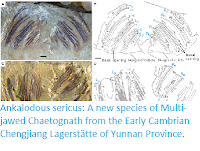
http://sciencythoughts.blogspot.co.uk/2017/12/ankalodous-sericus-new-species-of-mult.htmlhttp://sciencythoughts.blogspot.co.uk/2017/10/rhinebothrium-reydai-new-species-of.html
http://sciencythoughts.blogspot.co.uk/2017/09/nipponnemertes-incainca-new-species-of.htmlhttp://sciencythoughts.blogspot.co.uk/2017/09/oncholaimus-zhangi-new-species-of.html
http://sciencythoughts.blogspot.co.uk/2017/05/kuphus-polythalamia-can-giant-free.htmlhttp://sciencythoughts.blogspot.co.uk/2016/08/saccoglossus-testa-new-species-of-acorn.html
Follow Sciency Thoughts on Facebook.

Saturday, 23 December 2017

Vittatusivermis annularius: A Worm-like animal from the Early Cambrian of Yunnan Province, China.

While the earliest fossil animals appear in deposits over 750 million years old, animals do not become abundant until 541 million years ago, when a wide range of shelly fossils appear suddenly an event called the Cambrian Explosion  These shelly fossils were accompanied by the earliest unequivocal trace fossils, burrows presumed to have been produced by unknown Worm-like animals, implying that animals without hard parts also underwent a significant radiation at this time, and a several later Cambrian Lagerstätte preserve a range of soft bodied fossils, though soft bodied fossils from the earliest Cambrian are very rare, and nothing likely to have produced the burrows seen in these deposits has been seen to date.

In a paper published in the journal Scientific Reports on 6 November 2017, Xingliang Zhang and Wei Liu of the State Key Laboratory of the Continental Dynamics at Northwest University, and Yukio Isozaki and Tomohiko Sato of the Department of Earth Science and Astronomy at the University of Tokyo, describe a new species of Worm-like animal from the Early Cambrian Yuhucun Formation at the Tianning Phosphorite Mine in Anning County, Yunnan Province.

The new animal is named Vittatusivermis annularius, where 'Vittatusivermis' means 'ribbon-shaped Worm' and 'annularius' refers to the visible annuli (rings) on the surface of the animal. The species is described from a total of 66 specimens found on a single surface thought to be about 535 million years old. The largest specimens reach about 26 cm in length and 1 cm in width, they are flattened and show ring-like pattern, similar to that seen in  modern Annelids (though this does not imply a direct relationship, as such annuli are seen in other groups).

(a)–(c) Vittatusivermis annularius from the lowest Cambrian of the Baideng section, Anning, Yunnan, South China, with transverse annulations specifically emphasised. (a) specimen coated with MgO film and illuminated in a low angle light, showing cross annulations. (b) specimen folded lengthwise, showing a folded edge and both sides of the flattened body undifferentiated. (c) the same specimen as (b), coated with MgO film and illuminated in a low angle light, showing cross annulations. (d) Wutubus annularis from the late Ediacaran of South China. Zhang et al. (2017).

Vittatusivermis annularius cannot confidently be assigned to any modern group; its annuli are similar to those of Annelid Worms, but these are not usually flattened. Flatworms and Nemarteans are flattened, but do not usually have annuli. In the absence of any obvious preserved organs, it cannot be confidently assumed that the fossils represent entire creatures, they may be the shed skins of something like an Ecdysozoan. They do, however, resemble a number of other late Ediacaran and early Cambrian soft-bodied fossils and traces, including Onuphionella, a tubular fossil from the Early Cambrian interpreted as a Worm-tube, and Sabellidites, Shaanxilithes and Wutubus, worm-like soft-bodied animals from the Ediacaran Biota.

See also...


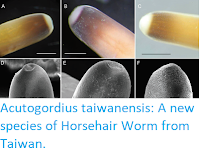
http://sciencythoughts.blogspot.co.uk/2017/12/ankalodous-sericus-new-species-of-mult.htmlhttp://sciencythoughts.blogspot.co.uk/2017/12/acutogordius-taiwanensis-new-species-of.html
http://sciencythoughts.blogspot.co.uk/2017/11/siphusauctum-lloydguntheri-enigmatic.htmlhttp://sciencythoughts.blogspot.co.uk/2017/09/nipponnemertes-incainca-new-species-of.html
http://sciencythoughts.blogspot.co.uk/2017/06/lepidocoleus-kuangguoduni-machaeridian.htmlhttp://sciencythoughts.blogspot.co.uk/2017/05/kuphus-polythalamia-can-giant-free.html
Follow Sciency Thoughts on Facebook.

Wednesday, 13 September 2017

Nipponnemertes incainca: A new species of Ribbon Worm from the Caribbean Coast of Colombia.

Ribbon Worms (Nemertea) are a small group of worms related to Platyhelminth Flatworms. They have a simple anatomy, essentially a long, ribbon-like body with a dermal layer (skin), a through gut and a three layers of muscle. They have an extendable proboscis or stylet, which forms a cavity when retracted, and which is turned inside out when extended. This is used to subdue prey, often by penetrating their bodies, and in some species produces toxic secretions. Most Ribbon Worms are small, under 20 cm and often only a few mm, but there have been reports of Ribbon Worms over 50 m long, which if true would make them the longest known animals.

In a paper published in the journal ZooKeys on 22 August 2017, Jaime Gonzalez-Cueto, Lyda Castro and Sigmer Quiroga of the Facultad de Ciencias Básicas at the Universidad del Magdalena, describe a new species of Ribbon Worm from Inca Inca Beach at Santa Marta, in Magdalena Department, Colombia.

The new species is placed in the genus Nipponnemertes, which currently contains eighteen species from around the world, and is given the specific name incainca, in reference to the beah where it was found. The species was found living under rocks in the intertidal zone, with adults measuring between 11.7 and 22.5 mm in length and 1-2 mm wide. These are dark red on their dorsal surface and lighter below, and have a shield-shaped head with two irregular groups of eyespots, which can be retracted into the head when disturbed. The worms were capable of swimming, using strong undulating movements.

 Nipponnemertes incainca. (A) Dorsal view of entire worm. (B) Ventral view of entire worm. Abbreviation: p proboscis. Gonzalez-Cueto et al. (2017).


See also... 

http://sciencythoughts.blogspot.co.uk/2014/05/a-new-species-of-ribbon-worm-from-north.html


Follow Sciency Thoughts on Facebook.

Tuesday, 9 July 2013

Two new species of Scolecodont from the Early Devonian of the Ukraine.

Scolecodonts are the fossilized remains of the chitinous teeth and jaw elements of Polychaete Worms. They are described as species since preservation of entire Worms more-or-less never happens. Scolecodonts are known in the fossil record from the Cambrian onwards (there are some claims for Precambrian Scolecodonts, but these are not widely accepted), but are most abundant in the Ordovician, Silurian and Devonian. Scolecodonts have been used in biostratigraphy (using fossils to date rocks) but they are notoriously hard to work with.

In a provisional paper published on the website of the journal Acta Palaeontologica Polonica on 28 May 2013, Hubert Szaniawski of the Institute of Palaeobiology at the Polish Academy of Sciences and Daniel Drygant of the State Museum of Natural History of the National Academy of Sciences of Ukraine describe two new species of Scolecodont from the Early Devonian, as part of a wider discussion of Early Devonian Scolecodonts from escarpments of Dniester River in the Podolia Region of the Ukraine. 

The first new species is placed in the genus Polychaetaspis, and given the specific name kozlowskii, in honour of the distinguished Polish palaeontologist Roman Kozłowski, who first described the genus. Polychaetaspis kozlowskii is described from three right and four left lower jaw elements and a basal plate, found by dissolving the rock matrix with acid then picking through the remaining material. The elements were found in the same sample and fit together well, suggesting this is a true species.

SEM micrographs of Polychaetaspis kozlowskii. (A) Right MI in dorsal view. (B) Right MI in dorsal view. (C) Incomplete right MI in dorsal view (C1) and ventral view (C2). (D) Basal plate in dorsal view (D1) and right lateral view (D2). (E) Left MI in dorsal view (E1) and left lateral view (E2). (F) Left MI in dorsal view (F1) and oblique ventral view (F2). (G) Left MI in dorsal view (G1) and oblique left lateral view (G2). Szaniawski & Drygant (2013).


The second new species is placed in the genus Atraktoprion, and given the specific name podolicus, after the Podolia Region where the specimens were found. Atraktoprion podolicus is described from 4 right and six left lower jaw elements (two of the right lower jaw elements being incomplete).

SEM micrographs of Atraktoprion podolicus. (A-D) Left MI dorsal view, (B) in ventral view, (C) in oblique dorsal view (C1) and dorsal view (C2), (D) in dorsal view, (E) in dorsal view. (F) Right MI in lateral view (F1) and dorsal view (F2). (G) Incomplete and deformed right MI in dorsal view. (H) Incomplete right MI in dorsal view. (I) Right MI in dorsal view. Szaniawski & Drygant (2013).


Follow Sciency Thoughts on Facebook.

Friday, 28 June 2013

Two new species of Earthworm from Korea.

Earthworms play a major role in the formation of soils in many parts of the world (though soils can and do form in there absence), ingesting and breaking larger portions of organic material and producing a nitrogen rich humus. This role in soil formation makes them very important members of many ecosystems, yet they are often not well understood, with the biology of only a few European species studied extensively.

In a paper published in the journal ZooKeys on 6 June 2013, Robert Blakemore, Seunghan Lee and Wonchoel Lee of the Biodiversity Laboratory at the College of Natural Science at Hanyang University, and Hong-Yul Seo of the National Institute of Biological Resources, describe two new species of Earthworm from Jeollabuck and Gangwon Provinces in South Korea.

The first new species is placed in the genus Amynthas and given the specific name daeari, after the location where it was discovered, Daea-ri village in Jeollabuck Province. Amynthas daeari is a 150 mm Earthworm found living in leaf-litter in woodland. It has a single female pore on segment 14 and paired male pores on segment 18.

Amynthas daeari. Blackmore et al. (2013).

The second new species is also placed in the genus Amynthas, and given the specific name jinburi, after the location where it was found, Jinbu-ri in Gangwon Province. Amynthas jinburi is a 210 mm Earthworm, living in deep burrows in remote mountain areas, where it is thought to be geophagus (i.e. consume significant amounts of rock-derived minerals. It also has a single female pore on segment 14 and paired male pores on segment 18.

Amynthas jinburi. Blackmore et al. (2013).


Follow Sciency Thoughts on Facebook.

Friday, 21 December 2012

An invasive Serpulid Worm in the La Encrucijada Biosphere Reserve, Mexico.

The Serpulid Worm Ficopomatus uschakovi was first described from Sri Lanka in 1960. Like all Serpulid Worms is an encrusting, sessile Polychaete that secretes a tube of calcite (calcium carbonate) in which it dwells. Unlike most other Serpulids Ficopomatus uschakovi inhabits brackish waters in estuaries and lagoons rather than fully saline waters. It can form large, reef-like masses and rapidly dominates ecosystems where it is present, outcompeting other invertebrates such as Barnacles, Oysters and Mussels.

In the 1970s the species was found to be living along the West Coast of Africa, where colonies were reported to have first appeared in the 1950s. Since this time the species has been found in the Philippines, Indonesia, Australia, Brazil and Venezuela. Because of its ability to modify ecosystems it is considered to be an invasive pest, associated with contamination by introduced with Shrimp farms; many invasive marine organisms are associated with ballast water and hull fouling of shipping, but since Ficopomatus uschakovi is not thought able to colonize fully marine waters this seems improbable for this species.

In a paper published in the journal ZooKeys on 5 November 2012, Rolando Bastida-Zavala and Socorro García-Madrigal of the Laboratorio de Sistemática de Invertebrados Marinos at the Universidad del Mar describe the discovery of colonies of Ficopomatus uschakovi in coastal lagoons in  La Encrucijada Biosphere Reserve in Chiapas State, on the south coast of Mexico.

Ficopomatus uschakovi from La Encrucijada Biosphere Reserve. (A) tubes
on mangrove roots. (B) Tubes on the shell of the gastropod Thaisella kiosquiformis. (C) Mangroves in the collecting site. (D) Tubes forming small aggregations. (E) Large, single tube. (F) Complete specimen in dorsal view. (G) Complete specimen with mass of sperm attached to the abdomen. (H) Operculum in dorsal view. (I) Operculum in aboral view. Bastida-Zavala & García-Madrigal (2012).

There are no Shrimp farms in La Encrucijada Biosphere Reserve, and the nearest port is at Puerto Chiapas, 70 km to the south. It is therefore unclear how the Worms reached the lagoons, suggesting that they have a means of dispersal that scientists are unaware of. At the moment the infestation appears limited in scope, with no reef-like structures observed. How the Worms will affect the reserve in the future remains unclear; Bastida-Zavala and García-Madrigal recommend that the situation should be monitored carefully.

(A) World-wide distribution of Ficopomatus uschakovi; circles represent previously described colonies, the triangle the new colonies described in this study. (B) Study area and the localities where specimens of Ficopomatus uschakovi were recollected. 1: Zacapulco; 2: Barra San Juan; 3: Las Garzas boat pier. Bastida-Zavala & García-Madrigal (2012).


Follow Sciency Thoughts on Facebook.