Sunday, 3 June 2012

Three new species of Braconid Wasp from Peru.

Braconid Wasps are parasitoid Wasps (i.e. Wasps whose larvae mature inside the living bodies of other insects, which generally die as a result) related to the more familiar Ichneumon Wasps, but much smaller. They have a formidable appearance, but are in fact stingless, making them harmless to non-host species. There are about 150 000 known species found across the globe.

In a paper published in the journal Zookeys on 21 May 2012, Lidia Sulca of the Natural History Museum at the University of San Marcos and Michael Sharkey of the Department of Entomology at the University of Kentucky describe three new species of Braconid Wasp from Peru.

The first of these species is Sesioctonus huggerti, Huggert's Wasp, named in honor of the late Swedish entomologist Lars Huggert, who collected the single known specimen from Puerto Maldonado in southern Peru in 1984. It is a 5 mm black wasp with yellow markings on the thorax and abdomen.

Sesioctonus huggerti. (1a) Dorsal view. (1b) Lateral view. (1c) Wings. (1d) Detail of (1a). Sulca & Sharkey (2012).

The second new species is named Sesioctonus wayquecha, the Wayquecha Wasp, after the locality where it was discovered (Presumably the Wayqecha Cloud Forest Biological Station, though this isn't specified). It is a 4.3-5.5 mm black wasp with yellowish mouthparts, limbs and mid-body.

Sesioctonus wayquecha. (2a) Lateral view. (2b) Wings. (2c) Detail of abdomen. (2d) Head. (2e) Dorsal view. Sulca & Sharkey (2012).

The third new species is Sesioctonus bina, 'bina' meaning 'wasp' in Shipibo, a language of the Peruvian Amazon. This is described from a single, female, specimen from San Pedro in the Cusco Region. It is a 3.35 mm black and orange wasp.

Sesioctonus bina. (3a) Head and forebody in lateral view. (3b) Lateral view. (3c) Wings. (3d) Midquaters. Sulca & Sharkey (2012).

See also Two new species of Soldier Fly from the Ningxia Hui Autonomous Region of northwest China, Two new species of True Bug from the Mesozoic of China, New species of Leaf-Mining Moth from northern Chile, An Assassin Bug from the Palaeocene of Spitsbergen Island and New species of moth from Yunnan Province.

Follow Sciency Thoughts on Facebook.

Saturday, 2 June 2012

A new species of Giant Side-Necked Turtle from the Palaeocene of Columbia.

Side-Necked Turtles are freshwater Turtles restricted to the Southern Hemisphere. They get their name from their inability to withdraw their heads completely into their shells, which causes them to fold their necks sideways beneath the lip of their upper shells. The group is split into two sub-groups; the African Side-Necked Turtles (Pelomedusidae), found in Eastern and Southern Africa, Madagascar and Norther South America, and the Austro-South American Side-Necked Turtles (Chelidae), found in Australia, New Guinea, Indonesia and South America. 

In a paper in the June 2012 edition of the Journal of Systematic Palaeontology, a team of scientists led by Edwin Cadena of the Department of Marine, Earth and Atmospheric Sciences at North Carolina State University, the Florida Museum of Natural History at the University of Florida and the Smithsonian Tropical Research Institute describe a new species of Palaeocene African Side-Necked Turtle from the Cerrejón Coal Mine in Columbia.

Map showing the location of the Cerrejón Mine. Cadena et al. (2012).

The new species is named as Carbonemys cofrinii, Cofrin's Coal Turtle, in honor of the late David Cofrin, a Floridan philanthropist noted for his support for the arts, education, nature preservation and community development.

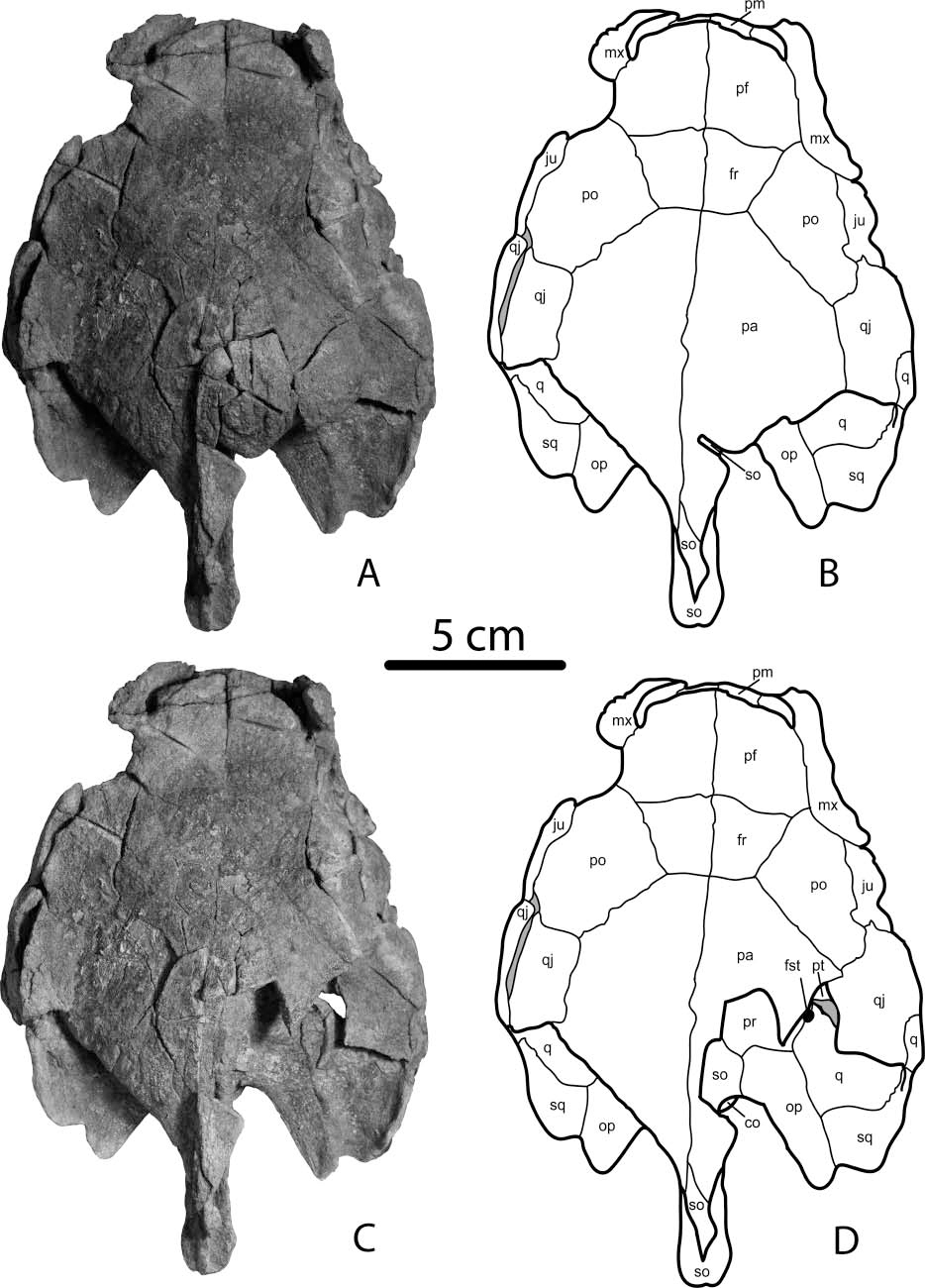
It is described from an isolated skull, 21 cm in length by 13 cm wide, from the 58-55 million year old, Upper Palaeocene Cerrejón Formation at the Cerrejón Mine.

Carbonemys cofrinii. (A) Photograph of skull, complete dorsal view. (B) Interpretive drawing of (A). (C) Skull without a portion of the parietal, showing the bones at the roof of the otic chamber. (D) Interpretive drawing of (C). Abbreviations: fr, frontal; fst, foramen stapedio temporale; ju, jugal; mx, maxilla; op, opisthotic; pa, parietal; pf, prefrontal; po, postorbital; pr, prootic; q, quadrate; qj, quadratojugal; so, supraoccipital; sq, squamosal. Cadena et al. (2012).

Carbonemys cofrinii. (A) Photograph of skull, complete ventral view. (B) Interpretive drawing of (A). Abbreviations: bo, basioccipital; bs, basisphenoid; cm, condylus mandibularis; co, condylus occipitalis, ju, jugal; mx, maxilla; op, opisthotic; pa, parietal; pal, palatine; pm, premaxilla; pp, processus paroccipitalis; pr, prootic; pt, pterygoid; ptp, processus trochlearis pterygoidei; q, quadrate; qj, quadratojugal; so, supraoccipital; sq, squamosal. Cadena et al. (2012).

Cadena et al. also describe two further Side-Necked Turtle finds from the same deposits. The first of these, described as Taxon A, is the nearly complete shell of a Turtle, 173 cm in length. This is the right sort of size to be the same species as Carbonemys cofrinii, but it is clearly a different specimen, and Cadena et al. decided not to assign it to the species without direct evidence. Whatever the case there were clearly large (~2 m) Side-Necked Turtles living in Northern Columbia during the Late Palaeocene, comparable with the largest Side-Necked Turtle ever known, Stupendemys geographicus (shell length 1.8 m), from the Miocene Venezuala, and the largest known Palaeocene Turtle of any description.

Taxon A. (A) Photograph of carapace (upper shell), dorsal view. (B) Interpretive drawing of (A). (C) Photograph of plastron (lower shell), ventral view. (D) Interpretive drawing of (C). Cadena et al. (2012).

The second undescribed Side-Necked Turtle is a group of four shells, about 20 cm in length, which are not formally described as they lack skulls, considered the by Cadena et al. the most important feature for classification purposes. One of these shows sign of having been bitten by a crocodile.

Taxon B. (A) Photograph of carapace. (B) Interpretive drawing of (A). (C) Photograph of plastron. (D) Interpretive drawing of (C). (E) Photograph of carapace. (F) Interpretive drawing of (E). (G) Photograph of plastron. (H) Interpretive drawing of (G). (I) Photograph of partial shell in dorsal view. (J) Interpretive drawing of (I), plastral elements in dark grey. (K) Photograph of partial shell in ventral view. (L) Interpretive drawing of (K), plastral elements in dark grey. (M) Photograph of nearly complete shell in dorsal view. (N) Interpretive drawing of (M), black spots represent crocodile bite marks. (O) Photograph of nearly complete shell in ventral view. (P) Interpretive drawing of (O), black spots represent crocodile bite marks. (Q) Photograph of the smallest turtle from the Cerrejón Formation, nuchal and costal 1 in ventral view. (R) Interpretive drawing of (Q) nuchal and costal 1 in dorsal view. Abbreviations: abd, abdominal scale; axb, axillary buttress; axs, axillary scar; c, costal; ent, entoplastron; epi, epiplastron; fem, femoral; gu, gular; hum, humeral; hyo, hyoplastron; hyp, hypoplastron; ins, inguinal scar; int, intergular; iscs, ischial scar; m, marginal; mes, mesoplastron; n, nuchal; p, peripheral; pec, pectoral; pl, pleural; pubs, pubis scar; pyg, pygal; sp, suprapygal; v, vertebral; xip, xiphiplastron. Cadena et al. (2012).

See also A new fossil bird from the Palaeocene of Brazil and Reptiles on Sciency Thoughts YouTube.

Follow Sciency  Thoughts on Facebook.

Two new species of Soldier Fly from the Ningxia Hui Autonomous Region of northwest China

Soldier Flies are smallish (2-30 mm), often brightly coloured metallic or wasp-mimicking flies related to the Horse Flies and Snipe Flies. They have membranous wings which are kept folded back over their bodies. The larvae can be aquatic or terrestrial; terrestrial larvae tend to be generalist scavengers, whereas the aquatic forms are often specialist algae feeders. The adults tend to be rather inactive, and seldom move far away from the spawning areas.

In a paper published in the journal Zookeys on 30 May 2012, Yang Zai-Hua and Yu Jin-Yong of the Guizhou Academy of Forestry and Yang Mao-Fa of the Institute of Entomology at Guizhou University, describe two new species of Soldier Flies from the Liupanshan Nature Reserve in the Ningxia Hui Autonomous Region of northwest China. 

The first species is named as Oxycera ningxiaensis, the Ningxia Soldier Fly, after the Ningxia Hui Autonomous Region, where it was found. It is a shiny black fly roughly 5 mm in length, slender, with an enlarged head and eyes. It is described from three adult male specimens, the female being unknown.

Oxycera ningxiaensis, dorsal view. Yang et al. (2012).

The second species is named Oxycera rozkosnyi, in honor of Rudolf Rozkošný of Masaryk University, an entomologist and expert on flies. It is described from a single female specimen, the male being unknown. O. rozkosnyi is a 6.3 mm black fly with yellow markings on the head, abdomen and thorax.

Oxycera rozkosnyi, dorsal view. Yang et al. (2012).

See also Two new species of True Bug from the Mesozoic of China, New species of Leaf-Mining Moth from northern Chile, An Assassin Bug from the Palaeocene of Spitsbergen Island, New species of moth from Yunnan Province and New species of Owlfly from Morocco.

Follow Sciency Thoughts on Facebook.

A new species of Scallop from Western Australia.

Scallops of the genus Pecten are distributed more-or-less globally in temperate waters, and are very well studied as they are important commercial species. Tropical members of the genus are less common, and less well understood, with species having low abundances and deeper habitats, making them less attractive commercially and harder to study.

In a paper published in the journal Molluscan Research on 30 March 2012, Peter Duncan of the Faculty of Science, Health and Education at the University of the Sunshine Coast and the School of Ocean Sciences at Bangor University, and independent researcher Gary Wilson, describe a new species of Scallop from the north coast of Western Australia.

The new species is named as Pecten dijkstrai, in honor of Henk Dijkstra, an expert on Australian Scallops. It is named from specimens collected from two sites off the north coast of Western Australia, roughly 200 km apart. The first of these sites being off the coast of Gnaraloo, the other in the Exmouth Gulf. Both sites were situated at depths of about 40 m.

Map showing the known and potential ranges of P. dijkstrai. Duncan & Wilson (2012).

P. djikstrai is a medium sized Scallop with a shell roughly 43 × 48 mm; it is deeply convex, and shells can reach 55 mm thick (unusual in a Scallop). It has 14-16 prominent radial ribs, and is an off-white colour, with extensive pink-to-dark-pink markings and (sometimes) black or white chevrons.

Pecten djikstrai. (A) Exterior left valve. (B) Interior left valve. (C) Interior right valve. (D) exterior right valve. Duncan & Wilson (2012).

Duncan and Wilson suspect that P. djikstrai may be present along much of the north coast of Australia, and may also be present in Indonesia, where Scallops are known to exist, that have previously been attributed to an East Asian species, P. excavatus, which is not found close to, or in a similar climate to, the Indonesian locations.


Follow Sciency Thoughts on Facebook.
Friday, 1 June 2012

The origin of Comet P/2006 VW₁₃₉.

Comet P/2006 VW₁₃₉ is a Main-Belt Comet, one of a recently discovered group of objects, which inhabit the main Asteroid Belt, but which produce a tail similar to that of a comet when at their closest to the Sun. Asteroids and comets have traditionally been viewed as very different types of objects; asteroids being rocky objects of the inner Solar System, Comets being icy objects from the outer system that occasionally get thrown into the inner system, melting as they do so (strictly speaking sublimating, the solid ices turning directly to gasses in the vacuum of space) and generating snowy tails that point away from the Sun. 

Main-Belt comets do not fit into either of these neat categories, they inhabit the Main Asteroid Belt, but have eccentric orbits (i.e. orbits that are not perfect circles centered on the Sun) and when they are closest to the Sun produce comet-lie tails, suggesting that they are primarily icy objects, similar to comets.

The orbit of P/2006 VW₁₃₉. Green squares are sightings; (a) 30 August 2011, (b) 5 November 2011, (c) 12-14 November 2011, (d) 22 November-4 December 2011, (e) 16-19 December 2011, (f)  7 January 2012. (A) Represents the aphelion, the point in the orbit where the orbiting object is furthest from the Sun. (P) Represents the perihelion, the point in the orbit closest to the Sun. Also shown are the orbits of Mercury, Venus, Earth, Mars and Jupiter. The scale is in Astronomical Units (AU), one AU being equal to the average distance between the Earth and the Sun. Hsieh et al. (2012).

In a paper published on the arXiv database at Cornell University Library on 22 May 2012, and also due to be published in the Monthly Notices of the Royal Astronomical Society, Bojan Novaković of the Department of Astronomy at the Faculty of Mathematics at the University of Belgrade, Henry Hsieh of the Institute for Astronomy at the University of Hawaii, and Alberto Cellino of the INAF–Osservatorio Astronomico di Torino, discuss the origin of P/2006 VW₁₃₉, and its relationship to other objects in similar orbits.

Novaković et al. compared the orbit of P/2006 VW₁₃₉ to that of 24 other objects in similar orbits, calculating their orbits backwards to look for a common origin. 19 of these objects were found to be in stable orbits; the remaining 5 were in unstable orbits, and therefore unlikely to have been there very long. These objects are most likely to have been shifted into their current orbits in the recent past (though this might mean a hundred thousand years or so) by encounters with other objects, and will most probably be shifted out of their current orbits within the next hundred thousand years or so. Of the remaining 19 objects, 11 could be traced backwards to a likely common origin with P/2006 VW₁₃₉, about 7.5 million years ago, in the breakup of a larger body, probably as the result of a collision. 

Furthermore the parent body probably belonged to a group of asteroids known as the Themis Family, which are thought to have originated in the breakup of a larger body about 2.5 billion years ago. This suggests that both the objects of the 'P/2006 VW₁₃₉ Family' and the Themis Family may also be substantially comet-like in composition, i.e. icy rather than rocky in composition.


Follow Sciency Thoughts on Facebook.

New species of Bromiliad from Brazil.

Bromeliads are monocotyledonous plants related to grasses. They are a diverse group, including many epiphytes (plants that grow on other plants, typically on the branches of trees), and a number of fleshy, succulent species dwelling in deserts. Bromiliads are noted for their tight whorls of leaves, that sometimes trap pools of water at the base. The group are almost entirely restricted to the American tropics, with a few subtropical species, and a single known species native to West Africa.

In a paper published in the journal Phytotaxa on 11 September 2011, Rafael Batista Louzada of the Departamento de Botânica at the Instituto de Biociências at Universidade de São Paulo and the Instituto de Botânica at the Secretaria do Meio Ambiente, and Maria das Graças Lapa Wanderley, also of the Instituto de Botânica at the Secretaria do Meio Ambiente, describe a new species of Bromeliad from the Chapada Diamantina National Park in Bahia State, Brazil.

The new species is placed in the genus Orthophytum, Straight or Erect Bromiliads (so called because of their erect flower spikes) and given the specific name argentum, meaning silver, the leaves having a silvery sheen. It is a 24-34 cm plant, topped by an 11-18 cm flower spike, growing on quartzite rock outcrops between 1000 and 1300 m in altitude; its closest relatives are forest dwellers.

Orthophytum argentium. (A) Whole plant. (B) Complete flower with floral bract. (C) Floral bract. (D) Abaxial sepal. (E) Adaxial sepal. (F) Adaxial sepal with the opposite stamen. (G) Petal with one adnate stamen, showing two petal callosities and two supra basal appendages. (H) Flower section showing adaxial sepal with the opposite stamen, petal with the adnate stamen, petal callosities and appedages, and the gynoecium showing style, stigma and ovary with axial placentation. (I) Detail of the stigma. Louzada & Wanderley (2011).


Follow Sciency Thoughts on Facebook.

Earthquake near Karachi.

On Thursday 31 May 2012, at 8.35 pm local time (3.35 pm GMT), an Earthquake struck near Karachi, the capital of Sindh Province, Pakistan. The quake was recorded by the United States Geological Survey as measuring 4.0 on the Richter Scale and being centered 26 km southeast of the city, at a depth of 14.4 km. There are no reports of any damage or casualties, nor does the event appear to have caused any alarm to the city's 14 million residents; the local press has ignored the event, giving more coverage to the ongoing rescue attempts in the aftermath of Tuesday's earthquake in Italy.

Map showing the location of the 31 May quake. The Pink line is the boundary between the Eurasian and Indian Plates. USGS.

Karachi lies close to the boundary between the Indian and Eurasian Plates, which runs the length of Pakistan, passing to the north of Islamabad before turning east into Kashmir. This is a convergent boundary between two areas of continental plate, which is highly geologically active. Where two areas of oceanic crust collide, or one area of oceanic plate and one of continental plate, then one of the plates is subducted beneath the other, sinking into the Earth's interior. However continental plates do not subduct in this way, so collisions between two areas of continental plate result in crumpling of the crust, leading to uplift. On the boundary between the Indian and Eurasian Plates this has led to the formation of the Himalayas, the Hindu Kush mountains, the Tibetan Plateau and the mountain ranges of Central Asia.

This is far from being a smooth process, and leads to frequent Earthquakes, many of which cause severe problems for Pakistan and other countries on the border between the plates. In October 2005 a magnitude 7.6 quake centered 105 km north of Islamabad killed at least 86 000 people in Pakistan, India and Afghanistan, leaving an estimated 4 million homeless. In December 1974 another magnitude 6.2 quake to the north of Islamabad killed an estimated 5300 people, and quakes in 1945 and 1935 killed approximately 4000 and 30 000 people respectively.

See also Earthquake in southeast Kazakhstan, Earthquake in Tajikstan, Earthquake rattles Assam, northeast India, Earthquake in northwest Azerbaijan and Earthquakes on Sciency Thoughts YouTube.

Follow Sciency Thoughts on Facebook.