Showing posts with label Braconid Wasp. Show all posts

Thursday, 2 June 2022

Utrillabracon electropteron: A new species of Braconid Wasp from Early Cretaceous San Just Amber.

Braconid Wasps are the second largest group of extant Hymenopterans (the group that includes all Wasps, Ants, Bees, and Sawflies), and are the sister group to the Ichneumonidae, the largest Hymenopteran group, with the two forming the Superfamily Ichneumonoidea. Both groups are parasitoids (i.e. their larvae are parasites which grow inside the bodies of other Animals, generally killing the host as they grow, but their adult stages are free-living), targeting a wide range of terrestrial Arthropod species. The Ichneumonoids have been around since at least the Early Cretaceous, although Cretaceous fossils of these Insects are not particularly common. One noteworthy group of early Braconids is the Protorhyssalinae, which is known only from Albian (113-100.5 million years ago) to the Campanian (83.6-71.2 million years ago) deposits, chiefly as inclusions within amber.

In a paper published in the journal ZooKeys on 30 May 2022, Sergio Álvarez-Parra of the Departament de Dinàmica de la Terra i de l’Oceà and Institut de Recerca de la Biodiversitat at the Universitat de Barcelona, Enrique Peñalver of the  Instituto Geológico y Minero de España, Xavier Delclòs, also of the Departament de Dinàmica de la Terra i de l’Oceà and Institut de Recerca de la Biodiversitat at the Universitat de Barcelona, and Michael Engel of the Division of Entomology at the Natural History Museum of the University of Kansas, the Department of Ecology and Evolutionary Biology at the University of Kansas, and the Division of Invertebrate Zoology at the American Museum of Natural History, describe a new species of Protorhyssaline Braconid Wasp from Early Cretaceous San Just Amber from the Maestrazgo Basin of eastern Spain.

The Maestrazgo Basin contains about 30 amber-producing outcrops, although amber with fossil inclusions is known from only four of these. The San Just outcrop produces amber clasts from a layer of organic-rich grey-black marls, which have been assigned to the Escucha Formation. This deposit is thought to have accumulated in a freshwater swamp plain, and has been dated to the upper Albian, based upon pollen inclusions in the amber. Twenty five species of Arthropod have previously been described from San Just Amber.

The new species is named Utrillabracon electropteron, where 'Utrillabracon' is a combination of Utrillas, the municipality in which the San Just outcrop is found, and '-bracon' for Braconid, while 'electropteron' means 'amber-wing'. The species is described from a single poorly preserved specimen, MAP-7819 (SJE2012 49-04), comprising the wings, head, and a single forelimb of the Wasp.

Utrillabracon electropteron (Braconidae, †Protorhyssalinae) from the upper Albian amber-bearing outcrop of San Just, specimen MAP-7819 (SJE2012 49-04). (A), (B) Photograph and drawing of preserved remains, both to the same scale. (C) Forewing venation. (D) Hindwing venation. (E), (F) Photograph and drawing of tarsus and pretarsus, both to the same scale. Abbreviation: pt, pterostigma. Scale bars: 0.5 mm (A), (B); 0.2 mm (C), (D); 0.1 mm (E), (F). Álvarez-Parra (2022).

While this material is very fragmentary, the wings of Insects are considered to be extremely useful taxonomically, with the veination typically unique at species level, but sufficiently similar within groups to allow the taxonomic placement of species. The veination of the wings of specimen MAP-7819 (SJE2012 49-04) is unlike that of any previously described species, but contains features which enable its confident placement within both the Protorhyssalinae and the Braconidae, notably the presence of veins Rs and M and absence of vein 2m-cu in the forewing, and the rs-m vein being proximal to the bifurcation of veins R1 and Rs in the hindwing, all traits diagnostic of Braconids, and the presence of a pentagonal (five-sided) second submarginal cell in the forewing and the presence of vein 2Cu in the hindwing, which are traits considered diagnostic of the Protorhyssalinae.

See also...

Online courses in Palaeontology. 

Follow Sciency Thoughts on Facebook.

Follow Sciency Thoughts on Twitter.


Saturday, 11 April 2020

Vipio spp.: Five new species of Braconid Wasps from Central and South America.

Braconid Wasps are small parasitoid wasps (Wasps whose larvae grow inside the bodies of a living animal host) targeting a variety of Insect and Spider species. They are unusual in that they will lay multiple eggs within the same host (most parasitoid Wasps lay a single egg on each host), thereby allowing multiple larvae to mature within a large host, which is not necessarily killed in the process. Braconid Wasps are often fearsome in appearance, but are other than to targeted host species as they lack stings. The braconid genus Vipio is most diverse in the Holarctic Region but has a significant representation in the Neotropical Region. However, little is known of these tropical species, only a very few of which are described, nor are there any host records for the species from this part of the world.

In a paper published in the journal ZooKeys on 8 April 2020, Donald Quicke of the Integrative Ecology Laboratory at Chulalongkorn University, Scott Shaw of the Department of Ecosystem Science and Management at the University of Wyoming, Mian Inayatullah of the Department of Entomology at the NWFP Agricultural University, and Buntika Butcher, also of the Integrative Ecology Laboratory at Chulalongkorn University, describe five new species of Vipio from Central and South America as part of a review of the genus in the Neotropical Region.

The first new species described is named Vipio boliviensis, meaning 'from Bolivia'. The species is described on the basis of three female specimens, one collected near the town of Comarapa in Santa Cruz Department, Bolivia, and two from Entre Ríos Province in north-eastern Argentina. This species reaches a length (excluding the ovipositor) of 5.4 mm with an ovipositor length of 6.4 mm, and a forewing length of 5.6 mm. It is yellowish red in colour, except for the head, antennae, palpi (segmented appendages near the mouth of an arthropod), prosternum (ventral plate of the prothorax of an insect) legs, and ovipositor, which are black, and the abdomen, which is yellow and black.

 Vipio boliviensis, female in lateral view. Quicke et al. (2020).

The second new species is named Vipio carinatus, for the presence of distinctive carinae (ridges) on the propodeum (first abdominal segment) of this species. The species is described from two female specimens from Santa Cruz Department, Bolivia, and a male from Chaco Province in Argentina. The females of this species reach 4.6-5.0 mm in length, excluding the ovipositor, with an ovipositor 2.5 mm in length and a forewing length of 4.6-5.0 mm. The male is 6.2-6.5 mm in length (the specimen was collected in 1948 and is dehydrated, preventing an accurate estimate). This species is predominantly yellowish-orange in colour, except for the head and antennae, which are black, and the sides of the face and mandibles, which are blackish red. The legs are blackish red and yellow, the wings brown with dark brown venation.

Vipio carinatus, female in lateral view. Quicke et al. (2020).

The third new species described is named Vipio godoyi, in honour of Carolina Godoy, of the Instituto Nacional de Biodiversidad, who assisted with collection of the holotype specimen. The species is described from two female and ten male specimens collected from Costa Rica, Honduras, Nicaragua, and Panama. Females of this species reach 7.1 mm in length with an ovipositor length of 3.8 mm and a forewing length of 7.1 mm. Males reach 7.5-7.9 mm in length. This species is reddish yellow in colour, apart from the except head, including mouthparts and antenna, legs, ovipositor sheath, and wings, which are black.

Vipio godoyi, female in lateral view. Quicke et al. (2020).

The fourth new species described is named Vipio hansoni, in honour of Paul Hanson, of the Universidad de Costa Rica, who collected the holotype specimen. The species is described from three female and two male specimens, all collected in Costa Rica. The females of this species reach 5.5 mm in length, with an ovipositor length of 2.9 mm and a forewing length of 5.5 mm. The males reach 3.3-3.5 mm in length. This species is reddish yellow except head, legs, propleuron, and ovipositor sheath, which are black, and the wings, which are brown.

Vipio hansoni, female in lateral view. Quicke et al. (2020).

The final new species is named Vipio lavignei, in honour of Robert Lavigne, for his diverse contributions to entomological research and his role in promoting the insect systematics program at the University of Wyoming. The species is described from four specimens, two females from Leoncio Prado Province in Peru and two males from Tucumán Province in Argentina. Females of this species reach 9.0-9.2 mm in length, with an ovipositor length of 3.3 mm, and a forewing length of 8.2-8.8 mm. Males reach 7.9 mm in length. This species is predominantly black, apart from some yellow markings around the eyes and the thorax, which is red with a black tinge.

Vipio lavignei, female in lateral view. Quicke et al. (2020).

See also...

https://sciencythoughts.blogspot.com/2020/02/brachyelatus-marthae-new-species-of.htmlhttps://sciencythoughts.blogspot.com/2020/01/cambodian-schoolgirl-killed-by-wasps.html
https://sciencythoughts.blogspot.com/2018/09/cassytha-filiformis-parasitic-plant.htmlhttps://sciencythoughts.blogspot.com/2018/04/cotesia-nuellorum-new-species-of.html
https://sciencythoughts.blogspot.com/2018/02/seneciobracon-novalatus-new-species-of.htmlhttps://sciencythoughts.blogspot.com/2017/03/three-new-species-of-fairy-wasp-from.html
Follow Sciency Thoughts on Facebook.

Saturday, 28 April 2018

Cotesia nuellorum: A new species of Braconid Wasp from Texas.

Braconid Wasps are small parasitoid wasps (Wasps whose larvae grow inside the bodies of a living animal host) targeting a variety of Insect and Spider species. They are unusual in that they will lay multiple eggs within the same host (most parasitoid Wasps lay a single egg on each host), thereby allowing multiple larvae to mature within a large host, which is not necessarily killed in the process. Braconid Wasps are often fearsome in appearance, but are harmless, other than to targeted host species, as they lack stings. Members of the genus Cotesia target large Butterfly and Moth caterpillars, including many species considered to be significant agricultural pests, making them of considerable interest to entomologists.

In a paper published in the journal ZooKeys on 5 February 2018, James Whitfield of the Department of Entomology at the University of Illinois, Urbana, and Robert Nuelle Jr. and Robert Nuelle III, of the Sam Houston State Natural History Collections Huntsville, describe a new species of Cotesia from Texas.

The new species is named Cotesia nuellorum, in honour of Robert Nuelle Jr. and Robert Nuelle III, who discovered the first examples of the species, raised from an infected Hickory Horned Devil caterpillar, Citheronia regalis, found in the Sam Houston National Forest in Walker County, Texas, and subsequently from an infected Luna Moth, Actias luna, from the same location. 

Larva of Citheronia regalis with emerged larvae and cocoons of Cotesia nuellorum, in rearing container. Robert Nuelle Jr. in Whitfield et al. (2018).

The adult Wasps reach 2.0-2.2 mm in length, with males slightly smaller than the females, and are black in colour with dark brown markings and brown legs. The species was found in an area of managed woodland in Texas, but is likely to be more widely distributed, as both known host species are widespread in North America and known to be prone to Braconid infections across their range.

Cotesia nuellorum, adult female in lateral view. Whitfield et al. (2018).

See also...

http://sciencythoughts.blogspot.co.uk/2018/04/chelonus-spinigaster-new-species-of.htmlhttp://sciencythoughts.blogspot.co.uk/2018/02/seneciobracon-novalatus-new-species-of.html
http://sciencythoughts.blogspot.co.uk/2014/09/two-new-species-of-braconid-wasps-from.htmlhttp://sciencythoughts.blogspot.co.uk/2014/08/four-new-species-of-braconid-wasps-from.html
http://sciencythoughts.blogspot.co.uk/2014/07/a-new-species-of-braconid-wasp-from.htmlhttp://sciencythoughts.blogspot.co.uk/2014/03/three-new-species-of-braconid-wasps.html
Follow Sciency Thoughts on Facebook.

Wednesday, 18 April 2018

Chelonus spinigaster: A new species of Braconid Wasp from Uttar Pradesh.

Moths of the Family Gracillariidae are found throughout the world except on Antarctica and some remote islands. Their larvae are leaf-miners, worm-like caterpillars that live in tunnels inside leaves. This makes these Moths significant agricultural pests, and considerable amounts of research have been dedicated to finding ways to control them. One of the most successful methods of reducing Mining Moth populations is the deliberate introduction of parasitoid predators, Insects (usually Wasps) which lay their eggs on or in the leaf-mining caterpillar, which the parasitoid larvae then consume. Since most parasitoids target only a single prey species, which is an advantage when introducing a biological control, as it makes them highly unlikely to target unintended species. However, before this can be done, suitable parasitoids need to be identified, something which has not been done in every part of the world.

In a paper published in the journal ZooKeys on 12 February 2018, Zubair Ahmad of the Department of Biology at King Khalid University, and Hamed Ghramh, also of the Department of Biology, and of the Research Centre for Advance materials Science, at King Khalid University, describe a new species of Braconid Wasp targetting Acrocercops lysibathra, a Mining Moth which feeds on a number of fruiting trees in India, a country where parasitoid-prey relationships have been little studied.

Braconid Wasps are small parasitoid wasps (Wasps whose larvae grow inside the bodies of a living animal host) targeting a variety of Insect and Spider species. They are unusual in that they will lay multiple eggs within the same host (most parasitoid Wasps lay a single egg on each host), thereby allowing multiple larvae to mature within a large host, which is not necessarily killed in the process. Braconid Wasps are often fearsome in appearance, but are harmless, other than to targeted host species, as they lack stings.

The new species is placed in the genus Chelonus and given the specific name spinigaster, meaning 'spiney tail'. The species is described from eight female and fourteen females collected from Acrocercops lysibathra caterpillars living on Cordia latifolia (Sebesten Fruit) trees at Aligarh in Uttar Pradesh. These are small Wasps, reaching about 2.4 mm, black in colour with yellow and brown markings, with a rugose (corrugated) epidermis.

Chelonus spinigaster, female specimen. Ahmed & Ghramh (2018).

See also...

http://sciencythoughts.blogspot.co.uk/2018/02/seneciobracon-novalatus-new-species-of.htmlhttp://sciencythoughts.blogspot.co.uk/2014/09/two-new-species-of-braconid-wasps-from.html
http://sciencythoughts.blogspot.co.uk/2014/08/four-new-species-of-braconid-wasps-from.htmlhttp://sciencythoughts.blogspot.co.uk/2014/07/a-new-species-of-braconid-wasp-from.html
http://sciencythoughts.blogspot.co.uk/2014/03/three-new-species-of-braconid-wasps.htmlhttp://sciencythoughts.blogspot.co.uk/2013/11/four-new-species-of-braconid-wasp-from.html
Follow Sciency Thoughts on Facebook.

Saturday, 24 February 2018

Seneciobracon novalatus: A new species of Braconid Wasp from Cretaceous Burmese Amber.

Braconid Wasps are a hyper-diverse group of parasitoid Wasps (Wasps with larvae that live inside the body of another Arthropod, slowly consuming it as they grow), with over 21 000 described species alive today, and many more species being described all the time. The Braconids have an excellent fossil record during the Cainozoic, with many modern groups found early in this period, suggesting that they probably first appeared and diversified early in the Cretaceous. However, specimens from the Cretaceous are much rarer, making the early history of the group hard to understand.

Cretaceous ‘Burmese Amber’ has been extensively worked at several sites across northern Myanmar (though mostly in Kachin State) in the last 20 years. The amber is fairly clear, and often found in large chunks, providing an exceptional window into the Middle Cretaceous Insect fauna. This amber is thought to have started out as the resin of a Coniferous Tree, possibly a Cypress or an Araucaria, growing in a moist tropical forest. This amber has been dated to between 105 and 95 million years old, based upon pollen inclusions, and to about 98.8 million years by uranium/lead dating of ash inclusions in the amber. 

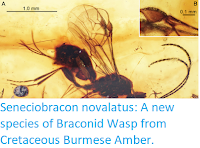
The new species is named Seneciobracon novalatus, where ‘Seneciobracon’ means ‘Old Man Braconid’ and ‘novalatus’ means ‘new wing’. The species is described from a single female specimen, 2 mm in length, from a piece of amber from the Hukawng Valley in Kachin State, northern Myanmar. This species is thought not to belong to any living Braconid group, but rather to a previously unknown, extinct lineage, and is therefore placed in its own separate subfamily, named the Seneciobraconinae.

Photographs of female of Seneciobracon novalatus, in mid-Cretaceous amber from northern Myanmar. (A) Specimen in right lateral view as preserved. (B) Inset detail of pterostigmal region of forewing, depicting small costal cell. Engel et al. (2018).

See also...

http://sciencythoughts.blogspot.co.uk/2014/09/two-new-species-of-braconid-wasps-from.htmlhttp://sciencythoughts.blogspot.co.uk/2014/08/four-new-species-of-braconid-wasps-from.html
http://sciencythoughts.blogspot.co.uk/2014/07/a-new-species-of-braconid-wasp-from.htmlhttp://sciencythoughts.blogspot.co.uk/2014/03/three-new-species-of-braconid-wasps.html
http://sciencythoughts.blogspot.co.uk/2013/11/four-new-species-of-braconid-wasp-from.htmlhttp://sciencythoughts.blogspot.co.uk/2012/06/three-new-species-of-braconid-wasps.html
Follow Sciency Thoughts on Facebook.

Tuesday, 30 September 2014

Two new species of Braconid Wasps, from Papua New Guinea and Baltic Amber.

The Betylobraconinae are a group of Braconid Wasps (small parasitoid Wasps that lack stings and which will lay more than one egg on a host Insect) found in Australia, New Guinea and New Caledonia. They are abundant within their range, but their biology is poorly understood.

In a paper published in the journal Zootaxa on 9 September 2014, Buntika Areekul Butcher of the Department of Biology at Chulalongkorn University, Alejandro Zalvidar-Riverón of the Colección Nacional de Insectos at the Institutode Biología at the Universidad Nacional Autónoma de México, Thomas van de Kamp, Tomy dos Santos Rolo and Tilo Baumbach of the Institute for Photon Science andSynchrotron Radiation at the Karlsruhe Institute of Technology and Donald Quicke, also of the Department of Biology at Chulalongkorn University describe two new species of Betylobraconid Wasps, one from Madang Province in Papua New Guinea and the other from Baltic Amber. Both are placed in the extant genus Mesocentrus.

The Papuan species is given the specific name sasquatch, after the mythical North American creature also known as Bigfoot (why this name was chosen is not explained). Mesocentrus sasquatch is described from a single female specimen 3.5 mm in length, collected in a Malaise Trap (fine net trap) at an altitude of 1700 m on Mount Wilhelm in Madang Province in Papua New Guinea.

Mesocentrus sasquatch in lateral view. Butcher et al. (2014).

The Baltic Amber species is given the specific name palaeoeuropaea, meaning ‘ancient European’. This is a 3.25 mm male specimen preserved in amber and visualised using tomographic scans at the Synchrotron Radiation Facility of the Karlsruhe Institute of Technology, due to the darkness of the amber in which it was preserved. It is the first specimen of a Betylobraconid Wasp from outside the modern distribution area (Australasia), and the oldest known member of the group, as the amber is thought to be at least 44 million years old.

Mesocentrus palaeoeuropaea in lateral view. Butcher et al. (2014).

Mesocentrus palaeoeuropaea in (left) dorsal and (right) ventral views. Butcher et al. (2014).

See also…

Braconid Wasps are small parasitoid wasps (Wasps whose larvae grow inside the bodies of a living animal host) targeting a variety of Insect and Spider species. They are unusual in that they will lay multiple eggs within the same host (most parasitoid Wasps lay a single egg on each host), thereby allowing multiple larvae to mature within a large host, which is...


Braconid Wasps are small parasitic Wasps which can typically lay several eggs on a large host species (typically another Insect or Spider). The larval Wasps grow inside the host, before emerging to pupate on its surface; unusually for parasitic Wasps the host is not usually killed...


 Braconid Wasps are parasitoid Wasps (i.e. Wasps whose larvae mature inside the living bodies of other insects, which generally die as a result) related to the more familiar Ichneumon Wasps, but much smaller. They have a formidable appearance, but are in fact stingless, making them harmless to non-host species. There are about 150 000 known...


Follow Sciency Thoughts on Facebook.


Sunday, 3 August 2014

Four new species of Braconid Wasps from Vietnam.

Braconid Wasps are small parasitoid wasps (Wasps whose larvae grow inside the bodies of a living animal host) targeting a variety of Insect and Spider species. They are unusual in that they will lay multiple eggs within the same host (most parasitoid Wasps lay a single egg on each host), thereby allowing multiple larvae to mature within a large host, which is not necessarily killed in the process. Braconid Wasps are often fearsome in appearance, but are other than to targeted host species as they lack stings. Members of the Subfamily Rogadinae target the caterpillars of Butterflies and Moths, always killing and mummifying the caterpillar in the process.

In a paper published in the journal ZooKeys on 24 July 2014, Khuat Dang Long of the Institute of Ecology & Biological Resources at the Vietnam Academy of Science & Technology describes four new species of Braconid wasps from Vietnam. All are placed in the Rogadinid genus Iporhogas, which has five previously described species from east Asia and one from Africa.

The first new species is named Iporhogas albilateralis, meaning ‘white-sided’, a reference to its colouration. Iporhogas albilateralis is named from three female specimens, one collected from bushes Tam Dao in the northeast of the country, one from a garden on Phu Quoc Island in the south and one from a fruit orchard in Yen Thuy in the northwest. This is a 6.1 mm Braconid Wasp, yellow and black in colour but with distinctive white sides to its abdomen.

Iporhogas albilateralis, female. Long (2014).

The second new species is named Iporhogas contrastus, meaning ‘opposite’, referring to the contrasting colours on its body. Iporhogas contrastus is named from three specimens, one from an orchard in Tan Sonin northwest Vietnam, one from a forest in Lai Nhi Thang, also in the northwest of the country, and one from a forest in Rao An in the north-central part of the country. This is a 6.1 mm Braconid Wasp, with yellow foreparts and black and white hindparts.

Iporhogas contrastus, female. Long (2014).

The third new species is named Iporhogas simulatus, meaning ‘imitate’ or ‘copy’, due to its close resemblance to the previously described Iporhogas guangxiensis. Iporhogas simulatus is described from a single female specimen collected from a forest in A Roang in central Vietnam. It is a 7.5 mm Braconid Wasp, yellow in colour with a black and white abdomen. 

Iporhogas simulatus, female. Long (2014).

The final new species is named Iporhogas tricoloratus, three-coloured. Iporhogas tricoloratus is described from one female specimen collected from a forest in the Phong Nha-Ke Bang National Park in north-central Vietnam, and ten males from across the north of the country. The female is 6.3 mm in length, the males range from 4.5 to 5.2 mm. The species is yellow with a white abdomen with a large brown spot on the dorsal (top) surface and brown rear legs.

Iporhogas tricoloratus, female. Long (2014).

See also…


Braconid Wasps are small parasitic Wasps which can typically lay several eggs on a large host species (typically another Insect or Spider). The larval Wasps grow inside the host, before emerging to pupate on its...


Braconid Wasps are parasitoid Wasps (i.e. Wasps whose larvae mature inside the living bodies of other insects, which generally die as a result) related to the more familiar Ichneumon Wasps, but much smaller. They have a formidable appearance, but are in fact...


Braconid Wasps are parasitoid Wasps (i.e. Wasps whose larvae mature inside the living bodies of other insects, which generally die as a result) related to the more familiar Ichneumon Wasps, but much smaller. They have a formidable appearance, but are in fact stingless, making them harmless to non-host species. There are about...


Follow Sciency Thoughts on Facebook.