Thursday, 3 January 2019

Partial Solar Eclipse to be visible from East Asia and parts of Alaska.

A partial Solar Eclipse will occur on Saturday 5-Sunday 6 January 2019, which will be visible from Japan, Korea, eastern China and parts of the Russian Far East. Part of the eclipse will also be visible from northern China, Mongolia, Siberia, and parts of Alaska, where the Sun will either rise or set part way through the eclipse. The event will occur between 23.34 pm on Saturday and 3.48 am on Sunday, GMT.

The area over which the 5-6 January partial Solar Eclipse will be visible. Areas in darker grey will be able to observe the entire eclipse, in the lighter grey areas the eclipse will either begin before sunrise or end after sunset, so only part of the event will be visible. HMNautical Almanac Office.

Eclipses are a product of the way the Earth, Moon and Sun move about one-another. The Moon orbits the Earth every 28 days, while the Earth orbits the Sun every 365 days, and because the two Sun and Moon appear roughly the same size when seen from Earth, it is quite possible for the Moon to block out the light of the Sun. At first sight this would seem likely to happen every month at the New Moon, when the Moon is on the same side of the Earth as the Sun, and therefore invisible (the Moon produced no light of its own, when we see the Moon we are seeing reflected sunlight, but this can only happen when we can see parts of the Moon illuminated by the Sun).

 The relative positions of the Sun, Moon and Earth during a Solar eclipse. Starry Night.

However the Moon does not orbit in quite the same plane as the Earth orbits the Sun, so the Eclipses only occur when the two orbital planes cross one-another; this typically happens two or three times a year, and always at the New Moon. During Total Eclipses the Moon entirely blocks the light of the Sun, however most Eclipses are Partial, the Moon only partially blocks the light of the Sun.

How the differing inclinations of the Earth and Moon's orbits prevent us having an eclipse every 28 days. Starry Skies.

Although the light of the Sun is reduced during an Eclipse, it is still extremely dangerous to look directly at the Sun, and an eclipse should always be viewed using appropriate equipment. 

Animation showing the shadow of the Moon at five minute intervals on 5-6 January 2019. Andrew Sinclair/HM Nautical Almanac.

See also...

https://sciencythoughts.blogspot.com/2019/01/earth-approaches-perihelion.htmlhttps://sciencythoughts.blogspot.com/2018/12/the-december-solstice.html
https://sciencythoughts.blogspot.com/2018/09/the-september-equinox.htmlhttps://sciencythoughts.blogspot.com/2018/08/partial-solar-eclipse-to-be-visible.html
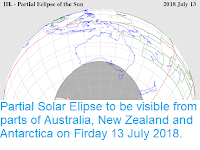
https://sciencythoughts.blogspot.com/2018/07/total-lunar-eclipse-to-be-visible-from.htmlhttps://sciencythoughts.blogspot.com/2018/07/partial-solar-elipse-to-be-visible-from.html
Follow Sciency Thoughts on Facebook.

Hylaecullulus fordi: A new species of Rangeomorph Ediacaran from Charnwood Forest, England.

The Ediacaran Fauna is the first complex macroscopic ecosystem known in the fossil record. It is found in rocks from the Late Ediacaran Period, between about 571 and 541 million years ago, and id dominated by a group of organisms called the Rangeomorphs, which formed fronds or branching structures attached to the substrate by a holdfast. How exactly these organisms lived is unclear, it is thought that their branching structure gave them a large surface area for exchange with the surrounding water, though there is no indication whether they gained nutrients or oxygen in this way. Nevertheless, it is now widely accepted that these organisms were among the first true Metazoan Animals. 

In a paper published in the journal Current Biology on 22 October 2018, Charlotte Kenchington of the Department of Earth Sciences at the University of Cambridge, Frances Dunn of the British Geological Survey and the School of Earth Sciences at the University of Bristol, and Philip Wilby, also of the British Geological Survey, describe a new species of Rangeomorph Ediacaran from Charnwood Forest, England.

The new species is named Hylaecullulus fordi, where ‘Hylaecullulus’ means ‘forest-goblet’, in reference to the shape of the specimens, and ‘fordi’ honours palaeontologist Trevor Ford (1925-2017) of the University of Leicester, for his work on the Ediacaran Fauna. The species is described from six specimens collected from the Ediacaran Bradgate Formation at the Charnwood Forest locality in Leicestershire, England, each of which has a holdfast surmounted by a long stalk then a cluster of branching fronds forming a goblet shape. At least four orders of branching can be seen, with some indication that a fifth was present. Importantly, in Kenchington et al.’s opinion, the specimens all show what they describe as eccentric branches, branches are arranged at random on the specimens, which are oversized compared to neighbouring branches on the same parent branch, and seem to expand to cover a gap in the basket structure.

(A) Specimen GSM105875 (mold), the plastotype (mold of the type, the specimen which is used to define the species; any specimen determined to belong to the same species as the type will be assigned to this species) and largest known example. (B) Interpretive overlay (up to folium level detail) of specimen GSM105875. The dark blue area is the holdfast disc, with dark blue lines outlining its internal rings. Medium blue is its stem, with red lines defining the ‘lineations’ and ‘triangle’. Bright blue outlines the folia. (C) Plastoparatype specimen GSM106040 (mold of a second specimen). (D) GSM105959 (cast). (E) Plastoparatype GSM106112 (cast). (F) GSM105957 (cast), the smallest well-preserved example. (G) GSM 105958 (cast). Scale bars, 2 cm. All molds and casts are held at the British Geological Survey, Keyworth. The interpretative overlay was digitized from a camera lucida interpretation. Kenchington et al. (2018).

Kenchington et al. interpret the eccentric branches as a sign of recovery from injury in Hylaecullulus fordi, something which has not previously been seen in any Ediacaran. The ability to respond to injury, and to grow in a way not preprogramed from the outset, is an important adaptation in a branching modular organism (such as modern Plants or Corals), and provides a way of recovering from damage that is not present in organisms that cannot do this. Such an ability would have made the Rangiomorphs more resilient to predation than has generally assumed to have been the case; the argument has often previously been made that this group became extinct early in the Cambrian because they were unable to cope with grazing by other emerging animal groups.

Increasingly higher-magnification views of the outlined boxed areas; the final image is an interpretative overlay (digitized from camera-lucida drawings) of the penultimate image. GSM106040 (cast) (A), GSM106112 (cast) (B), and GSM105875 (cast) (C) are shown. Scale bars, 2 cm. All casts are housed at the British Geological Survey, Keyworth. Kenchington et al. (2018).

See also...

https://sciencythoughts.blogspot.com/2017/09/looking-for-animals-in-wengan-biota.htmlhttps://sciencythoughts.blogspot.com/2016/05/multicellular-eukaryotic-organisms-from.html
https://sciencythoughts.blogspot.com/2015/11/reinterpretation-of-ediacaran.htmlhttps://sciencythoughts.blogspot.com/2014/11/an-enigmatic-animal-from-australian.html
https://sciencythoughts.blogspot.com/2014/09/a-possible-cnidarian-from-late.htmlhttps://sciencythoughts.blogspot.com/2012/02/oldest-animals-pre-ediacaran-sponges.html
Follow Sciency Thoughts on Facebook.

Wednesday, 2 January 2019

The Quadrantid Meteor Shower.

The Quadrantid Meteor Shower is one of the brightest meteor showers of the year, often producing over 100 meteors per hour at its peak, which falls on the night of 3-4 January each year, and is predicted to peak at about 2.00 am on Friday 4 January 2019; as this is only a few days before the new moon, which falls on Sunday 6 January, visibility for the shower should be very good.. The meteor shower originates in the constellation of Boötes, high in the northern sky, which is slightly confusing, as most meteor showers are named for the constellation in which they originate. This is because the constellation was named in the sixteenth century by astronomer Tycho Brahe, before the introduction of standardised constellations used by modern astronomers, though to make matters a little more confusing, Brahe didn't name the meteors this way either; the name comes from the constellation of Quadrans Muralis, introduced by Joseph Jérôme Lefrançois de Lalande in 1795, and dropped by the International Astronomical Union in 1922. Because Boötes is visible only from the Northern Hemisphere, the Quadrantid Meteor Shower is not visible from the Southern Hemisphere, and is best viewed from northerly locations such as Canada or Scandinavia.

The radiant point of the Quadrantid Meteors (i.e. the point from which the meteors seem to radiate). American Meteor Society.

The Quadrantid Meteors are unusual in that they typically are only visible for a few hours either side of this peak, whereas other showers are typically visible for days or even weeks. This is thought to be because they originate from an asteroid (196256) 2003 EH1, rather than the tail of a comet as with most meteor showers. The orbit of this asteroid is tilted at an angle of 71.9° to the plane of the Solar System, so that the Earth only very briefly passes through the debris trail left by it, rather than remaining in it for some time, as is the case with the trail of a comet with an orbit in roughly the same plane as the Earth.

See also...

https://sciencythoughts.blogspot.com/2018/12/fireball-over-northern-california.htmlhttps://sciencythoughts.blogspot.com/2018/12/the-gemenid-meteor-shower.html
https://sciencythoughts.blogspot.com/2018/11/the-leonid-meteor-shower.htmlhttps://sciencythoughts.blogspot.com/2018/11/southern-taurids-to-peak-on-monday-5.html
https://sciencythoughts.blogspot.com/2018/10/the-orionid-meteors.htmlhttps://sciencythoughts.blogspot.com/2018/10/unusual-inickel-iron-meteorite.html
Follow Sciency Thoughts on Facebook.

Difroehlichia elenae: A new species of Terrestrial Flatworm from Minas Gerais State, Brazil.

New World Terrestrial Flatworms, Geoplanidae, are carnivorous free-living Platyhelminth Worms found in terrestrial habitats. Like other Platyhelminths they have a very simple bodyplan, lacking an internal body cavity which holds the organs or any form of circulatory system or reproductive organs. They have flattened bodies, which allows oxygen absorbed through the skin to reach all the cells, with a simple gut with a single opening that serves as both the mouth and anus. Most Land Flatworms are extremely limited in their environmental tolerances, and consequently have very limited geographical ranges, but a few species have proved to be much more tolerant and have become highly invasive pest species.

In a paper published in the journal PeerJ on 4 December 2018, Ana Leal-Zanchet and Alessandro Damasceno Marques of the Instituto de Pesquisas de Planárias at the Universidade do Vale do Rio dos Sinos, describe a new species of Terrestrial Flatworm from Minas Gerais State in Brazil.

The new species is described from a single specimen assessed to be a member of the New World Terrestrial Flatworm Family Geoplaninae, on the basis of its subcylindrical body, poorly developed sub-epidermal musculature and a narrow creeping sole. However, it could not be assigned to any previously described genus within that family, and is therefore placed in a new genus, named Difroehlichia, in honour of Claudio Froehlich and the late Eudóxia Froehlich, for their work on the study of terrestrial Flatworms, and given the specific name elenae, in honour of the late Elena Diehl, for her studies of the Ants and Termites of southern Brazil.

Difroehlichia elenae is dark brown in colour and has a length of 13.5 mm and width of 1.5 mm. It has eyes along the margins of both sides of its body, with the exception of the very tip; these are small and monolobate towards the front of the animal and larger and trilobate along the majority of the body, becoming sparse towards the rear. The body is divided into two parts by a muscular, cylindrical pharynx, which is where the mouth is located.

Difroehlichia elenae, general dorsal view of preserved specimen. The arrow indicates the anterior extremity. Leal-Zanchet & Marques (2018). 

The specimen was found in the entrance to a cave in banded ironstone in an area of cerrado grassland, with a laterite soil and numerous rocky outcrops at the eastern margin of the Serra do Espinhaço Plateau, during the rainy season (November). It appeared to have recently mated and produced eggs, and it is possible that it had come to the cave for this purpose.

Entrance of the ferruginous cave at the basis of a vertical slope in rocky outcrop in the Brazilian where Difroehlichia elenae was discovered. Leal-Zanchet & Marques (2018).

See also...

https://sciencythoughts.blogspot.com/2017/10/rhinebothrium-reydai-new-species-of.htmlhttps://sciencythoughts.blogspot.com/2016/08/cratera-viridimaculata-new-species-of.html
https://sciencythoughts.blogspot.com/2015/03/a-trematode-flatworm-from-intestines-of.htmlhttps://sciencythoughts.blogspot.com/2014/10/parasite-infections-in-german-soldiers.html
https://sciencythoughts.blogspot.com/2014/07/a-new-species-of-liver-fluke-from.htmlhttps://sciencythoughts.blogspot.com/2013/06/fossil-tapeworm-eggs-from-permian.html
Follow Sciency Thoughts on Facebook.

Earth approaches perihelion.

On Thursday 3 January 2019 at 5.21 am, GMT, the Earth will reach its perihelion; the closest point on its orbit to the Sun, when it will be 147 099 760 km from the Sun. This is because the Earth's orbit is not a perfect circle, but varies by 3.3% over the course of a year. The Earth will reach its furthest point from the Sun, at a distance of 152 095 566 km, at 5.46 pm GMT on 6 July 2016. This perihelion distance varies each year; in 2018 the Earth reached 147 097 233 from the Sun and in 2020 it will reach 147 084 627. 

The Earth's Aphelion and Perihelion. My Dark Sky.

This means that the Earth is at its closest to the Sun in the middle of the Northern Hemisphere's winter, counter-intuitive to most of the planet's population. This is, however, purely coincidental; the Earth's season's are not caused by its distance from the Sun, which only varies by 3.3%, but rather by the tilt of the planet. The Earth is currently tilted at an angle of 25.5° to its plane of orbit (this varies on a timescale of tens of thousands of years, but remains fixed from the point of view of any human observer), causing the Sun to appear to rise higher and lower in the skies of each hemisphere as the year goes by. In the northern winter the Southern Hemisphere is tilted towards the Sun, so that the days are longer there (and in around the Southern Solstice in December, permanently above the horizon at the South Pole). In addition the Sun being directly overhead means that the energy from the Sun has to pass through less of the atmosphere before it reaches the surface of the Earth, so that less energy is lost to the atmosphere, causing the surface to warm.

 How the tilt of the Earth relative to its plane of orbit causes the seasons. ESA.

See also...

https://sciencythoughts.blogspot.com/2018/12/the-december-solstice.htmlhttps://sciencythoughts.blogspot.com/2018/09/the-september-equinox.html
https://sciencythoughts.blogspot.com/2018/08/partial-solar-eclipse-to-be-visible.htmlhttps://sciencythoughts.blogspot.com/2018/07/total-lunar-eclipse-to-be-visible-from.html
https://sciencythoughts.blogspot.com/2018/07/partial-solar-elipse-to-be-visible-from.htmlhttps://sciencythoughts.blogspot.com/2018/06/northern-solstice-2018.html
Follow Sciency Thoughts on Facebook.

Tuesday, 1 January 2019

Fifteen dead and twenty missing in West Java landslide.

Fifteen people are now known to have died and another twenty are still missing following a landslide in Java on Monday 31 December 2018. The incident happened amid heavy rainfall, late in the afternoon, when part of a hillslope collapsed onto the village of Sirnaresmi in Sukabumi District, West Java, covering the area in up to four metres of mud. Around sixty people have been evacuated from the village, but ongoing rainfall is hampering attempts to find more survivors or bodies.

Rescue workers at the scene of the 31 December 2018 Sirnaresmi landslide. AP.

Landslides are a common problem in Java, particularly during the Northeast Monsoon, which lasts from November to February, with peak rainfall in January and February, and can result in an annual rainfall of around of 4000 mm in parts of Central Java. This problem has been made worse as expanding populations has led to people farming higher on hillslopes, in an area where soils tend to be volcanic in action and poorly consolidated (i.e. lack much cohesion), making them more prone to landslides.

 The approximate location of the 31 December 2018 Sirnaresmi landslide. Google Maps.

Monsoons are tropical sea breezes triggered by heating of the land during the warmer part of the year (summer). Both the land and sea are warmed by the Sun, but the land has a lower ability to absorb heat, radiating it back so that the air above landmasses becomes significantly warmer than that over the sea, causing the air above the land to rise and drawing in water from over the sea; since this has also been warmed it carries a high evaporated water content, and brings with it heavy rainfall. In the tropical dry season the situation is reversed, as the air over the land cools more rapidly with the seasons, leading to warmer air over the sea, and thus breezes moving from the shore to the sea (where air is rising more rapidly) and a drying of the climate.

 Diagrammatic representation of wind and rainfall patterns in a tropical monsoon climate. Geosciences/University of Arizona.

Java has two distinct Monsoon Seasons, with a Northeast Monsoon driven by winds from  the South China Sea that lasts from November to February and a Southwest Monsoon driven by winds from the southern Indian Ocean from March to October. Such a double Monsoon Season is common close to the equator, where the Sun is highest overhead around the equinoxes and lowest on the horizons around the solstices, making the solstices the coolest part of the year and the equinoxes the hottest. 

The winds that drive the Northeast and Southwest Monsoons in Southeast Asia. Mynewshub.

See also...

https://sciencythoughts.blogspot.com/2018/12/hundreds-dead-after-krakatau-eruption.htmlhttps://sciencythoughts.blogspot.com/2018/02/landslide-kills-at-least-seven-in.html
https://sciencythoughts.blogspot.com/2018/02/flooding-and-landslides-kill-at-least.htmlhttps://sciencythoughts.blogspot.com/2017/12/magnitude-65-earthquake-beneath-west.html
https://sciencythoughts.blogspot.com/2017/10/landslide-kills-four-in-west-java.htmlhttps://sciencythoughts.blogspot.com/2017/02/thousands-of-homes-flooded-in-jakarta.html
Follow Sciency Thoughts on Facebook.