Friday, 29 July 2022

Reinterpreting the Chalcolithic Rinaldone burials of Central Italy.

It has been a long held opinion among archaeologists that social inequality in Europe first appeared during the Chalcolithic (or 'Copper Age') and Early Bronze Age. Prior to this, in the Late Neolithic, communal burials seem to have been the norm across Europe, but in the Chalcolithic and Early Bronze Age a new trend appeared; communal burials were still common, but alongside these were individual burials, typically of males, accompanied by grave goods including metal and non-metal weapons.

This trend appears to start with the Maikop Culture of the Caucasus Region between about 3700 and 3000 BC, and Bell Beaker Culture, which spread across Europe from about 2800 BC, and has been interpreted as a sign that these were high status individuals, either warriors who had achieved high status in battle, or chieftans whose status was based upon the control of resources. 

However, in recent years, many archaeologists have challenged this, arguing that such assumptions are based upon modern ideas of prestige and personhood, which are not applicable to many non-European cultures, and may not be the best model for these early Europeans. The majority of this work has centred on the re-evaluation of 'warrior burials' in Britain and Northern Europe, where the shift from communal to individual burials is quite sudden. 

This change in funerary practices also occurred in Southern Europe, but in a more gradual way, something which has largely been overlooked by modern archaeologists. For example, the Chalcolithic Rinaldone Culture of Central Italy, which lasted from about 3650 to about 2200 BC, produced multi-chambered tombs, with chambers holding single and multiple burials within the same complex, apparently providing an intermediate phase that predates the appearance of single 'warrior graves' in Northern Europe.

In a paper published in the journal World Archaeology on 8 February 2022, Andrea Dolfini of the School of History, Classics and Archaeology at Newcastle University re-examines the Rinaldone Culture's burial customs, with an emphasis on the Rinaldone and Casetta Mistici funerary sites, and proposes a new interpretation of these sites.

The prevalent theory about the origin of Chalcolithic 'warrior graves' throughout much of the twentieth century was that these marked the arrival of invaders from the Eurasian steppes who quickly subdued the largely peaceful local population with superior, metal-based weapons technology, setting themselves up as a new ruling caste. However, from the 1970s onwards this idea was replaced by a new concept, that the development of metal technologies in Europe allowed for the development of a more divided society without the need for any invaders, as the rarity and high value of metal allowed those who controlled its supply to set themselves up as rulers over the rest of the population. However, recent genetic studies of individuals from the Bell Beaker and Corded Ware (roughly 3000-2350 BC) cultures has suggested that these cultures did in fact have an influx of new genetic material compared to earlier inhabitants of the same area. This has brought the Eurasian invader theory back into favour, with many arguing that these invaders came from the Yamnaya Culture of the Pontiac Steppes (roughly 3300-2600 BC), who are also theorised to have brought with them Indo-European languages, although this fails to explain how the oldest 'warrior graves' predate the origin of this culture.

The Rinaldone Culture of Central Italy appeared in the middle of the fourth millennium BC, directly replacing Late Neolithic cultures in the same area, and marking the earliest example of metal-production in Italy. Unlike the cultures that preceded it, the Rinaldone Culture apparently made a clear distinction the dead and the living, building elaborate funerary complexes and engaging in elaborate mortuary rights.

Rinaldone cemeteries typically consist of small groupings of graves, each of which was a low-vaulted underground chamber, reached through an entrance shaft and closed of with a wooden or stone slab. Each grave could contain up to ten individuals, who might be articulated, disarticulated, or actively reorganised. Multiple burials typically contained a mixture of male and female individuals of all ages, although infants appear to be under-represented.

The funeral process was a long one, and strange to modern thinking. Bodies were initially placed intact within the grave, on their back or side, and often accompanied by some grave goods. The grave was returned to at a later date, and the now dry remains broken up, with some or all of the parts being removed from the grave. Finally, the remains were returned to the graves and either placed onto stacks of bones, or arranged around new burials. Grave goods, including food and drink, could be placed with articulated bodies or bone piles, or left in the corridor leading to the chamber. 

Grave goods varied depending on the age and gender of the person being buried. Adult males typically received copper and stone weapons, including daggers, maces, and axes. Women and children were given beads and jewellery made from silver, antimony, and soft stone, as well as flint blades and/or scrapers and arrowheads. Burials of both genders and all ages were accompanied by copper awls and flasks of a mead-like alcoholic drink.

Some of these tombs contained what would elsewhere be recognised as Chalcolithic 'warrior graves'; individual burials of adult males who were typically buried with weapons, and then sealed, never to be disturbed. The two sites examined by Dolfini, Rinaldone and Casetta Mistici, show an unusually high number of these 'warrior graves'. 

Map of central Italy showing sites associated with the Rinaldone culture. (1) Rinaldone, (2) Casetta Mistici, (3) Ponte San Pietro, (4) Fontenoce di Recaniti, (5) Marcellina-Vasoli, (6) Lunghezzina. Hollow circles represent modern cities. Dolfini (2022).

Rinaldone, which gives its name to the culture, lies between Lake Bolsena and the River Tiber, and comprises sixteen chamber graves with entrance corridors facing towards the southwest. The graves are arranged in two clusters, one containing thirteen graves, and the other three. Seven of the burial chambers at Rinaldone contain 'warrior graves', adult males buried with copper and stone weapons, six in the main cluster and one in the smaller cluster. One of the burials in the larger cluster also contains reorganised bones from other burials. Between them these graves contain six copper-alloy objects, two stone maceheads, 22 flint arrowheads, and a ceramic flask, one of the largest collections of grave goods from the Italian Chalcolithic. The graves have been dated to between 3650 and 3350 BC, based upon the manufacturing style of the objects present.

Objects collected from the Rinaldone 'warrior graves'. Museo delle Civiltà in Dolfini (2022).

As well as the 'warrior graves', the Rinaldone site also contains a grave with two sets of articulated remains, accompanied by four arrowheads, and a grave with the reorganised bones from an indeterminate number of individuals, accompanied by eight arrowheads, and a few potsherds. The site also contains five empty graves, two of which still contain grave goods; four arrowheads in one and an axe/hammer in the other. While the acid soil at the site had damaged all of the skeletons to some extent, skeletons are unlikely to have completely disappeared, and the site was excavated by competent archaeologists unlikely to have overlooked even the most fragmentary of Human remains. This leaves two possibilities; either the graves were never used, and what we interpret as grave goods were placed into the empty chambers for some reason unclear to us, or bodies (and possibly other goods) were placed into these chambers, and subsequently removed.

The Casetta Mistici site lies on the outskirts of Rome, and was excavated in 2005-6. The site comprises seven underground chambers, arranged in a tight cluster, with entrances facing to the south, and two later trench graves. The chamber burials have been radiocarbon dated to between 3650 and 3350 BC, although one of these graves contains a body which was apparently added later. One of the trench graves directly overlies one of the chamber burials (this is is thought to have been intentional) and was dug between 3540 and 3350, while the second dates from the early third millennium BC and has partially cut into another grave chamber, causing it to collapse.

Plan of the Casetta Mistici cemetery. Anzidei, Carboni, & Mieli (2020), reprinted in Dolfini (2022).

Other than the chamber which had a body added later, all of the graves contain a single body. Five of these contained children under twelve years old, four buried without any grave goods, the fifth with a copper awl, two stone beads, and a pendant made from the canine tooth of a large Canid. One of the graves contains a woman between the ages of 40 and 49, buried with a copper awl, a short flint blade, two arrowheads, and some pottery fragments. Notably, this woman showed signs of a blunt force trauma to the head at about the time she died, suggesting that she may have died a violent death. The two individuals sharing a grave are both between 13 and 19, and buried without goods. The remaining two graves contain individuals between 30 and 39, one of whom was buried with an impressive selection of grave goods. This includes five metal items, one of which is an axe of a type associated with the Levantine region, and otherwise unknown from Italy. Analysis of the lead isotopes present in this axe suggest it does come from outside of Italy. As well as the metal goods, this grave contained a finely knapped bifacial dagger, a long flint knife, ten arrowheads and a bone awl.

Items from a single chamber at Casetta Mistici. Anzidei, Carboni, & Mieli (2020), reprinted in Dolfini (2022).

'Warrior graves' are also known from several other Rinaldone burial sites, including Marcellina-Visoli, where a single 'warrior grave' is unaccompanied by other burials, Ponte San Pietro, where a large cemetery contains two 'warrior graves' among numerous other burials, Lunghezzina, where a single 'warrior grave' is present among other burials, and Fontenoce di Recaniti, where there are several 'warrior graves', but metal goods are rare. 

The appearance of these single graves with apparently valuable grave goods has generally been interpreted as the dawn of a new age of material culture in Italy, combined with the rise of new concepts of male dominance and power. This perception has, however, undergone several revisions over time. In the 1950s it was proposed that the Rinaldone culture marked the arrival of invading warrior-shepherds from the east, who set themselves up as rulers over the local population, establishing dynasties that would go on to become bronze-age aristocracies. From the 1970s onwards it has been argued that these burials represented the emergence of a local aristocracy, who gained power by securing control over resources such as metals and imported goods, although possibly without any concept of inheritance, so that each successful leader would have his accumulated wealth buried with him, rather than passing it on (although the presence of some children buried with lavish grave goods has been cited as evidence against this theory). It has also been noted that the Rinaldone burial sites tend to be located on fertile alluvial plains, possibly indicating that an emerging land-holding elite was using the location of burial grounds to lay claim to high quality farmland.

Dolfini has previously examined the nature of the burials at the Rinaldone sites, noting that a small number of men (and an even smaller number of women and children) were given single step burials, accompanied by grave goods, while the majority of the population were given multi-step burials, during which bodies were broken up and mixed with other remains over time, causing them to lose their individual identities. This led him to conclude that the single, undisturbed, burials were a mark of individuals having achieved some level of power and status meriting special treatment. 

All of these hypotheses make the assumption that the 'warrior graves' mark the appearance of a new elite caste, who were somehow able to gain control over resources, and whose burial marked them out as special, something which Dolfini now questions.

Dolfini starts his re-evaluation by questioning whether the goods placed within the 'warrior graves' were genuinely richer than those placed within other burials. We can see the value of the goods placed within the 'warrior graves' because they have largely remained there until uncovered by modern archaeologists. However, other graves were re-opened, probably several times, as part of a complex, multi-stage funerary process, during which parts of the body were removed and placed elsewhere. This removal of parts of the body makes it quite plausible that goods buried along with the body were also removed. 

This can clearly be demonstrated with ceramic vessels, as there is evidence of such vessels being buried with the dead, then smashed when people re-entered the tomb, with most of the fragments being removed, and some of them subsequently re-buried with the disarticulated body parts, and Dolfini believes that is likely to have been the case for other grave goods.

Another piece of evidence cited by Dolfini is the presence of occasional weapons in chambers with rearranged bones, or no burial at all. When found, these weapons are either alone or parts of small collections scattered over the floor apparently at random, rather than arranged in a precise pattern about the dead, as is the case in 'warrior graves', something which has been interpreted as evidence of evidence of collections of weapons being broken up and scattered at the same time as the bodies were dismembered.

Dolfini argues that it is the preconceptions of archaeologists and anthropologists, and in particular the tendency to try to interpret 'primitive' cultures through the lens of colonial studies of Polynesian and New Guinean societies, is likely to have led to a flawed interpretation of the Ridaldone burials and the customs surrounding them. 

He observes that the 'warrior burials' seen from five thousand years later, seem to have been the most important burials produced by the Rinaldone culture, but that in fact these were the most simple burials produced by these people. The 'warrior graves' contain an individual placed in a grave, which was then sealed and apparently forgotten, while other grave sites were re-opened numerous times and the remains within interacted with by the people in them. Dolfini theorises that it may be this ongoing ritual involvement with the community that may signal status within the community, rather than the presence of grave goods.

Many of the assumptions made about the status of 'warrior graves' relate to the perceived value and rarity of copper metal. It has been assumed that such items were rare objects, requiring considerable skill and technological know-how to produce, and that they are therefore valuable items which could have been hoarded by an emerging elite class. 

However, while the conceptual leap needed to smelt copper from ore is a big technological step up from the Neolithic, once this step has been made the smelting process is not particularly difficult (i.e. people who had seen the process were likely to be able to reproduce it). Furthermore, the production of copper items once you have copper requires considerably less skill than making similar items from stone. 

The apparent rarity of copper items probably stems not from the difficulty of making them, but from the fact that copper is recyclable. Once a flint blade is broken it must be discarded, and new flint collected to make a new blade, but if a copper blade is broken it can be melted and used to make a new blade, leading to far less discarded items entering the archaeological record. Analysis of bones and other material from Chalcolithic sites in Italy suggests that the use of copper tools was usual for ordinary domestic tasks.

The importance of trade as a source of wealth in the Chalcolithic may also have been over-stated. In the Late Neolithic Italian communities are known to have been plugged into very extended trade networks, with valued materials such as obsidian from Lipari and Greenstone from the Alps being traded thousands of kilometres from their source. In the Chalcolithic, these networks seem to have disappeared, with few materials being found more than 200 km from their source. 

If the Rinaldone 'warrior graves' do not contain important leaders, the question of who they were still remains. The presence of grave goods, while it may not be a sign of wealth, is clearly not a sign of poverty or social exclusion, suggesting that these people did have some status in the society they lived in. Rinaldone suggests that these burials may have been those of people (usually male) who either died violent deaths or lived violent lives, noting that many societies in different parts of the world have associated violent death with vengeful spirits, and developed a variety or rituals aimed at protecting themselves from said spirits. 

A person who had been somehow tainted by violent death could well be buried with personal effects (particularly weapons) which had also become tainted. It is also quite conceivable that other members of the community might leave weapons in a burial to placate the dead, or that the weapons of their enemies might be buried with them. However, once the dead were laid in their burial chamber, the tomb would then be sealed permanently, with no-one wishing to risk re-entering.

Dolfini theorises that such practices could be applied both to male warriors of particular ferocity (which would account for the overwhelming majority of 'warrior graves' containing male bodies, both in the Rinaldone culture and elsewhere in Europe), but also those that had died violent deaths at the hands of another. He suggests that the woman from Casetta Mistici may have been an example of this, as she shows signs of having died of a blunt force trauma, and was sealed in a burial chamber which was not subsequently disturbed. He further notes that a male burial from Marcellina-Vasoli had a copper arrowhead embedded in his tibia, and that other deaths by violence might not be detectable from skeletal remains (Ötzi the Iceman is known to have died as a result of an arrowshot, but has no marks on his bones).

Cross section of the tomb of a woman from Casetta Mistici who had apparently died a violent death, and was sealed in a tomb which was never re-entered. Dolfini (2022).

Dolfini questions the long-held assumption that the 'warrior graves' of the Rinaldone tradition held high-status individuals along with symbols of their wealth. He instead suggests that these individuals may have received different treatment in death because they were in some way tainted by deeds or circumstance in life, preventing them from being allowed the usual funerary rites. 

This claim relies heavily upon the idea that the goods found with these burials were not of outstanding value, and that other members of the community may have been buried with items of equal value, which were subsequently removed. Central to this review is a reassessment of the value of copper to Chacolithic communities. If it was genuinely rare, as has previously been assumed, then prior claims about the status of the 'warrior grave' internments are probably valid. But if, as Dolfini suggests, copper was a relatively abundant resource, then its inclusion in grave goods would be relatively unimportant, and these burials must be judged by their exclusion from the more usual burial customs of the day.

Dolfini does not attempt to suggest that important leaders were absent from Chalcolithic communities, but rather that it would not necessarily be possible to identify them via their graves. Such individuals could well have been buried with extensive grave goods, but in a community that valued post-mortem interactions between the living and the dead, such goods could well have subsequently been removed from the grave and distributed among the community for ritual or practical use, while the body eventually reached its rightful final destination, broken up and mixed in with the bones of the community they lead.

See also...


Follow Sciency Thoughts on Facebook.

Follow Sciency Thoughts on Twitter. 


Tuesday, 26 July 2022

Magnitude 5.4 Earthquake in Hormozgan Province, Iran.

The United States Geological Survey recorded a Magnitude 5.4 Earthquake at a depth of 10.0 km roughly 51 km to the northeast of the port of Bandar-e Lengeh in Hormozgan Province, Iran, slightly after 4.05 pm local time (slightly after 8.35 pm GMT) on Saturday 23 July 2022. There are no reports of any damage or casualties associated with this event, but many people in the United Arab Emirates reported feeling it.

The location of the 23 July 2022 Hormozgan Province Earthquake. USGS.

Iran is situated on the southern margin of the Eurasian Plate. Immediately to the south lies the Arabian Plate, which is being pushed northward by the impact of Africa from the south. This has created a zone of faulting and fold mountains along the southwest coast of the country, known as the Zagros Thrust Belt, while to the northeast of this the geology is dominated by three large tectonic blocks, the Central Iran, Lut and Helmand, which move separately in response to pressure from the south, stretching and compressing the rock layers close to the surface and creating frequent Earthquakes, some of which can be very large.

The movement of the Arabian Plate and extent of the Zagros Thrust Belt. Rasoul Sorkhabi/Geo ExPro.

To the northeast of this the geology is dominated by three large tectonic blocks, the Central Iran, Lut and Helmand, which move separately in response to pressure from the south, stretching and compressing the rock layers close to the surface and again creating frequent Earthquakes.

The population of Iran is particularly at risk from Earthquakes as, unlike most other Earthquake-prone nations, very few buildings in the country are quake-resistant. The majority of residential buildings in Iran are made of mud-brick, a building material particularly vulnerable to Earthquakes as the bricks often liquefy, trapping people inside and quickly asphyxiating them with dust. This is particularly dangerous at night when the majority of people are inside sleeping.

Section through the Zagros Fold Belt. Sarkarinejad & Azizi (2007).

See also...

Follow Sciency Thoughts on Facebook.

Follow Sciency Thoughts on Twitter. 


Barkeriella museensis: A new species of Systellommatophoran Slug from the tropical Afromontane greenhouse of the Science Museum of Trento, northern Italy.

Botanical gardens, Plant nurseries, and similar facilities are well known reserves of xenodiversity (diversity based upon introduced, non-local species). Such environments have been a route through which a wide range of Invertebrates, Micro-organisms, Fungi, and Plants are known to have spread from such centres into new environments, leading many countries to have introduced tight legislation around the importing of Plants and soil. In recent years taxonomists have described a number of new species from botanical gardens, including Fungi, Wasps, Gastrotrichs (four of the 800 species described within this group, or 0.5% of their total diversity), Arachnids, Insects, and Molluscs.

In a paper published in the Zoological Journal of the Linnean Society on 26 July 2022, Giuseppe Manganelli of the Dipartimento di Scienze Fisiche, della Terra e dell’Ambiente at the Università di Siena, Andrzej Lesicki of the Department of Cell Biology at the Adam Mickiewicz University in Poznan, Andrea Benocci of the Museo di Storia Naturale dell’Accademia dei Fisiocritici, Debora Barbato, also of the Dipartimento di Scienze Fisiche, della Terra e dell’Ambiente at the Università di Siena, Dannio Miserocchi of Ravenna, Joanna Pieńkowska, aslo of the Department of Cell Biology at the Adam Mickiewicz University in Poznan, and Folco Giusti, again of the Dipartimento di Scienze Fisiche, della Terra e dell’Ambiente at the Università di Siena, describe a new species of Slug from the tropical Afromontane greenhouse of the Science Museum of Trento, northern Italy.

The new species is described from a population found living in the greenhouse in January and May 2019, but which could not be refound in February 2022. During the intervening time the part of the greenhouse where the Slugs were found was restructured, and the entire greenhouse suffered an infestation with burrowing Suriname Cockroaches, Pycnoscelus surinamensis, and it is believed the population is now extinct. 

An initial examination of the Slugs quickly revealed that they had transverse ridges on the foot, indicating that they did not belong to the Order Stylommatophora, the most numerous and diverse group of Pulmonate Gastropods, but rather the less numerous Order Systellommatophora. Members of the Systellommatophora are all Slug-like forms lacking shells, and are exclusively hermaphroditic. They are considered to be a sister group to the Stylommatophora, with the two groups together forming the clade Geophila. 

The Order Systellommatophora comprises three families. The Onchidiidae are large, oval-to-round, predominantly semi-marine Slugs, with a single pair of tentacles, found throughout the coastal zones of the temperate, subtropical, and tropical oceans, but most diverse and abundant in the eastern Indian Ocean and tropical western Pacific. The Veronicellidae are medium-to-large sized, dorsoventrally flattened, elongate Slugs, with leathery backs and two pairs of tentacles, found throughout the tropics and subtropics, although favouring moist climates and most abundant and diverse in primary and secondary rainforests. The Rathouisiidae are small, slender, typically keeled, carnivorous Slugs, with two pairs of tentacles, found in Southeast Asia and Australasia. 

The new Slug is a small, slender species with four pairs of tentacles, which shares many features associated with the Rathouisiidae. However, the species also has a number of unique features which prevent it being placed into any currently described Rathouisiid genus, most notably the structure of the reproductive system, considered important in the classification of Gastropods, prompting Manganelli et al. to place it in a new genus.

The new species is named Barkeriella museensis, where 'Barkeriella' honours New Zealand Gary Barker for his work on  terrestrial Gastropods, and 'museensis' means 'coming from MUSE', where MUSE is an abbreviation commonly used for the Science Museum of Trento.

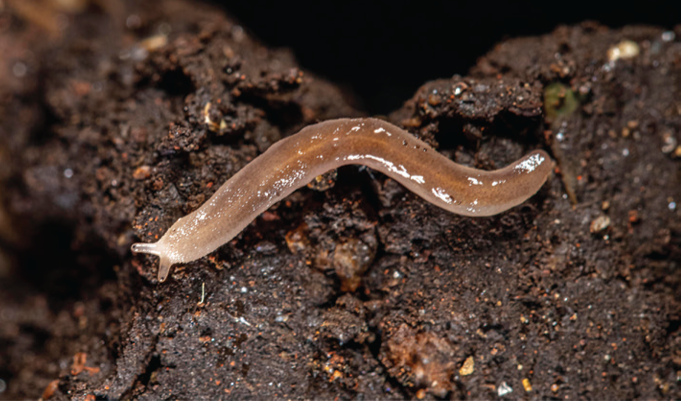
Live specimen of Barkeriella museensis from the tropical greenhouse of the Science Museum of Trento, Italy. Debora Barbato in Manganelli et al. (2022).

Barkeriella museensis is a small Slug, at most 20 mm in length and no more than 3 mm in width. It has a rounded body, whitish in colour with a grey band on each side, separated by a white line marking the trace of a keel. There are two pairs of tentacles, with the upper being longer and tending to have a pinkish hue. The foot is elongate.

The origin of Barkeriella museensis is unclear. The given the known range of the Rathouisiidae, it is unlikely that the species originates in the montane forests of Africa. However, the Afromontane greenhouse of the Science Museum of Trento is known to contain species of non-African origin, chosen for their close resemblance to African species which were not available, and the majority of Plants in the greenhouse were sourced from other collections or commercial dealers in Italy anyway.

There are currently four known genera of Rathouisiids (excluding Barkeriella), each with its own distribution. The genus Rathouisia, which gives its name to the group as a whole, is known from southeastern China, and possibly South Korea. The genus  Atopos is known from Southeast Asia, Indonesia, New Guinea, and northern Australia. The genus Granulilimax contains a single species from Japan, with another genus known, but never formally named or described, from the Ryukyu Islands.

Theoretically, if the relationship between Barkeriella and these other genera could be established, then it might be possible to estimate its point of origin. Unfortunately the GenBank database, an open access database of gene sequences containing data from more than 500 000 species of species of Animals and Plants, contains only a limited number of sequences from the genera Atopos and Granulilimax, and none from Rathouisia, despite this being the largest genus in the family. In order to remedy this Manganelli et al. uploaded sequences from key parts of the genomes of both Barkeriella museensis and Rathouisia sinensis. Unfortunately none of the sequences available were close enough to Barkeriella museensis to shed any light on its point of origin.

See also...

Follow Sciency Thoughts on Facebook.

Follow Sciency Thoughts on Twitter. 


Monday, 25 July 2022

Evacuations ordered after eruptions on Mount Sakurajima, on Kyūshū Island, Japan.

Authorities in Kagoshima Prefecture have issued an evacuation order to people living within 3 km of Mount Sakurajima, a 1117 m high stratovolcano (cone-shaped volcano made up of layers of ash and lava) on Kyūshū Island, Japan, following a series of large eruptions. The Japan Meteorological Agency (which is also responsible for monitoring volcanic and seismic threats in Japan) began detecting ground deformation around the volcano on 18 June 2022, but there were no major seismic events (Earthquakes) prior to the onset of eruptions. The volcano erupted four times on Saturday 23 and Sunday 24 July, producing columns of ash and gas up to 1.2 km high, and throwing rocks as far as 3 km from the Minimidake crater, mostly towards the south and southeast. A smaller eruption occurred at about 6.00 am local time on Monday 25 July, producing another ash column, this time about 2.2 km high, and the volcano shows no sign of ceasing activity.

Eruption on Sakurajima Volcano at 8.05 pm local time on Sunday 24 July 2022, from an unmanned, fixed point camera. Kyodo News.

Japan has a complex tectonic situation, with parts of the country on four different tectonic plates. Kyūshū Island lies at the northeast end of the Ryukyu Island Arc, which sits on top of the boundary between the Eurasian and Philippine Plates. The Philippine Plate is being subducted beneath the Eurasian Plate, in the Ryukyo Trench, to the Southeast of the Islands. As it is drawn into the interior of the Earth, the tectonic plate is partially melted by the heat of the Earth's interior, and liquid magma rises up through the overlying Eurasian Plate to form the volcanoes of the Ryukyu Islands and Kyūshū.

The movement of the Pacific and Philippine Plates beneath eastern Honshu. Laurent Jolivet/Institut des Sciences de la Terre d'Orléans/Sciences de la Terre et de l'Environnement.

See also...

Follow Sciency Thoughts on Facebook.

Follow Sciency Thoughts on Twitter. 


Fireball meteor over the Deux-Sèvres Department of France.

Witnesses across much of central and western France have reported observing a bright fireball slightly before 6.20 pm local time (slightly before 8.20 pm GMT) on Wednesday 20 July 2022. The fireball is described as having moved from southeast to northwest, with witnesses between La Rochelle and Poitiers also reporting hearing the event.. A fireball is defined as a meteor (shooting star) brighter than the planet Venus. These are typically caused by pieces of rock burning up in the atmosphere, but can be the result of man-made space-junk burning up on re-entry.

Heat map showing areas where sightings of the meteor were reported (warmer colours indicate more sightings), and the apparent path of the object (blue arrow). American Meteor Society.

Objects of this size probably enter the Earth's atmosphere several times a year, though unless they do so over populated areas they are unlikely to be noticed. They are officially described as fireballs if they produce a light brighter than the planet Venus. The brightness of a meteor is caused by friction with the Earth's atmosphere, which is typically far greater than that caused by simple falling, due to the initial trajectory of the object. Such objects typically eventually explode in an airburst called by the friction, causing them to vanish as an luminous object. However, this is not the end of the story as such explosions result in the production of a number of smaller objects, which fall to the ground under the influence of gravity (which does not cause the luminescence associated with friction-induced heating).

These 'dark objects' do not continue along the path of the original bolide, but neither do they fall directly to the ground, but rather follow a course determined by the atmospheric currents (winds) through which the objects pass. Scientists are able to calculate potential trajectories for hypothetical dark objects derived from meteors using data from weather monitoring services.

See also...

Follow Sciency Thoughts on Facebook.

Follow Sciency Thoughts on Twitter. 


Sunday, 24 July 2022

Mesolithic microliths from Gujarat State, India.

The term 'microlith' was first coined by the English archaeologist Archibald Campbell Carlyle, to describe small retouched stone blades generally thought to have been part of a larger tool, while he was working in the Vindhya Hills of central India in the 1860s. Here these items were produced from about 45 000 years ago onwards, with Pleistocene examples being referred to as 'Late Palaeolithic' and Holocene examples as 'Mesolithic'. The term was later applied to a wide range of similar small tools at sites around the world, and became the defining tool for separating Mesolithic from earlier technologies. 

The term is now used to cover a wide range of small stone tools with a wide variety of uses, with a confusing variety of descriptions. These tools appear at different times in different places, but are found on every inhabited continent by the end of the Pleistocene. The use of these tools persisted through the Neolithic and Bronze ages, and in some parts of the world into the modern era, making their use as a dating tool limited without a good understanding of local history.

In India, these tools were used by a wide range of semi-nomadic peoples engaging in hunting, gathering, fishing, and foraging, over a long time period that saw the arrival of the first Human inhabitation of the Ganga plains, the West Bengal delta, the Indian west coast and Kerala. Microlithic tools appear to have been used for a huge range of activities during this time, but there was no single microlith-producing culture or technology, but rather a vast range of peoples making and using microlithic tools over a long period of time.

The Thar Desert, which covers large areas of Rajastan and Gujarat states in India and Sindh Province in Pakistan, contains thousands of relic dunes (dunes which have no present day source of sand) with scatters of microlithic tools on their tops. These dunes typically overlook bodies of water, such as lakes or rivers, and which may be permanent or seasonal. Studies of the local geography suggest that these waterways date to the latest Pleistocene, at which time the dunes were still active. This was associated with the development of a wetter climate, with higher rainfall and increased vegetation, which in turn stabilised the dunes. This wetter climate appears to have attracted the first hunter gatherers into the area, resulting in the microliths on the dune tops.

This was not a simple change from a dry to a wetter climate, but a gradual process with bodies of water appearing and then disappearing over a period of several thousand years, which presumably resulted in different groups of people moving into and out of the area over that time. The available evidence appears to support this, with some dunes having successions of different tool-bearing and non-tool-bearing layers up to 150 cm thick. However, few of these sites have had chronologies developed, and there has been almost no work done which correlates any of this material to material elsewhere in India.

In a paper pulished in the journal Plos One on 22 June 2022, Charusmita Gadekar of the Department of Archaeology and Anthropology of the Milà iFontanals Institution for Research in Humanities, Juan José García-Granero, also of the Department of Archaeology and Anthropology of the Milà i Fontanals Institution for Research in Humanities, and of the School of Archaeology at the University of Oxford, Marco Madella of the Department of Humanities at the Universitat Pompeu Fabra, the Institució Catalana de Recerca iEstudis Avançats, and the School of Geography, Archaeology and EnvironmentalStudies, at the University of the Witwatersrand, and Pottentavida Ajithprasad of the Department of Archaeology and Ancient History at the Maharaja Sayajirao University of Baroda, examine the a lithic assemblage from Vaharvo Timbo, a dune-top archaeological site in the Patan District of Gujarat State, India.

The Vaharvo Timbo site was discovered in the 1980s, and was the subject of an excavation by the North Gujarat Archaeological Project (a collaboration between the Maharaja Sayajirao University of Baroda and the Milà i Fontanals Institution for Research in Humanities) in 2011. The site covers 52 000 m² at the top of a set of stabilised dunes in the estuary of the River Rupal. 

Two trenches were dug during the excavation, both measuring 4 x 4 m. The first of these was on the dune summit, and found a layer 135 cm deep, containing lithic tools and debitage, pieces of ochre, iron or manganese oxide nodules, Dentalium sp. (Tusk Shell) shell beads, bone points, and grinding stones, which was isotope dated to between 5600  and 5000 BC. The second trench was excavated lower on the dune slope, and uncovered a Human burial, containing a young individual and two pottery vessels in the style of the Early Harrapan Period (3300-2600 BC).

Vaharvo Timbo is located about 6 km to the south of the Loteshwar site, which was excavated by the North Gujarat Archaeological Project in 2009. The Loteshwar site produced material dated to 7168–4703 BC, which makes it one of the earliest known Holocene settlements in northwest India, including a wide range of Mesolithic stone tools, as well as traces of the consumption of Animals (principally Antelope) and Plants (principally wild grains and pulses) and charcoal.

Map of western India showing the location of notable archaeological sites in the Thar Desert. Francesc Conesa in Gadekar et al. (2022).

The relatively recent exploration of Loteshwar and Vaharvo Timbo mean that both were excavated in a controlled manner, with the precise location of each lithic item carefully recorded, and directly related to sediment structures, and biological items from which dates can be obtained, allowing direct comparison of the sites.

Gadekar et al.'s study concentrated on the early hunter-gatherer inhabitants of the Thar desert, and therefore concentrated on the material from the trench on the top of the dune, rather than the later burial. The lithic material included 5034 pieces of debitage (waste from the manufacturing of tools), 192 blades (including simple blades with parallel sides, backed blades, obliquely blunted blades, and retouched blades), 90 geometric tools (including isosceles triangles, with two equal sides, scalene triangles, without equal sides, lunates, shaped like a crescent, and trapezes, with two parallel horizontal sides and two non-parallel shorter sides), and 20 non-geometric tools (including points and double-sided scrapers). The material from which these tools were made includes chert, chalcedony, banded agate, moss agate, carnelian, bloodstone and quartz. The presence of large amounts of debitage implies that stone tools were being made at the site.

Examples of the lithic assemblage recovered from Vaharvo Timbo: (a)-(j) trapezes, (k)-(l) lunates, (m)-(p) points, (q) triangle isosceles and (r)-(z) various types of blades. Pottentavida Ajithprasad in Gadekar et al. (2022).

The microliths at Loteshwar and Vaharvo Timbo appear to have been made using similar techniques, and both at both sites the assemblage is dominated by blades. However, the Vaharvo Timbo assemblage contains a far higher proportion of retouched blades and geometric tools than that at Loteshwar. Conversely, the Loteshwar assemblage is dominated by blade flakes (flakes without uniform parallel sides like a blade), which are very rare at Vaharvo Timbo.

The Vaharvo Timbo site shows extensive evidence of tool manufacturing, as well as the exploitation of Plant and Animal resources. Ceramics are absent from the site, and, curiously, none of the tools show signs of wear, possibly implying they were being manufactured here for use elsewhere. The tools at Vaharvo Timbo appear to have been made using similar techniques to those at Loteshwar, but the range of tools is more limited. Possibly this reflects Loteshwar, which is located about 500 m from the Khari River, being a more permanent settlement, while Vaharvo Timbo was used as a base for hunting and fishing expeditions.

See also...

Follow Sciency Thoughts on Facebook.

Follow Sciency Thoughts on Twitter.