Showing posts with label Galapagos Islands. Show all posts

Monday, 22 June 2026

Microeledone galapagensis: A new species of Incirrate Octopus from the Galápagos Islands.

Incirrate, or Finless, Octopuses are one of the two major divisions of the Octopoda, and the one most familiar to most people. Whilst many species living on coastal shelves and the upper part of the water column have been studied extensively, they are also a major part of the deep-sea fauna, although these are much less well known. The Family Megaleledonidae comprises large Incirrate Octopuses with a single sucker-row. These were originally described from the deep waters of the Southern Ocean, and for a long time were assumed to be restricted to the Antarctic, but recently have been found living as far north as Iceland, suggesting a much wider distribution. 

In a paper published in the journal Zootaxa on 25 May 2026, Janet Voight and Stephanie Smith of the Negaunee Integrative Research Center of the Field Museum of Natural History, Salome Buglass of the Charles Darwin Fundación and the Department of Geography at the University of British Columbia, and Alexander Ziegler of the Bonner Institut für Organismische Biologie at the Rheinische Friedrich-Wilhelms-Universität, describe a new species of Megaleledonid Octopus from a seamount in the Galápagos Islands.

The species is described from a single female specimen which was recovered by the Remote Operated Vehicle Hercules from a seamount 25 km to the northwest of Isla Darwin, during a ten day voyage of the Research Vessel Nautilus to the Galápagos Marine Reserve. While this specimen was the only one directly examined, two other Octopus apparently belonging to the same species were observed within 1-2 km of the site where the specimen was caught.

The new species is placed in the Genus Microeledone, the first new species added to the genus since it was first described in 2004, and given the specific name galapagensis, meaning 'from the Galápagos'. As the name suggests, members of this genus are smaller than is typical for members of the Megaleledonida, with the single known specimen of Microeledone galapagensis having a mantle-length of only 31.5 mm. It is squat in form, with a head narrower with than the mantle and eyes which do not meet at the midline, and short arms, reaching only 1.4 times the length of the mantle, each of which has up to 30 suckers arranged in a single row. These suckers are tall and straight, with an approximately similar diameter along the tentacle, although they are sightly larger close to the body and slightly smaller at the tip.

Microeledone galapagensis in its natural environment. Voight et al. (2026).

Microeledone galapagensis lacks colouring on its outer mantle, but is heavily pigmented on the inner lining of the dorsal mantle muscles. This is thought to be an adaptation to its habitat and diet. In shallow-water Octopuses, pigment cells on the outer mantle allow the Octopus to change colour in order to blend in with its environment to avoid predators. All known specimens of Microeledone galapagensis were found living at depths of between 1770 and 1800 m beneath the sea surface. At these depths, there is no natural light, and therefore no need for Octopuses to camouflage themselves in this way. However, many available food species bioluminess when threatened, potentially giving away the location of anything consuming them to larger predators. The thick pigmentation on the inner lining of the dorsal mantle should hide such luminescence, thus protecting the Octopus from predation.

Interestingly, the only other known species of Microeledone, Microeledone mangoldi, lacks pigmentation on the inner lining of the dorsal mantle muscles, but has pigmented sheaths over its internal organs, apparently another way to deal with the problem of bioluminescent prey. This implies that the two species independently evolved different solutions to the same problem, which in turn suggests that their last common ancestor did not face this problem, and therefore must have lived in a different environment, presumably a more shallow one.

See also...


Saturday, 9 March 2024

Eruption on Mount La Cumbre, Fernandina Island.

At about 11.50 pm local time on Saturday 2 March 2024, a circumferential fissure on the upper southeastern flank of Mount La Cumbre, an active shield volcano on Fernandina Island in the Galápagos Islands. The fissure propagated for between three and five kilometres, and produced gaseous emissions with a low ash content which rose to between two and three kilometres above the summit of the volcano. These emissions continued to about 4.00 am before subsiding, with lava also issuing from the fissure between about 0.45 and 1.35 am. Based upon satellite observations of the eruption, about 46 460 tons of sulphur dioxide were released from the fissure on 3 March, with a further 24 000 of sulphur dioxide being released on 4 March, and about 2228 tons on 5 March. Lava continued to flow down the flanks of the mountain over this time, reaching 7.9 km from the fissure by Wednesday 6 March.

Lava issuing from a fissure on the side of Mount La Cumbre, Fernandina Island, on 3 March 2024. Andy Torres/Parque Nacional Galápagos/Getty Images.

The volcanos of the Galapagos are fuelled by a mantle plume, the Galapagos Hotspot, an upwelling of hot magma from deep within the Earth’s mantle which pierces the overlying Nazca Plate, and moves independently of it. This plume transverses the plate at a rate of 0.46 degrees per million years, which has led to the formation of the string of volcanoes which form the Galapagos Islands. However, analysis of the geochemical composition of the lavas of Wolf Volcano, one of the Galapagos volcanoes, has shown that these are distinct from the lavas of the neighbouring Ecuador and Darwin volcanoes, but show strong similarities to lavas produced on the Galapagos Spreading Centre over 200 km to the north, a trait shared with lavas from other Galapagos volcanoes, most notably Santa Cruz and Genovesa, suggesting that there is some interplay between these two sources.

The relative positions of the Galapagos Islands and Galapagos Spreading Center. School of Ocean and Earth Science and Technology/University of Hawaii at Manoa.

See also...

Sunday, 9 January 2022

Eruption on Wolf Volcano in the Galápagos Islands.

The Instituto Geofísico-Escuela Politécnica Nacional has reported an eruption on Wolf Volcano, on Isabela Island in the Galápagos Archipelago, late on Thursday 6 January 2022. The eruption produced an ash column about 3800 m high as well as a number of lava flows on the flanks of the volcano. The volcano lies at the northern end of the island, 100 km from the nearest settlement, and is not considered a threat to Human life, although eight people working close to the volcano at the time of the eruption, including park rangers and a group of scientists studying the Critically Endangered Pink Land Iguana, Conolophus marthae, were evacuated as a precaution.

 
A lave flow originating from Wolf Volcano on Friday 7 January 2022. Wilson Cabrera/National Galapagos Park/AP.

Wolf Volcano is the highest volcano in the Galapagos, reaching 1707 m above sea level, with an oval crater measuring 6 km by 7 km orientated in a northwest-southeast direction. Like all the volcanos of the Galapagos it is a shield volcano, i.e. a volcano made up largely of overlapping lava deposits that resembles an upturned bowl rather than a cone. The placement of this volcano on the northern tip of Isabella Island creates a unique microhabitat on the northwestern flanks of the volcano, cut off from the rest of the island by the steep, smooth lava flows of the main peak. This has served to protect the wildlife of the volcano from invasive species such as feral Cats and Goats, which threaten much of the unique fauna of the Galapagos (though Goats have recently been sighted here). As well as the Pink Land Iguana and its own unique Tortoise, the Wolf Volcano ecosystem is also home to several populations of introduced tortoises from other islands.

 
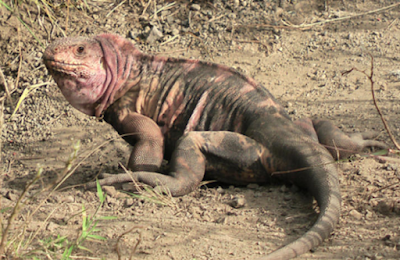
A Critically Endangered Pink Land Iguana, Conolophus marthae. Gabriele Gentile/IUCN/Red List of Threatened Species.

The volcanos of the Galapagos are fuelled by a mantle plume, the Galapagos Hotspot, an upwelling of hot magma from deep within the Earth’s mantle which pierces the overlying Nazca Plate, and moves independently of it. This plume transverses the plate at a rate of 0.46 degrees per million years, which has led to the formation of the string of volcanoes which form the Galapagos Islands. However, analysis of the geochemical composition of the lavas of Wolf Volcano has shown that these are distinct from the lavas of the neighbouring Ecuador and Darwin volcanoes, but show strong similarities to lavas produced on the Galapagos Spreading Centre over 200 km to the north, a trait shared with lavas from other Galapagos volcanoes, most notably Santa Cruz and Genovesa, suggesting that there is some interplay between these two sources.

 
The relative positions of the Galapagos Islands and Galapagos Spreading Center. School of Ocean and Earth Science and Technology/University of Hawaii at Manoa.

Wolf Volcano is the most active volcano in the Galapagos, it was first observed erupting in 1797 and most recently in 2015; the 2022 eruption is the twelfth recorded eruption on the volcano, which is believed to be slightly less than 500 000 years old, compared to an age of about 10 million years for the surrounding seafloor. It takes its name from Theodor Wolf, a German geologist who made the first organized study of the volcanoes of the Galapagos in the nineteenth century, and after whom Wolf Island is also named.

See also...


Follow Sciency Thoughts on Facebook.

Follow Sciency Thoughts on Twitter.

Wednesday, 27 June 2018

Evacuations ordered after eruption on Sierra Negra volcano, the Galápagos.

Around 250 people have been evacuated from homes around Sierra Negra, a 1124 m shield volcano (dome shaped volcano made up of layers of lava) on the eastern end ot Isabela Island, the Galápagos, on Tuesday 26 June 2018. The Instituto Geofísico-Escuela Politécnica Nacional recorded a sudden rise in seismic activity (Earthquakes) beneath the volcano from about 11.15 am local time, with Earthquakes between three and five kilometres beneath the surface, and with a maximum Magnitude of about 4.7. At about the same time, the GOES-16 Satelite, which is operated by the US National Oceanic and Atmospheric Administration and which is in a geostationary orbit, enabling it to monitor the region permanently, detected a thermal anomaly in the area of the volcano, probably indicating lava on the surface., with the eruption being directly observed by witnesses later that afternoon.

Eruption on Sierra Negra volcano, Isabela Island, on 26 June 2018. Xavier Garcia/Tarsicio Granizo/Twitter.

Sierra Negra  is the largest volcano in the Galápagos in terms of area, covering an area of about 7.2 by 9.3 km, and one of the most active, having last erupted in October 2005. It is estimated to be about 535 000 years old from its volume and rate of eruption, though it is hard to precisely date, as Isobela Island is made up of a series of overlapping volcanoes, making it difficult to assess the origin of the oldest lava deposits.

The volcanos of the Galapagos are fuelled by a mantle plume, the Galapagos Hotspot, an upwelling of hot magma from deep within the Earth’s mantle which pierces the overlying Nazca Plate, and moves independently of it. This plume transverses the plate at a rate of 0.46 degrees per million years, which has led to the formation of the string of volcanoes which form the Galapagos Islands. However analysis of the geochemical composition of the lavas of Wolf Volcano has shown that these are distinct from the lavas of the neighbouring Ecuador and Darwin volcanoes, but show strong similarities to lavas produced on the Galapagos Spreading Center over 200 km to the north, a trait shared with lavas from other Galapagos volcanoes, most notably Santa Cruz and Genovesa, suggesting that there is some interplay between these two sources.

The relative positions of the Galapagos Islands and Galapagos Spreading Center. School of Ocean and Earth Science and Technology/University of Hawaii at Manoa.

See also...

http://sciencythoughts.blogspot.com/2018/02/british-tourist-attacked-by-shark-while.htmlhttp://sciencythoughts.blogspot.com/2015/05/eruption-on-wolf-volcano.html
http://sciencythoughts.blogspot.com/2012/06/death-of-lonesome-george-and-extinction.html
Follow Sciency Thoughts on Facebook.

Wednesday, 7 February 2018

British tourist attacked by Shark while snorkeling in the Galapagos Islands.

A British tourist has suffered severe damage to his right leg after being bitten by a Shark while snorkeling in the Galapagos Islands. London-based businessman Andrew Phipps Newman, 45, originally from South Africa, suffered a broken bone and several severed ligaments after the Shark seized him by one foot off Santa Fe Island. The animal broke off its attack after being punched repeatedly on the nose, allowing Mr Phipps Newman to be pulled from the water into a boat, where he was treated by a doctor, Kathryn Gilbert, 27, also on holiday from the UK, during a three hour trip to the nearest hospital.

British tourist Andrew Phipps Newman recovering after being bitten by a Shark in the Galapagos Islands. Andrew Newman.

The attack is thought to have been carried out by a Galapagos Shark, Carcharhinus galapagensis, a large species of Requiem Shark, Carcharhinidae, which, despite its name, is found around tropical island and reefs in all the world's oceans. Galapagos Sharks typically feed on small Fish and Cephalopods (Squid and Octopus), but larger members of the species can be more adventurous, and will attack other Sharks and Marine Mammals. Shark attacks on Humans are extremely rare, with only eight such events recorded in Ecuadorian waters since records began in 1952.

A Galapagos Shark, Carcharhinus galapagensis, in the northwest Hawaiian Islands. Dwayne Meadows/NOAA.

See also...

http://sciencythoughts.blogspot.co.uk/2018/01/cretalamna-bryanti-new-species-of.htmlhttp://sciencythoughts.blogspot.co.uk/2017/12/shark-remains-from-early-cretaceous-of.html
http://sciencythoughts.blogspot.co.uk/2017/12/american-tourist-killed-by-shark-in.htmlhttp://sciencythoughts.blogspot.co.uk/2017/12/californian-student-recovering-after.html
http://sciencythoughts.blogspot.co.uk/2016/09/megachasma-alisonae-megamouth-shark.htmlhttp://sciencythoughts.blogspot.co.uk/2016/01/mollisquama-sp-pocket-shark-from-gulf.html
Follow Sciency Thoughts on Facebook.

Sunday, 31 May 2015

Eruption on Wolf Volcano.


At about 11.50 pm local time on Sunday 24 May 2015 the Instituto Geofísico-Escuela Politécnica Nacional recorded a sudden rise in seismic activity (Earthquakes) beneath Wolf Volcano, which is located on the northern tip of Isabella Island in the Galapagos. This was followed at 2.15 am on Monday 25 May by a major eruption which according to the  Washington Volcanic Ash Advisory Center, produced an ash column 10.7 km high, that subsequently drifted 65 km to the southwest. A second major eruption at 3.45 am produced a 15.2 km high plume which drifted 250 km to the east, while a third eruption shortly after produced a 13.7 km high plume which drifted 250 km to the east. At 4.28 am NASA’s MODIS satellite, which monitors infra-red emissions, detected a significant thermal anomaly on the southeastern flank of the volcano, which would generally indicate a lava eruption, which was later confirmed by investigators from the Galápagos National Park, who reported a new fissure close to the southeastern rim of the caldera, which was producing several major lava streams.

The May 2015 eruption on Wolf Volcano. Diego Paredes/AFP.

These eruptions continued throughout Monday 25 and Tuesday 26 May, before eventually subsiding, producing significant lava flows and smaller ash columns, as well as several hundred kilotons of sulphur-dioxide emissions. There was initial concern that the eruption might present a threat to the volcano’s distinctive fauna; the volcano is a distinct environment compared to the rest of the island, and hosts a unique set of animals of its own, including the Wolf Giant Tortoise, Chelonoidis nigra becki, and Pink Land Iguana, Conolophus marthae, though these are concentrated on the northwest flanks of the volcano and are unlikely to have been harmed by an eruption on the southeastern flanks.

A Pink Land Iguana, Conolophus marthae. Alamy.

Wolf Volcano is the highest volcano in the Galapagos, reaching 1707 m above sea level, with an oval crater measuring 6 km by 7 km orientated in a northwest-southeast direction. Like all the volcanos of the Galapagos it is a shield volcano, i.e. a volcano made up largely of overlapping lava deposits that resembles an upturned bowl rather than a cone. The placement of this volcano on the northern tip of Isabella Island creates a unique microhabitat on the northwestern flanks of the volcano, cut off from the rest of the island by the steep, smooth lava flows of the main peak. This has served to protect the wildlife of the volcano from invasive species such as feral Cats and Goats, which threaten much of the unique fauna of the Galapagos (though Goats have recently been sighted here). As well as its own unique Tortoise, the Wolf Volcano ecosystem is also home to several populations of introduced tortoises from other islands, including at least two possible specimens of the Pinta Island Giant Tortoise, Chelonoidis nigra abingdoni, thought to have gone extinct with the death of Lonesome George in 2012, which are currently under investigation by wildlife geneticists from Yale University and the Galapagos Conservatory.

Lonesome George, the last known surviving specimen of the Pinta Island Giant Tortoise, Chelonoidis nigra abingdoni, prior to his death in June 2012. Wikipedia.

The volcanos of the Galapagos are fuelled by a mantle plume, the Galapagos Hotspot, an upwelling of hot magma from deep within the Earth’s mantle which pierces the overlying Nazca Plate, and moves independently of it. This plume transverses the plate at a rate of 0.46 degrees per million years, which has led to the formation of the string of volcanoes which form the Galapagos Islands. However analysis of the geochemical composition of the lavas of Wolf Volcano has shown that these are distinct from the lavas of the neighbouring Ecuador and Darwin volcanoes, but show strong similarities to lavas produced on the Galapagos Spreading Center over 200 km to the north, a trait shared with lavas from other Galapagos volcanoes, most notably Santa Cruz and Genovesa, suggesting that there is some interplay between these two sources.

The relative positions of the Galapagos Islands and Galapagos Spreading Center. School of Ocean and Earth Science and Technology/University of Hawaii at Manoa.

Wolf Volcano is the most active volcano in the Galapagos, it was first observed erupting in 1797 and most recently in 1982; the 2015 eruption is the eleventh recorded eruption on the volcano, which is believed to be slightly less than 500 000 years old, compared to an age of about 10 million years for the surrounding seafloor. It takes its name from Theodor Wolf, a German geologist who made the first organized study of the volcanoes of the Galapagos in the nineteenth century, and after whom Wolf Island is also named.

See also…

Authorities in Chile have began to evacuate homes within 20 km of Mount Calbuco, a volcano in the Los Lagos Region in the south of the country, after the volcano began to erupt at about 6.00 pm local...


Authorities in Chile have began to evacuate people from the vicinity of Volcán Villarrica, following a major eruption overnight between Sunday 1 and Monday 2 March 2015. Villarrica is active at some level more-or-less all of the time, but in mid February the level...


The Vanuatu Geohazards Observatory issued a warning to the public on Saturday 21 February following an eruption from a new vent inside the caldera of Mount Ambrym a volcanic island in the New Hebrides. The eruption is apparently small in nature, but its...


Follow Sciency Thoughts on Facebook.

Monday, 25 June 2012

The death of Lonesome George and the extinction of the Pinta Island Giant Tortoise.

On 24 June 2012 Edwin Naula of the Galápagos National Park announced the death of a Giant Tortoise named Lonesome George at the Charles Darwin Research Station on Santa Cruz Island. Lonesome George had been a resident of the Station since 1972, after it was discovered that his native habitat on the remote, volcanic, Pinta Island had been devastated by introduced feral goats.

Lonesome George. Galápagos National Park.

Lonesome George was almost certainly the last member of his species, the Pinta Island Giant Tortoise, Chelonoidis nigra abingdoni, (there is another male Tortoise rumored to be a member of the species in Prague Zoo, but this animal has never been formally described in any scientific publication), meaning that his death comes the extinction of the species. The Charles Darwin Research Station had made several attempts to mate Lonesome George with females of the closely related Isobella Island Tortoise, Chelonoidis nigra becki, but this had failed to produce viable eggs (note: technically Chelonoidis nigra abingdoni and Chelonoidis nigra becki are subspecies, but most biologists define species as reproductively isolated units, which would seem to apply here). This was combined with the clearing of feral goats from Pinta Island, with a view to re-introducing the (hybrid) tortoises; it is likely that the Island will now be re-populated by Tortoises from elsewhere in the Galapagos. 

The Galapagos Islands have (or had) a distinctive fauna of Tortoises, with many islands, and some regions on larger islands, having evolved their own distinctive strains of Tortoise adapted to local conditions. When Charles Darwin visited the Galapagos in 1835 the Vice Governor of the islands, Nicholas Lawson, boasted of being able to tell what island a tortoise originated from at a glance. 

Scientists currently recognize twelve different varieties of Galapagos Tortoise, all currently classified as subspecies of a single species, Chelonoidis nigra. The Pinta Island Tortoise is the second of these to go completely extinct, after the Charles Island Tortoise, Chelonoidis nigra nigra, with the Duncan Island Tortoise, Chelonoidis nigra duncanensis, also extinct in the wild. In addition the Hood Island Tortoise, Chelonoidis nigra hoodensis, is considered Critically Endangered under the terms of the IUCN Red List of Threatened Species, with another four strains being considered Endangered, and the remainder Vulnerable.


Follow Sciency Thoughts on Facebook.

Saturday, 10 March 2012

New species of Catshark from the Galapaagos.

Catsharks, or Dogfish, are small bottom dwelling sharks found in oceans throughout the world.

In a paper published in the journal Zootaxa on 5 March 2012, John McCosker, of the Department of Aquatic Biology at the California Academy of Sciences, Douglas Long, of the Department of Aquatic Biology at the California Academy of Sciences and the Department of Natural Sciences at the Oakland Museum of California, and Carole Baldwin of the Division of Fishes at the National Museum of Natural History at the Smithsonian Institution, report the discovery of a new species of Catshark from the Galapagos Islands, named as Bythaelurus giddingsi, the Galapagos Catshark, or Giddings' Catshark, in honor of underwater filmaker Al Giddings.

The Galapagos, or Giddings', Catshark (Bythaelurus giddingsi). From McCosker, Long & Baldwin (2012).

The Galapagos Catshark grows to slightly over 400 mm in length. Unlike other Catsharks of the genus Bythaelurus, which tend to be plain in colour, or tend to have a single line of spots, Bythaelurus giddingsi is spotted all over, and, unlike most sharks of any type, these spots are not symmetrical but are placed in different positions on different parts of the body.

The sharks were discovered at a depths of between 450 and 600 m between the islands of Darwin and Marchena using the Johnson Sea-Link submersible. They are thought to be indigenous to the Galapagos.