Showing posts with label Seamounts. Show all posts

Monday, 22 June 2026

Microeledone galapagensis: A new species of Incirrate Octopus from the Galápagos Islands.

Incirrate, or Finless, Octopuses are one of the two major divisions of the Octopoda, and the one most familiar to most people. Whilst many species living on coastal shelves and the upper part of the water column have been studied extensively, they are also a major part of the deep-sea fauna, although these are much less well known. The Family Megaleledonidae comprises large Incirrate Octopuses with a single sucker-row. These were originally described from the deep waters of the Southern Ocean, and for a long time were assumed to be restricted to the Antarctic, but recently have been found living as far north as Iceland, suggesting a much wider distribution. 

In a paper published in the journal Zootaxa on 25 May 2026, Janet Voight and Stephanie Smith of the Negaunee Integrative Research Center of the Field Museum of Natural History, Salome Buglass of the Charles Darwin Fundación and the Department of Geography at the University of British Columbia, and Alexander Ziegler of the Bonner Institut für Organismische Biologie at the Rheinische Friedrich-Wilhelms-Universität, describe a new species of Megaleledonid Octopus from a seamount in the Galápagos Islands.

The species is described from a single female specimen which was recovered by the Remote Operated Vehicle Hercules from a seamount 25 km to the northwest of Isla Darwin, during a ten day voyage of the Research Vessel Nautilus to the Galápagos Marine Reserve. While this specimen was the only one directly examined, two other Octopus apparently belonging to the same species were observed within 1-2 km of the site where the specimen was caught.

The new species is placed in the Genus Microeledone, the first new species added to the genus since it was first described in 2004, and given the specific name galapagensis, meaning 'from the Galápagos'. As the name suggests, members of this genus are smaller than is typical for members of the Megaleledonida, with the single known specimen of Microeledone galapagensis having a mantle-length of only 31.5 mm. It is squat in form, with a head narrower with than the mantle and eyes which do not meet at the midline, and short arms, reaching only 1.4 times the length of the mantle, each of which has up to 30 suckers arranged in a single row. These suckers are tall and straight, with an approximately similar diameter along the tentacle, although they are sightly larger close to the body and slightly smaller at the tip.

Microeledone galapagensis in its natural environment. Voight et al. (2026).

Microeledone galapagensis lacks colouring on its outer mantle, but is heavily pigmented on the inner lining of the dorsal mantle muscles. This is thought to be an adaptation to its habitat and diet. In shallow-water Octopuses, pigment cells on the outer mantle allow the Octopus to change colour in order to blend in with its environment to avoid predators. All known specimens of Microeledone galapagensis were found living at depths of between 1770 and 1800 m beneath the sea surface. At these depths, there is no natural light, and therefore no need for Octopuses to camouflage themselves in this way. However, many available food species bioluminess when threatened, potentially giving away the location of anything consuming them to larger predators. The thick pigmentation on the inner lining of the dorsal mantle should hide such luminescence, thus protecting the Octopus from predation.

Interestingly, the only other known species of Microeledone, Microeledone mangoldi, lacks pigmentation on the inner lining of the dorsal mantle muscles, but has pigmented sheaths over its internal organs, apparently another way to deal with the problem of bioluminescent prey. This implies that the two species independently evolved different solutions to the same problem, which in turn suggests that their last common ancestor did not face this problem, and therefore must have lived in a different environment, presumably a more shallow one.

See also...


Friday, 10 May 2024

Gordonopsis mazupo: A new species of deep-sea Porter Crab from the South China Sea.

Porter Crabs, Homolidae, are long-limbed Crabs which live on the continental slope and continental shelf away from inshore environments. Their common name comes from their last pair of legs, which are held under the body, and used to carry other organisms, such as Corals, Anemones, or even Sea Urchin's, presumably as a defence against predators.

In a paper published in the journal Raffles Bulletin of Zoology on 3 May 2024, Peter Ng of the Lee Kong Chian Natural History Museum at the National University of Singapore, and Xinming Liu of the Institutes of Marine Drugs at the Guangxi University of Chinese Medicine, and the Guangxi Key Laboratory of Marine Drugs, describe a new species of Porter Crab from the Zhongnan Seamount in the South China Sea.

The new species is placed in the genus Gordonopsis, and given the specific name mazupo, in reference to the Chinese sea goddess of the same name. The species is named from a single male specimen, collected from the Zhongnan Seamount- at a depth of 897 m, along with a Bamboo Coral, by the Shenhaiyongshi submersible of the Research Vessel Tansuo2 on 20 March 2021.

Gordonopsis mazupo, holotype male (33.4 × 24.3 mm) (SY353B6), South China Sea. Colour in life. Scale bars are 10.0 mm. Yadong Zhou in Ng & Lui (2024).

The single known specimen of Gordonopsis mazupo has a yellowish carapace 33.4 mm in length and 24.3 mm in width, and extremely long, orange-coloured, spiney legs.

See also...

Saturday, 1 August 2020

Chrysogorgia dendritica, Chrysogorgia fragilis, & Chrysogorgia gracilis: three new deep-sea species of Octocoral from seamounts in the tropical Western Pacific Ocean.

The genus Chrysogorgia contains 72 species distributed in the world oceans, with water depths ranging from 10 m to 4492 m. Three branching forms have been recognized in the colonies of the genus: a single ascending spiral (clockwise or counterclockwise) producing a bottlebrush shape, a single fan (planar colony) and two fans emerging from a short main stem (biflabellate colony). Based on the shapes of rods or scales in the body wall and tentacles, a rough grouping has been built for the separation of Chrysogorgia species.

In a paper published in the journal PeerJ on 25 March 2020, Yu Xu of the Laboratory of Marine Organism Taxonomy and Phylogeny at the Institute of Oceanology of the Chinese Academy of Sciences, the Laboratory for Marine Biology and Biotechnology at the Pilot National Laboratory for Marine Science and Technology, the Center for Ocean Mega-Science, and the University of Chinese Academy of Sciences, Zifeng Zhan, also of the Laboratory of Marine Organism Taxonomy and Phylogeny at the Institute of Oceanology of the Chinese Academy of Sciences, the Laboratory for Marine Biology and Biotechnology at the Pilot National Laboratory for Marine Science and Technology, and the Center for Ocean Mega-Science, and Kuidong Xu, again of the Laboratory of Marine Organism Taxonomy and Phylogeny at the Institute of Oceanology of the Chinese Academy of Sciences, the Laboratory for Marine Biology and Biotechnology at the Pilot National Laboratory for Marine Science and Technology, the Center for Ocean Mega-Science, and the University of Chinese Academy of Sciences, describe three new species of Chrysogorgia collected while studying the benthic diversity in the tropical Western Pacific Ocean.

Specimens were obtained by the Remotely Operated Vehicle FaXian (Discovery) from an unnamed seamount (temporarily named as M2) adjacent to the Mariana Trench and the Kocebu Guyot in the Magellan Seamounts in the tropical Western Pacific Ocean during the cruises of the Research Vessel KeXue (Science) in 2016 and 2018. These specimens were photographed in situ before sampled, photographed on board and then stored in 75% ethanol after collection. Some branches were detached and stored at -80° C for molecular analysis.

Sampling sites on a seamount (M2) adjacent to the Mariana Trench and the Kocebu Guyot in the Western Pacific Ocean. Yu Xu in Xu et al. (2020).

The general morphology and anatomy were examined by using a stereo dissecting microscope. The sclerites of the polyps and branches were isolated by digestion of the tissues in sodium hypochlorite, and then were washed with deionized water repeatedly. Polyps and sclerites were air-dried and mounted on carbon double adhesive tape and coated for the Scanning Electron Microscope (SEM) to investigate their structure.

The first new species described is named Chrysogorgia dendritica, from the Latin adjective 'dendriticus' (dendritic) in reference to the dendritic shape of the colony. The species is known from a single specimen, collected from the Kocebu Guyot at a depth of 1821 m below sealevel, where the colony was attached to a dead Sponge. The water temperature at the collection site was about 2.31° C and the salinity about 35.8 psu.

The external morphology and polyps of Chrysogorgia dendritica. (A) The holotype in situ; (B) The holotype immediately after collection; (C) A single polyp under light microscope; (D) Single polyp under scanning electron microscope. (E) Tentacles with rods under scanning electron microscope. Yu Xu & Shaoqing Wang in Xu et al. (2020).

The specimen is about 57 cm long with the holdfast not recovered. Colony treeshaped, composed of a 36 cm long, straight and unbranched stem and a 21 cm long branched part with branching sequence 1/3L. The whole stem monopodial from bottom to top with lateral branches producing on the top. Stem surface almost smooth with a strong golden metallic luster, about two mm in diameter at base. Branches subdivided dichotomously, up to seventh order, most broken after collection. Distance between adjacent branches 16- 22 mm, and orthostiche interval 50 55 mm. First branch internodes 15 -20 mm long, with the terminal branchlets up to 50 mm. Polyps with a long neck and an expanded base, about three mm long and two mm wide at bases, composed of one or two on the first internodes, one to five in middle internodes, and up to six in terminal branchlets. No polyps on main axis internodes. Golden eggs often occurred at the expanded bases.

Rods longitudinally arranged in the back of tentacles, occasionally branched, with many small warts on surface, measuring 77 -330 x 15 -34 μm. Sclerites rarely extend into the pinnules, which are otherwise sclerite-free. Spindles and rods longitudinally arranged in the long polyp neck, slender with many small warts on surface, usually slightly curved, measuring 193- 800 x 25- 56 μm. Scales and rare plates transversely and crosswise arranged at body base, flat and amoeba-shaped with irregular edges, measuring 69 -248 x 11- 79 μm. Scales of coenenchyme sparse, flat and lobed with irregular edges, measuring 68 -268 x 10- 70 μm.

Sclerites of Chrysogorgia dendritica. (A)-( G) Sclerites of the polyp neck. (H )-(M) Sclerites in the back of tentacles; (N)-( X) Sclerites at the body base; (Y )-(GG) Sclerites in coenenchyme. Scale bars: (A)-( G) and (H)-( M), (N)-( X) and (Y)-( GG) at the same scale, respectively. Yu Xu in Xu et al. (2020).

The second new species described is named Chrysogorgia fragilis, from the Latin adjective 'fragilis' (fragile), and refers to the fragile stem and branches of the species. This species has been found only on the Kocebu Guyot in the Magellan Seamount chain. Colonies attached to rocky substrate. The holotype was attached with an egg-shaped structure and the paratype with an individual of the Squat Lobster genus Galathea. The water temperature at the collection site was about 3.2°C and the salinity about 35.8 psu.

The external morphology and polyps of Chrysogorgia fragilis. (A) The holotype in situ. Laser dots spaced at 33 cm used for measuring dimensions; (B) The paratype in situ; (C) The holotype immediately after collection; (D) The paratype after fixation; (E), (F) A single polyp under light microscope; (G)-( I) Three polyps under scanning lectron microscope. Yu Xu & Shaoqing Wang in Xu et al. (2020).

The holotype specimen is about 55 cm in height excluding the holdfast. Colony tree-shaped, composed of a sympodial branching part on the top and a fragile, slender and unbranched stem about 35.5 cm long and 1.5 mm in diameter at base. Stem surface almost smooth with a few scars and aeruginous metallic luster, and sometimes covered with a layer of pink mucous membrane. Branching part produced a slightly zigzag pattern at the top portion with branching sequence 1/3L. Branches subdivided dichotomously, nearly perpendicular to the axis, up to fifth order, most broken after collection. Distance between adjacent branches and the first branch internodes both 15 -22 mm long, orthostiche interval 50 -65 mm, and the terminal branches up to 75 mm. Polyps with a long neck and an expanded body base, 2 4 mm long, 1 2 mm wide at base, with the neck up to two mm long and less than one mm wide. Up to two polyps on the first internodes, two to four in middle internodes, up to ten in terminal branchlets. No polyp on main axis internodes. Golden eggs present in expanded body bases. Polyps pink immediately after collection, colour gradually faded in alcohol.

Rods longitudinally arranged in the back of the tentacles, rarely branched, with many small warts on surface, measuring 105- 442 x 14- 50 μm. Rare sclerites extend into the pinnules, and pinnules free of sclerites. Spindles and rods longitudinally arranged in the polyp neck, slender with many small warts on surface, sometimes with one or two sharp ends, measuring 170- 600 x 17- 62 μm. Scales longitudinally and transversally arranged at base of expanded polyp body, elongated with a few warts and irregular edges, sometimes branched, thicker and wider than those in coenenchyme, measuring 144- 551 x 34- 106 μm. Scales of coenenchyme flat and elongate, rarely with distinctly irregular edges, measuring 122- 435 x 28- 83 μm.

Sclerites of Chrysogorgia fragilis. (A)-( G) Sclerites of the polyp neck; (H )-(L) Sclerites in the back of tentacles; (M)-( V) Sclerites at the expanded polyp body base; (W)-( EE) Sclerites in coenenchyme. Scale bars are all at the same scale. Yu Xu in Xu et al. (2020).

The paratype specimen is 65 cm in height with unbranched stem about 35 cm long and one mm across at base. Branching part relatively longer and more zigzagging.

The third new species described is named Chrysogorgia gracilis, from the Latin adjective gracilis (gracile), and refers to the gracile stem and branches of this species. The species is known from a single specimen from an unnamed seamount (temporarily named as M2) adjacent to the Mariana Trench with water depths of 298 m. Colony attached to a rocky substrate with a small holdfast.

The external morphology and polyps of the holotype of Chrysogorgia gracilis. (A) -(C) The holotype in situ (A) and after collection (B) and fixation (C); Laser dots spaced at 33 cm used for measuring dimensions; (D) A single polyp under light microscope; (E) A single polyp under scanning electron microscope; (F) Tentacles under scanning electron microscope; (G) Mesozooids at the base of branch under light microscope; (H) Four mesozooids under scanning electron microscope; (I) A single mesozooid under scanning electron microscope. Yu Xu & Shaoqing Wang in Xu et al. (2020).

The specimen was orange to reddish after collection, became yellow in alcohol, about 51.8 cm long. Stem and branches golden with slightly glaucous metallic luster. Colony tree-shaped. Unbranched stem curved, up to 40.5 cm in arc length and 1.0 -2.9 mm in diameter, emanating in regular 1/4L spiral on the top of a tall. Holdfast small and rounded, about 9.8 -12.5 mm in diameter. Distance between adjacent branches in stem 2.0 -4.5 mm long and orthostiche interval 11- 16 mm. The first branch internodes 3 7 mm. Branches subdivided 2 7 times and the angle between bifurcating branches particularly obtuse: 18 °-62° . Terminal branchlets slender, usually whip-like, up to 90 mm long.

Polyps translucent, 0.9 -1.5 mm long, 0.2 -0.4 mm wide, uniserial spaced 2 5 mm on the branches by one side, with angle random to the branches. Polyp body base golden, without sclerites. Tentacles up to 1.0 mm in length, became white in alcohol. Three to 20 polyps on terminal branchlets and up to ten polyps in branch internodes. Axial internodal polyps not observed in the stem, where dense mesozooids occurred along the internodes of the stem and branch bases. Mesozooids bud-like shaped, orange in situ and yellowish in alcohol, without sclerites, about 0.3 -0.5 mm wide and up to 0.4 mm high.

Rods and rod-like scales slender, sometimes one end flat and the other end cylindric, mostly aggregated in the joints between the tentacles and bodies, or longitudinally along the back of the tentacles, with dentate projections at one or both ends and coarse, granular warts on surface, measuring 90 -450 x 15- 20 μm. Coenenchyme in branches with a thin pellucid and calcareous layer in outside of the central axis, sometimes with regular scales oriented along branches or without scales on branches. Scales elongated with smooth surface and edges, occasionally with finely serrated edges, usually becoming narrow in middle, rare to absent in coenenchyme, measuring 50 -250 x 12- 38 μm. All sclerites colourless.

See also...

https://sciencythoughts.blogspot.com/2020/05/understanding-gorgonian-soft-corals-of.htmlhttps://sciencythoughts.blogspot.com/2019/01/heliopora-hiberniana-second-species-of.html
https://sciencythoughts.blogspot.com/2019/01/hana-hanagasa-and-hana-hanataba-two-new.htmlhttps://sciencythoughts.blogspot.com/2018/04/adelogorgia-osculabunda-adelogorgia.html
https://sciencythoughts.blogspot.com/2017/06/sinularia-mesophotica-new-species-of.htmlhttps://sciencythoughts.blogspot.com/2017/04/flagelligorgia-gracilis-new-species-of.html
Follow Sciency Thoughts on Facebook.

Tuesday, 16 June 2020

Astrolirus patricki: A new species of Sponge-associated Starfish, from the seamounts of the northwest Pacific.

Seamounts are deep-sea biomes in the global ocean which harbor diverse habitats and benthic communities. Sponges are one of the dominant benthic groups in seamount ecosystems, playing important ecological roles by providing habitat and settlement substrate for other seamount invertebrates, such as Molluscs, Hydrozoans and Echinoderms. Suspension-feeding Brittle Stars and Crinoids with long and flexible arms are often observed perching on or wrapped around Sponges. 

In a paper published in the journal PeerJ on 27 May 2020, Ruiyan Zhang of the School of Oceanography at Shanghai Jiao Tong University and the Key Laboratory of Marine Ecosystem Dynamics at the Second Institute of Oceanography of the Ministry of Natural Resources, Yadong Zhou, also of the Key Laboratory of Marine Ecosystem Dynamics at the Second Institute of Oceanography of the Ministry of Natural Resources, Ning Xiao of the Laboratory of Marine Organism Taxonomy and Phylogeny of the Institute of Oceanology and the Center for Ocean Mega-Science of the Chinese Academy of Sciences, and Chunsheng Wang, also of the School of Oceanography at Shanghai Jiao Tong University, the Key Laboratory of Marine Ecosystem Dynamics and the State Key Laboratory of Satellite Ocean Environment Dynamics at the Second Institute of Oceanography of the Ministry of Natural Resources, describe a new Starfish species, which was found attaching to deep-sea Sponges, based upon five specimens from northwestern Pacific seamounts.

Species of the family Brisingidae possess 7 20 spiny arms that are up to about 40 times the length of the disk radius. As exclusive deep-sea inhabitants, their long arms and spines potentially equip them to be excellent suspension feeders, stretching out and gathering food particles in the water column in the resource-diluted deep ocean. The Brisingidae is composed of 62 extant species designated into 10 genera. The genus Astrolirus currently contains only one species, Astrolirus panamensis, and is differentiated from the other genera based on the presence of intercostal plates on arms and a pair of marginal plates between the first adambulacral plates. Astrolirus panamensis was discovered in the eastern Pacific Ocean at 1820- 2418 m depth, with 1 eight-armed specimen and 27 nine-armed specimens of varying size (disc diameter 6- 26 mm) reported. Thereafter, Astrolirus has seldomly been reported or investigated. 

The new species is named Astrolirus patricki, in honour of the character `Patrick Star' in the famous cartoon `SpongeBob Squarepants', who always spends time with his best friend `SpongeBob', a benthic Sponge. Since all specimens of the new species were observed in situ living on Sponges, it was name by Patrick to reflect this curious relationship.

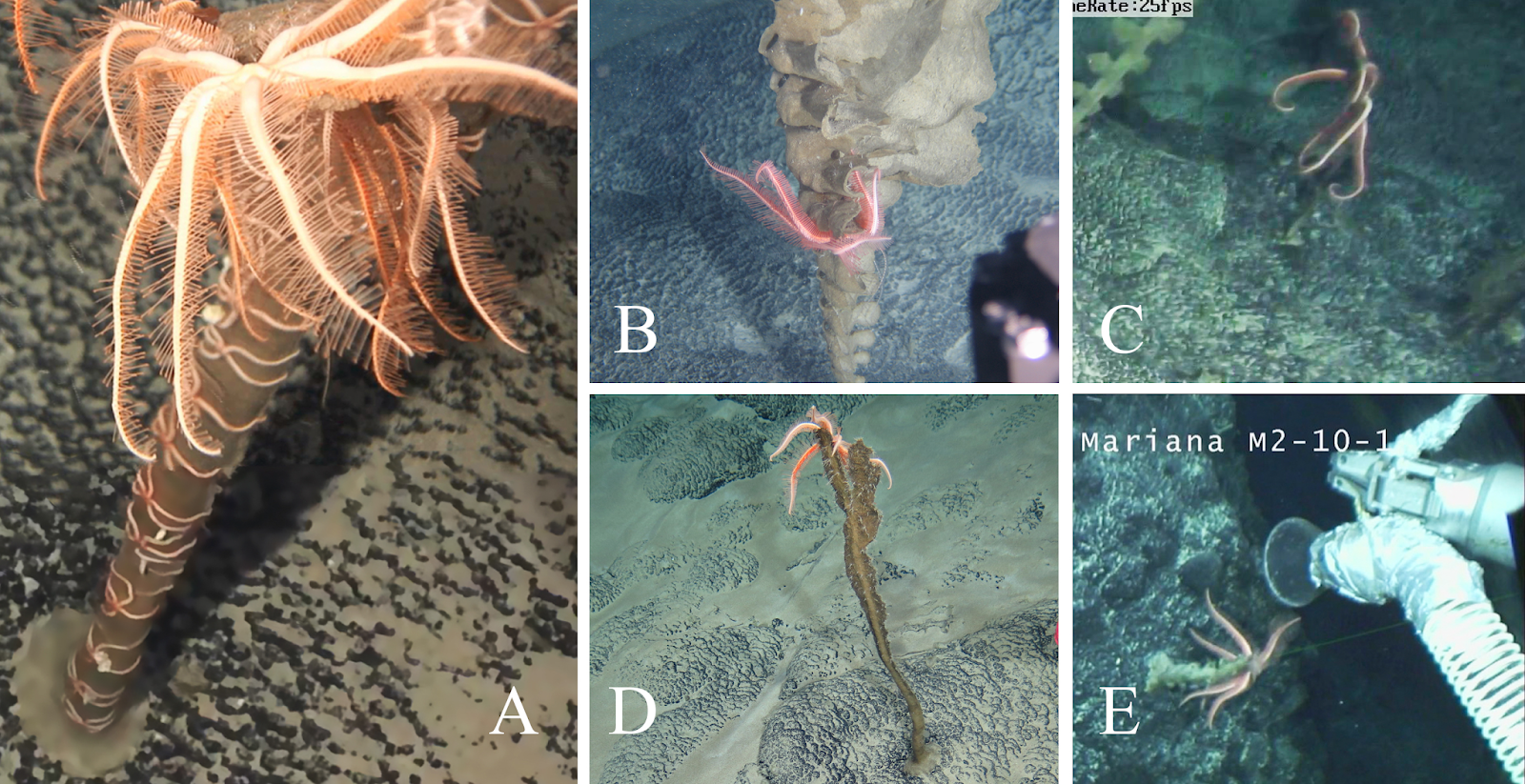
In situ photographs of Astrolirus patricki. Zhang et al. (2020).

All five specimens of the new species are seven-armed and were captured from Hexactinellid Sponges. Occasionally 2- 3 individuals were spotted on the same Sponge along with numbers of Ophiuroids and Crinoids. The new species differs greatly from Astrolirus panamensis in morphological characters and living habitat.

During the COMRA (China Ocean Mineral Resources R & D Association) cruises DY31, DY37, DY41, DY56 and a seamount cruise in the northwestern Pacific Ocean seamounts from 2013 to 2019, five specimens of the new species were collected by mechanical arms or siphon-pumps equipped on Human operated vehicles and remote operated vehicles. Specimens were photographed in situ and on board by digital cameras. Tube feet tissues were extracted from each specimen and frozen in -80°C refrigerator or liquid nitrogen for later molecular experiments, while other parts of specimens were preserved in 100% ethanol for morphological examinations. Morphological identification was conducted under a stereoscopic microscope. 

Astrolirus patricki has seven robust arms. The tntercostal integument is densely covered by irregular, abutting plates. There is no conection between proximal arm plates. The first pair of adambulacral plates is separated by a pair of marginal plates. A large interradial plate above the first marginal plates, is visible from the abactinal side, covered by scattered spinelets. The mouth spines and proximal adambulacral spines are robust, and densely distributed. There are 3-4 uboral spines and 1-2 subambulacral spines, the proximal ones of which are truncate and capitate. There is one lateral spine to each adambulacral plate, starting from about the 8th. There is a pair of gonads to each arm.

Astrolirus patricki, abactinal view. (A) Paratype RSIOAS028. (B) Paratype RSIOAS003. (C), (D), (H), holotype RSIOAS044, (C) Abactinal surface of disk and proximal part of arms, with red arrow pointing at the madreporite body, white arrow at the interradial plate and yellow arrows at the marginal plates. The red frame indicates the proximal region of arm connecting the disk and genital region, where pedicellariae do no form regular costae. (D) Abactinal surface of arm genital area with mosaic plating, red arrows show the costae bands. (E) Paratype RSIOAS003, abactinal surface of arm genital area, red arrows show the costae bands. (F) Paratype RSIOAS052, zoom in view of the abactinal disk, showing the multiple sharp spinelets on disk plates. (G) Paratype RSIOAS052, a piece of dissected skin from abactinal disk, shot from the inner side of the skin, showing the small round disk plates. (H) Abactinal surface at the middle of arm, black arrows indicate the pedicellariae bands. Zhang et ai. (2020).

See also...

https://sciencythoughts.blogspot.com/2019/08/asterodiscides-fourmanoiri-starfish.htmlhttps://sciencythoughts.blogspot.com/2019/01/acanthaster-solaris-using-environmental.html
https://sciencythoughts.blogspot.com/2019/01/sertulaster-keslingi-and-delicaster.htmlhttps://sciencythoughts.blogspot.com/2018/03/thousands-of-starfish-wash-up-on.html
https://sciencythoughts.blogspot.com/2016/02/estimating-role-of-temperature-in-sea.htmlhttps://sciencythoughts.blogspot.com/2013/12/a-mass-death-of-starfish-in-late.html
Follow Sciency Thoughts on Facebook.

Friday, 16 November 2018

Neopilina sp.: Tracking Monoplacophorans on the ocean floor.

The Monoplacophorans are a poorly understood group of Molluscs superficially resembling Limpets, but quite distinct from the Gastropods. Like Gastropods they have a muscular foot, a shell and a scraping radula (tongue), but unlike them they lack eyes (or much of a head at all) have gills on each side of their body, which form a series of pairs, and their shell is attached to their body by eight pairs of dorso-ventral muscles. Monoplacophorans are known in the fossil record from the Cambrian to the Devonian, and for a long time were thought to be extinct, till a live specimen was recovered from the deep sea in 1952. Since more than 35 species of Monoplacophorans have been described, all from the deep oceans, although only two species have been encountered more than once, and almost nothing is known about their habitat or ecology.

In a paper published in the journal Marine Biodiversity on 7 March 2018, Julia Sigwart of the Marine Laboratory at Queen’s University Belfast, and the Museum of Paleontology at the University of California, Berkeley, Mary Wicksten of the Department of Biology at Texas A&M University, Matthew Jackson of the Department of Earth Science at the University of California Santa Barbara, and Santiago Herrera of the Department of Biological Sciences at Lehigh University, report the first direct observations of what appears to be a new species of Monoplaophoran from seamounts in American Samoa.

Sigwart et al. report that non-periodic, sinusoidal trails clear of sediment were observed on ferromanganese-encrusted lava flows were observed at a depth of 3760 m on the Leoto Seamount and 3837 m on the Utu Seamount on the Manahiki Plateau while they were being explored by the remotely operated vehicle (ROV) Deep Discoverer and the camera platform Seirios, operated from the NOAA Ship Okeanos Explorer, during an expedition to the area between February and April 2007. Further examination of these trails revealed a Monoplacophoran trail-maker on the Utu Seamount.

Trackways attributed to Neopilina sp. in still images from HD video. (a) Overview of rock surface marked with feeding trails at Leoso Seamount (where no animals were observed). (b) Trackways at Utu Seamount; red dots are laser sights 10 cm apart. (c) Neopilina sp., at Utu seamount, close-up showing apparent radular scratches within trackway. Original video data from the NOAA Office of Ocean Exploration and Research. Sigwart et al. (2018). 

The trail-maker is thought to be a member of the genus Neopilina, and measures about 20 mm in length and about 12 mm in width, exceptionally large for a modern Monoplacophoran, even a member of the large-bodied genera Adenopilina, Vema, and Neopilina (prior to this only six modern specimens larger than 10 mm in length had been observed, all from depths of greater than 3000 m. However, the observed specimens differ from other previously described members of the genus in several ways, most notably the presence of longer, more slender gills. This is unsurprising, as the nearest previous sighting of a member of the genus was from Hawaii, 4000 km away, and leads Sigwart et al to conclude that this is a new species, though they stop short of describing it as such, due to the absence of any recovered material. In living on ferromanganese-encrusted lava flows, this Monoplacophoran inhabits an ecological niche where the group has not previously been observed, though other species have been recovered from ferromanganese nodules dredged from the seafloor (most known modern Monoplacophorans have been lifted from the seafloor on some sort of object). As such if opens the possibility that Monoplacophorans are much more abundant than previously realised, as seamounts and lava flows cover much of the deep ocean floor.

See also...

https://sciencythoughts.blogspot.com/2018/05/meganodontia-haunuiensis-elliptiolucina.htmlhttps://sciencythoughts.blogspot.com/2018/02/declining-ammanoid-diversity-before-end.html
https://sciencythoughts.blogspot.com/2018/01/acrotoma-likharevi-acrotoma.htmlhttps://sciencythoughts.blogspot.com/2017/11/chuvashiteuthis-aenigmatica.html
https://sciencythoughts.blogspot.com/2017/10/dozens-of-octopus-crawl-up-welsh-beach.htmlhttps://sciencythoughts.blogspot.com/2017/07/fluminicola-umpquaensis-fluminicola.html
Follow Sciency Thoughts on Facebook.

Saturday, 24 October 2015

Microplastics in deep-sea marine sediments.

Plastics are considered to be one of the major environmental challenges of our time. They are highly durable synthetic polymers, around 30% of which are produced for short-life purposes, such as disposable packaging, and are discarded within a year of being manufactured. Despite the large number of plastic items being manufactured and then thrown away, and visible evidence of plastic debris in ecosystems from pole to pole, environmental scientists for a long time struggled to find evidence of plastic accumulation (rather than presence) in natural ecosystems, until they began to examine microplastic particles (tiny plastic fragments, generally formed from the break-down of larger items) in sediments and ocean waters, where a steady build-up of plastics over time has been confirmed. However even these studies have failed to account for the amount of plastic thought likely to be present in the environment, leading scientists to suspect that a large amount of plastic is present but unaccounted for somewhere in the natural environment.

In a paper published in the journal Royal Society Open Science on 17 December 2014, Lucy Woodall of the Department of Life Sciences at The Natural History Museum, Anna Sanchez-Vidal and Miquel Canals of the Departament d’ Estratigrafia, Paleontologia i Geociències Marines at the Universitat de Barcelona, Gordon Paterson, also of the Department of Life Sciences at The Natural History Museum, Rachel Coppock and Victoria Sleight of the Marine Biology and Ecology Research Centre at Plymouth University, Antonio Calafat, also of the Departament d’ Estratigrafia, Paleontologia i Geociències Marines at the Universitat de Barcelona, Alex Rogers of the Department of Zoology at the University of Oxford, Bhavani Narayanaswamy of the Scottish Association for Marine Science and Richard Thompson, again of the Marine Biology and Ecology Research Centre at Plymouth University, discus the presence of microplastic particles in deep-marine sediment samples collected from a series of sites in the North Atlantic, Mediterranean and southern Indian Ocean.

The samples examined were taken from the upper portions of cores gathered for other studies by the Universitat de Barcelona and the Natural History Museum over a twelve year period. Because of this the samples were gathered following different procedures, limiting the amount of comparison that can be made between the samples. Nevertheless it was possible to establish the presence of plastics in areas not previously sampled, and compare the proportions of different plastics within individual samples.

Locations of sampling sites of bottom sediment and deep-water coral where content of microplasticswas investigated. Sample depth ranged down to 3500 m, for details see table 1. Sediment was collected by the University of Barcelona (circles) and the Natural History Museum (filled squares), and deep-water corals were collected by the Natural History Museum (open squares). Bathymetry corresponds to ETOPO1Global Relief Model. Woodall et al. (2014).

The areas sampled included open slopes in the subpolar North Atlantic, the northeast Atlantic and the Mediterranean, canyons in the northeast Atlantic and Mediterranean, basins in the Mediterranean and Corals from seamounts in the southwest Indian Ocean.

All of the samples were found to contain microplastics in the form of fibres 2-3 mm in length and ~0.1 mm in width. The most abundant fibre was rayon, which is not strictly speaking a plastic (it is made from dissolved and resolidified cellulose from wood-pulp, rather than hydrocarbons) and which comprised 56.9% of all the fibres found in the study; this is comparable to results for rayon in previous studies of synthetic fibres ingested by Fish (where 57.8% of all fibres were rayon) and in ice cores (where 54% of all fibres were rayon). Of actual plastics sampled 53.4% were polyester, 34.1% were 'other plastics (including polyamides and acetate) and 12.4% were acrylic.

Plastics were found at comparable levels to those seen in intertidal and shallow-marine sediments, and at a rate roughly a thousand times higher than found in surface waters. Given the vast areas covered by the deep ocean floor, this is likely to account for a substantial proportion of the 'missing' plastic predicted to be present in the natural environment.

All of the plastics found were heavier than water. At first sight this is what would be expected as such plastics should sink whereas plastics lighter than water should not, however for microplastics the situation is more complex, as such plastics will tend to be held at the surface by surface-tension, only sinking after becoming colonized by marine organisms, adhered to phytoplankton and the aggregated with organic debris and small particles in the form of marine snow.

The impact of microplastics on deep-sea ecosystems is unclear. In surface and shallow-marine organisms such plastics have been shown to have adverse effects both due to their physical and toxicological properties, and this is likely to be the case also with deep-marine organisms, but this cannot be asserted confidently without further study.

See also...

http://sciencythoughts.blogspot.co.uk/2014/12/counting-floating-plastics-in-worlds.htmlCounting floating plastics in the world’s oceans.                                                   Floating plastic is considered to be a major pollutant in the world’s oceans. It enters the oceans in large quantities from shipping, coastal communities...
 
 
http://sciencythoughts.blogspot.co.uk/2014/05/marine-litter-on-european-seafloor.htmlMarine litter on the European seafloor.   Manmade rubbish (litter) is known to be extremely harmful to aquatic lifeforms, both as a direct physical hazard (such as nets which continue to trap and kill Fish long after they have become detached from fishing vessels or plastic items which resemble food and...
 
http://sciencythoughts.blogspot.co.uk/2013/11/plastic-contamination-in-lake-garda.htmlPlastic contamination in Lake Garda, Italy. Plastic contaminants are known to present a threat in many ecosystems, with particular concern being raised about the oceans, where large accumulations of plastic are known to be found on ocean gyres (large rotating currents) and where damage to wildlife from plastic ingestion is well documented. The effect of plastic contamination on freshwater ecosystems is less well documented, though studies of...
 
Follow Sciency Thoughts on Facebook.