Showing posts with label Ichneumon Wasps. Show all posts

Thursday, 9 February 2017

Poemenia quercusia: A new species of Poemenine Wasp from Liaoning Province, China.

Poemenine Wasps are a small group of Ichneumon Wasps with a global distribution. They are parasitiods (animals with a larval stage that lives parasitical on other animals) targeting wood-boring insects. Most species target wood-boring Beetle larvae, though other groups are targeted, including other species of Wasp.

In a paper published in the journal ZooKeys on 8 February 2017, Shu-Ping Sun and Mao-Ling Sheng of the General Station of Forest Pest Management of the State Forestry Administration and Tian-Lin Chen of the Forest Protection Station of Haicheng, describe a new species of Poemenine Wasp from Liaoning Province in China.

The new species is placed in the genus Poemenia and given the specific name quercusia, where 'quercusia' derives from 'Quercus', Oak, the species being described from specimens collected from twigs of Quercus wutaishanica, the Mount Wutai Oak. The species is described from two specimens, one male and one female, the female being larger than the male at 8.5 mm compared to 6.8 mm. Both sexes are black in colour with yellow and brown markings.

Poemenia quercusia, female specimen in lateral view. Sun et al. (2017).

The host species for these Wasps is unknown, but the specimens were collected from twigs infested with boring Weevils of the genus Carcilia. However other members of the genus Poemenia, are known to target other species of Wasp, suggesting that such a host may also be present.

See also...

http://sciencythoughts.blogspot.co.uk/2016/12/promecidia-abnormis-promecidia-chui-two.htmlhttp://sciencythoughts.blogspot.co.uk/2016/11/nesolinoceras-laluzbrillante-new.html
http://sciencythoughts.blogspot.co.uk/2016/08/indothrix-brevicornis-new-species-of.htmlhttp://sciencythoughts.blogspot.co.uk/2016/04/holopsenella-primotica-new-species-of.html
http://sciencythoughts.blogspot.co.uk/2016/04/trieces-etuokensis-new-species-of.htmlhttp://sciencythoughts.blogspot.co.uk/2015/12/philoctetes-longiflagellis-philoctetes.html
Follow Sciency Thoughts on Facebook.

Monday, 28 November 2016

Nesolinoceras laluzbrillante: A new species of Ichneumon Wasp from the Dominican Republic.

Ichneumons are a widespread, numerous and diverse group of Wasps noted for their parasitoid reproductive strategy, which involves the adult female Wasp injecting an egg into a living host, with the emerging larva eating this host alive from the inside. Each species of Ichneumon Wasp typically targets a single host species, with the most common victims being Beetles, Butterflies, Spiders and other Wasps (including other Ichneumons). The genus Nesolinoceras contains a single species, Nesolinoceras ornatipennis, from Cuba, which targets the larvae of the Citrus-borer Beetle, Elaphidion cayamae, the female wasp drilling her ovipositor through the bark of the tree to lay her eggs on Beetle Grubs beneath.

In a paper published in the American Museum Novitates on 11 May 2016, Bernardo Santos of the Division of Invertebrate Zoology and Richard Gilder Graduate School at the American Museum of Natural History, describes a second species of Nesolinoceras from the Dominican Republic.

The new species is named Nesolinoceras laluzbrillante, where 'laluzbrillante' derives from the Spanish 'la luz brillante' meaning 'the bright light', in reference to the bright climate of the Dominican Republic and the glossy wings of the Wasp; this name having been chosen by students of the Washington Heights Expeditionary Learning School, in New York City. The species is described from five specimens, two females and three males, trapped in a recently cleared forest margin at the Punta Cana Ecological Foundation. These have a distinct black-and white colouration, and the females are slightly larger than the males, having a forewing length of 8.8-9.0 mm, while the forewing of the males measures 7.2-8.0 mm. The life-cycle of the species and host of the young is unknown.

Nesolinoceras laluzbrillante, female specimen. Santos (2016).

See also...

http://sciencythoughts.blogspot.co.uk/2016/04/trieces-etuokensis-new-species-of.htmlhttp://sciencythoughts.blogspot.co.uk/2015/02/a-new-species-of-ichneumon-wasp-from.html
http://sciencythoughts.blogspot.co.uk/2015/01/two-new-species-of-ichneumon-wasps-from.htmlhttp://sciencythoughts.blogspot.co.uk/2014/12/two-new-species-of-ichneumon-wasps-from.html
http://sciencythoughts.blogspot.co.uk/2014/03/a-new-species-of-ichneumon-wasp-from.htmlhttp://sciencythoughts.blogspot.co.uk/2012/08/new-species-of-ichneumon-wasp-from.html
Follow Sciency Thoughts on Facebook.

Saturday, 2 April 2016

Trieces etuokensis: A new species of Ichneumon Wasp from Qinghai Province, China.

Ichneumon Wasps are parasitoid Wasps (Wasps whose parasitic larvae grow within the body of a living host) that target a wide range of hosts, including Spiders, Beetles, Butterflies and Moths, and even other Wasps. Most species target the larvae of other Insects, with the female laying a single egg beneath the skin of the victim, the larval Wasp then growing inside the host, which is able to grow and feed, but when the host pupates the parasite finishes consuming it and emerges from the victim's pupa as an adult Wasp. Almost all Ichneumon Wasps are host specific, targetting only a single species, and the family is the largest known family of Wasps (and one of the largest known families of Insects) with over 60 000 species.

In a paper published in the journal ZooKeys on 15 March 2016, Ying Zhang and Mao-Ling Sheng of the General Station of Forest Pest Management of the State Forestry Administration and Zi-Cheng Xiong of the Forest Pest Control and Quarantine Station of Etuoke, describe a new species of Ichneumon Wasp from Dulan County in Qinghai Province, China.

The species is described from catapillars of Snout Moths of the species Bazaria turensis collected from a shrubbery in August 2013 and fromunidentified catapillars collected from scrubland at Etuoke in Inner Mongolia in September 2014 and raised in cages until they matured. It is placed in the genus Trieces, and given the specific name etuokensis, meaning 'from Etuoke'. The Wasps are 2.8 mm (females) and 3.1 mm long (males) and black in colour, except for a yellow face and yellow-brown markings on the limbs and underside.

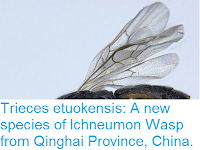
Trieces etuokensis, female in dorsal view. Zhang et al. (2016).

See also...

http://sciencythoughts.blogspot.co.uk/2015/02/a-new-species-of-ichneumon-wasp-from.htmlA new species of Ichneumon Wasp from Qinghai Province, China.                     Ichneumon Wasps of the genus Campoplex are parasitiods of Beetles and Moths (i.e. their larvae live inside Beetles and Moths, eating their living host as they mature) found predominantly in Europe and...
http://sciencythoughts.blogspot.co.uk/2015/01/two-new-species-of-ichneumon-wasps-from.htmlTwo new species of Ichneumon Wasps from Fennoscandia and Hungary.                             Ichneumon Wasps are parasitoids whose larvae develop on or in the bodies of other Arthropods, typically Insects or Spiders. Since Insect species are always described from adult specimens, species of parasitoid Wasps are generally named from specimens taken from the wild as adults, and the larval host of often unknown. However some scientists have developed an alternative method...
http://sciencythoughts.blogspot.co.uk/2014/12/two-new-species-of-ichneumon-wasps-from.htmlTwo new species of Ichneumon Wasps from Africa.                                                                           Ichneumon Wasps are large parasitoid Wasps (the largest species can exceed 5 cm) closely related to Braconids. They are noted for their reproductive behaviour, in which the females sting another Insect or Spider to paralyze it, then lay an egg on, in or near the...
Follow Sciency Thoughts on Facebook.

Monday, 2 February 2015

A new species of Ichneumon Wasp from Qinghai Province, China.


Ichneumon Wasps of the genus Campoplex are parasitiods of Beetles and Moths (i.e. their larvae live inside Beetles and Moths, eating their living host as they mature) found predominantly in Europe and Western Asia, with species also recorded from East and Southeast Asia, North America and Africa. Eleven species have previously been recorded from China.

In a paper published in the journal ZooKeys on 18 December 2014, Yu-Xiang Zhao of the The Key Laboratory for Silviculture and Conservation at Beijing Forestry University and the General Station of Forest Pest Management of the State Forestry Administration and Mao-Ling Sheng also of the General Station of Forest Pest Management of the State Forestry Administration, describe a new species of Campoplex from Qinghai Province in China.

The new species is named Campoplex bazariae, in reference to its host species the Moth Bazaria turensis. Females of the Wasp are 7.5-8.0 mm in length, males 8.0-8.2 mm. Both are predominantly black with some brown areas.

Female Campoplex bazariae inlateral view. Zhao & Sheng (2014).

The species was discovered while investigating an outbreak of Bazaria turensis (a form of Snout Moth) in a forest in Qinghai. The Wasps emerged from the cocoons of the Moths, both within clusters of leaves in the tree canopy and buried in soil on the forest floor.

See also…

http://sciencythoughts.blogspot.co.uk/2015/01/two-new-species-of-ichneumon-wasps-from.htmlTwo new species of Ichneumon Wasps from Fennoscandia and Hungary.                                    Ichneumon Wasps are parasitoids whose larvae develop on or in the bodies of other Arthropods, typically Insects or Spiders. Since Insect species are always described from adult specimens, species of parasitoid Wasps are generally named from specimens taken from the wild as adults, and the larval host of often unknown. However some scientists have developed an alternative method...
http://sciencythoughts.blogspot.co.uk/2014/12/two-new-species-of-ichneumon-wasps-from.htmlTwo new species of Ichneumon Wasps from Africa.                                                             Ichneumon Wasps are large parasitoid Wasps (the largest species can exceed 5 cm) closely related to Braconids. They are noted for their reproductive behaviour, in which the females sting another Insect or...
Ichneumon Wasps are a group of highly specialized...


Follow Sciency Thoughts on Facebook.

Tuesday, 6 January 2015

Two new species of Ichneumon Wasps from Fennoscandia and Hungary.


Ichneumon Wasps are parasitoids whose larvae develop on or in the bodies of other Arthropods, typically Insects or Spiders. Since Insect species are always described from adult specimens, species of parasitoid Wasps are generally named from specimens taken from the wild as adults, and the larval host of often unknown. However some scientists have developed an alternative method, in which members of host species infected with larval wasps are found, then kept in captivity as the larvae develops into an adult.

In a paper published in the journal Zootaxa on 11 December 2014, Niclas Fritzén of the Zoological Museum and Department of Biology at the Universityof Turku described two new species of Ichneumon Wasps from specimens reared from larvae living on Theridiid Spiders collected in Fennoscandia (Finland plus Scandinavia) and Hungary. Both the Wasps belong to the Polysphincta genus-group in which the larval Wasp develops as an ectoparasite, on the outside of the hosts body, making them particularly suitable for this method, as it is possible to detect infection with a simple visual inspection.

The first new species described is placed in the genus Flacopimpla, and given the specific name barathrica, in reference to the habitat where it was found, in caves rock clefts or similar spaces on manmade structures; the Barathrum was a pit in ancient Athens into which criminals were cast. The species is described from specimens raised from larvae found growing on Spiders of the species Thymoites bellissimus, collected from caves and rock clefts in Finland, Norway and Sweden, from pupae found in or close to the webs of the same species of Spiders, and from a single specimen adult specimen from a Malaise trap (expand) in a Pine forest in Sweden , though Fritzén notes that this wild-caught adult specimen had swellings on either side of its thorax not seen in any other specimens, making its taxonomic status slightly uncertain.

Flacopimpla barathrica in lateral view (slightly straightened) and head in anterior view. Fritzén (2014).

Adult wasps range from 3.6-5 mm in length in females and 3.0-4.5 mm in males. All are dark brown with pale legs. Larvae seemed to orientate themselves predominantly with their heads orientated towards the rear of the spider, though three (of 31 examined) were orientated the other way round. Pupae were loosely woven and spongy in appearance, and frequently (~60% of the time) infested with the larvae of the pseudohyperparasitoid (expand) Ichneumon Wasps Gelis sp.

(7) An adult female of the host Thymoites bellissimus with the larva of Flacopimpla barathrica.(8) A subadult male of the same host species infested with both the larva of Flacopimpla barathricaand an Iphidosoma physogastris Mite. (9) Cocoon with pupa in situ (Oulanka National Park), attached to the upper rock surface in the web of the host. (10) The newly emerged holotype in vitro, still resting on the cocoon. Scale bars 1 mm. Fritzén (2014).

This is the first species of Flacopimpla to be described from Europe; all previously known species have come from North and Central America. It is also the first known species of the genus to inhabit caves, and while it cannot be considered a true deep cave dweller, living in the dark zones of cave systems away from sunlight, it does live far enough in to be inhabiting a distinct micro-climate, more stable (i.e. less prone to extremes of temperature or strong fluctuations in temperature) than that of the surrounding boreal forests. The host species, Thymoites bellissimus, is found in boreal forests across the Arctic Circle, so it is likely that Flacopimpla barathrica is also more widely distributed than has been discovered to date; in particular it was found in Finland close to the border with Russia, and it is highly likely that it extends at least some way into Russian territory.

The first location where Flacopimpla barathrica was first discovered, in the Pirunpesä ravine in Kuopio, Finland. Fritzén (2014).

The second new species described is placed in the genus Zatypota, and given the specific name flamma, meaning ‘flame’, in reference to the colour of the adult. The species is described from a single female specimen raised from a Spider of the genus Parasteatoda, probably Parasteatoda lunata, found in mixed Beech/Oak woodland in Brennbergbánya in northwest Hungary. The specimen is 3.7 mm in length and brown and yellow in colour.

Zatypota flamma in lateral view (slightly straightened) and head in anterior view. Fritzén (2014).

Members of the genus Zatypota has previously been recorded from Europe, Asia, North America and Central America.

Zatypota flamma. (11) The cocoon and (12–13) the larva on its host Parasteatoda?lunata. Scale bars 1 mm.Fritzén (2014).

See also…

http://sciencythoughts.blogspot.co.uk/2014/12/two-new-species-of-ichneumon-wasps-from.htmlTwo new species of Ichneumon Wasps from Africa.                                                   Ichneumon Wasps are large parasitoid Wasps (the largest species can exceed 5 cm) closely related to Braconids. They are noted for their reproductive behaviour, in which the females sting another Insect or...
Ichneumon Wasps are a group of highly specialized...

Ichneumon Wasps are a group of highly specialized...
 
 
Follow Sciency Thoughts on Facebook.

Wednesday, 17 December 2014

Two new species of Ichneumon Wasps from Africa.


Ichneumon Wasps are large parasitoid Wasps (the largest species can exceed 5 cm) closely related to Braconids. They are noted for their reproductive behaviour, in which the females sting another Insect or Spider to paralyze it, then lay an egg on, in or near the victim, the larval Wasp emerges and consumes the paralyzed prey, typically keeping it alive (and therefore fresh) until ready to pupate. This behaviour is actually seen in a wide range of Wasp species, but tends to be noticed more in Ichneumons because of their large size.

In a paper published in the journal ZooKeys on 21 November 2014, Pascal Rousse of the Natural History Department at the Iziko South African Museum in Cape Town and the Department of Botany and Zoology at Stellenbosch University and Simon van Noort of the Natural History Department at the Iziko South African Museum in Cape Town and the Department of Biological Sciences at the University of Cape Town, describe two new species of Ichneumon Wasps from Africa as part of a review of the Ichneumon Wasp subfamily Ophioninae on the continent.

The first new species described is placed in the genus Dicamptus, and given the specific name maxipol, in reference to the large size of the gap between the two posterior ocelli (the back two of the three pit eyes between the two main compound eyes of a Wasp, Bee or Ant), which is called the post-ocellar line index (POL). The species is described from a single female specimen collected from the West Coast Fossil Park to the west of Langebaanweg in Western Cape Province, South Africa. The specimen is 20.8 mm long and orange and black in colour.

Dicamptus maxipol, female in lateral view. Rousse & van Noort (2014).

The second species is placed in the genus Enicospilus and given the specific name gauldetmitchellorum, which honours Ian Gauld and PA Mitchel, who mentioned a similar specimen as an undescribed species in a 1978 review of African Ophionine Wasps. The species is described from a single female specimen collected in the Mkomazi Game Reserve in Tanzania. The specimen is 18.8 mmin length and yellowish orange in colour.

Enicospilus gauldetmitchellorum, female in lateral view. Rousse & van Noort (2014).

See also…

Ichneumon Wasps are a group of highly specialized...

Ichneumon Wasps are a group of highly specialized...

Ichneumon Wasps are specialist parasites of other insects; typically they lay their eggs in the larvae of other insects, and their larvae then consume their hosts from the inside as they grow, eventually killing the host as...


Follow Sciency Thoughts on Facebook.

Sunday, 16 March 2014

A new species of Ichneumon Wasp from Liaoning Province, China.

Ichneumon Wasps are a group of highly specialized solitary wasps that lay their eggs inside the bodies of other insects (or, more typically, the larvae of other insects). The Wasp larvae then hatches inside the host, whereupon it proceeds to eat the other insect from within, typically killing its host as it emerges. This is a highly successful, if rather gruesome, survival strategy, and their are over 60 000 described species of Ichneumon Wasps around the world.


In a paper published in the journal ZooKeys on 10 March 2013, Shu-Ping Sun and Mao-Ling Sheng of the General Station of Forest Pest Management of the Chinese State Forestry Administration describe a new species of Ichneumon Wasp from Benxi County in Liaoning.

The new species is placed in the genus Notopygus and given the specific name longiventris, meaning ‘long-bodied’. Notopygus longiventris is a 15 mm, elongate, black Ichneumon Wasp with brown and white markings. The species is described from a single female specimen caught in a trap.

Notopygus longiventris, female specimen in lateral view. Sun & Sheng (2014).

See also New species of Ichneumon Wasp from Columbia and New species of Ichneumon Wasp from Jalisco State in central Mexico.

Follow Sciency Thoughts on Facebook.

Friday, 17 August 2012

New species of Ichneumon Wasp from Columbia.

Ichneumon Wasps are a group of highly specialized solitary wasps that lay their eggs inside the bodies of other insects (or, more typically, the larvae of other insects). The Wasp larvae then hatches inside the host, whereupon it proceeds to eat the other insect from within, typically killing its host as it emerges. This is a highly successful, if rather gruesome, survival strategy, and their are over 60 000 described species of Ichneumon Wasps around the world.

In a paper published in the journal ZooKeys on 1 August 2012, Andrés Fabián Herrera Flórez of the Department of Entomology at the University of Manitoba describes a new species of Ichneumon Wasp based upon specimens in the insect collection of the Instituto de Ciencias Naturales at the Universidad Nacional de Colombia, which were re-examined as part of an undergraduate study on the subfamily Labeninae, which parasitize Beetle Grubs, Lacewings, Spiders, Solitary Bees and Gall Wasps.

The new species is placed in the genus Apechoneura, the only genus of the Labeninae found in the Americas, all other genera being Australian or Australasian in distribution. It is based upon three female specimens collected in the Parque Nacional Natural Amacayacu Caño Mata Matá in 1989, and given the specific name seminigra, meaning 'half-black', due to its colouration. A possibly male specimen is also described, but this is damaged and not included in the formal description of the species. Apechoneura seminigra is a 25 mm orange and black wasp.

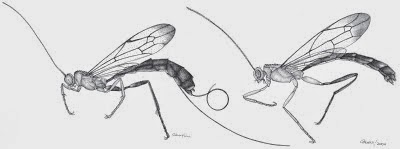
Apechoneura seminigra. (Top left) Line drawing of female specimen. (Top right) Line drawing of possible male specimen. (Middle) Photograph of female specimen. (Bottom) Line Drawing of possible male specimen. Herrera Flórez (2012).


Follow Sciency Thoughts on Facebook.

Sunday, 22 July 2012

New species of Ichneumon Wasp from Jalisco State in central Mexico.

Ichneumon Wasps are specialist parasites of other insects; typically they lay their eggs in the larvae of other insects, and their larvae then consume their hosts from the inside as they grow, eventually killing the host as they emerge. They are sometimes called Scorpion Wasps due to their elongated abdomens and formidable-looking ovipositors (egg laying organs), which resemble the stings of Scorpions, although they do not actually poses stings. This lifestyle, while gruesome to human observers, is clearly highly successful, with the Ichneumon Wasps being one of the most numerous and widespread groups of insects, with over 60 000 described species. 

In a paper published in the journal ZooKeys on 11 July 2012, Andrey Khalaim of the División de Estudios de Postgrado e Investigación at the Facultad de Ingeniería y Ciencias at the Universidad Autónoma de Tamaulipas and the Zoological Institute of the Russian Academy of Sciences, and Enrique Ruíz-Cancino and Juana Coronado-Blanco, also of the División de Estudios de Postgrado e Investigación at the Facultad de Ingeniería y Ciencias at the Universidad Autónoma de Tamaulipas describe a new species of Ichneumon Wasp from Jalisco Province in central Mexico.

The new species is named from a single female Wasp, black, and 12.6 mm in length. It is placed within the subfamily Metopiinae, which are specialist parasites of Caterpillars, in a new genus, Ojuelos, after the municipality of Ojuelos de Jalisco, the capitol of Jalisco State, where the Wasp was discovered, and given the specific name juachicus, after the city of Juachí, where it was found.

Ojuelos juachicus, a new species of Ichneumon Wasp named from a single female specimen found in Jalisco State, Mexico. Khalaim et al. (2012).

See also New species of Leafcutter Bee from Saudi ArabiaA Hatchet Wasp preserved in Tertiary amber from MexicoThree new species of Braconid Wasps from the Late Cretaceous of Magadan Province in the Russian Far EastThree new species of Braconid Wasp from Peru and Evidence of fungal parasites modifying the behavior of ants from the Eocene Messel Shale.

Follow Sciency Thoughts on Facebook.