Showing posts with label Kalimantan. Show all posts

Tuesday, 8 March 2022

Five new species of Staircase Snails from Borneo.

Staircase Snails, Diplommatinidae, are small terrestrial Gastropods with operculi, which get their common name from the strong ribbing on their shells, which can resemble a spiral staircase. They are members of the Cyclophoroidea, a group of Caenogastropods which have lost their combed gills and developed an internal lung independently of the Pulmonata.

In a paper published in the journal Folia Malacologia, Jaap Vermeulen of JK Art and Science and Mohd Zacaery Khalik of the Faculty of Resource Science and Technology at Universiti Malaysia Sarawak, describe five new species of Staircase Snails from Borneo.

The first new species described is placed in the genus Arinia, and given the specific name bathyodon, meaning 'deep-tooth'. The species is described from a collection of shells gathered on a limestone plateau in a primary rainforest Sangkulirang Peninsula in the Indonesian province of Kalimantan. These shells are 1.2-1.6 mm high, 0.75-0.90 mm wide, and ellipsoid-cylindrical to almost cylindrical in shape, with the last two whorls widest in frontal view. The whorls are convex, and there is a constriction of the shell before the aperture, which lacks teeth. The radial ribs are single-crested, and there are 8-12 per 0.5 mm. 

 
Arinia bathyodon: (1) Holotype, frontal view, shell height 1.6 mm; (2) same shell, right lateral view; (3) same shell, umbilical view; (4) paratype, right lateral view with part of the shell wall removed to show internal tooth. Vermeulen & Khalik (2022).

The second new species is also placed within the genus Arinia, and given the specific name congener, meaning 'of the same kind', in reference to the fact that it closely resembles the previously described Arinia similis, which is found in the same area. The species is described from a series of shells collected in the Gunung Mulu National Park in Sarawak Province, Borneo, on the path between Clearwater Cave and Moonmilk Cave. These shells are 1.0-1.2 mm in height, 0.75-0.80 mm in width, and shortly ellipsoid-cylindrical in shape, with the body whorl or last two whorls widest in frontal view. There is a constriction before the aperture, which lacks teeth. The earlier parts of the shell have 12-17 ribs per 0.5 mm, which drops to 5-7 ribs per 0.5 mm after the second half of penultimate whorl.

 
Arinia congener: (5) holotype, frontal view, shell height 1.2 mm; (6) same shell, right lateral view; (7) same shell, umbilical view. Vermeulen & Khalik (2022).

The third new species is again placed in the genus Arinia, and given the specific name semiconica, meaning 'half-cone-shaped', in reference to the shape of the shells. The species is described from a series of specimens collected at Kampong Air Putih near Samarinda, and at Gua Ambulabung in the Baay river valley on the Sangkulirang peninsula, with both localities being in Kalimantan. These shells are 1.7-2.3 mm high, 1.45-1.70 mm wide, and conical with almost flat sides, with the body whorl widest in frontal view. The whorls are convex, with the body whorl often slightly more narrowly rounded at the periphery. A constriction is present before the aperture, which lacks teeth. The ribs are single-crested with 3-6 ribs per 0.5 mm.

 
Arinia semiconica:(8) Holotype, frontal view, shell height 1.8 mm; (9) same shell, right lateral view; (10) same shell, umbilical view. Arrows indicate the position of the constrictions. Vermeulen & Khalik (2022).

The fourth new species is placed in the genus Notharinia, and given the specific name xenos, meaning 'foreigner', in reference to the fact that the genus Notharinia has previously only been identified from Laos and Cambodia, locations significantly distant from Borneo. Vermeulen and Khalik note that the genus Notharinia is similar to the genus Arinia, differing mainly in the constriction of the shell before the aperture of adult shells of Arinia, which is absent in Notharinia; something which could potentially have been lost separately in Notharinia xenos, thereby making the genus paraphyletic, but in the absence of genetic data they choose to base their diagnosis upon the available morphological data.

Notharinia xenos is described from six shells collected from limestone scarps in the upper Tatau river valley of Sarawak State Malaysia. These are 1.9-2.4 mm high and 0.85-0.90 mm wide, with cylindrical shells, slightly widened towards the base. The whorls are moderately convex, the ribs single crested and there are 8-15 ribs per 0.5 mm.

 
Notharinia xenos: (11) Holotype, frontal view, shell height 1.9 mm; (12) same shell, right lateral view; (13) same shell, umbilical view. Vermeulen & Khalik (2022).

The final new species is placed in the genus Opisthostoma, and given the specific name hemituba, meaning 'half-trumpet' in reference to the shortened shells of this species. The species is described from a series of shells collected at Gua Mardua near Kampong Pengadan on the Sangkulirang Peninsula of Kalimantan Province, Indonesia. These range from 1.6 mm to 1.7 mm in height and from 1.60 mm to 1.75 mm in width, and are shortly cylindrical to depressed conical, with the body whorl widest in frontal view. The apex of the shell is oblique and truncated. The whorls are moderately convex, and rounded, the  body whorl is rather narrowly rounded at the base, towards a constriction before the aperture. The ribs are low and thin, being widely spaced; on the spire there are 3-5 ribs per 0.5 mm, on the body whorl this drops to 2-3 ribs per 0.5 mm.

 
Opisthostoma hemituba. (14) Holotype, frontal view, shell height 1.6 mm; (15) same shell, right lateral view; (16) same shell, umbilical view. Arrows indicate the position of the constrictions. Vermeulen & Khalik (2022).

See also...


Follow Sciency Thoughts on Facebook.

Follow Sciency Thoughts on Twitter.


Saturday, 5 October 2019

Assessing the potential impact of planned road and rail developments on the forests of Kalimantan, southern Borneo.

A rising global population combined with a desire for people around the world to enjoy higher standards of living has led to dramatic infrastructure development worldwide, including a massive expansion in roads and other transport networks. It is estimated that about 12 million km of new roads has been built since 2000, with a further 25 million km of new roads predicted by 2050. Much of this expansion has taken place in countries with extensive tropical forests, threatening many of the world’s biologically richest ecosystems. The island of Borneo sustains the largest intact forest area in Southeast Asia. These forests harbour a global biodiversity hotspot, exceptionally high species endemism, and large carbon stocks. They also provide important ecosystem services for local and indigenous communities. About 370 000 km² of this forest lies within Kalimantan, or Indonesian Borneo, an area which comprises diverse ecosystems including montane forests, lowland mixed-Dipterocarp forests, and peat-swamp forests. These forests have been undergoing clearance and degradation at varying but generally high rates since the onset of industrial-scale extractive industries half a century ago. About 31% of the forests remaining in Kalimantan in 1973 have disappeared since that date, with primary (old-growth) forests being the worst affected. Key drivers include infrastructure expansion, logging, oil palm and wood-pulp plantations, mining, and wildfires associated with major droughts.

In a paper published in the journal Scientific Reports on 15 January 2019, Mohammed Alamgir, Mason Campbell, and Sean Sloan of the Centre for Tropical Environmental and Sustainability Science at James Cook University, Ali Suhardiman of the Laboratory of Forest Inventory and Planning at the University of Mulawarman, Jatna Supriatna of the Research Center for Climate Change and Department of Biology at the University of Indonesia, and William Laurance, also of the Centre for Tropical Environmental and Sustainability Science at James Cook University, present the results of a study into the predicted impact of currently planned road and rail developments on the forests of Kalimantan.

Alamgir et al. obtained spatial data and maps of planned and ongoing roads and rail lines in Kalimantan from a variety of regional and national sources in an endeavour to include the majority of the planned and ongoing roads and rail lines in our analyses. They digitised parallel border roads and other planned and ongoing road developments from infrastructure maps of each of the five provinces of Kalimantan (West Kalimantan, East Kalimantan, Central Kalimantan, South Kalimantan and North Kalimantan) generated from the Indonesian Government Infrastructure Information website. These maps contain planned and ongoing roads in each province of Kalimantan. Alamgir et al. also digitized planned new and upgrade roads of Trans Kalimantan Highways from Potter (2008) and the Indonesian Master Plan, which identified the planned routes and other planned highways in Kalimantan. Furthermore, they digitized additional planned and ongoing roads in North Kalimantan and West Kalimantan. Alamgir et al.also compiled spatial data on the planned roads, rail lines and rail stations in North Kalimantan, and on the Samarinda Freeway from the Department of Forestry at Mulawarman University. Extensive discussions to appreciate the ambitions, constraints, and precautions surrounding the planned and ongoing road expansion projects were held with relevant provincial and district planning offices (Bappeda), environmental agencies, Non-Government Organisations such as the World Wide Fund for Nature, and local community groups such as Balikpapan Bay Community Group in Balikpapan, with the aim of understanding of local pressing issues relevant to these infrastructure expansion projects.

An aerial view of construction activities on the Balikpapan-Samarinda toll road in the Samboja area in Kutai Kartanegara, East Kalimantan. Akbar Nugroho Gumay/Jakata Post.

Indonesia, the most extensively forested Southeast Asian nation, experienced the world’s highest annual rate of forest loss in 2011-12, losing 22 000 km² of forest and overtaking Brazil. Over the same period, its road network increased by about 42%, with legally mapped roads expanding in length by roughly 151 000 km. Many roads have markedly increased nearby forest loss and degradation, particularly those built through and adjacent to wilderness areas. Such trends are slated to increase further under the Indonesian Master Plan for the Acceleration and Expansion of Economic Development, which aims to sharply expand road infrastructure by 2025 via the development of six major economic corridors across the Indonesian archipelago. One of these, the Kalimantan Economic Corridor, will sharply expand transportation infrastructure across Kalimantan.

Among the infrastructure projects planned or underway in Kalimantan are an upgrade of 3316 km of the Trans-Kalimantan Highway in southern Kalimantan, 1920 km of new roads (parallel border roads) in northern Kalimantan flanking the Malaysian-Indonesian border, and additional highways and expressways in Central, South, East, and North Kalimantan. The primary goal of this new infrastructure is to increase commercial connectivity and primary industries, particularly coal mining, Oil Palm, and industrial logging. However, the major impacts of this spate of new infrastructure and extractive industries on native forest, biodiversity and relevant attributes, forest fragmentation, landscape connectivity and current forests pattern, in Kalimantan have not been quantified.

Major planned and ongoing infrastructure-expansion networks in Indonesian Borneo examined in the current study. Parallel border roads were extracted from Indonesian Government Infrastructure Information maps for each five provinces of Kalimantan. Alamgir et al. (2019).

Kalimantan’s forests are host to one of the two remaining habitat on the planet where Orangutan, Rhinoceros and Elephant co-exist. It also harbours several globally endangered species such as the Bornean Orangutan, Pongo pygmaeus, and Pygmy Elephant, Elephas maximus borneensis, and iconic species such as Bearded Pig, Sus barbatus, and Sun Bear, Helarctos malayanus, that require a large home range to maintain viable populations. Consequently, if planned and ongoing infrastructure expansion fragments forests and reduces landscape connectivity, it will likely seriously impact the key species and landscape ecological dynamics in Indonesian Borneo.

Alamgir et al. found that planned and ongoing road development will substantially alter the current spatial pattern of forests in Indonesian Borneo. Infrastructure expansion will create an additional 970 km² of forest-edge habitat (i.e. forest that is within 900 m of the nearest forest edge), an increase of 17% on current levels. Conversely about 2370 km² of core forest (forest that is more than 900 m from the nearest forest edge) will be transformed into other, non-core forest categories, primarily small forest patches and edge forests, due to increased forest fragmentation or clearing associated with infrastructure development. Furthermore about 9320 km² of existing ‘bridge’ forest corridors connecting different core-forest areas will be impacted, potentially ecologically disconnecting large expanses of core forest from one another. Finally 900 km² of loop forest (stretches of forest that connect different sections of a core-forest patch) will be created because of increased fragmentation.
All these findings clearly indicate that planned and ongoing road development in Indonesian Borneo will substantially alter the current spatial pattern of forests, leading to large-scale degradation and fragmentation of currently intact forest and a marked decline of forest connectivity.

A disorientated and displaced Orangutan in search of food, is rescued along a road in East Kalimantan. Borneo Orangutan Survival Foundation.

Planned and ongoing road development in Indonesian Borneo will significantly reduce the connectivity of forests at regional scales. Alamgir et al.'s analysis shows that the Equivalent Connected Area, a measure of the percentage of habitat accessible by wildlife based on the degree of network connectivity, is currently 89% for forested areas of Indonesian Borneo. If the planned and ongoing infrastructure expansion were to occur, this index would be reduced to 55%, meaning that more than one-third (34%) of the accessible habitat in the region would be isolated from the remaining accessible habitat. This would create a number of additional isolated habitat patches across the Kalimantan region. This process of patch isolation would predominantly occur via the bisection of larger habitat patches and destruction of numerous forest linkages that currently connect core-forest areas.

The planned and ongoing road expansion would have a major impact on existing protected areas in Indonesian Borneo. Alamgir et al. found that planned and ongoing construction of new road and rail lines would intersect a total of 25 existing protected areas that are currently free from major road incursion. Notably, a planned parallel border-road project in north Kalimantan will intersect a relatively intact protected area, Kayan Mentarang National Park,  that is among the largest remaining protected areas in Indonesian Borneo. Planned and ongoing projects would reduce the internal ecological connectivity of the protected areas and also the extensive trans-boundary connectivity between Indonesian Borneo and Malaysian Borneo. In addition to new infrastructure project, planned upgrades of existing roads will further impact 17 protected areas, particularly in southern Borneo. This process would increase disturbances from earth- and road-works, increase erosion and stream sedimentation, and increase barrier effects to wildlife by widening existing clearings inside protected areas.

The planned and ongoing road expansion in Kalimantan is likely to facilitate logging, oil palm, and wood-fibre industries in intact forest frontiers. Alamgir et al. found that most of the planned and ongoing road developments are situated either inside or along the margins of primary or selectively logged forests adjacent to logging, Oil Palm, and wood-fibre concessions. This pattern suggests that much road expansion will be at the expense of native forest. Alamgir et al. also observed that many ongoing and planned road developments are located along the margins of concessions adjacent to remaining primary or selectively logged forests.

Planned and ongoing infrastructure expansion and the projected decline in landscape connectivity in Indonesian Borneo. The left and right panel show landscape connectivity before and after infrastructure expansion, respectively. Different colours in a map indicate an isolated forest patch. Alamgir et al. (2019).

Different segments of the planned and ongoing road and rail lines in Kalimantan have varying environmental risks. Alamgir et al. classified planned and ongoing road and rail lines construction and upgrades into different categories, considering their overall potential implications for regional environmental integrity. They classified 634 km of new and upgraded road and rail lines in Kalimantan as Very High Impact (roads and rail line segments will bisect current protected areas), 1472 km of new road was classified as High Impact (segments will cut through primary forest or peat land), and 1242 km of new road was classified as Moderate Impact (indicating that these segments will cut through selectively logged forests or regrowth forests). This categorisation indicates that a substantial part of the planned construction and upgrade locations in Kalimantan coincides with current protected areas, peat land, intact forests, and selectively logged and regrowth forests.

The planned and ongoing expansion of infrastructure in Kalimantan will significantly degrade large expanses of native forest. It will sharply increase edge forests and forest fragmentation while reducing core forest. Alamgir et al.'s findings are consistent with several previous analyses showing that road proliferation in tropical landscapes dramatically increases forest fragmentation and abrupt forest edges. The projected changes in spatial pattern will occur because a number of ongoing and planned infrastructure projects, such as parallel border road projects in West, East, and North Kalimantan, will cut through large core-forest areas. Such large-scale fragmentation will inevitably diminish key environmental and ecological values, such as disturbance-sensitive biodiversity, carbon storage, and hydrological functioning. The fragmented forests would be more vulnerable to subsequent forest conversion via legal and illegal means, mirroring trends observed in the Amazon, Sumatra, and Malaysian Borneo.

Indices of landscape connectivity measure the proportion of suitable habitat in a landscape that is accessible by wildlife populations. Alamgir et al.'s findings include a marked loss of current forest linkages, the creation of a number of isolated forest patches, and a 34% decline in overall landscape connectivity. The consequences of this severe connectivity loss may be dire for the unique biodiversity of Borneo, particularly for several globally endangered animals that have large home ranges, such as Bornean orangutans, and Pygmy Elephants, as well as iconic species such as Bearded Pigs and Sun Bears, that will travel hundreds of kilometres in response to mast fruiting. The critically endangered Sumatran Rhinoceros, Dicerorhinus sumatrensis, may also persist in tiny numbers in Kalimantan. Planned projects could pose severe threats to the viability of these rare and space-demanding species, in part by massively reducing forest connectivity between Malaysian and Indonesian Borneo, which have long existed as a single forest block.

Categorization of planned and ongoing road and rail lines by their potential environmental impacts in Indonesian Borneo. Alamgir et al. (2019).

Many wildlife species, including many species actively poached and traded illegally, would become more vulnerable to poachers and hunters from increased road access and forest fragmentation. Similar consequences were reported from African tropical forests where Forest Elephants, Loxodonta cyclotis, declined by more than 60% between 2002 and 2011, largely due to the increased access for poachers and commercial hunters from forest-road expansion. In Peninsular Malaysia, about 90% of snares and poaching camps in a studied forested area were found within 5 km of a paved road. Similarly, Sumatran Orangutans, Pongo abelii, and Tapanuli Orangutans, Pongo tapanuliensis, in Sumatra are both critically endangered by infrastructure proliferation in their remaining habitat. Beyond these iconic species, infrastructure would also negatively affect forest-interior small Mammals, arboreal species, and Birds, among others.

Alamgir et al.'s analyses suggest that planned and ongoing infrastructure expansion in Kalimantan will be highly disruptive to protected areas, by diminishing their connectivity to nearby forests and increasing encroachment and poaching. If all planned infrastructure expansion proceeds, 42 protected areas will be impacted to varying degrees. This process will undermine the Indonesian commitment to achieve the Aichi Target 11 of the Convention on Biological Diversity that aims to ensure that by 2020 at least 17% of the total terrestrial area will be represented by well-connected protected area systems. Both at the regional (Kalimantan) and national scale, Indonesia is currently well behind schedule to achieve this target and immediate actions to maintain or improve protected-area connectivity are essential. Road construction facilitates deforestation and degradation of protection forest, and is one of the main causes of declining effectiveness of protected areas across Indonesia and the world.

If major infrastructure projects in Kalimantan proceed as planned, the majority of remaining old-growth forests (unlogged primary forests) and peatlands in Kalimantan may become accessible, threatening their near-term degradation. This would parallel current and historical trends of deforestation in Borneo and elsewhere in Indonesia. The current Indonesia Master Plan as presently framed will lead to sharp increases in forest loss and disruption and reductions in their associated environmental services, such as the high levels of carbon storage in upland and peatland forests, which would have global implications for climate change.

A massive toll road is near completion to connect to Balikpapan and Samarinda in East Kalimantan. Jack Board/MediaCorp.

See also...

https://sciencythoughts.blogspot.com/2019/10/elephas-maximus-borneensis-four-people.htmlhttps://sciencythoughts.blogspot.com/2019/09/malaysian-woman-killed-by-crocodile.html
https://sciencythoughts.blogspot.com/2018/10/pongo-pygmaeus-148-500-borneo.htmlhttps://sciencythoughts.blogspot.com/2018/08/indonesian-authorities-uncover-illegal.html
https://sciencythoughts.blogspot.com/2018/04/pipeline-rupture-leads-to-massive-oil.htmlhttps://sciencythoughts.blogspot.com/2015/03/terrestrial-behaviour-in-borneo.html
Follow Sciency Thoughts on Facebook.

Saturday, 13 October 2018

Pongo pygmaeus: 148 500 Borneo Orangutans lost between 1999 and 2015 due to Human intrusions into their habitats.

Demand for natural resources from highly biodiverse tropical regions has expanded greatly increased in recent decades placing a great deal of stress on species living there. There are currently seven described species of non-Human Great Apes, the Chimpanzee, Pan troglodytes, the Bonobo, Pan paniscus, the Eastern Gorilla, Gorilla beringei, the Western Gorilla, Gorilla gorilla, the Sumatra Orangutan, Pongo abelii,  the Tapanuli Orangutan, Pongo tapanuliensis, and the Borneo Orangutan, Pongo pygmaeus. All of these are classified as either Endangered or Critically Endangered under the terms of the the International Union for the Conservation of Nature's Red List of Threatened Species, with the three Orangutan species, Asia's only Great Apes, considered to be particularly at risk due to the rapid rate of deforestation in Indonesia.

In a paper published in the journal Current Biology on 5 March 2015, a group of scientists led by Maria Voigt of the Max Planck Institute for Evolutionary Anthropology and the German Centre for Integrative Biodiversity Research publish the results of a study that monitored the decline in Borneo Orangutans between 1999 and 2015, and examine the causes of this decline.

A juvenile Orangutan in the wild. Borneo Nature Foundation.

Voigt et al. compiled the results of 1743 ground and aerial transects made between 1999 and 2015, which used observations of Orangutan nests as a proxy for Orangutan numbers. From these statistics they conclude that the three largest populations of Borneo Orangutans, Western Schwaner, Eastern Schwaner and Karangan suffered a total decline in Orangutan numbers of 148 500 numbers over the study period, with Western Schwaner losing 42 700 individuals, Eastern Schwaner 20 100 and Karangan 8200.

Abundance of the Three Largest Orangutan Metapopulations between 1999 and 2015 and Projected Abundance for 2020 and 2050 Orangutan abundance was estimated for the three largest metapopulations with a multi-model approach over the study period (1999 to 2015). Estimates of future Orangutan abundance were based on forest cover projections for 2020 and 2050 and are indicated by a dashed line. Shaded areas and error bars represent the 95% confidence intervals. On the y axes, the number ‘10 000’ is highlighted in blue to show the scale difference between the three populations. The map shows all identified metapopulations in gray. The three largest metapopulations are indicated by their colour. State labels are as follows: Br,  Brunei; Sb, Sabah; and Sk, Sarawak in Malaysia; WK, West; EK, East; NK, North; SK South; and CK, Central Kalimantan in Indonesia. Voigt et al. (2018).

Surprisingly only about 9% of this total loss (i.e. 14 000 individuals) occurred in areas of extensive deforestation. There are two possible explanations for this, either Orangutans, which are intelligent, flexible animals, are better able to survive the loss of natural forest and the appearance of plantations for palm oil and paper pulp production than previously realised, or the population density of Orangutans in areas adjacent to plantations has risen sharply due to an influx of refugee animals, and is likely to drop sharply in the future due to an unsustainable high number of Apes.

Either way this also means that 91% of the loss (134 500 animals) occurred in areas not effected by major deforestation, indicating that there were more important factors at play. The strongest correlation with Orangutan population decline turned out to be rises in the Human population, strongly suggesting that Orangutans were dying principally as a result of being hunted, or other direct conflicts with Humans, such as the capture of young for the international pet trade (which also typically includes killing of the parents) or contracting Human diseases (known to be a significant cause of mortality in African Apes). Voigt et al. suggest that due to the low reproductive rate of Orangutans even a small increase in the mortality rate due to these causes could have a significant impact on the population.

Baby Orangutans rescued from the pet trade being raised at a project run by International Animal Rescue in Borneo. Tim Laman/National Geographic.

See also...

https://sciencythoughts.blogspot.com/2018/08/indonesian-authorities-uncover-illegal.htmlhttps://sciencythoughts.blogspot.com/2017/11/pongo-tapanuliensis-new-species-of.html
https://sciencythoughts.blogspot.com/2016/10/gorilla-beringei-graueri-grauers.htmlhttp://sciencythoughts.blogspot.com/2015/08/global-superpredator-how-human.html
https://sciencythoughts.blogspot.com/2015/03/terrestrial-behaviour-in-borneo.htmlhttps://sciencythoughts.blogspot.com/2014/11/crop-raiding-behaviour-by-chimpanzees.html
Follow Sciency Thoughts on Facebook.

Monday, 27 August 2018

Indonesian authorities uncover illegal bauxite mine in the buffer zone of Mount Palung National Park, West Kalimantan.

Authorities in West Kalimantan raided an illegal bauxite (aluminium ore) mine in the buffer zone of the Mount Palung National Park, an important Orangutan habitat, in the Ketapang Regency on Monday 20 August 2018. The site was raided by investigators from the Environment and Forestry Ministry and West Kalimantan Police following a tip-off from local residents. The site was allegedly being operated by mining company PT Laman Mining, which has been charged under the Prevention and Eradication of Forest Degradation Act of 2013.

An illegal bauxite mine in the buffer zone of the Mount Palung National Park, raided by Indonesian authorities on 20 August 2018. KLHK.
Dok. Gakkum KLHK

Artikel ini telah tayang di Kompas.com dengan judul "Kementerian LHK Gerebek Penambangan Ilegal di Habitat Orangutan Sungai Tulak", https://regional.kompas.com/read/2018/08/26/12435461/kementerian-lhk-gerebek-penambangan-ilegal-di-habitat-orangutan-sungai-tulak.
Penulis : Kontributor Pontianak, Yohanes Kurnia Irawan
Editor : Kurnia Sari Aziza
Dok. Gakkum KLHK

Artikel ini telah tayang di Kompas.com dengan judul "Kementerian LHK Gerebek Penambangan Ilegal di Habitat Orangutan Sungai Tulak", https://regional.kompas.com/read/2018/08/26/12435461/kementerian-lhk-gerebek-penambangan-ilegal-di-habitat-orangutan-sungai-tulak.
Penulis : Kontributor Pontianak, Yohanes Kurnia Irawan
Editor : Kurnia Sari Aziza
Dok. Gakkum KLHK

Artikel ini telah tayang di Kompas.com dengan judul "Kementerian LHK Gerebek Penambangan Ilegal di Habitat Orangutan Sungai Tulak", https://regional.kompas.com/read/2018/08/26/12435461/kementerian-lhk-gerebek-penambangan-ilegal-di-habitat-orangutan-sungai-tulak.
Penulis : Kontributor Pontianak, Yohanes Kurnia Irawan
Editor : Kurnia Sari Aziza

The Mount Palung National Park is home to an estimated 2500 Borneo Orangutans, Pongo pygmaeus, a species classified as Endangered under the terms of the the International Union for the Conservation of Nature's Red List of Threatened Species, with a total population of about 54 500, and considered to be particularly at risk due to the rapid rate of deforestation in Indonesia.

Borneo Orangutans, Pongo pygmaeus, in the Mount Palung National Park. Tim Laman/The Orangutan Conservancy.

See also...

https://sciencythoughts.blogspot.com/2017/11/pongo-tapanuliensis-new-species-of.htmlhttps://sciencythoughts.blogspot.com/2016/10/gorilla-beringei-graueri-grauers.html
https://sciencythoughts.blogspot.com/2015/03/terrestrial-behaviour-in-borneo.htmlhttps://sciencythoughts.blogspot.com/2014/11/crop-raiding-behaviour-by-chimpanzees.html
https://sciencythoughts.blogspot.com/2014/08/mapping-deforestation-on-borneo.htmlhttps://sciencythoughts.blogspot.com/2014/01/a-fossil-ape-from-late-miocene-of.html
Follow Sciency Thoughts on Facebook.

Wednesday, 25 November 2015

Sundathelphusa brachyphallus: A new species of Freshwater Crab from southern Kalimantan, Borneo.

Freshwater Crabs of the genus Sundathelphusa are found in the Philippines, Sulawesi, Borneo and the Lesser Sunda Islands. To date thirty-three species have been described, though only two of these came from Borneo, Sundathelphusa tenebrosa, from northern Sarawak and Brunei, and Sundathelphusa aspera from northwestern Sabah.

In a paper published in the Raffles Bulletin of Zoology on 23 October 2015, Peter Ng of the Lee Kong Chian Natural History Museum at the National University of Singapore, described a third Sundathelphusa species from Borneo.

The new species is named Sundathelphusa brachyphallus, in reference to the G1 segment of the abdomen (the tip of the tail of the crab, though this is folded under the body and invisible to a casual observer), which is short, stout and directed obliquely outwards. The species is described from two male specimens, one 27.1 mm in width the other 29.3 mm, collected at Liang Hintan in Kalimantan (Indonesian Borneo).

Sundathelphusa brachyphallus, male specimen in dorsal view. Ng (2015).

Ng notes that the three Bornean (check spelling) species of Sundathelphusa differ from other members of the genus in a number of ways, including a generally more flattened body and the structure of the abdomen. He suggests that these species may in the future be separated out to form a new genus.

See also…

http://sciencythoughts.blogspot.co.uk/2015/04/fizesereneia-panda-new-species-of-gall.htmlFizesereneia panda, a new species of Gall Crab from the Red Sea.                                          Gall Crabs, Cryptochiridae, are small Crabs which live in burrows within living Corals, causing the Coral to grow around the living Crab. Most species live in tropical reef Corals, where some can reach very high population densities, though some are known from deep water Corals. Gall Crabs are known to have a global distribution...
http://sciencythoughts.blogspot.co.uk/2015/02/two-new-species-of-vampire-crabs-from.htmlTwo new species of Vampire Crabs from Central Java.                                                                 Sesarmid crabs of the genus Geosesarma are large, often colourful, fully terrestrial Crabs found in Southeast Asia and Indonesia. In recent years they have been traded in the international aquarium trade under...
http://sciencythoughts.blogspot.co.uk/2015/01/a-new-species-of-icriocarcinid-crab.htmlA new species of Icriocarcinid Crab from the End Cretaceous of California.                    Icriocarcinid Crabs are a distinct group of Portunoid...
Follow Sciency Thoughts on Facebook.


Wednesday, 18 March 2015

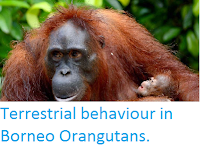
Terrestrial behaviour in Borneo Orangutans.


Orangutans, Pongo pygmaeus, are traditionally viewed as creatures of the forest canopy, with trips to the ground usually being made only to access specific resources and extended periods of locomotion on the ground being indicative of stressed animals struggling to cope with human modification of the environment. However several recent observations have suggested that Orangutans may spend more time on or close to the ground than previously thought, illustrating a need for a more organized, quantitative study of terrestrial behaviour in these Apes.

In a paper published in the journal Oryx on 22 January 2015, Brent Loken of the School of Resource and Environmental Management at Simon Fraser University, Chandradewana Boer of the Forestry Faculty at Mulawarman University and Nunuk Kasyanto of Integrated Conservation describe the results of a 2.5 year camera-trap investigation into the behaviour of Borneo Orangutans, Pongo pygmaeus morio, in and around the Wehea Forest in East Kalimantan, Indonesia.

Camera Traps were located in three types of forest; undisturbed primary rainforest, where there is a dense canopy but little ground cover, secondary rainforest, which was last logged in 1996, and where the forest has begun to recover, but has a thin canopy and dense ground cover, and active logging concessions, where the forest still remains but where desirable trees are being actively removed, and where logging roads create distinctive breaks in the canopy.

Over the period of two and a half years from October 2012 until June 2014 Loken et al. recorded 189 instances of Orangutans moving on the ground in logging concessions, 63 instances in secondary rainforest and 44 in primary rainforest. While this met the prediction that Orangutans moved on the ground far more in the logged areas, it also indicated that they spent far more time on the ground in other areas than previously anticipated. Furthermore the majority of sightings in the logging concessions were of Apes moving along rather than across roads, suggesting that they were opportunistically utilizing Human-created paths rather than moving from one area of canopy to the next across open ground.

Female Orangutan with newborn infant at the Lamandau River Wildlife Reserve in Central Kalimantan, Borneo. Orangutan Foundation.

Loken et al. suggest that from this evidence Orangutans may be more terrestrial in nature than previously realized, and that ground locomotion may be a regular part of their behavioural repertoire, rather than always a reaction to human-induced environmental stress. They further suggest that this may indicate that Orang-utans may be slightly more resilient to some forms of Human intervention in their environment than previously thought, though they stress that these animals are still extremely vulnerable and cannot survive in heavily altered environments or without extensive forest ranges, and that areas of managed timber extraction should be included in long-term management strategies for the species.

See also…

Chimpanzees, Pan troglodytes, like all the Great Apes, face increasing conflict with Humans throughout...


Industrial scale timber extraction began on Borneo in the 1970s and during the period 1980 to 2000 more timber was harvested from Borneo than from Africa and the Amazon Basin combined. In addition much forest has been cleared to make way for monoculture plantations, for the palm oil, rubber and timber industries, as well as being burned in forest fires.  For this reason the island is often assumed to be a hopeless case...


Apes (Hominoidea) are large, tailless Primates found in Africa, eastern Asia, and in one case (Homo sapiens) globally. Apes are commonly divided into Lesser and Great Apes, with the 17 species of Gibbon...


Follow Sciency Thoughts on Facebook.

Thursday, 4 December 2014

A new species of Glassperch from West Kalimantan, Borneo.


Glassperch, Gymnochanda, are small Perciforme Fish (seldom more than 30 mm) found in still pools close to swamp forest and riverine ecosystems on Borneo, Sumatra, Peninsula Malaysia and Belitung Island. They are scaleless and transparent and show high levels of sexual dimorphism, with the females tending to be inconspicuous but the males having elongated fin rays and bright fin colouration.

In a paper published in the Raffles Bulletin of Zoology on TanHeok Hui and Kelvin Lim Kok Peng of the Lee Kong Chian Natural History Museum and the Faculty of Science at the National University of Singapore describe a new species of Glassperch from West Kalimantan State (Indonesia) on Borneo.

The new species is named Gymnochanda ploegi, in honour of the late Alex Ploeg, former Secretary General of the Ornamental Fish International, who perished on Malaysia Airlines Flight MH17, which was shot down over Ukraine on 17 July 2014, for his work as a taxonomist and conservationist, particularly in the field of alien aquatic species, and his services to the ornamental fish trade. The species is described from 32 specimens gathered by local collectors for the ornamental fish trade, apparently the first time this fish has been collected.

Gymnochanda ploegi, male specimen in lateral view. Tan & Lim (2014).

The specimens range from 23.9 to 27.5 mm in length. The males have red and black pigmentation on their heads, particularly around the lips and snout, and similar colouration on the fins and in dark bars on the bodies. The females have similar colouration but with less black.

Gymnochanda ploegi, female specimen in lateral view. Tan & Lim (2014).

The specimens were collected from still pools in the Sanggau and Kapuas Lakes regions in West Kalimantan. The area from which they were collected was apparently remote, and took several hours trek to reach.

See also…

Gobies are small, benthic (bottom dwelling) members of the Perch Order, found in marine and freshwater environments around the world, but most numerous and diverse in the Indo-Pacific region. There are...

Cavefish (Amblyopsidae) are a group of predominantly cave-dwelling Perciform Fish from North America. Of the eight currently described species three are found at the surface, predominantly around springs...


The Cichlid Fish genus Chalinochromis is endemic to Lake Tanganyika in East Africa. To date two species have been formally described, Chalinochromis...


Follow Sciency Thoughts on Facebook.