Showing posts with label Orangutans. Show all posts

Tuesday, 16 December 2025

Tapanuli Orangutans brought closer to extinction by Cyclone Senyar.

The Tapanuli Orangutan, Pongo tapanuliensis, is thought to have moved significantly closer to extinction after Cyclone Senyar passed across Sumatra on 25 November 2025. The species, which was only discovered in 2017, is considered to be the world's rarest Ape, with a population of about 800 all living within an area of less than 1000 km² in North Sumatra. It is considered to be Critically Endangered under the terms of the International Union for the Conservation of Nature's Red List of Threatened Species.

A male Tapanuli Orangutan, Pongo tapanuliensis. Maxime Aliaga/Sumatran Orangutan Conservation Program.

Cyclone Senyar caused more than 1000 mm of rain to fall in a day in parts of North Sumatra, triggering a series of catastrophic floods and landslides which killed over a thousand people on the island. The three districts where the species is found, North, Central, and South Tapanuli, have been particularly badly hit, with satellite images showing that between 48 and 72 km² of the forest inhabited by Tapanuli Orangutans has been destroyed, according to Erik Meijaard of Borneo Futures, who has been studying the storm's impact on the Apes. This could potentially equate to between 33 and 55 Orangutans, or between 6.2% and 10.5% of the total population.

So far, only a single dead Orangutan has been found, leading to the possibility that the Apes may have been able to escape the area before the worst of the event, although this is not typical Orangutan behaviour; they usually seek the nearest shelter and attempt to wait out large storms. Even should this have been the case, the storm appears to have destroyed large areas of their native habitat, including food sources, which makes it likely that more Orangutans will be lost in the near future. 

A dead Tapanuli Orangutan found amid storm debris in the village of Pulo Pakkat, North Sumatra, following the passage of Cyclone Senyar. Decky Chandra/The Guardian.

The population was already considered to be threatened by the expansion of mining, hydropower projects and palm oil plantations, within their habitat, as well as a rapidly changing environment, with global warning already having led to an increase in rainfall of between 28 and 160% across Sumatra. One possible benefit to the Orangutans is that the Indonesian government has ordered a halt to all new development projects in the Tapanuli area, pending a survey of the region, which may lead to their gaining some extra long-term protection. The government has also indicated its support for forest restoration projects in the region, which could lead to an increase in the available habitat for the Apes.

The storm is also reported to have completely destroyed the Ketambe Research Station, within the Gunung Leuser National Park in Aceh Province, which was the first specialist Orangutan research centre in the world, opened in 1971 by Dutch primatologist Herman Rijksen, and a leading centre for research into the Sumatran Orangutan, Pongo abelii, which is also considered to be Critically Endangered.

Damage caused to the Ketambe Research Station, within the Gunung Leuser National Park by Cyclone Senyar. American Association of Zookeepers

See also...

Friday, 27 October 2023

Lithocarpus tapanuliensis: A new species of Stone Oak from northern Sumatra, utilised as a food source by Orangutans.

The tropical rainforests of Sundaland (Bali, Borneo, Java, Sumatra, the Malay Peninsula, and the surrounding small islands) form one of the most biologically megadiverse regions on Earth, with each landmass containing fragments of a larger forest which once covered the now largely submerged Sundaland landmass. The island of Sumatra, once considered to be too similar to Peninsula Malaysia to merit much study, is now recognised as one of the most diverse regions within Sundaland, possibly containing as many Plant species as the much larger island of Borneo; significantly more than the islands of Java or Sulawesi. The island is also home to a variety of Critically Endangered megafauna, including Sumatran Elephants, Elephas maximus sumatranus, Sumatran Rhinoceros, Dicerorhinus sumatrensis, Sunda Tiger, Panthera tigris sondaica, and Sumatran and Tapanuli Orangutans, Pongo abelii and Pongo tapanuliensis.
Stone Oaks, Lithocarpus spp., are currently considered to be the second largest genus within the Family Fagaceae, with about 347 named species (only the True Oaks, Quercus spp., have more, with around 600), including 32 species found on Sumatra, five of which are entirely endemic to the island. Stone Oaks are found across the island of Sumatra, found in all forest environments, although individual species tend to have limited elevation ranges, and the group is at its most diverse between 400 m and 700 m above sealevel. Fagacean trees, along with Laurels, Lauraceae, and Myrtles, Myrtaceae, form major components of the lower montane forests of Sumatra, between 900 m and 1500 m above sealevel, and eight species are known from the Sumatran upper montain forest, 1400-2500 m above sealevel.

The Batang Toru Ecosystem consists of a mosaic of mixed plantations and primary and secondary forests, with three remaining large forest blocks, the largest of which is the South Tapanuli Block, which forms the last refuge of the Critically Endangered Tapanuli Orangutan. 

In a paper published in the journal PhytoKeys on 20 October 2023, Try Surya Harapan of the Southeast Asia Biodiversity Research Institute and  Center for Integrative Conservation at the Xishuangbanna Tropical Botanical Garden, the Yunnan International Joint Laboratory of Southeast Asia Biodiversity Conservation and Yunnan Key Laboratory for Conservation of Tropical Rainforests and Asian Elephants, and the Herbarium at Universitas Andalas, Wei Harn Tan of the Faculty of Science at Universiti Brunei Darussalam, Thoriq Alfath Febriamansyah, Nurainas, and Syamsuardi, also of the Herbarium at Universitas Andalas, and Joeri Sergej Strijk of the Alliance for Conservation Tree Genomics at the Pha Tad Ke Botanical Garden, describe a new species of Stone Oak from the South Tapanuli Block, observed to be a food source utilised by Tapanuli Orangutans. 

The new species is named Lithocarpus tapanuliensis, where 'tapanuliensis' means 'from Tapanuli'. It is a large forest tree, reaching 35 m without any buttresses. It's bark is greyish-green with whitish lenticels, fissured in place to form longitudinal slits exposing a dark red inner bark. Leaves are elliptic to oblong in shape, reaching 20 cm in length and 8.5 cm in width, dark green above, and fawnish green on the underside, which is covered with woolly hair. Flowering of the tree has not been observed, but acorns 1.9–2.3 cm in length are born in cups 2.8–3.4 cm in diameter.

Lithocarpus tapanuliensis. (A) Fresh fruits from field collection, (B) fresh fruits in the canopy, (C) bark and sapwood, (D) fresh leaves, (E) dried mature and immature infructescence, (F) base of tree next to an Animal wallow, (G) cupule- bottom view, top view and nut bottom view and cross-section. Harapan et al. (2023).

The species was discovered during a field survey carried out in February 2023; only two trees were observed, growing at an altitude of 894 m within Pilar Forest of the South Tapanuli Block. A number of collected acorn remnants showed signs of having been fed upon by Orangutans, and an Orangutan was observed nesting in a neighbouring tree (Orangutans tend to nest near to, but not in, food trees, to avoid being disturbed by other Animals when they sleep). The consumption of the acorns, leaves and bark of Fagaceaen trees by Orangutans has previously been recorded, although these is generally overlooked as a food source in studies of the Apes. It is likely that acorns serve as a reliable source of food during periods of fruit-scarcity, caused by the multi-annual fruiting cycles of many rainforest trees. Asian Black Bears, Ursus thibetanus, and Malayan Sun Bears, Helarctos malayanus, have also been observed consuming acorns during periods of low fruit abundance.

(A) Acorns consumed by Orangutan. (B) Orangutan nest in a neighbouring tree. Harapan et al. (2023).

Only two specimens of Lithocarpus tapanuliensis has been observed, both within Pilar Forest. This forest is small, lacks any legal protection, and extensive habitat alteration and forest clearance are occurring within the immediate area to where the trees were found. For this reason Harapan et al. recommend that Lithocarpus tapanuliensis be classified as Critically Endangered under the terms of the International Union for the Conservation of Nature's Red List of Threatened Species.

See also...

Follow Sciency Thoughts on Facebook.

Follow Sciency Thoughts on Twitter.


Tuesday, 3 December 2019

Sumatran Orangutan found with gunshot wounds in Aceh Province, Indonesia.

A male Sumatran Orangutan, Pongo abelii, has been found with multiple injuries by staff from the Indonesian Natural Resources Conservation Agency while carrying out a patrol in the South Aceh District of Aceh Province, on the island of Sumatra on Thursday 28 November 2019. The Ape, who has been named Paguh by rescuers, was found to have 24 air rifles pellets in his body, and to have been blinded in both eyes. He was taken to the Batu Mbelin Sibolangit Orangutan Rehabilitation Center, run by the Lestari Ecosystem Foundation and PanEco Foundation - Sumatran Orangutan Conservation Programme, where he was treated for his injuries; he is expected to survive, but not to be able to return to the wild.

A male Orangutan named Pugeh who was rescued after  being blinded with airgun pellets last week. EPA.

The Sumatran Orangutan is considered to be Critically Endangered under the terms of the the International Union for the Conservation of Nature's Red List of Threatened Species,with less than 14 000 individuals surviving in the wild,  in a total area of 16 775 km² of forest. They are considered to be at threat from habitat loss and fragmentation, as a result of Indonesia's rapidly expanding Human population and associated development projects, such as mining, road building, and plantation forestry, as well as more directly from poaching. 

X-ray image of Paguh showing airgun pellets within his head. EPA.

See also...

https://sciencythoughts.blogspot.com/2018/10/pongo-pygmaeus-148-500-borneo.htmlhttps://sciencythoughts.blogspot.com/2018/08/indonesian-authorities-uncover-illegal.html
https://sciencythoughts.blogspot.com/2017/11/pongo-tapanuliensis-new-species-of.htmlhttps://sciencythoughts.blogspot.com/2015/03/terrestrial-behaviour-in-borneo.html
https://sciencythoughts.blogspot.com/2014/01/a-fossil-ape-from-late-miocene-of.html
Follow Sciency Thoughts on Facebook.

Saturday, 13 October 2018

Pongo pygmaeus: 148 500 Borneo Orangutans lost between 1999 and 2015 due to Human intrusions into their habitats.

Demand for natural resources from highly biodiverse tropical regions has expanded greatly increased in recent decades placing a great deal of stress on species living there. There are currently seven described species of non-Human Great Apes, the Chimpanzee, Pan troglodytes, the Bonobo, Pan paniscus, the Eastern Gorilla, Gorilla beringei, the Western Gorilla, Gorilla gorilla, the Sumatra Orangutan, Pongo abelii,  the Tapanuli Orangutan, Pongo tapanuliensis, and the Borneo Orangutan, Pongo pygmaeus. All of these are classified as either Endangered or Critically Endangered under the terms of the the International Union for the Conservation of Nature's Red List of Threatened Species, with the three Orangutan species, Asia's only Great Apes, considered to be particularly at risk due to the rapid rate of deforestation in Indonesia.

In a paper published in the journal Current Biology on 5 March 2015, a group of scientists led by Maria Voigt of the Max Planck Institute for Evolutionary Anthropology and the German Centre for Integrative Biodiversity Research publish the results of a study that monitored the decline in Borneo Orangutans between 1999 and 2015, and examine the causes of this decline.

A juvenile Orangutan in the wild. Borneo Nature Foundation.

Voigt et al. compiled the results of 1743 ground and aerial transects made between 1999 and 2015, which used observations of Orangutan nests as a proxy for Orangutan numbers. From these statistics they conclude that the three largest populations of Borneo Orangutans, Western Schwaner, Eastern Schwaner and Karangan suffered a total decline in Orangutan numbers of 148 500 numbers over the study period, with Western Schwaner losing 42 700 individuals, Eastern Schwaner 20 100 and Karangan 8200.

Abundance of the Three Largest Orangutan Metapopulations between 1999 and 2015 and Projected Abundance for 2020 and 2050 Orangutan abundance was estimated for the three largest metapopulations with a multi-model approach over the study period (1999 to 2015). Estimates of future Orangutan abundance were based on forest cover projections for 2020 and 2050 and are indicated by a dashed line. Shaded areas and error bars represent the 95% confidence intervals. On the y axes, the number ‘10 000’ is highlighted in blue to show the scale difference between the three populations. The map shows all identified metapopulations in gray. The three largest metapopulations are indicated by their colour. State labels are as follows: Br,  Brunei; Sb, Sabah; and Sk, Sarawak in Malaysia; WK, West; EK, East; NK, North; SK South; and CK, Central Kalimantan in Indonesia. Voigt et al. (2018).

Surprisingly only about 9% of this total loss (i.e. 14 000 individuals) occurred in areas of extensive deforestation. There are two possible explanations for this, either Orangutans, which are intelligent, flexible animals, are better able to survive the loss of natural forest and the appearance of plantations for palm oil and paper pulp production than previously realised, or the population density of Orangutans in areas adjacent to plantations has risen sharply due to an influx of refugee animals, and is likely to drop sharply in the future due to an unsustainable high number of Apes.

Either way this also means that 91% of the loss (134 500 animals) occurred in areas not effected by major deforestation, indicating that there were more important factors at play. The strongest correlation with Orangutan population decline turned out to be rises in the Human population, strongly suggesting that Orangutans were dying principally as a result of being hunted, or other direct conflicts with Humans, such as the capture of young for the international pet trade (which also typically includes killing of the parents) or contracting Human diseases (known to be a significant cause of mortality in African Apes). Voigt et al. suggest that due to the low reproductive rate of Orangutans even a small increase in the mortality rate due to these causes could have a significant impact on the population.

Baby Orangutans rescued from the pet trade being raised at a project run by International Animal Rescue in Borneo. Tim Laman/National Geographic.

See also...

https://sciencythoughts.blogspot.com/2018/08/indonesian-authorities-uncover-illegal.htmlhttps://sciencythoughts.blogspot.com/2017/11/pongo-tapanuliensis-new-species-of.html
https://sciencythoughts.blogspot.com/2016/10/gorilla-beringei-graueri-grauers.htmlhttp://sciencythoughts.blogspot.com/2015/08/global-superpredator-how-human.html
https://sciencythoughts.blogspot.com/2015/03/terrestrial-behaviour-in-borneo.htmlhttps://sciencythoughts.blogspot.com/2014/11/crop-raiding-behaviour-by-chimpanzees.html
Follow Sciency Thoughts on Facebook.

Monday, 27 August 2018

Indonesian authorities uncover illegal bauxite mine in the buffer zone of Mount Palung National Park, West Kalimantan.

Authorities in West Kalimantan raided an illegal bauxite (aluminium ore) mine in the buffer zone of the Mount Palung National Park, an important Orangutan habitat, in the Ketapang Regency on Monday 20 August 2018. The site was raided by investigators from the Environment and Forestry Ministry and West Kalimantan Police following a tip-off from local residents. The site was allegedly being operated by mining company PT Laman Mining, which has been charged under the Prevention and Eradication of Forest Degradation Act of 2013.

An illegal bauxite mine in the buffer zone of the Mount Palung National Park, raided by Indonesian authorities on 20 August 2018. KLHK.
Dok. Gakkum KLHK

Artikel ini telah tayang di Kompas.com dengan judul "Kementerian LHK Gerebek Penambangan Ilegal di Habitat Orangutan Sungai Tulak", https://regional.kompas.com/read/2018/08/26/12435461/kementerian-lhk-gerebek-penambangan-ilegal-di-habitat-orangutan-sungai-tulak.
Penulis : Kontributor Pontianak, Yohanes Kurnia Irawan
Editor : Kurnia Sari Aziza
Dok. Gakkum KLHK

Artikel ini telah tayang di Kompas.com dengan judul "Kementerian LHK Gerebek Penambangan Ilegal di Habitat Orangutan Sungai Tulak", https://regional.kompas.com/read/2018/08/26/12435461/kementerian-lhk-gerebek-penambangan-ilegal-di-habitat-orangutan-sungai-tulak.
Penulis : Kontributor Pontianak, Yohanes Kurnia Irawan
Editor : Kurnia Sari Aziza
Dok. Gakkum KLHK

Artikel ini telah tayang di Kompas.com dengan judul "Kementerian LHK Gerebek Penambangan Ilegal di Habitat Orangutan Sungai Tulak", https://regional.kompas.com/read/2018/08/26/12435461/kementerian-lhk-gerebek-penambangan-ilegal-di-habitat-orangutan-sungai-tulak.
Penulis : Kontributor Pontianak, Yohanes Kurnia Irawan
Editor : Kurnia Sari Aziza

The Mount Palung National Park is home to an estimated 2500 Borneo Orangutans, Pongo pygmaeus, a species classified as Endangered under the terms of the the International Union for the Conservation of Nature's Red List of Threatened Species, with a total population of about 54 500, and considered to be particularly at risk due to the rapid rate of deforestation in Indonesia.

Borneo Orangutans, Pongo pygmaeus, in the Mount Palung National Park. Tim Laman/The Orangutan Conservancy.

See also...

https://sciencythoughts.blogspot.com/2017/11/pongo-tapanuliensis-new-species-of.htmlhttps://sciencythoughts.blogspot.com/2016/10/gorilla-beringei-graueri-grauers.html
https://sciencythoughts.blogspot.com/2015/03/terrestrial-behaviour-in-borneo.htmlhttps://sciencythoughts.blogspot.com/2014/11/crop-raiding-behaviour-by-chimpanzees.html
https://sciencythoughts.blogspot.com/2014/08/mapping-deforestation-on-borneo.htmlhttps://sciencythoughts.blogspot.com/2014/01/a-fossil-ape-from-late-miocene-of.html
Follow Sciency Thoughts on Facebook.

Friday, 3 November 2017

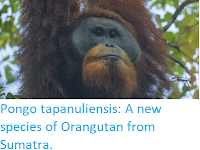
Pongo tapanuliensis: A new species of Orangutan from Sumatra.

There are currently six described species of non-Human Great Apes, the Chimpanzee, Pan troglodytes, the Bonobo, Pan paniscus, the Eastern Gorilla, Gorilla beringei, the Western Gorilla, Gorilla gorilla, the Sumatra Orangutan, Pongo abelii, and the Borneo Orangutan, Pongo pygmaeus. All of these are classified as either Endangered or Critically Endangered under the terms of the the International Union for the Conservation of Nature's Red List of Threatened Species, with the two Orangutan species, Asia's only Great Apes, considered to be particularly at risk due to the rapid rate of deforestation in Indonesia.

In a paper published in the journal Current Biology on 2 November 2017, a team of scientists led by Alexander Nater of the Department of Anthropology amd Department of Evolutionary Biology and Environmental Studies at the University of Zurich, and the Lehrstuhl für Zoologie und Evolutionsbiologie at the University of Konstanz, Maja Mattle-Greminger, also of the Department of Anthropology amd Department of Evolutionary Biology and Environmental Studies at the University of Zurich, Anton Nurcahyo of the School of Archaeology and Anthropology at the Australian National University, and Matthew Nowak of the Sumatran Orangutan Conservation Programme and Department of Anthropology at Southern Illinois University, describe a new species of Orangutan from the Batang Toro Forest of North Sumatra.

The new species is named Pongo tapanuliensis, meaning 'from Tapanuli', in reference to the three districts where it is found, North, Central, and South Tapanuli, all within the province of North Sumatra. The species is described from a male specimen killed in conflict with local villagers, which was initially determined to be different from museum specimens of the Sumatran and Borneo Orangutans based upon morphometric analysis (a tool used by palaeontologists, archaeologists, anthropologists and forensic pathologists to analyse and compare specimens, by taking numerous measurements of an object such as a bone or shell, and comparing both these measurements and ratios between measurements to those obtained from other specimens in order to establish relationships between them) of the skull bones and teeth, then confirmed as a separate species by genetic sequencing.

A male Orangutan from the Batang Toro Forest. Sumatran Orangutan Conservation Program.

The population of Orangutans in the Batang Toro Forest is separated from other Orangutan populations on Sumatra by several hundred kilometres. It has previously been thought that this was the result of relatively recent habitat destruction by Human activity, but a molecular clock analysis of the three Orangutan species suggests that the ancestors of Pongo tapanuliensis diverged from the ancestors of the other two Orangutan around 3 380 000 years ago, while Pongo abelii and Pongo pygmaeus only split from one-another around 674 000 years ago.

 The distributions of Pongo tapanuliensis (red) and Pongo abelii (yellow). ICUN Red List of Threatened Species.

Less than 800 Orangutans are thought to survive in the forests of Batang Toro, occupying an area of less than 1000 km². The species is found in both medium elevation hill and submontane forest, at altitudes of between 300 and 1300 m above sea level. These Orangutans clearly prefer untouched primary rainforest, where their population is densest, but is sometimes encountered in areas of mixed forest and agriculture around the edges of its range. The species is thought to have extended its range further to the south and west in the relatively recent past, but to have lost much of its range to Sumatra's rapid deforestation. 

See also...

http://sciencythoughts.blogspot.co.uk/2017/01/hoolock-tianxing-new-species-of-hoolock.htmlhttp://sciencythoughts.blogspot.co.uk/2016/10/gorilla-beringei-graueri-grauers.html
http://sciencythoughts.blogspot.co.uk/2015/03/terrestrial-behaviour-in-borneo.htmlhttp://sciencythoughts.blogspot.co.uk/2014/11/crop-raiding-behaviour-by-chimpanzees.html
http://sciencythoughts.blogspot.co.uk/2014/01/a-fossil-ape-from-late-miocene-of.htmlhttp://sciencythoughts.blogspot.co.uk/2011/08/ancient-ape-skull-found-in-uganda.html
Follow Sciency Thoughts on Facebook.