Showing posts with label Ursidae. Show all posts

Sunday, 27 March 2022

Hiker believed to have been killed by Bear in Montana.

A hiker is believed to have died in a Brown Bear, Ursus arctos horribilis, attack in the Absaroka Mountains of Montana on Thursday 24 March 2022. Craig Clouatre, 40, of Livingston in Park County, Montana, went missing while hiking with a friend Paradise Valley. A search carried out by officers from the Park County Search and Rescue Team, went on late into the night, but was unable to find him. The following morning a set of Human remains were discovered, showing what appeared to be signs of a Bear attack. These were subsequently identified as Mr Clouatre.

 
Craig Clouatre, 40, of Livingston, Montana, believed to have died in a Bear attack in Paradise Valley on Thursday 24 March 2022. Craig Clouatre/Facebook.

Brown Bears are highly adaptable large omnivores found across much of the Northern Hemisphere. They are extremely flexible in their dietary habits, and able to change their diet in response to Human or other environmental pressures in ways that few other large animals can manage. Whilst Bears have a fearsome reputation, and are rightly treated with great respect by people that share their environment, attacks on humans are exceptionally rare. 

See also...


Follow Sciency Thoughts on Facebook.

Follow Sciency Thoughts on Twitter.


Friday, 28 August 2020

Dutch citizen killed by Polar Bear on Spitsbergen Island, Norway.

A Dutch citizen has died after being attacked by a Polar Bear, Ursus maritimus, on Spitsbergen Island in Norway's Svalbard Archipelago. Johan Jacobus Kootte, 38, was sleeping in a tent on a campsite near the island's main settlemens of Longyearbyen, when he was attacked at about 3.50 an on Friday 28 August 2020. The Bear was shot by a local resident, and subsequently found close to the island's airport. Mr Koote was pronounced dead upon arrival at a local hospital. He is understood to have been working as a manager at the site, which is owned by a friend. Many people on Spitsbergen Island have subsequently questioned the positioning of the campsite, which is close to a shore known to be utilised by Polar Bears. The site was protected by an electric fence, but does not appear to have had other anti-Bear defences.

 
Dutch citizen Johan Jacobus Kootte, 38, who was killed by a Polar Bear on Spitsbergen Island, Norway, on 28 August 2020. Svalbard Posten.

Polar Bears are considered to be Vulnerable under the terms of the International Union for the Conservation of Nature's Red List of Threatened Species, and are a protected species in Norway, where it is only legal to shoot them in self defence. Bears which approach too close to Human settlements are typically shot with tranquiliser darts, and then relocated to more remote areas, with two Bears, a mother and cub, having been relocated from close to Longyearbyen earlier this week.

 
The remains of the tent in which Mr Kootte was sleeping at the time of the attack. Svalbard Posten.

Although Polar Bears are considered to be potentially very dangerous, attacks on Humans are relatively rare. There have been five fatal attacks in the Svalbard Archipelago in the past 50 years, the most recent in 2011, when English student Horatio Chapple, 17, was killed in an attack in which several other students were injured. There has been one other Bear-attack recorded in the past decade, when a Czech tourist was attacked at a campsite in 2015, although on that occasion the Bear was driven off before killing its victim.

 
A Polar Bear, Ursus maritimus. Alan Wilson/International Union for the Conservation of Nature/Red List of Threatened Species.

See also...


Follow Sciency Thoughts on Facebook.


Tuesday, 22 October 2019

Notorious Tiger-poacher arrested in Madhya Pradesh, India.

The Madhya Pradesh Special Taskforce, a police unit set up in 2002 to fight organised crime a terrorism, has captured a notorious Tiger poacher during a raid on a cottage by the Gujarat-Vadodara Highway this week. The Yarlen, 30, also known as Luzalen and Jazrat, went missing in 2014 while facing charges of poaching, after being caught with a Tiger skin. He has reportedly confessed to a number of wildlife crimes, including the death of T13, a female Tiger who went missing in the Pench Tiger Reserve in Madhya Pradesh, while raising two cubs. T13 was last recorded in the reserve by a camera trap on 28 February 2012, her skin was confiscated from a smuggler in Nepal on 12 January 2013. Yarlen is also believed to have confessed to the killing of several other Tigers, and as well as a number of Sloth Bears, Melursus ursinus, which have been found dead in the state with their penises removed. Some news reports have suggested that Yerlan was eating the penises to boost his own sexual prowess, but wildlife authorities suspect him of selling them to smugglers, who will in sell them on for their supposed aphrodisiac purposes.

The poacher Yerlan, 30, arrested in Madhya Pradesh this week after a six year hunt. Opindia.

Tigers are considered to be Endangered under the terms of the International Union for the Conservation of Nature's Red List of Threatened Species, with the Indian subspecies, Panthera tigris tigris, threatened by poaching, loss and fragmentation of habitat, with the result that the total adult Tiger population in India is currently thought to be about 3890 (up from about 1400 in 2006). As such Tigers are heavily protected in India, and those found in possession of Tiger body parts can face severe penalties.

Sloth Bears are considered to be Vulnerable under the terms of the Red List, with a population of no more than 20 000, though the exact population size is unclear, due to the difficulties of surveying a wide-ranging species with large territories. The species is still found in India, Nepal and Sri Lanka, but considered to be extinct in Bangladesh, which once formed part of its range. It may still be present in Bhutan. Sloth Bears are considered to be at risk due to habitat loss and conflict with Humans over resources, as well as active hunting.

See also...

https://sciencythoughts.blogspot.com/2019/09/suspected-poacher-killed-in-shootout.htmlhttps://sciencythoughts.blogspot.com/2019/09/investigation-under-way-after-two-bear.html
https://sciencythoughts.blogspot.com/2019/09/assessing-how-wildlife-attacks-upon.htmlhttps://sciencythoughts.blogspot.com/2019/08/pensioner-killed-by-bear-in-russian-far.html
https://sciencythoughts.blogspot.com/2019/07/villagers-kill-tiger-in-uttar-pradesh.htmlhttps://sciencythoughts.blogspot.com/2019/05/himachal-pradesh-man-arrested-with-two.html
Follow Sciency Thoughts on Facebook.

Wednesday, 14 August 2019

Pensioner killed by Bear in Russian Far East.

A Russian pensioner has died after being attacked by a Brown Bear, Ursus arctos, in Khabarovsk Krai in the Russian Far East on Wednesday 14 August 2019. Alexander Korneyev, 66, a retired railway worker, went missing while gathering Mushrooms near his home village of Suluk, about 250 km to the northeast of the state capitol, also Khabarovosk. He had apparently tried to defend himself with a pocket knife, but this had snapped. The Bear was later tracked and shot by villagers.

A Brown Bear, Ursus arctos, near Dvuhyurtochnoe on the Kamchatka Peninsula in the Russian Far East. Robert Tobler/Wikimedia Commons.

Brown Bears are highly adaptable large omnivores found across much of the Northern Hemisphere. They are extremely flexible in their dietary habits, and able to change their diet in response to Human or other environmental pressures in ways that few other large animals can manage. Whilst Bears have a fearsome reputation, and are rightly treated with great respect by people that share their environment, attacks on humans are exceptionally rare, and none has been recorded in the Suluk area before. However, there have been a string of Bear attacks in Siberia and the Russian Far East this summer, which authorities believe to be linked to a series of massive forest fires in the area, which have destroyed areas formerly available to Bears for foraging, causing them to come close to Human settlements, and thereby come into conflict with Humans.

See also...

https://sciencythoughts.blogspot.com/2018/04/ursus-arctos-marsicanus-rare-marsican.htmlhttp://sciencythoughts.blogspot.co.uk/2016/04/understanding-role-of-bears-in-enabling.html
http://sciencythoughts.blogspot.co.uk/2015/03/changes-in-diet-of-brown-bears-on.htmlhttp://sciencythoughts.blogspot.co.uk/2014/05/worker-killed-by-bear-at-alberta-oil.html
http://sciencythoughts.blogspot.co.uk/2013/05/fossil-pandas-from-middle-miocene-of.html
Follow Sciency Thoughts on Facebook.

Saturday, 21 April 2018

Ursus arctos marsicanus: Rare Marsican Brown Bear dies during tagging operation in Italy.

A rare Marsican Brown Bear, Ursus arctos marsicanus, has died during an operation to fit it with a radio collar in the Abruzzo National Park in the Appenine Mountains of Italy on Wednesday 18 April 2018. The Bear had been captured in a trap with a view to fitting it with a radio collar, which would have enabled scientists to track its movements, helping them to gain a better understanding of the behaviour of this rare subspecies, but suffered a reaction to an anaesthetic it was administered to it and asphyxiated.

A Mascarine Brown Bear, Ursus arctos marsicanus. Bear Conservation/Animalia Life.

The Mascarine Brown Bear is a subspecies of the Brown Bear, Ursus arctos, found only in the Appenine Mountains of Italy. They differ from other Brown Bears chiefly in their behaviour, with young Bears maturing more quickly, due to a higher fat content in the milk of the females, and the adult Bears being less aggressive, making them much less dangerous to Humans than other Brown Bears. There are currently thought to be only about 50 of this subspecies surviving, all within the Abruzzo National Park or its immediate surroundings, for which reason the subspecies is considered to be Critically Endangered under the terms of the International Union for the Conservation of Nature's Red List of Threatened Species.

See also...

http://sciencythoughts.blogspot.co.uk/2017/03/the-down-side-of-animal-tagging-in.htmlhttp://sciencythoughts.blogspot.co.uk/2016/04/understanding-role-of-bears-in-enabling.html
http://sciencythoughts.blogspot.co.uk/2016/04/lycaon-pictus-african-hunting-dogs.htmlhttp://sciencythoughts.blogspot.co.uk/2015/03/changes-in-diet-of-brown-bears-on.html
http://sciencythoughts.blogspot.co.uk/2014/05/worker-killed-by-bear-at-alberta-oil.htmlhttp://sciencythoughts.blogspot.co.uk/2013/05/fossil-pandas-from-middle-miocene-of.html
Follow Sciency Thoughts on Facebook.

Sunday, 22 March 2015

Changes in the diet of Brown Bears on Hokkaido.


Expanding Human populations have been the major factor affecting almost all of the Earth’s ecosystems since the end of the last glaciation. Human activity has altered food webs on every continent, led to the extinction of many species of animals and plants, with larger animals particularly adversely affected, and altered climates on a regional and increasingly global scale. Brown Bears, Ursus arctos, are highly adaptable large omnivores found across much of the Northern Hemisphere. They are extremely flexible in their dietary habits, and able to change their diet in response to Human or other environmental pressures in ways that few other large animals can manage. Reconstructing the diets of past populations of Brown Bears therefore offers the potential insight into wider impacts on the environment and food chain.

In a paper published in the journal Nature Scientific Reports on 17 March 2015, a team of scientists led by Jun Matsubayashi of the Center for Ecological Research at Kyoto University and the Laboratory of Forest Ecosystem Management at Hokkaido University describe the results of a series of tests on stable isotope ratios from Brown Bear collagen extracted from bone samples from archaeological sites on Hokkaido Island.

A Brown Bear eating a Salmon on Hokkaido. Masaaki Kadosaki/Hokkaido Wildlife Laboratory.

To establish a comparison Matsubayashi et al. established stable isotope levels for potential food sources for Brown Bears on Hokkaido; Herbs, Fruits, Corn, Terrestrial Animals (primarily Sika Deer, Cervus nippon) and Salmon (Chum Salmon, Oncorhynchus keta, and Pink Salmon, Oncorhynchus gorbuscha). These levels were then compared to stable isotope levels from the Bear collagen, in order to try to reconstruct the diets of the living Bears.

The Bear samples were split into two groups, for East and West Hokkaido, where development has proceeded at different rates and where environmental conditions are somewhat different. West Hokkaido is closer to the other islands of Japan and has been intensively settled for longer. It is home to Chum Salmon, which migrate upriver from October to February, and has had a low Deer population throughout the study period. East Hokkaido has been intensively settled and developed only since the mid nineteenth century. It is home to both species of Salmon, with the Chum Salmon migrating upriver from October to February and the Pink Salmon migrating upriver from August to October as well as having had higher Deer populations throughout most of the study period.

The locations of Hokkaido Island and each archaeological sites. Matsubayashi et al. (2015).

The Bear samples were also split into three time periods; Predevelopment (before 1890 in the west and before 1920 in the east), Early Development (1931-1942) and Post Development (after 1996), and the contribution of each dietary source to the isotope ratio in the Bear collagen from each period was estimated.

Bears on the west of Hokkaido consumed high levels of Deer and Salmon in the Predevelopment phase, but had switched to a diet comprising almost entirely Herbs and Fruits by the Early Development phase. Bears on the east of the Island also began with a diet rich in Deer and Salmon, and had largely dropped Salmon from their diet by the Early Development phase. These Bears were still consuming relatively high levels of Deer in the Early Development phase, but again had largely switched to a diet of Herbs and Fruits by the Post Development stage.

Salmon is a highly prized dietary component for Brown Bears, and the Bears would be predicted to use this food source for as long as it is available. Salmon populations are known to have crashed due to overfishing in the late nineteenth century, but recovered during the twentieth century. The failure of Bears to re-adopt Salmon as a major dietary component with recovering populations suggests that the loss of this item from their diet was driven by some factor other than the Salmon population. Matsubayashi et al. suggest that the main factor in determining Bear access to Salmon might be levels of development along river systems, particularly the lower parts of these systems, which are the preferred Salmon-fishing grounds for Brown Bears, but also the first places settled and developed by Humans. Many of these areas were covered by environments that Bears tend to avoid, such as urban areas, paved roads and intensive farmland early in the development of the island, potentially excluding the Bears from their former feeding grounds.

Deer populations also underwent a crash at the end of the nineteenth century, driven by overhunting and two periods of severe snowfall, but again recovered during the twentieth century. Unlike Salmon, Deer occupy essentially the same terrestrial environment as Bears, and therefore human development, unless completely excluding either or both species, cannot be directly responsible for the loss of this food source from the Bear’s diet. Instead Matsubayashi et al. suggest that this might be connected to the extinction of the Hokkaido Wolf (Canis lupus hattai), which died out at the end of the nineteenth century, due to a combination of overhunting and the crash in the population of Sika Deer, its main food species. While Bears will occasionally hunt and bring down Deer, they are not well adapted to this behaviour, and studies in other part of the world have suggested that most of the meat they consume comes from chasing other predators, particularly Wolves, off their kills. If this relationship also formerly existed on Hokkaido, then the loss of Deer from the Diet of Brown Bears there can be directly attributed to the extinction of the Wolves.

See also…

A worker was killed in an attack by a Bear at an oil sands excavation site operated by Suncor Oil, about 25 km north of Fort McMurray in Alberta Province, Canada, around mid-afternoon on Wednesday 7 May...


Giant Pandas, Ailuropodinae, are highly specialized members of the Bear Family, Ursidae, adapted to eat a diet of tough, woody plants, principally Bamboo...


Follow Sciency Thoughts on Facebook.

Friday, 9 May 2014

Worker killed by Bear at Alberta oil sands site.

A worker was killed in an attack by a Bear at an oil sands excavation site operated by Suncor Oil, about 25 km north of Fort McMurray in Alberta Province, Canada, around mid-afternoon on Wednesday 7 May 2014. Dublin-born instrument technician Lorna Weafa was carrying out electrical maintenance work when she was attacked and killed by a male Black Bear (Ursus americanus), despite attempts by colleagues to ward off the animal with air horns. The Bear was later shot and killed by the Royal Canadian Mounted Police. 

Instrument technician Lorna Weafer, killed by a Black Bear at a Suncor Oil site in Alberta, Canada, on Wednesday 8 May 2014. National Post.

Whilst Bears have a fearsome reputation, and are rightly treated with great respect by people that share their environment, attacks on humans are exceptionally rare, and the Black Bear is generally considered the least dangerous species in North America. Where such attacks do occur they are almost always by male Black Bears emerging from hibernation in spring, and motivated by hunger rather than territorial aggression, as seems to have been the case in this instance. Suncor employees in wilderness areas carry Bear sprays, which produce a noxious odour repellent to Bears, but these are not normally carried with camps, which are industrialized areas, where Bears are not expected. 

See also...


Giant Pandas, Ailuropodinae, are highly specialized members of the Bear Family, Ursidae, adapted to eat a diet of tough, woody plants, principally Bamboo. Only one species of Giant Panda lives today, but several fossil species are known, the earliest being the 8 million year old Ailurarctos lufengensis, from the Late Miocene of China, leading palaeontologists...


Oil sands are sandstones rich in heavy petroleum fractions (bitumen), these can be worked for oil by strip mining and separating the...


Caribou (Rangifer tarandus), or reindeer as they are known in the...


Follow Sciency Thoughts on Facebook.

Monday, 27 May 2013

Fossil Pandas from the Middle Miocene of Spain.

Giant Pandas, Ailuropodinae, are highly specialized members of the Bear Family, Ursidae, adapted to eat a diet of tough, woody plants, principally Bamboo. Only one species of Giant Panda lives today, but several fossil species are known, the earliest being the 8 million year old Ailurarctos lufengensis, from the Late Miocene of China, leading palaeontologists to conclude that the lineage probably diverged from other members of the Bear Family in Central Asia in the Early Miocene.

In a paper published in the journal PLoS One on 14 November 2012, a team of scientists led by Juan Abella of the Museo Nacional de Ciencias Naturales-Centro superior de Investigaciones Científicas in Madrid, describe a new species of Giant Panda from two specimens from the Middle Miocene of northeastern Spain, thought to be between 11.2 and 11.8 million years old.

The new fossils are named as Kretzoiarctos beatrix, where Kretzoiarctos means 'Kretzoi's Bear' after Miklós Kretzoi, a prominent Hungarian Palaeontologist of the mid-twentieth century. The specific name comes from Agriarctos beatrix, a species name that was given to two teeth found from the same area in 2011; this is now considered to belong to the same species as the new material, and removed from the genus Agriarctos. The new material comprises a fragmentary right mandible.

The right mandible of Kretzoiarctos beatrix in (1a) labial, (1b) lingual and (1c) occlusal views. Abella et al. (2012).

Line drawing of the same. Marta Palmero in Abella et al. (2012).

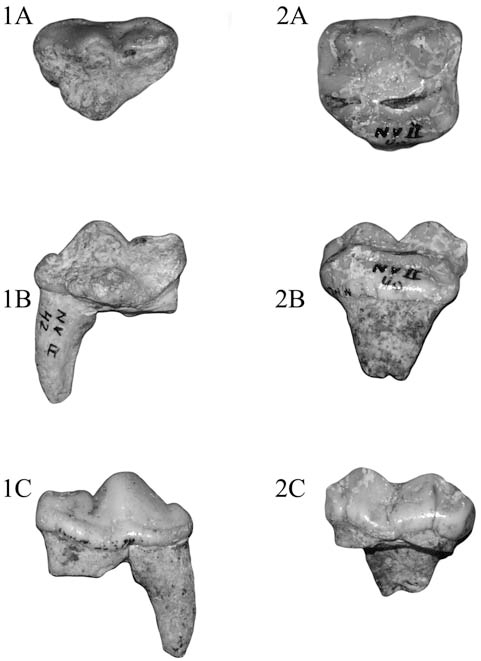
Teeth originally described as Agriarctos beatrix. (1) Left premolar in (A) occlusal, (B) lingual and (C) buccal views. (2) Right front molar in (A) occlusal, (B) lingual and (C) buccal views. Abella, Montoya & Morales (2011).


Follow Sciency Thoughts on Facebook.