Showing posts with label Hexatinellid Sponges. Show all posts

Tuesday, 16 June 2020

Astrolirus patricki: A new species of Sponge-associated Starfish, from the seamounts of the northwest Pacific.

Seamounts are deep-sea biomes in the global ocean which harbor diverse habitats and benthic communities. Sponges are one of the dominant benthic groups in seamount ecosystems, playing important ecological roles by providing habitat and settlement substrate for other seamount invertebrates, such as Molluscs, Hydrozoans and Echinoderms. Suspension-feeding Brittle Stars and Crinoids with long and flexible arms are often observed perching on or wrapped around Sponges. 

In a paper published in the journal PeerJ on 27 May 2020, Ruiyan Zhang of the School of Oceanography at Shanghai Jiao Tong University and the Key Laboratory of Marine Ecosystem Dynamics at the Second Institute of Oceanography of the Ministry of Natural Resources, Yadong Zhou, also of the Key Laboratory of Marine Ecosystem Dynamics at the Second Institute of Oceanography of the Ministry of Natural Resources, Ning Xiao of the Laboratory of Marine Organism Taxonomy and Phylogeny of the Institute of Oceanology and the Center for Ocean Mega-Science of the Chinese Academy of Sciences, and Chunsheng Wang, also of the School of Oceanography at Shanghai Jiao Tong University, the Key Laboratory of Marine Ecosystem Dynamics and the State Key Laboratory of Satellite Ocean Environment Dynamics at the Second Institute of Oceanography of the Ministry of Natural Resources, describe a new Starfish species, which was found attaching to deep-sea Sponges, based upon five specimens from northwestern Pacific seamounts.

Species of the family Brisingidae possess 7 20 spiny arms that are up to about 40 times the length of the disk radius. As exclusive deep-sea inhabitants, their long arms and spines potentially equip them to be excellent suspension feeders, stretching out and gathering food particles in the water column in the resource-diluted deep ocean. The Brisingidae is composed of 62 extant species designated into 10 genera. The genus Astrolirus currently contains only one species, Astrolirus panamensis, and is differentiated from the other genera based on the presence of intercostal plates on arms and a pair of marginal plates between the first adambulacral plates. Astrolirus panamensis was discovered in the eastern Pacific Ocean at 1820- 2418 m depth, with 1 eight-armed specimen and 27 nine-armed specimens of varying size (disc diameter 6- 26 mm) reported. Thereafter, Astrolirus has seldomly been reported or investigated. 

The new species is named Astrolirus patricki, in honour of the character `Patrick Star' in the famous cartoon `SpongeBob Squarepants', who always spends time with his best friend `SpongeBob', a benthic Sponge. Since all specimens of the new species were observed in situ living on Sponges, it was name by Patrick to reflect this curious relationship.
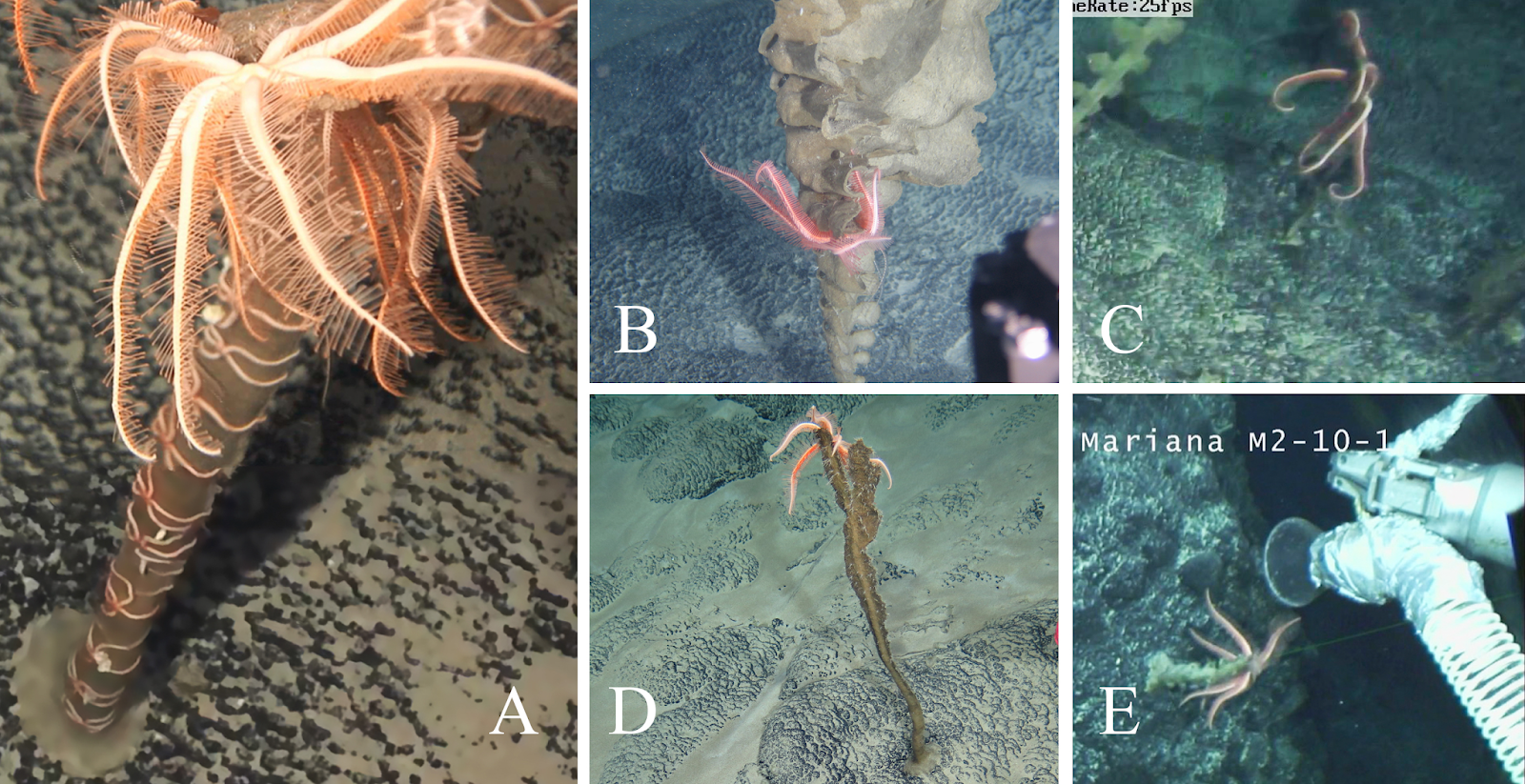
In situ photographs of Astrolirus patricki. Zhang et al. (2020).

All five specimens of the new species are seven-armed and were captured from Hexactinellid Sponges. Occasionally 2- 3 individuals were spotted on the same Sponge along with numbers of Ophiuroids and Crinoids. The new species differs greatly from Astrolirus panamensis in morphological characters and living habitat.

During the COMRA (China Ocean Mineral Resources R & D Association) cruises DY31, DY37, DY41, DY56 and a seamount cruise in the northwestern Pacific Ocean seamounts from 2013 to 2019, five specimens of the new species were collected by mechanical arms or siphon-pumps equipped on Human operated vehicles and remote operated vehicles. Specimens were photographed in situ and on board by digital cameras. Tube feet tissues were extracted from each specimen and frozen in -80°C refrigerator or liquid nitrogen for later molecular experiments, while other parts of specimens were preserved in 100% ethanol for morphological examinations. Morphological identification was conducted under a stereoscopic microscope. 

Astrolirus patricki has seven robust arms. The tntercostal integument is densely covered by irregular, abutting plates. There is no conection between proximal arm plates. The first pair of adambulacral plates is separated by a pair of marginal plates. A large interradial plate above the first marginal plates, is visible from the abactinal side, covered by scattered spinelets. The mouth spines and proximal adambulacral spines are robust, and densely distributed. There are 3-4 uboral spines and 1-2 subambulacral spines, the proximal ones of which are truncate and capitate. There is one lateral spine to each adambulacral plate, starting from about the 8th. There is a pair of gonads to each arm.

Astrolirus patricki, abactinal view. (A) Paratype RSIOAS028. (B) Paratype RSIOAS003. (C), (D), (H), holotype RSIOAS044, (C) Abactinal surface of disk and proximal part of arms, with red arrow pointing at the madreporite body, white arrow at the interradial plate and yellow arrows at the marginal plates. The red frame indicates the proximal region of arm connecting the disk and genital region, where pedicellariae do no form regular costae. (D) Abactinal surface of arm genital area with mosaic plating, red arrows show the costae bands. (E) Paratype RSIOAS003, abactinal surface of arm genital area, red arrows show the costae bands. (F) Paratype RSIOAS052, zoom in view of the abactinal disk, showing the multiple sharp spinelets on disk plates. (G) Paratype RSIOAS052, a piece of dissected skin from abactinal disk, shot from the inner side of the skin, showing the small round disk plates. (H) Abactinal surface at the middle of arm, black arrows indicate the pedicellariae bands. Zhang et ai. (2020).

See also...

https://sciencythoughts.blogspot.com/2019/08/asterodiscides-fourmanoiri-starfish.htmlhttps://sciencythoughts.blogspot.com/2019/01/acanthaster-solaris-using-environmental.html
https://sciencythoughts.blogspot.com/2019/01/sertulaster-keslingi-and-delicaster.htmlhttps://sciencythoughts.blogspot.com/2018/03/thousands-of-starfish-wash-up-on.html
https://sciencythoughts.blogspot.com/2016/02/estimating-role-of-temperature-in-sea.htmlhttps://sciencythoughts.blogspot.com/2013/12/a-mass-death-of-starfish-in-late.html
Follow Sciency Thoughts on Facebook.

Thursday, 21 May 2020

'Reticulosa' sp: A Reticulosan Sponge from the Early Ordovician of Salta Province, northwestern Argentina.

Reticulosan Sponges are a group of hexactine (six-rayed spicule) bearing early Sponges, that are considered typical components of the Cambrian Evolutionary Fauna. They are abundant in Cambrian deposits, scarce in the Early Ordovician, and subsequently unknown. Isolated fragments and partial specimens of 'Reticulosans' are known from the Tremadocian (earliest Ordovician, 485.4 to 477.7 million years ago) but they are not confidently assigned to a suitable taxon. The only diverse assemblages to date are those from Little Métis, Quebec, which is of uncertain age within the late Cambrian–Early Ordovician interval, and the Tremadocian-Floian Fezouata Biota of Morocco. A new association was described more recently from the Early Ordovician of Wales.

In a paper published in the journal Ameghiniana on 2 April 2020, Josefina Aris of the Consejo de Investigaciones de la Universidad Nacional de Salta, and the Instituto para el Estudio de la Biodiversidad de Invertebrados, Marcelo Carrera of the Facultad De Exactas Físicas y Naturales at the Universidad Nacional de Córdoba and Miguel Ángel Boso, also of the Consejo de Investigaciones de la Universidad Nacional de Salta, describe a Reticulosan Sponge from the Tremadocian Floresta Formation of Salta Province, northwestern Argentina.

In northwestern Argentina the Tremadocian Hexactinellid Sponge records include isolated spicules and Protospongiod Sponges and a complete Tremadocian Hexactinellid (Pelicaspongid) Sponge from the Puna Region of northwestern Argentina. Cambrian and Ordovician sponges, including Hexactinellid spicules, have been also reported from elsewhere in Argentina, but mainly concentrated in the limestone units of the Argentine Precordillera with a remarkable different geologic history to the northwest of the country.

The Sponge described by Aris et al. was collected from an outcrop of the Floresta Formation of the Santa Victoria Group, on the western flank of the Mojotoro Mountains, in Salta Province, Argentina. This unit has been previously studied and recognized for its exceptional preserved fossils, in particular Marrellomorph Arthropods.

Map showing the fossil locality (five points star). Aris et al. (2020).

The basement of the range of the Puncoviscana Complex has an Ediacarian-Early Cambrian age. Late Cambrian sediments of the Meson Group overlie these Precambrian units. The Late Cambrian to Ordovician sediments of the Santa Victoria Group unconformably overlie the Mesón Group. The Salta Group, comprising Cretaceous to Eocene sediments, overlie the Santa Victoria Group in the southern section of the mountain range. The youngest deposits, the Neogene Oran Group, overlie the Palaeozoic units on the eastern flank of Mojotoro Mountain Range.

The Santa Victoria Group in the Mojotoro range comprises eight unitst, from bottom to the top the La Pedrera, San José, Caldera, Floresta, Áspero, San Bernardo, Mojotoro, and Santa Gertrudis formations. The Floresta Formation was deposited during the late Tremadocian, and is the most fossiliferous unit of the Santa Victoria Group.

The fossiliferous levels, from which the Sponge derives, are located in a 6.8 m thick interval at 130 meters from the base of the Floresta Formation in Tres Cerritos Creek Section. They consist in olive-green siltstones with parallel lamination intercalated with thin levels of iron hydroxide siltstones. It also contains thin levels of very fine sandstones of similar colour and parallel lamination and olive green, slightly micaceous shales.

Stratigraphic column of Floresta Formation in the Tres Cerritos Creek Section. Aris et al. (2020).

The Sponge was found parallel to the stratification plane with Tergomyan Molluscs, Orthide Brachipods, and Trilobites of Bienvillia tetragonalis biozone.Therefore, the age of this level is assessed  to be early late Tremadocian. The grade of disarticulation and the fragmentary nature this association suggest some transportion of the material. In general, the environmental interpretation of these deposits at the Tres Cerrito Creek Section, suggests that the Sponge could have lived on a siliciclastic distal platform.

The recovered specimen is a single fragment (part and counterpart) that is deposited at the Department of Paleontology at the National University of Salta under the collection number CNS-I 153 (5-5´). The specimen occurs compressed as a bi-dimensional laminae and shows spicules preserved in iron replacement.

The specimen is referred to the genus 'Reticulosa', although this is now considered as a paraphyletic grouping, rather than a valid phylogenetic group. Accordingly, the term is used informally by Aris et al. (2020). The higher-level classification of complex Reticulosans and their familial levels has not yet been fully established.

The specimen is a single fragment of Reticulosid Sponge, 1.5 cm long, possibly a juvenile form, without base or osculum. It is thin-walled, with a single skeletal layer irregularly interrupted by parietal gaps. The thin skeletal layer composed of irregularly oriented stauractins of different sizes, and apparent longitudinal subparallel strands. Across some parts of the preserved fragment, larger spicules occur closely spaced, and with close overlapping of elongated spicule rays combining to form subparallel, straight or sinuous strands. There are also possible long monaxons (rhabdodiactines) intertwining with the long rayed hexactins or simply long monaxons in the strands cross-connected or overlaid by small perpendicular monaxons and hexactins.

'Reticulosa' sp. (1) Complete specimen, scale bar 1 mm. (2) Detail of the mid-central part of the specimen, scale bar 1 mm. (3) Detail of the main gaps, scale bar 1 mm. (4) Detail of the spicular structure, counterpart, scale bar 0.5 mm. (5) Detail of the same mold showing the hexactine-based structure with monaxons, scale bar 1 mm. (6) Detailed view of the spicular net and the small gaps (arrows), scale bar 0.5 mm. (7) Detail of the previous photograph showing sub-vertically oriented main axis of hexactine based spicules (stauracts) and a small square gap (lower right), scale bar 0.5 mm. (8) Detailed view of the previous photograph, showing sub-vertically oriented strands joined by small stauracts or a perpendicularly cross-connected monaxon (arrows), scale bar 0.5 mm. (9) Detail of photograph (6) showing rounded to angular small parietal gaps, scale bar 0.5 mm. Aris et al. (2020).

The hexactine spicules are of two main sizes: Large spicules with axis 1-1.5 mm long, and the smallest hexactins of 0.2-0.3 mm long. There are also intermediate sizes of 0.5-0.7 mm long. Parietal gaps are irregularly distributed and with no clear differentiated form (the largest 1-1.2 mm wide), occurring as slightly protruding mounds. Due to the fragmentary preservation of the specimen it is difficult to determine the real nature of these large apertures, whether they are gaps, an artifact of preservation or a damage of the skeleton. They occur partially outlined by small curved monaxons 0.2-0.3 mm long, united by their tips to conform and extremely irregular, sub-circular to sub-angular perimeter. There are also small and intermediate size gaps (in this case, with no doubts of their origin) ranging from 0.3 mm to 0.5 mm wide, rounded or sub-angular, commonly outlined by hexactins.

The main features of this Argentinean Sponge are the semi-regular to irregular skeletal structure in a single layer with rare irregularly distributed parietal gaps, hexactine based skeleton (stauracts of several sizes), and the presence of long apparently subparallel strands of long monaxons or hipertrofied hexactine rays. These characteristics are found in many Reticulosans, some of which possessed semi-regular skeletons with parietal gaps, bilaminar walls, or complex walls with both multiple layers and pronounced mounds. Others included features such as hypertrophied or highly modified spicules, or strengthening structures produced by modified overlapping spicule arrangements.

Members of the genus Ratcliffespongia have small parietal gaps and loosely stauracts of several sizes. In some species, such as Ratcliffespongia freuchenensis, the general structure is somewhat similar to the Argentinean Sponge, with long-rayed stauractins in irregular array and widely-separated parietal gaps. However, Aris et al.'s specimen has rare irregularly distributed parietal gaps, and it possesses monaxons in the skeletal net which are absent in Ratcliffespongia.

Stephenospongia is a conico cylindrical thin walled Reticulosid, with numerous large vertically elliptical parietal gaps outlined by tracts of irregularly oriented rhabdodiactines or fine stauractines. However, it shows a more regular structure and well defined parietal gaps, outline by tracts which is not seen in the Argentinean form.

Hintzespongia has double-layered walls, with parietal gaps of 0.5–0.7 mm in diameter, which is a clearly different structure that the one seen in Aris et al.'s material.

Valospongia has huge and regularly distributed parietal gaps compared to the Argentinean Sponge and a different structure. Lantianospongia possess basal diagonal monaxons as well as serrated oscular margin; it shares many characters with Valospongia. Both Valospongia and Lantianospongia share monaxons and the presence of several sizes of stauracts, which are also present in the Argentinean form. However, the structure of the skeletal net, more regular and defined around the parietal gaps are different from those of Aris et al.'s specimen.

The character combination in the Argentinean Sponge such as, irregular distributed stauracts of different sizes, presence of monaxons, scarce irregularly distributed small gaps, and in particular, the presence of subparallel strands joined by monaxons or small stauracts could be enough features to differentiate a new genus of Reticulosan. However, due to the particular and fragmentary preservation of the specimen, the absence of the base and osculum and the uncertainties on the real nature of the large apertures in the skeletal net, Aris et al. prefer to leave the Argentinean form in open nomenclature.

The Reticulosan genera are typical Cambrian Sponges, and this group together with the Protomonaxonids, are considered the Sponge members of the Cambrian Evolutionary Fauna. Because there are very few records of Late Cambrian and Early Ordovician non-Lithistid Sponges (part of the onset of the Ordovician Radiation), it is difficult to know when the Protomonaxonids declined, or when the Hexactinellid faunas changed from typically Cambrian groups to the more complex taxa typical of the Middle and Late Ordovician. 

The occurrence of the Argentinean Reticulosan form represents a new piece of evidence that elements of the Reticulosan Sponges from the Cambrian Fauna continued into the Early Ordovician as did genera such as Valospongia and Hintzespongia.

The sponge was recovered from the same unit as other exceptionally preserved fossils (e.g. Narrellomorphs). This location in a mid- to high palaeogeographic latitude in Gondwana, implies not only that several different elements of the Burgess Shale-type assemblages survived into the Early Ordovician, but also that this Sponge group survived well into the Early Ordovician at different palaeo-latitudes and in different environments.

The occurrence of a Tremadocian Hexactinellid Pelicaspongid Sponge from the nearby Puna Region in North Western Argentina, in a shallow water environment, shows the next step in Hexactinellid Sponge evolution: Sponge taxa from the Palaeozoic Evolutionary Fauna, show the acquisition of complex three-dimensional skeletons, for the invasion of high-energy, shallow platforms settings.

See also...

https://sciencythoughts.blogspot.com/2017/09/looking-for-animals-in-wengan-biota.htmlhttp://sciencythoughts.blogspot.com/2015/03/preservation-of-cellular-structures-in.html
http://sciencythoughts.blogspot.com/2014/12/a-new-species-of-sponge-from-late.htmlhttp://sciencythoughts.blogspot.co.uk/2014/01/a-hypercalcified-chaetetid-demosponge.html
http://sciencythoughts.blogspot.com/2013/11/a-chambered-glass-sponge-from-early.htmlhttp://sciencythoughts.blogspot.com/2013/09/a-mysterious-glass-sponge-from-early.html
Follow Sciency Thoughts on Facebook.