Tuesday, 3 February 2015

Sixteen new species of Scale Insects from Cretaceous and Eocene ambers.


Scale Insects are Hemipteran plant-parasites, closely related to Aphids. There are over 7900 living species, as well as an extensive fossil record, dating back to the Early Cretaceous. Most of the taxonomy of recent Scale Insects is based upon studies of the larger, wingless females, while most taxonomic studies of fossil groups has been based upon the smaller winged males, as these disperse in search of new females, and therefore are prone to becoming trapped in amber.

In a paper published in the American Museum Novitates on 16 January 2015, Isabelle Vea of the Richard Gilder Graduate School and Division of Invertebrate Zoology at the American Museum of Natural History and DavidGrimaldi, also of the Division of Invertebrate Zoology at the American Museum of Natural History, describe sixteen new species of Scale Insects from Early Cretaceous Lebanese Amber, Middle Cretaceous Burmese Amber, Early Eocene Cambay Amber and Middle Eocene Baltic Amber.

The first new species described is placed in a new genus, Pseudoweitschatus, meaning ‘similar to Weitschatus’, a previously described genus from Baltic Amber, which the new genus resembles and to which it is thought to be closely related. It is given the specific name audebertis, in honour of Vincent Audebert, Isobelle Rea’s high school biology teacher, for his inspiration to pursue a career in evolutionary biology, and in recognition of the role of science educators in inspiring future generations of scientists.

The species is described from a single male specimen from Middle Cretaceous Burmese Amber collected near Tanai Village in Kachin State, Myanmar. It is 1.76 mm in length, but significantly shrivelled, so that the original shape of the thorax is unclear. This species has two compound eyes, each with about 100 ommatidia, and ten-segmented antennae 1.30-1.33 mm in length. The wings are oval 1.55 mm in length, and 740 μm wide at their widest.

Dorsal view of Pseudoweitschatus audebertis. Abreviations: afp, anterior flexing patch; cr, cubital ridge; o, ocellus; pe, pedicel; pfp, posterior flexing patch; ps, penial sheath; pt, pterostigma; sc, scape; scr, subcostal ridge; td, tubular duct. Roman numerals indicate antennae segment numbers. Rea & Grimaldi (2015).

The second new species described is placed in a new genus, Kozarius, named in honour of the late Ferenc Kozár (1943–2013), for his contributions to the study of Scale Insects, and given the specific name perpetuus, meaning ‘continual’ or ‘continuing without interruption’.

The species is described from a single male specimen from Middle Cretaceous Burmese Amber collected near Tanai Village in Kachin State, Myanmar. It is 1.02 mm in length and has two large bulging compound eyes, each with 80-90 ommatidia, and 10 segmented antennae 480–535 μm in length. The wings are 660 μm long and 305 μm at their widest point.

Ventral view of Kozarius perpetuus. Abreviations: ae, aedeagus; bs, bristle; cr, cubital ridge; fe, femur; ha, hamulohaltere; pe, pedicel; pfp, posterior flexing patch; sc, scape; scr, subcostal ridge; tds, tubular duct secretion; ti, tibia; tr, trochanter; ts, tarsus. Rea & Grimaldi (2015).

The third new species described is also place in the genus Kozarius, and is given the specific name achronus, meaning ‘without time’, in reference to the timeless nature of specimens frozen in amber.

The species is described from a single male specimen from Middle Cretaceous Burmese Amber collected near Tanai Village in Kachin State, Myanmar.  It is 1.13 mm in length and has large protruding compound eyes with about 80 ommatidia each, and 9 segmented antennae 600–640 μm in length. The wings are 845 μm long and 90 μm wide at their widest point.

Ventral view of Kozarius achronus. Abreviations: ae, aedeagus; bs, bristle; ce, compound eye; cr, cubital ridge; ha, hamulohaltere; o, ocellus; pe, pedicel; pfp, posterior flexing patch; prtx, prothorax; sc, scape; scr, subcostal ridge; tds, tubular duct secretion. Rea & Grimaldi (2015).

The fourth new species described is placed in the genus Heteromargarodes, which currently includes three extent species from North America, and given the specific name hukamsinghi, in honour of Hukam Singh of the Birbal Sahni Institute for Palaeobotany, for his work on the fossils of the Cambay Shale and Cambay Amber.

The species is described from a single male specimen in a piece of Early Eocene Cambay Amber from the Tadkeshwar Lignite Mine in Gujerat State, India. The specimen is 1.6 mm long, with elongate, non-protruding compound eyes, each made up of about 30-40 large ommatidia. The antennae have at least 9 segments, though the tips of these are missing from the specimen. The wings are oval, 1.00 mm long and 570 μm wide at their widest point.

Heteromargarodes hukamsinghiin full ventral view. Abreviations: afp, anterior flexing patch; cl, claw; cr, cubital ridge; fe, femur; pfp, posterior flexing patch; pt, pterostigma; scr, subcostal ridge; ti, tibia; ts, tarsus. Rea & Grimaldi (2015).

The fifth new species described is placed in a new genus, Hodgsonicoccus, named in honour of Christopher Hodgson for his work on male Scale Insects, and given the specific name patefactus, meaning ‘discovered’ or ‘revealed’.

The species is described from a single specimen from Early Cretaceous amber from Bchare Mountain in northern Lebanon, thought to be a second or third instar nymph (a nymph is an immature Insect, an instar a life stage between moults). The specimen is 2.04 mm in length, with 10-15 large simple eyes. The antennae have 10 segments and are 1.56 mm in length. The specimen has no wings, as these are only present in adult male Scale Insects.

Hodgsonicoccus patefactus in lateral view. Abreviations: abds, abdominal setae; osc, ocular sclerite; prsc, prescutum. Rea & Grimaldi (2015).

The sixth new species described is placed in the genus Pityococcus, which previously includes three living species from North America and plus a specimen from Baltic Amber. It is given the specific name moniliformalis, meaning ‘necklace-shaped’, in reference to the segments of the antennae, which resemble beads.

The species is described from a single male specimen in Middle Eocene Baltic Amber, from the Palmnicken mines in Yantaryni on the Russian Baltic Coast. The specimen is 1.13 mm in length and has five pairs of simple eyes. The antennae are nine-segmented and 305–375 μm in length. The wings are oval, 780 μm long and 415 μm wide at their widest point.

Pityococcus moniliformalis in dorsal view. Abreviations: cr, cubital ridge; en, endophallus; mpnt, mesopostnotum; pe, pedicel; ps, penial sheath; prsc, prescutum; sc, scape; scr, subcostal ridge; sctl, scutellum. Roman numerals indicate antennae segment numbers. Rea & Grimaldi (2015).

The seventh new species is placed in the genus Apticoccus, which currently contains a single species from Early Cretaceous Lebanese Amber, and given the specific name fortis, meaning ‘strong’ in reference to its robust shape.

The species is described from a single male specimen in Early Cretaceous Amber from central Lebanon. It is 545 μm in length, and has a row of simple eyes on each side of the head; this probably contains six eyes on each side, but is hard to view due to a thin layer of bubbles covering the head. The antennae have ten segments and are about 220 μm in length. The wings are elongate, 620 μm long and 260 μm wide at their widest section.

Apticoccus fortis in dorsal view. Abreviations: cr, cubital ridge; pe, pedicel; prsc, prescutum; sc, scape; scr, subcostal ridge; se, simple eye; tsd, tarsal digitule. Roman numerals indicate antennae segment numbers. Rea & Grimaldi (2015).

The eighth new species is also placed in the genus Apticoccus, and is given the specific name longitenuis, meaning ‘long and thin’, in reference to the shape of the penal sheath.

The species is described from a single male specimen in Early Cretaceous amber from central Lebanon. The specimen is 615 μm long, with six simple eyes and ten segmented antennae, 300–320 μm in length. The wings are oval and 715 μm long and 135 μm wide at their widest point.

Apticoccus longitenuis in dorsal view. Abreviations: ae, aedeagus; cr, cubital ridge; pe, pedicel; prsc, prescutum; sc, scape; scr, subcostal ridge; sctl, scutellum. Rea & Grimaldi (2015).

The ninth new species described is placed in a new genus, Xiphos, for a type of double-edged sword used by Ancient Greeks, in reference to the shape of the penal sheath. It is given the specific name vani, in honour of Van Vea, the father of Isabelle Vea.

The species is described from a single male specimen from Early Cretaceous amber from central Lebanon. The specimen is 1.44 mm long and has a pair of protruding compound eyes, each with about 55–60 ommatidia. The antennae have ten segments and are 960–1000 μm long. The wings are suboval and 1135–1145 μm long and 460–465 μm at wide at their widest section.

Xiphos vani in dorsal view. Abreviations: pe, pedicel; sc, scape. Roman numerals indicate antennae segment numbers. Rea & Grimaldi (2015).

The tenth new species described is placed in a new genus, Alacrena, meaning ‘wing notch’ in reference to a distinctive notch on the wing, and given the specific name peculiaris, in reference to the peculiarity of that notch, as nothing similar has ever been recorded from any other Scale Insect.

The species is described from a single male specimen from Middle Cretaceous amber from near Tanai Village in Katchin State, Myanmar. The specimen is 990 μm in length and has a pair of large protruding compound eyes, probably with about 100 ommatidia, though this is difficult to determine. The antennae have ten segments and are about 450 μm long, the wings are rounded at the end with a distinctive notch, and 680 μm long, and 330 μm wide.

Alacrena peculiaris in dorsal view. Abreviations: adb, abdomen; ae, aedeagus; aln, alar notch; ce, compound eye; cr, cubital ridge; ha, hamulohaltere; o, ocellus; pe, pedicel; sc, scape; scr, subcostal ridge. Rea & Grimaldi (2015).


The eleventh new species described is placed in a new genus named Magnilens, meaning ‘large eye’, and given the specific name glaesaria, meaning ‘of amber’.

The species is described from a single male specimen from Middle Cretaceous amber from near Tanai Village in Katchin State, Myanmar. The specimen is 1.37 mm long and has seven pairs of large, protruding simple eyes. The antennae have ten segments and are 950 μm long, the wings are rounded, 1.28 mm long and 640 μm wide at their widest point.

Lateral view of Magnilens glaesaria. Abreviations: ae, aedeagus; cr, cubital ridge; dse, dorsal simple eye; fws, filamentous wax secretion; ps, penial sheath; ti, tibia; ts, tarsus; vse, ventral simple eye. Rea & Grimaldi (2015).

The twelth new species described is placed in a new genus, Pedicellicoccus, meaning ‘small foot’, in reference to the enlarged bubous foot of the species, and given the specific name marginatus, meaning ‘marginated’ in reference to the flat apical margin of the wing.

The species is described from a single male specimen from Middle Cretaceous amber from near Tanai Village in Katchin State, Myanmar. The specimen is 520 μm long, with at least five and possibly six pairs of simple eyes (this cannot be seen clearly due to the orientation of the specimen. The antennae are nine-segmented and 195–200 μm in length, the wings are broad and rounded distally, 500 μm long and 280 μm wide at the widest section.

Dorsal and view of Pedicellicoccus marginatus. Abreviations: en, endophallus; mpnt, mesopostnotum; ps, penial sheath; sctl, scutellum. Rea & Grimaldi (2015).

The thirteenth new species described is placed in a new genus named Williamsicoccus, in honour of Douglas Williams, for his contributions to Scale Insect systematics. It is given the specific name megalops, meaning ‘large eyes’.

The species is described from a single male specimen in Early Cretaceous amber from central Lebanon. The specimen is 775 μm in length and has two pairs of eyes, the lower pair being larger than the upper pair. The antennae have at least six segments, but are incomplete. The wings are long and thin with rounded tips, 885 μm long and 290 μm wide.

Dorsal view of Williamsicoccus megalops. Abreviations: dse, dorsal simple eye; mpnt, mesopostnotum; o, ocellus; pe, pedicel; prsc, prescutum; sc, scape. Rea & Grimaldi (2015).

The fourteenth new species described is placed in a new genus, Gilderius, named in honour of Richard Gilder, a trustee of the American Museum of Natural History, for his role in the creation of the Richard Gilder Graduate School. It is given the specific name eukrinops, meaning ‘well-separated’, in reference to the positioning of the ventral eyes.

The species is described from a single male specimen from Middle Cretaceous amber from near Tanai Village in Katchin State, Myanmar. The specimen is 840 μm long, though it is preserved in a bent position and may have been closer to 900 μm long in life. It has two pairs of large simple eyes, and ten-segmented antennae, 510–530 μm in length. The wings are narrow with rounded tips, 800 μm long and 400 μm wide.

Gilderius eukrinops in dorsal view. Abreviations: ae, aedeagus; dse, dorsal simple eye; fe, femur; o, ocellus; pe, pedicel; ps, penial sheath; sc, scape; ti, tibia; tr, trochanter; ts, tarsus; vse, ventral simple eye. Rea & Grimaldi (2015).

The fifteenth new species described is placed in a new genus, Rosahendersonia, named in honour of the late Rosa Henderson (1942–2012), for her work on the Insects of New Zealand. It is given the specific name prisca, meaning ‘ancient’.

The species is described from a single male specimen from Middle Cretaceous amber from near Tanai Village in Katchin State, Myanmar. The specimen is 535 μm in length, with two pairs of simple eyes. The antennae have ten segments and are 325–350 μm in length. The wings are 605 μm long with rounded tips.

Dorsal view of Rosahendersonia prisca. Abreviations: dse, dorsal simple eye; fe, femur; masc, membranous area on scutum; o, ocellus; pe, pedicel; sctl, scutellum; ti, tibia; ts, tarsus. Roman numerals indicate antennae segment numbers. Rea & Grimaldi (2015).

The final new species described is placed in a new genus, Normarkicoccus, named in honour of Benjamin Normark for his work on Armoured Scale Insects (Diaspididae), and given the specific name cambayae, in reference to the Cambay Basin, from where Cambay Amber originates.

The species is named from a single male specimen in Early Eocene Cambay Amber from the Tadkeshwar Lignite Mines in Gujarat State, India. The specimen is 365 μm long, with two pairs of simple eyes. The antennae have ten segments and are 225–250 μm long. The wings are narrow with rounded tips, 420 μm long and 100 μm wide.

Normarkicoccus cambayae in dorsal view. Abreviations: cl, claw; dse, dorsal simple eye; ha, hamulohaltere; pe, pedicel; sc, scape; ti, tibia; ts, tarsus. Roman numerals indicate antennae segment numbers. Rea & Grimaldi (2015).

See also…

http://sciencythoughts.blogspot.co.uk/2015/01/a-new-species-of-planthopper-from_17.htmlA new species of Planthopper from northern Vietnam.                                                                              Planthoppers, Fulgoromorpha,  are small members of the True Bug order Hemiptera, which also includes Aphids, Cicadas and Shield Bugs, amongst other Insects. The genus Paricanoides was erected in 2003 by Ai-Ping Liang of the Institute of Zoology of the Chinese Academy of Sciences, to describe two species of Planthoppers, one from southern Vietnam and one from northern Vietnam and Hainan Island...
http://sciencythoughts.blogspot.co.uk/2015/01/a-new-species-of-planthopper-from.html
A new species of Planthopper from Central Vietnam.                                                                      Planthoppers are small members of the True Bug order Hemiptera, which live by sucking sap from plants in a similar way to Aphids (which are also Hemipterans). In...


http://sciencythoughts.blogspot.co.uk/2015/01/the-sources-of-xixia-and-zhangpu-ambers.htmlThe sources of the Xixia and Zhangpu Ambers.                                                                          Amber is the mineralized remnants of resins secreted by ancient plants. It is valued by palaeontologists due to the frequent presence of preserved insects, pollen and soft-bodied micro-organisms within amber clasts; it is also widely used in the jewellery industry, and in...


Follow Sciency Thoughts on Facebook.

Free-living Amoebae in the water system of a South African hospital.


Free-living Amoebae are unicellular protozoan’s common in aquatic ecosystems, which are also known to colonize Human created water systems such as water supply systems and swimming pools. Whilst in some ways these organisms can be helpful, consuming a range of Bacterial, Viral and Fungal pathogens, they have also been shown to cause a range of infections themselves, and can themselves be infected by a variety of pathogenic Bacteria, such as Legionella pneumophila, Mycobacteria, Pseudomonas aerugionosa and Acinetobacter baumannii. Whilst most Bacteria are consumed and digested by the Amoebae, these pathogenic species have been shown to be able to resist digestion, instead surviving within the Amoebae, where they receive protection from biocides and antibiotics, later emerging to cause infections in Humans.

In a paper published in the South African Journal of Science in January 2015, Petros Muchesa and Tobias Barnard of the Water and HealthResearch Centre at the Department of Biomedical Technology at the University of Johannesburg and Catheleen Bartie of Immunology and Microbiology at the National Institute for Occupational Health, describe the results of a series of tests in which water samples and swab samples from taps and showers were collected from a number of locations at a hospital in Johannesburg and cultured to determine the presence of free-living Amoebae.

Muchesa et al. were able to culture Amoebae belonging to three identified genera, Acanthamoeba, Hartmanella and Balamuthia, as well as a number of unidentified species, from 43.7% of the water samples and 45.1% of the swab samples.

Balamuthia cysts (indicated by arrows) in water and biofilm samples from ahospital water system. Muchesa et al. (2015).

There have been relatively few published studies on free-living Amoebae in hospital water supplies, but these results are higher than a study of water in a Swiss hospital in 2006 which found Amoebae in 5.7% of samples and a study from American hspitals in 2014, which found Amoebae in 14.8% of samples.

While there have not been any reported instances of Amoeba-related invfections at the hospital, Acanthamoeba and Balamuthia have previously been implicated in infections of the eyes, skin and nervous system, and the presence of these organisms in the water supply system is of concern, particularly as the hospital has a high proportion of immunocompromised patients.

See also…

http://sciencythoughts.blogspot.co.uk/2015/01/bacteria-from-biofilms-in-water-supply.htmlBacteria from biofilms in the water supply at Mafikeng, South Africa.                                           South Africa has an arid climate and a rapidly rising Human population, which can place a strain on the country’s attempts to provide clean water for its entire...

Scientists from the German Federal Institute for Geosciences and Natural Resources, working in northern Namibia have this month announced the discovery of a substantial new aquifer, named...
John Snow was a nineteenth century London doctor, who is widely credited with the discovery of the transmission mechanism of Cholera, a severe and often fatal infection of the small intestine caused by the bacterium Vibrio cholerae. In Snow's time our...
Follow Sciency Thoughts on Facebook.

Monday, 2 February 2015

First evidence of Human consumption by Katydids and Woodlice.

Modern forensic science typically involves the detailed examination of corpses where foul play is suspected, with the aim of identifying any marks on the body, and relating them to the cause of, and circumstances surrounding, the death of the person in question. Numerous Arthropods are known to feed on vertebrate carrion, including Human remains, and marks left by feeding Arthropods have in the past been mistaken for burns, evidence of intravenous drug use, bite marks, defensive wounds and a variety of other forms of evidence. As such forensic scientists in a number of areas have begun to experiment with Human remains left to decompose in the environment, in order to better understand how Arthropod feeding traces and other forms of environmental destruction affect a body after death.

In a paper published in the Journal of Medical Entomology in January 2015, a team of scientists led by Jennifer Pechal of the Department of Biology at the University of Dayton and the Department of Entomology at Michigan State University, discuss the results of an experiment in which a body was left exposed at the Forensic Anthropology Center at Texas State University, and subsequently targeted by a variety of Arthropods not previously associated with the consumption of Human remains.

Firstly the cadaver was targeted by a gravid female Katydid, Pediodectes haldemani, which began feeding on the lower right arm of the body, approximately 32 hours after it was placed in the field. Katydids, Tettigoniidae, are Orthopteran Insects related to Grasshoppers and Crickets, but unlike these plant-eating groups they are generally omnivorous in their dietary preferences, and the species Pediodectes haldemani is known to be almost totally carnivorous. While Katydid have previously been recorded consuming vertebrate carrion, this is the first recorded instance of the consumption of Human remains by a Katydid, and Pechal et al. suggest that this might be slightly atypical behaviour, fuelled by a need for extra protein in the gravid female.

A gravid, female Pediodectes haldemani (Orthoptera: Tettigoniidae) feeding on the right forearm of a set of human remains (top), and the resulting physical artifact (indicated by the black arrow) on the remains by the feeding Pediodectes haldemani (bottom). Pechal et al. (2015).

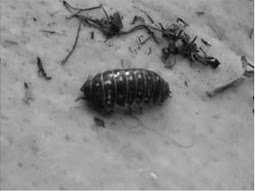
Secondly the remains were visited by a Common Woodlouse, Armadillidium cf. vulgare, this time feeding on the lower left arm. Woodlice are terrestrial Isopod Crustaceans, with a typicalldetritivorous diet; they are most commonly associated with plant remains, but are known to eat carrion, though once again this is the first time that a Woodlouse has been recorded eating Human remains.

Armadillidium cf. vulgare (Isopoda: Armadilidiidae) feeding on the left forearm of a human set of remains (top), and the resulting artifact (indicated by theblack arrow) on the remains from the isopod activity (bottom). Pechal et al. (2015).

Finally the body was visited by a colony of Red Fire Ants, Solenopsis invicta, an imported species in the US, but which has become common in grasslands; Ants, including Red Fire Ants, are common visitors to carrion. On this occasion it is unclear whether the Ants actually fed on the remains, rather they entered the body via the hole left by the Katydid’s feeding and appeared to build a shelter there, using soil and small pieces of woody debris, a structure which would have been difficult to interpret had its construction not been observed.

A structure consisting of soil, small organic woody debris, and other organic material by red imported Fire Ants, Solenopsis invicta (Hymenoptera: Formicidae), in the artifact resulting from Pediodectes haldemani feeding activity on the leftforearm of the descendent. The structure was re-constructed each time the remains were disturbed for sampling purposes. The small dots surrounding the debris pile are fly artifacts or speck. Pechal et al. (2015).

See also…

http://sciencythoughts.blogspot.co.uk/2015/01/two-new-species-of-katydids-from.htmlTwo new species of Katydids from Pakistan. Katydids (or Buschcrickets), Tettigonioidea, are Members of the Insect Order Orthoptera, which also includes Crickets and Grasshoppers. They are...


http://sciencythoughts.blogspot.co.uk/2014/11/the-impact-of-yellow-crazy-ant-on.htmlThe impact of the Yellow Crazy Ant on the Vallée de Mai Palm Forest of Praslin Island. Ants are often highly adaptable animals, and many species have proven to be highly invasive pests, able to reach new homes by hitching a ride on cargo moved by Humans, and often proceeding modify the ...
http://sciencythoughts.blogspot.co.uk/2014/10/three-new-species-of-katydid-from-china.htmlThree new species of Katydid from China. Katydids of the genus Xizicusand its close relatives are found across eastern Asia, though the taxonomy of the group is currently somewhat confused, in part due to publications being published in different languages...

Follow Sciency Thoughts on Facebook.

Asteroid 2015 BE passes the Earth.

Asteroid 2015 BE passed by the Earth at a distance of 11 890 000 km (30.91 times the average distance between the Earth and the Moon, or 7.9 % of the average distance between the Earth and the Sun), at about 8.25 am GMT on Friday 30 January 2015. There was no danger of the asteroid hitting us, though had it done so it would have presented only a minor threat. 2015 BE has an estimated equivalent diameter of 21-65 m (i.e. it is estimated that a spherical object with the same volume would be 21-65 m in diameter), and an object of this size would be expected to break up in the atmosphere between 22 and 4 km above the ground, with only fragmentary material reaching the Earth's surface.

 The calculated orbit of 2015 BE JPL Small Body Database.

2015 BD511 was discovered on 16 January 2015 (fourteen days before its closest approach to the Earth) by the University of Hawaii's PANSTARRS telescope on Mount Haleakala on Maui. The designation 2015 BE implies that it was the 5th asteroid (asteroid E) discovered in the second half of January 2015 (period 2015 B).

 2015 BE has a 788 day year orbital period and an eccentric orbit tilted at an angle of 14.5° to the plane of the Solar System, which takes it from 0.92 AU from the Sun (i.e. 92% of the average distance at which the Earth orbits the Sun) to 2.42 AU from the Sun (i.e. 242% of the average distance at which the Earth orbits the Sun, considerably outside the orbit of Mars). It is therefore classed as an Apollo Group Asteroid (an asteroid that is on average further from the Sun than the Earth, but which does get closer). This means that close encounters between the asteroid and Earth are fairly  common, with another predicted for June this year.

See also...

http://sciencythoughts.blogspot.co.uk/2015/01/asteroid-2015-bd511-passes-earth.htmlAsteroid 2015 BD511 passes the Earth.   Asteroid 2015 BD511 passed by the Earth at a distance of 1 714 000 km (4.47 times the average distance between the Earth and the Moon, or 1.1 % of the average distance between the Earth and the Sun), slightly before 0.50 am GMT on Friday 30 January...

Comet C/2014 Q1 (Lovejoy) reached its perihelion (the closest point on its orbit to the Sun) on Friday 30 January 2015, when it will be 1.29 AU from the Sun....
 
Asteroid (162004) 1991 VE passed by the Earth at a distance of about 15 600 000 km (40.6 times the average distance between the Earth and the Moon, or 10.4% of the average distance between the Sun and the Earth), slightly after 3.30 am GMT on Saturday 17 January 2015. There was no danger of the asteroid hitting us, though were it to do so it would have presented a serious threat. (162004) 1991 VE has an...


Follow Sciency Thoughts on Facebook.


A new species of Ichneumon Wasp from Qinghai Province, China.


Ichneumon Wasps of the genus Campoplex are parasitiods of Beetles and Moths (i.e. their larvae live inside Beetles and Moths, eating their living host as they mature) found predominantly in Europe and Western Asia, with species also recorded from East and Southeast Asia, North America and Africa. Eleven species have previously been recorded from China.

In a paper published in the journal ZooKeys on 18 December 2014, Yu-Xiang Zhao of the The Key Laboratory for Silviculture and Conservation at Beijing Forestry University and the General Station of Forest Pest Management of the State Forestry Administration and Mao-Ling Sheng also of the General Station of Forest Pest Management of the State Forestry Administration, describe a new species of Campoplex from Qinghai Province in China.

The new species is named Campoplex bazariae, in reference to its host species the Moth Bazaria turensis. Females of the Wasp are 7.5-8.0 mm in length, males 8.0-8.2 mm. Both are predominantly black with some brown areas.

Female Campoplex bazariae inlateral view. Zhao & Sheng (2014).

The species was discovered while investigating an outbreak of Bazaria turensis (a form of Snout Moth) in a forest in Qinghai. The Wasps emerged from the cocoons of the Moths, both within clusters of leaves in the tree canopy and buried in soil on the forest floor.

See also…

http://sciencythoughts.blogspot.co.uk/2015/01/two-new-species-of-ichneumon-wasps-from.htmlTwo new species of Ichneumon Wasps from Fennoscandia and Hungary.                                    Ichneumon Wasps are parasitoids whose larvae develop on or in the bodies of other Arthropods, typically Insects or Spiders. Since Insect species are always described from adult specimens, species of parasitoid Wasps are generally named from specimens taken from the wild as adults, and the larval host of often unknown. However some scientists have developed an alternative method...
http://sciencythoughts.blogspot.co.uk/2014/12/two-new-species-of-ichneumon-wasps-from.htmlTwo new species of Ichneumon Wasps from Africa.                                                             Ichneumon Wasps are large parasitoid Wasps (the largest species can exceed 5 cm) closely related to Braconids. They are noted for their reproductive behaviour, in which the females sting another Insect or...
Ichneumon Wasps are a group of highly specialized...


Follow Sciency Thoughts on Facebook.

Five new species of Proetoid Trilobites from northeastern Oman.


Trilobites dominated the seas of the early Palaeozoic, but suffered a major loss of diversity in the Devonian extinction and became extinct at the end of the Permian. For a long time it was assumed that the group was in decline before this final extinction event, but a series of recent discoveries have shown the group underwent a significant expansion in the Permian Period, particularly in the eastern Tethyan Realm, which today outcrops from Sicily in the west across Arabia and South Asia to Timor in the east.

In a forthcoming paper in the journal Acta  Palaeontologica Polonica available online from 30 December 2014, Richard Fortey of the Department of Palaeontology at The Natural History Museum and Alan Heward of Malvern in Worcestershire, England, describe a new Trilobite fauna from the Early-to-Middle Permian Qarari Unit in northeastern Oman.

The fauna comprises five previously undescribed Proetoid Trilobites, with affinities to other southern Asian Permian Trilobite faunas, particularly those of the Artinskian limestones of Afghanistan. The Trilobites are preserved in thin-bedded fine-grained limestones interpreted as having come from bellow the storm wave base in a shallow marine environment, with well-oxygenated waters. The vast majority of the Trilobires are preserved in an encapsulated state, leading Fortey and Heward to speculate that they may have died as a result of some sudden environmental stress, which provoked a defensive response before death.

The first new species describedis placed in the genus Hentigia and given the specific name ornata, in reference to the elaborate sculpting on the cephalic (head) region. This Trilobite is 1-1.5 cm in diameter when encapsulated and has a glabella (face, front part of the cephalic region), which is enlarged and covered in tubercles.

Ditomopygine Trilobite Hentigia ornata from Kungurian–Roadian (Permian) of Wadi Khawr al Jaramah, Oman. (A) Enrolled completespecimen, in dorsal (A1), lateral  and(A2) views. Scale bars 2.5 mm. Fortey & Heward (2015).

The second new species described is placed in the genus Iranaspidion and given the specific name elephas, meaning ‘Elephant’ for its prominent cheek tubercles and the shape of its hypostome, which resembles an Elephant’s head with ears extended when viewed from the rear.

Ditomopygine Trilobite Iranaspidion elephasfrom Kungurian–Roadian (Permian) of Wadi Khawr al Jaramah, Oman. (A)Enrolled complete specimen; cephalon in dorsal (A1) and anterior (A2) views; pygidium and half thorax in dorsal view (A3). Scale bars 2.5 mm. Fortey & Heward (2015).

The third new species described is placed in a new genus, Simulopaladin, meaning ‘similar to Paladin’ another genus of Trilobites. The genus Paladin was originally used to describe deepwater Trilobites from the Carboniferous of North America, though a number of Permian shallow marine Asian species have subsequently been added to the genus. Fortey and Heward suspect that these Permian Trilobites are erroneously placed in the genus, and erect the genus Simulopaladin to describe this Omani species, pending a review of the group. It is given the specific name tridentifer, meaning ‘carrting three teeth’, in reference to three tubercles on the occipital ring (back part of the cephalic region).

Ditomopygine Trilobite Simulopaladin tridentifer from Kungurian–Roadian (Permian) of Wadi Khawr al Jaramah, Oman. (A) Holotype, enrolled complete specimen; cephalon in dorsal view (A1); pygidium and half thorax in dorsal (A2) view. Scale bars 2.5 mm. Fortey & Heward (2015).

The fourth new Trilobite described is placed in the genus Acanthophillipsia, and given the specific name felicitae, in honour of Felicity Heward who collected some of the specimens. This species is described from only two specimens, one of which is crushed. The cephalic region of this species is almost completely covered in tubercles.

Ditomopygine Trilobite Acanthophillipsia felicitae.(F) Enrolled complete specimen; pygidium and half thorax in dorsal view (F1); cephalon in dorsal (F2), lateral (F3), and anterior (F4) views. (G) Enrolled complete specimen; pygidium and half thorax inlateral (G1), dorsal (G3), and anterior (G4) views; cephalon in dorsal view (G2). Scale bars 2.5 mm. Fortey & Heward (2015).

The final new species described is placed in the genus Triproetus, and given the specific name bonbon, for its resemblance to a boiled sweet. This has a swollen, bulging glabella with a fine tuberculate surface.

Proetid Trilobite Triproetus bonbon (A) Enrolled complete specimen; cephalon in dorsal (A1) and lateral (A2) views. Scale bars 2.5 mm. Fortey & Heward (2015).

See also…

http://sciencythoughts.blogspot.co.uk/2012/03/preserved-trilobite-digestive-tracts.htmlPreserved Trilobite digestive tracts from the Middle Cambrian of Utah.                                 Trilobites were a group of Arthropods that flourished throughout the Palaeozoic, but died out at the end of the Permian. They are abundant and well studied fossils, but little is known of their internal anatomies.
Follow Sciency Thoughts on Facebook.

Follow up observations of Kepler candidate stars.


The Kepler Space Telescope observed a 115 square degree of space for four years (from May 2009 till May 2013), looking for potential planets around the 150 000 stars in the magnitude range 8-16 within the field. In this time it found a total of 4233 candidate planets, of which 965 have subsequently been confirmed. The conformation of such a planet requires follow up observations from ground-based telescopes in order to eliminate potential sources of false readings, such as previously undetected faint companion or background stars.

In a paper published on the arXiv database at Cornell University Library on 14 November 2014, and in the Astronomical Journal on 15 January 2015, a team of scientists led by Mark Everett of the National Optical Astronomy Observatory present the results of follow up observations on eighteen Kepler candidate stars, several of which are confirmed to host planets.

Follow up observations were made from the Differential SpeckleSurvey Instrument at Gemini North on 25−31 July 2013, although the observations were hampered by light leakage on 25 July and by Tropical Storm Flossie brushing the Hawaiian Islands on 29-30 July, so most of the useful observations were in fact made on 27 July 2013. Further follow up observations of several candidate stars were made with the Lick Observatory Shane 3.5 m, the PalomarObservatory Hale 5 m or the 10m Keck-II Telescopes.

The KOI 115 system (that is ‘Kepler Object of Interest’ 115, the designation given to star systems with unconfirmed planets in the Kepler field), has previously been confirmed to host two planets and redesignated as the Kepler 105 system (i.e. the 105th system in the Kepler Field confirmed to host one or more planets). These planets were reconfirmed by the Gemini North Survey. The star has an effective surface temperature of 6075 K (compared to 5778 K for our Sun) and a mass 1.027 times that of the Sun. The planets were previously found to have orbital periods of 5.4 and 7.1 days, the new data from Gemini North in addition suggests that these planets have radii of 2.54 and 1.44 times that of the Earth, respectively.

The KOI 265 system has a candidate planet with a radius of 1.71 times that of the Earth, with an orbital period of 3.6 days. Everett et al. validate this planet with a 94% certainty level, though this is not considered sufficient to confirm the existence of a planet.

KOI 268 is a dwarf star with an effective surface temperature of 6343 K, with a candidate planet orbiting every 110 days. Everett et al.’s data reveals the presence of two previously undiscovered nearby stars, identified as neighbours B and C. Of these neighbour B is a small star with an effective surface temperature of 4007 Kwhich lies close enough to KIO 268 that the candidate planet is impossible to validate. It could be a planet with a radius of 3.04 times that of the Earth orbiting KOI 268, but it could also be a planet with a radius of 9.33 times that of the Earth orbiting Neighbour B (a larger planet would be needed to reduce the total light produced by the two stars if the planet is occluding the dimmer star); if the latter were the case then it would have a low equilibrium temperature, about 217 K.

KOI 274 has previously been confirmed to host two planets with periods of 15 and 22.8 days, and redesignated as Kepler 128. Everett et al. were able to confirm theses planets, and that the star is a single system. They also estimate that the planets both have about 1.2 times the radius of the Earth.

KOI 284 has previously been confirmed to host three planets, and a possible fourth, and redesignated as Kepler 132. However a nearby star makes it hard to resolve the system further; it was impossible to determine whether this star is a companion (orbiting the main star) or a field star (behind the star and unrelated to it, close only because of the angle from which we are viewing the system), though a companion is thought to be the more likely scenario. If this is the case then all of the planets, including the unconfirmed candidate, will have a radius between 1-2 times that of the Earth.

KOI 369 is a dwarf star with an effective surface temperature of 6157 K has previously been confirmed to host two planets, and redesignated as Kepler 144. Everett et al. are able to reconfirm these planets and estimate that they have radii of 1.78 and 1.69 times that of the Earth, respectively.

KOI 1537 is a dwarf star with an effective surface temperature of 6260 K and a candidate planet with a period of 10 days. A previous study suggested that a second star was close to this star, either as a companion or a field star, however Everett et al. were able to find no evidence for this second star. They were able to validate the planet with an 86.7% certainty (not enough to confirm its existence) and estimate its radius to be 1.35 times that of the Earth.

KOI 1964 is a dwarf star with an effective surface temperature of 5574 K and a candidate planet with an orbital period of 2.2 days. It also has a neighbouring star about 4” (four arc seconds; the sky, imagined as a globe, is divided into 360 degrees, each of which is divided into 60 arcminutes, with each arc minute being further divided into 60 arcseconds) to its north, as seen from Earth. This makes it very hard to confirm the planet is orbiting KOI 1964, though Everett et al. were able to come up with three possible scenarios. Firstly the second star could be a bound companion to KOI 1964, and the planet could also orbit KOI 1964 and have a radius of 0.764 times that of the Earth. Secondly, the second star could be a field star somewhere in the background and the planet could orbit KOI 1964 and have a radius of 0.785 times that of the Earth. Thirdly the second star could be a field star, and the planet could orbit that star, in which case the star would have an effective surface temperature of 3892 K and the planet a radius of 2.03 times that of the Earth.
 
Example high resolution imagery of KOI 1964 and its surroundings in 4 filters. The upper two panels are reconstructed images from speckle observations at 692 nm (upper left) and 880 nm (upper right) taken at Gemini North. The lower two panels are adaptive optics images at J (lower left) and Ks (lower right) taken at the Palomar Hale Telescope. Each image is oriented with North at the top and East to the left. The speckle images are 1.8′′ ×1.8′′ and the adaptive optics images are approximately 15′′ ×15′′ as seen by the scales. A faint neighbour star is detected 0.4′′ to the north of the brighter KOI star. Everett et al. (2014).

KOI 2311 is a sunlike dwarf star with two candidate planets, orbiting with periods of 192 and 14 days. There is a faint second star at a separation of 1”, making it hard to establish the true nature of the planets. Everett et al. Calculate that if the inner planet orbits KOI 2311 then it has a radius of 0.932 that of the Earth and if it orbits the second star it has a radius of 4.16 times that of the Earth. The if the outer planet is orbiting KOI 2311 then it is calculated to be cool (337 K) and have a radius of 115 times that of the Earth, while if it orbits the second star then it is colder (117 K) and has a radius of 5.14 times that of the Earth (making it larger than Neptune).

KOI 2365 is a sunlike star with two candidate planets. This was found to be a solitary star, and the planets were validated with a confidence of 99.9%, considered enough to confirm their existence. The system is therefore redesignated as Kepler 430, and the planets as Kepler 430b (when naming objects in other star systems planets are given lower case letters and stars upper case letters), which has a 36 day orbital period, a radius of 3.25 times that of the Earth and a temperature of 667 K, and Kepler 430c, which has an 111 day orbital period, a radius of 175 times that of the Earth and a temperature of 458 K.

KOI 2593 is another isolated star, this time with a single candidate planet. Everett et al. were only able to validate the planet with a 90.6% confidence, though they did establish the star has a surface temperature of 6119 K and the potential planet has a mass of 1.10 times that of the Earth and a temperature of 974 K.

KOI 3097 is an isolated star with three candidate planets. Everett et al. were able to establish that the star has a surface temperature of 6004 K, and validate the planets with a confidence of 99.8%. The system is redesignatedKepler 431, and the planets become Kepler 431b, with a 6.8 day orbital period, a radius of 0.764 times that of the Earth and a temperature of 1032 K, Kepler 431c with an 8.7 day orbital period, a radius of 0.668 times that of the Earth and a temperature of 951 K, and Kepler 431d with an 11.9 day orbital period, a radius of 1.11 times that of the Earth and a temperature of 865 K.

KOI 3204 is a hot dwarf star with a surface temperature of 7338 K and a candidate planet which orbits it every 0.57 days. Everett et al. validated the planet with a confidence of 98.5% (not enough to confirm it), and calculate it has a radius of 1.01 times that of the Earth and a temperature of 3268 K.

KOI 3224 is an isolated dwarf star with a single candidate planet. Everett et al. calculate that the star has a surface temperature of 5382 K, and validate the planet with a 90.5% certainty. They calculate that this candidate planet has a radius of 0.667 times that of the Earth, and a temperature of 1129 K.

KOI 3255 is a faint, cool dwarf star with a surface temperature of 4427 K, a single candidate planet with a 66.7 day orbital period, and two close stars, the relatively bright neighbour B at a separation of 0.18”, and the fainter neighbour C at 3”. The closeness of neighbour B makes it impossible to validate the planet, though Everett et al. calculate that it could be orbiting KOI 3255, in which case it would have a radius of 2.11 times that of the Earth and a temperature of 294 K, or neighbour B, in which case it would have a radius of 2.42 times that of the Earth and a temperature of 276 K, either of which scenarios would make it a habitable zone candidate.

KOI 3284 is the smallest star included in this study. It has a surface temperature of 3688 K (smaller stars are cooler than larger stars) and a candidate planet with a 35 day orbital period. It also has two close stars, neighbour B which has a separation of 0.44” and neighbour C. Because of the closeness of neighbour B it was impossible to validate the planet, nor was it possible to determine if neighbour B was a companion or a field star, though neighbour C did appear to be a background star. Everett et al. calculate that if neighbour B is a background star and the planet orbots KOI 3284 then the planet will have a radius of 0.99 times that of the Earth and a temperature of 272 K, that if it orbits KOI 3284 and neighbour B is a bound companion it will have a radius of 1.00 times that of the Earth and a temperature of 272 K, or if it orbits neighbour B and neighbour B is a bound companion to KOI 3284, then the planet will have a radius of 1.46 times that of the Earth and a temperature of 184 K, scenarios that make it a small habitable zone candidate.

KOI 4407 is a dwarf star with a single candidate planet that has a 1.34 day orbital period, and two close by stars that might be gravitationally bound companion stars or background field stars. It was possible to calculate that the surface temperature of KOI 4407 is 6408 K, but the presence of the neighbour stars makes it difficult to characterise the planet. Everett et al. were able to validate this planet, but only with a confidence of 19.2%. They calculate that if the two neighbour stars are actually components of a triple star system, then the planet probably has a radius of 0.65 times that of the Earth and a temperature of 2121 K, though the radius could possibly be anywhere between 0.64 and 0.75 times the Earth’s.

See also…

http://sciencythoughts.blogspot.co.uk/2014/07/conformation-of-third-planet-in-kepler.htmlConformation of the third planet in the Kepler-51 System.                                               Kepler-51 is a G-type Yellow Dwarf star 2800 light years from Earth in the constellation of Cygnus. It has a...

Kepler 186f: an Earth-sized planet in the habitable zone of a Red Dwarf star.
One of the key objectives in the search for planets orbiting other stars has been to locate planets in the habitable zones of such stars, i.e. planets on which liquid water could potentially exist. A number of...


 The Kepler 210 planetary system.
Since it began its survey of the section of the sky dubbed the Kepler Deep Field in 2009, the Kepler Space Telescope has discovered 2321 probable planets around 1790 stars, and it is thought that the vast majority of these probable planets will turn out to be true...
Follow Sciency Thoughts on Facebook.