Saturday, 7 February 2015

Asteroid 2015 BX509 passes the Earth.

Asteroid 2015 BX509 passed by the Earth at a distance of 13 610 000 km (35.48 times the average distance between the Earth and the Moon, or 9.1% of the average distance between the Earth and the Sun), slightly before 3.25 pm GMT on Thursday 5 February 2015. There was no danger of the asteroid hitting us, though had it done so it would have presented a minor threat. 2015 BX509 has an estimated equivalent diameter of 47-150 m (i.e. it is estimated that a spherical object with the same volume would be 47-150 m in diameter), and an object towards the upper end of this range would be expected to be capable of passing through the atmosphere reasonably intact, impacting the ground in an explosion equivalent to about 71.5 megatonnes of TNT (roughly 4200 times the energy of the Hiroshima bomb) and creating a crater about 2.4 km in diameter. Such an event would cause devastation over a wide area, and could cause climatic problems for decades.

The calculated orbit of 2015 BX509. JPL Small Body Database.

2015 BX509 was discovered on 23 January 2015 (twelve days before its closest approach to the Earth) by the University of Hawaii's PANSTARRS telescope on Mount Haleakala on Maui. The designation 2015 BX509 implies that it was the 12 748th asteroid (asteroid B509) discovered in the second half of January 2015 (period 2015 B).


2015 BX509 has a 1002 day year orbital period and an eccentric orbit tilted at an angle of 7.4° to the plane of the Solar System, which takes it from 0.92 AU from the Sun (i.e. 92% of the average distance at which the Earth orbits the Sun) to 3.00 AU from the Sun (i.e. 300% of the average distance at which the Earth orbits the Sun, about twice the distance at which the planet Mars orbits the Sun). It is therefore classed as an Apollo Group Asteroid (an asteroid that is on average further from the Sun than the Earth, but which does get closer).

See also...

Asteroid 2015 BH514 passed by the Earth at a distance of 8 509 000 km (22.53 times the average distance between the Earth and the Moon, or 5.6 % of the average distance between the Earth and the Sun), slightly before 8.40 pm GMT on Wednesday 4...

Asteroid (357439) 2004 made a close approach to the Earth on Monday 26 January 2015, enabling scientists at NASA's Deep Space Network antenna at...


Asteroid 2013 BZ45 passes the Earth.       Asteroid 2013 BZ45 passed by the Earth at a distance of 9 670 000 km (25.16 times the average distance between the Earth and the Moon, or 6.5 % of the average distance between the Earth and the Sun), slightly before 8.30 pm GMT on Tuesday 3 February...


Follow Sciency Thoughts on Facebook.

Friday, 6 February 2015

Three new species of Pitcher Plants from the Philippines.


Pitcher plants of the genus Nepenthes are known from Malaysia (where the genus reaches its maximum diversity) as well as Madagascar, Seychelles, Sri Lanka, northeast India, Indochina, Solomon Islands, New Caledonia, Australia and the Philippines. All the Philippine species are considered to be at risk due to deforestation, as the islands suffered a rapid loss of forests in the twentieth century (around 75% of the indigenous forest was undisturbed in 1925, but by the end of the century only 3% remained), and since most Nepenthes species have limited geographical ranges and are intolerant of disturbance, it is quite likely that many species have become extinct without ever being recorded.

In a paper published in the journal Blumea on 11 December 2014, Martin Cheek of the Royal Botanic Gardens at Kew and Mathew Jebb of the National Botanic Gardens at Glasnevin, describe three new species of Nepenthes from Sibuyan and Mindanao Islands in the Philippines.

The first new species described is named Nepenthes armin, in honour of Armin Rios Marin, a Municipal Councillor on Sibuyan and former official of the World Wildlife Fund, who on 3 October 2007 was shot and killed by a mining official while leading a community demonstration against forest clearances by the mining industry. Nepenthes armin is a climbing plant reaching 5 m in height. It produces elongate leaves up to 17.5 cm in length, with tendrils at their tips upon which the pitchers develop. The pitchers are green with a faint purple mottling and can reach 16 cm in depth.

The species was found growing in gallery forest on ultramafic rock (expand) at an altitude of 750 m. Only three individuals were found at three separate sites; several searches for further specimens by pitcher plant enthusiasts have failed to find any more plants, nor was it found by earlier expeditions to the area in the early twentieth century. The area where it grows has been partially cleared for lowland agriculture. As such the species is assessed to be Critically Endangered under the terms of the International Union for the Conservation of Nature’s Red List of Threatened Species.

Nepenthes armin. (a) Habit, male inflorescence, and upper pitchers (detached); (b) upper pitchers. Scale bar is 5 cm. Cheek & Jebb (2014).

The second new species described is named Nepenthes tboli, after the T’boli People, who live in the area where it was discovered. This is a shrub or climber reaching at least 50 cm in height, producing leaves up to 16 cm long, with tendrils at the tips upon which the pitchers grow. The pitchers are 11.5-17.5 cm deep.

Only two specimens of the plant were found, growing on open grassland by Lake Parker in South Cotabato Province on Mindanao. As such the species is assessed to be Critically Endangered under the terms of the International Union for the Conservation of Nature’s Red List of Threatened Species, though Cheek and Jebb note that the plants were found close to the botanically poorly known Tiruray Highlands, so there is hope of undiscovered populations being discovered.

Nepenthes tboli. Habit with upper pitchers and infructescence. Scale bar is 5 cm. Cheek & Jebb (2014).

The third new species described is named Nepenthes zygon, meaning ‘yoked’ or ‘coupled’, due to this species close relationship with Nepenthes mindanaoensis. This is a terrestrial climber reaching 2-3 m tall, possibly capable of rooting on stunted trees in cloud forest. Leaves can reach 30 cm in length, lower pitchers can reach 14 cm, upper pitchers 25 cm. Pitchers are covered with a white waxy layer and have red-to-purple stripes and flecks.

Nepenthes zygon has been observed growing in submontane mossy forest along ridges of non-ultramaffic rock, at altitudes of 1500-1875 m above sea level, on Mounts Masay and Pasian and possibly Hibok-Hibok. Unfortunately much of the forest on Mount Pasain has recently been clear-cut, leading to concerns that the species might be extinct there. The population at Mount Masay faces no such threat at the current time; that at Hibok-Hibok has yet to be confirmed. The species is assessed to be Critically Endangered under the terms of the International Union for the Conservation of Nature’s Red List of Threatened Species.

Nepenthes zygon. (a) Habit, climbing stem with male inflorescence and upper pitcher; (b) upper pitcher, not yet fully opened; (c) lower pitcher. Scale bars are 5 cm. Cheek & Jebb (2014).

See also…

Marsh, or Sun, Pitcher Plants (Sarraceniaceae) are Carnivorous Plants growing in nutrient poor marshy conditions in South America. They have the tubular leaves of all Pitcher Plants, but lack the lids of many such plants (Pitcher Plants are not a true taxonomic...

Sundews (Drosera spp.) are a widespread group of Carnivorous Plants, found on every continent except Antarctica. They are able to live on extremely nutrient...


Pitcher Plants, or Monkey-cups, are carnivorous plants that trap Insects inside a deep, fluid-filled trap, where their bodies are then digested, providing valuable nutrients for the plants, which are thereby able to survive on very nutrient-poor soils. They are not a true...


Follow Sciency Thoughts on Facebook.

Thursday, 5 February 2015

Asteroid 2015 BH514 passes the Earth.

Asteroid 2015 BH514 passed by the Earth at a distance of 8 509 000 km (22.53 times the average distance between the Earth and the Moon, or 5.6 % of the average distance between the Earth and the Sun), slightly before 8.40 pm GMT on Wednesday 4 February 2015. There was no danger of the asteroid hitting us, though had it done so it would have presented significant minor threat. 2015 BH514 has an estimated equivalent diameter of 43-140 m (i.e. it is estimated that a spherical object with the same volume would be 43-140 m in diameter), and an object towards the upper end of this range would be expected to be capable of passing through the atmosphere reasonably intact, impacting the ground in an explosion equivalent to about 200 megatonnes of TNT (roughly 12 000 times the energy of the Hiroshima bomb) and creating a crater over 2 km in diameter. Such an event would cause devastation over a wide area, and could cause climatic problems for decades.

 The calculated orbit of 2015 BH514. JPL Small Body Database.

2015 BH514 was discovered on 16 January 2015 (eighteen days before its closest approach to the Earth) by the University of Hawaii's PANSTARRS telescope on Mount Haleakala on Maui. The designation 2015 BH514 implies that it was the 12 858th asteroid (asteroid H514) discovered in the second half of January 2015 (period 2015 B).

2015 BH514 has a 435 day year orbital period and an eccentric orbit tilted at an angle of 33° to the plane of the Solar System, which takes it from 0.69 AU from the Sun (i.e. 69% of the average distance at which the Earth orbits the Sun, slightly inside the orbit of Venus) to 1.56 AU from the Sun (i.e. 1.56% of the average distance at which the Earth orbits the Sun, slightly outside the orbit of Mars). It is therefore classed as an Apollo Group Asteroid (an asteroid that is on average further from the Sun than the Earth, but which does get closer).

See also...

Asteroid (357439) 2004 made a close approach to the Earth on Monday 26 January 2015, enabling scientists at NASA's Deep Space Network antenna at...

Asteroid 2013 BZ45 passes the Earth.       Asteroid 2013 BZ45 passed by the Earth at a distance of 9 670 000 km (25.16 times the average distance between the Earth and the Moon, or 6.5 % of the average distance between the Earth and the Sun), slightly before 8.30 pm GMT on Tuesday 3 February...


Asteroid 2015 BL passed by the Earth at a distance of 17 350 000 km (45.38 times the average distance between the Earth and the Moon, or 11.6 % of the average distance between the Earth and the Sun), slightly before 0.10 am GMT on Tuesday 3 February...


Follow Sciency Thoughts on Facebook.

Underground fire at former coal mine near Gateshead, England.

The Tyne and Wear Fire service are investigating a possible underground fire at the site of the former Clara Vale mine workings. The fire is not thought to present any hazard to the public, but part of a local footpath, Keelman's Way, has been closed off due to concerns about potential ground collapse or tree falls caused by the fire. It is thought that the fire is occuring in spoil dust that collected at one of two settling ponds at the site (now filled in and burried) rather than in an actual coal seem.

 A firefighter investigating the scene of an underground fire at the site of the former Clare Vale mine workings in Gatesheasd. Chronicle Live.

Coal underground can burn at a low level for very long periods of time. Where oxygen is limited but available the fuel is not consumed rapidly as in a fire at the surface, and as long as the oxygen remains available it will continue to survive. A coal fire which started at Planitz in Germany in 1476 was not extinguished until 1860, while a fire at Emalahleni in Mpumalanga has been burning since 1953 and one in Columbia County, Pennsylvania since 1962. A fire at Burning Mountain, Australia is thought to have been burning for about 6000 years.

A burning tree at the site of the former Clare Vale mine workings in Gatesheasd. Chronicle Live.

Underground coal fires can have serious environmental impacts as they release large amounts of both carbon dioxide and carbon monoxide - the later is formed through incomplete combustion of the coal in an oxygen poor environment, and is extremely hazardous, as it binds with haemoglobin more easily than oxygen, leading to oxygen starvation and death in those who inhale it.

Two men described as being in their seventies were rescued from the disused Bwlch Glas Mine near Talybont in Ceredigion, Mid Wales, at about 5.45 pm...
http://sciencythoughts.blogspot.co.uk/2014/07/seven-year-old-girl-swallowed-by-8-m.htmlSeven-year-old girl swallowed by 8 m sinkhole in Derbyshire, England.                         A seven-year-old girl has escaped with cuts and bruises after falling into an 8 m sinkhole near her home in Shuttlewood, Derbyshire. Daisy-Mae Jones was playing with friends in a field near her home when she...
http://sciencythoughts.blogspot.co.uk/2014/02/australian-town-still-blanketed-in.htmlAustralian town still blanketed in smoke three weeks after fire started at coalmine.             The town of Morwell roughly 100 km to the east of Melbourne in southern Victoria, Australia, is still blanketed in smoke three weeks after a fire was deliberately started at the GDF Suez Australian...

Follow Sciency Thoughts on Facebook.

A compact planetary system around an ancient star.


The Kepler Space Telescope has discovered over 4000 candidate planets, around 40% of which are in systems with multiple planets. Many of the early multiple planet systems discovered contained one or more giant planets (planets of similar size to, or larger than, Jupiter), which tend to be easier to detect. More recent discoveries have found a wider range of planets, enabling comparisons to be drawn about the systems that host these planets. All of the giant planets have been found in systems with metal rich stars, indicating that they are relatively young and have formed late in the Universe’s history (all metal in the Universe is thought to have formed in old and dying stars, and as the universe has aged the amount of metal has steadily increased, so that younger stars contain more metal from the outset), but smaller planets have been found around a much wider range of stars, implying that such planets began to form much earlier in the Universe’s 13.8 billion year history.

In a paper published on the arXiv database at Cornell University Library on 26 January 2014 a team of scientists led by Tiago Campante of the School of Physics and Astronomy at the University of Birmingham and the StellarAstrophysics Centre at the Department of Physics and Astronomy at Aarhus University describe a system of planets around the ancient low metal star Kepler 444, which is estimated to be about 11.2 billion years old.

Kepler 444 was formerly designated as KOI 3158 (Kepler Object of Interest 3158, implying the 3158th star in the Kepler field found to have candidate planets), becoming Kepler 444 with the conformation of its planets (Kepler 444 implying the 444th system in the Kepler field with confirmed planets). It also has the catalogue designations HIP 94931, KIC 6278762 and LHS 3450. It is a K-type dwarf star, with about 75% of the mass of the Sun and an effective surface temperature of 5046 K (compared to 5778 K for our Sun).

It is also one of the closest stars in the Kepler study, at a distance of only 116.4 light years, and is part of the Arcturus Stream, a group of ancient stars with similar proper motions; these were formerly thought to have formed outside the Milky Way proper, in a now defunct satellite galaxy, though this is now considered unlikely, with the stars probably originating in the Thick Disk, an area ranging from one to five kiloparsecs of the galactic plane (85% of the galaxy’s stars originate within the Thin Disk, which lies within one kiloparsec of the galactic plane).

Campante et al. followed up the initial Kepler observations of the system with observations from the Keck I telescope and HIRES spectrograph on Mauna Kea, the Robo-AOlaser-adaptive-optics system, the Palomar Observatory 60-inch telescope and the NIRC2 instrument mounted on the Keck II 10-meter telescope.

These observations found a second, dimmer star at a distance of 1.8 arcseconds from Kepler 444 (an arcsecond is one sixtieth of an arcminute, which is one sixtieth of a degree, which is one three hundred and sixtieth of the sky envisioned as a sphere surrounding the Earth). This second star shows a common radial velocity with the primary star, suggesting that it is orbiting Kepler 444 roughly once every 430 years. Data from the HIRES spectograph further suggests that this second body is itself a pair of M-type Red Dwarf stars, the larger of which has an effective surface temperature of 3464 K, the smaller being cooler.

NIRC2 adaptive optics image of Kepler-444. The image was obtained using the K’filter (2:124mm) for a total of 378 s of integration time. Declination and right ascension coordinates (J2000.0) are given alongthe vertical and horizontal axes, respectively. Campante et al. (2015).

The Kepler 444 system had five planetary candidates, all of which were resolved to be true planets rather than background objects with a 99.9% certainty. The planets are all have short orbital periods, implying that they are all close to the star, within 0.06 AU (i.e. 6% of the distance at which the Earth orbits the Sun), and the orbital periods appear to be resonant; which is what would be expected from tightly packed planets.

Next Campante et al. examined the possibility that the planets might orbit one or both of the companions, rather than Kepler 444 itself. Since the data from the Kepler Space Telescope records the amount of dimming that occurs when a planet passes in front of a star, it is possible to calculate the radius of that planet if the brightness of the star is known. This suggests that the planets would have radii of 1.33, 1.64, 1.75, 1.80, and 2.45 times that of the Earth if they are orbiting the companion bodies. Since it would be virtually impossible for planets to retain gaseous envelopes or significant volumes of ice this close to a star, these bodies would have to be rocky in nature, and therefore have significant masses. Attempts to model such a system with bodies of such high masses close together suggested that such a system would be unstable and the planets would be lost within decades or centuries, ruling out this scenario.

This suggests that the five planets are indeed orbiting the K type star, from which their radii can be calculated to be 0.403, 0.497, 0.530, 0.546, and 0.741 times that of the Earth respectively, a much more stable configuration.

Thus the first planet, Kepler 444b (when naming bodies in other star systems planets are given lower case letters and stars upper case letters), will have a radius 40.3% of the Earth’s (roughly comparable with Mercury), and orbit the Keppler 444A (the main star in the system) every 3.6 days, at a distance of 0.04178 AU (4.178% of the average distance between the Earth and the Sun).

The second planet, Kepler 444c will have a radius 49.7% of that of the Earth (comparable to Mars), and orbit Kepler 444A every 4.5 days at a distance of 0.04881 AU.

Kepler 444d will have a radius 53.0% of that of the Earth (again comparable to that of Mars) and orbit Kepler 444A every 6.2 days at a distance of 0.06 AU.

Kepler 444e will have a radius 54.6% of that of the Earth, and orbit Kepler 444A every 7.7 days at a distance of 0.0696 AU.

Finally Kepler 444f will have a radius 74.1% of that of the Earth (intermediate between those of Mars and Venus) and orbit Kepler 444A every 9.7 days at a distance of 0.0811 AU.

Semi-major axes of planets belonging to the highly-compact multiple-planet systems Kepler-444, Kepler-11, Kepler-32, Kepler-33, and Kepler-80. Semi major axes of planets in the Solar System are shownfor comparison. The vertical dotted line marks the semi-major axis of Mercury. Symbol size is proportionalto planetary radius. Note that all planets in the Kepler-444 system are interior to the orbit of the innermostplanet in the Kepler-11 system, the prototype of this class of highly-compact multiple-planet systems.Campante et al. (2015).

Kepler 444 is the oldest star yet found to host planets, the former holder of which title was Kepler 10, at an age of 10.4 billion years. It is considered to be a second generation star (i.e. made of matter that had previously been in only one other star since the origin of the universe), unlike the Sun and most other known planet-hosting stars, which are third generation stars. This means that at the time when the Solar System was forming, the planets of the Kepler 444 system were already older than the Earth is now. The existence of rocky planets this early in the history of the Universe suggests that life may also have originated very early, and that truly ancient ecosystems may exist somewhere in the Universe.

See also…

http://sciencythoughts.blogspot.co.uk/2015/02/follow-up-observations-of-kepler.htmlFollow up observations of Kepler candidate stars.                                                                           The Kepler Space Telescope observed a 115 square degree of space for four years (from May 2009 till May 2013), looking for potential planets around the 150 000 stars in the magnitude range 8-16 within the field. In this time it found a total of 4233 candidate planets, of which 965 have subsequently been confirmed. The conformation of such a planet requires follow up...
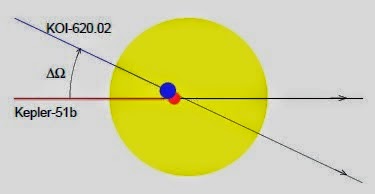
http://sciencythoughts.blogspot.co.uk/2014/07/conformation-of-third-planet-in-kepler.htmlConformation of the third planet in the Kepler-51 System.                                               Kepler-51 is a G-type Yellow Dwarf star 2800 light years from Earth in the constellation of Cygnus. It has a...
Kepler 186f: an Earth-sized planet in the habitable zone of a Red Dwarf star.
One of the key objectives in the search for planets orbiting other stars has been to locate planets in the habitable zones of such stars, i.e. planets on which liquid water could potentially exist. A number of.
Follow Sciency Thoughts on Facebook.

A new species of Caecilian from Brazil.


Caecilians are tropical Amphibians only distantly related to Frogs and Salamanders. They have highly modified bodies, having lost their limbs and taken on a worm-like soil dwelling lifestyle with a body covered in ring-shaped folds of skin called annuli, which resemble the segments of Annelid Worms, which they resemble closely and are often mistaken for, though a typical vertebrate jaw and a mouth full of sharp teeth reveals their true nature. Members of the South American genus Microcaecilia have their eyes covered over by a layer of bone, further increasing their resemblance to Worms.

In a paper published in the journal Zootaxa on 13 January 2015, MarkWilkinson of the Department of Life Sciences at The Natural History Museum and Marta Maria Antoniazzi and Carlos Jared of the Laboratório de Biologia Celular at Instituto Butantan describe a new species of Microcaecilia from the Área de Proteção Ambiental in Pará State, Brazil.

The new species is named Microcaecilia butantan in honour of Instituto Butantan. The species is described from one female and three male specimens, dug up at a Cupuaçu, Theobroma grandiflorum plantation (a plant related to Cacao producing edible fruit) with hand hoes. The female is 159 mm in length, the males range from 191 to 208 mm. They have more annuli than other known species (over 135 in all specimens) and a continuous tooth row (many species have a gap) with recurved but unserrated teeth.

Microcaecilia butantan,specimen in life dorsal view. Bar is 5 mm. Wilkinson et al. (2015).

Little is known of the natural history of this species, but it was easily found in the rainy season, within both the plantation where it was discovered and the surrounding forest, suggesting that it has a fairly high population at least locally, and so it is not at the current time considered to be under any immediate conservation threat.

The habitat where Microcaecilia butantan was found living. Wilkinson et al. (2015).

See also…

http://sciencythoughts.blogspot.co.uk/2014/05/a-new-species-of-caecilian-from-french.htmlA new species of Caecilian from French Guiana.                                                                            Caecilians (Gymnophiona) are a group of Amphibians only distantly related to Frogs and Salamanders. They have lost all limbs, and live a burrowing lifestyle in moist tropical forests. Caecilians have banded...
Caecilians are limbless burrowing Amphibians found in tropical regions of Asia, Africa and South America. They resemble Earthworms, with circular folds on their skin which make them look...


Follow Sciency Thoughts on Facebook.

Near Earth Asteroid (357439) 2004 BL84 discovered to have a small moon.


Asteroid (357439) 2004 made a close approach to the Earth on Monday 26 January 2015, enabling scientists at NASA's Deep Space Network antenna at Goldstone, California to collect radar images of the object. These revealed that the 325 m asteroid has a small moon, which is approximately 70 m in diameter. This is not the first asteroid to be found to possess such a moon; it is thought that abut 16% of Near Earth Asteroids larger than 200 m have such a companion body, and the figure may be similar or even higher for asteroids further out in the Solar System (though this is harder to assess).

(357439) 2004 BL84 and its newly discovered moon. NASA/Deep Space Network.

The close encounter also enabled scientists at NASA’s InfraredTelescope Facility on Mauna Kea, Hawaii, to study the spectroscopy of the asteroid, with initial results suggesting it has a surface composition similar to that of Vesta. (357439) 2004 BL84 is of particular interest as it is a Potentially Hazardous Asteroid (an asteroid larger than 150 m in diameter that is known to come within 0.05 AU of the Earth), and this was considered an excellent opportunity for observation as it is the closest predicted flyby of such a large object until 2027, when 1999 AN10, thought to be between 800 m and 1.8 km in diameter, will pass us at about 390 000 km (roughly the same distance as the Moon), and encounter that should be visible through binoculars.

Asteroid (357439) 2004 BL84 passed by the Earth at a distance of 1 200 000 km (3.1 times the average distance between the Earth and the Moon, or 0.8 % of the average distance between the Earth and the Sun), at about 4.20 pm GMT on Monday 26 January 2015. There was no danger of the asteroid hitting us, though had it done so it would have presented significant minor threat. With an estimated equivalent diameter of 325 m (i.e. it is estimated that a spherical object with the same volume would be 325 m in diameter)(357439) 2004 BL84would be expected to be capable of passing through the atmosphere reasonably intact, impacting the ground in an explosion equivalent to about 1800 megatonnes of TNT (roughly 106 000 times the energy of the Hiroshima bomb) and creating a crater about 5 km in diameter. Such an event would cause devastation over a wide area, and could cause climatic problems for decades.

(357439) 2004 BL84was discovered on 30 January 2004 by the Massachusetts Institute of Technology's Lincoln Near Earth Asteroid Research Laboratory in Socorro, New Mexico. The designation 2004 BL84 implies that it was the 2111th asteroid (asteroid L84) discovered in the second half of January 2004 (period 2004B).The longer designation, 357439 indicates that the asteroid was the 357 439th asteroid ever discovered. Asteroids are not given this longer designation immediately, to avoid duplicate or false sightings

The calculated orbit of (357439) 2004 BL84.  JPL Small Body Database.

(357439) 2004 BL84has a 672 day orbital period and an eccentric orbit tilted at an angle of 23.7° to the plane of the Solar System, which takes it from 0.89 AU from the Sun (i.e. 89% of the average distance at which the Earth orbits the Sun) to 2.10 AU from the Sun (i.e. 2.10% of the average distance at which the Earth orbits the Sun, considerably outside the orbit of Mars). It is therefore classed as an Apollo Group Asteroid (an asteroid that is on average further from the Sun than the Earth, but which does get closer). This means that close encounters between the asteroid and Earth are extremely common, with the last having occurred in September 2014 this year and the next predicted in February 2026. As an asteroid probably larger than 150 m in diameter that occasionally comes within 0.05 AU of the Earth, (357439) 2004 BL84is also classified as a Potentially Hazardous Asteroid.

See also…

http://sciencythoughts.blogspot.co.uk/2015/02/asteroid-2013-bz45-passes-earth.htmlAsteroid 2013 BZ45 passes the Earth.       Asteroid 2013 BZ45 passed by the Earth at a distance of 9 670 000 km (25.16 times the average distance between the Earth and the Moon, or 6.5 % of the average distance between the Earth and the Sun), slightly before 8.30 pm GMT on Tuesday 3 February...

Asteroid 2015 BL passes the Earth.
Asteroid 2015 BL passed by the Earth at a distance of 17 350 000 km (45.38 times the average distance between the Earth and the Moon, or 11.6 % of the average distance between the Earth and the Sun), slightly before 0.10 am GMT on Tuesday 3 February...
http://sciencythoughts.blogspot.co.uk/2015/02/asteroid-2008-cq-passes-earth.htmlAsteroid 2008 CQ passes the Earth.           Asteroid 2008 CQ passed by the Earth at a distance of 1 854 000 km (4.8 times the average distance between the Earth and the Moon, or 1.2 % of the average distance between the Earth and the Sun), at about 1.20 am GMT on Saturday 31 January 2015. There was no...
 
Follow Sciency Thoughts on Facebook.