Monday, 4 January 2016

Second eruptive episode on Mount Momotombo.

Mount Momotombo in Nicaragua underwent a series of explosive eruptions on Sunday 3 December 2015, with an initial eruption that produced incandescent (glowing) material slightly after 4.20 am local time, and two further explosions in the afternoon, slightly before and after 2.30 pm. The volcano also underwent a series of explosive eruptions on 1 December last year (2015), the first such events since 1905.

Webcam image of Mount Momotombo slightly after 2.30 pm on Sunday 3 December 2015. Instituto Nicaragüense de Estudios Territoriales.

Although the 1 December eruption was the first explosive eruption on the volcano since 1905, a small lava flow was recorded in 1980 and Earthquakes and gas emissions have been recorded on several occasions since.Eruptions on Momotombo are rare, they can be severe and are a cause for concern. In 1610 an eruption on the volcano led to the destruction of the city of León on the shore of Lago de Managua, and while it was rebuilt as the modern city of León about 30 km to the west, the modern town of Puerto Momotombo has grown around the ruins.

 The location of the Mount Momotombo. Google Maps.

Nicaragua is located on the southern edge of the Caribbean Plate, which underlies Central America as well as the Caribbean Sea. To the south the Cocos Plate, which underlies part of the eastern Pacific, is being subducted beneath the Caribbean Plate along the Middle American Trench, passing under Central America as it is sinks into the Earth. As it is subducted the Cocos Plate is being partially melted by the heat of the planet's interior and the friction caused by its dragging under the Caribbean Plate, producing liquid magma, which then rises through the overlying plate fueling the volcanoes of Central America.

 Diagrammatic representation of the Cocos Plate passing beneath the Central American Plate, showing how it fuels the volcanoes of Central America. VCS Mining.

See also...

http://sciencythoughts.blogspot.co.uk/2015/12/eruption-on-mount-momotombo-nicaragua.htmlEruption on Mount Momotombo, Nicaragua. Authorities in Nicaragua have reported an eruption on Mount Momotombo, a volcano in the east of the country, on Tuesday 1 December 2015. The eruption produced a column of gas and ash that rose about a kilometer over the summit of the volcano, and people in several...
http://sciencythoughts.blogspot.co.uk/2015/11/cattle-killed-by-eruption-on-mount.htmlCattle killed by eruption on Mount Telica, Nicaragua.                                                 Mount Telica, an active volcano in northwest Nicaragua, underwent an eruptive episode on Sunday 22 November 2015, with two rapid explosions reported shortly after 8.45 am, which threw fragments of rock up to 900 m from the crater, resulting in the deaths of several... 
http://sciencythoughts.blogspot.co.uk/2014/10/one-dead-after-central-american.htmlOne dead after Central American Earthquake.                                                   The United States Geological Survey recorded a Magnitude 7.3 Earthquake at a depth of 40 km, roughly 67 km offshore of the Nicaraguan coastal resort...

Follow Sciency Thoughts on Facebook.
 

Sunday, 3 January 2016

Magntude 1.1 Earthquake in Derbyshire, England.

The British Geological Survey recorded a Magnitude 1.1 Earthquake at a depth of about 16 km about 8 km to the southwest of the town of Chesterfield in north Derbyshire, England slightly before 9.00 pm GMT on Monday 28 December 2015. There are no reports of any injuries associated with this event, though it may have been felt locally.


The approximate location of the 28 December 2015 Chesterfield Earthquake. Google Maps.

Earthquakes become more common as you travel north and west in Great Britain, with the west coast of Scotland being the most quake-prone part of the island and the northwest of Wales being more prone  to quakes than the rest of Wales or most of England. However, while quakes in southern England are less frequent, they are often larger than events in the north, as tectonic presures tend to build up for longer periods of time between events, so that when they occur more pressure is released.

The precise cause of Earthquakes in the UK can be hard to determine; the country is not close to any obvious single cause of such activity such as a plate margin, but is subject to tectonic pressures from several different sources, with most quakes probably being the result of the interplay between these forces.

Britain is being pushed to the east by the expansion of the Atlantic Ocean and to the north by the impact of Africa into Europe from the south. It is also affected by lesser areas of tectonic spreading beneath the North Sea, Rhine Valley and Bay of Biscay. Finally the country is subject to glacial rebound; until about 10 000 years ago much of the north of the country was covered by a thick layer of glacial ice (this is believed to have been thickest on the west coast of Scotland), pushing the rocks of the British lithosphere down into the underlying mantle. This ice is now gone, and the rocks are springing (slowly) back into their original position, causing the occasional Earthquake in the process.


(Top) Simplified diagram showing principle of glacial rebound. Wikipedia. (Bottom) Map showing the rate of glacial rebound in various parts of the UK. Note that some parts of England and Wales show negative values, these areas are being pushed down slightly by uplift in Scotland, as the entire landmass is quite rigid and acts a bit like a see-saw. Climate North East.

Witness accounts of Earthquakes can help geologists to understand these events, and the structures that cause them. If you felt this quake, or were in the area but did not (which is also useful information) then you can report it to the British Geological Survey here.
 
See also...
 
http://sciencythoughts.blogspot.co.uk/2015/08/magnitude-18-earthquake-in-derbyshire.htmlMagnitude 1.8 Earthquake in Derbyshire, England.                                                The British Geological Survey recorded a Magnitude 1.8 Earthquake at a depth of 1 km about 1 km to the east of the town of Chapel-en-le-Frith in the Peak District in...
http://sciencythoughts.blogspot.co.uk/2015/07/magnitude-11-earthquake-in-south.htmlMagnitude 1.1 Earthquake in south Derbyshire, England.                             The British Geological Survey recorded a Magnitude 1.1 Earthquake at a depth of 7 km between the villages of Sutton on the Hill and Marston on Dove in...
A seven-year-old girl has escaped with cuts and bruises after falling into an 8 m sinkhole near her home in Shuttlewood, Derbyshire. Daisy-Mae Jones was playing with friends in a field near her home when she...
Follow Sciency Thoughts on Facebook.
 

Fossil Bats from the Early Pleistocene of Olduvai Gorge, Tanzania.

Bats are one of the most successful Mammal groups, with roughly 25% of all known living Mammal species being Bats (or about 50% of all living non-Rodent Mammal species). They have a fossil record dating back to the Paleocene, but their fossil record is not well studied as, like Birds, Bats have extremely light and fragile skeletons, with the effect that most fossil Bats are known from extremely limited and fragmentary material.

In a paper published in the American Museum Novitates on 16 December 2015, Gregg Gunnell of the Division of Fossil Primates at the Duke Lemur Center and the Department of Mammalogy at the American Museum of Natural History, the late Percy Buttler, formerly of the Royal Holloway University of London, the late Marjorie Greenwood, formerly of the Natural History Museum and Nancy Simmons, also of the Department of Mammalogy at the American Museum of Natural History describe a series of fossil Bats from the Early Pleistocene of Olduvai Gorge of Arusha Province in Tanzania. The bones were collected in the late 1950s and early 1960s from sediment sieved during the excavations that produced the first specimens of Zinjanthropus boisei. These deposits are thought to be between 1.80 and 1.85 million years old. Four new fossil Bat species are described from the remains.

The first new species described is placed in the genus Myzopoda and given the specific name africana, meaning 'from Africa'; there are two living species of Myzopoda today, both of which are found in Madagascar only. Older members of the family Myzopodidae (of which Myzopoda is the only living species) have previously been described from Africa, but this is the first species of Myzopoda. The species is described froma single whole left humerus, longer and more robust than those of either living species at 26.5 mm, plus two partial humeri. 

(A, C) Left humerus of Myzopoda africana, compared with (B, D) the living Madagascan species Myzopoda schliemanni, in anterior (A–B) and posterior (C–D) views. Gunnell et al (2015).

The second species described is placed in the genus Cardioderma and given the specific name leakeyi in honour of palaentologist Louis Leaky, for his work in East Africa. The genus Cardioderma contains a single living species, Cardioderma cor, the African Heart-nosed Bat, which is found across East Africa including Tanzania today. The species is described from a left maxilla and right dentary, both with teeth in place. The teeth of Cardioderma leakeyi are larger and more robust than those of Cardioderma cor. Fossils referred to the genus Cardioderma have previously been recorded from the Pliocene of Ethiopoa, though this material has never been formally described.

Upper dentition of Cardioderma cor (A) compared with Cardioderma leakeyi (B–D). (A) palate (photograph). Left maxilla with P4–M3 in (B, C) lateral (drawing and photograph of cast, respectively) and (D) occlusal (drawing) views. Gunnell et al (2015).

The third species described is placed in the genus Scotoecus (Lesser House Bats) and given the specific name olduvensis, meaning 'from Olduvai'. Five species of Scotoecus are alive today, four of them widespread in Africa, the other from South Asia. Scotoecus olduvensis is described from a left dentary with intact teeth and two fragments of humerus. This species also appears to have been larger and more robust than living species in the same genus. It is the first fossil species of Scotoecus described.

Left lower dentitions of Scotoecus in occlusal view. (A) Scotoecus albofuscus; (B) Scotoecus olduvensis; (C) Scotoecus hindei. Gunnell et al (2015).

The fourth specimen is a partial right humerus tentatively referred to the living species Eptesicus isabellinus, which is found today in North Africa and the Canary Islands and possibly Iberia, but which is considered by some to be a subspecies of Eptesicus bottae, a species found from North Africa across the Middle East and into Central Asia. Modern members of the genus are found across Africa, Europe, Asia, North, Central and South America and the Caribbean, with fossil specimens previously recorded from the Pliocene of Southern Africa and the Plio-Pliocen of the Northern Hemisphere.

Right distal humerus of cf. Eptesicus isabellinus in (A) anterior, (B) posterior, (C) medial, and (D) lateral views. Gunnell et al (2015).

The next specimen described is a fragment of left humerus assigned to the genus Myotis (Mouse-eared Bats). Modern members of this genus are found across Africa, Eurasia and the Americas, and is common in the fossil record of much of this area from the Pliocene onwards, though African fossil specimens have previously only been recorded in Southern Africa and Morocco.

Two more partial humeri are referred to the genus Pipistrellus, being similar to the modern species Pipistrellus nanulus and Pipistrellus rueppelli, both of which are found in Africa. Pipistrelle Bats are found across much of the globe today, and fossil specimens are known from a number of areas; they have previously been described from Olduvai, but not yet in the fossil record anywhere else in Africa.

The forth species described is placed in the genus Nycticeinops, and given the specific name serengetiensis, meaning 'from the Serengeti'. This species is described from a right and left dentary with some teeth and a second left dentary without teeth plus eleven partial humeri. The genus Nycticeinops contains only a single living species, Nycticeinops schlieffeni (Schlieffen's Twilight Bat) a widespread African species. Nycticeinops serengetiensis appears to have been slightly larger than Nycticeinops schlieffeni, though the modern species is particularly small (at about 3-4 cm), and Nycticeinops serengetiensis is still a small Bat. This is the first fossil species of Nycticeinops described.
 
 
Mandible of Nycticeinops schlieffeni, photographs in (A, lateral and (B) occlusal views compared with Nycticeinops serengetiensis, drawings. (C–E)  Nycticeinops serengetiensis, left dentary with m1–2 and all anterior alveoli in (C) occlusal, (D) lateral and (E) medial views. (F–H) Nycticeinops serengetiensis, right dentary with p4–m1 with all other alveoli in (F) occlusal, (G) lateral, and (H) medial views. Gunnell et al (2015).
 
The next specimen is a partial humerus tentatively referred to the living Mops condylurus, the Angolan Free-tailed Bat, a species widespread in Sub-Saharan Africa today.
 
 Right distal humerus of Mops cf. Mops condylurus in (A) anterior, (B) posterior, (C) medial, and (D) lateral views. Gunnell et al (2015).
 
The next specimens described are a complete left humerus plus a partial left and two partial right humeri referred to the living species Mops thersites, the Railer Bat, a widespread African species. The genus Mops is a member of the family Molossidae (Free-tailed Bats), previously only represented in Africa by an Early Miocene specimen of Tadarida from Kenya.

Left complete humerus of Mops cf. Mops thersites. (A) Photograph and drawing in posteromedial view; (B) drawing in medial view; (C) drawing in lateral view; (D) photograph and drawing in anterior view. Gunnell et al (2015).

The final group of specimens comprises a right dentary which had two teeth when first discovered but has subsequently lost one, plus eight partial humeri referred to the living Miniopterus schreibersi, or Common Bent-winged Bat, a species found today across much of Africa, Europe and Asia.

Comparison of extant Miniopterus schreibersi (A, C, E) photographs and fossiil Miniopterus cf. Miniopterus schreibersi (B, D, F) drawings in (A–B) occlusal, (C–D) lateral, and (E–F) medial views. Gunnell et al (2015).

The majority of the Bat species a either members of species or closely related to species found in dry-to-moist savannah or open woodland close to water today. This fits well with the interpreted environment of Olduvai in the Early Pleistocene, thought to have been open woodland with freshwater springs feeding into a nearby lake. However some of the Bats present, Pipistrellus, Eptesicus, and Scotoecus, are more typically found in drier or even semi-arid open woodland, which may suggest such habitats were present nearby.

See also...
 
http://sciencythoughts.blogspot.co.uk/2015/08/lonchophylla-inexpectata-new-species-of.htmlLonchophylla inexpectata: A new species of Nectar-feeding Bat from the Caatinga of Brazil.                                                                             Nectar-feeding Bats of the genus Lonchophylla are found tropical South and Central America, where they are important pollinators of...
http://sciencythoughts.blogspot.co.uk/2015/01/the-source-of-december-2013-guinean.htmlThe source of the December 2013 Guinean Ebola outbreak.                                                          In December 2013 cases of the haemorrhagic...
http://sciencythoughts.blogspot.co.uk/2014/12/nycteribiid-bat-flies-from-southwest.htmlNycteribiid Bat Flies from the southwest Indian Ocean.                                                           Nycteribiid Bat Flies are True Flies, Diptera, that have lost their wings and adopted a lifestyle as ectoparasites of Bats. They have an unusual lifestyle, with the larva maturing within the female Fly (which only produces one larva at a time), then being ‘laid’ during the pupa stage. The female Fly leaves her host Bat to lay this pupa, which hatches 3-4 weeks later, producing a new...
 
 
Follow Sciency Thoughts on Facebook.

Saturday, 2 January 2016

Asteroid 2015 YV9 passes the Earth.

Asteroid 2015 YV9 passed by the Earth at a distance of 3 602 000 km (9.37 times the average distance between the Earth and the Moon, or 2.4`% of the average distance between the Earth and the Sun), slightly after 3.00 pm GMT on Saturday 26 December 2015. There was no danger of the asteroid hitting us, though had it done so it would have presented only a minor threat. 2015 YV9 has an estimated equivalent diameter of 14-43 m (i.e. it is estimated that a spherical object with the same volume would be 14-43  m in diameter), and an object of this size would be expected to explode in an airburst (an explosion caused by superheating from friction with the Earth's atmosphere, which is greater than that caused by simply falling, due to the orbital momentum of the asteroid) in the atmosphere between 28 and 10 km above the ground, with only fragmentary material reaching the Earth's surface.

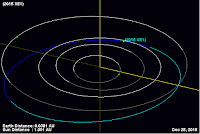
 The calculated orbit of 2015 YV9JPL Small Body Database.

2015 YV9 was discovered on 30 December 2015 (four days after its closest approach to the Earth) by the University of Arizona's Catalina Sky Survey, which is located in the Catalina Mountains north of Tucson. The designation 2015 YV9 implies that it was the 246th asteroid (asteroid V9) discovered in the second half of December 2015 (period 2015 Y).

2015 YV9 has an 1135day orbital period and an eccentric orbit tilted at an angle of 6.16° to the plane of the Solar System that takes it from 1.01 AU from the Sun (i.e. 101 % of the average distance at which the Earth orbits the Sun) to 3.25 AU from the Sun (i.e. 325% of the average distance at which the Earth orbits the Sun, over twice times the distance at which the planet Mars orbits). It is therefore classed as an Amor Group Asteroid (an asteroid which comes close to the Earth, but which is always outside the Earth's orbit).

See also...

http://sciencythoughts.blogspot.co.uk/2016/01/januarys-first-meteor-shower-2015.htmlJanuary's first meteor shower: The 2015 Quadrantids.                                                 The Quadrantid Meteor Shower is one of the brightest meteor showers of the year, often producing over 100 meteors per hour at its peak, which falls on the night...
http://sciencythoughts.blogspot.co.uk/2015/12/asteroid-2015-xa378-passes-earth.htmlAsteroid 2015 XA378 passes the Earth. Asteroid 2015 XA378 passed by the Earth at a distance of 3 857 000 km (10.0times the average distance between the Earth and the Moon, or 3.40% of the average distance between the Earth and the Sun), slightly after 7.15 pm GMT on Saturday 19...

http://sciencythoughts.blogspot.co.uk/2015/12/asteroid-2015-xe1-passes-earth.htmlAsteroid 2015 XE1 passes the Earth.      Asteroid 2015 XE1 passed by the Earth at a distance of 5 080 000 km (13.2 times the average distance between the Earth and the Moon, or 3.40% of the average distance between the Earth and the Sun), slightly before 3.00 am GMT on Saturday 19 December 2015...


Follow Sciency Thoughts on Facebook. 
 

Friday, 1 January 2016

Mollisquama sp.: A Pocket Shark from the Gulf of Mexico.

In 1984 the Russian ichthyologist Vladamir Dolganov described an unusual Dalatid Shark (the group which also includes Cookie Cutter Sharks, Kitefin Sharks and Taillight Sharks) from the Professor Mesyatzev Seamount on the Nazca Ridge of the southeast Pacific Ocean. This was 40 cm in length and had a distinctive pocket-shaped gland above the pectoral fin, earning it the common name 'Pocket Shark' (Mollisquama parini). However no further specimens of this Shark were found in the South Pacific, and the species remains somewhat of a mystery.

In a paper published in the journal Zootaxa on 22 April 2015, Mark Grace of the Mississippi Laboratories of the Southeast Fisheries Science Center, Michael Doosey and Henry Bart of the Tulane University Biodiversity Research Institute and Gavin Naylor of the Hollings Marine Laboratory describe a second specimen of Mollisquama from the Gulf of Mexico.

The new specimen is considerably smaller than the original, at 14.2 cm, with a head considerably larger in proportion to the body, though this may represent a different growth stage (most animals change their proportions as they grow). It is also male rather than female, and shows a number of features not seen on the first specimen, most notably a series of photophores (bioluminescent organs) and a distinctive circular dermal denticle (the scales of Sharks are structurally similar to the teeth of other vertebrates, and are therefore called dermal denticles) behind the lower jaw. This makes it quite likely that the Gulf of Mexico specimen is a different species to the South Pacific specimen, however since Grace et al. were not able to inspect the original specimen the refrain from describing it as such until this becomes possible.

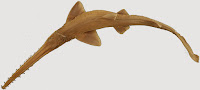
Mollisquama sp., Gulf of Mexico specimen in lateral view. Grace et al. (2015).

See also...

http://sciencythoughts.blogspot.co.uk/2014/08/satellite-tagging-whale-sharks-in-red.htmlSatellite tagging Whale Sharks in the Red Sea                                                                                  Whale Sharks (Rhincodon typus) are the largest extant Shark species, and indeed the largest living...

http://sciencythoughts.blogspot.co.uk/2014/03/a-new-species-of-sawshark-from.htmlA new species of Sawshark from the Philippines.                                            Sawsharks (Pristiophoridae) are highly specialized Sharks related to...
http://sciencythoughts.blogspot.co.uk/2012/03/new-species-of-catshark-from-galapogus.htmlNew species of Catshark from the Galapaagos.                                           Catsharks, or Dogfish, are small bottom dwelling sharks found in oceans throughout the world.
Follow Sciency Thoughts on Facebook
 

January's first meteor shower: The 2015 Quadrantids.

The Quadrantid Meteor Shower is one of the brightest meteor showers of the year, often producing over 100 meteors per hour at its peak, which falls on the night of 3-4 January each year, and is predicted to peak at 8.00 am GMT on Monday 4 January 2016. The meteor shower originates in the constellation of Boötes, which is slightly confusing, as most meteor showers are named for the constellation in which they originate. This is because the constellation was named in the sixteenth century by astronomer Tycho Brahe, before the introduction of standardized constellations used by modern astronomers, though to make matters a little more confusing, Brahe didn't name the meteors this way either; the name comes from the constellation of Quadrans Muralis, introduced by Joseph Jérôme Lefrançois de Lalande in 1795, and dropped by the International Astronomical Union in 1922.
 
 The point of origin for the Quadrantid Meteors. Sky-Watching.

The Quadrantid Meteors are unusual in that they typically are only visible for a few hours either side of this peak, whereas other showers are typically visible for days or even weeks. This is thought to be because they originate from an asteroid (196256) 2003 EH1, rather than the tail of a comet as with most meteor showers. The orbit of this asteroid is tilted at an angle of 71.9° to the plane of the Solar System, so that the Earth only very briefly passes through the debris trail left by it, rather than remaining in it for some time, as is the case with the trail of a comet with an orbit in roughly the same plane as the Earth. 

The orbit of (196256) 2003 EH1. JPL Small Body Datebase Browser.

See also...

http://sciencythoughts.blogspot.co.uk/2015/12/geminid-meteor-shower-should-be-clearly.htmlGeminid Meteor Shower should be clearly visible this year.                                                            The Geminid Meteor Shower is expected to peak on Sunday 13-Monday 14 December this year (2015) with potentially up to 120 meteors per hour being visible...
http://sciencythoughts.blogspot.co.uk/2015/11/leonid-meteor-shower-falls-this-week.htmlLeonid Meteor Shower falls this week.       Each year between 15 and 18 November (approximately), typically peaking between midnight and dawn on 18 November, the the Earth encounters the Leonid Meteors, one of the more spectacular of the annual meteor showers. Unlike most such showers, which are essentially composed of dust particles, the Leonids comprise particles of up to 8 mm across and up to 85 g in mass, leading to some...
http://sciencythoughts.blogspot.co.uk/2015/11/bright-fireball-over-saskatchewan-and.htmlBright fireball over Saskatchewan and Manitoba.                                                   Many people have reported seeing a bright fireball over parts of southern Saskatchewan and Manitoba at about 8.40 pm local tine on Sunday 8 November 2015. A fireball is defined as a meteor (shooting star)...
Follow Sciency Thoughts on Facebook.
 

Sinkhole swallows man in South Wales.

Officials from the Coal Authority and Bridgend Council are investigating after a man was swallowed by a sinkhole in the village of Nantyfyllon in Bridgend County, South Wales on 31 December 2015. The incident happened at about 8.00 am local time, when the hole, which measured roughly 3 m across and 4 m deep opened up in a pavement; the man was rescued uninjured by the South Wales Fire and Rescue Service, but some nearby homes have been evacuated as a precaution.

The 31 December 2015 Nantyffyllon sinkhole. Benjamin Wright/PA.

Sinkholes are generally caused by water eroding soft limestone or unconsolidated deposits from beneath, causing a hole that works its way upwards and eventually opening spectacularly at the surface. Where there are unconsolidated deposits at the surface they can infill from the sides, apparently swallowing objects at the surface, including people, without trace.

 The approximate location of the 31 December 2015 Nantyffyllon sinkhole. Google Maps.

On this occasion the sinkhole has been linked to very high rainfall levels associated with Atlantic Storm Frank which are thought to have washed away sediments beneath the pavement exposing an old and undocumented mine working. Very high levels of rainfall were observed on mountains close to the village prior to the event, with runoff flowing through the village.

Ground collapses thought to be associated with old mine workings, collapsed mines or mine entrances, unsealed mine entrances or gas or water emissions from old mine workings in the UK can be reported to the Coal Authority here.

See also...

http://sciencythoughts.blogspot.co.uk/2014/12/two-rescued-from-disused-mine-in.htmlTwo rescued from disused mine in Ceredigion, Wales.                                       Two men described as being in their seventies were rescued from the disused Bwlch Glas Mine near Talybont in Ceredigion, Mid Wales, at about 5.45...
http://sciencythoughts.blogspot.co.uk/2011/09/river-neath-turned-orange-by-mining-run.htmlRiver Neath turned orange by mining run-off.
On Friday 24 September 2011 anglers on the River Neath in South Wales reported that a stretch of the river between Abergarwed and Neath Town had turned a muddy orange colour, and that a number of fish could be seen to be visibly in distress.
http://sciencythoughts.blogspot.co.uk/2011/09/disaster-at-gleision-colliery-godrer.htmlDisaster at Gleision Colliery, Godre'r Graig, West Glamorgan.
The Gleision Colliery is roughly 18 km to the northeast of Swansea. It is Wales's smallest coal-mine, with less than 20 employees. Gleision is a drift mine, a mine that is cut in from the side of a hill, so that it is possible to...
Follow Sciency Thoughts on Facebook.