Friday, 8 January 2016

Possible Annelid Worm tubes from the Early Devonian of Brazil.

Worm tubes first appear in the fossil record in the Ediacaran and become increasingly common through the Palaeozoic. Most Worm tubes today are made by Polychaete Annelids, a group which have existed since at least the Cambrian, however in the Palaeozoic a variety of other groups, such as Tentaculitoids (thought to have been related to Molluscs and Lophophorates) and Hyolithelminths (possibly Cnidarians) are known to have made tubular structures, making it difficult to assess when tube-building Polychaetes first appeared.

In a paper published in the journal Acta Palaeontologica Electronica on 21 December 2015, Olev Vinn of the Department of Geology at the University of Tartu, Carolina Zabini and Gustavo Sene-Silva of the Universidade Tecnológica Federal do Paraná, Kalle Kirsimäe also of the Department of Geology at the University of Tartu and Lara Susan-Marcos, also of the Universidade Tecnológica Federal do Paraná, describe a series of tubes from the Early Devonian Ponta Grossa Formation of Paraná State in Brazil.

The tubes are fragmentary and have been reworked prior to preservation in sediment, The sample examined contains about 50 such tubes with a maximum length of 2.5 cm. They are 2.9–5.8 mm in width and eliptical, though this is thought to be due to compression. They are banded, with seven-to-ten rings every 5 mm, and do not taper or branch. Vinn et al. describe these as Annulitubus mutveii, where 'Annulitubus' means 'ringed-tube' and 'mutveii' honours palaeontologist Harry Mutvei for his work on the skeletal structures of extinct invertebrates.

Sample (MN 9571-I) from Rio Caniú outcrop, Ponta Grossa Formation, Upper Emsian, Lower Devonian. (A) Fragment showing numerous tubes; holotype of Annulitubus mutveii  (MN 9571-Ia) and paratypes (MN 9571-Ib–e). Note that all tube fragments are straight and have similar orientation, some show smooth surfaces, with very subtle striae, in others it is possible to see shallow rings. (B) Enlarged holotype (MN 9571-Ia), note the smooth rings. (C) Fragment showing paratype (MN 9571-Ig). Vinn et al. (2015).

The Worms are interpreted as having grown close to the site of deposition, probably in dense clusters but not attached to one-another. The locality is not thought to have had any solid rock close by, but shells were available and could possibly have served as points of attachment, or the worms could have lived and formed tubes partially or wholey within the sediment. The tubes are preserved in silica, a mineral not known to have been used to make tubes by any Worm group, and therefore Vinn et al. interpret this as a secondary material which has replaced the original tube material. Silica requires very alkaline conditions to form, conditions under which calcite tubes would be expected to lose much of their original structure, leading Vinn et al. to suggest that the tubes were originally formed from organic material rather than mineral. Such a structure, with non-tapering, non-branching organic tubes with a banded structure is typical of several Polychaete groups, but not associated with any non-Polychaete group, leading Vinn et al. to conclude the tube-builder was almost certainly a Polychaete.

See also...

http://sciencythoughts.blogspot.co.uk/2015/11/neosabellides-lizae-new-species-of.htmlNeosabellides lizae: A new species of Ampharetid Worm from Lizard Island on Australia's Great Barrier Reef.               Ampharetid Worms are small, usually marine, Annelid Worms related to the tube-building Trumpet Worms...
http://sciencythoughts.blogspot.co.uk/2015/04/cretaceous-bone-eating-worms-from.htmlCretaceous Bone-eating Worms from England.                                                 Siboglinid Worms are a distinctive group of Annelids which lack mouths and digestive tracts in their...
http://sciencythoughts.blogspot.co.uk/2015/01/a-new-species-of-serpulid-worm-from.htmlA new species of Serpulid Worm from the Caribbean.                                                 Serpulids are distinctive Polychaete Worms found throughout the world’s oceans, from the intertidal zones to the deep seas. They live in calcareous tubes, which they cement to hard substrates, and are...
Follow Sciency Thoughts on Facebook.

Thursday, 7 January 2016

Magnitude 6.7 Earthquake in Manipur State, India, kills at least 22 people.

At least 22 people are known to have died following an Earthquake in Manipur State, India, measured by the United States Geological Survey as having a Magnitude of 6.7 and occurring at a depth of 55 km about 30 km to the west of the city of Imphal atabout 4.35 am local time on Monday 4 January 2015 (about 11.05 pm on Sunday 3 January GMT). The event was felt as far away as Delhi, and caused damage and casualties as far away as Bihar State.

A collapsed house in  Imphal following the 4 January 2015 Manipur Earthquake. AP.

A total of nine deaths and 153 injuries have been reported in Manipur State, two deaths and twenty injuries in Assam, one death and twelve injuries in West Bengal, four deaths in Bihar and one injury in Mizoram. In Bangladesh a total of five fatalities and sixty six injuries have been reported. The quake was also felt across much of northern Myanmar, though no damage or injuries have been reported at this time.

The approximate location of the 4 January 2016 Manipur Earthquake. Google Maps.

Northeast India is on the northern part of the Indian Plate, close to its boundary with Eurasia. India is moving northward, pushing into Eurasia at a rate of 40 mm a year. This causes quakes on both plates, as well as the folding and uplift that has created the Himalayas and the Tibetan Plateau.

 The movement of India into Eurasia over the last 71 million years. USGS.

Witness accounts of Earthquakes can help geologists to understand these events, and the structures that cause them. The international non-profit organization Earthquake Report is interested in hearing from people who may have felt this event; if you felt this quake then you can report it to Earthquake Report here.
 
See also...
 
http://sciencythoughts.blogspot.co.uk/2015/11/magnitude-55-earthquake-in-sagaing.htmlMagnitude 5.5 Earthquake in Sagaing Region, Myanmar.                                        The United States Geological Survey recorded a Magnitude 5.5 Earthquake at a depth of 22 km about 50 km to the north of Monywa in the Sagaing Region, Myanmar, slightly before 3.05 pm local time...
http://sciencythoughts.blogspot.co.uk/2013/11/magnitude-43-earthquake-in-eastern.htmlMagnitude 4.3 Earthquake in eastern Bhutan. The United States Geological Survey recorded a Magnitude 4.3 Earthquake at a depth of 37.5 km in the Mongar District of eastern Bhutan, slightly before 0.10 am local time on Wednesday 30 October 2013...
http://sciencythoughts.blogspot.co.uk/2013/10/mysterious-eruption-in-manipur.htmlMysterious eruption in Manipur.                Press sources in India are reporting a mysterious 'volcanic' eruption that took place on Sunday 13 October 2013, close to the village of Tusom in the Ukhrul District of Manipur State in northeast India. The...
Follow Sciency Thoughts on Facebook. 

Wednesday, 6 January 2016

Townsendiella ensifera: A new species of Cuckoo Bee from the Pinnacles National Park in California.

Cuckoo Bees, Nomadinae, are cleptoparasitic Bees which resemble Wasps in appearance, and to some extent behavior. The group get their name from their habit of laying their eggs inside the nests of other Bees, the larvae emerging withing the sealed cells of the host species, killing the host's larvae with specialized elongate mandibles, then proceeding to eat both the host larvae and the food provided for it by its mother (cleptoparasitism).

In a paper published in the journal ZooTaxa on 16 December 2015, Michael Orr of the Biology Department at Utah State University and Terry Griswold of the United States Department of Agriculture Agricultural Research Institute's Pollinating Insects Research Unit describe a new species of Cuckoo Bee from the Pinnacles National Park in San Benito County, California.

The new species if placed in the genus Townsendiella, which is indigenous to the southwest United States and northwest of Mexico, and is given the specific name ensifera, meaning 'sword-bearer', in reference to the shape of the mouthparts and cleptoparasitic lifestyle. These are black Bees with a covering of largely white fur, though this is brownish or even reddish in places. The fur of the males is whiter than that of the females.

Townsendiella ensifera, female specimen in lateral view. Scale bar is 0.25 mm. Orr & Griswold (2015).

The Bees were active from early May to late August on the flowers of California Buckwheat, Eriogonum fasciculatum, and Greasewood, Adenostoma fasciculatum. The host Bee for this species is unknown, though Orr and Greenwold note that Townsendiella ensifera is closely related to Townsendiella pulchra, which parasitzes Bees of the genus Hesperapis. Two species of Hesperapis are known to be present in the Pinnacles National Park, Hesperapis regularis, which is considerably larger than Townsendiella ensifera, and Hesperapis ilicifoliae which is approximately the same size, leading to the suggesting that this may be the host species for Townsendiella ensifera.

See also...

http://sciencythoughts.blogspot.co.uk/2014/07/nest-cells-of-leafcutter-bees-from.htmlNest cells of Leafcutter Bees from the Rancho La Brea Tar Pits.                       Leafcutter Bees (Megachilidae) cut their name from their habit of cutting disk-shaped segments from leaves, from which they build their nests. Each female...
http://sciencythoughts.blogspot.co.uk/2014/05/two-new-species-of-orchid-bee-from.htmlTwo new species of Orchid Bee from Columbia and Brazil.                                    The Orchid Bees (Euglossini) of Central and South America have an unusual relationship with the Orchids they pollenate, in that the Orchids do not produce a food substance with which to attract the Bees, but rather...
http://sciencythoughts.blogspot.co.uk/2014/05/a-new-species-of-leafcutter-bee-from.htmlA new species of Leafcutter Bee from Mexico.                                                   Leafcutter Bees (Megachilidae) get their name from their habit of cutting segments from leaves with which to line their nests. They are solitary Bees, each female Bee building her own nest in a wood cavity, plant...
Follow Sciency Thoughts on Facebook.
 

Asteroid 2015 XC352 passes the Earth.

Asteroid 2015 XC352 passed by the Earth at a distance of 1 991 000 km (5.18 times the average distance between the Earth and the Moon, or 1.33% of the average distance between the Earth and the Sun), slightly after 7.00 pm GMT on Wednesday 30 December 2015. There was no danger of the asteroid hitting us, though had it done so it would have presented only a minor threat. 2015 XC352 has an estimated equivalent diameter of 14-43 m (i.e. it is estimated that a spherical object with the same volume would be 14-43  m in diameter), and an object of this size would be expected to explode in an airburst (an explosion caused by superheating from friction with the Earth's atmosphere, which is greater than that caused by simply falling, due to the orbital momentum of the asteroid) in the atmosphere between 28 and 10 km above the ground, with only fragmentary material reaching the Earth's surface.

 The calculated orbit of 2015 XC352JPL Small Body Database.

2015 XC352 was discovered on 13 December 2015 (seventeen days before its closest approach to the Earth) by the University of Hawaii's PANSTARRS telescope on Mount Haleakala on Maui. The designation 2015 XC352 implies that it was the 8803rd asteroid (asteroid C352) discovered in the first half of December  2015 (period 2015 X).

2015 XC352 has a 372 day orbital period and an eccentric orbit tilted at an angle of 4.48° to the plane of the Solar System that takes it from 0.86 AU from the Sun (i.e. 86% of the average distance at which the Earth orbits the Sun) to 1.16 AU from the Sun (i.e. 116% of the average distance at which the Earth orbits the Sun). It is therefore classed as an Apollo Group Asteroid (an asteroid that is on average further from the Sun than the Earth, but which does get closer). This means that close encounters between the asteroid and Earth are fairly common, with the last thought to have happened in December 2014 this year and the next predicted in November 2016.

See also...

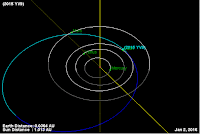
http://sciencythoughts.blogspot.co.uk/2016/01/asteroid-2015-yv9-passes-earth.htmlAsteroid 2015 YV9 passes the Earth.      Asteroid 2015 YV9 passed by the Earth at a distance of 3 602 000 km (9.37 times the average distance between the Earth and the Moon, or 2.4`% of the average distance between the Earth and the Sun), slightly after 3.00 pm GMT on Saturday 26 December 2015...


http://sciencythoughts.blogspot.co.uk/2016/01/januarys-first-meteor-shower-2015.htmlJanuary's first meteor shower: The 2015 Quadrantids.                                                 The Quadrantid Meteor Shower is one of the brightest meteor showers of the year, often producing over 100 meteors per hour at its peak, which falls on the night...

http://sciencythoughts.blogspot.co.uk/2015/12/asteroid-2015-xa378-passes-earth.htmlAsteroid 2015 XA378 passes the Earth. Asteroid 2015 XA378 passed by the Earth at a distance of 3 857 000 km (10.0times the average distance between the Earth and the Moon, or 3.40% of the average distance between the Earth and the Sun), slightly after 7.15 pm GMT on Saturday 19...


Follow Sciency Thoughts on Facebook.  

Landslide kills twenty three Sheep in County Antrim, Northern Ireland.

A farmer in County Antrim, Northern Ireland has lost twenty three sheep after a landslide dumped several tonnes of rock and soil onto his land on Tuesday 5 January 2015. The incident happened on Dermot McDonnell's farm at Kilmore, near Glenariff following a day of heavy rain. Landslides are a common problem after severe weather events, as excess pore water pressure can overcome cohesion in soil and sediments, allowing them to flow like liquids. Approximately 90% of all landslides are caused by heavy rainfall. As well as the immediate loss of livestock the event has left a large amount of debris on the farm, including large boulders which are likely to be difficult to remove and which present a potential threat to McDonell's home and  road below the farm.


Debris on a farm in County Antrim following the 5 January 2015 landslide. Dermot McDonnell.

Ireland and the United Kingdom have been struck by a series of severe Atlantic storms this winter, bringing widespread flooding and triggering a number of landslip and subsidence events. This is due to exceptionally high temperatures over the Atlantic Ocean this year; ocean storms form due to heating of air over the sea, as the air is heated the the air pressure drops and the air rises, causing new air to rush in from outside the forming storm zone. If this zone is sufficiently large, then it will be influenced by the Coriolis Effect, which loosely speaking means the winds closer to the equator will be faster than those further away, causing the storm to rotate, clockwise in the northern hemisphere and anticlockwise in the southern hemisphere.

Whilst the high winds associated these storms is extremely dangerous, the real danger from such storms is often the flooding. Each millibar drop in air pressure can lead to a 1 cm rise in sea level, and large storms can be accompanied by storm surges several meters high. This tends to be accompanied by high levels of rainfall, caused by water picked up by the storm while still at sea, which can lead to flooding, swollen rivers and landslides; which occur when waterlogged soils on hill slopes lose their cohesion and slump downwards, over whatever happens to be in their path.

See also...

http://sciencythoughts.blogspot.co.uk/2015/12/atlantic-storm-desmond-causes-three.htmlAtlantic Storm Desmond causes three fatalities, widespread flooding.                   Three fatalities have been confirmed in the wake of Atlantic Storm Desmond, which passed over the UK and Ireland on Saturday 5-Sunday 6 December...

http://sciencythoughts.blogspot.co.uk/2015/11/18-500-without-power-after-atlantic.html18 500 without power after Atlantic Storm Barny hits UK and Ireland.                        About 28 500 homes have been left without power after Atlantic Storm Barny hit the UK and Ireland on Tuesday 17 November 2015. The majority of those affected...
http://sciencythoughts.blogspot.co.uk/2013/11/magnitude-13-earthquake-off-north-coast.htmlMagnitude 1.3 Earthquake off the north coast of Ireland.                                                      The British Geological Survey recorded a Magnitude 1.3 Earthquake at a depth of 3 km roughly 2.5 km off the coast of Carrick-A-Rede on the north coast of Ireland...
Follow Sciency Thoughts on Facebook.

Tuesday, 5 January 2016

Pangolin trading in Mong La, Myanmar.

Pangolins, Pholidota, are highly specialized Mammals distantly related to the Carnivora (Dogs, Cats, Bears etc.). They are specialized Ant-eaters, lacking teeth and having long, sticky tongues used to extract the Insects from their nests. Uniquely among Mammals Pangolins are covered by keratin scales similar to those of Snakes and Lizards, although these are thought to be secondarily derived from Mammalian fur (i.e. modern scaley Pangolins had hairy ancestors). There are eight living species of Pangolins, four found in Asia and four in Africa, all of which are listed on the International Union for the Conservation of Nature's Red List of Threatened Species. The Sunda and Chinese Pangolins (Manis javonica and Manis pentadactyla) are listed as Critically Endangered, while the Philippine Pangolin and Indian Pangolin (Manis culionenesis and Manis crassicaudata) are listed as endangered; the four African species, the Black-bellied Pangolin (Phataginus tetradactyla), White-bellied Pangolin (Phatagimus tricuspis), Giant Ground Pangolin (Smutsia gigantea) and Temminck's Ground Pangolin (Smutsia temminckii) are all classified as Vulnerable. Pangolins face a variety of threats, including habitat loss and hunting for consumption by local human populations, however the major source of decline in all Pangolin populations, particularly those in Asia, is the international trade in both live Pangolins and Pangolin parts, to China and to a lesser extent Vietnam, where the meat of Pangolins is prized as a luxury food item and a variety of body parts including the scales and blood are used in traditional medicine. 

In a paper published in the journal Global Ecology and Conservation in January 2016, Vincent Nijman of the Oxford Wildlife Trade Research Group at Oxford Brookes University, Ming Xia Zhang of the Xishuangbanna Tropical Botanical Gardens of the Chinese Academy of Sciences and Chris Shepherd of TRAFFIC discuss the trade in Pangolins and Pangolin parts at the Special Development Zone of Mong La in Shan State, Myanmar.

Pangolins are protected by law in both Myanmar and China, with potentially severe punishments for those found in possession of whole or partial Pangolins. However law enforcement is sometimes patchy in both nations, and Myanmar is thought both to be a source of Pangolins traded in China and a conduit for Pangolins from elsewhere in Asia and possibly Africa entering China. Three species of Pangolin are found in Myanmar, with the Sunda Pangolin, Manis javanica and Chinese Pangolin, Manis pentadactyla, found in the east of the country, including the Mong La area, and the Indian Pangolin, Manis crassicaudata, found in the west of the country, more tan 1000 km from Mong La.

The Mong La Special Development Zone is one of 24 such economic zones in Myanmar set up in 2001 with the aim of combating poverty and raising living standards in rural areas. The zone lies on the border with China, and while theoretically under the jurisdiction of Myanmar, the enclave used the Chinese Yuan Renminbi currency and operates on Beijing Standard Time, an hour and a half ahead of the rest of Myanmar, and electricity and phone services are provided by Chinese companies. The enclave is under control of the National Democratic Alliance Army of the Eastern Shan State, a former communist guerrilla group which signed a ceasefire with the government in 1999. The town has been developed with Chinese investment, and has an economy largely built on the entertainment industry, with casinos, nightclubs, karaoke bars, exotic meat restaurants and a thriving sex industry.

Nijman et al. visited Mong La in 2006, 2009, 2013-14 and 2015. On all occasions the central market was surveyed, as were a number of specialist wildlife shops in the town. On the 2013-14 visit the casino complex, about 10 km to the west of the main settlement was also surveyed, as were a number of wildlife restaurants.

Both bags of Pangolin Scales and whole skins were observed being traded in the central market on all visits, with bags of scales estimated to contain material from as many as three individual Pangolins. In 2006 four bags of scales and one skin were observed in the market, in 2009 five bags of scales and one skin, in 2013-14 fifteen bags of scales and ten skins, and in 2015 eighteen bags of scales and thirteen skins. Three live Pangolins were also observed being traded in 2006, and one in 2013-14. A Pangolin head was observed for sale in 2006. It was not possible to inspect any of the items sufficiently to identify them to species level, but all other animals seen traded in the market were native to Myanmar, with the exception of two Alligator Snapping Turtles, Macrochelys temminckii, a North American species widely bred in captivity in Asia, leading Nijman et al to believe these specimens were also likely to be native species.

Bags of Pangolin scales in the Central Wet Market of Mong La. Nijman et al. (2016).

The area also boasts a number of specialist wildlife shops, selling skins, stuffed and mounted specimens and similar items. No Pangolin related items were seen in these shops in 2006 and 2009, but in 2013-14 five Pangolin skins were observed along with three Pangolins in wine (Pangolin wine is considered to have medicinal properties), while in 2015 three skins and ten Pangolins in wine were observed. As these shops are known to sell a variety of goods from considerably beyond the borders of Myanmar, including African Elephant and Hippopotamus ivory, Indian Tiger skins, horns from White Rhinos, Tibetan Antelope and Bharal (a wild Sheep native to the Himalayas), and parts of Helmeted Hornbills, from Southeast Asia, Nijman et al suggest it is quite likely that some of these Pangolin remains come from beyond Myanmar.

In 2013-14 Nijman et al also visited a number of casinos and wildlife restaurants, observing both Pangolins in wine and live Pangolins (being sold for consemption). Ten live Pangolins were observed in cages outside restaurants, and three Pangolins in wine, while thirteen live Pangolins were observed in cages outside casinos.

Live Pangolin in a cage awaiting slaughter in front of the wild meat restaurants. Nijman et al. (2016).

See also...

http://sciencythoughts.blogspot.co.uk/2015/08/global-superpredator-how-human.htmlGlobal Superpredator: How Human predation affects ecosystems in a way unlike that of any other predator.                                                    Humans are known to modify landscapes in ways quite unlike those...
http://sciencythoughts.blogspot.co.uk/2014/08/malayan-pangolin-classified-as.htmlMalayan Pangolin classified as Critically Endangered.                                                 The International Union for the Conservation of Nature's Species Survival Commission Pangolin Specialist Group at the Zoological Society of London published a report on 29 July 2013 warning that Pangolin's are...
http://sciencythoughts.blogspot.co.uk/2014/08/chinese-pangolin-classified-as.htmlChinese Pangolin classified as Critically Endangered.                                                 The International Union for the Conservation of Nature's Species Survival Commission Pangolin Specialist Group at the Zoological Society of London published a report on 29 July 2013 warning...
Follow Sciency Thoughts on Facebook.
 

Monday, 4 January 2016

Widespread flooding in southeast Australia.

Widespread flooding and at least one fatality have been reported in New South Wales, Victoria and South Australia following heavy rainfall across the region on Sunday 3 and Monday 4 January 2016. Authorities are advising against driving into floodwaters and advising people to evacuate in some low lying areas. Warnings about landslides and bush fires have also been issued in some areas.

Flooding at Moruya Gold Club in New South Wales. Christa Poulter/Batemans Bay Post.

The sole reported casualty of the flooding so far occurred near Seymour in Victoria where a 63-year-old man identified as Max Loweke was swept of a road in a bakery van he was driving by a swollen creek. Elsewhere in Victoria people are beginning to return to the towns of Wye River and Separation Creek, which were devastated by bush fires over the Christmas period. Such bush fires seem an unlikely accompaniment to flooding, but they are fairly common in areas where a largely dry climate is accompanied by periodic storms, enabling dry  vegetation and timber to build up, and potentially be ignited by lighting storms.

The town of Separation Creek in Victoria following fires on Christmas Day 2015. Darrian Traynor/Getty Image.

In New South Wales people and livestock have been evacuated from parts of the Moruya River Basin where over 200 mm of rain fell within 24 hours from Sunday evening. Landslides have been reported in several areas in the Snowy Mountains; landslides are a common problem after severe weather events, as excess pore water pressure can overcome cohesion in soil and sediments, allowing them to flow like liquids. Approximately 90% of all landslides are caused by heavy rainfall.

 Flooding on the Moruya River rising at the Kiora Bridge in New South Wales. Susan Jameson/ABC.

In parts of norther South Australia over 150 mm of rain fell in the first three days of 2016, with some areas receiving over 40 mm of rain in an hour on Sunday 3 January, breaking a drought that had lasted since May 2015. Many rural communities have been cut off by flooded roads, however there are no reports of any casualties and many people are grateful for the opportunity to replenish water reserves in an arid and often erratic climate.

Storm systems form due to heating of air over the sea. As the air is heated the the air pressure drops and the air rises, causing new air to rush in from outside the forming storm zone. If this zone is sufficiently large, then it will be influenced by the Coriolis Effect, which loosely speaking means the winds closer to the equator will be faster than those further away, causing the storm to rotate, clockwise in the northern hemisphere and anticlockwise in the southern hemisphere. Such storms can carry large amounts of water, evaporated from the surface of the sea by the warmth of the Sun, which can then be released abruptly as rain or hail when the moist air encounters cooler conditions over land (the amount of water the air can hold relates directly to its temperature).
 
The South Pacific is currently in an El Niño climate phase, which typically brings dryer conditions in Australia. However it also brings very high temperatures to the region, which can lead to the creation of more storm systems, with associated flash flooding events. Flash floods are a common problem in South Australia (and other areas with a dry climate) as protracted periods of dry weather can cause topsoil to dry out completely, making it vulnerable to being blown away by the wind. When rain does arrive it then falls on exposed bedrock, which is much less absorbent, triggering flash flooding as the water escapes over the surface of the ground rather than sinking into it. These floods wash away more topsoil, making the problem progressively worse over time.

  Movements of air masses and changes in precipitation in an El Niño weather system. Fiona Martin/NOAA.
 
The El Niño is the warm phase of a long-term climatic oscillation affecting the southern Pacific, which can influence the climate around the world. The onset of El Niño conditions is marked by a sharp rise in temperature and pressure over the southern Indian Ocean, which then moves eastward over the southern Pacific. This pulls rainfall with it, leading to higher rainfall over the Pacific and lower rainfall over South Asia. This reduced rainfall during the already hot and dry summer leads to soaring temperatures in southern Asia, followed by a rise in rainfall that often causes flooding in the Americas and sometimes Africa. Worryingly climatic predictions for the next century suggest that global warming could lead to more frequent and severe El Niño conditions, extreme weather conditions a common occurrence.
 
See also...
 
http://sciencythoughts.blogspot.co.uk/2015/12/landslide-destroys-house-in-victoria.htmlLandslide destroys house in Victoria, Australia.                                                        A woman was lucky to escape without injury after a landslide destroyed her house at Ovens in northeast Victoria, Australia, on the evening of Tuesday...
http://sciencythoughts.blogspot.co.uk/2015/07/wollangambe-river-severely-affected-by.htmlWollangambe River severely affected by mine runoff following wall collapse at Clarence Colliery.                                         The New South Wales Environmental Protection Agency is assessing...
http://sciencythoughts.blogspot.co.uk/2015/04/three-confirmed-dead-as-floods-and.htmlThree confirmed dead as floods and cyclonic winds hit New South Wales.                       Three people are reported to have died in the town of Dungog in New South Wales, as cyclonic winds hit the Hunter, Central Coast and Illawarra Regions of New South Wales on Monday 20 April 2015...
Follow Sciency Thoughts on Facebook.