Monday, 13 June 2016

Eruption on Mount Popocatépetl

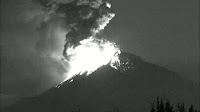
The Mexican National Centre for Disaster Prevention reported an  eruption on Mount Popocatépetl, a stratovolcano (cone shaped volcano made up of layers of ash and lava) in the central part of the country, on Sunday 12 June 2016. This began with the appearance of incandescent (glowing material) in the crater of the volcano overnight, followed by a series of smaller eruptions and a larger event slightly after 11.15 am local time,  which produced an ash column which rose 3 km over the summit of the volcano.

Ash column over Mount Popocatépetl on 12 June 2016. Chuy Torres/Twitter/Earth of Fire.

Major eruptions on Popocatépetl are a cause for concern as the volcano is in a densely populated area, with 30 million people living within the potential hazard zone. The last major eruption, a Plinian (or Vesuvian) event in about 800 AD, triggered a series of pyroclastic flows and lahars that scoured the basins around the volcano.

  The location of Popocatépetl. Google Maps.

The volcanoes of the Trans-Mexican Volcanic Belt (including Popocatépetl) are fuelled by the subduction of the Cocos Plate beneath the North American Plate along the Middle American Trench to the south of Mexico. As the subducting plate sinks into the Earth it is melted by the heat and pressure, and volatile minerals liquefy and rise through the overlying North American Plate as magma, fuelling Mexico's volcanoes. 

The subduction of the Cocos Plate beneath the North American Plate in Mexico, and how it leads to volcanoes and Earthquakes.

See also...

http://sciencythoughts.blogspot.co.uk/2016/06/magnitude-47-earthquake-off-coast-of.htmlMagnitude 4.7 Earthquake off the coast of Oaxaca State, Mexico.                                 The United States Geological Survey recorded a Magnitude 4.7 Earthquake at a depth of 10 km off...
http://sciencythoughts.blogspot.co.uk/2016/04/eruption-on-mount-popocatepetl.htmlEruption on Mount Popocatépetl.             Mount Popocatépetl in southern Mexico underwent a major eruption on Monday 18 April 2016, producing a column of ash rising 3 km above the summit and throwing incandescent material (glowing hot rocks...
http://sciencythoughts.blogspot.co.uk/2015/11/flights-cancelled-after-eruption-on.htmlFlights cancelled after eruption on Mount Colima.                                                     Several flights from airports in Mexico have been cancelled following an eruption on Mount Colima on Wednesday 18 November 2015. The eruption...
Follow Sciency Thoughts on Facebook.

Thursday, 9 June 2016

Hominin rib from Sterkfontein Caves.

Sterkfontein Caves is a palaeoarchaological excavation site about 40 km to the northwest of Johannesburg in Gauteng State, South Africa, which forms part of the Maropeng Cradle of Humankind World Heritage Site has previously produced a large volume of early Hominin material (fossils of species more closely related to modern Humans than modern Apes), including to almost complete skeletons assigned to the species Australopithecus africanus (considered highly likely to be directly ancestral to modern Humans) and numerous more fragmentary specimens.

In a paper published in the South African Journal of Science on 26 May 2016, a team of scientists led by Gaokgatlhe Tawane of the Evolutionary Studies Institute and Centre for Excellence in Palaeosciences at the University of the Witwatersrand, describe an isolated first (top) rib from the Sterkfontein Caves site.

First ribs are considered important in palaeoanthopology, as the structure of this bone has changed in distinctive ways over the history of the Hominin group. Most notably in Modern Humans and all known fossil Hominins the first rib has a single articulation surface with the spine, whereas in all other Great Apes two such articular surfaces are present. The bone also reflects the shape of the rib cage, which has two different, and distinct shapes in different Hominins; narrow at the top and wider at the bottom in Great Apes as well as some small-bodied Hominins such as Australopithecus afarensis and Homo naledi, but straight in larger Hominins such as Australopithecus africanus, Homo erectus \and Modern Humans.

Rib StW 670 in different views: (a) superior, (b) inferior, (c) posterior, (d) exterior and (e) interior. Tawane et al. (2016).

Tawane et al. carried out a morphometric analysis of the rib (a method used by palaeontologists that relies on comparing the ratios of different measurements to one-another rather than simply assigning the samples to groups based upon their obvious shape) in which it was compared to 33 Modern Humans (20 Europeans, 10 sub-Saharan Africans, 1 small-bodied member of the San population and 2 small-bodied individuals from the Andaman Islands), as well as 8 Chimpanzees, 3 Gorillas, 3 Orangutans and 3 Gibbons. 

The rib had a singular articlar facet, confirming it as a Hominin (although curiously one of the European Modern Human specimens had two facets, generally though to be a more Ape-like configuration, suggesting the presence of a second facet cannot be used to rule out a rib having come from a Hominin). Morphometricly the specimen was found to be closest to Australopithecus sediba, then to Modern Humans, particularly the small-bodied individuals from the Andaman Islands, and was least similar to the Ape specimens.

See also...


http://sciencythoughts.blogspot.co.uk/2014/06/dating-haasgat-cave-deposits.htmlDating the Haasgat Cave Deposits.              The Malmani Dolomite to the west of Johannesburg and Pretoria is host to a large number of cave systems that have formed from about 5.3 million years ago onwards. These caves are noted for a large volume of fossiliferous material, including many Hominin (species more closely related to modern Humans than...
http://sciencythoughts.blogspot.co.uk/2014/04/the-first-photographs-of-taung-child.htmlThe first photographs of the Taung Child.   One of the most important breakthroughs in palaeoanthropology in the twentieth century was the discovery of the fossil known as the Taung Child, the first known specimen of Australopithecus, by Raymond Dart of the University of the Witwatersrand in South Africa in 1924. This discovery refocused efforts to find human ancestors on the African continent, where...


Follow Sciency Thoughts on Facebook.

Monday, 6 June 2016

Magnitude 4.7 Earthquake off the coast of Oaxaca State, Mexico.

The United States Geological Survey recorded a Magnitude 4.7 Earthquake at a depth of 10 km off the coast of southwest Oaxaca State in southern Mexico slightly before 8.55 pm local time on Saturday 4 June 2016 (slightly before 1.55 am on Sunday 4 June GMT). There are no reports of any damage or casualties arising from this quake, but it was a moderately large event and people have reported feeling in the port of Puerto Escondido.

 The approximate location of the 4 June 2016 Oaxaca Earthquake. Google Maps.

Southern Mexico is located on the southernmost part of the North American Plate. To the south, along the Middle American Trench, which lies off the southern coast off Mexico, the Cocos Plate is being subducted under the North American Plate, passing under southern Mexico as it sinks into the Earth. This is not a smooth process, and the plates frequently stick together then break apart as the pressure builds up, causing Earthquakes on the process.

Witness accounts of Earthquakes can help geologists to understand these events, and the structures that cause them. The international non-profit organization Earthquake Report is interested in hearing from people who may have felt this event; if you felt this quake then you can report it to Earthquake Report here.
 
See also...

http://sciencythoughts.blogspot.co.uk/2016/04/eruption-on-mount-popocatepetl.htmlEruption on Mount Popocatépetl.             Mount Popocatépetl in southern Mexico underwent a major eruption on Monday 18 April 2016, producing a column of ash rising 3 km above the summit and throwing incandescent material (glowing hot rocks...
http://sciencythoughts.blogspot.co.uk/2015/11/flights-cancelled-after-eruption-on.htmlFlights cancelled after eruption on Mount Colima.                                                     Several flights from airports in Mexico have been canceled following an eruption on Mount Colima on Wednesday 18 November 2015. The eruption...
http://sciencythoughts.blogspot.co.uk/2015/10/eruption-on-mount-popocatepetl.htmlEruption on Mount Popocatépetl.                The Mexican National Centre for Disaster Prevention reported a series of eruptions on Mount Popocatépetl on Tuesday 20 October 2015, beginning at about 2.00 pm local time, the largest of which produced an ash...
Follow Sciency Thoughts on Facebook.
 

Sunday, 5 June 2016

Asteroid 2004 KH17 passes the Earth.

Asteroid 2004 KH17 passed by the Earth at a distance of 16 990 000 km (30.2 times the average distance between the Earth and the Moon, or 11.4% of the average distance between the Earth and the Sun), slightly before 0.20 am GMT on Thursday 2 June 2016. There was no danger of the asteroid hitting us, though had it done so it would have presented a considerable threat. 2004 KH17 has an estimated equivalent diameter of 78-250 m (i.e. a spherical body with the same mass would be 78-250 m in diameter), and an towards the upper end of this range would pass through the atmosphere and directly impact the ground with a force of about 600 megatons (about 35 000 times the explosive energy of the Hiroshima bomb), causing devastation over a wide area and creating a crater about 3.8 km across, and resulting in global climatic problems that could last for decades or even centuries.
 
 The calculated orbit of 2004 KH17JPL Small Body Database.
 
2004 KH17 was discovered on 29 May 2004 by the Massachusetts Institute of Technology's Lincoln Near Earth Asteroid Research Laboratory in Socorro, New Mexico. The designation 2004 KH17 implies that it was the 433rd asteroid (asteroid H17) discovered in the second half of May 2004 (period 2004 K).

2004 KH17  has a 219 day orbital period, with an elliptical orbit tilted at an angle of 22.1° to the plain of the Solar System which takes in to 0.36 AU from the Sun (36% of the distance at which the Earth orbits the Sun and considerably inside the orbit of the planet Mercury) and out to 1.07 AU (7% further away from the Sun than the Earth). This means that close encounters between the asteroid and Earth are fairly common, with the last thought to have happened in June 2013 and the next predicted in May 2019. Although it does cross the Earth's orbit and is briefly further from the Sun on each cycle, 2004 KH17 spends most of its time closer to the Sun than we are, and is therefore classified as an Aten Group Asteroid. As an asteroid possibly larger than 150 m in diameter that occasionally comes within 0.05 AU of the Earth, 2004 KH17 is also classified as a Potentially Hazardous Asteroid.
 
2004 KH17 also has frequent close encounters with the planets Mercury (which it last had a close encounter with in November 1999 and is predicted to pass next in October 2061) and Venus (which it last came close to in December 2006 and is predicted to pass close to again in October 2032). Asteroids which make close passes to multiple planets are considered to be in unstable orbits, and are often eventually knocked out of these orbits by these encounters, either being knocked onto a new, more stable orbit, dropped into the Sun, knocked out of the Solar System or occasionally colliding with a planet.
 
See also...
 
http://sciencythoughts.blogspot.co.uk/2016/06/fireball-over-arizona.htmlFireball over Arizona.                                  The American Meteor Society has received reports of a bright fireball meteor being seen over much of the southwest United States at about 4.00 am local time on Thursday 2 June 2016 (about 11.00 am GMT). The fireball was seen across Arizona, Utah, New...
http://sciencythoughts.blogspot.co.uk/2016/05/asteroid-2016-jd18-passes-earth.htmlAsteroid 2016 JD18 passes the Earth.    Asteroid 2016 JD18 passed by the Earth at a distance of 625 300 km (1.63 times the average distance between the Earth and the Moon, or 0.42% of the average distance between the Earth and the Sun), at about 11.25 pm on Monday 16 May 2016. There...
http://sciencythoughts.blogspot.co.uk/2016/05/asteroid-2016-jc6-passes-earth.htmlAsteroid 2016 JC6 passes the Earth.      Asteroid 2016 JC6 passed by the Earth at a distance of 4 922 000 km (12.8 times the average distance between the Earth and the Moon, or 3.29% of the average distance between the Earth and the Sun), at about 4.25 pm GMT on Sunday 8 May 2016...
Follow Sciency Thoughts on Facebook.

Trapped workers feared dead after landslide at Mississippi gravel quarry.

Two workers at a quarry in Copiah County, Mississippi are feared dead after they were buried by a landslide on Friday 3 June 2016. The men were driving separate vehicles at the Green Brother Gravel Co. quarry in Crystal Springs when part of a wall collapsed onto them, burying them under 3-4 m of gravel and clay. A rescue operation involving the Mississippi Emergency Management Agency and Mining Safety and Health Administration, as well as several fire departments, have been working to free the men, who could potentially have received some protection from the vehicles they were in, but as time passes hopes of recovering the men alive are fading.

The scene of the 3 June 2016 Mississippi gravel pit landslide. WJTV12.

The landslide came after a period of heavy rain which has caused flooding in parts of Texas and Louisiana and problems as far east as Florida. Landslides are a common problem after severe weather events, as excess pore water pressure can overcome cohesion in soil and sediments, allowing them to flow like liquids. Approximately 90% of all landslides are caused by heavy rainfall.

See also...

http://sciencythoughts.blogspot.co.uk/2015/12/stroms-and-floods-kill-at-least-43.htmlStorms and floods kill at least 43 people in the US over Christmas period.                      At least 43 people have died across the southern and midwest United States over the past week as the country has been hit by a series of severe floods and storm events. Multiple deaths have been recorded...
http://sciencythoughts.blogspot.co.uk/2015/11/giant-sinhole-swallows-at-least.htmlGiant sinhole swallows at least fourteen cars in Meridian, Mississippi.                                 At least fourteen cars are believed to have been swallowed by a giant sinkhole that opened up in a car park in the city of Meridian in Lauderdale County, Mississippi, at about 7.15 pm on Saturday 7...
http://sciencythoughts.blogspot.co.uk/2014/04/at-least-32-dead-as-tornados-hit.htmlAt least 32 dead as tornados hit Arkansas, Alabama, Iowa, Kansas, Mississippi and Oklahoma.                                                 Thirty two people are known to have died in the southern and...
Follow Sciency Thoughts on Facebook.

Thursday, 2 June 2016

Fireball over Arizona.

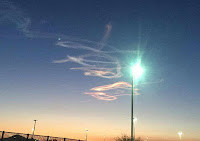
The American Meteor Society has received reports of a bright fireball meteor being seen over much of the southwest United States at about 4.00 am local time on Thursday 2 June 2016 (about 11.00 am GMT). The fireball was seen across Arizona, Utah, New Mexico, California, Texas, Colorado and Nevada, though the majority of sightings came from Arizona. A fireball is defined as a meteor (shooting star) brighter than the planet Venus. These are typically caused by pieces of rock burning up in the atmosphere, but can be the result of man-made space-junk burning up on re-entry.

 The 2 June 2016 Arizona meteor seen from Sky Harbor Airport in Phoenix. Fox 10.

Objects of this size probably enter the Earth's atmosphere several times a year, though unless they do so over populated areas they are unlikely to be noticed. They are officially described as fireballs if they produce a light brighter than the planet Venus. It is possible that this object will have produced meteorites that reached the surface (an object visible in the sky is a meteor, a rock that falls from the sky and can be physically held and examined is a meteorite).

Witness reports can help astronomers to understand these events. If you witnessed this fireball you can report it to the American Meteor Society here

See also...

http://sciencythoughts.blogspot.co.uk/2016/04/bright-fireball-meteor-seen-over.htmlBright fireball meteor seen over Southern California.                                                     The American Meteor Society has received reports of a bright fireball meteor being seen over much of southern California slightly at about 9.30 pm local time on Monday 23 April 2016 (about 4.30 am on Tuesday 24 April...
http://sciencythoughts.blogspot.co.uk/2016/04/brieght-fireball-meteor-seen-over-much.htmlBright 'fireball' meteor seen over much of New Zealand.                                         Witnesses have reported seeing a bright fireball type meteor over much of New Zealand at about 9.00 pm local time on Tuesday 5 April 2016. The meteor...
http://sciencythoughts.blogspot.co.uk/2016/03/bright-fireball-metoer-seen-over-much.htmlBright 'fireball' meteor seen over much of England.                                                       The UK Meteor Observation Network has recieved roports of a bright fireball meteor being seen over much of southern England slightly after 3.15 am GMT...
Follow Sciency Thoughts on Facebook. 


Wednesday, 1 June 2016

Sclerangia floridana: A new species of Coral from the Miocene of Florida.

Scleractinian Corals (or Stoney Corals) are colonial or singular Cnidarians that secrete calcium carbonate skeletons, with some colonial forms producing extensive reef systems, each individual polyp sitting in its own cup on the larger colonial strcture, and forming the dominant group of reef-building organisms in modern oceans. They appeared in the Middle Triassic, from an uncertain ancestor (earlier groups of reef-building Corals having gone extinct at the end of the Permian), and by the beginning of the Jurassic were already forming extensive reefs. However not all Sclerctinians are reef-builders, many species are solitary, or form small colonies on rocks or the shells of other animals.

In a paper published in the journal Paleontological Contributions on 30 April 2015, Rosemarie Baron-Szabo of the Department of Invertebrate Zoology at the Smithsonian Institution and the Senckenberg Research Institute, and Stephen Cairns, also of the Department of Invertebrate Zoology at the Smithsonian Institution, describe a new species of Scleractinian Coral from the Miocene Chipola Formation of Calhoun County, Florida.

The new species is named Sclerangia floridana, where 'Sclerangia' means 'hard-container' in reference to the corallite cups) and 'floridana' refers to the state of Florida. The species is described from a series of specimens in the collection of the Smithsonian Institution orginally described as Thysanus vaughani in 1972, but now recognized to be a separate species. Sclerangia floridana is a colonial Coral buding from the outside of the corallite cups. All specimens comprised small colonies growing on the surface of Gastropod (Snail) shells alongside Sipunculid Worms.

 Sclerangia floridana, Miocene, Chipola Formation, Calhoun County, Florida, United States; upper surface of largest colony (1) and close-up of (2); (3-5) smaller colonies. Scale bars: (1, 4) = 2.5 mm; (2, 3, 5) = 2 mm. Baron-Szabo & Cairns (2015).

See also...

http://sciencythoughts.blogspot.co.uk/2014/12/a-new-species-of-soft-coral-from.htmlA new species of Soft Coral from the Republic of Congo.                                                    Soft Corals (Octocorals) of the genus Alcyonium form encrusting, lobed colonies on shallow rocky surfaces in tropical waters. These Corals typically have...
The Abrolhos Bank is an area of the Brazilian continental shelf to the south of Bahia State, noted for its large and rich coral reef fauna and unique...
Zoanthids are unusual Corals with similarities to both the reef-forming calcareous skeleton excreting Scleractinian Corals and the larger, free living Sea Anemones. Most species are colonial, with...
Follow Sciency Thoughts on Facebook.