Saturday, 23 July 2022

Sinkhole opens up beneath swimming pool in Israel, killing one.

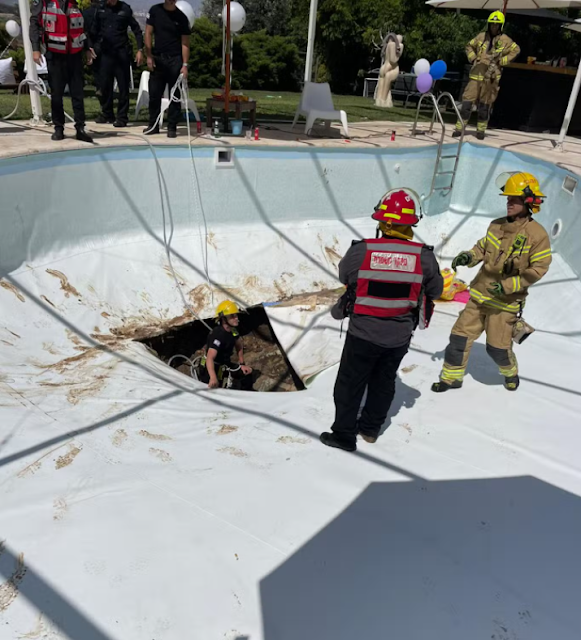
One person has died and another injured after a sinkhole opened up beneath a swimming pool in Israel on Thursday 21 July 2022. Both the victims were male, and were attending a company party at the villa where the pool was located, at Carmel Yosef, 40 km to the southeast of Tel Aviv, when the incident happened. Witnesses report that six people were in the pool when the hole opened, rapidly drawing in all the water in the pool, along with several floating toys and the two victims. Other bathers were able to avoid being drawn in by clinging on to the side of the pool. One of the men drawn into the hole was able to climb out with minor injuries, but the second, identified as Klil Kimhi, 32, from Tel Aviv, was found dead by rescue workers four hours later at the bottom of a fifteen metre pit.

Rescue workers preparing to enter a sinkhole which opened under a swimming pool in Carmel Yosef, Israel, on Thursday 21 July 2022, in search of the body of a man pulled into the hole when it opened. Israel Fire and Rescue Service.

Sinkholes are generally caused by water eroding soft limestone or unconsolidated deposits from beneath, causing a hole that works its way upwards and eventually opening spectacularly at the surface. Where there are unconsolidated deposits at the surface they can infill from the sides, apparently swallowing objects at the surface, including people, without trace. Potash, a potassium salt, is readily soluble and can be dissolved quickly if water gains access to deposits, leading to the rapid formation of sinkholes.

While the precise cause of the sinkhole in Carmel Yosef is unknown, the area is known to be prone to such problems, with Neogene alluvial sediments overlying soft Eocene and Cretaceous limestone deposits, and numerous cave systems. Local authorities report that the swimming pool had been built without planning permission, and that the owners of the villa where the pool was located, have been arrested for causing death by negligence, and are now under house arrest pending further investigations.

See also...

Follow Sciency Thoughts on Facebook.

Follow Sciency Thoughts on Twitter.


Friday, 22 July 2022

Swiftia phaeton: A new species of deepwater Octocoral from the coast of Mauritania.

Despite being relatively close to the numerous oceanological research institutes of western Europe, the deep waters off northwest coast of Africa have been relatively underexplored compared to those of many other regions of the world. The coast of Mauritania is known to be home to home to the world's largest Coral mound barrier, and their are extensive Coral colonies occupying the marine canyons off the Mauritanian coast, both fuelled by nutrient-rich upwellings from the deep Atlantic ocean along this section of coast.

In a paper published in the journal ZooKeys on 17 June 2022, Íris Sampaio of the Marine Research Department at Senckenberg am Meer, and the University of the Azores, and Lydia Beuck and André Freiwald, also of the Marine Research Department at Senckenberg am Meer, describe a new species of deepwater Octocoral from the coast of Mauritania.

The new species is placed in the genus Swiftia, and given the specific name phaeton, in reference to the PHAETON mission of the Research Vessel Maria S. Merian, which visited the coast of Mauritania, and recovered the first specimens of the species. The Greek Demigod Phaeton (or Phaëthon), is also linked to the region. A son of the Sun-god Apollo, he is supposed to have crashed his father's chariot into the Sahara Desert, burning the Earth and making the area uninhabitable. 

Swiftia phaeton forms simple colonies, either unbranching or with one or two divisions. The colonies are bright red in colour, with polyps densely packed on the branches. Tentacles are yellowish white.

Swiftia phaeton from Mauritania. (A) In situ colony with expanded polyps on coral framework. (B) Colony after ethanol preservation with expanded polyps (holotype SMF 13112). (C) In situ colony with retracted polyps on coral framework. (D) Part of a branch (paratype SMF 13113). (E) Fragment of specimen with anthocodiae slightly expanded (paratype SaM-ID 1566). (F) Polyp and coenenchyme details (paratype SaM-ID 1352). Scale bars are 1 cm (A)–(C) or 300 µm (D)–(F). (A) & (C) Tomas Lundälv/Sven Lovén Center for Marine Infrastructure in Sampaio et al. (2022), (B), (D)-(F) Sampaio et al. (2022).

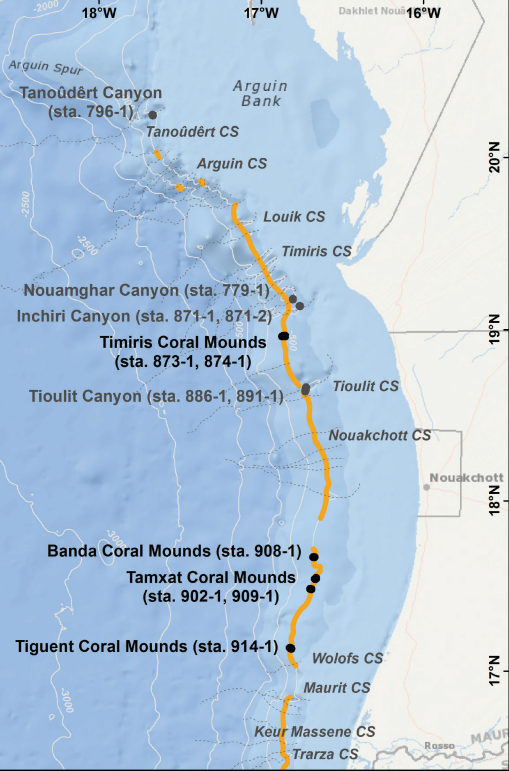
Swiftia phaeton was found living in Tanoûdêrt Canyon at a depth of 595 m, on the Timiris Mounds at depths of 446-602 m, in the Tioulit Canyon at a depth of 618 m, in the Southern Tamxat Mound Complex at a depth of 450 m, and on the Central Tamxat Mound Complex at a depth of 486 m.

Map showing MSM 16/3 ‘PHAETON’ ROV dive locations along the Mauritanian slope. Location names and GeoB 14 stations (sta.): grey, canyons; black, Coral mounds; orange, Scleractinian distributions. Sampaio et al. (2022).

See also...

Follow Sciency Thoughts on Facebook.

Follow Sciency Thoughts on Twitter.


Thursday, 21 July 2022

Looking for close encounters between the Sun and other stars.

Close encounters between stars have the potential to alter the evolution of planetary systems. This is particularly true in the early stages of their development, when planets are forming from circumstellar discs, a process which could easily be disrupted by an encounter with another star, but still applies later in a system's history, as most stars are thought to be surrounded by a loosely bound body of comets similar to our Oort Cloud, from which bodies could be disrupted sending them into the inner stellar system, potentially leading to impacts on the surface of planets, with a profound impact on any life their. A close star could also potentially go supernova, with even more devastating effect.

Clearly this makes close encounters between the Sun and other stars of great interest to scientists studying the history of the Solar System, who have speculated about such encounters for many years. Serious attempts at calculating the frequency of such close encounters has been possible only since 1997, when the Hipparcos star catalogue was produced, which for the first time included the parallaxes of over 118 000 stars. Two decades this became a much more realistic task with the production of the much more detailed Gaia catalogue, the development of software capable of analysing such large amounts of data, and the wider availability of computers capable of running such software.

Since its original release Gaia has been updated twice, with the current catalogue containing information on the movements of about 34 million bright stars.

In a paper published on the arXiv database at Cornell University on 14 July 2022, and accepted for publication in The Astrophysical Journal Letters, Coryn Bailer-Jones of the Max Planck Institute for Astronomy uses data from the latest version of the Gaia catalogue to produce a list of stars likely to have passed within 1 parsec (3.26 light years) of the Sun within about 6 million years of the current date. 

Bailer-Jones notes that some previous attempts at producing lists of close encounters have used limits greater than 1 parsec, but considers that since our current closest neighbour, the Alpha Centauri system, is only 1.3 parsecs (4.24 light years) away, 1 parsec seems a more useful upper limit. The Oort Cloud is currently thought extend to somewhere between 0.25 and 0.5 parsecs (0.82 and 1.63 light years) from the Sun, so stars coming closer than 1 parsec might be presumed to be starting to have some impact upon this cloud. The degree of error present in the Gaia catalogue makes calculation of encounters more than 6 million years into the past or future unreliable. Finally, the Gaia catalogue only includes stellar bodies larger than 0.12 times the mass of the Sun, so it is likely that other encounters with smaller stars (which are numerous) will have been missed.

Bailer-Jones's eventual list includes 61 stars, all currently within 380 parsecs (1329 light years) of the Sun, and with an average distance of 100 parsecs (326 light years), although he notes that this cannot be seen as a definitive list, and is likely to contain inaccuracies, particularly in the case of binary stars, which tend to have more complicated movement patterns, harder to calculate, and White Dwarf stars, which are notoriously hard to track. The list also includes two very young pre-main sequence stars, which may not have existed at all at the times when they theoretically came close to the Sun. 

Perihelion (encounter) times and distances for the 61 stars that have a median perihelion distance below 1 parsec. Negative times indicate past encounters, positive times future ones. The circles/squares show the median of the perihelion time and distance distributions computed from the 1000 data resamples (surrogates); the error bars show the 5th and 95th percentiles. Circles denote good encounters; squares denote the questionable encounters. The colour of each point indicates the median encounter velocity; those faster than 100 km per second are white. Bailer-Jones (2022).

Of the 61 stars for which an encounter closer than 1 parsec could be predicted, only 13 are predicted to come within 0.5 parsecs (1.63 light years).

The first star on Bailer-Jones's list is Gliese 710 (DR3 4270814637616488064 on the Gaia catalogue, and HIP 89825 on the Hipparcos catalogue). Gliese 710 is a K Class Orange Dwarf Star with approximately 70% of the Sun's mass, currently 19.1 parsecs (62.3 light years) from our Solar System in the constellation of Serpens. This star was first identified as likely to have a future close encounter with our Solar System in 1999, when it was calculated that it could potentially reach 0.34 parsecs from the Sun in 1.36 million years time. Since this first analysis Gliese 710 has been the subject of considerable interest to astronomers, and the time and distance of such a close encounter has been revisited several times. Bailer-Jones's new analysis is the most detailed yet, and calculates that the star may come to 0.064 parsecs (0.21 light years, or 13 200 astronomical units) in 1.29 million years. This is too distant to have any significant effect on the orbit of Pluto, but could potentially influence comets in the outer Oort Cloud quite severely. 

The second star on the list is HD 7977 (DR3 510911618569239040 on the Gaia catalogue), a G Class Yellow Dwarf Star with about 1.2 times the mass of the Sun, currently 75.6 parsecs (246.7 light years) from the Solar System in the constellation of Cassiopeia. This was first identified as likely to have a close encounter with the Sun by Bailer-Jones in 2018, when he calculated that it reached 0.43 parsecs (1.4 light years) from the Sun about 2.76 million years ago. The new data lowers this distance considerably, to 0.064 parsecs (0.21 light years).

The third star on the list is UPM J0812-3529 (DR3 5544743925212648320 on the Gaia catalogue), which was first identified as a nearby White Dwarf Star in 2018, but which has not previously been included in any study of potential close encounters. Bailer-Jones calculates that this star could reach 0.11 parsecs (0.36 light years) from the Sun in 29 000 years time. However, as previously noted, the distance and velocity of White Dwarf stars is notoriously hard to calculate, and the assumed timing and distance of approach for UPM J0812-3529 is based on current estimates that the star is 11.2 parsecs (36.5 light years) away, and travelling at a speed relative to the Sun of 374 km per second, both of which are uncertain, with the later being suspiciously large. This said, Bailer-Jones points out that a lower relative speed could lead to a closer encounter.

The fourth star on the list is UCAC4 689-035468 (DR3 213090546082530816 on the Gaia catalogue), another star identified as likely to have a close encounter with the Sun by Bailer-Jones in 2018, but for which the distance of this approach has been considerably reduced, from 1.44 parsecs (4.7 light years) in 2018 to 0.248 parsecs (0.81 light years) now, with such an encounter happening in 8.3 million years.

The fifth star on the list is identified on the Gaia catalogue as DR3 5571232118090082816, and is predicted to have come to 0.26 parsecs (0.85 light years) from the Sun 1.16 million years ago.

The sixth star on the list CD-25 8217 (DR3 5469802896279029504 on the Gaia catalogue), is also the latest possible encounter on the list, potentially reaching 0.35 parsecs (1.14 light years) from the Sun in 11.12 million years time. This is also predicted to be the slowest encounter on the list, both factors arising from its low relative velocity, approaching the Sun at only 3.2 km per second.

The seventh star on the list, identified as DR3 3372104035275483392 in the Gaia catalogue, is predicted to reach 0.36 parsecs (1.17 light years) from the Sun in 1.71 million years time.

The eighth star on the list, identified on the Gaia catalogue as DR3 3207963476278403200 is predicted to have reached 0.36 parsecs from the Sun 514 000 years ago, although Bailer-Jones identifies this as somewhat suspicious; the star is apparently above the main sequence, with a suspiciously high relative velocity and a fainter star behind it. This may in fact be a pre-main sequence star with a close companion, in which case the assumptions about it's movement would be quite wrong.

The ninth star on the list, identified as DR3 3106500096597409792 on the Gaia catalogue, is predicted to have reached 0.37 parsecs (1.19 light years) from the Sun 8.7 million years ago.

The tenth star on the list, DR3 4763293626627587840 is predicted to reach 0.45 parsecs (1.47 light years) from the Sun in 1.54 million years time.

The eleventh star on the list, DR3 929788371508812288 is predicted to have come to 0.46 parsecs (1.51 light years) of the Sun 364 000 light years ago.

The twelfth star on the list, DR3 6913732624445112832 is predicted will reach 0.46 parsecs from the Sun in 2.9 million years.

The thirteenth star on the list, DR3 3118526069444386944 is a young stellar object previously calculated to have reached 1.03 parsecs (3.36 light years) from the Sun, a distance now reduced to 0.49 parsecs (1.6 light years). However, this body is now considered to be a close binary star, and Bailer-Jones considers that this makes calculations of its velocity highly unreliable.

See also...

Follow Sciency Thoughts on Facebook.

Follow Sciency Thoughts on Twitter.


Wednesday, 20 July 2022

Bulbophyllum cryptomeriicola: A new species of Epidendroid Orchid from western Taiwan.

Epidendroid Orchids, Epidendroideae, are the largest subfamily of Orchids, with over 15 000 described species, more than all other Orchid groups combined. The majority of these species are epiphytic (live on other plants, typically in the canopy of rainforest trees), though terrestrial forms are known. The group is found across the globe, with the exception of the polar regions, the deserts of Africa, Arabia and Australia, and the southern part of South America. The genus Bulbophyllum contains around 2200 described species from tropical regions around the world, making it one of the largest known genera of Flowering Plants, and is thought likely to contain many more undescribed species. Members of the genus can be very difficult to tell apart when they are not in flower, as their vegetative parts tend to be much reduced, often with only a single leaf emerging from a pseudobulb (a pseudobulb, like a bulb, is an enlarged stem base used as a food store by a plant during dormant periods, but unlike a bulb is not found in the soil).

In a paper published in the journal Taiwania on 1 July 2022, Sheng-kun Yu of Taipei, Chiu-Wei Wang of the  Department of Biology at the National Museum of Natural Science, Kuo-Hsiung Wang of the College of Life Science at the National Taiwan University, and Tsan-Piao Lin of the Institute of Plant Biology at the National Taiwan University, describe a new species of Bulbophyllum from a coniferous forest growing at an altitude of 2200 m, in Chiayi County in western Taiwan.

The new species is named Bulbophyllum cryptomeriicola, where 'cryptomeriicola', in reference to the fact that it was discovered growing on Cypress trees of the genus Cryptomeria. This species is distinctive in that its rhizomes do not grow prostrate against the bark of a tree, but instead are suspended in the air by thick, erect roots.

Photos of Bulbophyllum cryptomeriicola. (A) Sheng-Kun Yu being lifted up a Cryptomeria japonica trunk. (B) Habitat of the patch of Bulbophyllum cryptomeriicola. (C) Inflorescence. (D) Lateral sepal, spread out. (E) Lip, view from above. (F) Column, side view. (G) Column with lifted anther-cap, with pollinia attached, view from below. Sheng-Kun Yu & Tsan-Piao Lin in Yu et al. (2022).

Bulbophyllum cryptomeriicola produces oblong leaves up to 3.5 cm in length and 1.5 cm in width, and paler on the underside. Flowers are produced in October on short peduncles arising from the pseudobulbs, each peduncle bearing 2-5 crimson red flowers.

See also...

Follow Sciency Thoughts on Facebook.

Follow Sciency Thoughts on Twitter.


Flash flooding kills at least twelve in western China.

At least twelve people have died, and thousands more have been forced to flee their homes, in a series of flash floods across western China. Six people have been confirmed dead and another twelve are missing in Sichuan Province, where 13 000 people have been evacuated from homes in low lying areas. In the city of Longnan, which lies in southern Gansu Province, slightly to the northeast of Sichuan, another six people have died and 3000 people have been forced to abandon their homes.

Cars trapped by floodwater in Lanzhou, Gansu Province, China. China News Service/Getty Images.

The flooding was triggered by 36 hours of near-continuous rainfall which fell over Friday 15-Saturday 16 July 2022, part of a season of extreme weather being suffered by China (and many other parts of the world). Much of China has been hit by an extreme heat wave, with many areas suffering heat in excess of 40°C. This has caused a wide range of problems, including making western China, which has a monsoonal climate, more vulnerable to flash flooding. 

Extreme heat waves can kill off herbaceous vegetation, which tends to stabilise environments against such events, and cause upper soil layers to bake dry, forming a solid crust which does not absorb water readily, leading it to flow over the soil surface. At the same time the high temperatures have extended over the South China Sea, raising the level of evaporation there, and therefore the amount of water being carried northward by southerly winds prevalent in the region at this time of year. As these warm, water-laden winds hit the uplands of the southern Tibetan Plateau, in western Sichuan and southern Gansu, they are pushed upwards where they encounter cooler air, leading them to rapidly drop their moisture as rainfall, leading to flash flooding events.

Diagrammatic representation of wind and rainfall patterns in a tropical monsoon climate. Geosciences/University of Arizona.

See also...

Follow Sciency Thoughts on Facebook.

Follow Sciency Thoughts on Twitter.


Three children dead after landslide hits school in Antioquia Province, Colombia.

Three children have died and two more required hospital treatment after a landslide hit the cafeteria of a school in the Medellin area of Antioquia Province, Colombia, on Thursday 14 July 2022. The event happened during a recess when 20 children of preschool and first grade ages were taking a break in the cafeteria, along with a teacher and the mother of one of the children. The incident is reported to have happened following a period of heavy rain. Landslides are a common problem after severe weather events, as excess pore water pressure can overcome cohesion in soil and sediments, allowing them to flow like liquids. Approximately 90% of all landslides are caused by heavy rainfall.

Rescue workers and local residents search for survivors after a landslide hit a school cafeteria in Antioquia Province, Colombia, on 14 July 2022. Associated Press.

Antioquia is a mountainous province with several distinct climate zones. The Medallin area is considered to gave a monsoon climate, with a to peaks in rainfall in May and October. Two hot wet seasons per year is normal on the equator, where the Sun is highest in the sky around the equinoxes and lowest at the solstices, as opposed to the situation at higher latitudes, where the Sun is highest at one solstice and lowest at the other.

This means that July would normally be a relatively dry time of year, making landslides and other high precipitation related events less likely, However, this year the climate of South America, and other areas around the Pacific Rim, are being hit by a La Niña weather system, bringing high rainfall to areas which would normally be dry.

The La Niña weather system is the opposite of the El Niño weather system, in which unusually cold surface temperatures spread across the equatorial Pacific from the upwelling zone on the South American coast. This traps warm water from the western Pacific, preventing it from spreading east and warming the central Pacific. This leads to lower evaporation over the (cooler) east Pacific during the southern summer, leading to low rainfall on the west coast of South America, and higher evaporation over the (warmer) west Pacific, leading to higher rainfall over East and Southeast Asia and northern Australia. However, during the southern winter the cooler climate over the northern Andes leads to higher rates of precipitation as water condenses out of the air more readily, bringing high rainfall, flooding, and landslides to the area at a time of year usually considered safe from such events. 

The effects of a La Niña weather system in December-February and June-August. NOAA.

See also...

Follow Sciency Thoughts on Facebook.

Follow Sciency Thoughts on Twitter.


Tuesday, 19 July 2022

Understanding the incorporation of older Human bodyparts into Bronze Age burials in Britain.

Improvements in dating techniques have led archaeologists to conclude that many artefacts placed in graves in Bronze Age Britain were already old when they were deposited. This possibly made them heirloom objects buried with people of significant standing, and retained till that point as an indicator of relationships to an older generation. Burials from this period also frequently include partial Human remains as well as the main burials, which raises the prospect that these objects too might have been heirloom objects prior to their burial.

Partial remains, including articulated and disarticulated fragments of bodies, are frequent occurrences in Chalcolithic and Early Bronze Age burials in Britain, and have traditionally been interpreted as evidence for the disturbance of earlier remains at sites which were re-used due to some spiritual significance. From about 2100 BC onwards, the cremation of remains prior to burial became the predominant funerary practice, although these cremation burials appear to have often only comprised fragments of the deceased, and on occasion fragments of more than one individual.

In a paper published in the European Journal of Archaeology on 25 May 2022, Joanna Brück of the School of Archaeology at University College Dublin, and Thomas Booth of the Skoglund Laboratory at the Francis Crick Institute, explore the possibility that the partial remains found in many Bronze Age British burials may be the result of the deliberate placement of these remains as artefacts in their own right, rather than the accidental disturbance of earlier remains.

A number of recent studies have found evidence of bodies in Bronze Age tombs in Britain being mummified before they were deposited. The most famous of these is the mummy from Cladh Hallan on South Uist, which was deposited beneath the floor of a Late Bronze Age/Early Iron Age roundhouse, but the practice has also been recorded from Chalcolithic and Early Bronze Age tombs. It is therefore not unreasonable to wonder if partial remains, articulated, disarticulated or cremated, from Bronze Age tombs in Britain might also have been mummified prior to their placement within the burial sites.

Brück and Booth collated 81 radiocarbon dates from fifteen graves at thirteen different locations; sixty four of these were from previous studies and seventeen are new to this publication. Of the thirteen burial sites, eleven were Chalcolithic or Early Bronze Age in origin. Eleven of the graves contained only unburnt bone, while the remaining four contained cremated remains. In the case of graves containing unburnt bones from both whole and partial bodies, the whole skeletons were used to provide an assumed date of burial, while other remains were dated separately and compared to these. In the case of graves containing cremated remains, each bone was dated separately. All but two of the graves were modern excavations, with osteological examination of the site being used to exclude the possibility of bones from the same individual being dated. Two of the sites included in the study were the subject of earlier excavations, though in both cases Brück and Booth are confident that the records provided by the archaeologists who carried out these digs were good enough to prevent double-sampling of the same individuals.

Bones which can be shown to have been old at the time of their burial could have been placed deliberately or accidentally, but the high proportion of burials in which older bones are incorporated makes accidental inclusion unlikely, as would any consistent relationship between the age of the main burial and the age of other bones included within a grave. Brück and Booth's data suggests that many of the partial remains incorporated into Bronze Age burials in Britain are about two generations older than the main burials; i.e. they had apparently been looked after elsewhere for decades, but not centuries. Other partial remains incorporated into burials showed no age difference to the main burial, but it is still possible that they were older, just not sufficiently so for the techniques used to detect the difference. 

Brück and Booth note that a high proportion of seafood in a persons diet can have an impact on the isotopic signature of their bones, but also observe that numerous previous studies have suggested that seafood was at most a very minor component of the British Bronze Age diet.

Histological examination of bones can also tell us a great deal about how they are treated after death. When individuals are buried in a dry, but well aerated, environment (such as that of most Bronze Age tombs), their bones will tend to suffer a great deal of bacterial bioerosion. On the other hand, bones of individuals who are prepared in some way prior to burial in the same environment, for example by mummification or excarnation (removal of the flesh from the bones), will show much less bone damage.

Seven of the thirteen sites examines were found to contain partial remains significantly older than the main burials. These remains all show less bioerosion than the main burials, suggesting that they were subjected to different treatment prior to their incorporation within the graves, and that this different treatment had begun immediately after death. 

At one site, Melton Quarry in East Yorkshire, the disarticulated and incomplete remains of an infant were found between the legs and torso of a complete and articulated adult. Radiocarbon dates obtained from the two sets of remains showed that the infant was in fact probably between 189 and 348 years older than the adult, and had relatively low levels of bioerosion to its bones, suggesting that the child had been stripped of their flesh shortly after death. Brück and Booth suggest that this infant may then have been kept in some sort of organic bag, possibly worn by a person, until the time of their eventual burial. 

Another example comes from a slab-lined grave found on the Cnip Headland on the Isle of Lewis. This grave contained one set of incomplete and partially articulated remains, thought to be those of an adolescent male, as well as the disarticulated remains of at least two adults. The adolescent male was placed on his right side, and it is thought that he was in an advanced state of putrefaction when he was buried; several vertebrae, the left fibula, and the right humorous were all out of position, suggesting that these parts of the body were skeletallised by the time burial occurred. There were also spaces between the head and torso, and the torso and lower body, which suggest the individual may have been in several pieces. However, the bones of the left hand are well articulated, which makes it likely that the hand was intact and fleshed at the time of deposition. The right arm, and both feet, are completely missing. The bones of this individual show little bioerosion, which may imply he was excarnated and then buried before complete skeletonisation occurred. However, a disarticulated bone from a layer depositionally below the adolescent produced a younger radiocarbon age, implying that his bones were already old when they were placed into the tomb. It is possible that the remains had been buried elsewhere and then excavated and placed in the Cnip Headland tomb, however calculations made using the OxCal radiocarbon calibration program suggest that between three and 82 years had passed between the death of the youth and his burial in the tomb, and again his bones show relatively low levels of bioerosion, suggesting that some form of treatment of the remains happened soon after death.
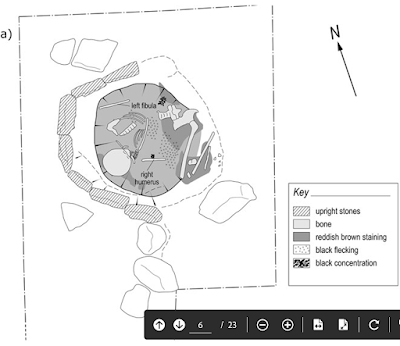
Cnip Headland, Isle of Lewis: plan of the partially articulated burial. Brück & Booth (2022).

Another burial of note is that at Windmill Fields in North Yorkshire. Here the primary burial is that of an adult woman, whose skeleton was articulate but heavily bioeroded, consistent with her having been buried whole and fully fleshed. In front of this individual had been stacked the disarticulated remains of another three individuals, an adult male, an adult female, and a probable adolescent female. Approximate dates were obtained from the crania of the two adults, suggesting that they are between 59 and 179 years older than the principle burial. Close to this burial was a pit with dark staining, consistent with a wooden structure such as a coffin having once been present. Further disarticulated bones were found within this structure, which were found to be of a similar age to the two crania, suggesting that this was the original location of the disarticulated remains found with the main burial.
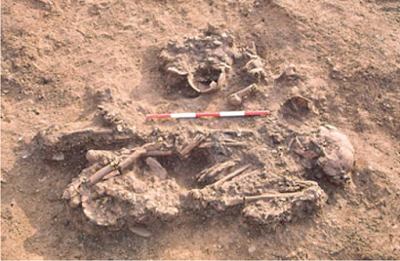
Windmill Fields, Ingleby Barwick, Stockton-on-Tees: inhumation burial accompanied by a carefully arranged stack of disarticulated bone. Tees Archaeology in Brück & Booth (2022).

It has been known for a long time that Bronze Age burial chambers in Britain were frequently reopened to place additional remains within them, and more recently it has also become clear that remains were also removed from them. 

The South Dumpton Down site in Kent contains two complete individuals buried in the Early Bronze age, one of which is also accompanied by a detached Human mandible. This mandible was not found to be anonymously older than the two intact individuals, but showed a level of decomposition which suggests that it was removed from a body that had died some time before. It is unclear whether this implies removal from a tomb of from remains kept elsewhere, but the revisiting of burials is known to have occurred in this area. One nearby site consists of a shaft with five bodies on it, which had been deposited sequentially. Several of these bodies were missing their skulls, suggesting that pieces of the skeletons were being removed as well as new bodies added. It is quite possible that the mandible was removed from one of these bodies, although if they are less than decades older than the other burial the dating technique used would be unable to detect the age difference.

A pit at Cotswold Community near Ashton Keynes in Wiltshire yielded fragments of burned bone from both Humans and Animals, as well as pieces of beaker pottery, charcoal, burnt stone and plant remains. Dates were obtained from a fragment of Human femur and a piece of Animal bone, with the femur proving to be between five and 175 years older than the Animal. It has been suggested that such pits represent settlements, due to the presence of possible domestic contents (charcoal, burnt Animal remains, pottery fragments), but these sites could also represent locations revisited periodically, possibly for annual festivals or other such events. If that is the case then it is also quite possible that the remains, or partial remains, of the dead might have been brought to these sites, either specifically, or as part of a wider pattern of carrying portions of the dead with a semi-mobile community. 

Analysis of the locations examined by Brück and Booth suggests that certain bones from grave sites may have been predominantly chosen for redeposition elsewhere, notably long limb-bones and skulls, However, they also caution that their sample size is small, and for the most part they are reliant on data collected by other archaeologists, who were not looking for data on this topic.

The comparison of burned and unburned bone using isotope dating methods is problematic, and Brück and Booth have sought to avoid this, including only four sites with burned bone in their study. Two of these sites again produced anonymously old bones, and although Brück and Booth are less confident of these findings, this does appear consistent with the data from non-cremation burials.

The Trelowthas burial in Cornwall comprises a stone cist filled with cremated bones from numerous individuals. The site also contained an urn containing further cremated remains, from at least two individuals, which appears to have been placed their at a later date. However, analysis of the remains in the urn suggests that they were between three and 72 years older than the other remains. Brück and Booth believe this is indicative of these remains being kept elsewhere between their cremation and their eventual placement within the tomb, possibly in an environment where they would be encountered, and possibly even handled, by the living on a regular basis.

Another pit burial was found in the middle of a stone circle at Whitton Hill in Northumberland. This yielded 21.6 kg of bone from at least 24 individuals, including both adults and children. Only a single individual could be sexed, being found to be female. All of the bones here appear to have deposited in a single event, but the three bones which could be dated yielded different ages, with the older skeletons being between three and 115 and between three and 37 years older than the youngest skeleton. This has previously been interpreted as remains from an older cremation being accidentally incorporated into the deposit, although there is no evidence for the site having been revisited. Brück and Booth suggest that, in the light of evidence from other sites of a similar age, this is likely to be another example of older remains being deliberately included into a burial.

Brück and Booth present a large body of evidence for the incorporation of older remains into Bronze Age burials (and in particular Early Bronze Age) in Britain. Some of these appear to have been recovered from other grave sites specifically for re-internment within the new burial, but others show signs of practices such as mummification and excarnation not seen in primary burials, strongly suggesting that these bodies were treated differently from the time of death. Brück and Booth strongly suspect that this may have involved carrying portions of the dead with the living, possibly as a form of personal ornamentation, a practice known from some modern Human groups.

Brück and Booth suggest that the incorporation of older Human remains into Bronze Age burials is likely to indicate kinship between these remains and the principle occupiers of the graves, given that the occupants of other multi-occupancy grave-sites from the same period are typically related. 

This can be confirmed for one site, the Boscombe Bowmen burial at Boscombe Down in Wiltshire. Here several sets of adult and child remains were found together, with one adult male being accompanied by a bundle of bones representing the partial remains of at least four other individuals; two adult males, a subadult male and a juvenile. The bones in the bundle were principally long bones (i.e. arm or leg bones) from the left side of the body, but the skeleton also had two further crania and a partial mandible at his feet. DNA was recovered from both the male skeleton and one of the skulls (an adult male, 25-30 years old), enabling comparison of the relationships between these two individuals. This revealed that this two came from different lineages on their maternal side, but paternally were related, potentially being half-siblings, cousins, an uncle (or great uncle) and nephew, or grandfather (or great grandfather) and grandson. Unfortunately this skull was not radiocarbon dated, but one of the bones from the bundle, a femur, was, and was found to be significantly older than the intact skeleton.
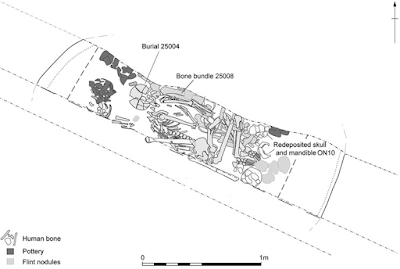
The Boscombe Bowmen, Wiltshire: plan. Wessex Archaeology in Brück & Booth (2022).

Furthermore, strontium isotope analyses of tooth enamel from the skeleton and the two detached skulls suggests that all three undertook similar childhood journeys (strontium isotopes in water vary with local geology, and are incorporated in tooth and bone, providing a record of where people have lived). This implies that either all three had undertaken a the same journey as children, presumably together as living contemporaries, or all three had lived at a similar location away from the burial site, and been transported to that site after death. Either case would imply that the individuals involved shared some measure of shared life-history as well as a genetic relationship, and that this is likely to be reflected in the decision to bury them together.

Next Brück and Booth examined the age gap between partial remains found within graves and the principal occupants of those graves, finding that the principle occupants were on average about 95 years younger than the partial remains incorporated into their burials. They suggest this may represent a rough upper limit on the cultural memory of these older individuals as living people.

Not all ancient skeletons can be confidently sexed, particularly when dealing with partial remains, but of the partial remains incorporated into younger burials which could be identified, four were male and two female, implying that gender was not considered important when selecting remains for this purpose. Therefore, if these burials do represent the inclusion of remains of significant relatives with the recently deceased, then perception of who was a significant relative was apparently not related to gender.

The age of these older relatives also appears relatively unimportant. Of the examined remains for which an age could be determined, four were adults, one a subadult, one an adolescent, and one was an infant aged 2-4 months. Views on who represents an adult are known to have changed significantly over written history, making it unlikely that the views of Bronze Age Britons were identical to those of their modern descendants, but this is unlikely to have included babes-in-arms, making it plausible that age at death was unrelated to the status of individuals, when determining significant relationships.

Brück and Booth also note that perceived kinship is unrelated to biological relationships, which may present difficulties when establishing relationships between individuals within ancient burials.

Finally, Brück and Booth mention the burial of an adult male at Wilsford in Wiltshire, dated to between 1950 and 1970 BC, who was found to have among his grave goods a whistle made from a Human femur. It has been suggested that this was the grave of a shaman or other ritual specialist. Brück and Booth were able to date the whistle from this grave, finding it was not significantly older that the skeleton it was buried with, and therefore that the two individuals could have been known to one-another in life, as well as having both been known by the people who placed the whistle in the grave with the body. Though the relationship between the two individuals could not be determined, there are clearly other possibilities than the two being relatives, for example the whistle could have been made from the bone of another ritual specialist, possibly a previous holder of the same role within the community, or a person perceived as an enemy by the deceased or whole community.

Bronze Aged peoples are known to have valued goods made from certain materials, such as jet or amber, and treated these as being significant and powerful items. It is not an unreasonable supposition that goods made from Human remains would be seen as being similarly significant, and that the ownership of such items may have conferred social status. The incorporation of Human remains into burials as grave goods may also be an indication of status, although this is difficult to unravel from funeral practices intended to reflect ritual, familial, or emotional relationships between the dead. Brück and Booth note that the tendency to finally deposit relics made from Human remains at about the time when the individuals from whom these were made would have been disappearing from the collective memory of the group may also be significant.

See also...

Follow Sciency Thoughts on Facebook.

Follow Sciency Thoughts on Twitter.