Saturday, 9 September 2023

Comet C/2023 P1 (Nishimura) makes its closest pass to the Earth.

Comet C/2023 P1 (Nishimura) will pass by the Earth at a distance of 125 363 000 km (83.8% of the distance between the Earth and the Sun), on Tuesday 12 September 2023. At this time the comet will be in the constellation of Leo, but will not be visible due to its proximity to the Sun.

Comet C/2023 P1 (Nishimura), imaged from the Trevinca-Skies remote-astronomy facility at A Veiga in Ourense Province, Spain, 0n 25 August 2023. Image is a composite made up of four 30 second exposures. Stars in background are slightly elongated due to their movement relative to the comet over this time interval. Wikimedia Commons.

Comet C/2023 P1 (Nishimura) was discovered on 12 August 2023 Japanese amateur astronomer Hideo Nishimura. The name C/2023 P1 (Nishimura) implies that it is a Comet (C/), that it was the 1st comet discovered in the first half of August 2023 (period 2023 P), and that it was discovered by Nishimura.

Comet C/2023 P1 (Nishimura) has an orbital period of 434 years and a highly eccentric orbit tilted at an angle of 132° to the plain of the Solar System, that brings it from 0.23 AU from the Sun at closest perihelion (23% of the distance between the Earth and the Sun, and considerably inside the orbit of Mercury) to 114 AU from the Sun at aphelion (114 times as far from the Sun as the Earth or a little under four times as far from the Sun as the planet Neptune, and slightly outside the Kuiper Belt). As a comet with a period of more than 200 years, C/2023 P1 (Nishimura) is considered to be a non-Periodic Comet, since it is unlikely that it would be identified as the same body on another visit to the Inner Solar System.

The orbit and position of Comet C/2023 P1 (Nishimura) on 12 September 2023.  JPL Small Body Database.

See also...

Follow Sciency Thoughts on Facebook.

Follow Sciency Thoughts on Twitter.


Friday, 8 September 2023

At least fourteen people dead as Storm Daniel sweeps across Greece, Turkey, and Bulgaria.

At least nine people have died, and several more are missing, after Storm Daniel swept across Greece, Turkey, & Bulgaria on Monday 4 and Tuesday 5 April 2023. In Greece a man died when a wall collapsed onto him in Volos on the Pagasetic Gulf, on Monday 4 September, and another man was killed in a vehicle-related incident, while on Wednesday 6 September the body of an elderly woman who was missing was found close to the city, having apparently drowned in the storm. Another four people are still missing in Greece. Considerable damage to infrastructure has occurred, and about a hundred people were evacuated from affected areas.

A collapsed bridge at Kala Nera on the western Pelion Peninsula. Stamos Prousalis/Reuters.

In Turkey at least two people have died in flooding in Istanbul and dozens have had to be rescued as floodwaters covered two neighbourhoods of the city, while in Kirklareli Province, close to the border with Bulgaria, five tourists are known to have died when a flash flood hit a campsite at which they were staying, and another one is still missing. Across the border in Bulgaria, four people are known to have died and three more are still missing after flooding hit the Black Sea coastal region.

Flood damage at Arnavutköy in Istanbul Province, Turkey. Ugur Yildirim/Getty Images.

Most storms form due to heating of air over the sea. As the air is heated the the air pressure drops and the air rises, causing new air to rush in from outside the forming storm zone. If this zone is sufficiently large, then it will be influenced by the Coriolis Effect, which loosely speaking means the winds closer to the equator will be faster than those further away, causing the storm to rotate, clockwise in the northern hemisphere and anticlockwise in the southern hemisphere.

A caravan swept out to sea on Bulgaria's Black Sea coast. Sofia Globe.

Whilst the high winds associated these storms is extremely dangerous, the real danger from such storms is often the flooding. Each millibar drop in air pressure can lead to a 1 cm rise in sea level, and large storms can be accompanied by storm surges several meters high. This tends to be accompanied by high levels of rainfall, caused by water picked up by the storm while still at sea, which can lead to flooding, swollen rivers and landslides; which occur when waterlogged soils on hill slopes lose their cohesion and slump downwards, over whatever happens to be in their path.

Such storms are common in tropical regions, but less so on the more temperate Mediterranean. However, this summer much of the eastern Mediterranean has suffered a prolonged heat wave, with temperatures regularly exceeding 40°C, and heat related deaths recorded across much of southern Europe, as well as a series of wildfires which have swept across Greece and other countries as vegetation has dried out. These events have been caused by a combination of an anticyclone (high pressure system) which formed over the Sahara then migrated northwards, intensified by an El Niño system over the southern Pacific, which tends to drive temperatures upwards in the Northern Hemisphere, both of which are considered to have been intensified by global warming.

See also...

Follow Sciency Thoughts on Facebook.

Follow Sciency Thoughts on Twitter.


Thursday, 7 September 2023

Magnitude 5.2 Earthquake in the Singida Region of central Tanzania.

The United States Geological Survey recorded a Magnitude 5.2 Earthquake at a depth of 10 km, roughly 39 km to the southeast of the town of Ikungi in the Singida Region of northern Tanzania, slightly after 6.40 pm local time (slightly after 3.40 pm GMT) on Wednesday 6 September 2023. There are no reports of any damage or casualties associated with this event (nor would any be expected with an event of this size), but people have reported feeling it locally.

The approximate location of the 5 September 2023 Singida Earthquake. USGS.

Western Tanzania lies within the of the Great Rift Valley, which is slowly splitting the African Plate in two along a line from the Red Sea through Ethiopia, and which includes the great lakes and volcanoes of east-central Africa. This has the potential to open into a new ocean over the next few tens of millions of years, splitting Africa into two new, smaller, continents; Nubia to the west and Somalia to the east.

Movement on the African Rift Valley, with associated volcanoes. Rob Gamesby/Cool Geography.

See also...


Follow Sciency Thoughts on Facebook.

Follow Sciency Thoughts on Twitter.


Wednesday, 6 September 2023

Changing burial practices across the Neolithic/Iron Age boundary at the MARP-79 Cemetary in Karnataka State, southern India.

Between 2010 and 2018 the Maski Archaeological Research Project (MARP) searched for further signs of Neolithic activity around the Maski Neolithic settlement, which had been excavated in the nineteenth century. One of the most important finds of this survey was the MARP-79 Cemetery, a large funerary complex beneath an elongated prominence in the southern Deccan region, which appears to have been used for more than a thousand years, from the middle Neolithic into the early Iron Age, showing patterns of both continuity and change across this time interval.

In a paper published in the journal Antiquity on 27 June 2023, Peter Johansen of the Department of Anthropology at McGill University, and Andrew Bauer of the Department of Anthropology at Stanford University present new radiocarbon dates for a number of graves at the MARP-79 Cemetery, and discuss the implications of these for our understanding of the Neolithic/Iron Age cultural transition in southern India.

Map showing the location of the MARP-79 Cemetery and related archaeological sites. Johansen & Bauer (2023).

Archaeologists studying the prehistory of southern India have built up a picture in which the Neolithic/Iron Age transition is an abrupt boundary, probably with an imigrant population or culture completely supplanting the previous one. However, at MARP-79 a more gradual transition can be perceived, with a long-standing Neolithic culture adopting new cultural and technological practices in a more gradual way.

A range of different mortuary practices appear at the MARP-79 Cemetery by the beginging of the second millennium BC, probably indicating social distinctions within the community. These innovations include the nature if grave goods, with ceramic vessels with slip-coatings and polished surfaces appearing and then being replaced by first copper and then iron items, differing materials being used to construct coffins, notably terracotta and burnt organic material, a mixture of singular and shared graves, and different forms of stone grave markings.

The Neolithic of southern India has been studied since the nineteenth century. Initial studies found a wide range of ground and pecked stone tools across the southern Deccan region, which became known as the Stone Axe Culture. As well as Neolithic stone tools, this culture also produced a variety of course, handmade ceramics, notably the Burnished Grey and Dull Red Ware traditions. Studies at sites such as  Brahmagiri and Piklihal enabled archaeologists to build up a picture of changing ceramic styles and settlement patterns over the span of the southern Indian Neolithic, which was later refined by the addition of radiocarbon dating and the study of macrobotanical remains.

This Neolithic culture appears to have farmed domesticated Sheep and Goats, along with a number of locally domesticated crops known as the South Indian Crop Package, which includes a selection of pulses and millets. By the beginging of the second millennium BC, northern Indian crops such as Wheat and Barley begin to appear, and become increasingly important over time, and from about 1600 BC, African crop Plants begin to appear. These crop introductions coincide with the appearance of new types of ceramics, notably necked jars. 

This appearance of crops Plants which were domesticated in other regions are indicative of this culture being part of an expanding exchange network, which makes it highly likely that they were also exchanging cultural ideas with other areas. This is further supported by the appearance of materials such as carnelian and lapis lazuli, neither of which occur in the region. These changes coincide with the decline and abandonment of the cities of the Indus Valley Civilization in northern India, the adoption of the earliest copper technologies, and the importation of some funrrary practices from the northern Deccan region.

Settlements in the southern Deccan region during the Neolithic typically comprised small villages or camps made up of circular wattle and daub houses, with sites outside the boundary of the settlement used for stone tool preparation, butchery, and the holding of Animals. Some of these settlements had distinctive ash mounds, large piles of ash and vitrified Cattle dung, which may have been associated with periodic feasting.

The area covered by the Maski Archaeological Research Project covers an area of 64 km², and contains four Neolithic settlements. These are the original Maski settlement (MARP-97), a multi-period site 1.5 km to the north of the cemetery, which was first excavated in the 1950s, MARP-64, a newly discovered small settlement running across several adjacent hill terraces which lies 6 km to the northwest of MARP-79,  and MARP-155 and MARP-203, which are both interpreted as small hilltop herding camps, which have produced scatterings of stone tools and ceramic fragments, and which lie to the north and south of MARP-79.

Map of the MARP study area, illustrating the relationship of MARP-79 with Neolithic settlements. Areas in black outline represent survey blocks; the site area at MARP-97 represents the surface area of the multi-component site and not the extent of Neolithic settlement, which is unknown. Johansen & Bauer (2023).

The Neolithic burial practices of the southern Deccan region include a number of infant urn burials, and adult pit graves, found both within and outside settlements. The most common of these are infants and sub adults buried in urns withing settlements, although some of these are buried in simple pits without urns. Urn burials typically contain a single individual, although sometimes two individuals are found within the same urn. Burial goods are extremely rare. The form of the urns varies considerably.

Where sites can be established to have gone through several phases of settlement, then burial practices can be shown to have changed over time. Most adults are buried in extended pits, with ceramic grave goods including examples of Burnished Grey Ware and plain terracotta. There is limited variation between these sites, although the orientation of the body can differ, both primary and secondary burials have been found (secondary burials occur when a body is buried, then dug up and buried again), the covering of part or all of the grave with stones, and the presence and variety of grave goods, which can include ceramic vessels, with bowls and spouted jars being the most common, as well as chipped and ground stone tools. 

At the Tekkalakota and Ramapuram, where a succession of burial styles can be seen, later graves can be observed to contain a greater quantity of grave goods, including polished ceramics with slip coatings, conforming to the Black-and-Red Ware, Slipped and Polished Black Ware, and Slipped and Polished Red Ware styles, which are otherwise associated with Iron Age Megalithic burials. At Ramapuram later burials comprise stone cairns and cists, and use burned organic material coffins. Here grave goods from these late burials include up to 29 vessels, made from a mixture of styles including Burnished Grey Ware and Black-and-Red Ware, and in some cases copper and iron artefacts. Burned organic coffins and a mixture of ceramic styles were also found during the Maski excavations in the 1950s, as well as Neolithic and Iron Age settlement phases.

However, all of this is based upon a very small number of burials in and around settlements; the known number of burials in the area has long been observed to be much lower than would be expected given the other archaeological remains found, leading to speculation that burials were occurring at other, undiscovered sites. One possible solution to this was presented by the discovery of a possible Neolithic cemetery at Nagarjunakonda in Andhra Pradesh, although this site, which included remains dating from the Lower Palaeolithic to the sixteenth century, including a significant Buddhist temple complex, was flooded by the construction of a dam in the early 1960s, preventing any further investigations.

The MARP-79 Cemetery was discovered in 2012 during a foot-survey of the area by archaeologists from the Maski Archaeological Research Project. A number of burial sites had been exposed by gravel quarrying activities, with graves visible in plan and section within gravel pits. A total of 21 partially exposed burials were found, and it is believed that hundreds more may have been lost due to the quarrying activities, while others may lie undisturbed in other portions of the site. The exposed graves were carefully photographed and drawn, and surface materials were collected. Three graves were excavated in 2018-19.

Map of MARP-79, with the location of recorded burial. Johansen & Bauer (2023).

Thirteen pieces of charcoal, obtained from seven of the graves, yielded radiocarbon dates of between 2472-2335 BC and 1222–1117 BC, enabling Johansen and Bauer to track changes in mortuary practices within the cemetery for over a thousand years. The oldest grave, Burial 12, dates from the Neolithic IB stage, and is a simple pit burial with modest furnishings, including broken micaceous dark grey ceramic fragments, observed in section (from the side).

MARP-79 Burials 1, 2, 3 and 12 exposed in section. Johansen & Bauer (2023).

Simple pit burials like this persist past the turn of the second millennium BC, with examples such as Burial 7, which is dated to between 1895 and 1756 BC, and which is another simple pit burial observed in section, containing fragments of slipped and unpolished ceramic. However, by this time other types of burial are also being practiced, including terracotta sarcophagus burials, such as Burial 8, which has been dated to between 1934 and 1700 BC, which in addition had grave goods including Black-and-Red Ware slipped and polished serving vessels and a dolerite ground stone axe. Also present by this stage are burials in which coffins made of combusted organic material contain defleshed coffins, such as Burial 11, which also had grave goods, including five short-necked, globular, red slipped ware jars and seven slipped and polished Black-and-Red Ware serving vessels. Both of these burial types are common in the Iron Age of southern India, and have previously been taken as evidence of a separate, Iron Age culture with more sophisticated burial customs, which was thought to have abruptly replaced the simpler Neolithic culture.

Burial 11 excavated, with burned organic coffin exposed in plan. Johansen & Bauer (2023).

A number of further combusted coffin burials (burials 1, 6, and 19) were dated to the e fifteenth and twelfth centuries BC, apparently continuing the funeral tradition first seen in Burial 11 some centuries previously. Again, the remains within the coffins have been defleshed prior to burial, and the grave goods include slipped and polished serving vessels and globular slipped jars, although Burial 6 also contains four carnelian beads and a copper bangle, and Burial 19 contains a bladed iron tool and some Animal remains (Sheep and/or Goat), and was covered by stone slabs. Similar graves to this have been found at Thapar and Maski, and have been interpreted as evidence of a funerary feasting tradition at the Neolithic/Iron Age transition.

Burial 19: unexcavated burned organic coffin, with overlying capstones (A); partially excavated coffin, with excarnated skeletal remains exposed (B). Johansen & Bauer (2023).

Simple pit burials, and terracotta sarcophagus burials also persist into later phases at MARP-79. For example, Burial 2, which has not been directly dated, contains a terracotta sarcophagus covered by stone slabs, with grave goods including a slipped and polished ware serving vessels and an iron blade, indicating that it must be of Iron Age origin. Iron artefacts and evidence of iron working are known in southern India from at least the fourteenth century BC, while terracotta sarcophagi, including variants with legs and other embellishments are known from elsewhere in the Deccan region, and in wider southern India, with examples dating to as late as the Early Historic Period (300 BC-500 AD). 

Chronological chart documenting the development of burial practices and grave inclusions at MARP-79. Johansen & Bauer (2023).

The use of stone slabs appears to be a progressive development, eventually developing into the megalithic graves of the southern Indian Iron Age. Such slabs are seen in conjunction with a variety of burial types, for example, Burial 3, an otherwise simple pit burial, which has not been dated but which contained a single slipped and polished red ware bowl, was covered by a layer of granite boulders. Burial 20 is an undated pit burial where the pit has been capped with two granite slabs, and these have in turn been covered by a circular cairn of boulders and cobbles, a style reminiscent of Iron Age and Early Historic Period burials elsewhere in southern India, although the grave goods consist only of a copper bracelet and a bone pendant. A similar burial was found at Terdal, with an apparently Iron Age burial containing typically Neolithic ceramics and a copper bangle. This suggests that instead of an abrupt replacement of Neolithic simple pit burials with Iron Age stone circles, cairns, and dolmens, these structures evolved from the pit burials, starting with the capping of the graves with stone slabs.

Burial 20: partially exposed in section prior to excavation (above), bone pendants in situ (left below), exposed skeletal remains (below centre) and excavated copper bracelet (below right). Johansen & Bauer (2023).

The MARP-79 Cemetery provides a record of changing funerary practices in the southern Deccan region dating back to at least the Neolithic IIB stage (defined as approximately 2000-1800 BC in southern India), showing that the dead were commemorated in a variety of ways within a single cemetery setting.  The site provides the earliest known examples of slipped and polished fine ware serving vessels and terracotta sarcophagi, with later burials also incorporating copper and iron objects. As well as greatly expanding our knowledge of Neolithic burial customs in the region, this is informative about the society carrying out these burials, with more sophisticated burial customs suggesting a larger population, with more people able to put resources into, and participate in a more elaborate burial, and evidence of funerary feasting, which again suggests a larger number of participants, and a population with sufficient resources to arange commemorative ceremonies, probably including feasting. The variety of different burial styles emerging from the Neolithic IIB onwards also suggests a more stratified society, with an uneven distribution of resources.

Notably, these findings challenge the perception that the Iron Age was notably different from the Neolithic in the southern Deccan region, and that this might reflect an incoming, more advanced, society displacing the Neolithic residents of the area, and introducing a new megalithic tomb-building style, at around 1200 BC. Johansen and Bauer's findings suggest a more gradual change-over between the two burial styles, and, importantly, provides radiocarbon dating evidence to support this. The MARP-79 Cemetery also provides the oldest known examples of slipped and polished fine ware serving vessels, dating from several centuries earlier than previously documented examples, further undermining the idea of an Iron Age, megalithic culture invading the area, and bringing this ceramic style with it. Instead this type of pottery appeared at MARP-79 in the Neolithic and persisted for hundreds of years into the Iron Age.
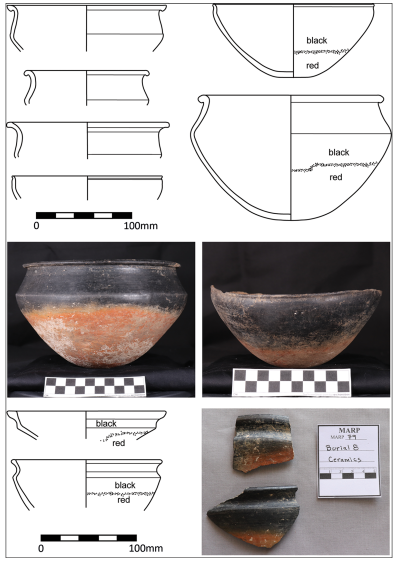
Early slipped and polished serving vessels from Burials 11 (above) and 8 (below). Johansen & Bauer (2023).

Terracotta sarcophagi, burned organic coffins, stone capped, burials, and cairns, all generally associated with Iron Age and Early Historic Period burials in southern India, appear in the Neolithic at MARP-79, with some of these elements also present at the undated Ramapuram and Tekkalakota burials. This sequential appearance of 'Iron Age' elements in Neolithic burials at MARP-79 runs against the previous interpretation of a static Neolithic culture being replaced by a very different Iron Age culture in southern India. Instead, the picture emerging from MARP-79 is one of a gradually changing culture adopting new technologies sequentially, including metal-working. 

MARP-79 records burial customs over a period of about 1500 years, from the Neolithic IIB stage into the early Iron Age. This site is the first Neolithic cemetery in southern India to have yeilded radiocarbn dates. The sequence begins with simple pit burials, later diversifying to include two different burial styles, intact remains being buried within terracotta sarcophagi, and defleshed skeletons placed within burned organic coffins. This suggests a degree of social partitioning within the living community, with different political or social groups with different funurary customs living in the same community. The radiocarbon ages obtained show that these different customs developed in parallel, through the Late Neolithic and into the Early Iron Age. Without the radiocarbon data, this progression would probably not have been identified, with the differing burials more likely to have been identified as coming from different periods. Johansen and Bauer observe that this demonstrates the danger of placing archaeological remains into broad cultural boxes, such as 'Neolithic' or 'Iron Age', which can hide more subtle, gradual changes.

See also...

Follow Sciency Thoughts on Facebook.

Follow Sciency Thoughts on Twitter. 


Friday, 1 September 2023

NASA's Lunar Reconnaissance Orbiter detects Luna 25 impact crator.

NASA's Lunar Reconnaissance Orbiter has detected a new crater on the Moon, thought likely to have been caused by the impact of the lost Russian probe, Luna 25, according to a press release issued on 31 August 2023. The crater is located on the inner rim of Pontécoulant G Crater, a position along Luna 25's planned trajectory, but about 400 km short of its intended landing site. This is approximately where Russia's Roscosmos space agency has predicted the probe impacted the Moon.

Lunar Reconnaissance Orbiter views from 27 June 2020, and 24  August 2023; before and after the appearance of a new impact crater likely from Russia’s Luna 25 mission. NASA.

Roscosmos, has lost contact with its Luna-25 spacecraft on Saturday 19 August, after a thruster rocket fired for 127 seconds instead of 84 as was planned, and believes that it has been destroyed after crashing into the Moon. The probe was intended to mark Russia's return to the Moon for the first time since the Soviet Luna 24 probe in 1977, which was the first robotic probe to land on the surface of another Solar System body, collect a sample, and return to Earth.

See also...

Follow Sciency Thoughts on Facebook.

Follow Sciency Thoughts on Twitter. 


Two Middle East Respiratory Syndrome Coronavirus related deaths in Saudi Arabia in the last year.

From 13 September 2022 to 12 August 2023, three laboratory-confirmed cases of Middle East Respiratory Syndrome Coronavirus, including two deaths, were reported to the World Health Organization by the Ministry of Health of the Kingdom of Saudi Arabia, according to a press release issued by the World Health Organization on 29 August 2023.  Close contacts for the three cases were followed up by the Ministry of Health, and no secondary cases were identified. The notification of these cases reiterates the need for global awareness of Middle East Respiratory Syndrome Coronavirus as the disease continues to pose a threat in countries where Middle East Respiratory Syndrome Coronavirus is circulating in Dromedary Camels, including those in the Middle East.  

Between 13 September 2022 to 12 August 2023, the Ministry of Health of the Kingdon of Saudi Arabia reported three additional cases of Middle East Respiratory Syndrome Coronavirus, with two associated deaths. The cases were reported from Riyadh, Aseer, and Makkah provinces. Laboratory confirmation of the cases was performed by real-time polymerase chain reaction.

Middle East Respiratory Syndrome Coronavirus cases reported by Kingdon of Saudi Arabia between 13 September 2022 and 12 August 2023. World Health Organization.

All three cases were non-health-care workers, who presented with fever, cough, and shortness of breath, and had comorbidities. Of the three cases, two had a history of contact with Dromedary Camels and all three cases had a history of consumption of raw Camel milk in the 14 days prior to the onset of symptoms. All three cases were male, and aged 42, 83, and 85 years respectively.

Since the first report of Middle East Respiratory Syndrome Coronavirus in the Kingdom of Saudi Arabia in 2012, human infections have been reported from 27 countries, in all six World Health Organization regions. Of the reported 2605 cases of Middle East Respiratory Syndrome Coronavirus, the majority cases (2196 cases or 84% the total) have been reported from the Kingdom of Saudi Arabia, including these newly reported cases. Of the 937 deaths reported from 27 countries, a total of 856 (91%) deaths have been reported from the Kingdom of Saudi Arabia, including the newly reported deaths.

Epidemic curve of Middle East Respiratory Syndrome Coronavirus cases and deaths reported in the Kingdom of Saudi Arabia between 2012 and 12 August 2023. World Health Organization.

Middle East Respiratory Syndrome is a viral respiratory infection caused by the Middle East Respiratory Syndrome Coronavirus, a form of positive sense single-strand RNA Virus. Approximately 36% of patients with Middle East Respiratory Syndrome have died, though this may be an overestimate of the true mortality rate, as mild cases of Middle East Respiratory Syndrome Coronavirus may be missed by existing surveillance systems, and the case fatality ratio is calculated based only on laboratory-confirmed cases.

Structure and genomic organization of a Middle East Respiratory Syndrome Coronavirus Viron. Bleibtreu et al. (2020). 

Humans are infected with Middle East Respiratory Syndrome Coronavirus from direct or indirect contact with Dromedary Camels, which are the natural host and zoonotic source of the Virus. Middle East Respiratory Syndrome Coronavirus has demonstrated the ability to transmit between Humans. So far, non-sustained Human-to-Human transmission has occurred among close contacts and in healthcare settings and outside of the healthcare setting, there has been limited Human-to-Human transmission.

Middle East Respiratory Syndrome Coronavirus infections range from showing no symptoms (asymptomatic) or mild respiratory symptoms, to severe acute respiratory disease and death. A typical presentation of Middle East Respiratory Syndrome disease is fever, cough, and shortness of breath. Pneumonia is a common finding, but not always present. Gastrointestinal symptoms, including diarrhoea, have also been reported. Severe illness can cause respiratory failure that requires mechanical ventilation and support in an intensive care unit. The virus appears to cause more severe disease in older people, persons with weakened immune systems, and those with comorbidities or chronic diseases such as renal disease, cancer, chronic lung disease, and diabetes.

No vaccine or specific treatment is currently available, although several Middle East Respiratory Syndrome Coronavirus-specific vaccines and therapeutics are in development. Treatment is supportive and based on the patient’s clinical condition and symptoms.

Follow-up of the close contacts was conducted for all three cases, and no secondary cases were identified. For the two cases reporting contact with camels, the Ministry of Agriculture was informed, and an investigation of camels was conducted. There are no treatments available for Middle East Respiratory Syndrome Coronavirus in animals. The identified positive camels were isolated until real-time polymerase chain reaction testing was negative.

From 13 September 2012 to 12 August 2023, the total number of laboratory-confirmed Middle East Respiratory Syndrome Coronavirus infection cases reported globally to the World Health Organization was 2605, with 937 associated deaths (a case fatality ratio of 36%). The majority of cases occurred in countries in the Arabian Peninsula, including 2196 cases with 856 related deaths (a case fatality ratio of 39%) in the Kingdom of Saudi Arabia. There has been one large outbreak outside of the Middle East, in the Republic of Korea, in May 2015, during which 186 laboratory-confirmed cases (185 in the Republic of Korea and 1 in China) and 38 deaths were reported. The index case in that outbreak had a travel history to the Middle East. The global number reflects the total number of laboratory-confirmed cases reported to the World Health Organization under the International Health Regulations (2005) or directly by Ministries of Health. The total number of deaths includes the deaths that the World Health Organization is aware of to date through follow-up with affected Member States. 

The World Health Organization expects that additional cases of Middle East Respiratory Syndrome Coronavirus infection will be reported from the Middle East and/or other countries where Middle East Respiratory Syndrome Coronavirus is circulating in Dromedaries, and that cases will continue to be exported to other countries by individuals who were exposed to the virus through contact with dromedaries or their products (for example, consumption of raw camel milk), or in a healthcare setting. the World Health Organization continues to monitor the epidemiological situation and conducts risk assessment based on the latest available information.  

The number of Middle East Respiratory Syndrome cases reported to the World Health Organization has substantially declined since the beginning of the COVID-19 pandemic. This is likely the result of epidemiological surveillance activities for COVID-19 being prioritized and the similar clinical picture of both diseases, resulting in reduced testing and detection of Middle East Respiratory Syndrome Coronavirus cases. The Ministry of Health of the Kingdom of Saudi Arabia is working to improve testing capacities for better detection of Middle East Respiratory Syndrome Coronavirus during the COVID-19 pandemic. In addition, measures taken during the COVID-19 pandemic to reduce the transmission of Severe Acute Respiratory Syndrome Coronavirus 2 (the causative agent of COVID-19, such as mask wearing, hand hygiene, physical distancing, improving ventilation of indoor spaces, respiratory etiquette, stay-at-home orders, reduced mobility, also likely reduced opportunities for onward human-to-human transmission of Middle East Respiratory Syndrome Coronavirus.

Based on the current situation and available information, the World Health Organization re-emphasizes the importance of strong surveillance by all Member States for acute respiratory infections, including Middle East Respiratory Syndrome Coronavirus, and to carefully review and investigate any unusual patterns. 

Human-to-human transmission of Middle East Respiratory Syndrome Coronavirus in healthcare settings has been associated with delays in recognizing the early symptoms of Middle East Respiratory Syndrome Coronavirus infection, slow triage of suspected cases, and delays in implementing infection, prevention, and control measures. Infection, prevention, and control measures are critical to prevent the possible spread of Middle East Respiratory Syndrome Coronavirus between people in healthcare facilities. Healthcare workers should always apply standard precautions consistently with all patients, at every interaction in healthcare settings. Droplet precautions should be added to the standard precautions when providing care to patients with symptoms of acute respiratory infection; contact precautions and eye protection should be added when caring for probable or confirmed cases of Middle East Respiratory Syndrome Coronavirus infection; airborne precautions should be applied when performing aerosol generating procedures or in settings where aerosol generating procedures are conducted. Early identification, case management and isolation of cases, quarantine of contacts, together with appropriate infection prevention and control measures in health care setting and public health awareness can prevent human-to-human transmission of Middle East Respiratory Syndrome Coronavirus. 

Middle East Respiratory Syndrome Coronavirus appears to cause more severe disease in people with underlying chronic medical conditions such as diabetes, renal failure, chronic lung disease, and immunocompromised persons. Therefore, people with these underlying medical conditions should avoid close contact with Animals, particularly Dromedaries, when visiting farms, markets, or barn areas where the Virus may be circulating. General hygiene measures, such as regular hand washing before and after touching Animals and avoiding contact with sick Animals, should be adhered to. 

Food hygiene practices should be observed. People should avoid drinking raw camel milk, camel urine or eating meat that has not been thoroughly cooked.  The consumption of raw or undercooked Animal products, including milk and meat, carries a high risk of infection from pathogens that may cause disease in Humans. Animal products that are processed appropriately through cooking or pasteurization are safe for consumption. Foods that have gone through these processes should be handled with care to avoid cross contamination with uncooked/unsafe foods. Camel meat and Camel milk are nutritious products that can continue to be consumed after cooking, pasteurization, or other thermal treatments.

The World Health Organization does not advise special screening at points of entry regarding this event, nor does it currently recommend the application of any travel or trade restrictions. 

See also...


Follow Sciency Thoughts on Facebook.

Follow Sciency Thoughts on Twitter.