Monday, 20 August 2012

A fourth body in the KOI-13 system.

The KOI-13 system (Kepler Object of Interest system) comprises a pair of A-type White Dwarf stars 1630 light years from Earth, orbiting each to closely to be well differentiated. The larger of these, KOI-13α, has a mass 2.05 times that of the Sun, the smaller, KOI-13β, has a mass 1.95 times that of the Sun. In 2011 the Kepler Space Telescope discovered an object (KOI-13.01) orbiting one of these stars every 1.76 days. This object was discovered by the dimming it caused as it passed in front of the star, which meant it was possible to calculate its radius (2.2 times that of Jupiter), but not its mass, leaving scientists unsure whether the object was a very large planet or a Brown Dwarf. In February 2012, a team from the University of Cambridge published a model of the KOI-13 system which suggested that KOI-13.01 was likely to be a super-heated (and therefore super-inflated) Hot Jupiter type planet, with a mass 8.3 times that of Jupiter.

An artists impression of the KOI-13 system. Inset is a telescope image of the stars, scale bar is 1 arc-second. Konkoly Observatory.

In a paper published on the online arXiv database at Cornell University Library on 10 August 2012, and in the journal Astronomy & Astrophysics on 13 August 2012, a team of scientists led by Alexandre  Santerne of the Laboratoire d’Astrophysique de Marseille and Observatoire de Haute-Provence at the Université d’Aix-Marseille & CNRS, detailing the results of a new study of the KOI-13 system using the SOPHIE Spectrograph at the Observatoire de Haute-Provence.  This study used the radial velocity method, which measures the wobble of stars caused by the gravity of objects orbiting around them, to try to determine the mass of KOI-13.01. 

Santerne et al. concluded that KOI-13.01 has a maximum mass of 14.8 times that of Jupiter if it orbits KOI-13α and 9.4 times that of Jupiter if it orbits KOI-13β, supporting the theory that this is a large Hot Jupiter type planet rather than a Brown Dwarf. 

They also found evidence for an extra stellar-mass object within the system, which they name KOI-13γ. This appears to have a mass between 0.4 and 1.0 that of our Sun, and to orbit one of the stars every 65.8 days in an eccentric orbit that does not cross the plane of the star when seen from Earth. KOI-13γ could be potentially the same star as KOI-13.01 if it is towards the smaller end of this mass range, but the most likely scenario that could be modeled was that KOI-13.01 orbits KOI-13α, while KOI-13γ orbits KOI-13β.

See also KOI-13b, a big, hot planet not a Brown Dwarf and Exoplanets on Sciency Thoughts YouTube.

Follow Sciency Thoughts on Facebook.

The biology of pumice rafts.

Pumice is a volcanic rock, produced by the rapid cooling of gas rich lava from submarine eruptions, or high-pressure eruptions on land. The rapid cooling traps bubbles of gas within the rock, creating a very light material that will often float on water. Submarine volcanic eruptions can produce vast mats of pumice, which cover hundreds of square kilometers and persist for years, traveling vast distances across the oceans. While this is unusual on a human timescale, it is very common geologically, with 20 major events known in the last 200 years (not including the Kermadec Islands event of July/August 2012), suggesting that pumice rafts could provide a major dispersal mechanism for marine organisms. 

In a paper published in the journal PLoS One on 18 July 2012, a team of scientists led by Scott Bryan of the School of Geography, Geology and Environment at Kingston University and the School of Earth, Environmental and Biological Sciences at the Queensland University of Technology report the results of a study of a pumice raft produced by Home Reef Volcano in Tonga in 2006. 

Home Reef is a submarine volcano midway between Metis Shoal and Late Island in Tonga. It currently has a summit 10 m bellow sea-level, but sometimes rises above the waves forming ephemeral islands. In August 2006 the volcano an eruption produced a pumice raft covering over 440 km², which then drifted through the islands of Tonga and Fiji before reaching the Australian coast in March 2007, by which time it had spread out to cover about 1600 km²; roughly ⅔ of the original material is thought to have reached Australian waters.

Map showing the progress of the Home Reef pumice raft. Bryan et al. (2012).

The pumice proved to be a very good transport system for marine organisms with a short larval stage and an attached adult phase. Unlike other floating material, such as rafts of algae (Seaweed) or wood, it started out with nothing living on it, thus everything present had to reach it, but it was long-lived on the surface, due to the nature of its buoyancy, and its lack of nutritious value (biological rafts are typically broken up in the end by feeding).

The pumice was host to a wider range of organisms than found by previous studies, which had concentrated on beech-collected pumice, where typically only the remains of mineralized shells of attached organisms were found; non-mineralized organisms on stranded pumice quickly die and decay, and non-attached organisms (e.g. crabs) simply walk away. The amount of organisms growing on the pumice grew steadily as time progressed, with some organisms living long enough to spawn and produce a second generation.

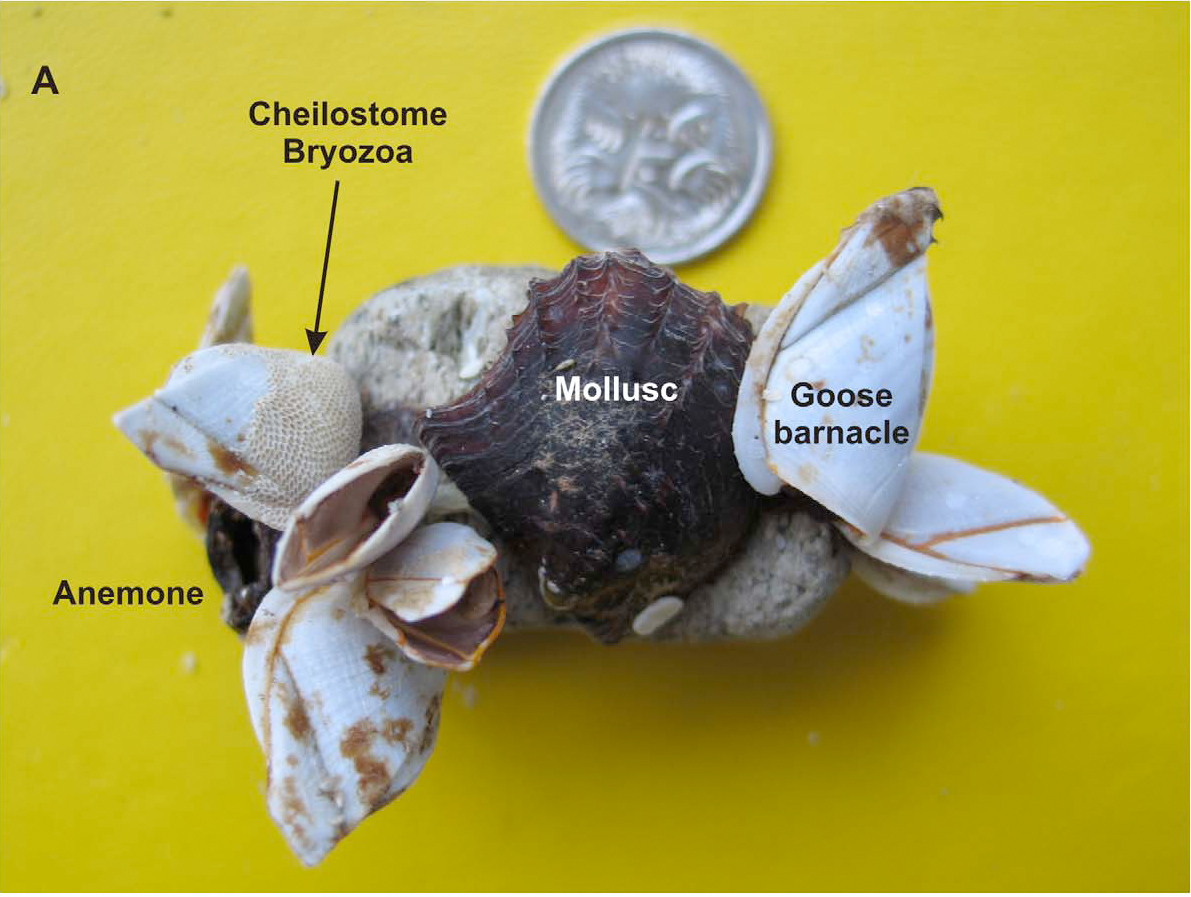
Piece of pumice collected at Marion Reef (roughly 450 km off the Queensland coast) on 30 April 2007. Based upon their size, the Goose Barnacles (Lepas anserifera; largest specimen 23 mm length) have been attached for at least 60 days and the Mollusc over 200. Coin is 2 cm in diameter. Bryan et al. (2012).

Two pieces of pumice bound together by Cyanobacteria (photosynthetic filament-forming Bacteria, principally Rivularia sp.) and Macroalgae (Seaweed, Caulerpa sp.) collected from Broadbeach in southeastern Queensland on 27 December 2007. Also present are two Cauliflower Corals (Pocillopora sp.), a Colonial Scyphozoan (Order Coronatae, the benthic larval stage of a Crown Jellyfish), Goose Barnacles (Lepas anserifera) and a Pearl Oyster (Pinctada sp.) Bryan et al. (2012).

Three pieces of pumice collected from Broadbeach in southeastern Queensland on 27 December 2007. Each has a Sea Anemone (Calliactus sp.) forming a keel, with Cheilostome Bryozoa (Jellyella sp.) along the waterline and Cyanobacteria (Rivularia spp.) occupying allof the dorsal surface. Left hand pumice stone is 5 cm in length. Bryan et al. (2012).

Piece of pumice collected at Lamberts Beach, Mackay, with dorsal surfaces almost exclusively occupied by Cyanobacteria (Rivularia sp.), and the ventral surface entirely covered by cheilostome Bryozoa (Jellyella sp.) colonies. Piece is 1.7 cm long. Bryan et al. (2012).


Follow Sciency Thoughts on Facebook.

Sunday, 19 August 2012

Earthquake hits Sulawesi.

On Saturday 18 August 2012, slightly after 5.40 pm, local time (slightly after 9.40 am GMT), the Indonesian island of Sulawesi was hit by an Earthquake measured by the United States Geological Survey as 6.3 on the Richter Scale at a depth of 19.9 km, by the Indonesian agency Badan Meteorologi Klimatologi dan Geofisika as 6.2 on the Richter Scale at a depth of 10 km, and by Geoscience Australia as 6.5 on the Richter Scale at a depth of 35 km. Any of these measurements represents a serious Earthquake, and there are mixed reports coming from the scene. The area reportedly suffered 15 minutes of 'intense shaking', and there has apparently been considerable localized damage to property and a number of injuries and possibly fatalities; some reports claiming a six-year-old child has been killed by a collapsing house, and others stating the child was only injured but that a family of four was killed by a flash flood.

Map showing the area affected by the quake, which would have been felt within the black circle, and caused damage within the red circle. Geoscience Australia.

The tectonic situation beneath Sulawesi is complex, as it is caught in the collisional zone between the Eurasian, Pacific and Australian Plates. The north of the island is located on a breakaway section of the Eurasian Plate, called the Sangihe Plate. To the east lies the remnant Molucca Sea Plate, which is being subducted beneath both the Sangihe Plate and the more easterly Halmahera Plate, leading to Earthquakes and volcanism on Sulawesi and the islands of the Sangihe Ard in the west and the islands of the Halmahera Arc in the east.

The subduction of the Molucca Sea Plate beneath the Sangihe and Halmahera Plates. What on Earth.

The south of the island mostly lies on the Banda Sea Plate, which is being subducted beneath the Timor  Plate to the south, leading to further Earthquakes, as well as volcanism in the Timor Arc. The southwesternmost tip of Sulawesi lies on the Sunda Plate, with a complex system of convergent and transform faults bisecting the South Sulawesi Peninsula.

See also Eruption on Mount Sirung, Eruptions on Batu Tara, Eruptions from the Tompaluan Crater, Lokon-Empung, Sulawesi, Volcanic activity in the Halmahera Islands and Earthquakes on Sciency Thoughts YouTube.

Follow Sciency Thoughts on Facebook.

Saturday, 18 August 2012

A new species of Barnacle from Taiwan.

Barnacles are Crustaceans, related to Shrimps, Crabs and Lobsters, but having a remarkably different lifestyle, with a free-swimming larval stage that then settles on rocks, or other substrates, and becomes an immobile filter-feeder, protected by a mineralized shell. Some species have become parasites on other Crustaceans, and have even more modified body-plans, growing through the host's tissues like a fungus.

In a paper published in the journal Zookeys on 7 August 2012, Yi-Yang Chen of the Institute of Ecology and Evolutionary Biology at the National Taiwan University, Hsiu-Chin Lin of the Biodiversity Research Center at Academia Sinica and Benny K.K. Chan of both, describe a new species of Barnacle discovered during a study of Darwiniella conjugatum, a widespread tropical species found living on Coral Reefs from the Pacific to the Red Sea.

Chen et al. took samples of 'Darwiniella conjugatum' from five sites on Taiwan and nearby islands. They found that many of the specimens examined differed from typical Darwiniella conjugatum, when their internal structure was examined; a DNA analysis confirmed these specimens were in fact a new species.

Map showing the areas where Barnacles were sampled. Chen et al. (2012).

The new species in named Darwiniella angularis, where angularis refers to the presences of the obvious adductor plate angle, an internal feature considered diagnostic of the species. It was found growing on the coral Astreopora sp. at Lobster Cave on Siaoliouciou Island and on Cyphastrea chalcidicum on the Turtle Tail on Turtle Island. Its external structure is identical to that of Darwiniella conjugatum, making it a cryptic species. Since this study only included specimens from Taiwanese waters, it is quite likely that the species is more widespread, and that the wide geographical range of Darwiniella conjugatum, includes other cryptic species.

Darwiniella angularis. (A) Dorsal view of shell. (B) Ventral view
of shell. Scale bars are in μm.  Chen et al. (2012).


Follow Sciency Thoughts on Facebook.
Friday, 17 August 2012

New species of Ichneumon Wasp from Columbia.

Ichneumon Wasps are a group of highly specialized solitary wasps that lay their eggs inside the bodies of other insects (or, more typically, the larvae of other insects). The Wasp larvae then hatches inside the host, whereupon it proceeds to eat the other insect from within, typically killing its host as it emerges. This is a highly successful, if rather gruesome, survival strategy, and their are over 60 000 described species of Ichneumon Wasps around the world.

In a paper published in the journal ZooKeys on 1 August 2012, Andrés Fabián Herrera Flórez of the Department of Entomology at the University of Manitoba describes a new species of Ichneumon Wasp based upon specimens in the insect collection of the Instituto de Ciencias Naturales at the Universidad Nacional de Colombia, which were re-examined as part of an undergraduate study on the subfamily Labeninae, which parasitize Beetle Grubs, Lacewings, Spiders, Solitary Bees and Gall Wasps.

The new species is placed in the genus Apechoneura, the only genus of the Labeninae found in the Americas, all other genera being Australian or Australasian in distribution. It is based upon three female specimens collected in the Parque Nacional Natural Amacayacu Caño Mata Matá in 1989, and given the specific name seminigra, meaning 'half-black', due to its colouration. A possibly male specimen is also described, but this is damaged and not included in the formal description of the species. Apechoneura seminigra is a 25 mm orange and black wasp.

Apechoneura seminigra. (Top left) Line drawing of female specimen. (Top right) Line drawing of possible male specimen. (Middle) Photograph of female specimen. (Bottom) Line Drawing of possible male specimen. Herrera Flórez (2012).


Follow Sciency Thoughts on Facebook.

Names for nine craters in the North Polar Region of Mercury approved.

The MESSENGER space probe has been in orbit about the planet Mercury since March 2011, since when it has beamed back over 100 000 images of the surface of the planet, helping scientists to construct detailed maps revealing many new geological features. This includes a number of impact craters in the North Polar Region that show signs of containing water ice, which was not expected on the surface of Mercury and is therefore of great scientific interest. Since these craters are likely to be the subject of considerable ongoing study, the NASA team behind the probe have named nine of the most prominent craters, names which have now been approved by the International Astronomical Union, the body that regulates the naming of Solar System objects.

Following current procedures for the naming of features on Mercury, all the craters are named after 'deceased artists, musicians, painters, and authors who have made outstanding or fundamental contributions to their field and have been recognized as art historically significant figures for more than 50 years'.

Map of the North Polar Region of Mercury, showing the nine newly named craters. Universe Today.

The first of these craters is named Egonu, after Uzo Egonu (1931-1996), a Nigerian/British painter considered one of the greatest African artists of the twentieth century. Egonu was born in Onitsha (in what is now Anambra State), and moved to London in 1945, only ever returning to Nigeria for a few days in the 1970s. His work combined African influences with European cubism, and is held in the permanent collections of a number of galleries around the world.

Sacrifice by Uzo Egonu. Live Auctioneers.

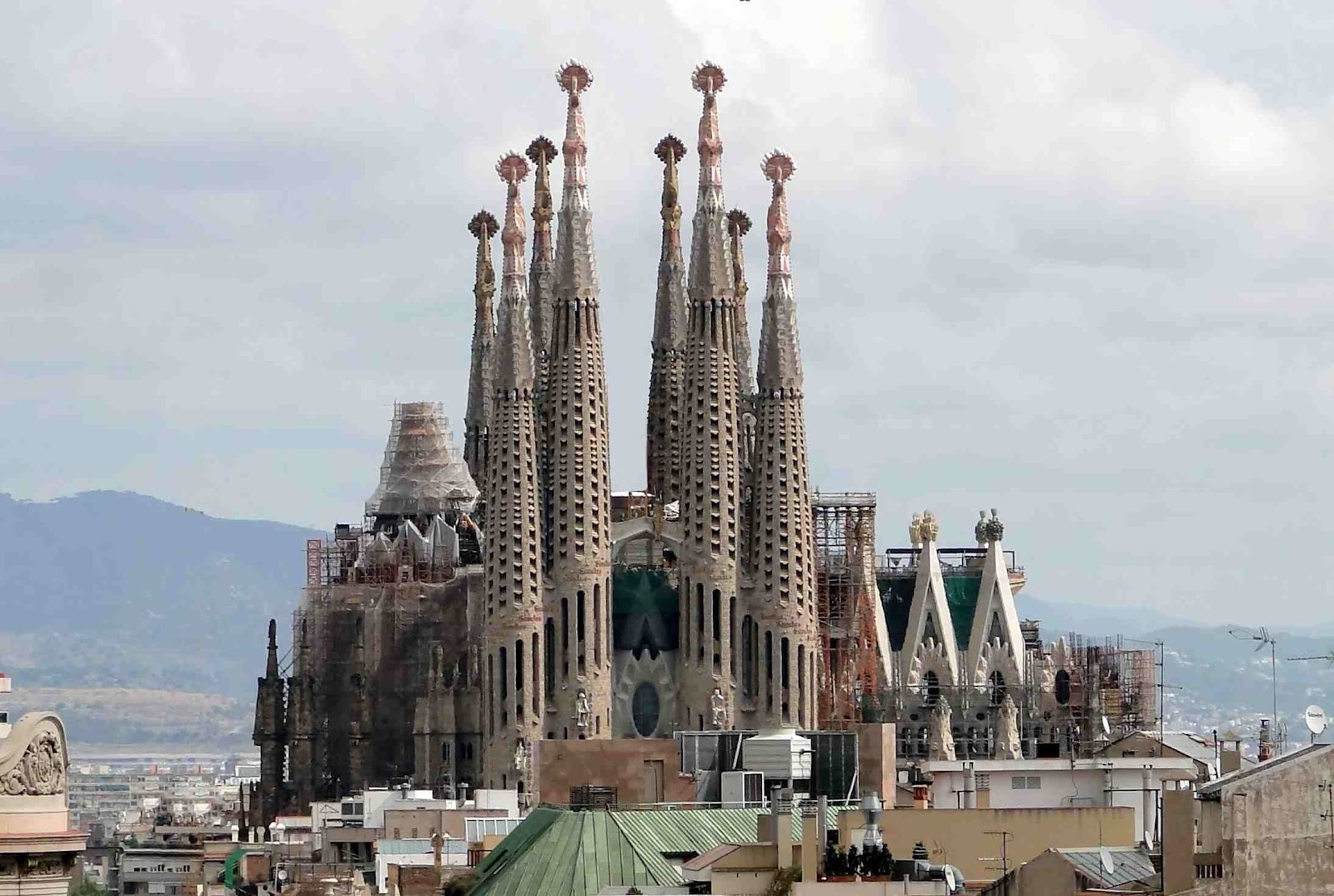
The second crater is named Gaudi, after Antoni Gaudí (1852-1926), the Spanish architect noted for the flowing organic style of his work. Much of Gaudí's work can still be seen in the city of Barcelona, most notably the cathedral, probably his most famous work. 


The third crater is named Kandinsky, after the Russian painter Wassily Kandinsky (1866-1944), noted for his abstract works.

Transverse Line (1923) by Wassily Kandinsky. abstract.art.com

The fourth crater is named Petronius, after Titus Petronius (c. AD 27-66), considered to be the author of the Satyricon, a Roman work of humerus fiction, concerning a retired gladiator who has trouble holding on to his young male lover.

The fifth crater is named Prokofiev, after Sergei Prokofiev (1891-1953), the noter Russian composer and pianist.

Sergei Prokofiev. Classic FM.

The sixth crater is named Tolkien, after J.R.R. Tolkien (1892-1973), the South African/British writer of the Lord of the Rings trilogy of fantasy novels, and related works.

Poster for Peter Jackson's Lord of the Rings trilogy, a recent adaptation of Tolkien's saga.

The seventh crater is named Tryggvadóttir, after Nina Tryggvadóttir (1913-1968), the Icelandic abstract expressionist artist. Tryggvadóttir settled in the US in 1942, and married American artist Alfred L. Copley in 1949, but was refused permission to re-enter the US after a visit to Iceland later that year, on suspicion of being a Communist sympathizer.

Untitled painting by Nina Tryggvadóttir. Expertissm.

The eighth crater is named Qiu Ying, after Shifu Qiu Ying (1494-1552), a Ming Dynasty realist painter, considered a master of Chinese gongbi painting. 

Painting by Shifu Qiu Ying. Cultural China.

The final crater in named Yoshikawa, after Eiji Yoshikawa (1892-1962), the Japanese historical novelist, noted for the reworking of classic tales in a more accessible style.


Follow Sciency Thoughts on Facebook.

Massacre at Lonmin Marikana Platinum Mine, Rustenburg, South Africa.

Police in South Africa have reportedly opened fire on a group of striking miners armed with sticks and machetes, killing 18 people, on Thursday 16 August 2012 (versions of this story vary slightly, some sources put the death toll as high as 38, with the BBC, London, claiming only 12 workers were killed, that the miners were armed with machetes, clubs, spears, petrol bombs and grenades, and that the police tried to disperse the protesters with tear-gas before firing; however the source of this claim is unclear as it is not reported in other news sources). Workers belonging to the Association of Mineworkers and Construction Union have been on strike at the Marikana Platinum Mine since Friday 10 August, demanding a sharp increase in wages, but mine owners, London-based Lonmin PLC, have refused to negotiate with the union and declared the strike illegal. Clashes earlier in the week led to the deaths of at least ten people, including two policemen and two security guards.

Police surveying the bodies of striking miners outside the Marikana site. AP.

The dispute is apparently partly fueled by rivalry between the official  National Union of Mineworkers, which is linked to the ruling African National Congress, and which Lonmin PLC do recognize, and the more radical Association of Mineworkers and Construction Union, which claims that improvements in the lives of mine-workers in post-Apartheid South Africa are coming to slowly, with workers still living in shantytowns and receiving very low wages 18 years after the ANC came to power. Despite not supporting the strike and urging workers to return to work, the National Union of Mineworkers has accused Lonmin of contributing to the unrest by offering allowances to some workers outside the formal bargaining process.

South Africa is the world's largest producer of Platinum, accounting for 77% of global production, and having 80% of the world's known reserves. The Marikana mine alone accounts for 12% of the world's production, with a yearly production target of 750 000 ounces (unlikely to be met this year due to the industrial action). Platinum is currently trading at slightly under US$1440 per ounce, though this has risen this week due to the fall in production at the Marikana mine. Workers at the mine are currently said to be earning around R5000 per month (~US$600), with the Association of Mineworkers and Construction Union demanding R12 500 (~US$1520). 

The incident has provoked widespread shock in South Africa, which has not seen such events since the  end of Apartheid rule in 1994. Following news of the massacre shares in Lonmin fell 6.7% on the London Stock Exchange and 7.3% in Johannesburg; the share-price has fallen 13% since the start of the strike. In January this year a similar round of strikes closed the Impala Platinum mine (the world's largest Platinum mine, accounting for 25% of global production) for six weeks, led to at least three deaths, and pushed the price of Platinum up by 15%.


Follow Sciency Thoughts on Facebook.