Friday, 28 June 2019

Total Solar Eclipse to be visible from South and Central America, 2 July 2019.

A total eclipse of the Sun will be visible from parts of Chile and Argentina as well parts of the South Pacific on Tuesday 2 July 2019, with a partial eclipse visible from other parts of those countries, as well as Paraguay, Bolivia. Peru, Ecuador, Colombia, western Brazil, southern Guyana, Panama, Costa Rica, southern Nicaragua, the Galapagos Islands, Pitcairn Island, French Polynesia, Kiribati, the Cook Islands, the Marshal Islands and Samoa. The event will occur between 4.55 pm and 9.50 pm  GMT.

The path of the 2 July 2019 Solar Eclipse. The total eclipse will be visible along the central dark grey path. A partial eclipse will be visible from the shaded areas; in the lighters area the full eclipse will not be visible as it will have started before dawn (west) or will continue after sunset (east). The solid red lines are the Equator and the International Date Line, the dashed red lines are the Tropic of Cancer and Tropic of Capricorn. HM Nautical Almanac Office.

Eclipses are a product of the way the Earth, Moon and Sun move about one-another. The Moon orbits the Earth every 28 days, while the Earth orbits the Sun every 365 days, and because the two Sun and Moon appear roughly the same size when seen from Earth, it is quite possible for the Moon to block out the light of the Sun. At first sight this would seem likely to happen every month at the New Moon, when the Moon is on the same side of the Earth as the Sun, and therefore invisible (the Moon produced no light of its own, when we see the Moon we are seeing reflected sunlight, but this can only happen when we can see parts of the Moon illuminated by the Sun). 

The relative positions of the Sun, Moon and Earth during a Solar eclipse. Starry Night.

However the Moon does not orbit in quite the same plane as the Earth orbits the Sun, so the Eclipses only occur when the two orbital planes cross one-another; this typically happens two or three times a year, and always at the New Moon. During Total Eclipses the Moon entirely blocks the light of the Sun, however most Eclipses are Partial, the Moon only partially blocks the light of the Sun.

 How the differing inclinations of the Earth and Moon's orbits prevent us having an eclipse every 28 days. Starry Skies.

Although the light of the Sun is reduced during an Eclipse, it is still extremely dangerous to look directly at the Sun, and viewing eclipses should not be undertaken without appropriate equipment.
 
Animation showing the shadow of the Moon at five minute intervals on Tuesday 2 July 2019. Andrew Sinclair/HM Nautical Almanac.

See also...

https://sciencythoughts.blogspot.com/2019/06/the-northern-solstice.htmlhttps://sciencythoughts.blogspot.com/2019/03/investigating-meteoroid-impact-on-moon.html
https://sciencythoughts.blogspot.com/2019/03/the-furthest-lunar-apogee-of-2019.htmlhttps://sciencythoughts.blogspot.com/2019/02/the-closest-lunar-perigee-of-2019.html
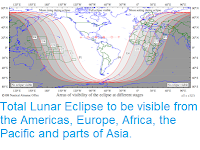
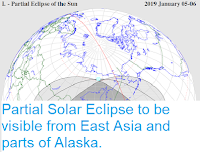
https://sciencythoughts.blogspot.com/2019/01/total-lunar-eclipse-to-be-visible-from.htmlhttps://sciencythoughts.blogspot.com/2019/01/partial-solar-eclipse-to-be-visible.html
Follow Sciency Thoughts on Facebook.

Wednesday, 26 June 2019

Thismia submucronata: A new species of Thismia from Thialand.

Thismias (Thismiaceae) are a small group of Parasitic Plants found throughout the tropics, with a few temperate species known from North America, Japan, New Zealand and Australia. They parasitise the Mycorrhizal Fungi with which all vascular plants have a relationship, but where other plants exchange sugars produced by photosynthesis for nutrients obtained from the soil by the Fungi, Thismias do not photosynthesise, instead taking both nutrients and sugars from the Fungi and giving nothing in return. In order to do this Thismias must target Fungi in relationships with other Plants (since Fungi do not produce sugars), preventing the Thismia from growing to any great size. Thismias are related to Bat Flowers and Arrowroots; they were formerly classified within the (also parasitic) Burmanniaceae, but it is now recognised that while the two groups are fairly closely related, both are more closely related to some non-parasitic plants than they are to each-other.

In a paper published in the journal Taiwania on 24 June 2019, Sahut Chantanaorrapint of the Department of Biology at Prince of Songkla University, Naiyana Tetsana of the Forest Herbarium of the Department of National Parks, Wildlife and Plant Conservation, Petch Tripetch of Muang, and Somran Suddee, also of the Forest Herbarium of the Department of National Parks, Wildlife and Plant Conservation, describe a new species of Thismia from the Phu Hin Rong Kla and Phu Suan Sai national parks in northern Thialand.

The new species is named Thismia submucronata, where 'submucronata' meaning 'short-tipped'. The plant is whitish (it does not produce chlorophyll) with white flowers with darker bases, and small, triangular, scale-like leaves. It reaches about 14 cm in height. The species was found growing in two different locations, in both places growing in leaf litter, under the shade of moist evergreen forest, near a waterfall or stream side. The plants were found at altitudes of between 1200 and 1300 m.

Thismia submucronata, plant in natural habitat. Sahut Chantanaorrapint in Chantanaorrapint et al. (2019).

See also...

https://sciencythoughts.blogspot.com/2018/09/cassytha-filiformis-parasitic-plant.htmlhttps://sciencythoughts.blogspot.com/2017/09/thismia-nigricoronata-new-species-of.html
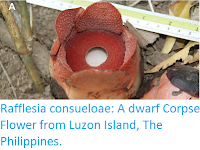
https://sciencythoughts.blogspot.com/2016/12/lecanorchis-tabugawaensis-new-species.htmlhttps://sciencythoughts.blogspot.com/2016/02/rafflesia-consueloae-dwarf-corpse.html
https://sciencythoughts.blogspot.com/2015/08/gastrodia-madagascariensis-not-so-new.htmlhttps://sciencythoughts.blogspot.com/2015/06/balanophora-coralliformis-new-species.html
Follow Sciency Thoughts on Facebook.

Tuesday, 25 June 2019

Raikoke volcano erupts for the first time in almost a century.

Raikoke, a volcanic island in the Kuril Archipelago, erupted at about 4.00 am local time on Saturday 22 June 2019 (about 5.00 pm on Friday 21 June GMT), the first eruption on the island since 1924, and only the third eruption recorded, the first having been in 1778. The eruption produced a volcanic plume that rose to between 13 and 17 km above sea level, which was observed by several satellites, as well as by astronauts on the International Space Station.

 Eruption on Raikoke, seen from the International Space Station. Earth Observatory/NASA.

The Kuril Archipelago runs from the northwestern tip of Hokkaido to the southern tip of the Kamtchatka Peninsula. It marks the southern margin of the Okhotsk Plate, which underlies the Sea of Okhotsk, the Kamchatka Peninsula, Sakhalin Island and Tōhoku and Hokkaidō in Japan. Along this southern margin the Pacific Plate is being subducted beneath the Okhotsk Plate in the Kuril Trench. As the Pacific Plate sinks under the Okhotsk Plate it is partial melted by the resultant friction and the heat of the Earth's interior. Some of the melted material then rises up through the overlying Okhotsk Plate as magma, fuelling the volcanoes of the Kuril Archipelago.

Simple diagram showing the subduction of the Pacific Plate beneath the Okhotsk Plate along the Kuril Trench. Auburn University.

See also...

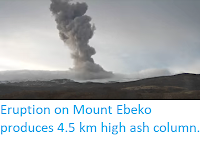
https://sciencythoughts.blogspot.com/2018/11/eruption-on-mount-ebeko-produces-35-km.htmlhttps://sciencythoughts.blogspot.com/2018/02/eruption-on-mount-ebeko.html
https://sciencythoughts.blogspot.com/2015/02/eruption-on-mount-chikurachki.htmlhttps://sciencythoughts.blogspot.com/2012/10/volcanic-activity-on-mount-alaid.html
https://sciencythoughts.blogspot.com/2012/08/eruption-on-ivan-grozny.html
Follow Sciency Thoughts on Facebook.

Monday, 24 June 2019

Isisfordia molnari: A new species of Crocodyliform from the Middle Cretaceous of New South Wales.

The Crocodyliforms were the only group of Crocodylomorphs to survive the End Triassic Extinction event. The group includes all modern Crocodylians, but also a number of extinct groups, such as the Dog-like Peirosaurians, the short-snouted, long-legged Notosuchins, the fully marine Metriorhynchids, and the Dyrosaurids, a diverse group which survived till the Eocene. These Crocodyliforms were abundant in the Mesozoic of most of the Southern Hemisphere, but are startlingly absent from the Australian continent, where only a single species has been described, Isisfordia duncani, from the Middle Cretaceous of Queensland, a species thought to be closely related to, but not placed within, the still extant Crocodylians.

In a paper published in the journal PeerJ on 21 June 2019, Lachlan Hart and Phil Bell of the Palaeoscience Research Centre at the University of New England, Elizabeth Smith of the Australian Opal Centre, and Steven Salisbury of the School of Biological Sciences at the University of Queensland describe a second species of Isisfordia from two opalised bone fragments from mines in the Lightning Ridge area of New South Wales and Queensland.

Opal is an amorphous form of silica containing as much as 21% water, It is made up of tiny spheroids of crystalline silica some 150 to 300 nm in diameter, with random alignments to one another. Light passing through these crystaloids is refracted as by a prism, leading to the 'opalescent' sheen which gives the mineral its value. Opal is formed by water percolating through silica rocks, where it dissolves some of the mineral forming a silica-rich solution. This can accumulate in any cracks or gaps in the rock, where if it reaches a high enough concentration it can precipitate out as opal. The Cretaceous Griman Creek Formation of northern New South Wales and southern Queensland is noted for the occurrence of opalised vertebrate fossils, replacement fossils formed when opal forms in gaps in the rock left by the dissolution of bone or earlier replacement material. However, these are rare and are not always spotted in areas where the opal is mined using mechanised equipment, which also means that the material that is recovered is often fragmented.

The new species is named Isisfordia molnari, in honour of Ralph Molnar, for his work on Crocodylomorphs from the Griman Creek Formation, and Australian vertebrate palaeontology in general. The species is described from two specimens, a braincase recovered from a mine in 2000 and donated to the Australian Museum by opal miners Peter and Lisa Caroll, and a partial maxilla (upper jawbone) extracted in 1914 and donated to the Australian Museum by Colonel Reuter Emerich Roth. The precise locations where these specimens were found is unclear, though the jaw was probably from Three Mile Field, close to the town of Lightning Ridge, and the braincase is probably from Coocoran Fields, 30 -40 km to the west.

Isisfordia molnari, maxillary fragment from the Griman Creek Formation. (A) medial, (B) lateral, (C) palatal views. Arrows indicate rostral end. Scale bars equal 10 mm. Abbreviations: ag, alveolar groove; is, interalveolar septa; ms, medial `shelf'; pp, palatal process. Hart in Hart et al. (2019).

Isisfordia molnari is differentiated from Isisfordia duncani on the basis of the shape of the pariedal bones (the bones which form the side and roof of the skull in Humans), which are flat in Isisfordia molnari and have ridges on them in Isisfordia duncani, and the shape and spacing of the tooth sockets, which are rounded in Isisfordia duncani  and oval in Isisfordia molnari.

Reconstruction of Isisfordia molnari in life, swimming next to a wading Sauropod. José Vitor Silva in Hart et al. (2019).

See also...


https://sciencythoughts.blogspot.com/2019/06/fostoria-dhimbangunmal-opalised.htmlhttps://sciencythoughts.blogspot.com/2019/04/cricosaurus-bambergensis-new-species-of.html
https://sciencythoughts.blogspot.com/2016/10/queensland-miner-killed-in-trench.htmlhttps://sciencythoughts.blogspot.com/2016/05/gryposuchus-pachakamue-gavialoid.html
https://sciencythoughts.blogspot.com/2015/06/redescription-of-thalattosuchian.htmlhttps://sciencythoughts.blogspot.com/2015/03/hydrated-silicate-minerals-in-mariner.html
Follow Sciency Thoughts on Facebook.

Sunday, 23 June 2019

Fireball over southeast Queensland.

Witnesses in southeast Queensland, have reported a bright fireball meteor being seen over the area to the north and west of Brisbane at about 10.00 pm local time on Saturday 22 June 2019. The fireball was accompanied by three loud sonic booms, caused by the object moving through the atmosphere faster that the speed of sound. A fireball is defined as a meteor (shooting star) brighter than the planet Venus. These are typically caused by pieces of rock burning up in the atmosphere, but can be the result of man-made space-junk burning up on re-entry. 

Fireball meteor seen in a 15 second exposure looking southeast from North Pine Dam on 22 June 2019. Craig Turton/AAP.

Objects of this size probably enter the Earth's atmosphere several times a year, though unless they do so over populated areas they are unlikely to be noticed. They are officially described as fireballs if they produce a light brighter than the planet Venus. The brightness of a meteor is caused by friction with the Earth's atmosphere, which is typically far greater than that caused by simple falling, due to the initial trajectory of the object. Such objects typically eventually explode in an airburst called by the friction, causing them to vanish as an luminous object. However this is not the end of the story as such explosions result in the production of a number of smaller objects, which fall to the ground under the influence of gravity (which does not cause the luminescence associated with friction-induced heating).
 
These 'dark objects' do not continue along the path of the original bolide, but neither do they fall directly to the ground, but rather follow a course determined by the atmospheric currents (winds) through which the objects pass. Scientists are able to calculate potential trajectories for hypothetical dark objects derived from meteors using data from weather monitoring services.
 
See also...
 
https://sciencythoughts.blogspot.com/2019/05/bright-fireball-meteor-over-south.htmlhttps://sciencythoughts.blogspot.com/2019/05/fireball-over-lake-michigan.html
https://sciencythoughts.blogspot.com/2019/04/fireball-meteor-over-new-jersey.htmlhttps://sciencythoughts.blogspot.com/2019/04/the-lyrid-meteor-shower.html
https://sciencythoughts.blogspot.com/2019/03/fireball-meteor-over-new-york-state.htmlhttps://sciencythoughts.blogspot.com/2019/03/nasas-terra-satelite-detects-huge.html
Follow Sciency Thoughts on Facebook.

Friday, 21 June 2019

Magnitude 4.8 Earthquake in the Maine-et-Loire Department of western France.

The Centre Sismologique Euro-Méditerranéen recorded a Magnitude 4.8 arthquake at a depth of 10 km, in the Maine-et-Loire Department of western France, slightly after 8.50 am local time (slightly after 6.50 am GMT) on Friday 21 June 2019. There are no reports of any damage or injuries associated with this event, but people have reported feeling it across western France and in parts of southwest England.

The approximate location of the 21 June 2019 Maine-et-Loire Department Earthquake. Centre Seismologique Euro-Méditeranéen.

The precise cause of Earthquakes in France can be hard to determine; the country is not close to any obvious single cause of such activity such as a plate margin, but is subject to tectonic pressures from several different sources, with most quakes probably being the result of the interplay between these forces.

France is being pushed to the east by the expansion of the Atlantic Ocean and to the north by the impact of Africa into Europe from the south. It is also affected by lesser areas of tectonic spreading beneath the North Sea, Rhine Valley and Bay of Biscay. Finally the country is subject to glacial rebound; until about 10 000 years ago much of the mountainous and upland areas of the country were covered by a thick layer of glacial ice, pushing the rocks of the French lithosphere down into the underlying mantle. This ice is now gone, and the rocks are springing (slowly) back into their original position, causing the occasional Earthquake in the process. 

Glacial rebound seems an unlikely cause of Earthquakes in the Channel region, an area that was never glaciated, but this is not entirely the case. The northwest of Scotland is rising up faster than any other part of the UK, but the Earth's crust on land in the UK is fairly thick, and does not bend particularly freely, whereas the crust beneath the Channel is comparatively thin and more inclined to bend under stress. Thus uplift in Scotland can cause the entire landmass of Great Britain to pivot, causing movement in the rocks beneath the Channel, and affecting both the English and French coasts.

(Top) Simplified diagram showing principle of glacial rebound. (Bottom) The extent of glaciation in Europe at the last glacial maximum. Wikipedia.

Witness accounts of Earthquakes can help geologists to understand these events, and the structures that cause them. The Centre Seismologique Euro-Méditeranéen is interested in hearing from people who may have felt this event; if you felt this quake then you can report it to Earthquake Report here.

See also...
 
https://sciencythoughts.blogspot.com/2018/12/twelve-year-old-skier-survives-despite.htmlhttps://sciencythoughts.blogspot.com/2018/10/sixteen-kilometre-stretch-of-southern.html
https://sciencythoughts.blogspot.com/2018/09/british-and-french-fishing-fleets-clash.htmlhttps://sciencythoughts.blogspot.com/2018/04/french-beach-invaded-by-by-wind-sailors.html
https://sciencythoughts.blogspot.com/2018/03/german-skier-killed-and-canadian.htmlhttps://sciencythoughts.blogspot.com/2018/03/avalanche-kills-at-least-four-in-french.html
Follow Sciency Thoughts on Facebook.
 

Cynanchum brevipedunculatum: A new species of Dogbane from Yunnan Province, China.

Dogbanes, Apocyanaceae, are flowing trees, shrubs, herbs, succulents, and vines found in tropical, subtropical and occasionally temperate regions of Europe, Asia, Africa, Australia and the Americas (tree forms are mostly restricted to tropical forests, and sometimes deserts). Many of these plants are toxic, and some have been used to poison Dogs (hence the name), and a number of pharmacological products have been derived from them. Members of the genus Cynanchum are climbers producing white latex, sometimes known as Swallowworts or Dog-stranglers.

In a paper published in the journal Taiwania on 14 June 2019, Jian-Yong Shen, Xing-Da Ma, Wen-Guang Wang, and Ji-Pu Shi of the Xishuangbanna Tropical Botanical Garden describe a new species of Cynanchum from Menghai County in Yunnan Province, China.

The new species is named Cynanchum brevipedunculatum, meaning 'short peduncle' (flower stem), as it has short peduncles. The species is a climber with larger leaves than related species, and shorter flower stems. It produces paired bracts of green and white flowers in November. Only two specimens of the species could be found despite an extensive search, for which reason Shen et al. recommend that the species be classed as Critically Endangered under the terms of the  International Union for the Conservation of Nature's Red List of Threatened Species

Cynanchum brevipedunculatum. (A) Habit. (B)-(C) Adaxial and abaxial leaf surface. (D)-(E) Inflorescences and flowers. (F) Gynostegium in side view. (G) Gynostegium in top view. (H) Pollinarium. Shen et al. (2019).

See also...

http://sciencythoughts.blogspot.com/2019/06/heliotropium-pakistanicum-new-species.htmlhttp://sciencythoughts.blogspot.com/2019/05/limonium-dagmarae-new-species-of-sea.html
https://sciencythoughts.blogspot.com/2019/05/justicia-cubangensis-justicia-eriniae.htmlhttp://sciencythoughts.blogspot.com/2019/05/tamarix-humboldtiana-new-species-of.html
https://sciencythoughts.blogspot.com/2019/02/thesium-nautimontanum-new-species-of.htmlhttps://sciencythoughts.blogspot.com/2018/12/drosera-albonotata-new-species-of-pygmy.html
Follow Sciency Thoughts on Facebook.