Showing posts with label Fennoscandia. Show all posts

Sunday, 7 January 2024

Woman and child confirmed dead in Finland avalanche.

A woman and her twelve-year-old son have been confirmed dead following an avalanche at Pyhäkuru slope in the Pallastunturi Fells of Finnish Lapland on Tuesday 2 January 2024. The pair, who have not been named, but have been identified as having come from the town of Korsnäs in Ostrobothnia, 700 km to the south, called for help from Lappland Rescue Service after getting into trouble with high winds and extreme cold, but when they arrived at the site there were no signs of the two. Attempts to locate them were hampered by high winds (about 40 m per second), extreme cold (about -23°C at the time of the incident), and limited light conditions (the Sun rose in the region on Friday 5 January for the first time in a month, earlier in the week light was limited to about five hours of twilight per day). The body of the woman was found by a Lapland Police Department rescue team at about 10.00 pm on the day of the avalanche, that of the boy was not recovered until the morning of Thursday 4 January.

(Top) Conditions on Pyhäkuru slope on Tuesday 2 January 2024. Antte Lauhamaa/Lappland Police Department/Yle. (Bottom) Pyhäkuru slope on Wednesday 3 January. Otto Ponto/Helsingin Sanomat.

Avalanches are caused by the mechanical failure of snowpacks; essentially when the weight of the snow above a certain point exceeds the carrying capacity of the snow at that point to support its weight. This can happen for two reasons, because more snow falls upslope, causing the weight to rise, or because snow begins to melt downslope, causing the carrying capacity to fall. Avalanches may also be triggered by other events, such as Earthquakes or rockfalls. Contrary to what is often seen in films and on television, avalanches are not usually triggered by loud noises. Because snow forms layers, with each layer typically occurring due to a different snowfall, and having different physical properties, multiple avalanches can occur at the same spot, with the failure of a weaker layer losing to the loss of the snow above it, but other layers below left in place - to potentially fail later.

Diagrammatic representation of an avalanche, showing how layering of snow contributes to these events. Expedition Earth.

Pyhäkuru slope is popular with freeskiers, but local residents consider it to be extremely dangerous in bad weather. In high winds loose snow from the surrounding area can pile up against the side of the slope, making it appear much less steep than it actually is, but this snow is only loosely packed, and will easily give way if people venture onto it, making skier-induced avalanches a frequent problem.

See also...


Follow Sciency Thoughts on Facebook.

Follow Sciency Thoughts on Twitter.


Tuesday, 29 November 2022

Investigating burial customs in Bronze Age Finland.

Bronze age Scandinavian burial practices are well documented from southern Norway and Sweden, as well as Denmark, where a wide range of burial styles, including large elite burial mounds, gallery graves, cairns and flat ground cemeteries. Away from this area the range of practices is much less diverse. In Finland, where the Bronze Age is thought to have lasted from about 1800 to about 500 BC, the only form of burial known from this period is the cairn. There are, however, a very large number of these cairns, some estimates suggesting as many as 10 000, of which only a tiny fraction have ever been excavated. Furthermore, many of the cairns that have been investigated have yielded no archaeological material. Where material has been found beneath cairns, the most common thing recovered is burned Human bone, apparently produced when the dead were cremated. Since many of the cairns which have been investigated were excavated at a time when methods in archaeology were rather less vigorous, it is possible that many of these also contained burned bone, but that this was overlooked. However, there are other possible explanations for the boneless cairns; they may have formerly contained unburned burials in wooden coffins (something known from southern Scandinavia), which would have decomposed far more quickly than burned bone in the acidic soils present across most of Finland. Alternatively, the interpretation of these sites as burial cairns may be completely wrong, they may simply represent piles of rocks formed as agricultural land was cleared, as landmarks used by sailors, indicators of land ownership, or sacred sites of some other, non-burial related nature. These possible explanations have been debated for over a century, without any evidence being found to favour one theory over another. 

Bronze Age cairns in Finland, particularly those found close to the coast, tend to be different to those constructed in the Stone Age (9000-1800 BC), being more monumental in nature. The largest of these Bronze Age cairns are the largest prehistoric monuments in Finland. The practice of cremating the dead appears to have been introduced to Finland at the beginning of the Bronze Age, and to have persisted till the end of the Iron Age, which in Finland is placed at 1050 AD. However, the way in which the cremated remains were buried changed considerably over that time, starting with large stone cairns in the Early Bronze Age, which shrank over time. Later a soil infill between the stones appeared, eventually progressing to the remains being buried beneath the ground in flat cemeteries. 

In a paper published in the International Journal of Osteoarchaeology on 9 June 2022, Kati Salo, Jarkko Saipio, Maddie Hentunen,  Kristiina Mannermaa, and Markku Oinonen of the University of Helsinki, present a review of cremated bone remains from cairn burials in Bronze Age Finland held in the National Museum of Finland, and provincial museums in Finland. They examine the number of burials beneath each cairn, the location of the cairns in relationship to resources such as agricultural land, and the health of those buried, as reflected by pathologies detectable on the cremated remains. They also look at the distribution of the cairns across Finland, and their timescale, introducing a number of new carbon-dates, and compare the burials to Bronze Age burials elsewhere in Scandinavia and around the Baltic Sea. Salo et al. aim to understanding the relationship between the changing use of food resources, health of the population, and burial customs over the course of the Bronze Age in Finland.

Bone material from 218 cairns was examined, including material from 76 cairns in the Satakunta Region of central Finland, where the densest concentrations of cairns are found, 50 cairns from the northern coast of Ostrobothnia, most of which have been shown to be Iron Age in origin, 36 cairns from the Southwest Finland Region, 33 cairns from the southern coast of the Uusimaa and Kymenlaakso regions, 16 from inland regions, and 7 from the Åland Islands.

Location of the cairn burial sites in this study. Dashed lines represent land uplift isobases. As the land uplift is greatest in the Ostrobothnian area (northern coast), these cairns have also mostly been located near the coastline in the Bronze Age. Wesa Perttola in Salo et al. (2022).

The study concentrates on the Bronze Age, and includes material from 118 cairns dating to this period, but also includes material from 57 Iron Age cairns, 37 cairns that may be either Bronze Age or Iron Age, and 6 cairns that have been shown to contain material from both the Bronze and Iron ages.

The cairns range from 1.6 to 21 m in width, 1 to 20 m in width, and 0.2 to 3 m in height, with an 'average' cairn being roughly 8 m long, 7 m wide, and 1 m high. Ninety seven of the cairns are built on top of identifiable stone rings, made of larger stones than the rest of the cairn, 31 are built around large individual boulders, and 24 are built around stone cists (small stone-built coffin-like boxes or ossuaries used to hold the bodies of the dead).

Bronze Age cairn in Satakunta (Kaupinvuori in Rauma). Leena Koivisto in Salo et al. (2022).

The most common item recovered from the cairns other than bone was ceramic, with 58 cairns producing ceramic fragments. This was followed by iron artefacts, recovered from 42 cairns, bronze objects, recovered from 41 cairns, quartz, 41 cairns, flint, 18 cairns, other lithic items, 37 cairns, and burnt clay, 14 cairns. However, some of the ceramic, stone, and burnt clay items may have come from Stone Age settlements overlain by the cairns, while some of the metal items may post-date cairn construction.

Salo et al. obtained 15 new carbon dates from bone fragments recovered from 14 cairns during the course of the study. These were added to previously obtained carbon dates, contributing to a growing chronological database for Bronze Age Finland. Altogether, 67 dates have now been obtained from 43 cairns. This dating of cairns in Finland has enabled the connection of cairn-building activities to be connected to other events in ancient Finland, such as shifting shorelines.

Nine of the new dates obtained by Salo et al. were from Satakunta, and six were from the Åland Islands. Thirteen were obtained from cremated Human bone, one from cremated Dog bone (which was found with cremated Human bones), and one from a Sheep or Goat bone. The two bones dated from the same cairn were the Dog bone and a Human bone, both from a cairn in the Åland Islands, with both dating from the Late Bronze Age. The Sheep or Goat bone was of Iron Age origin.

The dates obtained showed that many late Bronze Age cairns in Satakunta were built on top of Late Neolithic or Early Bronze age settlements, something which had previously been suspected, but which archaeologists had been unable to confirm by now. Late Bronze Age cairns in Satakunta were also often built around large solitary stones, generally glacial erratics (large stones deposited away from their source after being carried by glaciers). Furthermore, they demonstrate a connection between the distribution of Late Bronze Age cairns and agricultural land; in the Early Bronze Age cairns tended to be built on high up on prominent features, while Late Bronze Age cairns are typically located close to good agricultural land, and often known Bronze Age settlements. In Gotland (Sweden) the Late Bronze Age saw the appearance of permanent settlements, and across southern Scandinavia population levels are known to have risen from about 1000 BC onwards, leading people to expand into new areas. These changes are likely to have been linked to changing economic circumstances. An increase in the number of bronze artefacts originating from Scandinavia has also been recorded in Satakunta in the Late Bronze Age, something not observed in other parts of Finland. 

Salo et al. were able to identify the remains of a minimum of 212 individual Humans from 164 cairns. The majority of the cairns (132) nappeared to hold only a single burial, with 32 cairns holding the remains of between two and five individuals. The single cairn that contained the remains of at least five individuals also yielded Iron Age material, but with a single Bronze Age metal item. Two cairns in the Luistari cemetery in Eura were shown to contain at least four individuals. Both appear to have been repeatedly used over a long period of time, but with their oldest remains dating to the Late Bronze Age. 

Five left zygomatic bones (cheekbones) from the Salo Palomäki Cairn, indicating a minimum of 5 individuals were buried beneath the cairn. Kati Salo in Salo et al. (2022).

Iron Age cairns were more likely to contain multiple burials than Bronze Age cairns, although it is also possible that all the cairns contained more individuals than have been recorded, since the numbers are based upon the minimum number of individuals that could have produced the recovered remains. One Iron Age site, Cairn 89 from Rieskaronmäki, in Nakkila, in the Satakunta Region, is thought to contain five-to-six individuals, buried at different locations within the cairn over a period of about 270 years, based upon radiocarbon dates.

Single-burial cairns are also common in Bronze Age Sweden, although here double-burials are more common. Salo et al. also note that several other burial types are present in Bronze Age Sweden, and that in some of these multiple burials are more common. 

Ninety five cairns were shown to contain identifiable Animal bones, 53 of which also contained Human remains. A further 15 cairns contained unidentifiable Animal remains; although in all of these cases the sample of material was very small, i.e. less than 3 g. The majority of these Animal bones were uncremated; 27 of the cairns were found to contain cremated Animal bones alongside cremated Human remains, but these were all dated to the Iron Age. Additionally, some of the cremated Animal bones found in Bronze Age cairns may actually come from older, Stone Age, settlements covered by the monuments. This absence of cremated Animal remains from Bronze Age cairns in Finland appears to be significant, implying that the burning of Animals with the deceased and/or the deposition of burned Animal remains alongside the deceased, was not a common practice. These practices were common in Middle and Late Iron Age burials in Finland, and in Bronze Age burials elsewhere in Scandinavia. This difference in timing may be linked to the later adoption of field-cultivation in Finland than elsewhere in Scandinavia.

Iron Age cairns in Finland were also more likely to contain artefacts than Bronze Age cairns, and were more likely to be built on top of older settlements, which may also reflect improving agricultural knowledge.

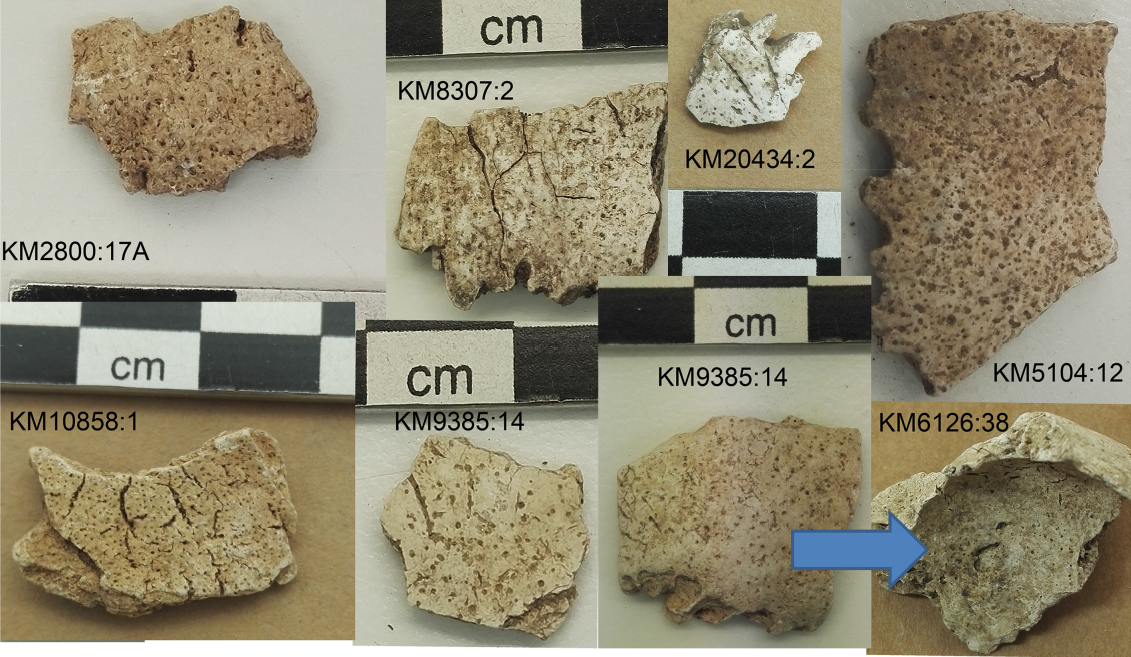
Between fifteen and eighteen individuals from fifteen Bronze Age cairns and seven individuals from Iron Age cairns could be diagnosed with porotic hyperostosis; a pathological condition in which patches of spongy bone form on the cranium as a result of anemia, which in turn may be a result of malnutrition or a genetic condition. A further nineteen cairns, ten of which could be dated to the Bronze Age, produced remains with signs of osteoarthritis.

Porotic hyperostosis in Rauma Huhdanniska (KM2800:17A), Eura Junnila (KM8307:2), Parainen Trollberg (KM20434:2), Harjavalta Kaasanmäki (KM5104:12), Laihia Murhaasto (KM10858:1), and Vöyri Viskusbacken (KM9385:14). Cribra orbitalia from Nakkila Kuusisto site (KM6126:38). Kati Salo in Salo et al. (2022).

Two Iron Age Cairns and two Bronze Age cairns produced remains with signs of having lost teeth before death. Two Bronze Age cairns produced remains with signs of periapical lesions (tissue produced by a bone or tooth in response to an infection), and one Bronze Age and one Iron Age cairn produced remains with signs of  periosteal bone formation, which is generally provoked by an injury. Osteochondritis dissecans, caused by repetitive trauma to a joint, was observed in remains from a Bronze Age cairn, and may also be present in remains from an Iron age Cairn. One Bronze Age cairn produced a vertebra with a possible Schmorl's node, a form of spinal disk herniation, which would probably have been caused by repetitive injury.

Joint conditions. Possible Schmorls node from Eura Kivimäki site (vertebral body, KM 7412:4). Signs of degerative joint disease from Uusikaarlepyy Råbacken (vertebral body, KM24015:20), Nakkila Rieskaronmäki (articular facet of a rib, SatM16455:4), Laihia Riitasaari (body of a cervical vertebra, KM10435:1), Pedersöre EsseLillmossbacken (scapula, glenoid KM10105:9), and Isokyrö Kaaminmäki (atlas, articular facet for dens axis KM10678:60). Possible osteochondritis dissecans (first hand phalanx, proximal) from Eura Uotinmäki (KM5629:232) and Laihia Riitasaari (KM 10435:1) sites. Kati Salo in Salo et al. (2022).

The commonest form of pathology seen in archaeological material is dental. However, teeth seldom survive cremation, and the material used in Salo et al.'s study was no exception to this, with only small fragments of tooth found. Some of the alveolar fragments found showed signs of dental problems - tooth loss and periapical lesions - showing that these conditions were present in the population, but providing little other information. 

Cribra orbitalia and porotic hyperostosis, spongy bone formation around the orbit and cranium, respectively, both of which are caused by chronic iron deficiencies, were observed in several sets of remains. These can be caused by a direct shortage of iron in the diet, by other dietary problems, such as a lack of vitamin B12, or genetic conditions, something which today is most common among people living around the Mediterranean Basin. Similar conditions can also be caused by Malaria, something common in Finland until the early twentieth century.

The mostly densely populated areas in Bronze Age Finland were around the coast, making it highly likely that Fish were an important dietary resource. Remains from archaeological sites close to the coast around Europe over a wide range of times have been shown to be more prone to porotic hyperostosis and cribra orbitalia than inland populations, and it has been suggested that these conditions might have been caused by parasites contracted from Fish. 

The adoption of agriculture has been widely linked to declining health in many Human populations, and the Bronze Age is thought to have been the period during which agriculture became widespread in Finland.

Cribra orbitalia and porotic hyperostosis have been shown to be rare in populations from the Neolithic-Bronze Age transition in southern Sweden, and the Late Bronze Age of Estonia. These conditions have been shown to be very common in Early Bronze Age Poland, where they are found in more than 20% of the population, however, this is in a sample of remains with much better overall preservation, so direct comparison is difficult.

The other common pathology found in the collection is marginal osteophytes, or signs of osteoarthritis. This is found in 10 individuals, who are typically older than the majority of the samples. Of the 10 individuals, all but one were found in Satakunta, and all but one were found in cairns built on top of former settlements. The majority of the remains with osteophytes appear to have been male, which is common in ancient populations. This may be a sign that the individuals had been undertaking hard physical labour, associated with agriculture, which is believed to have been adopted in Satakunta before other regions of Finland. The practice of building cairns on top of former dwelling sites appears to have been linked to the adoption of agriculture, something which had happened by the Late Bronze Age in Satakunta, but which did not happen until the Iron Age in other parts of Finland. Other studies have shown that early agriculturalists were particularly prone to osteoarthritis of the vertebral joints, which seems to be the area most affected in the individuals from Satakunta.

Another practice that appears to have been adopted earlier in Satakunta than other areas is that of placing more than one individual beneath the same cairn. These cairns with more than one internment were also the ones which had the highest rates of osteophytes and porotic hyperostosis, with these individuals also being more likely to be male. Thus these were older male individuals who had been involved with hard manual labour, probably agriculture related, and were suffering from iron-deficiency, something also associated with the adoption of agriculture, which led to lower levels of meat consumption. Analysis of Animal bone from Late Bronze Age cairns in Satakunta suggests that Seal meat was disappearing from the diet at this time. 

Other pathologies, such as trauma or periostitis, were much less common, but this does not mean that they were absent from the population. Other studies of cremated remains have shown that these are generally much less common, suggesting that this is related to the cremation process, rather than the health of the population, possibly because new bone growth tends to split away from older bone when burned. Degenerative joint disease and porotic hyperostosis are more likely to survive cremation, and have been shown to be more common in other populations where cremation was practised.

It is likely that future excavations will uncover more remains from cairns in Finland, and that this will lead to a more detailed understanding of cairn-building people and the lives they lead. Salo et al. suggest that more detailed studies of Iron Age cairns may lead to a better understanding of the transition to an agricultural lifestyle across Finland. 

Strontium isotope analysis could potentially be used to determine the origin of the individuals within the cairns. Studies using this method have been carried out in Estonia, and Gotland (Sweden), where genetic analysis of Bronze Age burials has also been undertaken, although this is not likely to be possible in Finland, where cremation appears to have been a universal practise, as DNA cannot usually be recovered from cremated remains.

The Bronze Age is the earliest period in Finland where sufficient remains exist for a large scale comparison between sites, and Salo et al.'s study provides insights into this little-known area of the European Bronze Age. The common Bronze Age practise appears to have been to bury a single individual beneath a large cairn, although this appears to have changed over time, with multiple burials appearing in the Late Bronze Age and becoming more common in the Iron Age, apparently reflecting a change in burial custom associated with the spread of agriculture. These single burials appear to have been much less likely to have been accompanied by Animals or artefacts than contemporary burials in southern Scandinavia, probably reflecting cultural and economic differences between the two areas. Porotic hyperostosis is more common than in other Bronze Age populations around the Baltic Sea, and osteophytes are seen to appear earlier in Satakunta than other areas of Finland, apparently connected to an earlier adoption of agriculture.

See also...


Follow Sciency Thoughts on Facebook.

Follow Sciency Thoughts on Twitter.


Thursday, 26 August 2021

Interpreting the gender identity of the Suontaka Vesitorninmäki burial.

Reports of women buried with weapons always generate considerable interest in archaeology. One notable example of this is the Suontaka Vesitorninmäki grave from southern Finland, which has been interpreted as a woman buried with two swords, based upon the feminine clothing of the individual, and the presence of jewellery, which is not generally found in male burials of the period (the grave has been dated to between 1050 and 1300 AD). This site has been held up as an example of a powerful woman in a late Iron Age/early medieval society since its discovery in the 1960s, and was on permanent display as evidence of a female leader at the National Museum of Finland from 1995 to 2016, with one of the swords from the site being on display in the ‘Meet the Vikings’ exhibition at the National Museum of Denmark as a woman's weapon.

In a paper published in the European Journal of Archaeology on 15 July 2021, Ulla Moilanen of the Department of Archaeology at the University of Turku, Tuija Kirkinen of the Department of Cultures at the University of Helsinki, Nelli-Johanna Saari and Adam Rohrlach of the Max Planck Institute for the Science of Human History, Johannes Krause of the Max Planck Institute for Evolutionary Anthropology, Päivi Onkamo of the Department of Biology at the University of Turku, and Elima Salmela of the Organismal and Evolutionary Biology Research Programme at the University of Helsinki, present a review of our understanding of the Suontaka grave, re-examining the original field documentation of the site and presenting new microscopic analysis of material from the grave and a DNA analysis of the genetic identity of the individual from the grave.

 
Location of the Häme (Tavastia) region in Finland, with Suontaka marked with a red dot. Moilanen et al. (2021).

For much of the history of archaeology, bodies have been identified as male or female, depending on analysis of skeletons and/or the presence of grave goods interpreted as masculine or feminine, with genetic analysis recently added to the available repertoire of techniques. However, simply dividing Human populations into men and women is sometimes an oversimplification, with a range of genetic, chromosomal, and hormonal conditions known to blur the biological lines between the sexes, and people sometimes self-identifying in ways that differ from their biology. Recent developments in neurology have demonstrated that our brains do not neatly divide into 'male' and 'female' groups, but show a variation in personality, cognition, and behaviour that is individualistic rather than coupled to biological sex.

Since the 1970s, anthropologists have come to an understanding that biological sex and socially determined gender are different things, with gender roles essentially learned, with people tending to conforn to the norms expected of their body-type, while biological sex is an expression of chromosomal, hormonal, anatomical, and physical features.

Modern western perceptions of a binary division of the sexes tend to dominate in archaeology, but other cultures have had different perspectives. Early medieval cultures had their own views on masculinity and femininity, but it is unclear how fixed these roles were in their perception, and to what extent they could be modified by circumstances. Traditionally, medieval societies have been perceived as having very distinct male and female roles, but more recent studies have suggested that they may have been more flexible in their views.

The practice of identifying the gender of individuals by the grave goods buried with them adds further confusion to this issue, since we cannot be confident about how rigid these rules were. The presence of swords in medieval graves in northern Europe is generally taken as a strong indicator of masculinity, and as having the status as a member of a warrior class, but this secondary role, one as a class identifier rather than a gender one could potentially confuse the issue. Individuals identified as female by their body type, and who are buried with jewellery (usually taken as a sign of femininity), have occasionally been found with axes, spear- and arrow-heads, but swords are much rarer, and generally taken as cause for comment. Notably, bodies which are identified as female, and which are buried with swords, are generally lacking in 'feminine' grave goods such as jewellery, possibly suggesting that women were allowed to take on masculine gender under some circumstances in Scandinavian culture, but that once they had done so, were expected to conform to their new gender identity. Working from this assumption, the presence of weapons in 'female' graves becomes problematic, and has led to archaeologists sometimes looking for more explanation than might be merited, such as assuming that graves containing both weapons and jewellery must have originally been double burials, despite there being no evidence for a second body. Such investigations potentially tell us more about the cultural assumptions of the archaeologists excavating the burial than those of the people who dug the grave in the first place.

Discovered in 1968, the Suontaka Vesitorninmäki gained fame for the mixture of 'masculine' and 'feminine' grave goods found within a single burial. The most notable item was a bronze-hilted sword with Urnes style ornamentation (slim, stylised animals woven into patterns, typically indicative of late eleventh or early twelfth century manufacture), with the grave also containing a second, hiltless sword blade, two oval brooches, a small penannular (ring shaped, with part of the circumference missing) brooch, a twin-spiral chain-bearer, and a sickle. Traditionally, swords are considered to be masculine items in burials, while jewellery is feminine. Sickles can be found in graves associated with either gender in Finland, but are more common in female burials. All of the objects point towards a burial in the late eleventh or early twelfth century AD, which would coincide with the Crusade Period in Finland (during which Sweden invaded southwestern Finland, officially to convert the pagan Finns to Christianity, although it is likely that the Finns were already Christian by this point). A subsequent radiocarbon date obtained from a fragment of femur obtained from the grave indicated the burial took place between 1040 and 1174 AD.

 
The objects found in the Suontaka grave. (A) bronze-hilted sword (NM 17777:1); (B) hiltless sword (NM 17777:2) with silver inlays (inset); (C) two oval brooches with textile fragments (NM 17777:4–5); (D) twin-spiral chain-bearer (NM 17777:6); (E) sheathed knife (NM 17777:3); (F) penannular brooch (NM 17777:7); (G) sickle (NM 17777:8). Moilanen et al. (2021).

The original excavation of the Suontaka Vesitorninmäki site was carried out in October 1968, after the bronze-hilted sword was discovered during work on a water pipeline. The discovery of the sword led to archaeologist Oiva Keskitalo investigating to the site. Keskitalo subsequently discovered an area of darker soil cross-cutting the pipeline trench, further investigation of which revealed the grave. The pipeline intersected the upper right corner of the grave, which was where the sword was located. The distance between the sword and the skeletal remains and other artefacts within the grave was not recorded, but some of the dark soil needed to be removed to expose these, whereas the sword appears to have been on top of the dark layer, making it likely that the sword was not part of the original burrial assemblage. No other graves have been found in the area, so the grave was either a solitary burrial, or is the sole survivor of a burial ground which has otherwise been lost.

The context of the find makes the interpretation of the sword difficult; the site had been disturbed by pipeline workers before archaeologists were called in, and the site was excavated in late autumn, with temperatures dropping as low as -10°C. However, it would have been warmer at the bottom of the pit, so the field observations should be seen as reasonably reliable. The position and shape of the skeleton were documented, with the tibias, femora, pelvis, elbow joints, ribs, and skull all in place when they were uncovered, although they were in an advanced state of decomposition and almost entirely composed of soft material which could not be recovered, with the exception of two femora fragments. 

 
(A) Plan of the Suontaka burial. ‘Täckdike’ marks the water pipe trench which led to the discovery of the grave. (B) Artist’s reconstruction of the burial, showing the position of the objects on the body. Drawing by Veronika Paschenko. Moilanen et al. (2021).

The rarity of swords in graves which also contain 'feminine' grave goods led to some controversy in how the Suontaka Vesitorninmäki burial should be interpreted. The most obvious possibility, based upon 1960s archaeologists' understanding of early medieval graves, was that this was a double burial, and that there must originally have been two bodies in the grave. Confronted with a grave containing a skeleton associated with two brooches and a sword, Keskitalo searched for evidence of a second body, but could find none. The grave was found to have an even floor, upon which the body had been placed, with no evidence of a coffin, and was apparently two small for a second corpse. It is possible that a second body could have been placed on top of the first body, something which is known to accelerate the decay rate of the upper body (or bodies), but the grave lacks any sign that would be associated with that, such as varying soil colouration caused by an upper decomposition layer, and the only artefact that does not appear to have been placed in context with the skeleton is the bronze-hilted sword.

The sword without a hilt was located on the left side of the pelvis, with the sheathed knife on top of it. The two oval brooches, and associated fibres, were located beneath the shoulders, which implies the body was dressed in the typical female clothing of the day. The chain bearer lacked associated chains and was located in the centre of the chest, which may imply it was worn as a pendant rather than as an actual chain-bearer, something typically associated with female burials. The penannular brooch was located at about waist level, the sickle placed upon the chest. Items placed on top of bodies tend to move downwards, although this is likely to be less notable in an instance like the Suontaka Vesitorninmäki grave, where no coffin was used, enabling sediment to replace tissue as it decayed. This supports the idea that all the objects other than the bronze-hilted sword were placed directly on the body, rather than on another corpse that subsequently decomposed completely.

No samples of soil were deliberately collected at the time of the excavation, but small amount of soil was excavated along with the recovered femur fragments, which Moilanen et al. analysed for fragments of hair or textiles. They were able to recover a total of 23 Mammal hair-fragments, mostly between 0.2 and 2 mm in length, and three fragments of Bird feathers, between 0.2 and 0.5 μm. Seven of the hairs were unidentifiable. Fourteen of the hairs came from Sheep (i.e. wool), of which nine were naturally coloured (six white and three brown) and five had apparently been died (three bluish green and two blue). In addition there was one hair identified as either coming from a Fox or a Mustelid, and one identified as either Rabbit or Hare, the latter of which was purple in colour, again probably due to dying. None of the feather fragments could be identified. 

 
Examples of identified animal hairs from the soil sample. (A) Leporidae; (B) Vulpes vulpes or Mustelidae (K20); (C) Ovis aries (K13); D: Aves (K19). Moilanen et al. (2021).

The limited amount of bone material recovered from the grave prevented any osteological analysis, but it did prove possible to extract DNA from the sample. This sample was again limited in nature, preventing a full genetic analysis, but did allow for sex identification, as this is one of the tests which requires the least amount of data.

Surprisingly, the most likely outcome of this test was neither an XX ('normal female') or XY ('normal male') karyotype, but rather an XXY karyotype, i.e. a male (the presence of an Y chromosome usually determines maleness), but with a second X chromosome, a condition called Klinefelter syndrome. In modern populations about 1 in 576 male Humans have Klinefelter syndrome, the majority of whom will never show any symptoms of the condition, but in some cases symptoms are present, including infertility, small genitalia, breast development, and occasionally a small vaginal opening beneath the penis. There are also some psychological symptoms that are sometimes associated with the condition when physical symptoms are not present, but since these are closely linked to cultural background, and observed in men who have been told they have it, it is difficult to assess how they could be related to twelfth century Finland.

The Suontaka Vesitorninmäki grave appears to have contained a single individual, dressed in a way that would have been considered feminine at the time. The grave contains a hiltless sword associated with the body, the other, bronze-hilted, sword appears to post-date the original burial. It is possible it was deliberately placed at the grave site by a later generation; such hiding of swords in burial mounds and other special locations for magical purposes is known to have been practiced. However, the hiltless sword was clearly buried with the body, and presumably therefore relates to the person in the grave. The sword bears no sign of battle-damage, and the hilt may have been deliberately removed (although it might have been made of material which has degraded post-burial), which might be a way of indicating the owner of the sword was less than completely masculine. The presence of an apparently intentionally unusable sword is curious, as the burial occurred in a time of violent cultural disturbance, with a number of hillforts being erected in the area at the time, and other swords locally recovered from the period often showing battle damage.

The hairs recovered from the grave imply the presence of both naturally coloured and dyed fabrics, and possibly garments made from fur or Animal skin; such materials were often used to make cloths linings, mittens, pouches, and knife sheaths in early medieval Finland. The presence of a Rabbit or Hare hair might imply a garment made from a textile made from Rabbit fur, or blended Rabbit fur and wool, both of which would have been high value items at the time. The feather fragments might relate to a pillow or other bedding item. All of this points towards an individual with some social standing in the society in which they lived.

The possibility that the individual in the grave was a male with Klinefelter syndrome is not unprecedented in archaeology; other individuals with the condition have been reported from Viking Age Iceland, early Neolithic Germany, and possibly the Orkney Islands in the Viking Age, although none of these graves appeared to be otherwise atypical for the cultures that produced them. Based upon this, the discovery of an individual with Klinefelter syndrome in a grave bearing a mixture of goods with different gender-associations is a novel one.

However, it should be remembered that Klinefelter syndrome does not necessarily have any visible symptoms, and that people's personal gender identity sometimes varies considerably from their anatomical appearance, and that it is dangerous to make assumptions about the Suontaka Vesitorninmäki individual's gender identity purely based upon their karyotype.

The possibility that the individual did show some noticeable symptoms of Klinefelter syndrome cannot be completely overlooked, however. The age of the individual is unknown, but it is likely they had lived past puberty, when any such symptoms would have become more obvious. Gender roles tend to be shaped by both an individual's perception of themselves, and the way in which their wider society views them. In Early Modern Finland masculinity is known to have been closely related to the ability to sire children, and a man who could not do so was likely to be seen as less that fully masculine, although it is unclear how far back in time these cultural assumptions can safely be projected.

Clothing is also an important manifestation of personal identity. This appears to have been well understood in medieval Europe, where there are numerous tales of female warriors adopting male dress and identities. In early modern Finland cross-dressing was strongly associated with anatomical ambiguity, and anyone wearing gender-inappropriate clothing was likely to be refferred to as a hermaphrodite (although, again it is hard to judge how far back in time this assumption can be extrapolated). Seen in this light, an individual buried with a mixture of male and female accoutrements could quite possibly have been anatomically non-binary. However, our current understanding of the culture of early medieval culture would predict such an individual would be viewed in a fairly negative light, whereas the context of the Suontaka Vesitorninmäki burial implies an individual held in high regard by those that buried them. 

Early medieval Scandinavia is generally viewed as having had an ultra-masculine culture, with strongly defined gender roles, in which it would be seen as shameful for a man to adopt women's clothing. However, there is some evidence that individuals with more ambivalent gender identities could have been involved in ritual practices, and would therefore have been tolerated, and even valued. A twelfth century grave from Vivallen in western Sweden was found to contain a male body buried in female clothing, but with masculine grave goods. This grave has been interpreted as that of a shaman, possibly deriving from the Sámi culture of northern Scandinavia. 

A binary view of gender assumes that there is a single way of being a man and a single way of being a woman. The Vivallen and Suontaka Vesitorninmäki burials suggest that medieval Scandinavian societies may not always have seen the world in this way. The Suontaka Vesitorninmäki burial in particular appears to present evidence of a non-binary individual being able to hold a valued role in such a society, despite being willing to be conspicuously different from the norm. It is of course possible that such an individual was respected because of their birth rank rather than because of their difference; an unusual person from a powerful and well-connected family would probably be tolerated more easily that one from a less prominent family, since people would seek to avoid conflict with that person's relatives, no matter what they might privately think. The presence of a sword in the grave may be indicative of this, since swords were a valuable artefact at the time, and not necessarily available to every male member of the population. The individual does appear to have been a local; the brooches are of a local type and nothing in the grave appears to indicate a foreign origin, whereas other Scandinavian graves (such as Vivallen) in which males were buried with female items have been interpreted as being of strangers, buried with inappropriate items as a sign of disrespect.

In early medieval times, Suontaka does not appear to have been a remote location; the area is surrounded by other archaeological sites, including a hillfort, sacrificial stones, cemeteries, and settlement sites surrounded by ancient fields. The village was probably one of the more important in the region, possibly the site of local assemblies. The presence of a burial with grave goods including feather bedding, fur cloths and a silver-inlaid sword would appear to support this view, as well as the likelihood that the individual buried came from a wealthy and well-connected family, and might therefore have been tolerated a degree of cultural freedon not accorded to all members of society. However, it is also possible that the people of early medieval Finland were more flexible in their views of gender roles than has generally been assumed. The Suontaka Vesitorninmäki individual appears to have been buried with items associated with both genders, and those items appear to have been indicative of a degree of wealth. This makes it less likely that that person had been forced into a gender ambivalent role as a mark of humiliation, and more likely that they were able to express their identity freely, in contrast to the normal expectations of their society (or our expectations of it) and still hold a relatively high position in that society. The addition of a second, high-status sword at some time after the initial burial would seem to imply that the individual retained their high status after death, and was seen as important by subsequent generations.

The Suontaka Vesitorninmäki  individual was previously interpreted as a woman buried with two swords. The grave was clearly well stocked with high value items, but it is likely that only one of the swords was part of the original grave assemblage, with the second being added later. The individual in the grave now seems less likely to have been female, and more likely to have been a male individual with Klinefelter syndrome. The individual appears to have been a male, but one who would not fit the expected norms of a masculine society in which warfare was celebrated. Nevertheless, the individual appears to have been a respected member of that society, implying that that society was more open-minded about individuals who did not fit typical gender roles that has previously been assumed, although to what extent this was dependent on that person's pre-existing social rank is unclear.

See also...


Follow Sciency Thoughts on Facebook.

Follow Sciency Thoughts on Twitter.