Friday, 14 August 2015

Adiantum shastense: A new species of Maidenhair Fern from California.


Maidenhair Ferns of the genus Adiantum are global in distribution, though most species are restricted to the tropics and subtropics.About 225 species (roughly 10% of the total number of described species in the genus) are found in temperate regions, though most of these are found only in Asia. Nine species of Adiantum are currently recognised from Canada and the United States, though four of these are essentially tropical species with the northernmost limit of their range in the southern US, one species is global in distribution and found on all continents except Antarctica, one is found in Asia as well as North America and one is thought to be introduced. However recent genetic studies of Maidenhair Fern populations suggest that many of these ‘species’ may in fact be clusters of cryptic morphospecies (plants which appear identical but which are genetically isolated from one-another), suggesting that the group may be larger and more complex than is currently understood.

In a paper published in the journal PhytoKeys on 21 July 2015, Layne Huiet of the Department of Biology at Duke University, Martin Lenz and Julie Nelson of the USDA Forest Service at Shasta-Trinity National Forest, Kathleen Pryer, also of the Department of Biology at Duke University and Alan Smith of the University Herbarium at the University of California, Berkeley, describe a new species of Maidenhair Fern from Shasta County in California.

The new species is named Adiantum shastense, where ‘shastense’ means ‘from Shasta’, the species having only been found to date around Lake Shasta in Shasta County, California, an area with a high number on endemic species (species not found elsewhere). It is essentially similar to Adiantum jordanii, a species wide-ranging in North America, being a rhizomatous Fern (Fern which can regrow each year from a creeping underground root) producing up to 10 fronds 30-60 cm in length. However it has a longer growing season than Adiantum jordanii, persisting later in the summer.

Fronds of Adiantum shastense growing in the wild. Huiet et al. (2015).

Adiantum shastense was first identified from herbarium specimens, some of which were collected over a hundred years ago, during a study into the globally distributed Adiantum capillus-veneris, in California; Adiantum shastense grows alongside Adiantum capillus-veneris in places, whereas Adiantum jordanii is generally intolerant of other Maidenhair species. DNA sequencing analysis of these herbarium specimens revealed that they were neither Adiantum capillus-veneris nor Adiantum jordanii, but a new and previously undescribed species apparently endemic to Shasta County. Subsequent investigations found it to be widespread within this area, growing on a variety of substrates, and in places forming the dominant understory plant. Since the species is currently known only from a limited area, Huiet et al. recommend that it be treated as having a California Rare Plant Rank of 4.3, though they note that unlike other endemic plants of the Shasta Lake area (but like other Maidenhair Ferns) Adiantum shastense is distributed via wind-blown spores, making it highly possible that it is also found at (as yet undiscovered) locations outside of this area.

See also…

Governor Laffan's Fern declared Extinct in the Wild.
The International Union for the Conservation of Nature published its annual update of its Red List of Threatened Species on Thursday 12 June 2014, marking the 50th year of the list's existence...


Three new species of Fern from the Middle Triassic of northern Italy.
Middle Triassic plant fossils have been collected from the Dolomites for at least a century and a half. These Triassic floras were dominated by Conifers, and were long thought to have lived in an arid...

Follow Sciency Thoughts on Facebook.

Thursday, 13 August 2015

Archaeodobenus akamatsui: A fossil Walrus from the early Late Miocene of Hokkaido.


Walruses, Odobenidae, have a good fossil record from the middle Late Miocene (about 8 million years ago) onwards, and appear to have been a fairly diverse group of large Seals for much of that time, with the single surviving modern species, Odobenus rosmarus, being a rather modified and specialized member of the group. Fossil Walruses older than about 8 million years are rare, though the group was clearly present before this time, as the group was already quite diverse when it became abundant in the fossil record; older fossil Walruses are therefore key to understanding diversity within the group.

In a paper published in the journal PLoS One on 5 August 2015, Yoshihiro Tanaka of the Hokkaido University Museum, the Department of Geology at the University of Otago and the Numata Fossil Museum and Naoki Kohno of the Department of Geology and Paleontology at the National Museum of Nature and Science and the Graduate School of Life and Environmental Sciences at the University of Tsukuba describe a new species of fossil Walrus from a partial skull and skeleton from the 10.0-9.5 million-year-old Ichibangawa Formation of Tobetsu Town in Hokkaido.

The new species is named Archaeodobenus akamatsui, where ‘Archaeodobenus’means ‘ancient Walrus’ and ‘akamatsui’ honours Morio Akamatsu of the Hokkaido Museum for his longstanding contributions to the geology and palaeontology of Hokkaido. The species is described from a single specimen comprising a partial skull with most of the left side preserved, as well as the left mandible and several teeth, several vertebrae and ribs and an incomplete sternebra, a partial scapulae, and a nearly complete right humerus. The specimen is thought to have been a male animal between about 2.8 and 3 meters in length, and weighing about 390–473 kg.

Cranium of Archaeodobenus akamatsui, in (A) dorsal view, (B) left lateral view, (C) ventral view. Tanaka & Kohno (2015).

Archaeodobenus akamatsui clearly belongs to the Odobenidae, having a number of traits only found in Walruses, notably a laterally expanded pterygoid strut (supporting structure on the upper jaw which forms part of the palate), a bony tentorium that is closely appressed to the petrosal (part of the structure of the ear) and well developed first and second premolars. However it is otherwise distinct from other members of the group, suggesting that it represents a distinct lineage.

Reconstructed cranium of Archaeodobenus akamatsui, in (A) dorsal view, (B) left lateral view, (C) ventral view. Tanaka & Kohno (2015).

Archaeodobenus akamatsui was derived from a distinctive glauconitic (green sandstone, typically deposited in a marine environment with low oxygen levels) layer within the Ichibangawa Formation. It is the second Walrus species described from this layer, implying that two separate Walrus lineages were already present in the area at this time, and that therefore that the rapid diversification of the group had already begun. This glauconite layer is thought to represent a deposits laid down following a sudden transgression (rapid deepening of the sea) covering part of a delta environment following a period of receding sea levels over the previous million-and-a-half years.

Tanaka and Kohno reason that the falling sea levels between 12 and 10.5 million years ago would have reduced the number of coastal environments suitable for Seals on the East Asian coastline as the waters drew towards the continental shelf, leading to seas that increased in depth rapidly close to the shore. This would have caused reproductive isolation between groups of Early Walruses, with small isolated populations beginning the process of diversifying away from one-another. The sudden transgression after 10.5 million years ago would have flooded many coastal areas, creating many new shallow marine coastal environments, allowing these isolated Walrus species to greatly expand their ranges, bringing them into contact with other, now reproductively isolated, populations and triggering competition between these groups, pushing further morphological diversification within the group.

The role of eustasy in early late Miocene odobenid diversification in Hokkaido, Japan. Tanaka & Kohno (2015).

Such sea-level change events have been linked to events in Seal evolution elsewhere, most notably in South America where a sudden transgression in the Late Pliocene is thought to have triggered an extinction event among Phocids ('True' or Earless Seals) by replacing broad shallow seas covering much of what is now the Atacama Desert with deeper water environments less suitable for these animals.

Reconstruction of Archaeodobenus akamatsui. Tatsuya Shinmura/Ashoro Museum of Paleontology, in Tanaka & Kohno (2015).

See also…

The Caribbean Monk Seal, Monachus tropicalis, has not been seen in the wild since 1952, and is now generally excepted as being extinct. Its two surviving...

Walruses (Odobenidae) are large Seals (Pinnipedia) related to Sea Lions and Fur Seals (Otariidae). The group first appears in the fossil record about 16 million years ago towards the end of the Early Miocene. The modern Walrus (Odobenus rosmarus) is one of the largest living Seals, and is a specialized shellfish eater, with well-developed tusks used to root out Clams...


Follow Sciency Thoughts on Facebook.

Wednesday, 12 August 2015

The 2015 Perseid Meteors.

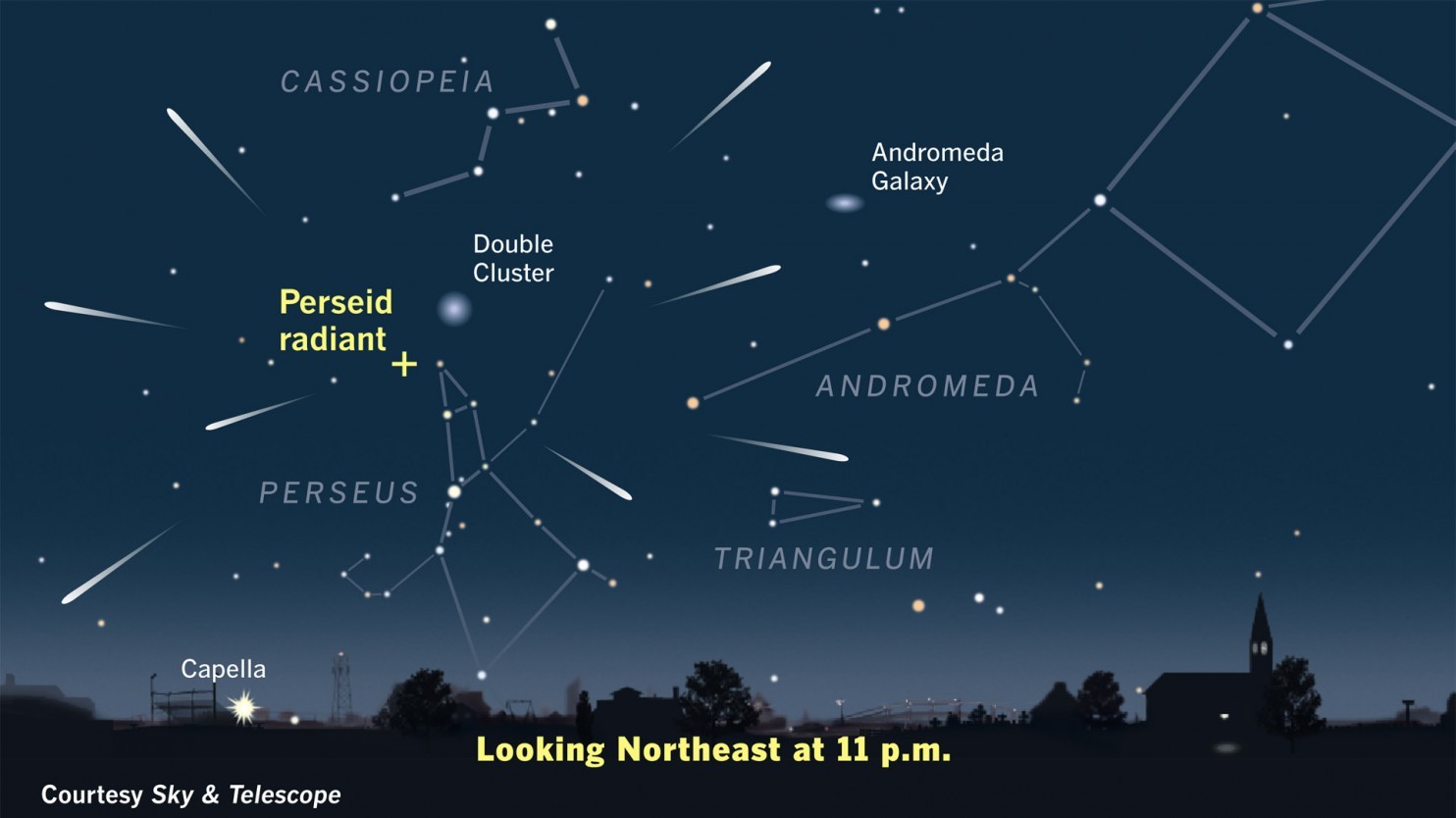
The Perseid Meteor shower lasts from late July to early September each year, and are expected to be at a peak on 12-13 August 2015, which falling slightly before the new moon of 14 August, should mean could viewing from most parts of the globe. At the peak of the shower there can be 50-100 meteors per hour. The Perseids get their name from the constellation of Perseus, in which the meteors have their radiant (the point from which they appear to originate).

The radiant of the Perseid Meteors. Sky and Telescope.

The shower is caused by the Earth passing through the trail of the Comet 109P/Swift-Tuttle, and encountering dust from the tail of this comet. The dust particles strike the atmosphere at speeds of over 200 000 km per hour, burning up in the upper atmosphere and producing a light show in the process. 

The Earth does not need to pass close to 109P/Swift-Tuttle for the meteor shower to occur, it simply passes through a trail of dust from the comet's tail that is following the same orbital path. Comet 109P/Swift-Tuttle itself only visits the Inner Solar System once every 133 years, last doing so in 1992. It is currently 36.4 AU from the Earth (i.e. 36.4 times as far from the Earth as the Sun, more than twice the distance between Neptune and the Sun) on an eccentric orbit tilted at 113° to the plane of the Solar System (or 67° with a retrograde orbit - an orbit in the opposite direction to the planets - depending on how you look at it), that takes it from 0.95 AU from the Sun (95% of the distance at which the Earth orbits the Sun) to 51.22 AU from the Sun (51.22 times as far from the Sun as the Earth, more than three times as far from the Sun as Neptune and slightly outside the Kuiper Belt, but only scraping the innermost zone of the Oort Cloud).

The orbit of 109P/Swift-Tuttle. Note that this is almost entirely below the plain of the Solar System. JPL Small Body Database Browser.

109P/Swift-Tuttle is next expected to visit the Inner Solar System in 2126, reaching about 22 950 00 km  (0.15 AU) from Earth in August of that year.

See also...

Comet C/2014 Q1 (PANSTARRS) reached its perihelion (the closest point on its orbit to the Sun) on Monday 6 July 2015, when it was 0.31 AU from the Sun (i.e. 0.31 times the average distance...


2015's Eta Aquarid Meteors.
The Eta Aquarid Meteor Shower will be at a peak on Tuesday 5/Wednesday 6 May 2014, with up to 45 meteors per hour at its peak, radiating from the constellation of Aquarius...


The effect of the Perseid Meteor Shower on the Lunar Exosphere.
The Moon lacks a dense atmosphere in which gases can interact to create weather systems or undergo chemical reactions, but it...


Follow Sciency Thoughts on Facebook.

Saturday, 8 August 2015

Landslide hits bus in Palpa District, Nepal, killing at least three.

Three people have been confirmed dead after a landslide hit a bus traveling from Palpa to Butwal on the Siddhartha Highway near Siddhababa on the afternoon of Saturday 8 August 2015, sweeping it into the Tinau River. Twenty six people were on the bus at the time of the incident, and it was initially feared that all had died, but around fifteen passengers have now been pulled from the wreckage alive, though there is little hope of finding any more survivors as the bus is now completely submerged in the river. The incident happened following 24 hours of heavy rain in the area, which reportedly weakened the hillslope above the road. Landslides are a common problem after severe weather events, as excess pore water pressure can overcome cohesion in soil and sediments, allowing them to flow like liquids. Approximately 90% of all landslides are caused by heavy rainfall.

Rescue workers recover the body of a victim following the 8 August 2015 Siddhababa landslide. DC Nepal.

Landslides are common during the monsoon season in Nepal, which lasts from May to September, with  the highest rainfall occurring in July, when the Palpa District typically receives around 230 mm of rain in the month. August is the second wettest month, typically receiving around 130 mm of rain.

The approximate location of the 8 August 2015 Siddhababa landslide. Google Maps.

Monsoons are tropical sea breezes triggered by heating of the land during the warmer part of the year (summer). Both the land and sea are warmed by the Sun, but the land has a lower ability to absorb heat, radiating it back so that the air above landmasses becomes significantly warmer than that over the sea, causing the air above the land to rise and drawing in water from over the sea; since this has also been warmed it carries a high evaporated water content, and brings with it heavy rainfall. In the tropical dry season the situation is reversed, as the air over the land cools more rapidly with the seasons, leading to warmer air over the sea, and thus breezes moving from the shore to the sea (where air is rising more rapidly) and a drying of the climate. This situation is particularly intense in South Asia, due to the presence of the Himalayas. High mountain ranges tend to force winds hitting them upwards, which amplifies the South Asian Summer Monsoon, with higher winds leading to more upward air movement, thus drawing in further air from the sea. 

Diagrammatic representation of wind and rainfall patterns in a tropical monsoon climate. Geosciences/University of Arizona.

See also...

One pupil has been confirmed dead and at least 13 more students and teachers have sustained injuries after a landslide struck a secondary school in the Chhorepatan area of Pokhara on Thursday 16...

Two doctors from India serving at the Lumbini Medical College are reported to have died after a landslide struck their car at Siddababa in Palpa District in southern Nepal on Wednesday 17 June 2015.  The two have been named as Tarun Deep Singh Kochar...

Over 4500 people have been confirmed dead after an Earthquake measured as a Magnitude 7.8 event at a depth of 15 km by the United States Geological Survey struck the Lamjung District of Nepal...


Follow Sciency Thoughts on Facebook.

Injuries reported after eruption on Manam Moto, Papua New Guinea.

The Rabaul Volcano Observatory reported an eruption on Manam Motu, a volcanic island 13 km off the north coast of Papua New Guinea on Friday 31 July 2015, which started at about 11.30 am local time, which resulted in fragments of scoria (a form of basaltic rock) up to 20 cm in diameter landing in the villages of Warisi and Baliau, where two people were reportedly knocked unconscious after being struck. Ashfall was reported across the island and in the villages of Bogia and Potsdam on the Papuan mainland. The Darwin Volcanic Ash Advisory Centre reported an ash column rising 19.8 km above the island, which then drifted 370 km to the southwest.

Image of the ash column over Manam Moto on 31 July 2015 captured by the Himawari-8 weather satellite. Japan Meteorological Agency/Volcano Discovery.

Following the eruption much of the north and west island is reportedly covered by ash 1-2 cm thick. preventing residents from accessing crops and in some cases water, prompting fears of food shortages, Many people in the affected areas have also reported suffering breathing difficulties, and most of the residents have been evacuated to rescue centers outside the affected zones, where it is unclear when they will be able to return home.

Manam Moto is essentially a submarine stratovolcano (cone-shaped volcano) with its tip sticking above the sea, forming a 10 km diameter circular island with the summit of the volcano at the centre. The island is remarkably symmetrical, with four valleys at 90° angles leading from the summit to the sea, which carry ejecta from the frequent eruptions.

The location of Manam Moto. Google Maps.

Manam Motu is one of Papua New Guinea's most active volcanoes; it underwent four eruptive cycles in 2011. The island was inhabited until 2004, when the island's population of ~9000 was evacuated after an eruption killed five people. The Papuan government allowed re-settlement to begin in March 2007, but three people were killed on the island within a month; the island's inhabitance status is currently unclear. Prior to 2004 the most recent fatalities had been in 1996, when a pyroclastic flow (avalanche of hot ash and poisonous gas) hit the village of Budua, killing 13. Despite its small size and inhospitable nature Manam Motu was apparently settled for a long time, having developed its own distinctive language (Manam). 

Manam Motu is located on the southern margin of the South Bismarck Plate, close to its boundary with the Australian Plate, which underlies the Papuan mainland. The Australian Plate is being subducted beneath the South Bismarck, and as it does so it is partially melted by the friction and the heat of the planet's interior. Some of the melted material then rises up through the overlying South Bismarck Plate as magma, fueling the volcanoes of the north Papuan margin.

See also...

Nine people have died after two landslides swept through the village of Kenagi, in Papua New Guinea's Eastern Highlands, late in the evening of Saturday 2 November 2013, and early in the morning...


Manam Motu is a volcanic island 13 km off the north coast of Papua New Guinea; it is essentially a submarine stratovolcano (cone-shaped volcano) with its tip sticking above the sea, forming a 10 km diameter circular island with the summit of the volcano at the centre. The island is remarkably symmetrical, with four valleys at 90° angles leading from the summit to the sea, which carry ejecta from the frequent eruptions.


Karkar is a volcanic island about 30 km north of Papua New Guinea. The whole island is a single giant stratovolcano (cone-shaped volcano), rising 1839 m from the sea. The summit is made up of two concentric craters. The outer, older crater is thought to have last been active around 9000 years ago. The inner crater, which has formed since the last eruption of the outer...


Follow Sciency Thoughts on Facebook.

Tityus apozonalli: A new species of Scorpion from Miocene Chiapas Amber.


The ambers of Chiapas State, Mexico, were laid down in the Miocene (and possibly Oligocene) in shallow marine environments. The amber is thought to be derived from resin secreted from a Leguminous tree of the genus Hymenaea, which lived in mangrove forests along the Caribbean shoreline. This amber is almost identical to amber produced in similar mangrove forests during the Miocene in the Dominican Republic and to a lesser extent other parts of the Caribbean, and a thriving, and sometimes illegal, trade in these fossils, combined with poor recording by commercial fossil collectors (particularly those acting illegally) means that fossils in Caribbean amber derived from private collections can be hard to connect to their point of origin. To date two Scorpions have been described from Chiapas Amber, and at least four further specimens attributed to this source are known in private collections, however the exact provenance of these fossils is unclear as precise data on the outcrops which produced them is unavailable.

In a paper published in the journal PLoS One on 5 August 2015, Francisco Riquelme of the Escuela de Estudios Superiores de Jicarero at the Universidad Autónoma del Estado de Morelos, Gabriel Villegas-Guzmán of the Laboratorio de Acarología at the Escuela Nacional de Ciencias Biológicas at the Instituto Politécnico Nacional, Edmundo González-Santillán of the Laboratorio de Aracnología at the Universidad Nacional Autónoma de México, Víctor Córdova-Tabares, also of the Laboratorio de Acarología at the Escuela Nacional de Ciencias Biológicas at the Instituto Politécnico Nacional, Oscar Francke of the Colección Nacional de Arácnidos at the Universidad Nacional Autónoma de Mexico, Dulce Piedra-Jiménez, also of the Laboratorio de Aracnología at the Universidad Nacional Autónoma de México, Emilio Estrada-Ruiz of the Laboratorio de Ecología at the Instituto Politécnico Nacional and Bibiano Luna-Castro of the Museo del Ámbar de Chiapas, describe Scorpion preserved in amber from the Early-Middle Miocene Guadalupe Victoria site near Simojovel in Chiapas, the first known fossil Scorpion that can be confidently assigned to a specific amber-producing site in Chiapas.

The new Scorpion is placed in the large (and probably paraphyletic – not containing all the descendants of the last common ancestor of the group) genus Tityus, within the Family Buthidae, and given the specific name apozonalli, which means ‘sea-bubble’ or ‘sea-foam’ in the Náhuatl language, and which was the term used amber by the pre-Columbian Aztecs.

Tityus apozonalli. (A) Amber piece, arrow indicates the position of fossil inclusion, scale bar 10 mm. (B) General view of fossil Scorpion, scale bar 5 mm. (C) Close view of the specimen, scale bar 2 mm. Riquelme et al. (2015).

Tityus apozonalli is thought to be most closely related to the modern species Tityus clathratus and Tityus columbianus, which are known from the Caribbean Islands, Central America and northern South America, as well as showing features in common with members of the genus from Dominican Amber, and to a lesser extent Tityus knodeli, which is attributed to Chiapas Amber, though of uncertain origin. A single specimen assigned to the genus has been described from Baltic Amber from Europe, Tityus eogenus, however this was described in 1869 and is now missing, and so is considered somewhat dubious.

See also…

The Scorpion genus Scorpiops is a wide ranging and highly specious group of medium-sized, generally brown Scorpions. There are currently about a dozen species known from China, all of which are found in Tibet.


There are thought to be about 50 described species of Scorpion from Pakistan, although these have not been systematically reviewed since 1900. Since 1995 there have been sixteen published studies on...


Wood Scorpions of the genus Euscorpius are found in Europe from Iberia to Russia, as well as North Africa and southwest Asia, and is therefore one of the best studied Scorpion genuses, with eighteen described species grouped into four subgenera, and numerous subspecies. Despite this it is thought that there is still much to be learned about its taxonomy, and that...


Follow Sciency Thoughts on Facebook.

Asteroid 2015 NA14 passes the Earth.

Asteroid 2015 NA14 passed by the Earth at a distance of 9 099 000 km (23.7 times the average distance between the Earth and the Moon, or 6.08% of the average distance between the Earth and the Sun), at about 6.05 pm GMT on Friday 31 July 2015. There was no danger of the asteroid hitting us, though had it done so it would have presented a considerable threat. 2015 NA14 has an estimated equivalent diameter of 71-230 m (i.e. a spherical body with the same mass would be 71-230 m in diameter, and an object towards the upper end of this range would pass through the atmosphere and directly impact the ground with a force of about 400 megatons (about 23 500 times the explosive energy of the Hiroshima bomb), causing devastation over a wide area and creating a crater over 3.5 kilometers across, and resulting in global climatic problems that could last for decades or even centuries.

The calculated orbit of 2015 NA14. JPL Small Body Database.

2015 NA14 was discovered on 15 July 2015 (sixteen days before its closest approach to the Earth) by the University of Hawaii's PANSTARRS telescope on Mount Haleakala on Maui. The designation 2015 NA14 implies that it was the 351st asteroid (asteroid A14) discovered in the first half of July  2015 (period 2015 N).

2015 NA14 has a 347 day orbital period, with an elliptical orbit tilted at an angle of 6.37° to the plain of the Solar System which takes in to 0.79 AU from the Sun (79% of the distance at which the Earth orbits the Sun, slightly outside the orbit of Venus) and out to 1.14 AU (14% further away from the Sun than the Earth). This means that close encounters between the asteroid and Earth are fairly common, with the last thought to have happened in November 2014 and the next predicted in July 2016. Although it does cross the Earth's orbit and is briefly further from the Sun on each cycle, 2015 NA14 spends most of its time closer to the Sun than we are, and is therefore classified as an Aten Group Asteroid. This also means that close encounters between 2015 NA14 and Venus are quite common, with the last having occurred in December 2013 and the next predicted for June 2024.

See also...

Asteroid 2015 OQ21 passed by the Earth at a distance of 567 900 km (1.48 times the average distance between the Earth and the Moon, or 0.38% of the average distance between the Earth and the Sun), at about midnight GMT between Thursday 23 and...


Asteroid (242191) 2003 NZ6 passed by the Earth at a distance of 12 470 000 km (32.4 times the average distance between the Earth and the Moon, or 8.33% of the average distance between the Earth and the...


Asteroid (385186) 1994 AW1 passed by the Earth at a distance of 9 725 000 km (25.3 times the average distance between the Earth and the Moon, or 6.50% of the average distance between the Earth and the...


Follow Sciency Thoughts on Facebook.