Showing posts with label Microbial Mats. Show all posts

Wednesday, 3 April 2024

Living Stromatolites from Sheybarah Island, Saudi Arabia.

Fossil Stromatolites form some of the earliest evidence for life on Earth, being present in deposits from the Palaeoproterozoic and Archaean, with the oldest known examples currently dated to about 3.48 billion years ago. However, their importance has declined in the Phanerozoic, forming significant proportion of carbonate reefs only for brief periods following the End Ordovician and End Permian extinctions. Stromatolites still exist today, and understanding formation presents us with the possibility of understanding some of the oldest ecosystems on Earth, although modern forms are generally restricted to extreme environments, such as hypersaline marine settings and alkaline lakes, with living Stromatolites only known from two modern open-marine environments, Shark Bay in Western Australia and in the Exuma Islands of the Bahamas. 

In a paper published in the journal Geology on 15 February 2024, Volker Vahrenkamp and Viswasanthi Chandra of the Physical Sciences and Engineering Division at King Abdullah University of Science and Technology, Elisa Garuglier and Ramona Marasco of the Biological and Environmental Sciences and Engineering Division at King Abdullah University of Science and Technology, Kai Hachmann, also of the Physical Sciences and Engineering Division at King Abdullah University of Science and Technology,  Pankaj Khanna of the Department of Earth Sciences at the Indian Institute of Technology GandhinagarDaniele Daffonchio, also of the Biological and Environmental Sciences and Engineering Division at King Abdullah University of Science and Technology, and Alexander Petrovic, again of the Physical Sciences and Engineering Division at King Abdullah University of Science and Technology, and of Carmeuse, describe the discovery of a colony of living Stromatolites in the intertidal zone on Sheybarah Island on the Red Sea coast of Saudi Arabia.

Sheybarah Island forms part of the Al Wajh Carbonate Platform on the northwest coast of Saudi Arabia. The Al Wajh Carbonate Platform is connected to the Arabian mainland, and is enclosed by a 115 km reef-shoal belt. The central part of the platform hosts a lagoon with a maximum depth of 42 m, which is surrounded by 92 islands and patch-reefs. Sheybarah Island is located on the southwest edge of this platform, and has an area of 27 km², with a maximum elevation of 2 m above sealevel. The lagoon-facing rim of the southern slope of the Al Wajh Carbonate Platform is dominated by Mangroves, behind which is a sandy and rocky, then a rocky reef flat facing towards the open sea.

(A) Location of study area in northern Red Sea. (B) Sheybarah Island on the southwest Al Wajh Carbonate Platform. White arrows indicate prevailing wind direction based on annual average wind data over 10 years. (C) Location of Stromatolite field at southwestern extent of Sheybarah Island. Vahrenkamp et al. (2024).

The Red Sea is semi-enclosed, with slow surface-water renewal, creating a low nutrient environment. In the northeast part of the Red Sea, the average surface temperature is typically about 28°C during the summer, falling to about 23°C in winter, and surface salinity can reach 41‰. Prevailing winds come from the north-northwest, with an average windspeed of 4 m per second, although in winter strong southwesterly winds sometimes occur. The prevailing winds bring with them a high load of iron-rich sediment.

The presence of Stromatolites on Sheybarah Island was discovered during a scouting visit made to the island in January 2021. The Stromatolites form a field in the intertidal to shallow subtidal zone, on a flat slope which dips towards the sea, formed from a fossil Coral reef. A core drilled into this reef produced a radiocarbon date of 5264 years before the present, suggesting that it was formed during the Holocene sealevel highstand, between 4000 and 8000 years ago, when sealevels in the area would have been about 2 m higher than today. The surface of this reef is eroded, presumably due to modern wave action lowering the flat upper reef to the modern sealevel. A lithified sand layer beneath the Stromatolites yielded a date of 1640 years before present, which dates obtained from laminations within the Stromatolites ranged from 120 to 325 years before the present. This implies that the onset of Stromatolite growth was no more than 300-400 years ago; it is possible that it was more recent and that sand grains from a now absent upper layer have been incorporated into the Stromatolite structure.

Stromatolite samples being collected from the location. Vahrenkamp et al. (2024).

The tidal range in the area where the Stromatolites are growing is typically 50-60 cm, with a maximum of about 1 m, although occasional storm surges can inundate lower lying parts of the island. Sea temperatures measured at a depth of 5 m varied between 21°C and 31°C over the course of a year, though in the intertidal zone the temperature variation was much higher, between 8°C and 48°C, as very shallow seawater was exposed to highs of day time and lows of night time air temperatures. Salinity measured in March was 42‰; at the same time the water pH was 7.8 and dissolved oxygen was 5.9 mg per litre.

The Stromatolites are found over an area of about 50 000 m³, which could be divided into three zones, upper intertidal or beach-adjacent, mid-intertidal, and shallow subtidal, each of which was dominated by Stromatolites of a different morphotype. Stromatolites in the beach-adjacent zone, referred to as Type 1 Stromatolites, tend to be grey-green to dark brown in colour, and elongated-sinusoidal to rhomboidal in shape, aligned so that their long axis is perpendicular to the predominant wave crest direction. These tend to be less than 15 cm high, 5-50 cm wide, and 10-100 cm long, although they often coalesce into larger structures, which can be as much as 10 m long. The surface of these Stromatolites tends to be pustular in texture, and their interiors fairly well lithified. The Stromatolites of the mid-to-lower intertidal zones, referred to as Type 2 Stromatolites, are flatter, reaching a maximum of about 5 cm  in height, forming irregularly shaped, ovoid to tabular clusters which can cover as much as 100 m³. The base of these Stromatolites is often raised above the platform, on a small column of eroded Holocene Coral. In the lower intertidal to shallow subtidal zones Type 3 Stromatolites are low relief and poorly lithified, and often covered by a thin layer of carbonate sand.

(A) Drone survey image of Stromatolite fields, showing three main morphotypes of Stromatolites and their distributions. (B)–(C) Type 1 Stromatolites in upper intertidal zone, with elongated sinusoidal to rhomboidal morphology, laminated internal structures, and pustular exterior. White arrows show grazing Gastropods during high tide (underwater photo). (D)–(E) Type 2 Stromatolites, consisting of low-relief, irregularly shaped ovoid clusters of Stromatolites in the outer field. (F)–(G) Type 3 Stromatolites, composed of less-defined, low-relief microbial mats covered by a thin coating of carbonate sand. Vahrenkamp et al. (2024).

The internal structure of Type 1 Stromatolites was found to be laminated, with undulating layers of sediment interspersed with layers with clotted fabrics and vugs (cavities lined with mineral crystals), which in the fossil record would be interpreted as Thrombolitic Stromatolites. When sections of this material were cut and washed, dense lithified layers stood out in relief. Grazing organisms such as Gastropods were often trapped in the matrix. Millimetre scale microlitic crusts (microbially derived calcium carbonate crusts) alternated with millimetre scale sediment layers, within which lithification was beginning to break down grain boundaries. These grain layers often showed high levels of microboring, suggesting ongoing micritization even after sediment accretion.  Rim cements contained numerous aragonite needles, while microlitic crusts were predominantly aragonite (85%), with significant proportions of high magnesium calcite (9%) and low magnesium calcite (5%), and small amounts of quartz and clay minerals.

(A) Hand sample of Type 1 Stromatolite demonstrating layered structures. (B) X-ray micro–computed tomography (µCT) X-Z cross-section image of Type 1 Stromatolite exposing denser internal laminations (red). Colour bar represents range of µCT values corresponding to CT density; blue represents a void. (C) Thin-section micrograph illustrating micritic crust at surface of Stromatolite. (D) Millimetre-scale lithified sediment grain layers (yellow arrows) and fused grains (green arrows). (E) Grains infested with microborings near outer rims and fused at grain contacts (green arrows). (F) Acicular needle aragonite cements (AA) formed around the grain (G) rims. Vahrenkamp et al. (2024).

Examined through a scanning electron microscope, filamentous Cyanobacteria appeared to be the most abundant organisms within the structure of the Stromatolites, enveloping sediment grains in single strands of bundles, covered with mucous sheaths made up of excreted biological polymers. These filament and biopolymer masses also contained large numbers of sub-micron sized calcium and magnesium carbonate crystals. Also present were biofilm structures with Bacterial cells, and Navicula-like Diatoms. The upper and lower surfaces of the topmost microbial mat included numerous reticulated filament structures. An investigation into the biodiversity of the mats using 16S rRNA gene metabarcoding found that the most abundant micro-organisms were Proteobacteria, which made up 49% of the total (30% Alphaproteobacteria, 12% Gammaproteobacteria, and 7% Deltaproteobacteria), with Cyanobacteria making up 16% of the total, and Bacteroidetes 11%.

(A)–(E) Representative scanning electron micrographs showing (A) extensively microbored sediment grains (MG) wrapped in cyanobacterial filaments and extracellular polymeric substance (EPS) films (arrows); (B) High magnesium calcite microcrystals (triangles) associated with Cyanobacterial filaments; (C) filamentous structures, possibly bunches and strings of Cyanobacteria (black arrows), and single cells of various shapes (white arrows) surrounded by desiccated EPS; (D) filamentous structures of different dimensions (black arrows), surrounding bored surface of sand grain. A Diatom is also present (white arrow); and (E) reticulated filaments (black arrows) surrounded by copious amounts of EPS (white arrows). (F) Microbial diversity of Sheybarah Island Stromatolites. Vahrenkamp et al. (2024).

The presence of Stromatolites on the intertidal platform of Sheybarah Island appears to be driven by environmental factors. The platform surface here is exposed to frequent wetting and drying cycles, as well as extreme temperature fluctuations, with generally low current conditions, apart from the occasional storm event. Similar conditions are found on the other islands of the Al Wajh Carbonate Platform, making it likely that these to are home to Stromatolite colonies. The conditions here are similar to those found in the Exuma Islands of the Bahamas, where Stromatolites are also found; the much lower profile of the Sheybarah Island Stromatolites (never more than 15 cm high) probably reflect the limited tidal range of the Red Sea.

Growth of the Sheybarah Island Stromatolites appears to be driven by microbial activity, which leads to the accretion and differential lithification of sediment grains. The range of structures observed appears to be driven by a cycle of grain-entrapment followed by sedimentation, similar to that which has been documented in the Bahamas. The microbial community within the Stromatolites appears to be made up of a combination of photoautotrophic organisms (Cyanobacteria), and heterotrophic organisms, including ones capable of reducing sulphates.

The reticulated filaments seen in the Sheybarah Island Stromatolites are a surprising structure. Such filaments have previously been observed in microbial mats from aphotic environments, such as caves. At Sheybarah Island they appear to be ubiquitous in the upper layer of Stromatolites, and have a variety of morphologies, including horizontal ridges supported by vertical columnar structures. The nature and composition of these filaments is unclear, and will be the subject of future research.

Vahrenkamp et al. believe the Sheybarah Island Stromatolites to be the first open marine Stromatolites discovered in the Middle East, providing a new opportunity to study structures sparsely distributed on the modern Earth, but which were an important part of the Earth's earliest ecosystems. To date, the Stromatolites of the Bahamas have been considered the best analogue for the shallow-marine Stromatolites which formed throughout the Proterozoic, making the similar, but not identical, Stromatolites from Sheybarah Island a significant discovery with the potential to greatly enhance our understanding of Proterozoic ecosystems.

See also...

Monday, 20 June 2022

Evidence for photosynthetic oxygen production in a Neoarchean lake.

The photosynthetic production of oxygen has been a driving force in the evolution of the Earth's surface throughout much of the planet's history. However, quite when this process began remains a mystery. Oxygen has been present in the Earth's atmosphere since the Great Oxidation Event, 2.4 billion years ago, which provides a latest possible date for the onset of photosynthesis, but opinions are divided as to whether this marks the onset of oxygen production by the biological organisms, which then rapidly changed the face of the Earth, or whether photosynthesis had been occurring long before this, but been masked as a signal in the geological record by abundant reducing compounds in Archean environments, which prevented oxygen from building up in the atmosphere. 

Theoretically, if oxygen production did start long before the Great Oxidation Event, then this should have led to the development of local 'oxygen oases', areas where oxygen production was able to overpower any local redox buffering to produce localised oxidative conditions, which might have been preserved in the rock record. Many Archean continental sedimentary deposits show signs of oxidative weathering, despite having apparently been laid down under a reducing atmosphere. A possible cause of this could have been the local production of oxygen in lake environments. A modern analogue for this has been observed in lakes in Antarctica, where photosynthetic Cyanobacteria produce oxygen in benthic microbial mats, beneath an anoxic water column. 

Microbial mats produce distinctive sedimentary structures called Stromatolites; these form when layers of micro-organisms create biofilms on the surface of sediments in shallow water environments. Typically such films are buried by sediments periodically, with a new biofilm forming on the surface. Over time this builds up to a distinctive structure with layers of organic and inorganic material. Since these structures record the environment in which pre-Great Oxidation Event photosynthesis was likely to have occurred, Archean lacustrine Stromatolites have become a target for scientists searching for evidence of such activity.

In a paper published in the journal Geology on 9 May 2022, Dylan Wilmeth of the Department of Earth Sciences at the University of Southern California, and the Laboratoire Géosciences Océan at the Institut Universitaire Européen de la MerStefan Lalonde, also of the Laboratoire Géosciences Océan at the Institut Universitaire Européen de la Mer, William Berelson, also of the Department of Earth Sciences at the University of Southern California, Victoria Petryshyn of the Environmental Studies Program at the University of Southern California, Aaron Celestian, again of the Department of Earth Sciences at the University of Southern California, and the Natural History Museum of Los Angeles CountyNicolas Beukes of the Department of Geology at the University of Johannesburg,  Stanley Awramik of the Department of Earth Science at the University of California, Santa BarbaraJohn Spear of the Department of Civil and Environmental Engineering at the Colorado School of Mines, and Taleen Mahseredjian and Frank Corsetti, again of the Department of Earth Sciences at the University of Southern California, present evidence for the presence of oxygen within microbial mats in a 2.74 billion-year-old palaeolake in the Hartbeesfontein Basin of South Africa.

The Hartbeesfontein Palaeolake formed in a half-graben structure within the Ventersdorp Continental Rift. ItTH has been identified as a lacustrine deposit on the basis of frequent, meter-scale facies shifts and intercalation with subaerial volcanic deposits. The palaeolake deposits also contain numerous Stromatolites, preserved as chert, many of which show exquisitely preserved microbial structures. Also present in the Stromatolites showing this high quality preservation are numerous rounded fenestrae (holes), which are interpreted as having been formed by gas bubbles produced by the activities of microbes living within the mats. These fenestrae are evenly distributed across the structures. Microbes living within mats of this sort can potentially produce a range of gasses (e.g. methane), so the presence of the fenestrae does not necessarily indicate the production of oxygen. 

Hartbeesfontein Basin (South Africa) Stromatolite textures. (A) Location map. Black square in inset represents map location. (B) Domal stromatolitic chert; hammer head is 2 cm tall. Wilmeth et al. (2022).

Wilmeth et al. used Rare Earth Element data to investigate the possible presence of oxygen within the Hartbeestfontein Stromatolites, in particular the distribution of cerium. Cerium levels were found to be anomalously high around fenestrae, and anomalously low in the surrounding laminae, which Wilmeth et al. believe is evidence of the element being scavenged onto oxides forming around the bubbles.

Fenestral oxides. (A), (B) Bubble fenestra with extensive oxides along bottom margin viewed in plane-polarized and reflected light. (C), (D) Fenestral (fen.) oxide viewed in reflected light. (E) Schematic of manganese (Mn) and cerium (Ce) oxidation and sorption onto fenestral oxides during mat growth. Qtz strom., quartz Stromatolite layers. Wilmeth et al. (2022).

Three distinctive assemblages of oxides could be observed within the Hartbeestfontein Stromatolites; within the bubble fenestrae, within the laminae, and on erosional surfaces. The fenestrae oxides appear orange and white under reflected light, and are found at the contact between the walls of the fenestrae and the megaquartz filling of the interior, implying that they were deposited early, before the emplacement of the quartz cement. Examination of this oxide layer with an electron microprobe found it to be rich in manganese, and the minerals goethite and titanite, whereas the oxide layers in the Stromatolite laminae were formed of  haematite and goethite, and are black, red, and yellow in colour, often with a metallic lustre. Oxides on recent erosional surfaces are reddish-orange in colour, and dominated by iron compounds.

Laminar and surficial oxides. (A), (B) Laminar oxides viewed under reflected light. Note the difference between laminar and fenestral oxides. (C) Laminar oxide with dissolution zones filled by orange goethite shown in reflected light. (D) Electron microprobe analysis backscatter image of laminar oxide with dissolution zones. (E) Schematic of laminar versus fenestral oxides during mat growth. (F) Surficial oxides formed by recent weathering. Qtz cem., quartz cement. Wilmeth et al. (2022).

All of the oxides present within the Hartbeestfontein Stromatolites are thought to have derived from minerals present in the original Archean microbial mats. However, these deposits have since undergone both  greenschist-grade metamorphism and weathering at the surface, so interpreting the original conditions must be done with care. For example, the haematite minerals present in the laminae of the Stromatolites were probably originally deposited as ferrihydrite or goethite.

Rare Earth Elements such as Cerium tend to be fairly immobile once deposited in rock formations, and not prone to redistribution by metamorphic processes. This makes them a useful tool for geologists wishing to understand the depositional conditions under which ancient strata were laid down. Furthermore, any available cerium within the water column will rapidly be incorporated into any manganese or iron oxides forming.

Cerium anomalies which are believed to have been formed after deposition are known, though these are due to the precipitation of cerium from water running over or through the rock. In the case of the Hartbeestfontein Stromatolites, the raised cerium levels can be observed around fenestrae that were enclosed within chert and recovered from drill cores, making this scenario highly unlikely. 

The presence of areas of both raised cerium (around fenestrae) and lowered cerium (within laminar layers), suggests that a radox boundary was present within the original Stromatolites, and therefore presumably the surrounding water column. Disolved cerium is scavenged from water and deposited onto iron or manganese oxides under oxidising conditions, but dissolves back into solution under reducing conditions. This would imply a shifting redox boundary within the ancient Hartbeestfontain Palaeolake, shifting above and below the microbial mats in response to changing local conditions. 

The deposition of cerium oxides around fenestrae withoin the Hartbeestfontain Stromatolites appears to be indicative of oxgen formation by microbes within the mats from which the Stromatolites formed. Given the highly reducing conditions thought to have been present within most Archean environments, this oxygen is likely to have been consumed by redox reactions long before it was able to make any meaningful impact on the wider lake environment, let alone the world beyond, but nevertheless the presence of these oxides tells us that ancient microbes had begun to produce oxygen by this time.

See also...


Online courses in Palaeontology

Follow Sciency Thoughts on Facebook.

Follow Sciency Thoughts on Twitter.


Thursday, 19 August 2021

Looking for a conection between the length of the Earth's days and the development of an oxygen-rich atmosphere.

A day on Earth (i.e. the period between one sunrise and the next) lasts for 24 hours, but four billion years ago it may have been as short as six hours. Thus, the length of the day, and the length of time for which any given part of the Earth's surface is exposed to sunlight during each cycle has increased threefold over the history of the planet. The rate of photosynthesis (i.e. the rate at which oxygen is produced by Plants, Algae, and Cyanobacteria exposed to sunlight) is determined by instantaneous photon flux, and should not be affected by the length of the day, as long as the total amount of sunlight over any given period remains the same. However, the net rate of oxygen is influenced by both how much oxygen is produced, and the rate at which organic material (and the bio-available carbon it contains) is buried, and this burial rate is potentially influenced by the length of the day. Thus the net production of oxygen by benthic ecosystems will be influenced by changes in the length of the day, due to changes in the availability of metabolites, the import, export and accumulation of which can be sensitive to daylength.

In a paper published in the journal Nature Geoscience on 2 August 2021, Judith Klatt of the Microsensor Group at the Max Planck Institute for Marine Microbiology, the Department of Earth & Environmental Sciences at the University of Michigan, Arjun Chennu, also of the Microsensor Group at the Max Planck Institute for Marine Microbiology, and of Data Science and Technology at the Leibniz Centre for Tropical Marine Research, Brian Arbic, also of the Department of Earth & Environmental Sciences at the University of Michigan, Bopaiah Biddanda of the Annis Water Resources Institute at Grand Valley State University, and Gregory Dick, again of the Department of Earth & Environmental Sciences at the University of Michigan, present a model which aims to explore this interaction, and how it would influence the export of oxygen into the atmosphere.

Klatt et al. modelled benthic ecosystems as systems in which oxygen photosynthesis, anoxygenic photosynthesis, aerobic respiration, anaerobic respiration (by sulphate reduction or without sulphate reduction), and the oxidation of sulphides by non-biological means, could all occur. The simplest model, with only oxygen photosynthesis and aerobic respiration, showed the amount of oxygen exported to the water column increased with increasing day length, as oxygen will not move from the mats to the water column until it builds up to a certain concentration, which takes time at the beginning of each daylight period. As this build up time is fixed, it represents a larger proportion of the day when the day is shorter, and a smaller proportion when the day is longer. Thus, with a longer day, the amount of oxygen exported from the mats will increase. If the mats are thin, then this will not just apply to oxygen being exported into the water column, but also to oxygen being exported into the substrate, which may create a distinctive weathering pattern that could be detected. This build up of oxygen would also increase the amount of bio-available oxygen within the mats, enabling the export of more organically bound carbon from the mats, therefore influencing the overall efficiency of the mats, and increasing the amount of organic carbon being buried, which in turn influences the level of oxygen in the atmosphere. Thus, although the rate of photosynthesis is independent of the length of the day, increasing the length of the day increases the amount of organic carbon burrial, and therefore the amount of oxyen build up in the water column and atmosphere.

 
Schematic of the global sinks and sources of oxygen with net release vs uptake of reductant by mats. The daylength-driven changes in organic carbon burial from benthic or terrestrial mats (mB; flux arrows not to scale) cause quasi steady-state transitions of global atmospheric oxygen pressure. Offsets in oxygen pressure between such steady states are conceptualised here as atmospheric oxygen (aO). The diel mat processes (inset box) produce organic carbon burial fluxes (mB), which along with burial from the pelagic domain (pB) comprise the global oxygen source. Both oxygen (mO) and reductant (mR) export from mats are controlled by the interaction between mass transfer and mat-intrinsic process rates (oxygenic photosynthesis, OP; anoxygenic photosynthesis, AP; aerobic respiration, Raero; sulphate reduction, Ranaero; aerobic hydrogen sulphide oxidation, SOX), and hence are sensitive to daylength changes. For the global oxygen sinks, Klatt et al. considered that some of the surplus oxygen released from the terrestrial or marine realm was consumed directly in the atmosphere (atmR) by volcanism- and metamorphism-derived gases (vR). Surplus reductant released from mats (mR in (a)) will increase atmospheric reductants (atmR). Surplus reductant consumed by mats (mR in (b)) will decrease atmospheric reductants, and add to source strength organic carbon burial. Thus, mat organic carbon burial is the sum of oxygen export and reductant import, and also sensitive to daylength. Note that volcanic reductant fluxes (vR) are equal to pelagic organic carbon burial (pB) and the equivalent pelagic oxygen export (pO) to illustrate that reductant uptake by mats influence the global availability of reductant. This influences the consumed fraction of oxygen pressure by atmospheric reductants. As a result, organic carbon burial is equal to water exported into the water column (wO), that is the oxygen that escapes reduction by atmospheric reductants. The sink for oxygen in the water column is erosional weathering (WEATH), and the emergent oxygen pressure for a reference weathering level is (wO/(0.95 × tB + uB)), where (uB) describes the size of the global organic carbon reservoir, uplift forcing and a weathering constant, was chosen based on a mid-Proterozoic oxygen pressure of 0.01 or 0.1 and was set constant over Earth age. To account for the direct erosion of terrestrial mats, WEATH was set to interact with 95% of terrestrial organic carbon burial rates (tB; a fraction of total mat burial mB). While this makes WEATH also sensitive to daylength and produces a buffering effect through increased weathering strength, atmospheric oxygenation (aO) still increases with daylength. Klatt et al. (2021).

For a more realistic scenario, Klatt et al. also included the consumption of organic carbon by anaerobic respiration (i.e. through the sulphate reduction process). In theory, both sulphate (the oxidised form) and sulphite (the reduced form) can be reacted with any other redox pair (such as ferrous and ferric iron), but Klatt et al. concentrated on the reduction of sulphate to sulphide, as this is thought to have evolved in Microbes early in life's history, and sulphide is known to have been abundant in many Precambrian coastal sediments. Klatt et al. therefore began with a model in which anaerobic sulphate reduction occurred at a fixed rate, in order to assess the impact of day length changes on the export of sulphites from the mats. As with the export of oxygen, the export of sulphites is determined by diffusion rates, anf the extent to which the produced sulphite is consumed within the mats. The consumption of sulphites within the mats also uses oxygen, competing with aerobic respiration for the available supply. Any organic carbon that is exported from the mats must escape being used for either aerobic or anaerobic respiration, and, therefore, the rate at which this is produced relates directly to the amount of oxygen and the amount of sulphite being exported. As the day length increases, the rate of both aerobic and anaerobic respiration increases, and the rate of sulphur oxidisation decreased. Thus, the rate of aerobic respiration is less sensitive to the effect of day length when sulphate reduction is introduced to the model than it was previously, and the rate at which oxygen is exported from the mats is lowered, but not eliminated, by the inclusion of sulphite production. Modern mat-dwelling sulphate-reducing Bacteria are inhibited by the presence of oxygen; when Klatt et al. introduced this to their model, the rate at which organic carbon was buried increased with increasing daylength.

Since the redox environment on Earth is known to have changed over time (just as the day length has), Klatt et al. examined the relationship between the (daylight driven) rate of organic carbon burrial and the available oxygen in the water column. Increasing the day length was found to increase both the rate of organic carbon burial and the rate at amount of available oxygen in the water column under all circumstances. Increasing the available oxygen in the water in turn led to an increase in the rate of aerobic respiration. However, the influence of available oxygen had a more complicated affect on the rate of organic carbon burial, as organic carbon can be produced both aerobically and anaerobically, dependent on whether or not the anaerobic respiration method was sensitive to the presence of oxygen. When Klatt et al. assumed that anaerobic respiration was inhibited by the presence of oxygen, as is the case with most anaerobic respirating microbes today, then increasing the day length resulted in a higher rate of organic carbon burial.

Next Klatt et al. considered the possibility that anaerobic photosythesisers, using hydrogen sulphide as an electron donor, might be present in the mats. This resulted in a longer time-period before the mats began to export oxygen each day, during which time the anaerobic microbes were depleting the hydrogen sulphite to a level at which oxygen photosynthesis could occur. Thus, although the amount organic carbon produced by photosynthesis remains fairly constant, increasing the day length both increases the amount of oxygen being exported and lowers the rate of anaerobic respiration (due to the presence of inhibiting oxygen). Unexpectedly, this also lowers the rate of aerobic respiration, due to the presence of sulphur oxides, which compete with the respirators for the available oxygen. Thus, when modelled with a wide range of oxygen and sulphur levels in the water column, Klatt et al. found that in all cases the oxygen and sulphur model made organic carbon buial more closely tied to day length than was the case when only oxygen was considered. Thus the range of metabolic pathways available has more influence on the relationship between daylength and organic carbon burial than the redox state of the water column.

Klatt et al. were able to demonstrate that the rate of organic carbon burial, which is thought to be closely linked to the accumulation of oxygen in the atmosphere, would increase with increases in daylength under a wide range of conditions, without assuming a decreasing oxygen sink (i.e. a supply of substances on the Earth's surface which would react with oxygen, thereby preventing it from building up in the atmosphere), or an increase in the global rate of photosynthesis. It is, however, likely that the global rate of photosynthesis did change over this period, as new, more efficient metabolic pathways evolved, and redox and phosphate levels in the oceans changed due to the weathering of rocks on land during what has been turned the 'boring billion' years of the Mesoproterozoic. The accumulation of oxygen in the atmosphere is still expected to be driven largely by the global rate of production by photosynthesis, but the length of the day clearly has a major impact on the burial of organic carbon, and there is a predicted link between the extent of benthic environments in which photosynthesis can occur and the extent to which day length is able ro affect the system.

As a further test of this model, Klatt et al. measured the rate of photosynthesis and oxygen export by Cyanobacterial mats from the Middle Island Sinkhole in Michigan, USA, which are considered to be a good model for Proterozoic microbial mats under low oxygen conditions. They found that the mats only exported oxygen after they had been exposed to light for some time. White Sulphur-oxidising Bacteria grew on top of the mats during the night and early morning, and these reduced the light available for photosynthesis. Light levels did not become high enough for photosynthesis until the early afternoon, at which point the White Sulphur-oxidising Bacteria migrated downwards through the mats, possibly in response to the depletion of sulphides by the oxygen produced by the Cyanobacteria. After this, the oxygen produced needed to react with any sulphide in the water column before free oxygen began to build up, creating an additional lag of 1-8 hours. Increasing the strength of the light to the mats increased the speed at which oxygen was produced and exported into the water column, with the oxygen production remaining high once sulphides were depleted even if light levels fell.

The presence of White Sulphur-oxidising Bacteria at the top of the mats lowered light availability for the Cyanobacteria, delaying the onset of oxygen production. This implies that day length has a strong effect on overall oxygen production in communities where photosynthetic and chemosynthetic microbes are competing. Klatt et al. further tested this model by exposing samples of the mats to 'days' of different length using artificial lighting in a laboratory. They found that when the total day length was less than twelve hours then the mats produced non oxygen, instead becoming a sink for any oxygen in the water column. When the day length reached sixteen hours (predicted for the Late Archaean), then the mats became net exporters of oxygen, with the amount of oxygen produced at a day length of twenty one hours (predicted for the Late Proterozoic) doubling that produced at sixteen hours, and the amount of oxygen produced at a day length of twenty four hours being three times that of the sixteen hour day.

Similar interactions have been seen in other microbial mats at other locations, although it is unclear which of them, if any, provides the best model for life in the Precambrian. However, several different sets of conditions can be shown to produce less oxygen with a shorted day length, largely to fluctuations in the redox state within the mats over the course of  the day. Many types of microbes also have the ability to alter their metabolic pathways in response to environmental conditions, which may lead to further delays in the onset of oxygen production in the presence of sulphides. 

This conceptual model, in which the length of the day effects the burial rate of organic carbon, fits well with observations of modern sediments, in which it has been shown that exposure to oxygen decreases burial efficiency. As the days get longer, aerobic respiration takes over from anaerobic respiration, and the extent to which oxygen penetrates into the mat decreases. This means that layers of the mats which are not dominated by photosynthetic organisms (i.e. those lower down) actually recieve less oxygen over the course of a day. This would enhance the burial of organic carbon. The rate at which mats accumulate must also be taken into account when looking at the burial of organic carbon. Modern mats can accumulate at rates of 0.5 to 5 mm per year, with estimates of ancient mat growth having a slightly higher range, perhaps 0.5 to 15 mm per year. If lengthening days decreased the oxygen availability within the mats, and increased the burial of organic carbon, then it is likely that the accretion rate of the mats would also have increased, potentially making a more pronounced shift in productivity and carbon burial than was observed in the modern mats.

This phenomenon, in which the lengthening day caused changes in the production and export of oxygen and organic carbon from microbial mats would have gone on as long as the 'matworld' existed. Unfortunately, it is hard to quantify the rate at which this would have occurred, as we are uncertain of the rate at which the Earth's days have increased, other than that this has not proceeded at a steady rate over the history of the Earth. If we extrapolate backwards, using the current rate at which our days are lengthening and the related rate at which the Moon is moving away from the Earth, we get a scenario in which the Moon would have collided with the Earth 1.5 billion years ago; something for which there is no evidence. Some recent models have tried to take into account the influence of the position of the continents on the Earth's rotational deceleration, and have come to the conclusion that the lengthening of the days would have been at its lowest in the Middle Proterezoic. Another hypothesis suggests that there may have been periods in which the days did not lengthen at all and the Earth-Moon system remained stable due to a resonant atmospheric thermal tide. In this scenario on the length of the day would have remained stable throughout the 'boring billion' years of the Mesoproterozoic, then started to lengthen at around the time of the Neoproterozoic Oxygenation Event (between 800 and 540 million years ago), which in turn suggests there might be a link between the two events.

In order to model the impacts of a link between daylength, oxygen production, and organic carbon burial on a global scale, Klatt et al. used a recent model which suggests that the length of the days increased steadily until about 2.2 billion years ago, when they stabilized, due to a resonant stability with the Moon, with a resumption in lengthening occurring about 650 million years ago. In this model Klatt et al. combined their findings on organic carbon burial and oxygen production with other events likely to have influenced the composition of the atmosphere, notably the reducing influence on the atmosphere caused by large scale metamorphism, the production of volcanic gasses, and weathering of exposed rocks on the Earth's surface. They found that this model could account for the change in atmospheric composition associated with the Great Oxidation Event (between 2.4 and 2.0 billion years ago) without the need to invoke any change in the global rate of photosynthesis, or any other redox change in the atmosphere. This scenario starts with an 18-hour day in the Archaean, which results in zero burial of organic carbon, increasing to a 21 hour day in the mid-Proterozoic, when about 50% of the current burial rate of organic carbon is achieved, although these mats would only cover 3.7% of the area of the modern oceans (for comparison the modern shallow water zone (where photosynthesis is possible for benthic organisms) covers about 7.5% of the ocean surface. This day lengthening would allow atmospheric oxygen to reach 28% of current levels by about 550 million years ago (the beginning of the Cambrian), which is consistent with a Neoproterozoic Oxygenation Event, between 800 and 540 million years ago, and a later Palaeozoic Oxygenation Event, possibly coincident with the Ordovician Biodiversity Event, at about 400 million years ago.

 
Weathering and organic carbon burial rates over time and corresponding examples for proxies in the geological record. Increases in the latter two parameters indicate enhanced weathering fluxes. All rates were derived from the modelled scenario that include aerobic and anaerobic respiration and exclusive oxygenic photosynthesis. Shaded areas represent the range of rates dependent on 1.5–3.7% modern oceanic coverage by benthic coastal mats (corresponding to 20–50% of global marine organic carbon burial during the mid-Proterozoic) and a continental coverage of 5% by terrestrial mats. Changes in global coastal benthic and terrestrial organic carbon burial fluxes are driven by changes in daylength and are shaped by feedback effects of increasing oxygen pressure on aerobic respiration. Pelagic burial, atmospheric reduction by volcanism- and metamorphism-derived gases and weathering were parameterized for a reference oxygen pressure of 0.1 in the mid-Proterozoic. The rate of atmospheric reduction was assumed to be constant and determined by the flux of reduced gases. In contrast, the rate of erosional weathering increases with daylength as it depends on oxygen pressure and organic carbon burial by terrestrial mats. Klatt et al. (2021).

Klatt et al. suggest that isotope excursions in the Precambrian rock record associated with oxygenation events are actually signals of the increased burial rate for organic carbon, which is in turn caused by increases in the global photosynthesis rate and a drop in remineralisation as the increased available oxygen caused by the increasing day length used up available oxygen-reactive minerals. It is difficult to connect isotope signatures directly to microbial mats, as limited isotope fractionation occurs within them, but the model of atmospheric oxygen enhancement and increased burial of organic carbon driven by increasing day length does match the signatures seen in the rock record. An increase in weathering in terrestrial rocks with rising oxygen levels, which would release more phosphorous into the system, resulting in a further boost in microbial productivity has been previously predicted. Klatt et al. have not included this in their models as they believe any such effect would be transitory in nature, with oxygen levels quickly returning to a steady state. The availability of nutrients could shape the rate of global photosynthesis, and therefore the possible range of oxygen pressures that could be achieved, but Klatt et al. believe the length of the day and burial rate for organic carbon would have actually driven oxygenation rates, at least until the Palaeozoic Oxygenation Event.

Klatt et al.'s models indicate that the length of the day is a consistent driver of oxygenation levels across a range of possible metabolic parameters. The possibility that the Earth and Moon could have gone through periods of resonance locking, with abrupt changes in day length as these phases are entered or escaped from, serves as a possible trigger for the distance oxygenation events seen in the rock record. In this sense, day length changes can be considered to be of similar significance to events such as the opening of major tectonic rifting zones and the formation of supercontinents, which are also thought to have had profound impacts on the composition of the atmosphere, although there is no known link between the Earth's orbital parameters and these events. Even of a simple gradual increase in day length is assumed, Klatt et al.'s model produces an increase in oxygen production and decrease in oxygen sinks that could produce relatively rapid shifts in the atmospheric oxygen level. The exact extent to which the length of days contributed to shifts in atmospheric oxygen levels is impossible to know, nut Klatt et al.'s model provides a remarkably good reconstruction of the shifts in the oxygen content of the Early Earth's atmosphere without the need to invoke other factors, which strongly suggests that the orbital dynamics of the Earth-Moon system played a role in the evolution of the Earth's atmosphere during the Proterozoic Eon.

See also...


Online courses in Palaeontology. 

Follow Sciency Thoughts on Facebook.

Follow Sciency Thoughts on Twitter


Friday, 17 July 2020

The end of the Jabłonna Reef system of the Zechstein Sea.

The Zechstein Sea was once a shallow marine basin that occupied much of the area covered by northeastern England, the North Sea, Germany and Poland during the Late Permian. It was connected to the Palaeotethys Ocean, and formed a shallow sea dominated by microbial reef systems. Towards the end of the period it repeatedly became cut off from the wider ocean and developed into a hypersaline basin similar to the modern Dead Sea, before vanishing completely. The Zechstein evaporite deposits are today mined for salt, gypsum, and potash in England, Germany and Poland. Carbonates preceding the vast accumulation of evaporites reflect changes in the basin hydrology and the degree of connection to the open sea. The resulting sequence of deposits mirrors a shift from normal marine to evaporitic conditions. In the Zechstein Basin microbial deposits abound in the uppermost part of the first Zechstein cycle carbonate, of middle Wuchiapingian age, both in marginal and central parts of the basin. Traditionally, the Zechstein Group is divided into cycles reflecting progressive evaporation: at the base of a cycle are normal marine sediments; these are followed by sediments indicative of increasing salinity, first sulphates, next chlorides and eventually potash salts. Traditionally, four evaporitic cycles were distinguished. The total stratigraphic thickness of the Zechstein deposits in the basin centre exceeds 1.5 km.

In a paper published in the Journal of Palaeogeography on 3 July 2020, Tadeusz Marek Peryt and Marek Jasionowski of the Polish Geological Institute, Paweł Raczyński of the Institute of Geological Sciences at the University of Wrocław, and Krzysztof Chłódek of the Polish Oil and Gas Company, report and interpret the changes in the middle Wuchiapingian sedimentary environments at the transition from carbonate to sulphate deposition at the Jabłonna Reef area in southwest Poland.

Microbial deposits are an essential component of Zechstein Limestone reefs, and their frequency increases upsection. Such a trend was regarded in the past as the record of increasing seawater salinity that eventually led to the deposition of sulphate evaporites. However, a recent study indicated that Echinoids are common throughout the Zechstein Limestone section except close to its top, suggesting that most of the Zechstein Limestone sedimentation was within the normal range of marine salinity and remained at roughly the same level. However, the evaporite drawdown effect caused significant salinity increase at the top of the Zechstein Limestone deposits. The eventual rise of salinity led to the onset of the evaporite deposition in the basinal facies. The sharp boundary between the Zechstein Limestone and the overlying sulphate deposits (Lower Anhydrite) in the basinal facies is due to the nature of evaporites that start to precipitate immediately when the brines reach saturation.

Lithostratigraphy and sequence stratigraphy of the basal Zechstein strata in southwest Poland. Peryt et al. (2020).

Peryt et al.'s choice of the study area was controlled by two factors. First, the uppermost part of the Zechstein Limestone and the transition Zechstein Limestone-Lower Anhydrite was cored in three boreholes (Jabłonna 1, 2, and 3) of four drilled in this particular reef. Secondly, both the Zechstein Limestone (except its uppermost part) and the Lower Anhydrite were characterized in detail in previous studies. Thus, this study fills a gap in the knowledge of depositional history at the carbonate-sulphate transition in the basinal setting.

Location of the study area. (a) The Zechstein Basin, asterisk shows the location of the Jabłonna Reef; (b) Palaeogeography of the Zechstein Limestone, rectangle shows the Wolsztyn reefs shown in (d); (c) The location of arbitrary line 2 showing the location of boreholes (black dots); (d) Reefs of the Wolsztyn palaeo-High; (e) Interpretation of Zechstein along the cross-section shown in (c). Abbreviations: Ca1, Zechstein Limestone reef; eva, evaporites (anhydrite and halite) of the PZ1 cycle (cyclothem); PZ1, PZ2, PZ3, Polish Zechstein cycles (cyclothems); Z₁𝇃, Z₁, Z₂, Z₃; Zechstein seismic reflectors. Peryt et al. (2020).

The Jabłonna Reef is one of many isolated reefs located on the elevated parts of the Brandenburg-Wolsztyn-Pogorzela High that is a part of the Variscan Externides consisting of strongly folded, faulted and eroded Visean to Namurian flysch deposits, capped by a thick cover of Upper Carboniferous–Lower Permian volcanic rocks. The reefs came into existence shortly after the rapid transgression of the Zechstein sea that flooded, probably catastrophically, this intracontinental depression located well below the contemporaneous sea level, some 257 million years ago. The rapid inundation allowed for almost perfect preservation of the uppermost Rotliegend landscape. The rapid inundation was succeeded by several rises in sea level, and thus the Zechstein Limestone section of the Wolsztyn palaeo-high may comprise only the younger part of the unit elsewhere.

The analysis of three dimensional seismic sections indicated that the Jabłonna Reef is composed of three parts: two small, roughly elliptical, and west northwest-east southeast elongated (penetrated by boreholes Jabłonna 3 and Jabłonna 4) and one large, elongated (penetrated by boreholes Jabłonna 1 and Jabłonna 2). Coeval Zechstein Limestone deposits in the depressions between and outside the reefs are thin (a few metres at most), and they are eventually underlain by the middle Wuchiapingian Kupferschiefer, one of the prime correlation markers in northwest and Central European stratigraphy. This unit records a period of basin-wide euxinic conditions, and can thus be considered an excellent time-marker.

The mineralogical composition of the Zechstein Limestone of the Jabłonna Reef varies, although limestone is the main rock type. Most of the Zechstein Limestone sections of the Jabłonna Reef is composed largely of bioclastic (mostly bryozoan) grainstones, and bryozoan and microbial boundstones that were formed in subtidal environments. The general shallowing-upward nature of deposition in the Jabłonna Reef area resulted in reef-flat conditions with ubiquitous microbial deposits in its central part. Subsequently, because of reef-flat progradation, the entire Jabłonna Reef area became a site of very shallow, subaqueous deposition. The uppermost part of the Zechstein Limestone, 2.8–5.1m thick, shows a breccia texture, and is the subject of Peryt et al.'s study.

The Lower Anhydrite consists of nodular anhydrite occurring at the base, which gradually passes into anhydrite with pseudomorphs after gypsum crystals. It is overlain by the Upper Anhydrite. In total, the thickness of PZ1 (Polish Zechstein 1) anhydrite in the Jabłonna Reef area varies from 59.2 to 66.0m; these are followed by PZ2-PZ4 (Polish Zechstein 2-Polish Zechstein 4) that are several 100m thick, and then by Triassic and Cainozoic deposits.

The reefs related to the Wolsztyn palaeo-high are excellent gas reservoirs, and part of their porosity owes its origin to freshwater flushing after deposition of the major part of the Zechstein Limestone and/or during the deposition. Certainly, the freshwater diagenesis occurred before the Lower Anhydrite deposition, as the subsequent geological history indicates that the reef deposits were continuously affected by marine-derived brines. Thus the geological history of the area rules out freshwater diagenesis after the onset of the PZ1 evaporite deposition on the top of the Jabłonna Reef.

Altogether 43.4m of core from three borehole sections: Jabłonna 1, Jabłonna 2 and Jabłonna 3 across the uppermost part of the Zechstein Limestone (15 m) and the Lower Anhydrite (41.3 m) were subjected to a detailed sedimentological analysis. Following detailed core measuring, 15 polished core samples and 40 thin sections were examined for sedimentological aspects of the Zechstein Limestone and to record the changes in the frequency of occurrence and the state of preservation of fossil taxa. Twelve thin sections were studied with cathode luminescence.

The uppermost part of the Zechstein Limestone in the Jabłonna 1 borehole is 4.0m thick (depth 2342.0–2346.0 m) and shows a brecciated nature. Clasts are usually sharp-edged and of very various, often centimetric sizes, and show the inclined arrangement. They are composed of limestone and dolomite showing various microbial textures and more rarely organo-detrital texture. These clasts are embedded in nodular anhydrite(−enriched) matrix, and sometimes are accompanied by fine sharp-edged clasts that commonly occur also in the strata underlying the brecciated top part of the Zechstein Limestone. This part of the section smoothly passes into fine nodular, bedded anhydrite that shows abundant carbonate content; the thickness of beds varies from a few to about 10 cm, and in places, the beds are slightly inclined. This portion is 3.2m thick and it gradually passes (0.6 m) into massive anhydrite with clear centimetric pseudomorphs after upright-growth gypsum crystals (this part of the sequence is 2.0m thick), followed by finenodular anhydrite (10.3 m thick). Then, anhydrite breccia (0.6 m thick) occurs, followed by recrystallised anhydrite of conglomeratic appearance (12.3 m thick) with locally occurring clear pseudomorphs after bottomgrowth gypsum crystals.

Samples of the uppermost Zechstein Limestone of the Jabłonna 1 borehole; the depths in relation to the top of Zechstein Limestone are: (a) 0.1 m, (b) 0.9 m, (c) 1.3 m, (d) 2.15 m, (e) 3.4 m, (f) 3.7 m, (g) 4.8 m. Abbreviations: an, anhydrite; dd, detrital dolomite; md, microbial dolomite. (a)-(c) Clasts of microbial carbonates and peritidal laminites within anhydritic and dolomitic matrix; (d) steeply inclined pisolitic dolomite; (e), (f) large clasts of microbial carbonate in nodular anhydrite; (g) microbial encrustations and cement crusts (arrowed) stabilising detrital deposit consisting of sharp-edge clasts, underlying the brecciated deposits shown in (f). Peryt et al. (2020).

In the Jabłonna 2 borehole, the breccias (2.8 m thick) consist of clasts of limestones (mostly Bryozoan grainstone and Stromatolite) in a dolomite matrix. In some instances, dolomicrite with quartz silt and micas (of aeolian origin?) were recorded. These breccias occur at a depth of 2345.4–2348.2 m. Due to the abundance of anhydrite nodules in the top 1.1 m, the transition to the Lower Anhydrite is, in fact, gradual. Above the conventional boundary, now placed at a depth of 2345.4 m, distinctively bedded nodular anhydrite (5.0 m thick) occurs, and the bedding is disclosed by dolomite laminae and lenses showing carbon¹³ and oxygen¹⁸ levels characteristic of the Zechstein evaporite formations. In the upper part of the section, a 2.4-m-thick interval composed of bedded nodular anhydrite occurs, which shows clear pseudomorphs after upright-growth gypsum crystals.

Aspects of the uppermost part of the Zechstein Limestone in the Jabłonna 1 borehole; the depths in relation to the top of Zechstein Limestone are: (a), (b) 2.8 m, (c) 2.4 m, (d)-(h) 0.1 m; Abbreviations: an, anhydrite; bs, Bivalve shell; fe, Foraminiferal encrustation; ga, Gastropod shell; me, microbial encrustation; os, Ostracod. (a), (b) Clast of recrystallised peloidal deposit showing relics of stromatolitic lamination and encrusting Foraminifers; arrow shows the carbonate crust with common pseudomorphs after lenticular gypsum crystals shown in (b); (c) Bivalve shells with microbial encrustations, Gastropods, Ostracods, encrusting Foraminifers and other small allochems in recrystallised micritic matrix and anhydrite cement (sample taken from a clast); (d) sample shown by X (3) above; (e)-(h) fragments of (d) showing aspects of microbial lamination (e), (f), (h) and encrusting Foraminifers (g), (h). Peryt et al. (2020).

The uppermost part of the Jabłonna 2 section resembles most of the underlying deposits consisting of granular sediments with inclined crusts of possible microbial laminites. However, due to dolomitisation and severe recrystallisation, these primary features are poorly (but still) visible. A complex diagenesis in this part of the section might account for the seemingly brecciated nature. But on the other hand, the occurrence, in the close neighbourhood, of clasts of rocks that originated in various environments indicates their transportation.

Polished section (a) and thin sections (b)-(d), uppermost Zechstein Limestone, Jabłonna 2 borehole (the depths in relation to the top of Zechstein Limestone are: (a) 0.6 m, (b) 1.4 m, (c) 1.7 m, (d) 2.2 m). Abbreviations: an, anhydrite; dl, detrital limestone; ml, microbial limestone. (a) Dolomite breccia composed of sharp-edged clasts of peritidal carbonates and, in the top part of the sample, nodular anhydrite; (b) microbial encrustations at the boundary of a clast composed of Bryozoan grainstone that is enclosed in nodular anhydrite; (c) recrystallised limestone composed of crinkle laminations and fine allochems; arrows show Bryozoan zoaria; (d) micritic dolomite showing laminae (arrow) and faint outlines of allochems, with abundant fine quartz grains (white dots) and rare fine mica flakes. Peryt et al. (2020).

The brecciated portion of the Zechstein Limestone in the Jabłonna 3 borehole is 5.1m thick and occurs at a depth of 2348.9–2354.0 m. The clasts show various sizes – from less than 1 mm to several cm. Clasts are accompanied by microbial laminations that also occur at the Zechstein Limestone-Lower Anhydrite boundary. They are overlain by nodular anhydrite (0.9 m thick) containing abundant dolomite in the matrix; the nodules show a clear upward trend toward the bedding arrangement. Next, there is bedded nodular anhydrite (2.4 m thick), most probably clastic, followed by nodular anhydrite with pseudomorphs after upright-growth gypsum crystals up to 2 cm high. The topmost 1.25 m of the cored interval consists of massive anhydrite with gypsum pseudomorphs up to 25 cm high.

Polished sections (a)-(d) and thin sections (e)-(g) from the uppermost Zechstein Limestone, Jabłonna 3 borehole; the depths in relation to the top of Zechstein Limestone are: (a) 0m, (b) 2.2 m, (c) 0.5 m, (d) 1.5 m, (e) 0.6 m, (f) 2.7 m, (g), (h) 3.8 m. Abbreviations: an, anhydrite; dd, detrital dolomite; ml, microbial limestone. (a) Zechstein Limestone–Lower Anhydrite boundary (dotted): microbial (thrombolitic) dolomite overlain by dolomite-rich anhydrite with anhydrite nodules; (b) clasts and microbial laminations steeply inclined within nodular anhydrite; (c), (d) clasts of various size in the anhydrite matrix; (e) aspect of microbial carbonate (filaments?); (f) sharp-edge fine clasts of microbial carbonate with isopachous cement; (g), (h) Stromatolitic encrustations on and accompanied by detrital deposit; X in (h) indicates the location of (g). Peryt et al. (2020).

In terms of mineralogy, the uppermost portions of the Jabłonna sections are generally dolomites with a variable contribution of anhydrite. They show a more complex mineralogical composition. Besides dolomite and anhydrite, they also contain calcite and a minor admixture of accessory minerals, such as celestite, fluorite and authigenic quartz. 

Medium crystalline nonplanar unimodal dolomite with partly preserved primary fabrics (?boundstone–upper four images, bioclastic grainstone–lower four images). (a), (b), (e), (f) transmitted light microphotographs (plane-polarized light and crossed polars, respectively), (c), (g) cathodoluminescence images, (d), (h) backscattered electron images. Abbreviations: dol, dolomite; anh, anhydrite; fine red dots mark spots of microprobe analyses). The anhedral dolomite crystals are usually few tens of micrometres in size and exhibiting undulatory extinction in crossed polarised light. The dolomite is red with some yellowish patches in cathodoluminescence. Primary porosity is plugged with anhydrite cements. Fine crystalline (dolomicritic) patches in the image (a) are encrusting Foraminifers. Jabłonna 1 borehole, sample located 0.5m below the top of the Zechstein Limestone. Peryt et al. (2020).

Two main varieties of dolomite can be distinguished. The most common one is usually nonplanar mediumcrystalline, unimodal dolomite composed of anhedral crystals, mostly a few tens of micrometres in size, exhibiting undulatory extinction in crossed polarised light. However, planar euhedral dolomite crystals are also visible in places. The dolomite crystals are typically cloudy and are rich in inclusions. They show red cathodoluminescence with yellowish spots or zones in places. The dolomite crystals form massive mosaics or very cavernous masses plugged with coarsely crystalline anhydrite and sometimes coarsely crystalline calcite. In some cases, pores are lined by thin rims dolomite crystals. Dolomitisation was generally fabric-destructive and matrix- and grain-replacive, but remains of original fabrics are still traceable in places. The porosity may be in part both secondary (e.g. after dissolution of some components, e.g. fossils) and primary (e.g. original interparticle porosity); the cavernous portions mimic probably original sedimentary fabrics, such as the grainstone texture.

Coarse crystalline calcite (orange in cathodoluminescence) within medium crystalline dolomite (bright red in cathodoluminescence) with abundant anhydrite cementation. (a), (b), (e), (f) transmitted light microphotographs (plane-polarized light and crossed polars, respectively), (c), (g) cathodoluminescence images, (d), (h) backscattered electron images images. Abbreviations: cal, calcite; dol, dolomite; anh, anhydrite; fine red dots mark spots of microprobe analyses. The calcite crystals are probably burial cements that occlude porosity within dolomite. Jabłonna 3 borehole, sample located 0.6 m below the top of the Zechstein Limestone. Peryt et al. (2020).

The second type of dolomite in the sections studied, volumetrically subordinate, is finely crystalline dolomite (dolomicrite). Some fossils (e.g. sessile Foraminifers) or microbialitic fabrics are mimetically replaced by dolomite.

Calcite is present only in some of the thin sections studied. Petrographically, two calcite varieties can be distinguished: massive calcite mosaics and coarsecrystalline calcite cements distributed within dolomite.

Coarse crystalline calcite mosaic with numerous euhedral fluorite crystals. (a), (b) Transmitted light microphotographs (plane-polarized light and crossed polars, respectively); (c) cathodoluminescence image, (d) backscattered electron image. Abbreviations: cal, calcite; dol, dolomite; fl, fluorite; qtz, quartz; fine red dots mark spots of microprobe analyses. The clearer (inclusion-poor) crystals with distinct internal zonation pattern (orange in cathodoluminescence) are probably cements that occlude porosity within calcite mass composed cloudy (inclusion-rich) dull dark/nonluminescent in cathodoluminescence crystals. Scattered tiny crystals or irregular patches of dolomite (pinkish red in cathodoluminescence) occur within the calcite. Additionally, a euhedral quartz crystal is visible in the backscattered electron image (d). Jabłonna 1 borehole, sample located 0.5m below the top of the Zechstein Limestone. Peryt et al. (2020).

The calcite mosaics are composed of anhedral, medium to coarse crystals that are about 100 μm long; these were encountered only in one thin section derived from the lowermost breccia sequence in the Jabłonna 1 borehole. The calcite crystals usually appear cloudy due to numerous inclusions. Patches or aggregates of small dolomite crystals are chaotically dispersed throughout the calcite mosaics. Additionally, euhedral fluorite crystals are dispersed within the calcitic mosaics.

The second type of calcite is coarse calcite cements that fill the pores after the dissolution of some former crystals/skeletons or just the porosity within crystalline dolomite. They are very clear and translucent (inclusion-poor) in transmitted light and exhibit a faint pale-yellow/orange cathodoluminescence.

Based on petrographic studies, the uppermost portions of the Jabłonna sections studied experienced rather simple diagenetic history. They were affected by only one episode of pervasive dolomitisation that usually obliterated to a significant extent of its original textures. The dolomitisation resulted in one type of dolomite, usually nonplanar medium-crystalline dolomite. Such dolomite texture is thought to originate in a higher-temperature environment. It seems that the dolomitisation took place under shallow-burial conditions and could be a result of the seepage of brines that originated during the deposition of the PZ1 anhydrite, as it is generally constrained only to the uppermost portions of the Jabłonna sections studied. Downward the sections, calcite mineralogy prevails and the Jabłonna Reef deposits are still essentially limestones.

Spatially very limited calcite cementation postdates the dolomitisation. The calcite cements show the characteristics typical of higher-temperature burial diagenesis (large and inclusion-free translucent monocrystals, quite homogeneous in cathodoluminescence). Possibly, their crystallisation could be related to fluids released during gypsum-to-anhydrite transition (dehydration), which were relatively rich in calcium ions. Calcite cementation was followed by pervasive anhydrite cementation (in places preceded by, or undergoing simultaneously with, local celestite crystallization) that reduced the remaining porosity significantly.

The uppermost part of the Zechstein Limestone is, in general, much more altered diagenetically than the other parts of the Zechstein Limestone are. This is interpreted as due to two circumstances. The first is the early spelean-like diagenesis in a carbonate-evaporite salina in which the deposits of the uppermost Zechstein Limestone of the Jabłonna Reef have originated (this is discussed later in this paper). The second is its location in the neighbourhood of the anhydrite deposits being the screen for the ascending fluids. In general, dolomitization of the Wolsztyn reefs was polyphase, and this is particularly characteristic of this part of the profile.

Although microbial deposits often show the inclined (even to subvertical) position, this is probably related to the changing configuration of microbial reef complex in time, as it was previously demonstrated for the Westerstein Reef in the Harz Mountains. The alternative for a part of the inclination, in particular, accompanied by the occurrence of complex coated grains, is that they might have resulted during the development of teepee structures which might be expected in a very shallow subaqueous environment that was subject to quite common episodes of subaerial exposure. In any case, in contrast to the most part of microbial biofacies, the strata characterized in this paper cannot be related to the merely subtidal environments.

Peryt et al. assume that during the evaporative drawdown that resulted first in the deposition of thin microbial carbonate in the basinal sections, the Jabłonna Reef became subaerially exposed. Its top (and possibly slopes) became thus an emersion surface, which led to an irregular, karstified and brecciated relief surface related to a stratigraphic hiatus before the establishment of a salina environment in which the regolith became cemented by precipitated halite. Thus, the deposits composing the topmost part of the Zechstein Limestone actually derive from weathering and erosion of the microbial deposits of the uppermost part of the shallowing-upward sequence of the Zechstein Limestone and from precipitation of gypsum from transgressing brines of the sulphate system developed in the basinal facies.

Diagrammatic presentation of sea/brine level changes at the Zechstein Limestone/Lower Anhydrite boundary along the arbitrary seismic line. (1) progradational deposits; (2) degradational deposits; (3)–(4) progradational to aggradational deposits (3)–(4); (5) aggradational to retrogradational deposits: (1) Final stage of deposition of microbial deposits of the reef flat environment in Jabłonna 1. (2) Final stage of deposition of microbial deposits of the reef flat environment in Jabłonna 2 and 3; subaerial exposure in Jabłonna 1. (3) Stages (3a)-(3c) of sea level fall related to evaporative drawdown – subaerial exposure of the Jabłonna Reef and origin of fresh-water diagenesis and anhydrite cementation (possibly related to longer periods of stabilization of sea level during steps in sea level fall). (4) Deposition of microbial deposits in the top layer of the Zechstein Limestone in the basin. (5) Possibly the (beginning of) deposition of carbonate-enriched strata of the Lower Anhydrite. Peryt et al. (2020).

It was previously shown that the general shallowing-upward nature of deposition in the Jabłonna Reef area resulted in reef-flat conditions with ubiquitous microbial deposits in the central part of the Jabłonna Reef. Then, the reef flat started to prograde, and eventually, the entire Jabłonna Reef area became the site of very shallow, subaqueous deposition. Once the sea-level has dropped slightly, the Jabłonna 1 area became exposed first. At that time, shallow subtidal deposition still continued in the other parts of the Jabłonna Reef. Then, the areas at Jabłonna 2 and Jabłonna 3 became exposed, possibly due to the ongoing fall of sea level. 

The result of the long subaerial exposure of the Jabłonna Reef was the origin of an emersion surface and an irregular, karstified and brecciated relief. The length of the stratigraphic hiatus before the establishment of the salina environment is difficult to ascertain. In fact, there is no accord about the length of individual Zechstein formations and members, and even of the entire Zechstein, but Peryt et al. assume that it possibly took a few 100 000 years.

The duration of this exposure is difficult to specify because of several reasons. First, the depositional duration of the Zechstein and its particular cycles is subject to debate, but the estimate that the Z1 phase was about two million years long seems valid. Second, there are substantial differences in the rate of deposition of carbonates and evaporites. Subaquatic sulphates often have the accumulation rates in the order of 1–40 m per thousand years, and the rate of chloride deposition is 4–5 times greater. The duration of the deposition of the Zechstein Limestone has been estimated at about 400 000 years, based on the average rate of deposition of platform carbonates, but it did not include the time of subsequent exposure of marginal carbonate platform (and the reefs of the Wolsztyn palaeo-High). Considering the scale of freshwater diagenesis, the length of the exposure was presumably similar to the range of Zechstein Limestone deposition.

Microbial carbonates are the primary lithology in the uppermost part of the Zechstein Limestone of the Jabłonna Reef. The increase in the amount of microbial deposits upsection was regarded in the past as the record of increasing seawater salinity that eventually led to the deposition of sulphate evaporites. However, a recent study of basin sections indicated that, for the most part of the Zechstein Limestone sedimentation, the salinity remained at roughly the same level of normal seawater until it increased due to the evaporite drawdown effect at the very end of the Zechstein Limestone deposition. Then, the salinity increase eventually led to the onset of the evaporite deposition in the basinal facies.

Microbial carbonates also abound in the shelf-edge reef of the English Zechstein, where Algal Stromatolites and diverse laminar encrustations form up to 90% of reef-flat rock. Thus, in biofacies terms, this part of the Zechstein Limestone is dominated by Stromatolite biofacies. Microbial carbonates occur in situ, and they compose the majority of clasts. However, also clasts of Bryozoan grainstones occur. These rocks are typical for the biofacies occurring below the Stromatolite biofacies that formed in low-energy (indicated by in situ, or almost complete overthrown, zoaria) and occasional high-energy (indicated by intercalations of coquinas) lagoonal environments. These lagoons could evolve into salinas, possibly when the communication with the basin became cut off. Accordingly, there were many environmental perturbations prior to the evaporative drawdown.

The microbial carbonates that developed in the uppermost Zechstein Limestone throughout the basin are commonly not coeval, though. A thin packet of microbial deposits occurring at the topmost part of the basinal sections of the Zechstein Limestone originated following the sea level fall at the end of the Zechstein Limestone deposition. The deposition of peritidal carbonates in the basinal facies was accompanied by subaerial emergence of the marginal carbonate platform (and the reefs related to the Wolsztyn palaeohigh). Subsequently, as a result of a basin-wide deepening-upward trend recorded in the Lower Anhydrite, the deposition of the Lower Anhydrite began at the reef zone. Such a scenario explains well the gradual change from carbonate to sulphate deposition in the Jabłonna Reef. The change took place in shallow salinas, i.e. in the same environment in which the oldest sediments of the Lower Anhydrite formed close to the Wolsztyn reefs, in the area characterized by condensed sequences. This leads to the conclusion that the uppermost part of the Zechstein Limestone in the reef area postdates the uppermost Zechstein Limestone in the basinal area. As recently commented, 'the dynamic relationships between marine and freshwater systems on carbonate platforms and their responses to sea level rise remain poorly understood. This is surprising given the frequency of platform exposure and flooding events seen in the stratigraphic record.' Considering that the flooding of the Zechstein reefs was executed by saline brines, and that the freshwater system has formed during subaerial exposure of the reefs, a much more complex fluid and diagenetic history can be expected than in the case of marine transgression. During transgression, the displaced freshwater lens created an extensive freshwater and brackish system, a transitional deposystem from marine to non-marine carbonate deposition.

The sharp boundary between the Zechstein Limestone and the overlying Lower Anhydrite in the basinal facies represents the nature of evaporites that start to precipitate immediately when the brines reach saturation. The increase in seawater salinity, which eventually led to evaporite precipitation, occurred during the deposition of the uppermost (about 10 cm thick) unit of the Zechstein Limestone in basinal facies, during the sedimentation of heterogeneous deposits composed mainly of ill-sorted oncoids and peloids with Stromatolites, above the last occurrence of Echinoids. This increase in seawater salinity was accompanied by sea level fall (evaporite drawdown). The coeval deposits of the reef (shoal) facies experienced some effect of this general increase in salinity, but it was controlled largely by local conditions in the environment of reef flat where considerable fluctuations in salinity might be expected. In general terms, this environment can be compared to Lake MacLeod and other Australian salinas
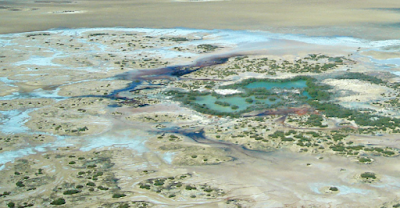
Lake MacLeod has a unique karst system, made of coastal limestone, which passes water from the Indian Ocean, 18 km underground using a hydrostatic pressure system, to bring salty water through sinkholes and vents into the lake basin. The lake surface is below sea level and water in the sinkholes and vents may be several metres deep. The sinkholes are connected by channels to a system of permanent mudflats, lagoons, and marshes, which can be up to a metre deep. As water travels through sinkholes, it evaporates creating a hypersaline environment when it reaches the terminal lagoon. Because of the variable environmental conditions, pond areas can vary substantially. The Northern Ponds area of Lake MacLeod include intermittently inundated flats, with water matching the ocean’s salinity coming through seepage vents. Freshwater enters though inflow from the Lyndon and Minilya Rivers. This mixture of the two sources makes Lake MacLeod as a brackish water environment. Gnaraloo Wildlife Foundation.

The uppermost part of the Zechstein Limestone in the Jabłonna Reef abounds in nodular anhydrite that forms the matrix in which carbonate clasts are embedded. However, in places the matrix is predominantly or entirely dolomitic. The lowermost Lower Anhydrite is also nodular, which otherwise is common for the entire Zechstein Basin. But we assume that this is a diagenetic fabric, and the original sulphate mineral was gypsum. In Jabłonna 1, some clasts have been encrusted by microbial mats containing pseudomorphs after lenticular gypsum crystals that have originated in a shallow subaqueous environment, most probably in relation of the transgressive Lower Anhydrite.

In the lower part of the Lower Anhydrite in the basinal facies, there is a unit rich in carbonate composing streaks and discontinuous laminae. The increased carbonate content in this unit can be related to either the dissolution phase of the Jabłonna Reef or the onset of the deposition on the Jabłonna Reef top after the evaporative drawdown. In the Ruchocice 4 section, located east of the Jabłonna Reef, thin microbial deposits (25 cm) of the Zechstein Limestone are followed by nodular anhydrite of the Lower Anhydrite, which contains intercalations of microbial dolomite in its lowermost part. These may correspond to unit B of the Lower Anhydrite in more basinal locations. In any case, the transgressive nature of the Lower Anhydrite is indubitable. In addition, the deposition of chloride deposits contemporaneous with sulphate deposits occurred quite early in the PZ1 history.

In some locations, microbial deposits were lacking in the upper part of the Zechstein Limestone. This was interpreted as due to lowering of the tectonic blocks on which the buildups were located, which could have resulted in the cessation of intensive carbonate deposition characteristic of reefs. 

The subaerial exposure of the reefs and the marginal carbonate platforms in the basin centre is a logical consequence of sea level fall at the end of the Zechstein Limestone deposition, which was related to evaporative drawdown. This major sea level fall could be preceded by earlier sea level falls that have been concluded by several authors based on sedimentary and diagenetic premises. However, there is no doubt that the most important factor, in terms of duration and impact of poroperm properties, was the sea level fall related to the change from a marine carbonate to an evaporite basin. Large parts of the Hessian Basin became subaerially exposed for a long period of time, as is indicated by common karstification. Widely developed shallowing-upward peri-littoral, sabkha and salina successions in the Hessian Basin have been interpreted as an indication of a renewed rise of brine level (a transgressive systems tract) due to inflow of preconcentrated brines from the Southern Zechstein Basin to the north. This inflow was preceded by the development of a karstic, subaerial exposure surface, interpreted as a record of type-1 sequence boundary that formed during a distinct brinelevel fall.

In turn, Stromatolitic facies of the transition interval are contained between carbonate platforms or isolated carbonate buildups. The overlying evaporites showed no evidence of subaerial exposure and formed during a relative sea level rise as transgressive systems tract or early highstand systems tract deposits. They commented, however, that it is highly likely that the thick evaporites in the basin centre formed during local or global sea level lowstands. Peryt et al.'s data indicate that a subaerial exposure episode existed, in the study area, after the deposition of transitional Stromatolitic facies in the uppermost part of the Zechstein Limestone, and the regolith can be related to falling stage systems tract deposits, that can be correlated with the lowest Anhydrite unit in the salt basin located to the northeast of the Jabłonna Reef.

A previous studyindicated a good lateral correlation of anhydritized zones in the reefs, which was regarded as an evidence in favour of their syndepositional origin, namely during sea level falls that have been recorded in the marginal Zechstein Limestone carbonate platform. Another possible mechanism is that the anhydrite zones record the brine-level stands during the abrupt lowering of relative sea level at the end of Zechstein Limestone deposition, or they represent a longer stabilization of brine level during the transgression of the Lower Anhydrite.

Peryt et al. conclude that the thin (2.8–5.1 m) unit of brecciated limestones and subordinate dolomites at the top part of the Zechstein Limestone (Wuchiapingian) in the Jabłonna Reef in western Poland recorded a sudden sea level fall that resulted in a long subaerial exposure of the reef, followed by a slow brine-level rise. This unit, regarded as a regolith, originated during the sea level fall related to evaporative drawdown. Eventually, it was locally reworked during the Lower Anhydrite transgression. Therefore, it can be regarded as a transgressive lag deposit.

The highstand systems tract deposits of the Zechstein Limestone are followed by transgressive systems tract deposits of the Lower Anhydrite in the Jabłonna Reef. The regolith can be related to falling stage systems tract deposits that can be correlated with the lowest anhydrite unit in the salt basin adjacent to the Jabłonna Reef.

The dolomite composing the unit studied originated through the seepage of brines in shallow-burial conditions during the deposition of the PZ1 anhydrite.

The nature of primary sulphate mineral in the lowermost Lower Anhydrite is enigmatic, but it is probable that cyclic gypsum upright-growth deposition occurred in salinas developed during deposition of microbial flats at the final stage of deposition of the Zechstein Limestone, and, consequently, sulphate deposition in the reef area could predate the sulphate accumulation in the basin area.

The complex hydrological setting of the reef controlled its early diagenesis. During the sea level fall, the Jabłonna Reef became exposed and subjected to freshwater diagenesis that improved poroperm characteristics of reef reservoirs. During the sea level fall or/and during subsequent transgression of the Lower Anhydrite, the reefs were subjected to intense anhydrite cementation, although its overall impact on the porosity was quite limited.

The studied case implies that important environmental perturbations related to sea/brinelevel fluctuations existed at the transition from carbonate to evaporite deposition in other giant evaporite basins.

See also...

https://sciencythoughts.blogspot.com/2020/07/herbivorous-actinopterygians-from.htmlhttps://sciencythoughts.blogspot.com/2020/06/leinzia-similis-deciphering-nature-of.html
https://sciencythoughts.blogspot.com/2020/01/fluctuations-in-mercury-and-organic.htmlhttps://sciencythoughts.blogspot.com/2019/06/tobleria-bicuspis-earliest-cone.html
https://sciencythoughts.blogspot.com/2018/02/declining-ammanoid-diversity-before-end.htmlhttps://sciencythoughts.blogspot.com/2017/08/understanding-conection-between.html
Follow Sciency Thoughts on Facebook.