Showing posts with label Boreholes. Show all posts

Thursday, 11 August 2022

Wildfires in the Silurian.

Free oxygen first appeared in the Earth's atmosphere during the Great Oxidation Event, between 2.5 and 2.3 billion years ago, and has played a significant role in all biogeochemical cycles ever since. A soil-forming microbial cover is thought to have begun to form on the Earth's landmasses about 850 million years ago, which further contributed to the oxygen content of the atmosphere. Following this, atmospheric oxygen concentrations are thought to have remained fairly constant until the appearance of the first land Plants in the Ordovician. 

These first Plants emerged into a world already dominated by Fungi, a group which quickly acquired the ability to both break-down the tissues of dead plants, and to form mycorrhizal relationships with living ones, enhancing the flow of nutrients through these primitive terrestrial ecosystems, and causing another rise in oxygen levels. The oldest known Vascular Plant, Cooksonia, a leafless, dichotomously branching Plant reaching less than 10 cm high, appeared during the Wenlock Epoch of the Silurian, between 433.4 and 427.4 million years ago, and has been recorded from rocks in Ireland and the Czech Republic. However, Cooksonia is not the most common form in the deposits where it is found, it lived in a landscape dominated by Namatophytes, vegetative organisms comprised of aggregations of tubes and cuticles, which were almost certainly Fungi, and possibly Lichens, and fossils of which have been found around the world.

The appearance of terrestrial Plants is generally accepted to have provoked a rise in atmospheric oxygen levels, although the extent of this is hard to determine, and scientists have differing opinions upon when oxygen levels comparable to those seen today were first achieved. 

In a paper published in the journal Geology on 13 June 2022, Ian Glasspool and Robert Gastaldo of the Department of Geology at Colby College, attempt to reconstruct the oxygen content of the Silurian atmosphere, by using charcoal fragments from deposits in Wales and Poland as evidence of Silurian wildfires, which would have required a minimum level of oxygen to occur.

Charcoal can only form when the atmospheric oxygen pressure is between 70% and 140% of that of today's atmosphere. Lower than this, and plant matter will not combust, higher, and it will combust completely, turning all available carbon into CO₂. Charcoal first appears in the Ordovician, suggesting that the atmosphere had sufficient oxygen for it to form then, but disappears again in the (Early Devonian, 419.2-410.8 million years ago), and is absent for much of the the rest of the Devonian. 

Glasspool and Gastaldo examine microscopic charred plant fragments from the Middle Silurian Pen-y-lan Mudstone at Rumney in Wales, and which is about 10 million years older than the previous oldest charred vegetative material, from the Late Silurian Winnica Formation at Winnica in Poland.

Silurian palaeogeography with Rumney (Wales, UK) and Winnica (Poland) localities plotted against International Geological Congress time scale version 2021.7. Abbreviations: Ord., Ordovician; Sa, Sandbian; Ka, Katian; Hi, Hirnantian; Rh, Rhuddanian; Ae, Aeronian; Te, Telychian; Sh, Sheinwoodian; Ho, Homerian; Go, Gorstian; Lu, Ludfordian; Pd, Přídolí; Lo, Lochkovian; Pr, Pragian; Em, Emsian; Ei, Eifelian; Gi, Givetian; Fr, Frasnian; Fa, Famennian. Glasspool & Gastaldo (2022).

Organic material from Rumney is dominated by Nematophytes, and in particular members of the genus Pachytheca. Glasspool  and Gastaldo obtained charred vegetative fragments from rock samples obtained from a borehole, drilled by the British Geological Survey, at depths of between 314.71 and 316.3 m. 

Since the exact nature of Nematophytes is unclear, it was necessary to use proxies to estimate the temperature at which this material may have burned; previous research having found that charcoal can be made from wood at temperatures between 410 and 730°C, and from Bracket Fungi at between 440 and 940°C. Based upon the degree of charring, Glasspool  and Gastaldo conclude that the material from Rumney burned at an average of about 490°C if Namatophytes were woody, or about 540°C if they were Bracket Fungus-like, although the most charred were probably burned at about 640°C (if woody) or 820°C (if Bracket Fungus-like).

Select charred phytoclasts: Rumney (Wales, UK) Nematophytes in reflected light (A), (B) and scanning electron microscopy images of Nematophytes from Winnica (Poland) (C), (D). (A) High reflectance and brittle fracture in Prototaxites. (B) Outer cortex of Pachytheca. (C) Trilayered Nematophyte cf. Tristratothallus. (D) Aggregation of small and large tubes. Glasspool & Gastaldo (2022).

The development of an oxygen-rich atmosphere has been crucial for the development of life on Earth, and particularly so for the emergence of Animals onto land. However, there is no direct way of measuring the oxygen content of ancient atmospheres is impossible, forcing scientists to rely on proxies for this information. As the formation of charcoal requires atmospheric oxygen levels approaching those of today, charcoal is an excellent proxy for the development of an oxygen-rich atmosphere, and Glasspool and Gastaldo's evidence that this may have developed by the Wenlock Epoch of the Silurian Period. about 430 million years ago.

There are some significant carbon isotope excursions (short intervals in which the proportions of carbon isotopes in sedimentary rocks shift significantly) in the Silurian, including notable ones in the Wenlock to Přídolí epochs, which suggests that the Silurian carbon cycle was more prone to severe disruption than that of any other period of the Phanerozoic. While some fairly good models of oxygen fluctuations in the Silurian have been developed, these operate on a scale of tens of millions of years, and cannot provide helpful data on the sort of sudden, short lived events that would cause these isotope excursions. However, a stratigraphic model of fire intervals within the Silurian could potentially address this mystery, something Glasspool and Gastaldo propose creating.

Most current predictions of oxygen levels in the atmosphere suggest that the oxygen content remained below 15% from the Late Ordovician until the Early Devonian. However, this is inconsistent with evidence for wildfires in the Silurian, as an oxygen content of 16% or above is needed for the combustion of dry vegetative matter. One model (GEOCARBSULFOR) does allow for higher oxygen levels, but still below 18%, which would allow for small fires under very dry conditions, though Glasspool and Gastaldo question whether any Silurian Plant or Fungus was capable of surviving in such an environment. The deposits at Rumney record a fairly high proportion of charcoal in a marine sediment, which would generally imply a conflagration of some size, inconsistent with any current model of Silurian oxygen levels.

Most of the data from Rumney implies a fairly low temperature fire (how low depending on whether the vegetation was Plant- or Fungus-like), but there are charcoal fragments which formed at far higher temperatures, suggesting at least pockets of high temperature fire. This seems implausible given the nature of the fuel, though Glasspool and Gastaldo suggest it it more plausible if Nematophytes were Fungal in nature, as Fungi naturally burn at higher temperatures.

The limiting factor for vegetative growth in the Silurian was probably the availability of phosphorus. Fungi and Bacteria can liberate this from rock to some extent, enabling the growth of Lichens and Plants (the later through symbiotic mycorrhizal relationships), but the phosphorus then becomes locked into the Plant or Fungus body, even after it dies. Fires would have had the ability to free up phosphorus locked into dead vegetation, making it available for new growth on land and in the oceans, where it could prompt blooms of photosynthetic algae, further rising the oxygen level. However, too frequent or severe fires would have damaged the soil structure, killing off microbial communities and creating a sterile environment.

See also...

Online courses in Palaeontology. 

Follow Sciency Thoughts on Facebook.

Follow Sciency Thoughts on Twitter.


Friday, 17 July 2020

The end of the Jabłonna Reef system of the Zechstein Sea.

The Zechstein Sea was once a shallow marine basin that occupied much of the area covered by northeastern England, the North Sea, Germany and Poland during the Late Permian. It was connected to the Palaeotethys Ocean, and formed a shallow sea dominated by microbial reef systems. Towards the end of the period it repeatedly became cut off from the wider ocean and developed into a hypersaline basin similar to the modern Dead Sea, before vanishing completely. The Zechstein evaporite deposits are today mined for salt, gypsum, and potash in England, Germany and Poland. Carbonates preceding the vast accumulation of evaporites reflect changes in the basin hydrology and the degree of connection to the open sea. The resulting sequence of deposits mirrors a shift from normal marine to evaporitic conditions. In the Zechstein Basin microbial deposits abound in the uppermost part of the first Zechstein cycle carbonate, of middle Wuchiapingian age, both in marginal and central parts of the basin. Traditionally, the Zechstein Group is divided into cycles reflecting progressive evaporation: at the base of a cycle are normal marine sediments; these are followed by sediments indicative of increasing salinity, first sulphates, next chlorides and eventually potash salts. Traditionally, four evaporitic cycles were distinguished. The total stratigraphic thickness of the Zechstein deposits in the basin centre exceeds 1.5 km.

In a paper published in the Journal of Palaeogeography on 3 July 2020, Tadeusz Marek Peryt and Marek Jasionowski of the Polish Geological Institute, Paweł Raczyński of the Institute of Geological Sciences at the University of Wrocław, and Krzysztof Chłódek of the Polish Oil and Gas Company, report and interpret the changes in the middle Wuchiapingian sedimentary environments at the transition from carbonate to sulphate deposition at the Jabłonna Reef area in southwest Poland.

Microbial deposits are an essential component of Zechstein Limestone reefs, and their frequency increases upsection. Such a trend was regarded in the past as the record of increasing seawater salinity that eventually led to the deposition of sulphate evaporites. However, a recent study indicated that Echinoids are common throughout the Zechstein Limestone section except close to its top, suggesting that most of the Zechstein Limestone sedimentation was within the normal range of marine salinity and remained at roughly the same level. However, the evaporite drawdown effect caused significant salinity increase at the top of the Zechstein Limestone deposits. The eventual rise of salinity led to the onset of the evaporite deposition in the basinal facies. The sharp boundary between the Zechstein Limestone and the overlying sulphate deposits (Lower Anhydrite) in the basinal facies is due to the nature of evaporites that start to precipitate immediately when the brines reach saturation.

Lithostratigraphy and sequence stratigraphy of the basal Zechstein strata in southwest Poland. Peryt et al. (2020).

Peryt et al.'s choice of the study area was controlled by two factors. First, the uppermost part of the Zechstein Limestone and the transition Zechstein Limestone-Lower Anhydrite was cored in three boreholes (Jabłonna 1, 2, and 3) of four drilled in this particular reef. Secondly, both the Zechstein Limestone (except its uppermost part) and the Lower Anhydrite were characterized in detail in previous studies. Thus, this study fills a gap in the knowledge of depositional history at the carbonate-sulphate transition in the basinal setting.

Location of the study area. (a) The Zechstein Basin, asterisk shows the location of the Jabłonna Reef; (b) Palaeogeography of the Zechstein Limestone, rectangle shows the Wolsztyn reefs shown in (d); (c) The location of arbitrary line 2 showing the location of boreholes (black dots); (d) Reefs of the Wolsztyn palaeo-High; (e) Interpretation of Zechstein along the cross-section shown in (c). Abbreviations: Ca1, Zechstein Limestone reef; eva, evaporites (anhydrite and halite) of the PZ1 cycle (cyclothem); PZ1, PZ2, PZ3, Polish Zechstein cycles (cyclothems); Z₁𝇃, Z₁, Z₂, Z₃; Zechstein seismic reflectors. Peryt et al. (2020).

The Jabłonna Reef is one of many isolated reefs located on the elevated parts of the Brandenburg-Wolsztyn-Pogorzela High that is a part of the Variscan Externides consisting of strongly folded, faulted and eroded Visean to Namurian flysch deposits, capped by a thick cover of Upper Carboniferous–Lower Permian volcanic rocks. The reefs came into existence shortly after the rapid transgression of the Zechstein sea that flooded, probably catastrophically, this intracontinental depression located well below the contemporaneous sea level, some 257 million years ago. The rapid inundation allowed for almost perfect preservation of the uppermost Rotliegend landscape. The rapid inundation was succeeded by several rises in sea level, and thus the Zechstein Limestone section of the Wolsztyn palaeo-high may comprise only the younger part of the unit elsewhere.

The analysis of three dimensional seismic sections indicated that the Jabłonna Reef is composed of three parts: two small, roughly elliptical, and west northwest-east southeast elongated (penetrated by boreholes Jabłonna 3 and Jabłonna 4) and one large, elongated (penetrated by boreholes Jabłonna 1 and Jabłonna 2). Coeval Zechstein Limestone deposits in the depressions between and outside the reefs are thin (a few metres at most), and they are eventually underlain by the middle Wuchiapingian Kupferschiefer, one of the prime correlation markers in northwest and Central European stratigraphy. This unit records a period of basin-wide euxinic conditions, and can thus be considered an excellent time-marker.

The mineralogical composition of the Zechstein Limestone of the Jabłonna Reef varies, although limestone is the main rock type. Most of the Zechstein Limestone sections of the Jabłonna Reef is composed largely of bioclastic (mostly bryozoan) grainstones, and bryozoan and microbial boundstones that were formed in subtidal environments. The general shallowing-upward nature of deposition in the Jabłonna Reef area resulted in reef-flat conditions with ubiquitous microbial deposits in its central part. Subsequently, because of reef-flat progradation, the entire Jabłonna Reef area became a site of very shallow, subaqueous deposition. The uppermost part of the Zechstein Limestone, 2.8–5.1m thick, shows a breccia texture, and is the subject of Peryt et al.'s study.

The Lower Anhydrite consists of nodular anhydrite occurring at the base, which gradually passes into anhydrite with pseudomorphs after gypsum crystals. It is overlain by the Upper Anhydrite. In total, the thickness of PZ1 (Polish Zechstein 1) anhydrite in the Jabłonna Reef area varies from 59.2 to 66.0m; these are followed by PZ2-PZ4 (Polish Zechstein 2-Polish Zechstein 4) that are several 100m thick, and then by Triassic and Cainozoic deposits.

The reefs related to the Wolsztyn palaeo-high are excellent gas reservoirs, and part of their porosity owes its origin to freshwater flushing after deposition of the major part of the Zechstein Limestone and/or during the deposition. Certainly, the freshwater diagenesis occurred before the Lower Anhydrite deposition, as the subsequent geological history indicates that the reef deposits were continuously affected by marine-derived brines. Thus the geological history of the area rules out freshwater diagenesis after the onset of the PZ1 evaporite deposition on the top of the Jabłonna Reef.

Altogether 43.4m of core from three borehole sections: Jabłonna 1, Jabłonna 2 and Jabłonna 3 across the uppermost part of the Zechstein Limestone (15 m) and the Lower Anhydrite (41.3 m) were subjected to a detailed sedimentological analysis. Following detailed core measuring, 15 polished core samples and 40 thin sections were examined for sedimentological aspects of the Zechstein Limestone and to record the changes in the frequency of occurrence and the state of preservation of fossil taxa. Twelve thin sections were studied with cathode luminescence.

The uppermost part of the Zechstein Limestone in the Jabłonna 1 borehole is 4.0m thick (depth 2342.0–2346.0 m) and shows a brecciated nature. Clasts are usually sharp-edged and of very various, often centimetric sizes, and show the inclined arrangement. They are composed of limestone and dolomite showing various microbial textures and more rarely organo-detrital texture. These clasts are embedded in nodular anhydrite(−enriched) matrix, and sometimes are accompanied by fine sharp-edged clasts that commonly occur also in the strata underlying the brecciated top part of the Zechstein Limestone. This part of the section smoothly passes into fine nodular, bedded anhydrite that shows abundant carbonate content; the thickness of beds varies from a few to about 10 cm, and in places, the beds are slightly inclined. This portion is 3.2m thick and it gradually passes (0.6 m) into massive anhydrite with clear centimetric pseudomorphs after upright-growth gypsum crystals (this part of the sequence is 2.0m thick), followed by finenodular anhydrite (10.3 m thick). Then, anhydrite breccia (0.6 m thick) occurs, followed by recrystallised anhydrite of conglomeratic appearance (12.3 m thick) with locally occurring clear pseudomorphs after bottomgrowth gypsum crystals.

Samples of the uppermost Zechstein Limestone of the Jabłonna 1 borehole; the depths in relation to the top of Zechstein Limestone are: (a) 0.1 m, (b) 0.9 m, (c) 1.3 m, (d) 2.15 m, (e) 3.4 m, (f) 3.7 m, (g) 4.8 m. Abbreviations: an, anhydrite; dd, detrital dolomite; md, microbial dolomite. (a)-(c) Clasts of microbial carbonates and peritidal laminites within anhydritic and dolomitic matrix; (d) steeply inclined pisolitic dolomite; (e), (f) large clasts of microbial carbonate in nodular anhydrite; (g) microbial encrustations and cement crusts (arrowed) stabilising detrital deposit consisting of sharp-edge clasts, underlying the brecciated deposits shown in (f). Peryt et al. (2020).

In the Jabłonna 2 borehole, the breccias (2.8 m thick) consist of clasts of limestones (mostly Bryozoan grainstone and Stromatolite) in a dolomite matrix. In some instances, dolomicrite with quartz silt and micas (of aeolian origin?) were recorded. These breccias occur at a depth of 2345.4–2348.2 m. Due to the abundance of anhydrite nodules in the top 1.1 m, the transition to the Lower Anhydrite is, in fact, gradual. Above the conventional boundary, now placed at a depth of 2345.4 m, distinctively bedded nodular anhydrite (5.0 m thick) occurs, and the bedding is disclosed by dolomite laminae and lenses showing carbon¹³ and oxygen¹⁸ levels characteristic of the Zechstein evaporite formations. In the upper part of the section, a 2.4-m-thick interval composed of bedded nodular anhydrite occurs, which shows clear pseudomorphs after upright-growth gypsum crystals.

Aspects of the uppermost part of the Zechstein Limestone in the Jabłonna 1 borehole; the depths in relation to the top of Zechstein Limestone are: (a), (b) 2.8 m, (c) 2.4 m, (d)-(h) 0.1 m; Abbreviations: an, anhydrite; bs, Bivalve shell; fe, Foraminiferal encrustation; ga, Gastropod shell; me, microbial encrustation; os, Ostracod. (a), (b) Clast of recrystallised peloidal deposit showing relics of stromatolitic lamination and encrusting Foraminifers; arrow shows the carbonate crust with common pseudomorphs after lenticular gypsum crystals shown in (b); (c) Bivalve shells with microbial encrustations, Gastropods, Ostracods, encrusting Foraminifers and other small allochems in recrystallised micritic matrix and anhydrite cement (sample taken from a clast); (d) sample shown by X (3) above; (e)-(h) fragments of (d) showing aspects of microbial lamination (e), (f), (h) and encrusting Foraminifers (g), (h). Peryt et al. (2020).

The uppermost part of the Jabłonna 2 section resembles most of the underlying deposits consisting of granular sediments with inclined crusts of possible microbial laminites. However, due to dolomitisation and severe recrystallisation, these primary features are poorly (but still) visible. A complex diagenesis in this part of the section might account for the seemingly brecciated nature. But on the other hand, the occurrence, in the close neighbourhood, of clasts of rocks that originated in various environments indicates their transportation.

Polished section (a) and thin sections (b)-(d), uppermost Zechstein Limestone, Jabłonna 2 borehole (the depths in relation to the top of Zechstein Limestone are: (a) 0.6 m, (b) 1.4 m, (c) 1.7 m, (d) 2.2 m). Abbreviations: an, anhydrite; dl, detrital limestone; ml, microbial limestone. (a) Dolomite breccia composed of sharp-edged clasts of peritidal carbonates and, in the top part of the sample, nodular anhydrite; (b) microbial encrustations at the boundary of a clast composed of Bryozoan grainstone that is enclosed in nodular anhydrite; (c) recrystallised limestone composed of crinkle laminations and fine allochems; arrows show Bryozoan zoaria; (d) micritic dolomite showing laminae (arrow) and faint outlines of allochems, with abundant fine quartz grains (white dots) and rare fine mica flakes. Peryt et al. (2020).

The brecciated portion of the Zechstein Limestone in the Jabłonna 3 borehole is 5.1m thick and occurs at a depth of 2348.9–2354.0 m. The clasts show various sizes – from less than 1 mm to several cm. Clasts are accompanied by microbial laminations that also occur at the Zechstein Limestone-Lower Anhydrite boundary. They are overlain by nodular anhydrite (0.9 m thick) containing abundant dolomite in the matrix; the nodules show a clear upward trend toward the bedding arrangement. Next, there is bedded nodular anhydrite (2.4 m thick), most probably clastic, followed by nodular anhydrite with pseudomorphs after upright-growth gypsum crystals up to 2 cm high. The topmost 1.25 m of the cored interval consists of massive anhydrite with gypsum pseudomorphs up to 25 cm high.

Polished sections (a)-(d) and thin sections (e)-(g) from the uppermost Zechstein Limestone, Jabłonna 3 borehole; the depths in relation to the top of Zechstein Limestone are: (a) 0m, (b) 2.2 m, (c) 0.5 m, (d) 1.5 m, (e) 0.6 m, (f) 2.7 m, (g), (h) 3.8 m. Abbreviations: an, anhydrite; dd, detrital dolomite; ml, microbial limestone. (a) Zechstein Limestone–Lower Anhydrite boundary (dotted): microbial (thrombolitic) dolomite overlain by dolomite-rich anhydrite with anhydrite nodules; (b) clasts and microbial laminations steeply inclined within nodular anhydrite; (c), (d) clasts of various size in the anhydrite matrix; (e) aspect of microbial carbonate (filaments?); (f) sharp-edge fine clasts of microbial carbonate with isopachous cement; (g), (h) Stromatolitic encrustations on and accompanied by detrital deposit; X in (h) indicates the location of (g). Peryt et al. (2020).

In terms of mineralogy, the uppermost portions of the Jabłonna sections are generally dolomites with a variable contribution of anhydrite. They show a more complex mineralogical composition. Besides dolomite and anhydrite, they also contain calcite and a minor admixture of accessory minerals, such as celestite, fluorite and authigenic quartz. 

Medium crystalline nonplanar unimodal dolomite with partly preserved primary fabrics (?boundstone–upper four images, bioclastic grainstone–lower four images). (a), (b), (e), (f) transmitted light microphotographs (plane-polarized light and crossed polars, respectively), (c), (g) cathodoluminescence images, (d), (h) backscattered electron images. Abbreviations: dol, dolomite; anh, anhydrite; fine red dots mark spots of microprobe analyses). The anhedral dolomite crystals are usually few tens of micrometres in size and exhibiting undulatory extinction in crossed polarised light. The dolomite is red with some yellowish patches in cathodoluminescence. Primary porosity is plugged with anhydrite cements. Fine crystalline (dolomicritic) patches in the image (a) are encrusting Foraminifers. Jabłonna 1 borehole, sample located 0.5m below the top of the Zechstein Limestone. Peryt et al. (2020).

Two main varieties of dolomite can be distinguished. The most common one is usually nonplanar mediumcrystalline, unimodal dolomite composed of anhedral crystals, mostly a few tens of micrometres in size, exhibiting undulatory extinction in crossed polarised light. However, planar euhedral dolomite crystals are also visible in places. The dolomite crystals are typically cloudy and are rich in inclusions. They show red cathodoluminescence with yellowish spots or zones in places. The dolomite crystals form massive mosaics or very cavernous masses plugged with coarsely crystalline anhydrite and sometimes coarsely crystalline calcite. In some cases, pores are lined by thin rims dolomite crystals. Dolomitisation was generally fabric-destructive and matrix- and grain-replacive, but remains of original fabrics are still traceable in places. The porosity may be in part both secondary (e.g. after dissolution of some components, e.g. fossils) and primary (e.g. original interparticle porosity); the cavernous portions mimic probably original sedimentary fabrics, such as the grainstone texture.

Coarse crystalline calcite (orange in cathodoluminescence) within medium crystalline dolomite (bright red in cathodoluminescence) with abundant anhydrite cementation. (a), (b), (e), (f) transmitted light microphotographs (plane-polarized light and crossed polars, respectively), (c), (g) cathodoluminescence images, (d), (h) backscattered electron images images. Abbreviations: cal, calcite; dol, dolomite; anh, anhydrite; fine red dots mark spots of microprobe analyses. The calcite crystals are probably burial cements that occlude porosity within dolomite. Jabłonna 3 borehole, sample located 0.6 m below the top of the Zechstein Limestone. Peryt et al. (2020).

The second type of dolomite in the sections studied, volumetrically subordinate, is finely crystalline dolomite (dolomicrite). Some fossils (e.g. sessile Foraminifers) or microbialitic fabrics are mimetically replaced by dolomite.

Calcite is present only in some of the thin sections studied. Petrographically, two calcite varieties can be distinguished: massive calcite mosaics and coarsecrystalline calcite cements distributed within dolomite.

Coarse crystalline calcite mosaic with numerous euhedral fluorite crystals. (a), (b) Transmitted light microphotographs (plane-polarized light and crossed polars, respectively); (c) cathodoluminescence image, (d) backscattered electron image. Abbreviations: cal, calcite; dol, dolomite; fl, fluorite; qtz, quartz; fine red dots mark spots of microprobe analyses. The clearer (inclusion-poor) crystals with distinct internal zonation pattern (orange in cathodoluminescence) are probably cements that occlude porosity within calcite mass composed cloudy (inclusion-rich) dull dark/nonluminescent in cathodoluminescence crystals. Scattered tiny crystals or irregular patches of dolomite (pinkish red in cathodoluminescence) occur within the calcite. Additionally, a euhedral quartz crystal is visible in the backscattered electron image (d). Jabłonna 1 borehole, sample located 0.5m below the top of the Zechstein Limestone. Peryt et al. (2020).

The calcite mosaics are composed of anhedral, medium to coarse crystals that are about 100 μm long; these were encountered only in one thin section derived from the lowermost breccia sequence in the Jabłonna 1 borehole. The calcite crystals usually appear cloudy due to numerous inclusions. Patches or aggregates of small dolomite crystals are chaotically dispersed throughout the calcite mosaics. Additionally, euhedral fluorite crystals are dispersed within the calcitic mosaics.

The second type of calcite is coarse calcite cements that fill the pores after the dissolution of some former crystals/skeletons or just the porosity within crystalline dolomite. They are very clear and translucent (inclusion-poor) in transmitted light and exhibit a faint pale-yellow/orange cathodoluminescence.

Based on petrographic studies, the uppermost portions of the Jabłonna sections studied experienced rather simple diagenetic history. They were affected by only one episode of pervasive dolomitisation that usually obliterated to a significant extent of its original textures. The dolomitisation resulted in one type of dolomite, usually nonplanar medium-crystalline dolomite. Such dolomite texture is thought to originate in a higher-temperature environment. It seems that the dolomitisation took place under shallow-burial conditions and could be a result of the seepage of brines that originated during the deposition of the PZ1 anhydrite, as it is generally constrained only to the uppermost portions of the Jabłonna sections studied. Downward the sections, calcite mineralogy prevails and the Jabłonna Reef deposits are still essentially limestones.

Spatially very limited calcite cementation postdates the dolomitisation. The calcite cements show the characteristics typical of higher-temperature burial diagenesis (large and inclusion-free translucent monocrystals, quite homogeneous in cathodoluminescence). Possibly, their crystallisation could be related to fluids released during gypsum-to-anhydrite transition (dehydration), which were relatively rich in calcium ions. Calcite cementation was followed by pervasive anhydrite cementation (in places preceded by, or undergoing simultaneously with, local celestite crystallization) that reduced the remaining porosity significantly.

The uppermost part of the Zechstein Limestone is, in general, much more altered diagenetically than the other parts of the Zechstein Limestone are. This is interpreted as due to two circumstances. The first is the early spelean-like diagenesis in a carbonate-evaporite salina in which the deposits of the uppermost Zechstein Limestone of the Jabłonna Reef have originated (this is discussed later in this paper). The second is its location in the neighbourhood of the anhydrite deposits being the screen for the ascending fluids. In general, dolomitization of the Wolsztyn reefs was polyphase, and this is particularly characteristic of this part of the profile.

Although microbial deposits often show the inclined (even to subvertical) position, this is probably related to the changing configuration of microbial reef complex in time, as it was previously demonstrated for the Westerstein Reef in the Harz Mountains. The alternative for a part of the inclination, in particular, accompanied by the occurrence of complex coated grains, is that they might have resulted during the development of teepee structures which might be expected in a very shallow subaqueous environment that was subject to quite common episodes of subaerial exposure. In any case, in contrast to the most part of microbial biofacies, the strata characterized in this paper cannot be related to the merely subtidal environments.

Peryt et al. assume that during the evaporative drawdown that resulted first in the deposition of thin microbial carbonate in the basinal sections, the Jabłonna Reef became subaerially exposed. Its top (and possibly slopes) became thus an emersion surface, which led to an irregular, karstified and brecciated relief surface related to a stratigraphic hiatus before the establishment of a salina environment in which the regolith became cemented by precipitated halite. Thus, the deposits composing the topmost part of the Zechstein Limestone actually derive from weathering and erosion of the microbial deposits of the uppermost part of the shallowing-upward sequence of the Zechstein Limestone and from precipitation of gypsum from transgressing brines of the sulphate system developed in the basinal facies.

Diagrammatic presentation of sea/brine level changes at the Zechstein Limestone/Lower Anhydrite boundary along the arbitrary seismic line. (1) progradational deposits; (2) degradational deposits; (3)–(4) progradational to aggradational deposits (3)–(4); (5) aggradational to retrogradational deposits: (1) Final stage of deposition of microbial deposits of the reef flat environment in Jabłonna 1. (2) Final stage of deposition of microbial deposits of the reef flat environment in Jabłonna 2 and 3; subaerial exposure in Jabłonna 1. (3) Stages (3a)-(3c) of sea level fall related to evaporative drawdown – subaerial exposure of the Jabłonna Reef and origin of fresh-water diagenesis and anhydrite cementation (possibly related to longer periods of stabilization of sea level during steps in sea level fall). (4) Deposition of microbial deposits in the top layer of the Zechstein Limestone in the basin. (5) Possibly the (beginning of) deposition of carbonate-enriched strata of the Lower Anhydrite. Peryt et al. (2020).

It was previously shown that the general shallowing-upward nature of deposition in the Jabłonna Reef area resulted in reef-flat conditions with ubiquitous microbial deposits in the central part of the Jabłonna Reef. Then, the reef flat started to prograde, and eventually, the entire Jabłonna Reef area became the site of very shallow, subaqueous deposition. Once the sea-level has dropped slightly, the Jabłonna 1 area became exposed first. At that time, shallow subtidal deposition still continued in the other parts of the Jabłonna Reef. Then, the areas at Jabłonna 2 and Jabłonna 3 became exposed, possibly due to the ongoing fall of sea level. 

The result of the long subaerial exposure of the Jabłonna Reef was the origin of an emersion surface and an irregular, karstified and brecciated relief. The length of the stratigraphic hiatus before the establishment of the salina environment is difficult to ascertain. In fact, there is no accord about the length of individual Zechstein formations and members, and even of the entire Zechstein, but Peryt et al. assume that it possibly took a few 100 000 years.

The duration of this exposure is difficult to specify because of several reasons. First, the depositional duration of the Zechstein and its particular cycles is subject to debate, but the estimate that the Z1 phase was about two million years long seems valid. Second, there are substantial differences in the rate of deposition of carbonates and evaporites. Subaquatic sulphates often have the accumulation rates in the order of 1–40 m per thousand years, and the rate of chloride deposition is 4–5 times greater. The duration of the deposition of the Zechstein Limestone has been estimated at about 400 000 years, based on the average rate of deposition of platform carbonates, but it did not include the time of subsequent exposure of marginal carbonate platform (and the reefs of the Wolsztyn palaeo-High). Considering the scale of freshwater diagenesis, the length of the exposure was presumably similar to the range of Zechstein Limestone deposition.

Microbial carbonates are the primary lithology in the uppermost part of the Zechstein Limestone of the Jabłonna Reef. The increase in the amount of microbial deposits upsection was regarded in the past as the record of increasing seawater salinity that eventually led to the deposition of sulphate evaporites. However, a recent study of basin sections indicated that, for the most part of the Zechstein Limestone sedimentation, the salinity remained at roughly the same level of normal seawater until it increased due to the evaporite drawdown effect at the very end of the Zechstein Limestone deposition. Then, the salinity increase eventually led to the onset of the evaporite deposition in the basinal facies.

Microbial carbonates also abound in the shelf-edge reef of the English Zechstein, where Algal Stromatolites and diverse laminar encrustations form up to 90% of reef-flat rock. Thus, in biofacies terms, this part of the Zechstein Limestone is dominated by Stromatolite biofacies. Microbial carbonates occur in situ, and they compose the majority of clasts. However, also clasts of Bryozoan grainstones occur. These rocks are typical for the biofacies occurring below the Stromatolite biofacies that formed in low-energy (indicated by in situ, or almost complete overthrown, zoaria) and occasional high-energy (indicated by intercalations of coquinas) lagoonal environments. These lagoons could evolve into salinas, possibly when the communication with the basin became cut off. Accordingly, there were many environmental perturbations prior to the evaporative drawdown.

The microbial carbonates that developed in the uppermost Zechstein Limestone throughout the basin are commonly not coeval, though. A thin packet of microbial deposits occurring at the topmost part of the basinal sections of the Zechstein Limestone originated following the sea level fall at the end of the Zechstein Limestone deposition. The deposition of peritidal carbonates in the basinal facies was accompanied by subaerial emergence of the marginal carbonate platform (and the reefs related to the Wolsztyn palaeohigh). Subsequently, as a result of a basin-wide deepening-upward trend recorded in the Lower Anhydrite, the deposition of the Lower Anhydrite began at the reef zone. Such a scenario explains well the gradual change from carbonate to sulphate deposition in the Jabłonna Reef. The change took place in shallow salinas, i.e. in the same environment in which the oldest sediments of the Lower Anhydrite formed close to the Wolsztyn reefs, in the area characterized by condensed sequences. This leads to the conclusion that the uppermost part of the Zechstein Limestone in the reef area postdates the uppermost Zechstein Limestone in the basinal area. As recently commented, 'the dynamic relationships between marine and freshwater systems on carbonate platforms and their responses to sea level rise remain poorly understood. This is surprising given the frequency of platform exposure and flooding events seen in the stratigraphic record.' Considering that the flooding of the Zechstein reefs was executed by saline brines, and that the freshwater system has formed during subaerial exposure of the reefs, a much more complex fluid and diagenetic history can be expected than in the case of marine transgression. During transgression, the displaced freshwater lens created an extensive freshwater and brackish system, a transitional deposystem from marine to non-marine carbonate deposition.

The sharp boundary between the Zechstein Limestone and the overlying Lower Anhydrite in the basinal facies represents the nature of evaporites that start to precipitate immediately when the brines reach saturation. The increase in seawater salinity, which eventually led to evaporite precipitation, occurred during the deposition of the uppermost (about 10 cm thick) unit of the Zechstein Limestone in basinal facies, during the sedimentation of heterogeneous deposits composed mainly of ill-sorted oncoids and peloids with Stromatolites, above the last occurrence of Echinoids. This increase in seawater salinity was accompanied by sea level fall (evaporite drawdown). The coeval deposits of the reef (shoal) facies experienced some effect of this general increase in salinity, but it was controlled largely by local conditions in the environment of reef flat where considerable fluctuations in salinity might be expected. In general terms, this environment can be compared to Lake MacLeod and other Australian salinas
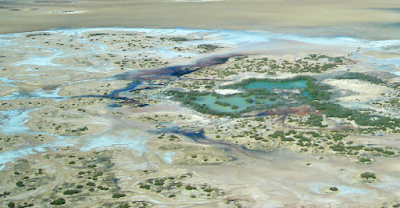
Lake MacLeod has a unique karst system, made of coastal limestone, which passes water from the Indian Ocean, 18 km underground using a hydrostatic pressure system, to bring salty water through sinkholes and vents into the lake basin. The lake surface is below sea level and water in the sinkholes and vents may be several metres deep. The sinkholes are connected by channels to a system of permanent mudflats, lagoons, and marshes, which can be up to a metre deep. As water travels through sinkholes, it evaporates creating a hypersaline environment when it reaches the terminal lagoon. Because of the variable environmental conditions, pond areas can vary substantially. The Northern Ponds area of Lake MacLeod include intermittently inundated flats, with water matching the ocean’s salinity coming through seepage vents. Freshwater enters though inflow from the Lyndon and Minilya Rivers. This mixture of the two sources makes Lake MacLeod as a brackish water environment. Gnaraloo Wildlife Foundation.

The uppermost part of the Zechstein Limestone in the Jabłonna Reef abounds in nodular anhydrite that forms the matrix in which carbonate clasts are embedded. However, in places the matrix is predominantly or entirely dolomitic. The lowermost Lower Anhydrite is also nodular, which otherwise is common for the entire Zechstein Basin. But we assume that this is a diagenetic fabric, and the original sulphate mineral was gypsum. In Jabłonna 1, some clasts have been encrusted by microbial mats containing pseudomorphs after lenticular gypsum crystals that have originated in a shallow subaqueous environment, most probably in relation of the transgressive Lower Anhydrite.

In the lower part of the Lower Anhydrite in the basinal facies, there is a unit rich in carbonate composing streaks and discontinuous laminae. The increased carbonate content in this unit can be related to either the dissolution phase of the Jabłonna Reef or the onset of the deposition on the Jabłonna Reef top after the evaporative drawdown. In the Ruchocice 4 section, located east of the Jabłonna Reef, thin microbial deposits (25 cm) of the Zechstein Limestone are followed by nodular anhydrite of the Lower Anhydrite, which contains intercalations of microbial dolomite in its lowermost part. These may correspond to unit B of the Lower Anhydrite in more basinal locations. In any case, the transgressive nature of the Lower Anhydrite is indubitable. In addition, the deposition of chloride deposits contemporaneous with sulphate deposits occurred quite early in the PZ1 history.

In some locations, microbial deposits were lacking in the upper part of the Zechstein Limestone. This was interpreted as due to lowering of the tectonic blocks on which the buildups were located, which could have resulted in the cessation of intensive carbonate deposition characteristic of reefs. 

The subaerial exposure of the reefs and the marginal carbonate platforms in the basin centre is a logical consequence of sea level fall at the end of the Zechstein Limestone deposition, which was related to evaporative drawdown. This major sea level fall could be preceded by earlier sea level falls that have been concluded by several authors based on sedimentary and diagenetic premises. However, there is no doubt that the most important factor, in terms of duration and impact of poroperm properties, was the sea level fall related to the change from a marine carbonate to an evaporite basin. Large parts of the Hessian Basin became subaerially exposed for a long period of time, as is indicated by common karstification. Widely developed shallowing-upward peri-littoral, sabkha and salina successions in the Hessian Basin have been interpreted as an indication of a renewed rise of brine level (a transgressive systems tract) due to inflow of preconcentrated brines from the Southern Zechstein Basin to the north. This inflow was preceded by the development of a karstic, subaerial exposure surface, interpreted as a record of type-1 sequence boundary that formed during a distinct brinelevel fall.

In turn, Stromatolitic facies of the transition interval are contained between carbonate platforms or isolated carbonate buildups. The overlying evaporites showed no evidence of subaerial exposure and formed during a relative sea level rise as transgressive systems tract or early highstand systems tract deposits. They commented, however, that it is highly likely that the thick evaporites in the basin centre formed during local or global sea level lowstands. Peryt et al.'s data indicate that a subaerial exposure episode existed, in the study area, after the deposition of transitional Stromatolitic facies in the uppermost part of the Zechstein Limestone, and the regolith can be related to falling stage systems tract deposits, that can be correlated with the lowest Anhydrite unit in the salt basin located to the northeast of the Jabłonna Reef.

A previous studyindicated a good lateral correlation of anhydritized zones in the reefs, which was regarded as an evidence in favour of their syndepositional origin, namely during sea level falls that have been recorded in the marginal Zechstein Limestone carbonate platform. Another possible mechanism is that the anhydrite zones record the brine-level stands during the abrupt lowering of relative sea level at the end of Zechstein Limestone deposition, or they represent a longer stabilization of brine level during the transgression of the Lower Anhydrite.

Peryt et al. conclude that the thin (2.8–5.1 m) unit of brecciated limestones and subordinate dolomites at the top part of the Zechstein Limestone (Wuchiapingian) in the Jabłonna Reef in western Poland recorded a sudden sea level fall that resulted in a long subaerial exposure of the reef, followed by a slow brine-level rise. This unit, regarded as a regolith, originated during the sea level fall related to evaporative drawdown. Eventually, it was locally reworked during the Lower Anhydrite transgression. Therefore, it can be regarded as a transgressive lag deposit.

The highstand systems tract deposits of the Zechstein Limestone are followed by transgressive systems tract deposits of the Lower Anhydrite in the Jabłonna Reef. The regolith can be related to falling stage systems tract deposits that can be correlated with the lowest anhydrite unit in the salt basin adjacent to the Jabłonna Reef.

The dolomite composing the unit studied originated through the seepage of brines in shallow-burial conditions during the deposition of the PZ1 anhydrite.

The nature of primary sulphate mineral in the lowermost Lower Anhydrite is enigmatic, but it is probable that cyclic gypsum upright-growth deposition occurred in salinas developed during deposition of microbial flats at the final stage of deposition of the Zechstein Limestone, and, consequently, sulphate deposition in the reef area could predate the sulphate accumulation in the basin area.

The complex hydrological setting of the reef controlled its early diagenesis. During the sea level fall, the Jabłonna Reef became exposed and subjected to freshwater diagenesis that improved poroperm characteristics of reef reservoirs. During the sea level fall or/and during subsequent transgression of the Lower Anhydrite, the reefs were subjected to intense anhydrite cementation, although its overall impact on the porosity was quite limited.

The studied case implies that important environmental perturbations related to sea/brinelevel fluctuations existed at the transition from carbonate to evaporite deposition in other giant evaporite basins.

See also...

https://sciencythoughts.blogspot.com/2020/07/herbivorous-actinopterygians-from.htmlhttps://sciencythoughts.blogspot.com/2020/06/leinzia-similis-deciphering-nature-of.html
https://sciencythoughts.blogspot.com/2020/01/fluctuations-in-mercury-and-organic.htmlhttps://sciencythoughts.blogspot.com/2019/06/tobleria-bicuspis-earliest-cone.html
https://sciencythoughts.blogspot.com/2018/02/declining-ammanoid-diversity-before-end.htmlhttps://sciencythoughts.blogspot.com/2017/08/understanding-conection-between.html
Follow Sciency Thoughts on Facebook.

Tuesday, 7 July 2020

Placoderms from the Early Devonian of Belarus.

Little work has been done on the Early Devonian (late Emsian) Placoderm fishes of Belarus despite these being relatively common in Belarus and their use in regional biostratigraphy elsewhere in the Old Red Sandston continent. Specimens from the orders Acanthothoraci, Ptyctodontida, Arthrodira, and Antiarcha are all recorded from the Lower Devonian deposits of Belarus. Arthrodires are the most common Placoderm group found in the upper Emsian deposits of Belarus. The first recorded find of an Arthrodire in the Emsian of Belarus was in 1963 from the Vilchitsy 1 borehole in the Obol and Lepel beds of the Vitebsk Regional Stage. These remains consisted of a skull roof, trunk shield, and a number of isolated plates from the trunk shield, as well as endocranium remains.

In a paper published in the Journal of Paleontology on 31 March 2020, Dmitry Plax of the Belarusian National Technical University and Michael Newman of Haverfordwest in Pembrokeshire, Wales, describe four new Placoderms from from the Lepel Beds of the Vitebsk Regional Stage of the Lower Devonian (upper Emsian) of Belarus. They erect two new species of arthrodire and describe two other forms in open nomenclature.

The Vilchitsy 1 borehole remains were considered by Elga Mark-Kurik to be a single species and referred to it as 'Kartalaspis belarusica'. She considered it a Phlyctaeniid Placoderm. However, the species was not formerly described despite it being mentioned in many publications and so it must be considered a nomen nudum. Even the species name of this fish in the literature has been spelled in several ways, e.g., belorussica, byelorussica, and belarussica, adding to the confusion. It is in need of being properly described.

Later,  Lyubov Lyarskaya  recorded Ptyctodontida indet., Phyctaeniina indet., and Antiarcha indet. in the Vitebsk Formation of the Orsha Depression (in the Vilchitsy 1, Pochtari 1 and Liozno 1 boreholes). 

Subsequently Millerosteus orvikui was recorded from Mstislavl 1 borehole in the Lepel Beds of the Vitebsk Regional Stage. This species was originally described from strata of Eifelian age (Kernavė Regional Substage) of the Baltic region, and this species is now considered a subjective junior synonym of Coccosteus cuspidatus. The genus Millerosteus is known from the Givetian of both Estonia and Scotland; it thus seems unlikely that it is present in the Emsian of Belarus and the remains recorded there must be considered for now as indeterminate.

Dmitry Plax started a study of the upper Emsian deposits of Belarus in 2002, and has reviewed and studied about 25 boreholes containing deposits of this age. Remains of late Emsian placoderms in various states of preservation were recovered from 13 boreholes, all within the Lepel Beds of the Vitebsk Regional Stage. Acanthothoracid remains were recovered from the Berdyzh 1 borehole. Ptyctodontida remains were recovered fromthe Chashniki 53, Lepel 1, and Latvishi 12 boreholes. One undefinable plate fragment of a Ptyctodontid was also recovered from the rocks of the Lepel Beds of the Vitebsk Regional Stage in the Rudnya 14 borehole. Arthrodiran remains are the most commonly recovered remains found in boreholes. They have been recovered from the Osipovichi 6, Bobruysk 691, Bobruysk 691/2, Lepel 1, Bykhov 151, Rogachev 736, Buda Dal’nyaya 35, Bykhov 1, and Korma 1 boreholes. Finally, a few Antiarch remains have been recovered from the Osipovichi 6, Buda Dal’nyaya 35, Berdyzh 1, Bykhov 1, and Korma 1 boreholes.

All of the specimens described in this work were collected from core samples extracted from the Lepel Beds. The Lepel Beds form the upper part of the Vitebsk Regional Stage, with the lower part being the Obol Beds. The Vitebsk Regional Stage constitutes the upper Emsian (Lower Devonian) in Belarus. These deposits are widespread throughout Belarus. The Eifelian Adrov Regional Stage lies above the Vitebsk Regional Stage. The Lepel Beds correspond to the upper part of the Rhabdosporites mirus-Gneudnaspora divellomedium Miospore Biozone and approximately to the upper part of the Polygnathus costatus patulus Conodont Biozone. This is approximately equivalent to the upper part of the Rezēkne Regional Stage in the Baltic region and the upper part of the Novobasovo Beds of the Ryazhsk Regional Stage in the central part of Russia.

Stratification of the Upper Emsian deposits of Belarus and their correlation with the synchronous deposits from the adjacent territories. Plax & Newman (2020).

The first new species described is named Stipatosteus svidunovitchi, where 'Stipatosteus' comes from the Latin, ;'stipa', packed and 'osteus', bone, and honours Igor Svidunovitch who participated in the sampling of paleoichthyological material from the cores of boreholes. All specimens came from the Korma 1 borehole at depths of 340.2 m, 340.8 m, 337.7 m, 337.8 m, and 337.9 m.

Map of Belarus showing the location of the borehole sections where the skeletal elements of the Placoderm Fish were found. Boreholes: (1) Osipovichi 1; (2) Bobruysk 691; (3) Rogachev 736; (4) Korma 1; (5) Bykhov 1; (6) Buda Dal’nyaya 35. Plax & Newman (2020).

Only four near complete identifiable plates are known, all from the trunk armor. These include a right anterior lateral plate, a right anterior ventrolateral plate with attached right spinal plate, and a right posterior ventrolateral plate. There are also fragments of spinal plates and other unidentifiable plate fragments. All plates are characterized by ornamentation of densely packed tubercles forming distinct rows. The tubercles are star-shaped at their bases. Some of the individual tubercles have an unusual crown ornament of sinuous, bifurcating ridges emanating from the center. This is due to tubercles overgrowing older tubercles, indicating that these plates do not belong to juvenile individuals.

Stipatosteus svidunovitchi, dermal plate remains: (1)–(3) indefinable dermal plate fragments: (1) BNTU 121/44-23; (2) BNTU 121/44-18; (3) BNTU 121/44-16; (4) right anterior lateral plate (BNTU 121/38-2); (5)–(7) holotype, a right anterior ventrolateral plate with attached right spinal plate (BNTU 121/38-1): (5) ventral view with impression of visceral armor; (6) view of the visceral armor; (7) detail of right spinal plate; incomplete right spinal plate (BNTU 121/46-1): (8) probable dorsal view; (9) probable ventral view; (10), (11) both sides of incomplete spinal plate, orientation unclear (BNTU 121/46-3); (12) left posterior ventrolateral plate (BNTU 121/40-1). gl,  growth lines. Scale bars, 5 mm (4)–(6), (8)–(12), 1 mm (1), (7), 0.5 mm (2), (3). Plax & Newman (2020).

BNTU 121/38-2 is a right anterior lateral plate with a broken posterior edge. The edge contacting the spinal plate is also slightly broken and irregular. This makes it difficult to estimate a breadth/length index. The ornamentation consists of tightly packed tubercles that extend in rows subparallel to the outline of the plate. The anterior ventral corner has a significant process pointing anteriorly from which extrudes a ridge. The anterior dorsal corner is rounded with the dorsal edge extending diagonally ventrally.

BNTU 121/38-1 is a right anterior ventrolateral plate attached to a right spinal plate preserved in part and counterpart. The plate is worn at the edges, but its overall shape is discernible. The plate is quite long with a breadth/length index of about.8. The plate is quite flat-bottomed. The plate is very rounded mesially and anteriorly with no evidence for a contact face for an anterior ventral plate. Little or no ornamentation is preserved on the part althoughit ispresent on the attached spinal plate The suture between the anterior ventrolateral plate and spinal plate is difficult to discern. The rest of the specimen has an impression of the visceral surface of the bone. The counterpart shows the visceral side of the plate. The bone is at full thickness at the center of the plate but is worn and delaminated toward the edges. Growth lines can be seen which indicate that the bone grew from the center of the plate. The visceral surface has a ridge that extends from the posterior contact of the spinal plate a short distance into the plate.

BNTU 121/46-1 is the most complete of the known isolated spinal plates, and the species description is mostly based on this specimen. It is preserved in three dimensions, and oval in transverse section. It is probably a right spinal plate because one surface is smoother than the other. The anterior section of the ‘free’ part of the plate is preserved with little or no contact face to the anterior ventrolateral plate visible. The tip of the distal end is also missing. BNTU 121/46-1 is long and slender with a gentle mesial curve. Rows of rounded tubercles extend the length of the spinal plate. There are no spinelets on the inner edge of the plate. Similar ornamentation is seen in BNTU/46-3, which shows BNTU 121/46-1 is neither worn nor aberrant. BNTU 121/38-1 is a third right spinal plate attached to an anterior ventrolateral plate and shows similar ornamentation. However, it has been crushed flat and shows no curvature. Also, it is not clear how complete it is. Certainly, some of the free end is missing. It has a long contact with the anterior ventrolateral plate at about half of its preserved length.

BNTU 121/40-1 is a left posterior ventrolateral plate with preserved lateral and ventral laminae. The plate is fairly complete with a breadth/length index of at least 0.5, although the posterior end of the plate is missing. The ventral lamina is approximately twice as wide as the lateral lamina and is as long as two thirds of the ventral lamina. The ventral lamina is flat-bottomed. The ventrolateral ridge is quite pronounced posteriorly. Where preserved, the plate is densely packed with tubercles. The visceral side is still buried within the matrix.

Because a number of the ventral trunk plates areknown, Plax and Newman were able to reconstruct the ventral trunk armor. It is clear the trunk armor is quite short with a breadth/ length index of about 1.0 at the anterior ventral plate’s widest points. The anterior ventrolateral plates are particularly short, and shorter than the posterior ventrolateral plates. Another distinctive character is the long spinal plates, which are only gently curved without mesial denticles. The free end of the spinal plate is approximately the same length as the spinal plate attached to the anterior ventrolateral plate. These characters are incompatible with Stipatosteus svidunovitchi being a Petalichthyid. The ventral armor is most similar to that of the Arthrodiran infraorder Actinolepina, but the lack of an anterior ventral plate clearly places it in the suborder Phlyctaenioidei. The long, thin spinal plates with long, thin, free distal ends are characteristic of the Phlyctaeniidae.

Stipatosteus svidunovitchi n. gen. n. sp., reconstruction of ventral trunk armor. Abbreviations: AMV, anterior median ventral plate; AVL, anterior ventrolateral plate; IL, interolateral plate; PMV, posterior median ventral plate; PVL, posterior ventrolateral plate; Sp, spinal plate. Dashed lines indicate the boundaries of unknown plates. Plax & Newman (2020).

Approximately 18 genera are known in the Phlyctaeniidae with the highest diversity being known from the Early Devonian of Spitsbergen and Campbellton in New Brunswick, Canada. Stipatosteus svidunovitchi displays some similarity to species of Phlyctaenius. There are three species known: Phlyctaenius acadicus, Phlyctaenius atholi, and Phlyctaenius stenosus. The closely related form Gaspeaspis cassivii is probably a junior subjective synonym of Phlyctaenius atholi. Stipatosteus svidunovitchi differs from Phlyctaenius in several ways. The anterior ventrolateral plates are shorter, but also wider in Stipatosteus svidunovitchi, making the whole trunk shorter than in Phlyctaenius. The posterior ventrolateral plates form an embayment at their posterior ends, absent in Phlyctaenius stenosus. The spinal plates are also slenderer than in Phlyctaenius. The arrangement of the tubercles is uniform and close together in both Phlyctaenius acadicus and Phlyctaenius atholi. However, in Phlyctaenius stenosus, they are arranged parallel to the plate margins, similar to those in Stipatosteus svidunovitchi. Some of the tubercles of Phlyctaenius show a similar crown ornament of sinuous ridges due to tubercle overgrowth as seen in Stipatosteus svidunovitchi. Stipatosteus svidunovitchi slightly differs from Phlyctaenius in having a shorter body trunk with, therefore, shorter trunk plates. The spinal plates are also narrower.

Of the Spitsbergen species, some of the genus Heterogaspis acuticornis, Heterogaspis minutus, Heterogaspis hornsundi, are somewhat similar to Stipatosteus svidunovitchi. Stipatosteus svidunovitchi differs from Heterogaspis acuticornis in having a longer posterior ventrolateral plate. However, as in Stipatosteus svidunovitchi, there is an embayment at the posterior median end of the posterior ventrolateral plates. However, the spinal plate of Heterogaspis acuticornis is strongly curved, making it quite different from Stipatosteus svidunovitchi. In Heterogaspis minutus, the ventral trunk armor is unknown but the spinal plate is strongly curved, unlike that of Stipatosteus svidunovitchi. Heterogaspis hornsundi is poorly known. with many missing characters. Like other Heterogaspis species, it has strongly curved spinal plates. Thus, whereas some Heterogaspis species are similar to Stipatosteus svidunovitchi, they differ in having strongly curved spinal plates.

The second new species described is placed in the genus Actinolepis, and given the specific name zaikai, in honour of the Belarusian palaeontologist Yury Zaika. The species is based upon 22 specimens from the boreholes Osipovichi 6 at depths of 118.8 m, 113.8 m, and 113.5 m, Bobruysk 691 at a depth of 234.5 m, and Bykhov 1 at a depth of 307.3 m, all from the Mogilev region. Also, the boreholes Rogachev 736 at a depth of 293.0 m and Korma 1 at a depth of 322.3 m, both from the Gomel region. All occurrences are within the Lepel Beds of the Vitebsk Regional Stage, which is in the upper Emsian of the Lower Devonian.

Seventeen of the 22 specimens are fragmentary and not identifiable as specific plates. However, they each have a similar external ornamentation allowing a fair degree of confidence that they all belong to the same species. The ornamentation consists of narrow ridges topped by a single row of tubercles. Five specimens are identifiable plates.

Actinolepis zaikai, dermal plate remains: (1)–(4) plate fragments: (1) BNTU 44/1-7f.2; (2) BNTU 44/1-6a; (3) BNTU 44/1-16; (4) BNTU 44/1-16a; (5), (6) fused left and right preorbital plate (BNTU 44/1-12): (5) dorsal view; (6) visceral view; (7), (8) right paranuchal plate (BNTU 44/1-21): (7) dorsal view; (8) visceral view; (9) left anterior dorsolateral plate (BNTU 44/1-13); (10) anterior lateral plate (BNTU 6/1-1); (11) indefinable plate fragment (BNTU 44/1-6). Abbreviations: af, articular flange; lc, main lateral line groove; oa, overlap area; oa.C, area overlapped by central plate; oa.MD, area overlapped by median dorsal plate; occ, occipital cross commissure canal; pp, posterior pit line; r, ridges under supraorbital sensory line on visceral side; sl, sensory line; soc, supraorbital sensory line. Scale bars are 5 mm. Plax & Newman (2020).

BNTU 44/1-12 consists of a fused left and right preorbital plate and is the only specimen of this plate available to study. The plate is V-shaped and fairly well preserved. It has a maximum length of 24 mm with a maximum width of 16 mm. The width/length ratio is 0.67. The dorsal surface has an ornamentation of narrow ridges each topped by a single row of small tubercles. These tubercles are somewhat worn. The left and right branches of the supraorbital sensory line meet in the middle of the plate toward the posterior. On the visceral surface are two low longitudinal ridges under the soc forming the thickest part of the plate. The visceral surface is relatively smooth on both sides of these ridges.

BNTU 44/1-21 is a right paranuchal plate, irregularly oval in shape with a rounded outer margin. The ornamentation of the dorsal surface is formed by concentrically located, narrow ridges, each topped by a single row of tubercles. The tubercles are somewhat smoothed. Three grooves of the lateral line system pass on the external surface of the plate: the posterior pit line extending approximately from the center of ossification of the plate upward to the central plate, the main  lateral line canal extending to the marginal plate and anterior dorsolateral plate, and the occipital cross commissure canal. The grooves connect with each other over the center of ossification at different angles: the angle between occipital cross commissure canal and lateral line canal is about 60°, the angle between occipital cross commissure canal. and pp is about 70°, and the angle between posterior pit line and lateral line canal is about 100°. The area overlapped by the central plate is a depression on the anterior mesial margin. The rest of the mesial margin is broken. The visceral surface is worn and delaminated in places.

BNTU 44/1-13 is the most dorsal part of a left anterior dorsolateral plate. The preserved area is triangular, with only a small ornamented area. Most of the posterior portion of the preserved plate consists of the overlap area for the median dorsal plate, and the anterior portion for the articular flange. These two areas are separated by a low ridge. The ornamentation consists of narrow sinuous ridges with a single row of small, numerous tubercles on their tops, which for the most part are worn.Within these ridges in the center of the ornamented area is the anterior part of the main lateral line groove. The visceral surface is uninformative. In some places, this plate is slightly rough on the margins.

BNTU 6/1-1 is a very incomplete anterior lateral plate. It is flattened, rather large, with an ornamentation of concentrically orientated ridges topped by a single row of tubercles. The tubercles are quite worn. There is a pair of ridges that join to form a ‘V’ shape. This character is only seen on anterior lateral plates. However, because the plate is incomplete, we are unable to determine whether it is a right or left plate or even the original orientation. The visceral surface is obscured by matrix.

BNTU 44/1-6 is an incomplete unidentified plate. The ornamentation is well preserved consisting of narrow, concentrically orientated ridges topped by a single row of tubercles. Part of an overlap area and a sensory line are visible. However, due to the incomplete nature of the plate, we cannot determine what the sensory line was or what plate overlapped this plate. The visceral surface is uninformative.

The first unnamed form is placed in the family Coccosteidae, but not assigned to a genus or species due to the limited and fragmentary nature of the material, which comprises seven identifiable plates were found, one from the cranial roof and six from the trunk armor, as well as two unidentifiable plate fragments, all from the Buda Dal’nyaya 35 borehole at a depth of 233.2 m; also from the Vitebsk region in the Lepel Beds of the Vitebsk Regional Stage, upper Emsian, Lower Devonian.

BNTU 51/2-2c is an incomplete right central plate that is slightly convex. It is about 10 mm long and 8 mm wide. The supraorbital sensory line, the central sensory canal, and the middle pit-line groove are well developed on the dorsal side of the plate. The central sensory canal and mp branch off from one another on the left side of the plate and then extend parallel to one another to the right edge of the preserved plate. The supraorbital sensory line curves anteriorly from the csc toward the right edge of the plate. The angle between the central sensory canal and supraorbital sensory line at the right lateral edge is 30°. The tubercles are rounded and of approximately the same size. They are evenly distributed across the plate surface. These form weakly expressed rows near the sensory grooves.

Indeterminate Coccosteidae form 1, dermal plate remains: (1) right central plate (BNTU 51/2-2c); (2), (3) posterior part of a median dorsal plate (BNTU 51/2-2b); (2) dorsal view; (3) visceral view; (4), (5) left anterior dorsolateral plate (BNTU 51/2-2): (4) lateral view; (5) visceral view; (6, 7) right anterior dorsolateral plate (BNTU 51/2-2a): (6) lateral view; (7) visceral view; (8), (9) left posterior ventrolateral plate (BNTU 51/2-2e): (8) ventral view; (9) visceral view; (10), (11) probable left posterior lateral plate (BNTU 51/2-2g): (10) lateral view; (11) visceral view; (12), (13) spinal plate (BNTU 51/2-2f): (12) outer view; (13) visceral view; (14), (15) indefinable plate fragment (BNTU 51/2-2d): (14) external view; (15) visceral view. Abbreviayions: af.smd.pl, articular face for submedian dorsal plate; cf.PDL, area overlapping posterior dorsolateral plate; cf.PVL, area overlapping posterior ventrolateral plate; cr.pr, carinal process of median dorsal plate; csc, central sensory canal; k, keel; kd, glenoid condyle; lc, main lateral line canal; ld, dorsal branch of main lateral sensory line groove; mp, middle pit line groove; oa.AL, area overlapped by anterior lateral plate; oa.AVL, overlap area for anterior ventrolateral plate; oa.MD, area overlapped by median dorsal plate; os, osteolepid scale; pr.p, cartilaginous prepectoral process of endoskeletal scapular belt; pr.sbgl, subglenoid condyle; soc, supraorbital sensory line. Scale bars: 5 mm (1)–(11), (14), (15), 1 mm (12), (13). Dashed lines indicate the estimated boundary of the missing parts of the plate. Plax & Newman (2020).

BNTU 51/2-2b is a fragment of the posterior part of amedian dorsal plate. The specimen is 21 mm long and 7 mm wide at its widest point. With extrapolation, it can be argued that the plate is relatively long and slightly concave in profile. The posterior part of the plate tapers to a point, although the tip is missing. The dorsal surface is covered with small round tubercles, which form rows parallel to the lateral edges. Toward the center of the plate, the tubercles are more random and much scarcer. The right side of the dorsal branch of the main lateral sensory line groove is present as a gentle curve. Although the left side of the plate is missing, the lateral sensory line groove do not connect to the midline. The lateral sensory line groove would have intersected the right and left posterior dorsolateral plates. The visceral surface is smooth, except for a slight depression for the area overlapping the posterior ventrolateral plate. The median ventral keel is sharp and well developed. It begins near the anterior margin of the missing part of the plate, and continues to the posterior, gradually deepening. It ends posteriorly with a carinal process. The posterior face of the carinal process flares out and is hollowed to make an articular surface for the submedian dorsal plate.

Two anterior dorsolateral plates have been identified. BNTU 51/2-2 is a left anterior dorsolateral plate and BNTU 51/2-2a a right anterior dorsolateral plate. BNTU 51/2-2 is the better-preserved specimen. It is convex on its lateral surface and is quadrangular overall. The plate is 10 mm long and 14 mm wide. The glenoid condyle and the subglenoid process are not preserved. Also, the most anterior ornamented part of the plate is not preserved. The lateral surface is covered by numerous, well developed, small, round tubercles arranged in concentric rows around a center of ossification. The areas overlapped by the median dorsal plate and the left anterior lateral plate are partially preserved. The dorsal branch of the main lateral line canal and main lateral line canal are clearly seen on the lateral surface. The main lateral line canal originates where the glenoid condyle would be and extends posteriorly in a downward diagonal direction to where the posterior lateral plate would have been. The dorsal branch of the main lateral line canal extends posteriorly from near the anterior end of the main lateral line canal diagonally upward toward where the posterior dorsolateral plate would have been. The angle between the main lateral line canal diagonally and dorsal branch of the main lateral line canal is about 60°. The visceral surface is smooth. The area overlapping the posterior dorsolateral plate is visible on the visceral surface on the posterior margin.

BNTU 51/2-2a is a right anterior dorsolateral plate  with broken lateral edges. The plate is 12 mm long and 14 mm wide. Its lateral surface is somewhat obscured by matrix although the lateral lines are visible, particularly the dorsal branch of the main lateral line canal. The plate is morphologically similar to BNTU 51/2-2 but has the glenoid condyle and the subglenoid process preserved. These two structures are morphological similar to those of the better-known ones in Coccosteus cuspidatus. The visceral surface is smooth and shows no diagnostic characters other than the area overlapping the posterior dorsolateral plate.

BNTU 51/2-2e is a left posterior ventrolateral plate lacking the anterior lateral corner. It is elongated and ventrally convex in profile. The plate is 21 mm long and 11 mm wide at the widest point. At the anterior edge, part of the overlap area for the anterior ventrolateral plate is visible. The ventral surface is covered with small, rounded tubercles that are slightly larger and more prominent along the edges of the plate. An osteolepid scale and matrix obscures part of the ventral surface of the plate, which is too delicate to allow removal. The visceral surface is mostly smooth. The area overlapping the right posterior ventrolateral plate is clearly seen on the mesial margin.

BNTU 51/2-2 g is probably a left posterior lateral plate but it could be a posterior dorsolateral plate because they are morphologically very similar. The plate is vaulted, triangular, and nearly complete. It is length is 8 mm long and 9 mm wide on the longest axis. Almost the entire lateral surface is covered with matrix, but there are small areas where several small, round tubercles can be observed. Overlap areas for other plates are visible on some of the edges but it is not certain which plates attached to these areas. The visceral surface is smooth and featureless.

BNTU 51/2-2f is a relatively short spinal plate. It is 7 mm long and about 3.5 mm wide. Its external surface has small, rounded tubercles arranged in rows parallel to the long axis. Viscerally, there is a conical cavity opening anteriorly that was filled with the cartilaginous prepectoral process of the endoskeletal scapular belt.

BNTU 51/2-2d is a small unidentifiable plate fragment. It is triangular is shape with a maximum length of 11 mm. The plate has a similar ornamentation on the external surface as the plates described above, showing that even in the smallest specimen, there is reasonable confidence in identifying it to species.

Plax and Newman are confident that all the specimens represent one Coccosteid species because all specimens have a very similar ornamentation. However, it is not possible to assign the remains to a genus and species due to the uniformity of known plates when compared with other coccosteid genera such as Coccosteus, Dickosteus and Millerosteus.

The final indeterminate form comprises a large number of small (3–20 mm), thin, unidentifiable plate fragments from the Bykhov 1 borehole at depths of 325.5 m, 324.3 m, 324.2 m, 321.3 m, 321.2 m, and 321.0 m, Mogilev region; also from the Korma 1 borehole at depths of 343.5 m and 323.3 m, Gomel region. Both borehole specimens are from the Lepel Beds of the Vitebsk Regional Stage, which is in the upper Emsian of the Lower Devonian. They have a characteristic ornamentation of variably sized, rounded tubercles, which are star-shaped at their bases. Often these tubercles form distinct rows; also larger tubercles are often present between smaller ones.

Indeterminate Placoderm, dermal plate fragments: (1), (2) fragment of a spinal plate (BNTU 116/49-8): (1) external view; (2) visceral view; (3) fragment of spinal plate (BNTU 116/54-1); (4) fragment of a plate (BNTU 116/49-7); (5), (6) fragment of a plate (BNTU 116/53-4): (5) external view; (6) visceral view. Scale bars are 1 mm. Plax & Newman (2020).

Several small fragments of spinal plates have also been collected. They are oval in cross section. The tubercles on these plates often fuse with each other to form distinct rows. Along the mesial margin of the spinal plates are rows of large, well-developed, strongly curved, evenly spaced spinelets.

Indeterminate Placoderm. Dermal plate fragments: (1) plate fragment (BNTU 116/49-1); (2)–(6) spinal plate fragments: (2) BNTU 121/48-1; (3) BNTU 116/49-2; (4) BNTU 116/48-3; (5) BNTU 116/48-5; (6) BNTU 116/ 56-1. spl.b, spinelet base. Scale bars: 1 mm (1), (3); 0.5 mm (2), (4); 0.2mm (6); 0.1 mm (5). Plax & Newman (2020).

Due to the incomplete nature of these specimens, it is not possible to assign them to a genus and species. The spinal plates are reminiscent of an Aactinolepid, Phlyctaenine, or Groenlandaspidid, but there are other possibilities, e.g., a Petalichyiid, which makes assignment even to Arthrodires impossible. They are different from the three other forms described in having spinelets on the spinal plates.

The Lepel Beds Placoderms described by Plax and Newman are found in the terrigenous and carbonate-terrigenous rocks. The lithology consists mostly of mudstones with occasional siltstones and sandstones. Associated with the Placoderms are Ostracod valves (less common), Conchostracan shells (very rare), and near-complete valves of inarticulate Brachiopods (less common). Vertebrate remains include dentine tubercles, tesserae, and small plate fragments of Psammosteid Heterostracans (quite rare); scales and fin spine fragments of Acanthodians (scales very common, fin spines quite rare); scales of Chondrichthyans (very rare); scales, teeth, jaws, and unidentifiable bone fragments of Sarcopterygians (less common); scales of Actinopterygians (very rare); and Fish otoliths (very rare). Acritarchs (less common) and Miospores (very common) are also present.

Most of the organic remains are found in massive or poorly laminated rock. The placoderm remains are usually isolated, but occasionally form small accumulations with other organic remains. The organic remains usually lie flat on the bedding planes. The placoderm remains are usually well preserved, but often fragmentary with only occasionally whole plates preserved. These remains range in size from a few to 40 mm. Although the plates are quite dense, they are often also brittle. The histological structure of the placoderm remains are well preserved. The Placoderm plates are not deformed and are yellowish orange to dark brown (sometimes black). The plates have sharp edges with little rounding, indicating that they were deposited in a quiet environment. However, because the remains are fragmentary, they must have been transported for some distance. The presence of Acritarchs indicates a marine influence on the deposit, but the lack of other true marine forms suggests that it was marginal. Conchostracans and inarticulate Brachiopods often preferred brackish-water conditions during the Devonian, and thus the deposit could represent a shallow coastal basin with an input of freshwater, perhaps even an estuary or lagoon. However, it is difficult to be certain of the precise environment because there are no surface outcrops of the Lepel Beds.

Despite disarticulated material, it is clear that at least four Placoderm species are present in the upper Emsian rocks of Belarus. There is sufficient material to erect two new taxa: Stipatosteus svidunovitchi and Actinolepis zaikai. The other two species were not well-enough preserved to allow species assignment and had to be left in open nomenclature.

The presence of a species of Actinolepis indicates at least some connection during the Devonian between Belarus and the Baltic region where the genus also occurs. Actinolepis also occurs in Scotland and Spitsbergen, indicating a possible connection during the Devonian. Whether this connection was during the upper Emsian or earlier is impossible to say at present and further research by the authors and others is presently under way to ascertain this. It has been noted that the acanthodian Diplacanthus kleesmentae was very similar, if not a subjective junior synonym of the Scottish Middle Devonian species Diplacanthus crassisimus, but that the Baltic material was not well-enough preserved to be certain. Further research is being undertaken by Burrow and her team on the Scottish Acanthodians to establish the species diversity recorded within the Old Red Sandstone. The Belarus material is particularly important to the latter investigation because some of the Devonian strata includes a fully marine fauna, thus allowing a global correlation.

Based on lithological, palaeontological, and taphonomic data, it is thought that the Placoderms described by Plax and Newman, with their associated vertebrates and invertebrates, lived in a shallow epicontinental sea basin, probably with freshwater input. These new data allow us to supplement the biostratigraphy of the subregional stratigraphic units of the most recently published stratigraphic chart of the Devonian deposits of Belarus.

See also...

https://sciencythoughts.blogspot.com/2016/12/ontogeny-in-siphonodellid-conodonts.htmlhttps://sciencythoughts.blogspot.com/2015/10/raynerius-splendens-ray-finned-fish.html
https://sciencythoughts.blogspot.com/2015/09/rhegmaspis-xiphoidea-streamlined.htmlhttps://sciencythoughts.blogspot.com/2015/06/gogoselachus-lynnbeazleyae-first.html
https://sciencythoughts.blogspot.com/2014/12/reconstructing-cranial-endocasts-of.htmlhttps://sciencythoughts.blogspot.com/2014/12/sharks-teeth-and-scales-from-devonian.html


Follow Sciency Thoughts on Facebook.