Tuesday, 7 October 2014

A new species of Dolphin from the Early Miocene of Peru.


The Squalodelphinidae are a small group of small to medium-sized Toothed Whales known from the Miocene of Europe and North and South America. They are thought to be related to the modern Asian River Dolphin, Platanista gangetica, which lacks any close living relatives. The group is not well understood, with most described specimens being fragmentary in nature.

In a paper published in the Journal of Vertebrate Paleontology on 9 September 2014, Oliver Lambert of the Institut royal des Sciences naturelles deBelgique, Giovanni Bianucci of the Dipartimentodi Scienzedella Terra at the Università di Pisa and Mario Urbina of the Departamentode Paleontología de Vertebrados at the Museode Historia Natural in Lima, describe a new species of Squalodelphinid from three skulls and some fragmentary post-cranial material from the Chilcatay Formation in the Pisco-Ica Basin in southwest Peru.

The new species is named Huaridelphis raimondii, where ‘Hauri’ refers to the ancient Hauri people of the south-central Andes and coastal Peru, ‘delphis’ is Latin for Dolphin and ‘raimondii’ honours Antonio Raimondi (1826–1890), who first described fossil Whale remains in Peru.

Huaridelphis raimondii, skull in ventral (A, B), posterior (C), anterior (D), and right lateral (E, F) views. Diagonal solid lines indicate major breaks. Lambert et al. (2014).

See also…

http://sciencythoughts.blogspot.co.uk/2013/09/a-fossil-porpoise-from-early-pliocene.html A fossil Porpoise from the early Pliocene of northern Hokkaido Island, Japan.            Porpoises (Phocoenidae) are small Whales, related to Dolphins (Delphinidae). They tend to have shorter snouts than Dolphins, with flattened, spade-shaped teeth, as opposed to the conical, pointed teeth of Dolphins. They are among the smallest and shortest lived Whales, ranging from 1.2 to 2.3 m in length and typically reaching sexual maturity at about eight...

http://sciencythoughts.blogspot.co.uk/2013/08/a-fossil-neobalaenine-whale-from-late.html A fossil Neobalaenine Whale from the Late Miocene of Argentina.                                         The Pygmy Right Whale (Caperea marginata) is not considered to be closely related to other Baleen Whales, though it's precise affinities have alluded taxonomists for some time. It has been suggested that it is related to true Right Whales (Balaenidae), Rorquals and Grey Whales (Balaenopteroidea) and the extinct Cetotheres. At the moment it is generally place in its own family, the Neobalaenidae.

Follow Sciency Thoughts on Facebook.

A new species of Cichlid Fish from the Amazon Basin in Peru.

Cichlid Fish of the genus Apistogramma are found in waterways across tropical South America. There are currently 84 known species, of which 18 are found in the Peruvian Amazon Basin. They are small Fish, never exceeding 60 mm in length, the males growing larger than the females and typically being more brightly coloured.

In a paper published in the journal Zootaxa on 2 October 2014, Ricardo Britzke and Claudio Oliveira of the Departamento de Morfologia at the Universidade Estadual Paulista and Sven Kullander of the Department of Zoology at the Swedish Museum of Natural History, describe a new species of Apistogramma from a small tributary of the Ampyiacu River in the upper Amazon Basin in eastern Peru.

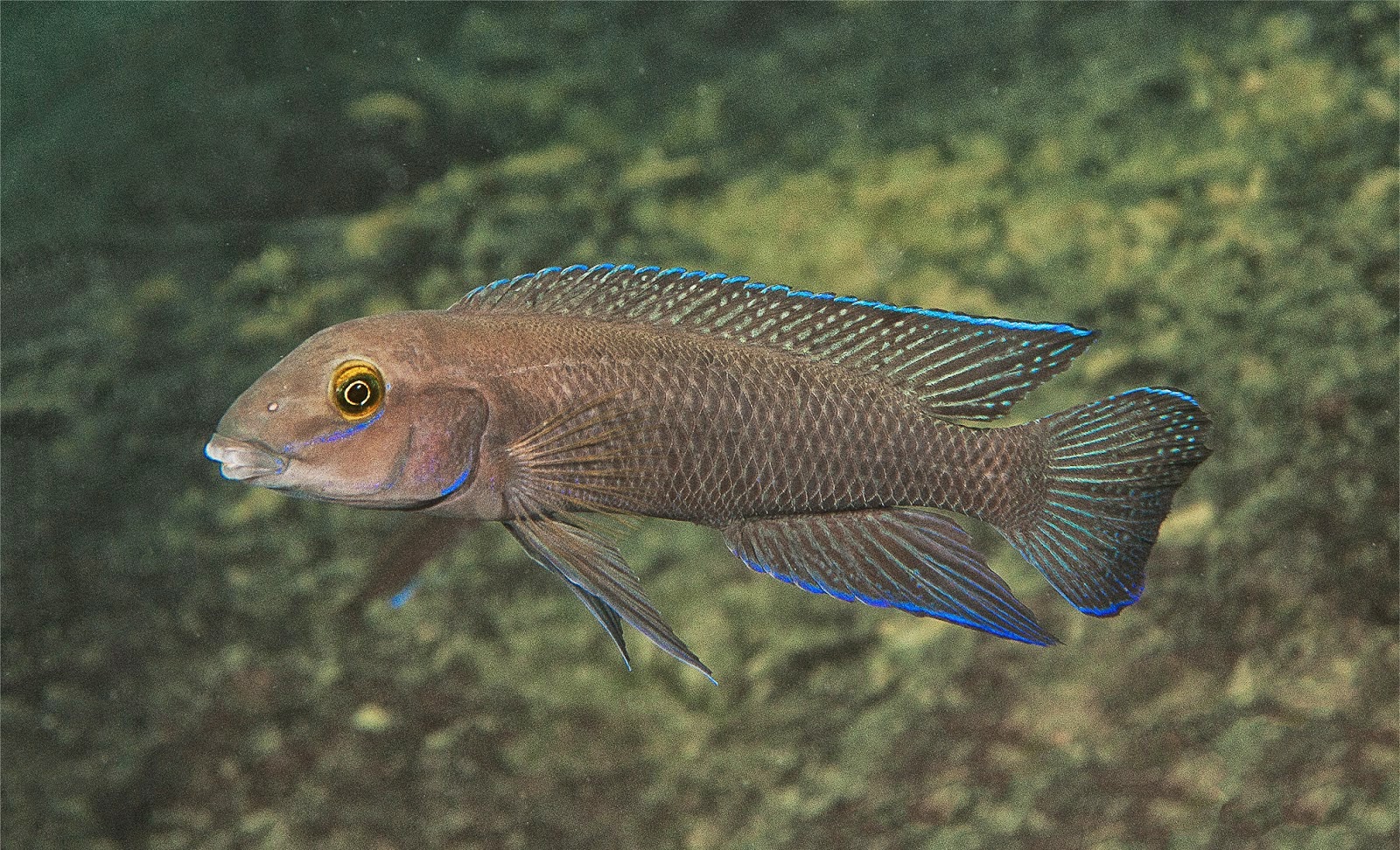
The new fish is named Apistogramma ortegai, in honour of the ichthyologist Hernán Ortega Torres of the Museo de HistoriaNatural at the Universidad Nacional Mayor de San Marcos. It is a deep bodied, flattened Fish reaching a maximum recorded length of 50.5 mm. The males are an iridescent blue with red marks around the scales of the lateral band, the females are similar but with black marks.

Apistogramma ortegai, live colouration in male (A) and female (B). Britzke et al. (2014).

Apistogrammaortegai was found only in a single small stream, which fed into a tributary of the Ampyiacu River, which in turn runs into the Amazon. The stream is small (50 cm at its deepest) and runs through an area of thick forest. It is warm (26°C) and slightly acidic (pH 6), and lacks any aquatic vegetation, though there were fallen leaves on the bottom, which was otherwise sandy with a little clay.

Locality where Apistogramma ortegai was found. Peru, Departamento Loreto, Distrito Pebas, small stream tributary of Ampiyacu River. Britzke et al. (2014).

Map showing the locality where Apistogramma ortegai was found. Britzke et al. (2014).

See also…

The Cichlid Fish genus Chalinochromis is endemic to Lake Tanganyika in East Africa. To date two species have been formally described, Chalinochromis...


http://sciencythoughts.blogspot.co.uk/2013/07/five-new-species-of-mbuna-from-lake.html Five new species of Mbuna from Lake Malaŵi.                                                      Mbuna are rock dwelling Cichlids known only from Lake Malaŵi in East Africa. They are typically colourful Fish, and often sexually dichromic (the males and females...
  
Follow Sciency Thoughts on Facebook.

A new species of Ankylosaurid Dinosaur from the Late Cretaceous of New Mexico.

Ankylosaurids were large, heavily armoured Ornithischian Dinosaurs, which appeared in the Early Cretaceous and persisted to the end of the period. They had bony shells comprised of fused osteoderms (bony plates that develop within the skin) that enclosed their torsos in a similar way to the shells of tortoises and turtles, but appear to have been more active, with limbs built for an upright stance and a large bony club on their tail, presumably used for defence against the large carnivores of the Cretaceous.

In a paper published in the journal PLoS One on 24 September 2014, Victoria Arbour and Michael Burns of the Department of Biological Sciences at the University of Alberta, Robert Sulivan, Spencer Lukas and Amanda Cantrell of the New Mexico Museum of Natural History and Science, Joshua Fry of the Department of Geosciences at Fort Hays State University and Thomas Suazo, also of the New Mexico Museum of Natural History and Science describe a new species of Ankylosaurid Dinosaur from the Late Cretaceous Kirtland Formation at Hunter Wash in San Juan County, New Mexico.

The new species is named Ziapelta sanjuanensis, where ‘Zia’ refers to the stylised sun on the flag of New Mexico (which is derived from the Zia sun symbol of the indigenous Zia people of the state) and ‘pelta’ means a small shield, in reference to the animals osteoderms, while ‘sanjuanensis’ means ‘from San Juan’.Ziapelta sanjuanensis is described from an largely complete skull plus two partial cervical vertebrae (neck bones) and some fragmentary osteoderms.

Ziapelta sanjuanensis, complete skull. (A) Dorsal view; (B) ventral view; (C) anterior view; (D) occipital view; and (E) left lateral view. Abbreviations: asca, anterior supraorbital caputegulum; bas, basioccipital; ch, choana; fm, foramen magnum; j, jugal; laca, lacrimal caputegulum;loca, loreal caputegulum; ltf, laterotemporal fenestra; mnca, median nasal caputegulum; nar, externalnaris; oc, occipital condyle; orb, orbit; pal, palatine; par, parietal; parocc, paroccipital process; pmx, premaxilla; psca, posterior supraorbital caputegulum; pt, pterygoid; q, quadrate; qj, quadratojugal; qjh, quadratojugal horn; snca, supranarial caputegulum; socc, supraoccipital; sqh, squamosal horn; tr, tooth row; v, vomer. Arbour et al. (2014).

Speculative life restoration of Ziapelta sanjuanensis. Sydney Mohr in Arbour et al. (2014).

See also…

The Nodosaurids were a group of Ankylosaurid Dinosaurs that differed from other members of the group in having spines, rather than bony clubs, on the ends of their tails, and additional large spines on their...


The Ankylosaurids were large armoured Dinosaurs from the Cretaceous of Europe, Asia and North America...

The 1971 Polish-Mongolian Palaeontological Expedition to the Gobi Desert unearthed a great deal of dinosaurian material, including the partial skeleton of an...

Follow Sciency Thoughts on Facebook.

Saturday, 4 October 2014

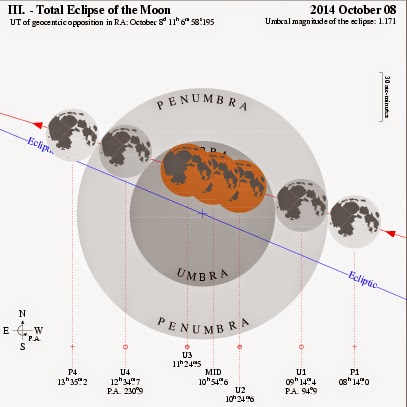
The 8 October 2014 Total Lunar Eclipse.

A total Lunar Eclipse will occur on 8 October 2014, starting at about 9.15 am GMT. It will be visible across much of the Pacific, as well as eastern parts of the United States and Canada, northeastern Asia and eastern Australia. Part of the eclipse will be visible from remaining areas of the Americas as well as the rest of Australia most of Asia, although in these areas the Moon will either rise part way through the eclipse, or set before it is complete.

Areas from which the 8 October 2014 Lunar Eclipse will be visible. In the white area the full extent of the eclipse will be visible, in the shaded areas it will either begin before the Moon rises or end after the Moon has set, while in the darkest area it will not be visible at all. HM Nautical Almanac Office.

The Moon produces no light of its own, but 'shines' with reflected light from the Sun. Thus at Full Moon the Moon is on the opposite side of the Earth to the Sun, and its illuminated side is turned towards us, but at New Moon the Moon is between the Earth and the Sun, so that its illuminated side is turned away from us.

Lunar eclipses occur when the Moon passes through the Earth's shadow. This can only happen at Full Moon (unlike Solar Eclipses, which happen only when the Moon passes between the Earth and the Sum, and therefore only occur at New Moon), but does not happen every Lunar Month as the Sun, Moon and Earth are not in a perfect, unwavering line, but rather both the Earth and the Moon wobble slightly as they orbit their parent bodies, rising above and sinking bellow the plane of the ecliptic (the plane upon which they would all be in line every month).

Because the Moon is passing through a shadow, rather than being blocked from our view, it does not completely disappear during an eclipse like the Sun, but rather goes through two distinct phases of dimming, the Penumbra, when it is still partially illuminated by the Sun, and the Umbra, when the Earth completely blocks direct sunlight from the Moon. This does not result in complete darkness, as the Moon is still partially lit by reflected Earthlight, but it does turn a deep, dark red colour.

Phases of the Lunar Eclipse that will be seen on 8 October 2014. The times are given in GMT, to the nearest 10th of a minute, thus 08.14.0 represents 8.14 am GMT. HM Nautical Almanac Office.

See also…


The September Equinox will fall on 23 September 2014, when the day and night will be of equal length in both of the Earth's hemispheres. The Earth spins on its axis at an angle to the plain of the Solar System. This means that the poles of the Earth do not remain at 90°...
 
http://sciencythoughts.blogspot.co.uk/2014/09/venus-at-perihelion.html
Venus at perihelion.
The planet Venus will reach perihelion (the closest point on its orbit to the Sun) at 3.3p pm GMT on Friday 5 September 2014, when it will...


The planet Neptune reached opposition (i.e. was directly opposite the Sun seen from Earth) at  2.18 pm GMT on Friday 29 August 2014. This means that it will both be at its closest to the Earth this year, about 28.96 AU (28.96 times the average distance between the Earth and the Sun, or about 4 332 000 000 km), and completely...


Follow Sciency Thoughts on Facebook.

How an invasive Grass species makes American Toads more vulnerable to Wolf Spiders.


Invasive plants can significantly modify local habitats, particularly if they lack herbivores in the environments they are colonising, by both modifying the structure of the environment and excluding native plants which provide food and homes to native animals. One such plant is the Japanese Stilt Grass (Microstegium vimineum), which has invaded moist forest-floor environments across the eastern United States. Japanese Stilt Grass has been shown to modify soil chemistry and Arthropod diversity and abundance in areas where it invades, and lacks any significant herbivores in the United States, allowing it to spread with little impediment.

Japanese Stilt Grass, Microstegium vimineum. Theresa Yednock/National Park Service/Wikimedia Commons.

One Vertebrate species is also apparently affected by the presence of Japanese Stilt Grass, the American Toad (Anaxyrus americanus), which appears to decline where the Grass becomes established. This could potentially be for a number of reasons. Firstly, like all Amphibians, American Toads have permeable skin through which they exchange fluids and gasses with the environment, which may make them vulnerable to changes in soil chemistry. Secondly they feed almost exclusively on Arthropod prey, notably Mites and Ticks (Acari), Spiders (Araneae), Beetles (Coleoptera), Springtails (Collembola), Flies (Diptera), Bugs (Hemiptera), and Ants, Bees and Wasps (Hymenoptera) and changes in the abundance of these prey items may affect the survival of the Toads. Finally the Toads themselves are vulnerable to predation by larger Arthropods, as they metamorphose (change from tadpoles into adult Toads) very young, achieving most of their growth in the terrestrial environment.

American Toad, Anaxyrus americanus. Brad Glorioso/National Wetlands Research Center/USGS.

In a paper published in the journal Ecology in July 2014, Jayna DeVore of the Warnell School of Forestry and Natural Resources at the University of Georgia and the School of Biological Sciences at the University of Sydney, and John Maerz, also of the Warnell School of Forestry and Natural Resources, describe the results of a series of experiments designed to determine exactly how the presence of Japanese Stilt Grass affects the American Toad.

Firstly DeVore & Maerz created enclosures in four areas of woodland in Georgia State that were enclosed in a way that prevented the entrance or exit of Toads but allowed Arthropods free movement. Within these enclosures the numbers of both Toads and the various Arthropod groups were monitored. No correlation between prey species numbers and Toads was found, but Toad numbers did decline in numbers in pens where Wolf Spiders (Lycopsidae) were present in large numbers.

Wolf Spiders are large predatory Spiders that hunt by waiting in ambush for mobile prey, then running it down. Small Toads, which actively seek out prey, moving about as they forage, are particularly vulnerable to this hunting technique, as they cannot feed it they remain immobile (the Spiders do not themselves forage, and will not find stationary prey) and have no defence against the Spiders.

The Carolina Wolf Spider, Hogna carolinensis. Patrick Edwin Moran/Wikimedia Commons.

DeVore & Maerz then carried out a series of cage experiments where Toads were placed in cages with or without Japanese Stilt Grass, and Wolf Spiders (Hogna carolinensis or Hogna helluo). In cages lacking Spiders the Toads survived well, regardless of the presence of the Stilt Grass, suggesting that it does not affect the soil chemistry in a way that harms the Toads. However in cages with Wolf Spiders the Toads suffered significant mortality, and this rose sharply in cages where both Spiders and Grass were present, suggesting that the Grass modifies the environment in a way that makes it easier for the Spiders to hunt the Toads.

Conceptual diagram of explored mechanisms through which Microstegium vimineum invasion can affect the survival and growth of metamorphic Toads, indicating both direct (solid line) and indirect (dashed line) effects. Black arrows are used to portray connections that were altered following invasion, resulting in significant changes in depicted parameters (e.g., densities, survival rates), whereas those that were unaffected are depicted in gray (i.e., growth rates). Significant changes are also annotated with a sign indicating whether the indicated parameter was positively (+) or negatively (-) affected (as compared with adjacent, uninvaded habitats; see Appendix C for effect sizes). In summary, invasion amplified top-down pressure on toads by increasing structural complexity, which dampened the strength of a pre-existing intraguild (IGP)/cannibalistic trophic linkage among Lycosid Spiders, resulting in higher spider densities and, subsequently, lower Toad survival within invaded habitats. The potential for bottom-up effects occurred via post-invasion changes in detrital food webs, which ultimately decreased the availability of edible invertebrates, but Toad growth was unaffected by these reductions. Although we also documented significant changes in abiotic habitat parameters following invasion, these effects alone did not significantly influence Toad survival (linkage not pictured). DeVore & Maerz (2014).

See also…


Sociality is rare in Spiders, which are by nature solitary and aggressive...


Cryptic species are species which resemble one-another physically, and which cannot generally be separated using traditional taxonomic methodology, but which are nevertheless genetically and reproductively...


Cave Spiders (Nesticidae) are found across the Mediterranean Basin, as well as in the Canary Islands and parts of Asia. They are...

Follow Sciency Thoughts on Facebook.

Friday, 3 October 2014

A Hadrosaurid Dinosaur trackway from the Denali National Park in Alaska.

The preserved tracks of ancient animals such as Dinosaurs can provide insights into their lifestyles and biology that could not be determined by examination of bones alone, although such data needs to be interpreted carefully. Such studies can potentially provide data on herding or other social structures among extinct animals, as well as data on the movement of individual creatures.

In a paper published in the journal Geology on 30 June 2014, Anthony Fiorillo of the Perot Museum of Nature and Science, Stephen Hasiotis of the Department of Geology at the University of Kansas and Yoshitsugu Kobayashi of the Hokkaido University Museum describe a newly discovered Dinosaur trackway in the Denali National Park in Alaska.

The trackway appears to show the movements of a large number of Hadrosaurid Dinosaurs. It is found in the lower part of the Late Cretaceous Cantwell Formation, which comprises fluvial (riverine) deposits preserved in a highly seasonal environment. The site is thought to be close to the same position that it occupied during the Late Cretaceous, i.e. it would have been within the Arctic Circle at the time when the tracks were laid down. Arctic ecosystems during the Cretaceous are thought to have been unlike anything found in the modern world, as the greenhouse climate of the period prevented the formation of permanent ice caps, but within the Arctic Circle the winter would still have been marked by several months of complete darkness.

Polar projection of tectonic plates during the Late Cretaceous, with inset map of Alaska. NA—North America. Dots in both maps indicate location of Denali National Park. Fiorillo et al. (2014).

The tracks appear to have been laid down over a short period of time (based upon analysis of plant and invertebrate fossils in the deposits, which are thought to have been highly seasonal) leading Fiorillo et al. to conclude they represent the passage of a single herd of animals. This herd apparently contained individuals with a wide range of sizes, from mature individuals, to very young juveniles. This is interesting as Hadrosaurid tracks in more southerly locations have previously shown only individuals of a single size, suggesting that the animals moved in packs determined by age. In contrast the Denali Herd appears to have contained animals of different ages, suggesting that younger animals were incorporated into a multi-generation herd, which in turn implies that extended parental care may have been occurring.

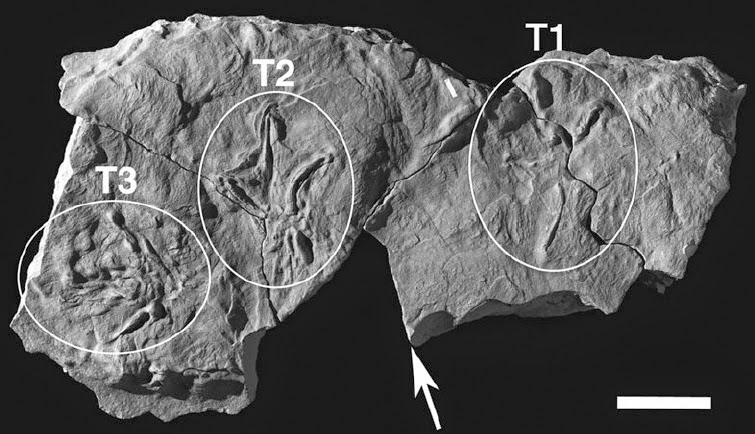
(A–C) Size ranges of tracks found at Denali National Park, Alaska, tracksite. (D) Adult Hadrosaurid track with skin impressions. Scale bar for (C1) is 5 cm.Fiorillo et al. (2014).

Fiorillo et al. also observe that while there appear to have been Hadrosaurs of all sizes in the pack, the size distribution is skewed towards larger, presumably adult, specimens. They suggest that this may be indicative of rapid growth in juvenile Hadrosaurs, with a lifecycle that includes a short growing period followed by an extended adult phase (something that has been suggested for Hadrosaurs previously).

Relative frequencies of each growth stage as function of body mass in the Denali Hadrosaur herd. This curve independently corroborates hypothesised growth curve for Hadrosaurid dinosaurs proposed by others. Fiorillo et al. (2014).

It has been suggested that Dinosaurs living within the Arctic Circle may have migrated seasonally to escape the dark winter season, in a similar way to the long distance migrations of modern Caribou. Based upon our understanding of the location of the Dinali site during the Cretaceous, and the sizes of the Dinosaurs within this pack (which affects the distance an animal can migrate by walking), Fiorillo et al. suggest that it would have been impossible for the Dinali herd to migrate seasonally from the site to a location outside the Arctic Circle, suggesting that they were able to overwinter in the Arctic.

See also…


In 1940 palaeontologist Roland Bird of the American Museum of Natural History in New York described and partially excavated a...


Dinosaur footprints are well documented from a number of sites...


Follow Sciency Thoughts on Facebook.

Is the occurrence of multi-kiloton impact events on Earth truly random?


In 1984 palaeontologists David Raup and Jack Sepkowski of the Department of Geophysical Sciences at the University of Chicago analysed the occurrence of mass extinction events on Earth and came to the conclusion that these events appeared to be cyclic in nature. Since no known Earthly phenomena is cyclic on a scale of tens of millions of years, he suggested an extra-terrestrial cause for such events, leading to a brief period when it became fashionable to try to explain such extinction events by means of large impact events. This hypothesis lives on in the Alvarez Impact Event Theory, which postulates that the End Cretaceous Extinction was caused by a large body impacting into the Yucatan Peninsula in Mexico, but has otherwise fallen from favour. Our ability to place dates in ancient events has dramatically improved since the 1960s, and has led scientists to conclude that extinction events were not cyclic in occurrence, and we have come up with robust explanations for most of these events which do not need to invoke extra-terrestrial causes. At the same time our understanding of Solar System dynamics has improved to the point where we can rule out cyclic events on a tens of millions of years scale, and we have found numerous large impact craters on Earth that do not seem associated with even the smallest extinction events.

While major impact events occurring regularly on a tens of millions of years scale has now been ruled out, at the opposite end of the scale we do expect small events to occur regularly on an annual scale, for example we can state with confidence the days on which meteor showers will fall, as the Earth passes through the orbital trail of comets or other bodies which leave trails of dusty or sand-size grains in their paths, resulting in harmless but visible showers of micrometeorites falling on Earth.

In a paper published on the arXiv database at Cornell University Library on 1 September 2014 and accepted for publication in the Monthly Notesof the Royal Astronomical Society, Carlos and Raul de la Fuente Marcos of the UniversidadComplutense de Madrid describe the results of a study in which they analysed the distribution of multi-kiloton impacts on Earth since 2000 in order to determine whether the distribution of these events was truly random.

De la Fuente Marcos and de la Fuente Marcos started by taking data collected by the Comprehensive Nuclear-Test-Ban Treaty Organization, which uses infrasound sensors to look for clandestine nuclear tests, but which have also recorded a 26 events attributed to objects with masses between one and 500 kilotons impacting the Earth’s atmosphere since 2000. This was adjusted for known inaccuracies, such as the 22 September 2007 event which was recorded as occurring over the Indian Ocean, but which was observed over the South Pacific, and other events not detected by the network, such as the 18 kiloton object which impacted the atmosphere over Botswana on 21 November 2009, resulting in a list of 33 events between 2000 and 2013 that were included in the study. Only one of these events, the 7 October 2008 impact of Apollo asteroid 2008 TC3 near Almahatta Sitta in Sudan was detected in advance, and then only by a matter of hours.

Geographical distributions of the events included in the study. De la Fuente Marcos and de la Fuente Marcos (2014).

The list included four calendar days on which more than on object hit the Earth on the same day, albeit in different years (including one set of three objects on 8 October 2004, 2008 and 2009). In addition there were 9 events that occurred within one day in different years, 14 events that occurred within two days on different years and three events that occurred within three days. De la Fuente Marcos and de la Fuente Marcos calculate that there is a 35.7% chance of two such events falling on the same day, but only a 4.05% chance of four such pairings occurring. They further calculate that there is only a 1.9% chance of 9 events occurring within one day in different years, a  0.93% chance of 14 events occurring within two days and a 2.16% chance of 16 events occurring within three days in different years.

Calendar-day distributions of the events in the study. Green points correspond to impacts in the northern hemisphere and blue points correspond to impacts in the southern hemisphere. There are 17 impacts in the northern hemisphere and 16 in the southern one. The calendar day distribution for impacts in the northern hemisphere is almost uniform. In contrast, the equivalent distribution for the southern hemisphere is very asymmetric. The overall impact risk for the southern hemisphere is 50 per cent higher than that of the northern hemisphere from September to December.De la Fuente Marcos and de la Fuente Marcos (2014).

This strongly suggests that the distribution of impact events throughout the year is non-random, and that impacts are preferentially likely to happen on certain days of the year, presumably as the Earth’s orbit intersects other orbital pathways where more than one object follows the same path. This can occur for one of two reasons. Firstly a single object can break up for some reason, and the resultant bodies continue to follow the same path. This most notably occurred in 1994, when comet Shoemaker-Levy 9 broke up into several component bodies after a close encounter with Jupiter, each of these daughter bodies going on to impact the planet. Alternatively different bodies can be shepherded into similar orbital paths by repeated encounters with planets. This occurs because when two bodies pass close to one-another they exchange some momentum energy, so that one body speeds up slightly and the other slows down slightly. When this happens repeatedly between a very large body, such as a planet, and a very small body, such as an asteroid, the smaller body is herded into a resonant orbit with the larger body, and over time many objects can be herded into such orbital paths.

Images of the impacts on Jupiter caused by the breakup of comet Shoemaker-Levy 9 in 1994 at (left) visible and (right) ultraviolet wavelengths. NASA/Hubble Space Telescope.

The 15 February 2013 Chelyabinsk impact event has been studied particularly extensively, due to the large and conspicuous nature of this event, and the impacting body has tentatively been linked to a family of resonant asteroids. The Chelyabinsk object is believed to have been on an orbital pathway intersecting the Earth’s orbit at an angle of 146.5˚. The  South China Sea impact event of 18 February 2000 occurred within three calendar days of the Chelyabinsk event, and this object has also been suggested to have been travelling at 146.5˚ to the Earth’s orbital trajectory, strongly supporting the idea that these bodies hailed from a single population.

The fireball caused by the Chelyabinsk Bolide. Astro Bob.

The North Pacific object of 23 April 2001 fell between Hawaii and California. The Sutter’s Mill Meteor of 22 April 2012 fell in California and may be related to this. The Sutter’s Mill Meteor if thought to have been on a trajectory at an angle of ~212.5˚ to the orbit of the Earth, falling towards the Sun at the time of the impact, possibly similar to the trajectory of a Jupiter Family Comet (a comet with a period of less than 20 years, and an inclination of less than 30˚ to the plain of the Solar System). The Santiago del Estero object fell in Argentina in 21 April 2013, but appears to have had quite different properties to the other two impacts, and is probably unrelated.

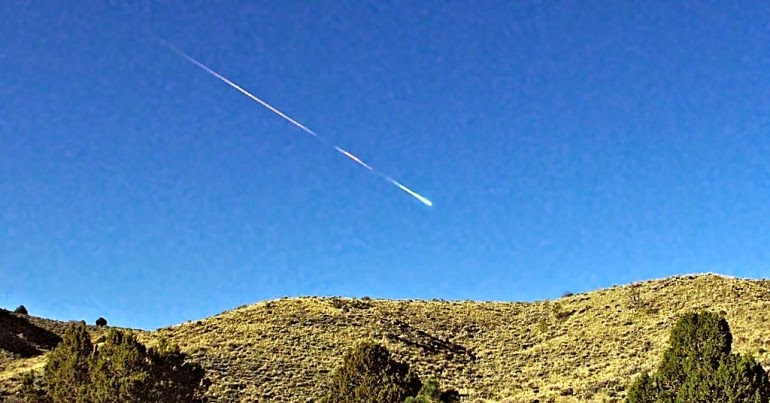
Sutter’s Mill Meteor seen from Reno, Nevada. Lisa Warren/NASA.

The Crete Bolide of 6 June 2002 and the Reisadalen Event of 7 June 2007, which occurred close to the Norway/Finland border, both involved objects travelling at an angle of 255.5˚ to the Earth’s orbital trajectory, and falling towards the Sun at the time of the impact.  A bright fireball observed over Washington State on 3 June 2004 may also be related to these objects.
 
The Southern Ocean event of 3 September 2004, which fell near Antarctica, the Indian Ocean Event of 2 September 2006 and the South Pacific Event of 3 September 2010 all appear to be related. All were apparently travelling at an angle of 340˚ to the orbital path of the Earth, and falling towards the Sun at the time of the impact. It has been suggested that the parent body of the Southern Ocean event was a small Aten Family Asteroid (an asteroid which orbits mostly inside the orbit of the Earth, but which is further away some of the time), with an orbital period of 293 days. Aten Family Asteroids are thought to have particularly short lifetimes, as the planets of the Inner Solar system are quite close together, so that orbits are easily perturbed by repeated encounters with these planets, resulting in objects breaking up, colliding with something or being thrown out of the system.

The South Pacific event of 22 September 2007 and the Vitim event over Siberia on 24 September 2002 appear to be related, both objects having been travelling at an angle of 359˚ to the Earth’s orbit prior to their impacts.

The Indian Ocean event of 7 October 2004, the Almahatta Sitta impact in Sudan on 7 October 2008 also appear to be connected, both having involved objects travelling at 14˚ to the Earth’s orbit. The Almahatta Sitta impact involves the only asteroid in the study observed prior to its impact on the Earth, 2008 TC3, which in turn has been linked to the Nysa-Polana Asteroid Family (expand). The South Sulawesi event of 8 October 2009 appears to be unrelated.

A recovered piece of the Almahatta Sitta meteorite. Jon Taylor/Wikimedia Commons.

The 10 November 2002 North Pacific impact and 9 November 2005 New South Wales impact also appear to be related. Both caused by objects travelling at almost 47˚ to the Earth’s orbital trajectory.

The 26 December 2007 South Pacific event and 25 December 2010 North Pacific event also appear related, both having impacted at an angle of ~93˚.

De la Fuente Marcos and de la Fuente Marcos are confident that there is less than a 5% chance that all of the objects occurring on similar trajectories on similar dates could be coincidences. They note that streams of asteroids containing large bodies that intersect the Earth’s orbit are unlikely to persist for very long periods of time, as such bodies are likely to either impact the Earth or Moon or be disrupted into different orbits by their gravity or those of nearby planets. However such streams of asteroids could still potentially persist for several decades, leading to a series of connected impacts.

See also…


The Chelyabinsk Meteorite detonated in the atmosphere over the southern Russia on 15 February 2013 with an equivalent energy to 500 kilotons of TNT. From the size of the explosion it is estimated to have...


65 million years ago, at the end of the Cretaceous, the Earth underwent the last of the five great mass extinctions recorded in the fossil record. While this is by no means the largest of these events, it is the most familiar to the general public, as it was responsible for the extinction of, amongst other things, the non-Avian Dinosaurs and the large marine Reptiles of the...


Lake Bosumtwi is an 8 km diameter roughly circular lake about 30 km to the southeast of Kumasi in the Ashanti Province of Ghana. It is thought to have been created by a large meteorite impacting the Earth roughly 1.07 million years ago during the Late...


Follow Sciency Thoughts on Facebook.