Sunday, 17 July 2022

Pluto comes to opposition.

The Dwarf Planet Pluto will reach opposition (be directly on the opposite side of the Earth as the Sun) at 9.46 am GMT on Wednesday 20 July 2022. This means that it will be at its closest to the Earth this year, about 33.61 AU (33.61 times the average distance between the Earth and the Sun, or about 5 028 000 000 km), and completely illuminated by the Sun. While it is not obvious to the naked eye observer, the planets have phases just like those of the Moon; being further from the Sun than the Earth, Pluto is 'full' when directly opposite the Sun, although with an apparent magnitude of only 14.9 it will take a reasonably good telescope to see Pluto at all, and it will only be visible as a star-like point to those that can see it.

The relative positions of Earth and Pluto at 10.00 am on 20 July 2022. JPL Small Body Database.

Pluto was discovered in 1930 by Clyde Tombaugh, a young astronomer working at the Lowell Observatory in Arizona; its existence had been predicted as early as 1909, due to anomalies in the orbit of Neptune. At the time it was assumed that Pluto was a planet of some size, capable of disturbing the orbit of Neptune. Pluto spends part of its 248 earth year orbit inside the orbit of Neptune; this is not the same on every orbit, but alternates between a 20 and a 14 year stay.

The Dwarf Planet Pluto imaged by the New Horizons space probe in July 2015. NASA/JPL/Southwest Research Institute.

Pluto was downgraded from a planet to a dwarf planet by the International Astronomical Union in 2006, following the discovery of several similar small bodies in the Kuiper Belt beyond the orbit of Neptune. The term 'Dwarf Planet' is now used to designate objects large enough to form a roughly spherical shape under their own gravity, but no so massive as to have cleared the area around their orbit of all other objects. Pluto, Haumea, Makemake, and Eris were placed in this category, as was Ceres in the asteroid belt. Ceres had also been classified as a planet at the time of its discovery in 1801, as were a number of other asteroids until the mid-nineteenth century, when it became clear that asteroids were too abundant to be classed as planets.

The comparative sizes of Pluto, its largest moon, Charon, and the continental United States of America. Calvin Hamilton/Cornell University.

Pluto has an 247.7 year orbital period and an eccentric orbit tilted at an angle of 17.1° to the plane of the Solar System, which takes it from 29.6 AU from the Sun (i.e. 2960% of the the average distance at which the Earth orbits the Sun) to 49.4 AU from the Sun (i.e. 4940% of the average distance at which the Earth orbits the Sun). As a body which spends most of its time outside the orbit of the planet Neptune it is classed as a Trans-Neptunian Object, even though it does come inside the orbit of Neptune for part of its orbital period.

See also...


Follow Sciency Thoughts on Facebook.

Follow Sciency Thoughts on Twitter. 


Notalina (Neonotalina) ralphi: A new species of Long-horned Caddisfly from Brazil

Caddisflies, Trichoptera, are a widespread and numerous (over 12 000 described species) group of Insects closely related to the Lepidoptera (Butterflies and Moths). Like Butterflies and Moths, Caddisflies undergo a complete metamorphosis upon reaching maturity, with a long-lived caterpillar-like larvae, and a shorter-lived flying adult stages (which typically lives one-to-two weeks). However, unlike the larvae of Butterflies and Moths, Caddisfly larvae are entirely aquatic, with only the winged adults emerging above the water surface. Most larval Caddisfly inhabit cases which they make out of silk, which some species are noted for covering with small stones, pieces of plant matter, shells or other matter they find in their environment. The larvae may be herbivorous or carnivorous, adult Caddisfly generally do not eat at all. Long-horned Caddisflies, Leptoceridae, are the second most numerous group of Caddisflies, with about 2200 described species grouped into four subfamilies the Grumichellinae, the Leptocerinae, the Leptorussinae, and the Triplectidinae. The tropical Southern Hemisphere genus Notalina is placed within the Subfamily Triplectidinae, and is itself divided into two subgenera, Notalina (Notalina), which is found in Austalasia and Notalina (Neonotalina) from South America.

In a paper published in the journal ZooKeys on 11 July 2022, Erica Silva Pereira of the Programa de Iniciação Científica and the Divisão do Curso em Entomologia at the Instituto Nacional de Pesquisas da Amazônia, Ian Oliveira of the Laboratório de Entomologia Aquática at the UniversidadeFederal da Bahia, Gleison Robson Desidério, also of the Divisão do Curso em Entomologia at the Instituto Nacional de Pesquisas da Amazônia, Adolfo Calor, also of the Laboratório de Entomologia Aquática at the Universidade Federal da Bahia, and Neusa Hamada, once again of the Divisão do Curso em Entomologia at the Instituto Nacional de Pesquisas da Amazônia, describe a new species of Notalina (Neonotalina) from Brazil.

The new species is described from specimens collected using Malaise traps close to rivers in the Cerrado (Brazilian savanna) biome in Brazil's Federal District, and Tocatins and Bahia states. It is named Notalina (Neonotalina) ralphi, in honour of Ralph Holzenthal of the University of Minnesota, for his work on Neotropical Caddisflies and support for new entomologists.

Notalina (Neonotalina) ralphi, lateral view. Silva Pereira et al. (2022).

See also...

Follow Sciency Thoughts on Facebook.

Follow Sciency Thoughts on Twitter. 


Wednesday, 13 July 2022

Geckos from the Early Eocene Dormaal Site in Belgium.

The Middle and Late Eocene Lizard faunas of Europe are relatively well known, thanks to a number of lagerstätten (deposits with exceptional preservation) such as the Messel Shale of Germany. However, the Lizards of the Early Eocene are much less well understood, due to a paucity of such sites. This is unfortunate, as this interval starts with the Palaeocene-Eocene Thermal Maximum at 56 million  years ago, the which saw the warmest temperatures of the past 66 million years, with Northern Europe developing a sub-tropical to tropical climate, and therefore presumably being a particularly good environment for Lizards.

One exception to this lack of Early Eocene is the Dormaal locality at  Zoutleeuw, eastern Belgium, where a fluvial deposit comprised of layers of clayey and lignitic (coal-rich) sands are interbedded with lenses of grey clays. These deposits are thought to have been laid down in a system of rivers and lagoons in the earliest Eocene, and have yielded a diverse fauna of Mammals, Lizards, Fish, Turtles, and Crocodiles.

In a paper published in the journal Royal Society Open Science on 29 June 2022, Andrej Čerňanský of the Department of Ecology at Comenius University in Bratislava, Juan Daza of the Department of Biological Sciences at Sam Houston State University, Richard Smith of the Directorate Earth and History of Life at the Royal Belgian Institute of Natural Sciences, Aaron Bauer of the Department of Biology and Center for Biodiversity and Ecosystem Stewardship at Villanova University, Thierry Smith, also of the Directorate Earth and History of Life at the Royal Belgian Institute of Natural Sciences, and Annelise Folie of the Scientific Survey of Heritage at the Royal Belgian Institute of Natural Sciences, describe A new species of Gacko from the Dormaal Site.

Location of the earliest Eocene locality of Dormaal (MP7, Belgium) that has yielded Dollogekko dormaalensis and the early Eocene locality of Prémontré (MP10, France) that has yielded Laonogekko lefevrei. Čerňanský et al. (2022).

Geckos as a group have a poor fossil record, due to their lightly mineralised and easily disarticulated skeletons. The oldest known Geckos come from the Early Cretaceous amber deposits of Myanmar, with Geckos also known from Eocene Baltic Amber and Miocene Dominican Amber. Outside of these amber deposits, however, almost all fossil Geckos are known from isolated skeletal elements. Geckos have previously been recorded from the Dormaal locality, but never actually formally described.

The new species is named Dollogekko dormaalensis, where 'Dollogekko' honours the prominent Belgian palaeontologist Louis Dollo (1857-1931), combined with '-gekko' the Malay root word of the English 'gecko', often used as a suffix for generic names within the group, and 'dormaalensis' means 'from Dormaal'. The species is described from a single incomplete frontal bone (the bone that forms the forehead in Humans).

Dollogekko dormaalensis, the holotypic frontal IRSNB R 452 in (a) dorsal, (b) ventral, (c) right lateral,(d) left lateral and (e) anterior views. Čerňanský et al. (2022).

The frontal bones of Geckos tend to be highly distinctive at the species level, making it possible to reliably describe new taxa on these bones alone. The specimen from which Dollogekko dormaalensis is described comprises about the anterior half of the frontal bone, with the posterior half being lost. The preserved portion is 4.3 mm in length, is tubular-to-funnel-shaped (the whole bone would almost certainly have been hourglass shaped), and would have extended about ¾ of the way around the orbit. 

Dorsal view of the skull of some extant Geckos exhibiting diversity of frontal bone shape and sculpturing (yellow). (a) Carphodactylidae, Underwoodisaurus  milii (CAS  74744),  (b)  Diplodactylidae, Rhacodactylus  leachianus (MCZ–R15967), (c) Phyllodactylidae, Thecadactylus rapicauda (CAS 95146) and (d) Gekkonidae, Chondrodactylus angulifer (CAS 126466). Čerňanský et al. (2022).

In addition to the partial frontal from which Dollogekko dormaalensis is described, Čerňanský et al. also describe two fragments of dentary and a partial mandible from the same deposit. The dentary fragments appear to be from a Gecko about the same size as Dollogekko dormaalensis, while the partial mandible appears to come from an Animal about twice the size. Since the frontal bone from which Dollogekko dormaalensis is described is fully fused, and therefore presumed to come from an adult individual which has stopped growing, this appears likely to represent a separate species. The dentary fragments are of a size compatible with he frontal bone, but it is impossible to confirm that they belong to the same species, derive from a juvenile of the species which produced the mandible, or represent a third species. Due to this uncertainty, and the low value of mandible fragments for taxonomic purposes, none of these specimens are named, but instead referred to as Gekkota indet 1 (dentaries) and Gekkota indet 2 (mandible).

Gekkota indet. 1, the dentaries IRSNB R 454 and IRSNB R 453; Gekkota indet. 2, the mandible fragment IRSNB R 456 in(a), (e), (i) lateral, (b), (f), (j) medial, (c), (g), (k) dorsal, (d) ventral and (h) anterior views. Čerňanský et al. (2022).


See also...

Online courses in Palaeontology. 

Follow Sciency Thoughts on Facebook.

Follow Sciency Thoughts on Twitter.


Sunday, 10 July 2022

Does the Nebra Disc represent a Bronze Age supernova?

Discovered with a hoard of Bronze Aged weapons in 1999 by two metal-detectorists in a prehistoric enclosure in the Ziegelroda Forest, 60 km west of Leipzig in the German State of Saxony-Anhalt, and subsequently traded several times on the black market before coming to the notice of archaeologists, the Nebra Disc is now considered to be one of the oldest known depictions of celestial objects. 

The disc depicts a cluster of stars, which can be confidently identified as the Pleiades flanked by a disc interpreted as the Sun and a crescent interpreted as a waning Moon, against a starry background with a blue-green patina. Additional arcs are present on two edges of the disc, although these are now thought to have been added later. Organic material found with the disc has been carbon dated to 1600-2000 BC, while material adhered to one of the swords found with it has been dated to between 1600 and 1560 BC. This gives an estimated burial time for the object, although the disc is likely to be older. Its style of manufacture has been linked to the Unetice Culture, which was found in Central Europe between about 2300 and 1600 BC. 

X-ray fluorescence trace element analysis of the metals used in the disc has suggested that the copper used in its manufacture originated from  Bischofshofen in Austria, the gold of the outer crescents (thought to have been added later) probably came from the Carpathian Mountains, while the gold of the original stars and discs probably came from Cornwall. 

The disc was clearly a high value object, with considerable effort and resources going into its manufacture, and therefore is likely to have had specific meaning for its makers, but that meaning remains obscure to us today. The objects at its centre have clearly been chosen carefully, yet their conjunction is highly unlikely. A waning Moon would not occur close to a Sun-disc in nature; the Moon does occasionally pass close to, or even in front of, the Sun, but is always in the New Moon (invisible) phase, as all the phases of the Moon are driven by reflected sunlight. This has led to the conclusion that the selection of objects is purely symbolic in nature, not directly related to a specific observation.

In a paper published in the Journal of Anthropological and Archaeological Sciences on 24 March 2022, Rosario Gianluca Pizzone and Roberta Spartá of the Laboratori Nazionali del Sud at the Istituto nazionale di fisica nucleare, make the proposal that the large disc seen on the Nabra Disc does not in fact represent the Sun, but is instead a depiction of a supernova explosion.

The Nebra disc as it appears now (on display in Halle Museum of Prehistory). The Pleiades cluster shows up in the top part, amid the golden disc and the waning Moon. The solar arcs on the right and bottom of the picture were added in a post-construction phase (see text for details). Pizzone & Spartá (2022).

Pizzone and Spartá note that the large gold disc is depicted in a part of the sky (the Auriga-Taurus astersim) known to be very active in terms of stellar formation and supernova explosions (the two are connected, with the largest stars, which are the ones that undergo such explosions, having very short lives). This area contains a number of supernova remnants, and is home to the only historically recorded supernova explosion, which led to the formation of the Crab Nebula in 1054 and was recorded by Chinese scholars.

Armed with this knowledge, Pizzone and Spartá conducted a survey of the Auriga-Taurus asterism, looking for young supernova remnants which might be associated with the event depicted on the Nebra Disc. This survey uncovered five such young supernovae. The first of these, SH2 224, is estimated to be between 13 000 and 24 000 years old, and is located 4500 parsecs (1470 light years) from our Solar System. The second, SH2 221 (HB9) is estimated to be 4000-6600 years old and is roughly 800 parsecs (2600 light years) away. The third, Semeis 147, is thought to be 30 000-40 000 years old and is 1200-1500 parsecs (3900-4500 light years away). The fourth, the Crab Nebula, can be precisely dated at 966 years old, and is 2000 parsecs (6500 light years) away. The final object, IC443, is between 3000 and 30 000 years old, and located 1500 parsecs (4500 light years) from us.

Pizzone and Spartá observe that one of these supernovae, SH2 221 (HB9) has a lower age range which coincides roughly with the possible creation of the Nebra Disc. They estimate, from the size of this object and its estimated distance, that at its peak this explosion would have been as bright as the Full Moon, a striking event which would likely have been seen as being of great importance to any Bronze Age European observers. 

They further note that several stone carvings, of roughly the same age, in the Burzahom archaeological site in Srinagar, Jammu and Kashmir, India, depict stick figures observing two light-emitting objects in the sky. The precise meaning of these has also been debated, with the objects possibly being the Sun and Moon or two stars, but could also conceivably represent a supernova explosion close in the sky to the Moon.

Photograph of a stone carving from Burzahom, and drawing of the same. Joglekar et al. (2007).

See also...

Follow Sciency Thoughts on Facebook.

Follow Sciency Thoughts on Twitter.


Friday, 8 July 2022

Gorgosaurus libratus: Two new juvenile specimens shed light on the ontogeny of a Late Cretaceous Tyrannosaurid Dinosaur.

Gorgosaurus libratus is one of the best known Tyrannosaurids, with dozens of skeletons known from the Late Cretaceous Dinosaur Park Formation of Alberta and Judith River Formation of Montana. This has enabled scientists to develop a good understanding of the Ontogeny (developmental changes during growth) of this Dinosaur. The species was first described in 1914 from a mature specimen from the Dinosaur Park Formation. A second species of Gorgosaurus, Gorgosaurus sternbergi, was subsequently described on the basis of a smaller, more slender skeleton from the same formation, though this was later recognised as a juvenile, rather than a separate species, the beginning of a long process of discovery about the life history of this Tyrannosaurid.

In a paper published in the Journal of Vertebrate Paleontology on 13 April 2022, Jared Voris and Darla Zelenitski of the Department of Geoscience at the University of Calgary, François Therrien of the Royal Tyrrell Museum of Palaeontology, Ryan Ridgely of the Department of Biomedical Sciences at Ohio University, Philip Currie of Biological Sciences at the University of Alberta, and Lawrence Witmer, again of the Department of Biomedical Sciences at Ohio University, describe two new juvenile specimens of Gorgosaurus libratus from the Dinosaur Park Formation, and the implications of these for our understanding of ontogeny in the species.

The first specimen described is TMP 2009.12.14, a juvenile Gorgosaurus libratus skeleton with an articulated skull, a partial vertebral columns with ribs, a pelvic girdle, and an articulated left pectoral girdle. The skull of this specimen is almost complete on the left side, but lacks the articular, epipterygoid, jugal, lacrimal, prearticular, quadrate, quadratojugal, squamosal, and surangular bones on the right side, as well as the unpaired ethmoid and orbitosphenoid bones, while the right angular, ectopterygoid, and post-orbital are preserved, but disarticulated from the skull.

Skull of MP 2009.12.14 in lateral view. Voris et al. (2022).

The second specimen, TMP 2016.14.1, is a partial skeleton with an  articulated skull, partial vertebral column with ribs, and pelvic girdle. In this case the skull is largely intact, although theright quadratojugal is disarticulated.

Skull of TMP 2016.14.1. in lateral view. Scale bar equals 10 cm. Voreis et al. (2022).

Together, TMP 2009.12.14 and TMP 2016.14.1 represent two of the most complete juvenile Gorgosaurus libratus specimens known, and considerably to our understanding of the ontogeny of this species. Tyrannosauroids in general are known to have undergone dramatic morphological changes as they grew. 

In Gorgosaurus libratus juveniles had narrow, shallow skulls with large circular orbits (eye sockets) and ziphodont teeth (flat, sharp teeth with serrated edges), as well as uninflated sinuses and little cranial ornamentation, while adults had wide, deep skulls with incrassate (thickened) teeth, p-shaped orbits, inflated sinuses, and prominent cranial ornamentation. 

The additional data provided by the new specimens enables a better understanding of when these changes took place. The proportions of juvenile Gorgosaurus libratus individuals seems to have remained fairly constant until they reached about 50% of their maximum size, when they began to grow much more rapidly, with their skulls becoming deeper, wider, and generally more robust. Once the skulls reached about 60% of their maximum size, other adult features, including changes to the shape of the bones around the orbits, thickening of the teeth, and the development of ornamentation. When the skull had reached 80% of its maximum size the relative increases in depth and width plateaued, with the skull maintaining the same approximate proportions for the rest of its growth, and the sutures of the braincase had all closed, while the sinuses expanded and the bones around the orbit began to reach their final structures. At 90% of maximum size the transformation appeared to be complete, with the final stages including the resorbtion of the extremities of the antorbital fossa and the expansion of the flange on the posterior of the dentary.

Comparison of the growth series of Gorgosaurus libratus and Tyrannosaurus rex, demonstrating similar ontogenetic stages (and morphologies) occurring at similar relative size (percent of largest specimen skull length) but different body sizes and biological ages. Voris et al. (2022).

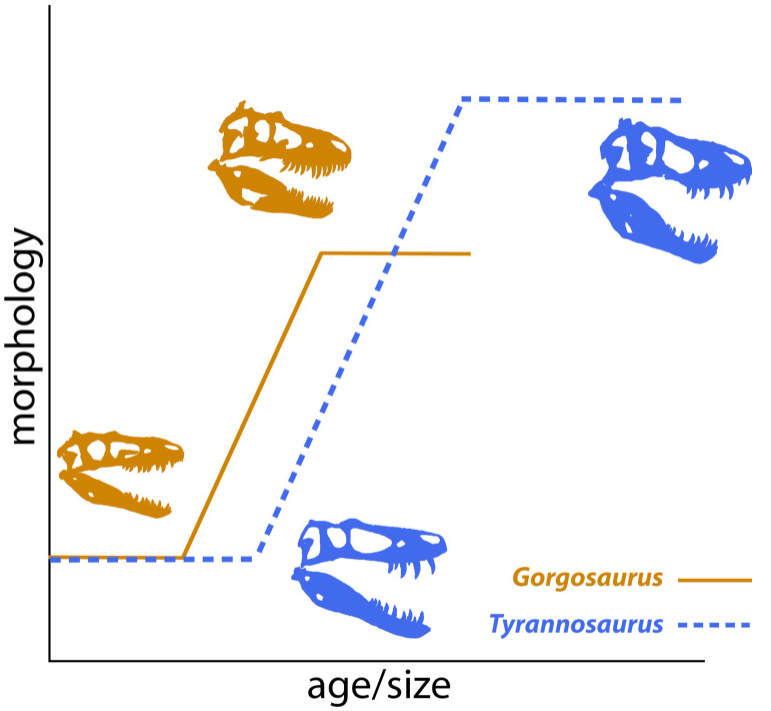
The development of the cranial morphology during ontogeny has also been studied Tyrannosaurus rex, enabling direct comparison of these two closely related species. Both species entered a period of accelerated growth when they reached about 50% of their maximum size. In both species this period of accelerated growth was accompanied by a significant increase in the relative width and depth of the skull, as well as a general increase in robustness. Furthermore, both species developed incrassate teeth, nasal ornamentation and changes to the shape of the eye socket when they reached about 50% of their maximum size, with the eye socket shape continuing to change until the animal reached about 80% of its maximum size and these bones began to permanently fuse. However, while the general growth trajectory of the two species was generally similar, in Tyrannosaurus this occurred when the Dinosaur was both older and larger. A Gorgosaurus with a skull length of about 720 mm would have been about 14 years old, and have had features consistent with a young adult developmental stage, whereas a Tyrannosaurus the same age would have been 11-13 years old, with completely juvenile features. This suggests that the onset of accelerated growth in Tyrannosaurids was associated with maturity rather than absolute size, and that the larger size achieved by Tyrannosaurus was linked to both the delayed occurrence and increased length of this developmental stage.

Simplified comparison of ontogenetic trajectories of Gorgosaurus and Tyrannosaurus. Relative to the more basal morphology of Gorgosaurus, the delayed onset of similar ontogenetic changes in Tyrannosaurus coupled with its more hypermorphic features may suggest sequential hypermorphosis to have played a role in the evolution of this taxon. Voris et al. (2022).

See also...

Online courses in Palaeontology. 

Follow Sciency Thoughts on Facebook.

Follow Sciency Thoughts on Twitter.

Tuesday, 5 July 2022

Cokotherium jiufotangensis: A new species of Eutherian Mammal from the Early Cretaceous Jehol Biota of China.

Eutherian Mammals (or Placental Mammals) represent the largest Mammal group alive today. Molecular clock analysis suggests that thy diverged from the Marsupials during the Jurassic, which is supported by the oldest known Eutherian Mammal fossil, Juramaia sinensis, coming from the Late Jurassic Tiaojishan Formation of Liaoning Province in China. However, the fossil record of early Eutherians is sparse, with only Juramaia sinensis known from the Jurassic, and a only a few examples, such as Eomaia, Acristatherium, Ambolestes, Sasayamamylos, Sinodelphys, and Prokennalestes coming from the Early Cretaceous. This makes it hard to make solid predictions about the relationships between these early Eutherian species, with the discovery of new species often leading to the reassessment of the importance of features used to define the group (for example Sinodelphys was considered the earliest known Marsupial until 2018, when a re-evaluation of the group following the discovery of Ambolestes zhoui lead to it being classified as a Eutherian.

In a paper published in the Philosophical Transactions of the Royal Society Series B: Biological Sciences on 7 February 2022, Hai-Bing Wang of the Key Laboratory of Vertebrate Evolution at the  Institute ofVertebrate Paleontology and Paleoanthropology, the Centre for Excellence in Life and Paleoenvironment of the Chinese Academy of Sciences, and the Key Laboratory of Palaeobiology and Stratigraphy at the Nanjing Institute of Geology and Palaeontology, Simone Hoffmann of the  Department of Anatomy at the New York Institute of Technology, Dian-Can Wang of the Department of Oral and Maxillofacial Surgery at Peking University, and Yuan-Qing Wang, also of the Key Laboratory of Vertebrate Evolution at the  Institute of Vertebrate Paleontology and Paleoanthropology, and the Centre for Excellence in Life and Paleoenvironment of the Chinese Academy of Sciences, and of the College of Earth and Planetary Sciences at the University of Chinese Academy of Sciences, describe a new species of Eutherian Mammal from the Early Cretaceous Jehol Biota of Liaoning Province, China.

The new species is described from a single specimen collected from the Jiufotang Formation at the Sihedang Site in Lingyuan City, and has an estimated age of 120 million years. It is named Cokotherium jiufotangensis, where 'Cokotherium' is intended to honour the late Chuan-Kui Li for his  contributions to our understanding of the evolution of early Mammals, and 'jiufotangensis' means 'from Jiufotang'.

Holotype specimen of Cokotherium jiufotangensis (IVPP V23387). (a) Skeleton of Cokotherium jiufotangensis; (b) skull in ventrolateral view; (c) forelimb mainly in lateral view; (d) virtual reconstruction of the skull in dorsolateral view; (e) virtual reconstruction of the skull in ventrolateral view. Right side indicated by (r), left side indicated by (l). (d) and (e) at same scale. ap, angular process; as, alisphenoid; bh, basihyal; c, lower canine; C, upper canine; C2, axis (cervical vertebra 2); ca, capitate; ci, crista interfenestralis; cl, clavicle; cot, coronoid tubercle; cp, coronoid process; ct, centrale; cv, cervical vertebrae; d, dentary; eh, epihyal; fc, fenestra cochleae; fr, frontal; fv, fenestra vestibuli; gf, glenoid fossa; h, humerus; ha, hamate; if, infraorbital foramen; ju, jugual; lc, lacrimal; lcf, lacrimal foramen; lu, lunate; mac, mandibular condyle; maf, masseteric fossa; max, maxilla; mc, metacarpals; na, nasal; oc, occipital condyle; omc, ossified Meckelian cartilage; pa, parietal; pgf, postglenoid fossa; pgp, postglenoid process; ph, phalanges; pi, pisiform; pmx, premaxilla; po, postorbital process; pr, promontorium; ptf, posttemporal foramen; r, radius; s, scapular; sc, scaphoid; sh, stylohyal; sf, stapedius fossa; sq, squamosal; st, sternum; T, thoracic vertebrae; td, trapezoid; th, thyrohyal; tm, trapezium; tq, triquetrum; u, ulnar. Wang et al. (2022).

The specimen is a partial skeleton with a complete skull, forelimbs and part of the trunk and hindlimbs, which is preserved on a single slab of material. The dorsal and right lateral portions of the skull are obscured by the rock-matrix, but could be observed by computerised tomographic imaging.

Cokotherium jiufotangensis has an ossified Meckelian cartilage, something seen in modern Eutherians, but not previous Early Cretaceous examples such as Eomaia, Prokennalestes, Hovurlestes or Ambolestes. This had led to speculation that early members of the group retained a cartilaginous Meckelian sulcus into adult life, as was the case in the contemporary Eutriconodontan and Zhangheotheriid Mammals. 

Furthermore, this cartilage is reduced in size, which likely indicates that the middle ear bones have become detached from it, a key development of the ear in modern Mammals, which is not seen in the Eutriconodontans. The ear bones are separated from the Mecklian cartilage in some Zhangheotheriids, although only by a small gap, and this may also be the case in Cokotherium jiufotangensis.

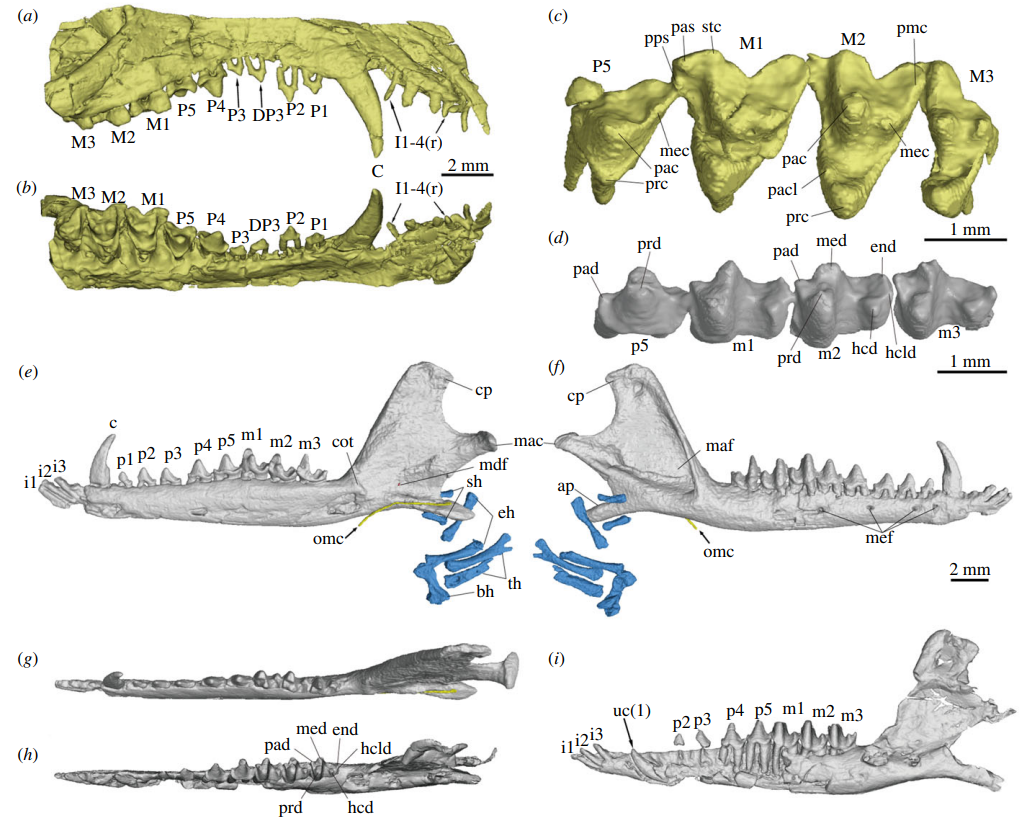
Jaws and dentition of Cokotherium jiufotangensis (IVPP V23387). (a) Right upper jaw in lateral view; (b) right upper jaw in occlusal view; (c) left P5-M3 in occlusal view; (d) left p5-m3 in occlusal view; (e) right mandible with the ossified Meckelian cartilage (yellow) and hyoid bones (blue) in medial view; (f) right mandible with the ossified Meckelian cartilage (yellow) and hyoid bones (blue) in lateral view; (g) right mandible in dorsal view; (h) left mandible in dorsal view; (i) left mandible in lateral view showing unerupted canine. Right side indicated by (r), left side indicated by (l). (e)-(i) at same scale. ap, angular process; bh, basihyal; c, lower canine; C, upper canine; cot, coronoid tubercle; cp, coronoid process; DP, deciduous upper premolar; eh, epihyal; end, entoconid; hcd, hypoconid; hcld, hypoconulid; i, lower incisor; I, upper incisor; m, lower molar; M, upper molar; mac, mandibular condyle; maf, masseteric fossa; mdf, mandibular foramen; mec, metacone; med, metaconid; mef, mental foramen; omc, ossified Meckelian cartilage; p, lower premolar; P, upper premolar; pac, paracone; pacl, paraconule; pad, paraconid; pas, parastyle; pmc, post-metacrista cusp; pps, preparastyle; prc, protocone; prd, protoconid; sh, stylohyal; stc, stylocone; th, thyrohyal; uc, unerupted lower left canine. Wang et al. (2022).

Wang et al. were also able to reconstruct the inner ear of Cokotherium jiufotangensis in three dimensions using computerised tomographic scanning, the first time this has been done for an Early Cretaceous Eutherian Mammal (although the morphology of part of the inner ear has been described in Prokennalestes, a Eutherian from the Early Cretaceous of Inner Mongolia).

The  cochlear canal of Cokotherium jiufotangensis comprises a single coil (i.e. 360°). This is similar to the state in most later Cretaceous Eutherian Mammals, with greater coiling seen in most modern Mammals as well as some Cretaceous Zhelestids. Many other features of the ear, including  a secondary crus commune, the base of a secondary osseous lamina, the primary osseous lamina and a bony cribriform plate, are similar to those in both later Cretaceous and modern Eutherian Mammals, confirming these arose early in the history of the group.

Inner ear of Cokotherium jiufotangensis (IVPP V23387). (a) Position of inner ear (green), veins (blue), and nerves (yellow) in ventral view of cranium; (b) endocast of right and left inner ear (green), veins (blue), and nerves (yellow) in same ventral view; (c) cross section through left inner ear showing internal structures of cochlear canal; (a-c) at same scale. Endocast of inner ear (grey), cochlear and vestibular nerves (yellow) in (d) ventral, (e) dorsal, (f) medial and (g) lateral views, anterior is down, all at same scale. am, ampulla; asc, anterior semicircular canal; ca, cochlear aqueduct; cc, crus commune; ci, crista interfenestralis; cn, cochlear nerve; co, cochlear canal; cp, cribriform plate; crp, crista parotica; fc, fenestra cochleae; fn, facial nerve; fv, fenestra vestibuli; gf, glenoid fossa; gg, geniculate ganglion; hf, hiatus Fallopii; ips, inferior petrosal sinus; jf, jugular fossa; lhv, lateral head vein; lsc, lateral semicircular canal; pl, primary osseous lamina; pr, promontorium; psc, posterior semicircular canal; scc, secondary crus commune; sff, secondary facial foramen; slhv, sulcus for lateral head vein; vca, vein of cochlear aqueduct; vn, vestibular nerve. Wang et al. (2022).
The earliest Eutherian Mammals generally have a larger number of teeth than modern members of the group, and consequently these teeth are closely packed together. Cokotherium jiufotangensis has a reduced number of both incisors and molars, and consequently a less densely packed dentition, a trait otherwise recorded in Eutherian Mammals from the Late Cretaceous onwards. It still has four premolars on each side of both the upper and lower jaws, but the hindmost premolars are starting to show signs of molarisation, another trait previously known only from later Eutherian species.

Despite these apparently derived traits, a phylogenetic analysis carried out by Wang et al. suggests that Cokotherium jiufotangensis is one of the most basal Eutherians known, and possibly outside the Theria (Eutherians plus Marsupials) altogether. However, it is possible that this placement is an artefact of the small number of early Eutherians known, and our subsequent poor understanding of the relationships between these early Mammals.

See also...

Online courses in Palaeontology. 

Follow Sciency Thoughts on Facebook.

Follow Sciency Thoughts on Twitter.