Tuesday, 25 November 2014

Melbourne woman swallowd by 3 m sinkhole.

A woman had to be rescued by firefighters after being swallowed by a sinkhole while hanging out washing in her garden on Tuesday 25 November 2014. Christina Beaumont fell into the hole at about 11.30 am local time in the Springvale South area of the city, and had to tread water until the rescuers arived at 12.30, allerted by a neighbour who had heard her cries for help. The whole was less than a meter wide, but around three meters deep and flooded in its bottom part, while sediment continued to fall from the sides of the hole onto Ms Beaumont, who is being treated for shock.

The sinkhole on the property at Springvale South, Melbourne. News.com.

Sinkholes are generally caused by water eroding soft limestone or unconsolidated deposits from beneath, causing a hole that works its way upwards and eventually opening spectacularly at the surface. Where there are unconsolidated deposits at the surface they can infill from the sides, apparently swallowing objects at the surface, including people, without trace. Potash, a potassium salt, is readily soluble and can be dissolved quickly if water gains access to deposits, leading to the rapid formation of sinkholes.

On this occasion investigators from Greater Dandenong City Council have determined that the sinkhole occured at the site of an old well on the property, which had been improperly sealed off.

See also...

A three-story house in Swansea Head, New South Wales, has had to be evacuated after a sinkhole opened up beneath it on Tuesday 27 May 2014. The hole is...

Five homes have been evacuated following a landslide at Bilgola Beach on the Barrenjoey Peninsula in northern Sydney, New South Wales. The incident occurred early on the morning of Tuesday 13 May 2014, and was made worse when a fire truck arrived at...
 
 
Follow Sciency Thoughts on Facebook.
 

X-ray Computed Tomography studies of two Woolly Mammoth calves from Russia.


The Woolly Mammoth, Mammuthus primigenius, is thought to have diverged from the earlier Steppe Mammoth Mammuthus trogontherii in northeast Asia around 700 000 years ago and by 200 000 years ago spread across Asia and into Europe and across the Bering Strait into North America, where they hybridized with the Columbian Mammoth Mammuthus columbi. They are believed to have been the last surviving species of Mammoth, persisting to as late as 3700 years ago on Wrangel Island, off the northeast coast of Siberia (with some claims of even more recent specimens). As a widespread and apparently numerous species living in the recent past they have left an extensive fossil record, primarily of isolated teeth and bones, but also including a number of mummified and frozen specimens, trapped within the Arctic permafrost. These have allowed a number of detailed anatomical and molecular studies of the Woolly Mammoth, although many were excavated in the nineteenth and early twentieth centuries, and have subsequently degraded due to poor storage facilities, preventing the application of the most modern methods to these specimens.

In a paper published in the Journal of Paleontology in July 2014, a team of scientists led by Daniel Fisher of the Museum of Paleontology at the University of Michigan describe the results of a series of X-ray Computed Tomography studies of two recently discovered Woolly Mammoth calves from permafrost in the Siberian Arctic.

The first specimen, named Lyuba, was found in May 2007 by on a bank of the Yuribei River on the Yamal Peninsula, where it is believed to have been deposited by an ice-melt flood the previous spring. When found it was almost intact, having lost only its hair and nails, however it was transported to a nearby village where it was partially scavenged by domestic Dogs, losing part of the tail and right ear, before being acquired by the Shemanovskiy Museum and Exhibition Center in Salekhard in the Yamalo-Nenets Autonomous Okrug of the Russian Federation. Here the specimen was found to be partially dehydrated, having lost approximately half of its expected water content, and found to be female by examination of the urogenital tract, and subsequent DNA analysis.

Lyuba’s body was found to have been acidified, probably by colonization of the corpse by lactic acid-producing Bacteria, leading to the degradation of much of the connective tissue (collagen). The facial region was found to contain numerous masses of vivianite (hydrated iron phosphate). Examination of Lyuba’s teeth was able to find a neonatal line (produced at the time of birth) followed by 30-35 daily growth increment lines, setting her age at the time of death at 30-35 days. She appears to have been healthy and well fed at the time of her death. An isotopic analysis of the age of the body suggested an age of about 41 800 years.

Lyuba was subjected to a full CT scan, then examined endoscopically through two holes drilled in her left side. She then underwent two necropsy sessions, in which her body was thawed, partially dissected then refrozen. In the first the teeth were removed from the left side of the face, and portions of the large and small intestine were also extracted. In the second the pleural and abdominal cavities were examined. At this point it was determined by the Shemanovskiy Museum that the body would need to be treated chemically to prevent further decomposition, and allowed to dehydrate fully.

Fisher et al. were unable to access the original CT scans of Lyuba made at the Shemanovskiy Museum before chemical treatment. However they were able to take the body to the GE Healthcare Institute in Waukesha, Wisconsin, where it was possible to scan the Mammoth’s head and neck and a portion of the right forelimb and (separately) her pelvic region and left hind limb (the entire Mammoth was too large to fit into the scanning equipment at Waukesha). A complete scan of the Mammoth’s body was later made at the Nondestructive Evaluation Laboratory of the Ford Motor Company in Livonia, Michigan (as far as Fisher et al. are aware this is the first time a Mammoth has undergone a complete full-body scan in this way). Unfortunately industrial scanners like the one at Livonia are slower than medical models, and only seventeen hours were available for the scans on Lyuba, so the resolution achieved was not as high as hoped. Micro CT scans of the extracted teeth were carried out at the University of Michigan Dental School in Ann Arbor, Michigan.

Lyuba was already known to have significant sediment lodged within her trunk. Her oral cavity (mouth) was also filled with sediment, although this matched the bank sediment at the site by the Yuribei River where she was found, so it is assumed that this was emplaced during the recent transportation of the body. The second necropsy carried out on Lyuba was able to determine that her lungs had collapsed, and that larger bronchial cavities were filled with a bright blue powder identified as vivianite with some clay minerals. The CT scans revealed that Lyuba’s trachea was also filled with material which had the same density as the material in both the trunk and lungs, suggesting that all three are the same.

Fisher et al. suggest that Lyuba died after inhaling mud which blocked her trachea and the front part of the bronchial system in her lungs, preventing her from breathing and leading to suffocation; this matches the distribution of sediment seen in the trachea and lungs and the collapse of the other lung tissue (in the alternative scenario, drowning, sediment would have spread throughout the lungs, which would not have collapsed. It is impossible to assess where this happened, as the body had been transported prior to its discovery, but fine-grained vivianite is typical of lake-bottom sediments.

Aspirated sediment in the Mammoth calf Lyuba, sediment with a radiodensity in the range of bone can be traced from the pharyngeal region,through the trachea, and into the lung bronchi (from the Ford scan). Fisher et al. (2014).

The first vivianite detected on Lyuba was found on her left side, which was the side she was laying on when discovered, wher a number of circular pit where filled with bright blue material. This is interpreted to have been caused by fungal growth, which has previously been documented on a number of other specimens of similar age, including the ‘Blue Babe’ Steppe Bison mummy and the Tyrolian iceman ‘Otzi’. However vivianite was also found in nodules throughout the facial region of Lyuba, and within the diaphyses of her long bones (the growing ends of the long bones in a young mammal), where a better explanation was needed.

Fisher et al. suggest that this is connected closely to the manner of Lyuba’s death. If she did asphyxiate on lake bottom sediments, then it is likely that she was in a cold, wet environment suffering from oxygen deprivation immediately prior to death. Mammals in such circumstances have a ‘diving reflex’, whereby blood is withdrawn from the skin and extremities, but the supply increased to the face and brain, thereby keeping the animal alive as it tries to escape its predicament. Vivianite is an iron-phosphorous mineral, and needs a supply of both elements to form. In the case of the facial nodules the iron comes from blood pumped to the head as Lyuba struggled for her life, while the phosphorus comes from the dissolution of bone tissue by the action of lactic-acid forming Bacteria after her death. In the case of the long bone diaphyses the iron would have come from bone marrow, which is particularly rich in iron in these areas of bone growth.

Larger elements of Lyuba’s appendicular skeleton (without maniand pedes) extracted from the Ford scan: (1) radiodense nodules withindeveloping trabecular spaces in long bones are probably vivianite crystalsformed from bone-derived phosphate and blood- and marrow-derived iron;bones show radiodensity disparity between diaphyses and epiphyses; rightlateral aspect, hind limbs on left (right ahead of left) and forelimbs on right(right ahead of left); (2) left humerus in anterior aspect,diaphysis (green) segmented separately from epiphyseal ossifications(labeled); (3) segmented radiodense nodules show through cortical bone of diaphysis (humerus unsegmented in this image so that nodules show through);common scale for 2 and 3. Fisher et al. (2013).

Lyuba’s ribcage had been laterally compressed (squashed from the sides) after death, with the greatest amount of deformation occurring on the left side. Her backbone is intact, and appears to be in life position. Her skull is also slightly deformed and compressed, which may have been aided by partial dissolution of the bone by lactic acid.

The second Mammoth calf, Khroma, was found preserved in situ, upright in permafrost near the Khroma River in northern Yakutia in October 2008, and subsequently excavated and shipped to the Mammoth Museum at the Institute of Applied Ecology of the North at North-East Federal University in Yakutsk in the Sakha Republic. At the time of discovery it had been partially eroded from the sediment, and parts of the head trunk and shoulders scavenged by Ravens and (possibly) Arctic Foxes. Thus, while in generally good condition, the body had lost much of the trunk, the flesh from the head, the fatty tissue from the back of the neck (where a fatty hump would be expected) and the heart and lungs. DNA analysis showed Khroma to be female, which was subsequently confirmed by CT scanning of the urogenital tract. A necropsy revealed she had abundant subcutaneous fat, and undigested milk in her stomach. It was not possible to determine the age of Khroma isotopically, suggesting she died more than 45  000 years ago.

Khroma was also subjected to two rounds of CT scanning, first at the Centre Hospitalier Universitaire de Clermont-Ferrand, then at the CentreHospitalier Emile Roux in Le Puy-en-Velay, both in France. Her teeth were also extracted and micro CT scanned at the at the University of Michigan Dental School in Ann Arbor, Michigan.

Examination of Khroma’s teeth enabled the detection of a neonatal line, followed by at least 52 daily growth increment lines, although these were somewhat unclear, leading Fisher et al. to conclude that she was 52-57 days old at the time of her death.

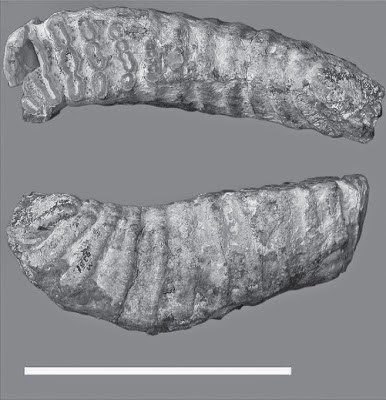
Khroma’s age, determined from her right dP3: (1) right image shows lingual aspect of a slab cut from the right dP3, anterior to the left; (2) enlargedview of the anterior root in 1; the dark line running vertically, parallel to the pulp cavity surface, is the neonatal line (NnL); (3) photomicrograph of a thin sectionof the anterior root, with pulp cavity (pc) surface at right, neonatal line (NnL) at left, and 52 or more daily dentin increments (small white dots) between them; (4) enlargement of area designated in (3), showing increments for last 18 days of life. Fisher et al.estimate Khroma’s age at death as 52–57 days. Fisher et al. (2013).

Elephants walk on a thick pad of fat with a thick layer of skin over it. The distal phalanges (bones at the tips of the toes) are believed to help distribute weight evenly within this structure, though exactly how this works is unclear. In African Elephants only the third and fourth toes have ossified (bone) distal phalanges, with these elements in the other toes being cartilage, while in Asian Elephants the distal phalanges of toes two, three and four are ossified. Attempts to resolve the number of ossified distal phalanges in Mammoths have been, to date, unsuccessful, largely as the limb tips are seldom preserved intact.

Khroma was preserved with her feet undamaged, making analysis of the ossification state in the distal phalanges a possibility. Unfortunately no ossified distal phalanges could be detected, nor was it possible to detect ossification in the metatarsal-phalangeal sesamoid (known to ossify in Woolly Mammoths), suggesting that Khroma was too young at the time of death for complete ossification of all the bones in the foot to have occurred. However it was possible to detect the synovial capsules in the foot (fluid filled capsules that form between bone-bone joints in Mammals, but not bone-cartilage joints), as these had lost their fluid but filled with (distinctly less dense) air. This suggests that the second, third, fourth and fifth distal phalanges may have ossified.

Khroma’s left hind foot: (1) lateral aspect, anterior to left,showing nucleation sites and epiphyseal ossification center on calcaneumtuber at right; (2) anterior aspect; (3) anterior aspect, synovial joint capsules ondigits, light blue; (4) anterior aspect, non-terminal joint capsules light blue andterminal joint capsules purple. Abbreviations: Ast., astragalus; Cal., calcaneum; Cub., cuboid; Ect., ectocuneiform; Ent., entocuneiform; IP, intermediate phalanx; Mes., mesocuneiform; MT, metatarsal; MT I, metatarsal I (red); MT V, metatarsal V (blue diaphysis); PP, proximalphalanx. Separate scales for 1 and 2; common scale for 3 and 4. Fisher et al. (2013).

Khroma’s skeleton was more damaged than Lyuba’s, with some of the ribs broken by recent scavenging, and a break between the seventh and eighth thoracic vertebrae, which occurred at about the time of death. Khroma is thought to have died of sediment inhalation in a similar way to Lyuba, but this break suggests a much more violent setting (the backbones of even very small Elephants are quite robust). Fisher et al. suggest that she may have been caught in a mud flow or bank collapse, which caused a significant lateral impact as well as burying her and preventing breathing.

 Khroma’s ribcage in right lateral aspect (interruption of rib sequence caused by break in vertebral column). Fisher et al. (2013).

See also…

Fossil Dwarf Elephants are known from a number of small islands around the world; this is not altogether surprising, dwarfism is common in populations of animals cut of on small islands (as is giantism). Animals in such environments often need to adapt to different niches to those they inhabit on larger land-masses, but are able to do so due to lack of competition, since there...

Nitrogen has two stable isotopes, Nitrogen-14 (¹⁴N) and Nitrogen-15 (¹⁵N), which have different atomic weights, but identical chemical properties, and can be incorporated into identical compounds by organisms. Nitrogen fixing organisms (diazotrophs) tend to fix Nitrogen isotopes in the ratio found in the atmosphere, but each time the Nitrogen is passed from one...


Elephants have a long and well understood fossil record, but this can usually only tell us about the physical attributes of Elephants, i.e. their...

Follow Scieny Thoughts on Facebook.

Asteroid 2014 WF201 passes the Earth.

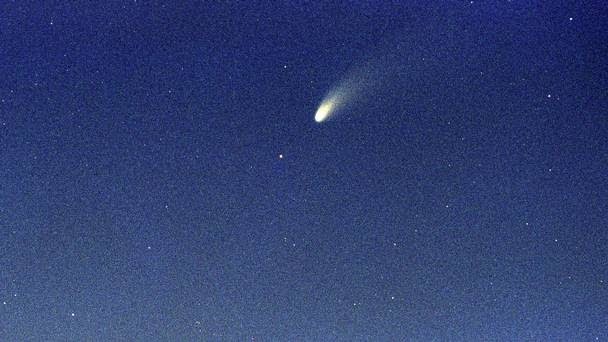
Asteroid 2014 WF201 passed by the Earth at a distance of 2 398 000 km (6.24 times the average distance between the Earth and the Moon, or 0.016% of the average distance between the Earth and the Sun), slightly after 11.35 am GMT on Monday 24 November 2014. There was no danger of the asteroid hitting us, though had it done so it would have presented only a minor threat. 2014 WF201 has an estimated equivalent diameter of 18-57 m (i.e. it is estimated that a spherical object with the same volume would be 18-57 m in diameter), and an object of this size would be expected to break up in the atmosphere between 22 and 7 km above the ground, with only fragmentary material reaching the Earth's surface.
 
 The calculated orbit of 2014 WF201. JPL Small Body Database Browser.

2014 WF201 was discovered on 23 November 2014 (the day before its closest approach to the Earth) by the University of Arizona's Catalina Sky Survey, which is located in the Catalina Mountains north of Tucson. The designation 2014 WF201 implies that it was the 5031stasteroid (asteroid F201) discovered in the second half of November 2014 (period 2014 W).

2014 WF201 has a 426 day year orbital period and an eccentric orbit tilted at an angle of 8.5° to the plane of the Solar System, which takes it from 0.987 AU from the Sun (i.e. 98.7% of the average distance at which the Earth orbits the Sun) to 1.23 AU from the Sun (i.e. 123% of the average distance at which the Earth orbits the Sun). It is therefore classed as an Apollo Group Asteroid (an asteroid that is on average further from the Sun than the Earth, but which does get closer). This means that close encounters between 2014 WF201 and the Earth are fairly common, with the last thought to have occurred in July this year next one predicted for June 2021.

See also...

The Irish Astronomical Association has reported a fireball over County Antrim in Northern Ireland at about 5.30 pm GMT on Tuesday 18 November 2014. The meteor was reportedly brighter than the Moon, and...

In 1984 palaeontologists David Raup and Jack Sepkowski of the Department of Geophysical...


Asteroid 2014 RC passed by the Earth at a distance of 39 910 km (0.1 times the average distance between the Earth and the Moon, or 0.03% of the average distance...

 Follow Sciency Thoughts on Facebook.

A new species of Dog Whelk from the South and East China Seas.


Dog Whelks, Nassariidae, are burrowing carnivorous Gastropods living in muddy or sandy sediments, from the intertidal zones to the deeper parts of the continental shelves (and possibly deeper). They are found across the globe, but are most abundant in the Indo-Pacific region, with 70 species recorded from Australia, 69 from Japan, 47 from the island of Ambon in Indonesia, 41 species from the Philippines and 64 from Vietnam. About 60 species have been described from Chinese waters, though this is likely to be an underestimate of their true diversity.

In a paper published in the Raffles Bulletin of Zoology on 22 August 2014, Junlong Zhang and Suping Zhang of the Institute of Oceanology of the Chinese Academy of Sciences describe a new species of Dog Whelk from the South and East China Seas.

The new species is placed in the genus Nassarius and given the specific name glabrus, meaning smooth, in reference to the surface of the shell. Nassarius glabrus has an elongated ovular shell reaching up to 18.7 mm in length with 7-8 whorls. Its shell is light brown in colour, with yellowish-brown flame-like patterns.

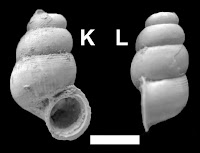
Nassarius glabrusin (A)apertural view; (B) lateral view; (C) dorsal view .Zhang & Zhang (2014).

See also…

Omalogyrid Snails are among the smallest known Gastropods, with adult body sizes often comparable with larger Protozoans (single-celled ‘animals’). As such they tend only to be collected in surveys which directly target them, rather than general surveys of Mollusc faunas, and are often undocumented even in areas where other Molluscs have been studied extensively. Omalogyrid Snails are not well...


Jamaica is considered to be a biodiversity hotspot for Land Snails, with over 505 species considered to be endemic to the island (i.e. coming from the island and not found anywhere else) and 562 species found on the island in total. This is despite the island having a...


http://sciencythoughts.blogspot.co.uk/2014/08/two-new-species-of-cyclophoroid-land.html
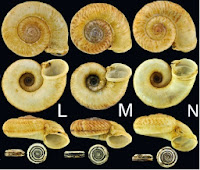
Two new species of Cyclophoroid Land Snails from Thailand and Peninsula Malaysia.
The Cyclophoroidea are a large and diverse group of terrestrial Gastropods, occupying a range of ecological niches from species that live entirely below the soil surface to species that spend their entire life cycles...


Follow Sciency Thoughts on Facebook.

Magnitude 5.4 Earthquake beneath the Vatnajökull Glacier in Iceland.

The Icelandic Met Office, which also monitors seismic activity, recorded a Magnitude 5.4 Earthquake at a depth of 4.1 KM beneath the Vatnajökull Glacier slightly after 9.00 am GMT on Monday 24 November 2014. This is roughly 4.1 m to the northeast of the Bárðarbunga Volcano, which lies beneath the Vatnajökull Glacier and which began an active cycle at the end of August 2014, with magma apparently rising beneath the volcano then migrating to the Holuhraun Lava field, to the north of the glacier. Magnitude 5.4 Earthquakes at shallow depths are potentially quite dangerous, but the remote location of this event makes it highly unlikely that there were any casualties or damage.

The approximate location of the 24 November 2014 Vatnajökull Glacier Earthquake. Google Maps.

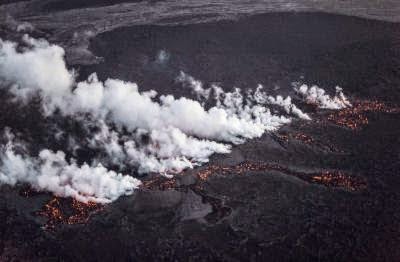
 Seismic activity beneath volcanoes can be significant, as they are often caused by the arrival of fresh magma, which may indicate that a volcano is about to undergo an eruptive episode. Bárðarbunga last erupted in about 1862, and has undergone several periods of raised seismic activity since then, most recently in 1996 and 2010, so there is no reason to believe that this weeks events will automatically lead to an eruption from the volcano itself. Bárðarbunga began to undergo seismic activity (Earthquakes) on 19 August, and lava began to erupt from a fissure in the Holuhraun lava field, no the north of the Vatnajökull Glacier, late in the evening of Thursday 28 August, and has continued since then, with lava flows now covering over 37 square kilometres of land. 

Lava flows in the Holuhraun lava field. Arctic-Images/Corbis.

Iceland lies directly upon the Mid-Atlantic Ridge, a chain of (mostly) submerged volcanoes running the length of the Atlantic Ocean along which the ocean is splitting apart, with new material forming at the fringes of the North American and European Plates beneath the sea (or, in Iceland, above it). The Atlantic is spreading at an average rate of 25 mm per year, with new seafloor being produced along the rift volcanically, i.e. by basaltic magma erupting from below. The ridge itself takes the form of a chain of volcanic mountains running the length of the ocean, fed by the upwelling of magma beneath the diverging plates. In places this produces volcanic activity above the waves, in the Azores, on Iceland and on Jan Mayen Island.
The passage of the Mid-Atlantic Ridge beneath Iceland. NOAA National Geophysical Data Center.
See also...
The Icelandic Met Office recorded a Magnitude 5.4 Earthquake at a depth of 3.9 km beneath the Vatnajökull Glacier slightly before 7.10 am local time (which is...

Lava began to erupt from a fissure in the Holuhraun lava field, no the north of the Vatnajökull Glacier in central Iceland, late in the evening of Thursday 28 August, and has continued to do so for the next three days. The lava field lies to the northeast of  Bárðarbunga, a volcano...
The Icelandic Met Office recorded a Magnitude 5.0 Earthquake at a depth of 3 km beneath the Vatnajökull Glacier slightly before 8.15 am GMT on Thursday 28...
Follow Sciency Thoughts on Facebook.
 

Monday, 24 November 2014

Nine new species of Crab Spiders from Africa.


Crab Spiders of the genus Mystaria are found in Africa from Guinea in the west to Ethiopia in the east and south to Cape Province in South Africa. They are ambush hunters, lying in wait for prey on plants in a wide variety of environments, from forest canopies to grasses to coastal wetlands.

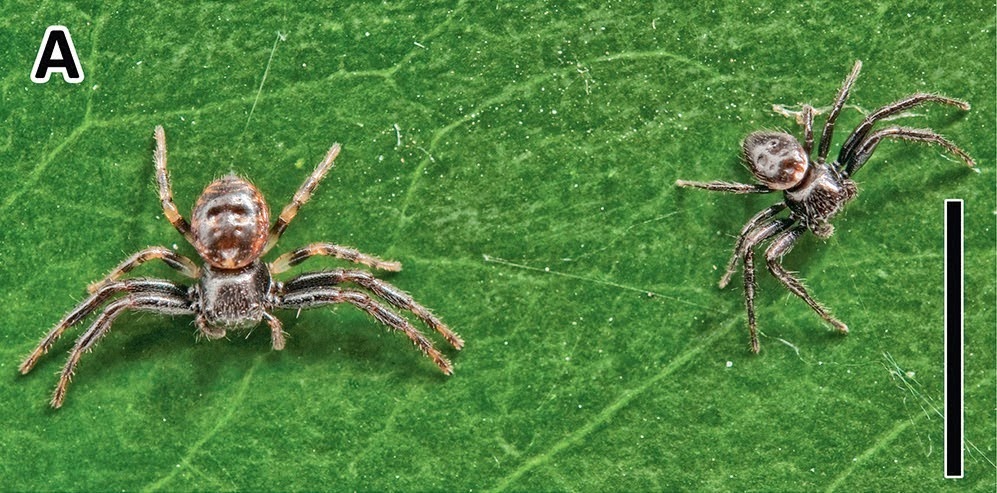
In a paper published in the journal Zootaxa on 15 October 2014, Allet Honibull Lewis of the Department of Zoology & Entomology at the University of Pretoria and Ansie Dippenaar-Schoeman of the Department of Zoology & Entomology at the University of Pretoria and the ARC-Plant Protection Research Institute describe nine new species of Crab Spiders from across Africa, eight of them in the genus Mystaria, and one in a new genus, Leroya, which lives exclusively in the rainforest canopy. In addition they contend that the previously described genus Paramystaria is invalid, and move six species from this genus to Mystaria, and one species from Mystaria to Leroya.

The first new species described is named Mystaria budongo, in reference to the Budongo Forest of Uganda, where it was most abundant. The species is described from sixteen specimens collected in Rwanda, Democratic Republic of Congo, Kenya and Uganda. All of the known specimens are male. Mystaria budongo is 2.7-2.9 mm in length, and has a pear-shaped carapace with an orange-yellow median band and horizontal black and brown bands. The legs are yellow. The species lives in the forest canopy.

Mystaria budongo male from Rwanda, Ibanda Makera (dorsal view). Honibull Lewis & Dippenaar-Schoeman (2014).

The second new species described is named Mystaria irmatrix, in honour of Allet Honibull Lewis’ mother. The species is described from 19 specimens collected in Mozambique and South Africa, including members of both sexes and juveniles. Females were 3.15-4.14 mm in length and either orange with black markings or black with orange markings. Males were smaller, at 2.50-3.13 mm in length, and orange or brown with black markings. The species was found living in trees in coastal woodlands and grasslands, along rivers and around sand dunes

Mystaria irmatrix female from Mozambique, Marracuene in antero-dorsal view. Honibull Lewis & Dippenaar-Schoeman (2014).

The third new species is named Mystaria lindaicapensis, honouring Linda Wiese who collected the first specimen, and referring to the Cape region of South Africa where it is found (in both Eastern and Western Cape Provinces). The species is described from one female and two male specimens. The female is 3.9 mm in length and brown with orange markings. The males are 2.78 and 2.87 mm in length, and blackish brown with orange-red markings. Two of the specimens were collected from a garden the third from woodland.

Mystaria lindaicapensis female from South Africa, Jeffreys Bay in antero-dorsal view. Honibull Lewis & Dippenaar-Schoeman (2014).

The fourth new species described is named Mystaria mnyama, meaning ‘black’ in Zulu, a reference to the colouration of areas on the face and around the eyes. The species is described from one male and one female specimen, collected from grass and shrubs in Tembe Elephant Park in KwaZulu-Natal Province, South Africa. The female is 2.64 mm in length and copper-red in colour with dark facial markings and a lighter abdomen with two dark spots. The male is 2.29 mm in length with a dark copper-black body with lighter markings.

Mystaria mnyama female from South Africa, Tembe Elephant Parkinantero-dorsal view. Honibull Lewis & Dippenaar-Schoeman (2014).

The fifth new species described is named Mystaria oreadae, in reference to the Oreads (Mountain Nymphs) of Greek mythology, as the species was found exclusively in mountainous regions. The species is described from four female specimens, three from Nord Province in Rwanda and one from Orientale Region in the Democratic Republic of Congo. The specimens are 2.74-3.53 mm in length, red to orange copper with lighter or darker markings and a pale carapace.

Mystaria oreadae female from Rwanda, Rwankuba in antero-dorsal view. Honibull Lewis & Dippenaar-Schoeman (2014).

The sixth new species is named Mystaria savannensis, meaning ‘Savanah-dweller’. The species is named from 111 specimens collected in Zambia, Botswana, South Africa and Zimbabwe, including males, females and juveniles. The females are 3.15-5.08 mm in length and orange red or dark brown with a pale abdomen with a darker central stripe. The males are 2.50-3.27 mm in length and copper brown in colour with a darker abdomen. The species was found in trees, shrubs and leaf litter across a wide area of southeast Africa.

Mystaria savannensis female from South Africa, Soutpansberg in antero- dorsal views. Honibull Lewis & Dippenaar-Schoeman (2014).

The seventh new species is named Mystaria soleil, meaning ‘Sun’ in French, due to its bright yellow colour. The species is described from 42 specimens collected in Masindi District, Uganda and Western Province, Kenya. The females are 3.13-3.48 mm in length, the males 2.46-2.70 mm, females are pale brown with darker bands and spots and yellow legs, males also have a yellow abdomen.

Mystaria soleil female from Kenya, Kakamega in dorsal view. Honibull Lewis & Dippenaar-Schoeman (2014).

The eighth new species described is named Mystarias takesbyi, in honour of Eduard Stakesby, the husband of Allet Honibull Lewis. The species is described from 15 specimens from Ghana, the Democratic Republic of Congo, Gabon, Liberia, Kenya, Rwanda, Tanzania and Uganda. Females are 2.72-4.07 mm in length and copper-red, orange or brown in colour, usually with a darker central band and lighter patches. Males are 2.34–2.76 mm in length and a uniform dark copper red, with a lighter abdomen with faint black marks. The species was found primarily in the rainforest canopy, but was also found in leaf litter.

Mystaria stakesbyi female from Ghana, Legonin dorsal view. Honibull Lewis & Dippenaar-Schoeman (2014).

The final new species is placed in a new genus, Leroya, named in honour of John and Astri Leroy; John Leroy collected a specimen of Mystaria unicolor, at Rwankwi in the Belgian Congo (now the Democratic Rebulic of Congo) in 1951, when he was six years old, which is one of the specimens used to re-assign this species to the new genus (becoming Leroya unicolor). It is given the specific name Leroya silva, which means forest in Latin. The species is described from nine specimens from the Democratic Republic of Congo, Rwanda and Uganda. Females are 3.89-4.22 mm in length and copper brown in colour with a metallic sheen. The males are 3.04–3.92 mm in length and copper or blackish-turquoise in colour, also with a metallic sheen. The species was found exclusively in the rainforest canopy.

Leroya silva from the Democratic Republic of Congo, Mayombe, male in dorsal view. Honibull Lewis & Dippenaar-Schoeman (2014).

See also…

http://sciencythoughts.blogspot.co.uk/2014/10/how-invasive-grass-species-makes.html How an invasive Grass species makes American Toads more vulnerable to Wolf Spiders. 
Invasive plants can significantly modify local habitats, particularly if they lack herbivores in the environments they are colonising, by both...


Sociality is rare in Spiders, which are by nature solitary and aggressive. However it is known to have evolved...

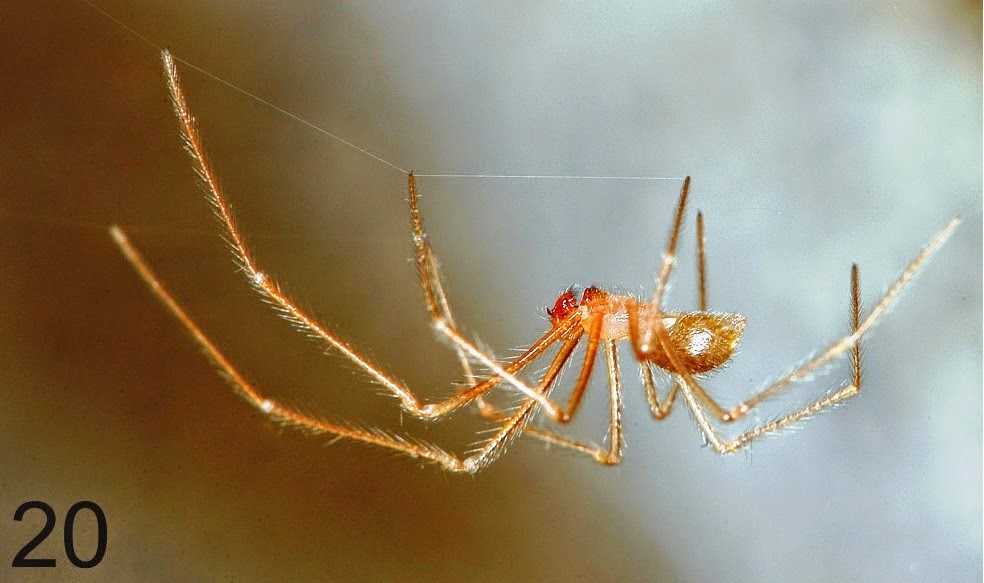
Cave Spiders (Nesticidae) are found across the Mediterranean Basin, as well as in the Canary Islands and parts of Asia. They are cave-dwelling...

Follow Sciency Thoughts on Facebook.

Reconstructing the skull of a Therizinosaurian Dinosaur.


The Therizinosauria are a poorly understood group of Theropod Dinosaurs from the Cretaceous of Asia and North America, exhibiting a number of unique, and sometimes hard to interpret, features. These include the loss of the front teeth, leaf-shaped rear teeth, an elongate neck, wide hips and long arms with feathers and large sickle-shaped claws. It has been widely accepted that these are adaptations to herbivorey, but the group is not well understood, as it is known largely from fragmentary skeletons.

In a paper published in the Journal of Vertebrate Paleontology on 4 November 2014, Stephan Lautenschlager of the School of Earth Sciences at the University of Bristol, Lawrence Witmer of the Department of Biomedical Sciences at the Heritage College of Osteopathic Medicine at Ohio University, Perle Altangerel of the National University of Mongolia, Lindsay Zanno of the Nature ResearchCenter at the North Carolina Museum of Natural Sciences and the Department ofBiology at North Carolina State University and Emily Rayfield, also of the School of Earth Sciences at the University of Bristol present a three-dimensional reconstruction of the skull of Erlikosaurus andrewsi, the most complete known Therizinosaur skull specimen.
Digital representation of the skull of Erlikosaurus andrewsi. (A) Left lateral; (B) dorsal; and (C) ventral views. Abbreviations: bsp, basisphenoid; exoc, exoccipital; f, frontal; j, jugal; la, lacrimal; mx, maxilla; n, nasal; oc, occipital condyle; pa, parietal; pal, palatine; pmx, premaxilla;po, postorbital; prf, prefrontal; pty, pterygoid; q, quadrate; qj, quadratojugal; soc, supraoccipital; sq, squamosal; vo, vomer. Lautenschlager et al. (2014).

The specimen was discovered at the Upper Cretaceous Baishin Tsav locality of Mongolia, and previously described in 1980, 1981, 1983 and 1994 when the Therizinosaur were far less well understood as a group, and when technology such as Computed Tomographic (CT) scanning were unavailable. Lautenschlager et al. subjected the specimen to CT scanning at XTek Systems Ltd. (now Nikon Metrology) at Tring in Hertfordshire, England, and in addition scanned two related species, Falcarius utahensis and Nothronychus mckinleyithen at Ohio University. They then built up a three-dimensional computer model of the skull.

Restored skull of Erlikosaurus andrewsi. (A) Left lateral; (B) dorsal; and (C) ventral views. Abbreviations: bsp, basisphenoid;exoc, exoccipital; f, frontal; j, jugal; la, lacrimal; mx, maxilla; n, nasal; oc, occipital condyle; pa, parietal; pal, palatine; pmx, premaxilla; po, postorbital;prf, prefrontal; pty, pterygoid; q, quadrate; qj, quadratojugal; scr, sclerotic ring; soc, supraoccipital; sq, squamosal; vo, vomer. Lautenschlager et al. (2014).


From this reconstruction Lautenschlager et al. conclude that Erlikosaurus andrewsi almost certainly had a keratinous beak over the front part of its snout, something that has previously been speculated (and in some cases proven) for other non-avian Theropod Dinosaurs.

Reconstructed rhamphothecae of Erlikosaurus andrewsiwith (A) small and (B) extensive keratinous sheath (rendered transparentin the back to reveal underlying bone). Lautenschlager et al. (2014).

See also…

Terrestrial faunas of the Triassic comprised a wide variety of large Vertebrates, including Synapsids and both Dinosaurian and non-Dinosaurian Archosaurs. At...


 In recent years China has become a focus for...


 Dinosaurs are the most distinctive element of Mesozoic Vertebrate faunas, arising in the Triassic, and coming to dominate all known terrestrial ecosystems during the Jurassic and Cretaceous, before disappearing abruptly (other than the still extant Birds) at the end of that period. Despite this widespread distribution, very few...


Follow Sciency Thoughts on Facebook.