Friday, 27 January 2017

Cleanup operation underway after 530 000 litres of diesel spills from Iowa pipeline.

A cleanup operation is underway in Worth County, Iowa, following a spill from a ruptured pipeline onto a farm near Hanlontown, on Wednesday 25 January 2017. The leak in the Magellan Midstream Partners operated pipeline was discovered at about 8.00 am local time and the supply shut off. About 530 000 litres of fuel was discharged, contaminating soil, but not reaching local waterways. The cleanup, which has started with vacuum trucks removing diesel, has been hampered by heavy snowfall and high winds. The operation will proceed with the removal of contaminated topsoil.

Cleanup operation underway in Hanlontown, Iowa, following a diesel spill on 25 January 2017. KIMT.

The pipeline reportedly dates from the 1950s, and is 30 cm in width, running 204 km from Rosemont in Minnesota to Mason City in Iowa. This is the latest in the series of incidents involving Megellan Midstream-owned pipelines; the company has had more than 40 cases brought against it for breaches of safety and environmental regulations in the last 10 years, during which time it has suffered 218 accidents spilling more than 3 150 000 litres of petroleum products.

See also...

http://sciencythoughts.blogspot.co.uk/2016/04/sinkhole-threatens-homes-in-des-moines.htmlhttp://sciencythoughts.blogspot.co.uk/2015/09/canadian-homes-evacuated-following-fire.html
http://sciencythoughts.blogspot.co.uk/2015/06/magnitude-33-earthquake-in-cherry.htmlhttp://sciencythoughts.blogspot.co.uk/2015/05/giant-sinkholes-appear-at-missouri-golf.html
http://sciencythoughts.blogspot.co.uk/2015/04/magnitude-36-earthquake-in-pemiscot.htmlhttp://sciencythoughts.blogspot.co.uk/2015/03/fires-still-burning-two-days-after.html
Follow Sciency Thoughts on Facebook.

Thursday, 26 January 2017

Magnitude 7.9 Earthquake beneath Bougainville Island.

The United States Geological Survey recorded a Magnitude 7.9 Earthquake at a depth of 136 km,beneath central Bougainville Island, Papua New Guinea, at about 2.30 pm local time (about 4.30 am GMT) on Saturday 22 January 2017. This is a large quake, and was felt across Bourgainville, as well as northern parts of the Solomon Islands, New Britain and mainland Papua New Guinea, and some damage to buildings has been reported on Bougainville.

The approximate location of the 22 January 2017 Bougainville Earthquake. USGS.

Bougainville Island lies on the southern fringe of the Pacific Plate. To the south of the island the Solomon Sea Plate is being subducted beneath the Pacific Plate along the Bougainville Trench, passing under the island of Bougainville as it sinks into the Earth. This is not a smooth process; the rocks of the two plates constantly stick together, then break apart as the pressure builds up, causing Earthquakes in the process.

Witness accounts of Earthquakes can help geologists to understand these events, and the structures that cause them. The international non-profit organisation Earthquake Report is interested in hearing from people who may have felt this event; if you felt this quake then you can report it to Earthquake Report Here

See also...

http://sciencythoughts.blogspot.co.uk/2016/10/magnitude-69-earthquake-beneath-western.htmlhttp://sciencythoughts.blogspot.co.uk/2015/08/injuries-reported-after-eruption-on.html
http://sciencythoughts.blogspot.co.uk/2015/05/magnitude-75-earthquake-off-east-coast.htmlhttp://sciencythoughts.blogspot.co.uk/2014/08/eruptions-on-mount-tavurvur.html
http://sciencythoughts.blogspot.co.uk/2014/04/magnitude-71-earthquake-off-coast-of.htmlhttp://sciencythoughts.blogspot.co.uk/2013/11/landslides-kills-nine-in-papua-new.html
Follow Sciency Thoughts on Facebook.

Wednesday, 25 January 2017

Pennsylvania homes threatened by sinkhole.

Emergency services were called to a residential street in the township of Cheltenham in Montgomery County, Pennsylvania, after a large sinkhole opened up in front of two houses early on Wednesday 25 January 2017. The sinkhole, which is about 10 m deep, swallowed the front gardens of both properties, as well as part of the sidewalk in front, a tree in one of the gardens and a pickuptruck. Both properties have been declared unsafe for the time being by township officials, though one is understood to currently be unoccupied.

Sinkhole in Cheltenham, Pennsylvania, on 25 January 2017. 6abc.

Sinkholes are generally caused by water eroding soft limestone or unconsolidated deposits from beneath, causing a hole that works its way upwards and eventually opening spectacularly at the surface. Where there are unconsolidated deposits at the surface they can infill from the sides, apparently swallowing objects at the surface, including people, without trace.

The approximate location of the 25 January 2017 Cheltenham Sinkhole. Google Maps.

On this occasion it is believed that the sinkhole was caused by a burst water main which washed away sediments beneath the road, causing it to collapse. A number of properties in the area are currently without water, and gas and electricity supplies may also have to be disconnected.

See also...

http://sciencythoughts.blogspot.co.uk/2016/12/cleanup-underway-after-chemical-spill.html
http://sciencythoughts.blogspot.co.uk/2016/12/seven-hospitalized-after-acid-spill-at.html

http://sciencythoughts.blogspot.co.uk/2016/06/flooding-kills-26-in-west-virginia.html
http://sciencythoughts.blogspot.co.uk/2016/11/apartment-blocks-evacuated-after.html
http://sciencythoughts.blogspot.co.uk/2015/03/three-homes-evacuated-after-giant.html
http://sciencythoughts.blogspot.co.uk/2016/02/truck-swallowed-by-sinkhole-in.html

Follow Sciency Thoughts on Facebook.

Eruptive activity on Erte Ale.

Eyewitnesses have reported a bout of fresh activity on Erte Ale (or Erta Ale), an active shield volcano in the north of Ethiopia, during the first weeks of January 2017. Infrared cameras mounted on satellites recorded a sharp increase in temperatures beneath the volcano on 19 December 2016, with temperatures remaining high at the time of writing. The volcano was visited by a group of tourists travelling with Volcano Discovery on 16-19 January, who reported lava fountains and lava overtopping the crater, producing lava rivers on several flanks. On 21 January local residents reported a new fissure on the southeast flank of the volcano, about 7 km from the caldera, producing a significant lava flow.

Lava overflowing the caldera of Erta Ale on 17 January 2017. Enku Mulugeta/Volcano Discovery.

Erta Ale is on the Ethiopian Rift, the boundary between the Nubian Plate and the Danakil Microplate. The African Plate is slowly splitting apart along the Ethiopian Rift and the East African Rift to the south (which is splitting the Nubian Plate to the West from the Somali Plate to the East). Arabia was a part of Africa till about thirty million years ago, when it was split away by the opening of the Red Sea Rift (part of the same rift system), and in time the Ethiopian and East African Rifts are likely to split Africa into a number of new landmasses.

Rifting in East Africa. The Danakil Microplate is the red triangle to the east of the Afar depression at the southern end of the Red Sea. Università degli Studi di Firenze.

See also...

http://sciencythoughts.blogspot.co.uk/2015/05/magnitude-47-earthquake-in-gulf-of.htmlhttp://sciencythoughts.blogspot.co.uk/2013/10/submarine-eruption-to-northwest-of.html
http://sciencythoughts.blogspot.co.uk/2013/10/the-movement-of-deep-magma-beneath-afar.htmlhttp://sciencythoughts.blogspot.co.uk/2013/09/magnitude-50-earthquake-beneath-coastal.html
http://sciencythoughts.blogspot.co.uk/2013/07/earthquakes-beneath-gulf-of-aden.htmlhttp://sciencythoughts.blogspot.co.uk/2013/07/earthquake-beneath-red-sea.html


Follow Sciency Thoughts on Facebook.

Tuesday, 24 January 2017

Habenaria yookuaaensis: A new species of Bog Orchid from Oaxaca State, Mexico.

Bog Orchids, Habenaria spp., are an extremely large group of Orchids found in temperate and tropical regions on all continents except Antarctica. They are perennials, producing a plant 20-80 cm in height, with white, yellow or green flowers during the growing season, that dies back to an underground tuberous root during the non-growing season. 

In a paper published in the journal Phytotaxa on 20 January 2017, María Isabel Mejía-Marín, Adolfo Espejo-Serna, and Ana Rosa López-Ferrari of the Herbario Metropolitano at the Universidad Autónoma Metropolitana Unidad Iztapalapa and Rolando Jiménez-Machorro of the Herbario AMO, descibe an new species of Bog Orchid from Oaxaca State in Mexico.

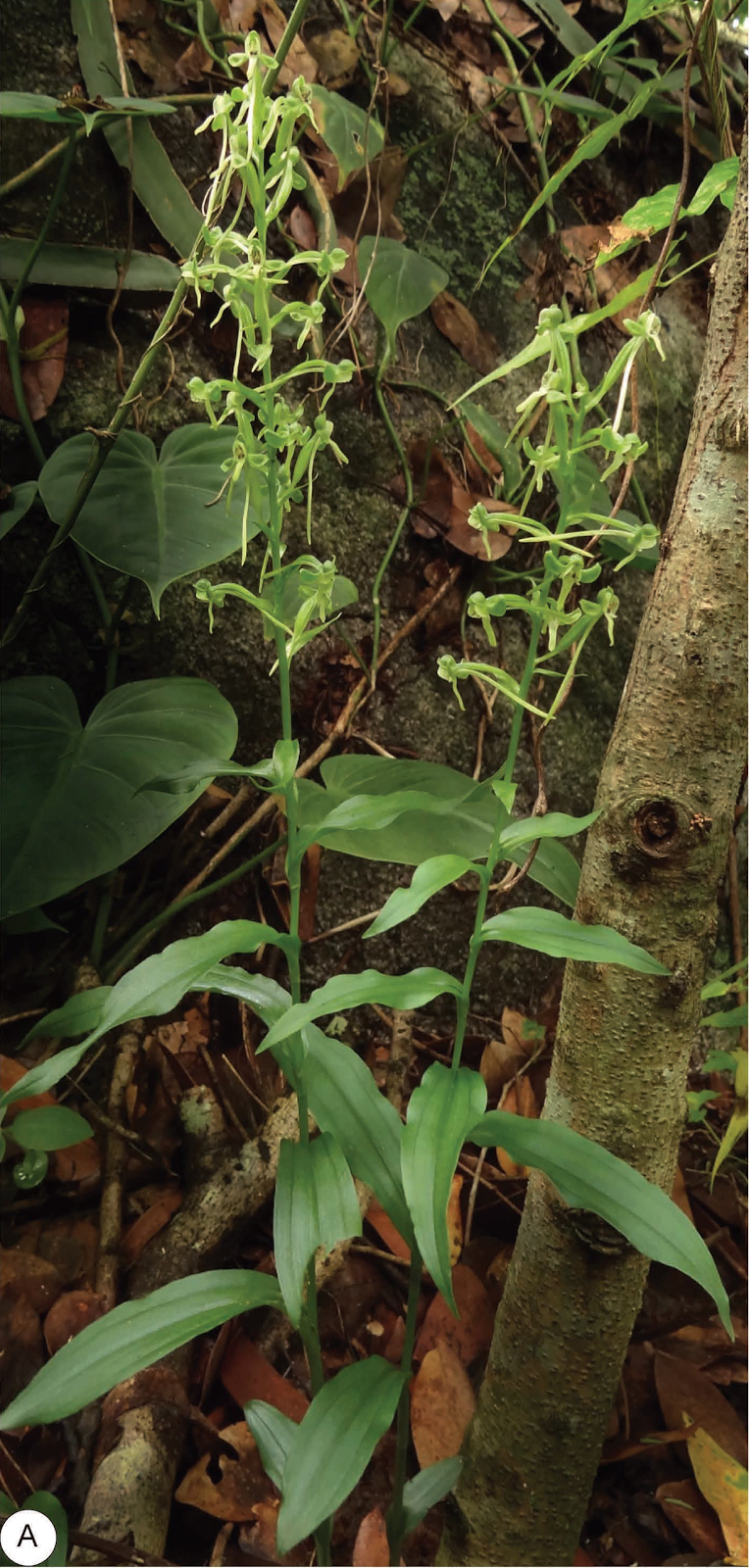
The new species is named Habenaria yookuaaensis, which means 'place of red soil' the Mixtec name for San Juan Colorado, the municipality where the Orchid was discovered. It forms erect plants 35-42 cm in height, with 8-11 leaves and green flowers produced in September.

Habenaria yookuaaensis, growing plant. Mejía-Marín et al. (2017).

See also...

http://sciencythoughts.blogspot.co.uk/2016/12/lecanorchis-tabugawaensis-new-species.htmlhttp://sciencythoughts.blogspot.co.uk/2016/04/epiphytic-orchids-from-lengguru-fold.html
http://sciencythoughts.blogspot.co.uk/2015/08/gastrodia-madagascariensis-not-so-new.htmlhttp://sciencythoughts.blogspot.co.uk/2015/08/catasetum-telespirense-new-species-of.html
http://sciencythoughts.blogspot.co.uk/2015/05/liparis-wenshanensis-new-species-of.htmlhttp://sciencythoughts.blogspot.co.uk/2014/09/a-new-species-of-parasitic-orchid-from.html
Follow Sciency Thoughts on Facebook.

Monday, 23 January 2017

Investigating the nature of Extreme Trans-Neptunian Objects (474640) 2004 VN112 and 2013 RF98.

Extreme Trans-Neptunian Objects are Outer Solar System bodies with orbits that never bring them closer to the Sun than 30 AU (i.e. 30 times as far from the Sun as the Earth), and an average distance from the Sun of greater than 150 AU. The first of these objects, (148209) 2000 CR105, was discovered in 2000, since when a total of 21 have been found. Curiously these bodies not appear to orbit in the plane of the Solar System, but rather follow highly eccentric orbits that are consistent with having been thrown from this plane by encounters with a large, undiscovered body, a body that has been referred to as Planet 9 or Planet X.

In a paper published on the online arXiv database at Cornell University Library on 10 January 2017, and submitted for publication in the Monthly Notes of the Royal Astronomical Society, Julia de León of the Instituto de Astrofísica de Canarias and the Departamento de Astrofísica at the Universidad de La Laguna, and Carlos and Raul de la Fuente Marcos of the Universidad Complutense de Madrid describe the results of a study of the visible spectra of two Extreme Trans-Neptunian Objects, (474640) 2004 VN112 and 2013 RF98, made with the OSIRIS camera-spectrograph at the 10.4 m Gran Telescopio Canarias.

(474640) 2004 VN112 was discovered on 6 November 2004 by the ESSENCE Supernova Survey using the 4 m Blanco Telescope at Cerro Tololo International Observatory. The  name 2004 VN112 implies that 2813th asteroid (asteroid N112) discovered in the first half of November 2004 (period 2004 V), while the longer designation 474640 implies that it was the 474 640th asteroid ever discovered. It is estimated to be between 130 and 300 km in diameter, and has an orbit calculated from 31 observations made over a period of fourteen years. This orbit is calculated to take 5629 years and is tilted at an angle of 26°, taking the asteroid from 47.3 AU from the Sun at its closest out to 586 AU from the Sun at its furthest. It is calculated that an object of this size in an orbit of this nature would be visible to the ESSENCE survey for only 2% of its orbit, which suggests that a significant number of similar asteroids could be awaiting discovery.

2013 RF98 was discovered on 12 September 2013 by the Dark Energy Camera on the Blanco 4-meter Telescope at the Cerro Tololo Inter-American Observatory in La Serena, Chile. The designation 2013 RF98 implies that it was the 2456th asteroid (asteroid F98) discovered in the first half of September 2013 (period 2013 R). It is estimated to be between 50 and 120 km in diameter, and has had an orbit described from 38 observations made over a period of 56 days. This orbit is calculated to take 6527 years and be tilted at an angle of 30°, taking the asteroid from 36.1 AU from the Sun at its closest out to 662 AU at its farthest.

2013 RF98, at center of circle, as seen on 11 October 2013 by the Dark Energy Camera. Dark Energy Survey.

These objects are considered to be part of the Scattered Disk, objects sufficiently distant from the Sun that they are not influenced by tidal forces exerted by the eight known planets. Nevertheless both objects are tilted strongly from the Plane of the Solar System, which implies that they have had their orbits perturbed by the influence of some large body, one of the pieces of evidence that led astronomers to propose that an undiscovered ninth planet may be present in the Outer Solar System. These orbits are not only inclined to the Plane of the Solar System, they are very similar, leading de León et al. to speculate that these bodies might share a common origin.

To this end they examined the visual spectra of the two objects with the OSIRIS Spectograph in March and August 2016. Since all materials reflect light at certain wavelengths (spectra), the visual spectra of an object will reflect the materials present on its surface. Thus if two objects have similar visual spectra, then they are likely to have similar compositions.

De León et al. calculated that the spectral slope for 474640 is 12±2 %/0.1 μm and that of 2013 RF98 is 15±2 %/0.1 μm. As with the orbital parameters, these are not identical, but are very similar (to give some comparison the Trans-Neptunian Dwarf Planets Eris, Pluto, Makemake and Haumea have spectral slopes in the range 0–10 %/0.1 μm, while Sedna has a spectral slope of 26-42 %/0.1 μm). This suggests these objects have surfaces with variety of pure ices (water, methane, carbon dioxide etc.) as well as carbon and possibly amorphous silicates, but not complex organic molecules.

 Comparison between the spectra of (474640) 2004 VN112 and 2013 RF98 smoothed by a Savitzky-Golay filter and scaled to match at 0.60 μm. The most prominent absorption band of pure methane ice at 0.73 μm is not seen on either spectra. De León et al. (2017).

Given the similarities between the orbits and spectra of the two objects, de León et al.conclude that the two bodies are likely to share a common origin. They therefore consider two possibilities; that the two bodies are the result of a single object breaking up close to perihelion (when bodies are at their closest to the Sun, and receiving their most heat and tidal stress from it), or that they were a single object or binary asteroid (i.e. two asteroids orbiting one-another) torn apart by repeated tidal stresses from an encounter with a larger body.

Of these hypotheses, de León et al. reject the idea that the two objects reject the idea that the two bodies might represent the remains of a single body torn apart by tidal forces close to perihelion, as two fragments of such a bodies which fragment at perihelion are should not return to perihelion at the same time on every passage (if they did there would be no tidal forces pulling them apart) so happening to see the two together close to perihelion within a year would be a remarkable coincidence.

In order to test the second hypothesis, de León et al.used a computer model, which was run several thousand times with varying parameters, in order to work out the most likely scenarios for such an encounter. They conclude that the most likely scenario would be one where the parent body of the two objects repeatedly encountered a planet with a mass 10-20 times that of the Earth on an orbit with an eccentricity of up to 40% (an orbit in which it is 40% closer to the Sun at its closest than at its furthest), inclined to the Plain of the Solar System by 20-40°. Such a planet could cause a binary asteroid pair of weekly consolidated asteroid to break apart and nudge the parts onto the observed orbits due to repeated encounters over a period of 5-10 million years.

See also...

http://sciencythoughts.blogspot.co.uk/2016/07/using-hypothetical-ninth-planet-to.htmlhttp://sciencythoughts.blogspot.co.uk/2016/05/hubble-space-telescope-discovers-moon.html
http://sciencythoughts.blogspot.co.uk/2016/03/sputnik-planum-apparently-young-feature.htmlhttp://sciencythoughts.blogspot.co.uk/2016/02/deciphering-rings-of-10199-chariklo.html
http://sciencythoughts.blogspot.co.uk/2015/04/assessing-composition-of-ices-on.htmlhttp://sciencythoughts.blogspot.co.uk/2015/01/searching-for-bright-objects-in-outer.html


Follow Sciency Thoughts on Facebook.

Sunday, 22 January 2017

Magnitude 4.8 Earthquake in Mendoza Province, Argentina.

The United States Geological Survey recorded a Magnitude 4.8 Earthquake at a depth of 22.4 km in Mendoza Province, Argentina, at about 6.30 am local time (about 9.30 am GMT) on Saturday 21 January 2017. There are no reports of any damage or injuries relating to this event, but people have reported feeling it in the cities of Mendoza and San Rafael.

The approximate location of the 21 January 2017 Mendoza Earthquake. USGS.

Mendoza Province is located on the eastern margin of the Andes Mountains, one of the most tectonically active mountain ranges in the world, and the plains to the east of these mountains. The Andes are being formed as the Nazca Plate to the west is subducted beneath the South American Plate. This causes quakes in a number of ways. Firstly there is friction between the two plates as the Nazca Plate passes under South America. Then there is crumpling and upthrust of the South American as it is pushed from the west by the Nazca Plate and from the east by the expansion of the Atlantic. Finally there is volcanic activity in the Andes, as lighter minerals in the Nazca Plate are melted by the heat of the Earth's interior, then rise up through the overlying South American Plate to form volcanoes. 

The subduction of the Nazca Plate beneath the South American Plate, and how it causes Earthquakes and volcanoes. Pacific Earthquake Engineering Research Center.

This means that Earthquakes, even large events, are quite common in the area, but since the province is on the eastern margin of the Andes, such quakes usually happen at considerable depth (the margin between the Nazca and South American plates is angled downwards, so that maximum seismic activity happens close to the surface on the coast of Chile and deep within the Earth beneath eastern Argentina), so that much of the energy from the quake is dissipated before it reaches the surface. 

Witness accounts of Earthquakes can help geologists to understand these events, and the structures that cause them. The international non-profit organisation Earthquake Report is interested in hearing from people who may have felt this event; if you felt this quake then you can report it to Earthquake Report here.

See also...
 
http://sciencythoughts.blogspot.co.uk/2016/11/magnitude-64-earthquake-in-san-juan.htmlhttp://sciencythoughts.blogspot.co.uk/2015/10/eruption-on-mount-copahue.html


http://sciencythoughts.blogspot.co.uk/2015/10/deadly-earthquake-in-salta-province.htmlhttp://sciencythoughts.blogspot.co.uk/2014/06/magnitude-49-earthquake-in-southern-la.html
http://sciencythoughts.blogspot.co.uk/2013/11/magnitude-55-earthquake-in-mendoza.htmlhttp://sciencythoughts.blogspot.co.uk/2013/10/magnitude-46-earthquake-in-eastern.html
Follow Sciency Thoughts on Facebook.