Showing posts with label United States. Show all posts

Friday, 23 April 2021

United States returns seized archaeological artefacts to Afghanistan.

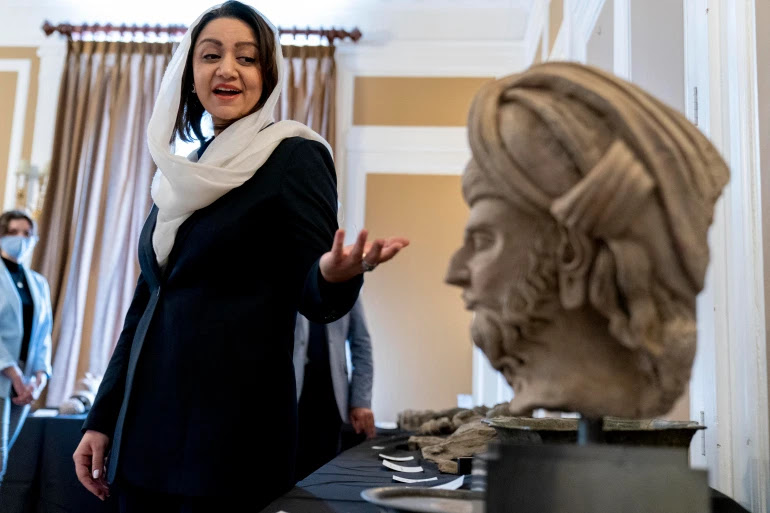
The United States government has formerly handed over a collection of ancient artefacts seized from a New York art dealer to the government of Afghanistan. The collection comprises 33 artefacts, including masks, sculptures, and other items from the Greek, Hindu, Buddhist, and Early Islamic periods, were handed over by the Manhattan District Attorney’s Office and Homeland Security Investigations at a ceremony in New York on Monday 19 April 2021, and will be briefly on display at the Afghanistan Embassy in Washington DC, before being returned to the National Museum of Afghanistan in Kabul.

 
Roya Rahmani, Afghanistan's ambassador to the US, with looted and stolen Afghan religious relics and antiquities. Andrew Harnik/AP.

Afghanistan lies on a hub of ancient trade routes connecting Europe and the Middle East to Central and South Asia. As such it has a long archaeological record, with art and artefacts left behind by many civilisations that have passed through the region over the past 6000 years, and around 2600 known archaeological sites within the country. From the 1980s onwards the Taliban, a deeply conservative Islamic organisation which took the view that all images of Human subjects and religious art from non-Islanic sources were wrong, waged a war against first the Soviet Union, which entered the country in 1978 following a coup by the communist People's Democratic Party of Afghanistan, which overthrew the democratic government of Mohammed Daoud Khan, and then the United States and their NATO allies, who invaded the country in 2001 following the terrorist attacks carried out in the US by al-Qaeda, and organisation which had been allowed to operate within Afghanistan by a Taliban government.

During this time many archaeological sites were destroyed or looted, including the National Museum and the famous Giant Buddhas of Bamiyan Province, which were dynamited in March 2001. However, any of the artifacts supposedly destroyed on the orders of Taliban leaders were in fact smuggled out of the country, entering an international trade in looted art and archaeological artefacts. 

In October 2011 New York-based art dealer Subhash Kapoor was arrested at Frankfurt International Airport and charged with smuggling artefacts from a number of South Asian countries; he was subsequently extradited to India where he remains in prison. Subsequent raids on his properties in New York recovered artefacts with a total estimated value in excess of US$100 million, which the US authorities are in the process of returning to their original owners, having previously returned material to Nepal, Sri Lanka, and Thailand.

See also...


Follow Sciency Thoughts on Facebook.

Follow Sciency Thoughts on Twitter.


Monday, 25 January 2021

Kenyan man extradited by the United States for trafficking in Rhinoceros horns, Elephant ivory and heroin.

Audrey Strauss, the United States Attorney for the Southern District of New York, announced in a press release on Monday 25 January 2021, that Mansur Mohamed Surur, 60, a Kenyan citizen, was extradited from Kenya and arrived in the United States this morning. Surur was arrested by Kenyan authorities on 29 July 2020, in Mombasa, Kenya, on charges of conspiracy to traffic in Rhinoceros horns and Elephant ivory, both endangered wildlife species, which involved the illegal poaching of more than approximately 35 Rhinoceros and more than 100 Elephants.  In addition, Surur was charged with conspiracy to commit money laundering and conspiracy to distribute and possess with intent to distribute more than 10 kilograms of heroin. Surur's co-defendant, Moazu Kromah, a citizen of Liberia, was previously deported to the United States from Uganda on 13 June 2019.  Co-defendant Amara Cherif, a citizen of Guinea, was extradited to the United States from Senegal on 3 April 2020.  Co-defendant Abdi Hussein Ahmed, citizen of Kenya, remains a fugitive. Surur is expected to be arraigned later today before U.S. Magistrate Judge Debra Freeman.  The case has been assigned to U.S. District Judge Gregory Woods.
 
 
Mansur Mohamed Surur, extracted from Kenya to the United States to face charges of trafficking in Rhinoceros horns, Elephant ivory and heroin. The Standard.
 
Manhattan U.S. Attorney Audrey Strauss said:  'Mansur Mohamed Surur is alleged to be a member of an international conspiracy to traffic in Rhino horns, Elephant ivory, and heroin.  The enterprise is allegedly responsible for the illegal slaughter of dozens of Rhinos and more than 100 Elephants, both endangered species.  The excellent work of the Fish and Wildlife Service and the Drug Enforcement Administration has put an end to this operation.'
 
According to allegations in the indictment Kromah, Cherif, Surur,  and Ahmed were members of a transnational criminal enterprise based in Uganda and surrounding countries that was engaged in the large-scale trafficking and smuggling of Rhinoceros horns and Elephant ivory, both protected wildlife species. Trade involving endangered or threatened species violates several U.S. laws, as well as international treaties implemented by certain U.S. laws.
 
From at least in or about December 2012 through at least in or about May 2019, Kromah, Cherif, Surur, and Ahmed conspired to transport, distribute, sell, and smuggle at least approximately 190 kilograms of Rhinoceros horns and at least approximately 10 tons of Elephant ivory from or involving various countries in East Africa, including Uganda, the Democratic Republic of the Congo, Guinea, Kenya, Mozambique, Senegal, and Tanzania, to buyers located in the United States and countries in Southeast Asia.  Such weights of Rhinoceros horn and Elephant ivory are estimated to have involved the illegal poaching of more than approximately 35 Rhinoceros and more than approximately 100 Elephants.  In total, the estimated average retail value of the Rhinoceros horn involved in the conspiracy was at least approximately $3.4 million, and the estimated average retail value of the Elephant ivory involved in the conspiracy was at least approximately $4 million.
 
The defendants exported and agreed to export the Rhinoceros horns and Elephant ivory for delivery to foreign buyers, including those represented to be in Manhattan, in packaging that concealed the Rhinoceros horns and Elephant ivory in, among other things, pieces of art such as African masks and statues.  The defendants received and deposited payments from foreign customers that were sent in the form of international wire transfers, some which were sent through U.S. financial institutions.
 
On a number of occasions, Kromah, Surur, and Ahmed met with a confidential source (identifies as 'CS-1'), both together and separately, concerning potential purchases of Elephant ivory and Rhinoceros horn.  During these meetings and at other times via phone calls and electronic messages, CS-1 discussed with Kromah, Surur, and Ahmed, in substance and in part, the terms of such sales, including the price, weight, or size of the rhinoceros horns, as well as payment, destination, and delivery options.  CS-1 also discussed with Cherif via phone calls and electronic messages, in substance and in part, the terms of the sales, as well as how to send payment for Rhinoceros horns from a United States bank account located in New York, New York.  On or about 16 March 2018, law enforcement agents intercepted a package containing a Black Rhinoceros horn sold by the defendants to CS-1 that was intended for a buyer represented to be in New York, New York.  From in or about March 2018 through in or about May 2018, the defendants offered to sell CS-1 additional Rhinoceros horns of varying weights, including horns weighing up to approximately seven kilograms.  On or about 17 July 2018, law enforcement agents intercepted a package containing two Rhinoceros horns sold by the defendants to CS-1 that were intended for a buyer represented to be in New York, New York. 
 
Separately, from at least in or about August 2018 through at least in or about May 2019, Surur and Ahmed conspired to distribute and possess with intent to distribute more than approximately 10 kilograms of heroin to a buyer represented to be located in New York. 
 
Surur is charged with one count of conspiracy to commit wildlife trafficking and two counts of wildlife trafficking, which each carry a maximum sentence of five years; one count of conspiracy to commit money laundering, which carries a maximum sentence of 20 years; and one count of conspiracy to distribute and possess with intent to distribute one kilogram or more of heroin, which carries a maximum sentence of life imprisonment and a mandatory minimum sentence of 10 years in prison.  The maximum potential sentences are prescribed by Congress and are provided here for informational purposes only, as any sentencing of the defendant will be determined by the judge.
 
Ms. Strauss praised the outstanding investigative work of the U.S. Fish and Wildlife Service and the U.S. Drug Enforcement Administration.  In addition, she thanked law enforcement authorities and conservation partners in Uganda as well as the Kenyan Directorate of Criminal Investigations and the Kenyan Office of the Director of Public Prosecutions for their assistance in the investigation.  Ms. Strauss also thanked the U.S. Department of Justice’s Office of International Affairs for their assistance, and noted that the investigation is continuing.
 
The prosecution of this case is being handled by the Office’s Complex Frauds and Cybercrime Unit.  Assistant United States Attorneys Sagar Ravi and Jarrod Schaeffer are in charge of the prosecution. The charges contained in the Indictment are merely accusations.  The defendants are presumed innocent unless and until proven guilty.
 
See also...


Follow Sciency Thoughts on Facebook.

Follow Sciency Thoughts on Twitter.


Friday, 24 May 2013

Northeast California shaken by Magnitude 5.7 Earthquake.

A Magnitude 5.7 Earthquake struck northeastern California on Wednesday 23 May 2013, according to the United States Geological Survey. The quake occurred at a depth of 11 km, to the east of Lake Almanor in Plumas County, roughly 275 km northwest of San Francisco. There are no reports of any damage or casualties, but the quake was apparently felt across much of northern California and in parts of western Nevada. 

Map showing the location of the 23 May California Earthquake. Google Maps.

California is America's most Earthquake-prone state, being bisected by the San Andreas Fault,  which is the boundary between the Pacific Plate, which is moving northeast, and North American Plate, which is moving southwest. This is actually nowhere near Plumas County, but the area is still affected by the tectonic movement; the two plates do not move smoothly past one-another, but rather continuously stick together than break apart, which has lead to a large number of smaller stress related faults that criss-cross the state. 

Witness accounts can help geologists to understand Earthquakes and the underlying structures and processes that cause them. If you felt this quake (or were in the area but did not, which is also useful information) then you can report it to the United States Geological Survey here.


Follow Sciency Thoughts on Facebook.

Wednesday, 3 April 2013

Earthquake in southeast Missouri.

On Tuesday 2 April 2013, at about 10.20 pm local time (3.20 am on Wednesday 3 April, GMT), the United States Geological Survey recorded a Magnitude 2.7 Earthquake at a depth of 13.4 km beneath southeastern Missouri, close to the border with Tennessee. Such small quakes rarely cause any damage or injuries, an quite often go completely unnoticed, though this one was felt as far away as Union City in Tennessee.

Areas where shaking from the 2 April Earthquake was felt. USGS.

Southeast Missouri lies within an area known as the New Madrid Fault Zone, an seismically active area which lies over the deeply buried Reelfoot Rift, an area of tectonic expansion associated with the breakup of the ancient supercontinent of Rodinia about 750 million years ago. This is no longer an active rift, but it is an area of weakness within the North American Plate which is more prone to movement in response to other tectonic stresses, such as the compression of the plate by expansion beneath the Atlantic and Pacific Oceans.

The Reelfoot Rift is overlain by a deep layer of poorly consolidated tertiary sediments. These sediments are prone to liquefaction during tremors. When this occurs the sediments behave as a liquid, rather than a solid, with often devastating consequences for man made structures such as buildings and roads on the surface.

The New Madrid Earthquakes of 1811-12 was felt over mush of the central United States, entirely destroying the city of New Madrid, Missouri, caused damage to buildings as far away as St Louis, Missouri and Memphis Tennessee and diverted the course of the Mississippi River.

The structures underlying the New Madrid Fault Zone. University of Arizona.

 Witness reports can help Geologists understand Earthquake events and the underlying structures that cause them. If you felt this quake you can report it to the United States Geological Survey here.

Follow Sciency Thoughts on Facebook.

Saturday, 30 March 2013

Fireball over Wyoming.

A fireball was seen traveling from southwest to northeast over Wyoming at about 5.45 am local time (11.45 GMT) on Thursday 28 March 2013, according to the American Meteor Society, who also received witness statements from Colorado, South Dakota, Montana and Alberta. The fireball was observed to flare green and blue, suggesting the object which caused it was composed largely of nickel and magnesium.

Map showing the location of witness reports for the 28 March fireball. Mike Hankey/American Meteor Society.

A fireball is defined as a meteor (shooting star) brighter than the planet Venus. These are typically caused by pieces of rock burning up in the atmosphere, but can be the result of manmade space-junk burning up on re-entry.

Witness reports can help astronomers to understand these events. If you witnessed this fireball you can report it to the American Meteor Society here.


Follow Sciency Thoughts on Facebook.

Saturday, 23 March 2013

Fireball over the northeastern United States.

A fireball was seen streaking through the sky over the US Coast from South Carolina to Maine, and inland as far as Ohio and Ontario, on the evening of Friday 22 March. The object was described as outshining both the Moon and the lights of New York City, and was described as probably being a rock the size of a volleyball by Derek Pitts of the Franklin Institute.

Map showing siting reports for the 22 March fireball. Mike Hankey/American Meteor Society.

The object appears to have first become visible in the Ohio/east Pennsylvania region, moving to the east, before breaking up as it passed over New York and disappearing out to sea. Such events are relatively common, and are being noticed more in the press at the moment following the breakup of an exceptionally large object over the Russian city of Cherblinsk in February.


Follow Sciency Thoughts on Facebook.

Willard Bay State Park, Utah, closed by oil spill.

Willard Bay is a freshwater reservior seperated off from Great Salt Lake in 1964. It suplies freshwater to much of northern Utah, an is a popular recreational facility, with camping, boating and fishing facilities. On Monday 18 March 2013 the northern part of the park was closed following a leak from a deisel pipeline connecting Salt Lake City to Burley, Idaho, which was detected when opperators Chevron detected a fall in pressue in the pipe.

Map showing the location of Willard Bay State Park. Standard-Examiner.

Two campers and the family of the park manager were evacuated and the northern part of the park, where the spill occurred, was closed as a precaution. Since the southern part of the park was closed for seasonal maintenance, this means the park is currently completely shut, although workers from Utah State Parks are now attempting to reopen the southern part of the park as quickly as possible.

Deisel is believed to have been prevented from entering the reservoir itslef by a series of beaver dams, though scientists from the Utah Division of Water Quality are monitoring the situation closely. Sadly the Beaver dams are likely to be demolished as part of the cleanup operation. Two oiled beavers have been brought into local rescue centers since Monday, it is unclear how the rest of the local population has been affected.

Workers from Chevron began excavating the area around the pipeline on Tuesday, vacuuming spilt fuel from the ditch in the process. The United States Environmental Protection Agency also have a team on the ground, and have expressed concerns about the possibility of contamination enetering the reservoir or affecting migratory birds, including Snow Geese, Tundra Swans and Pelicans, which are expected to start ariving at the site within the next two weeks.

Workers from Chevron excavating the damaged pipeline on Wednesday. Salt Lake Tribune.

The pipeline is believed to have leaked at least 83 000 liters of diesel, and it is not clear that the leak has been halted. The area near the pipeline has been isolated from the reservoir by a series of absorbant booms.Chevron have been ordered not to reopen the pipeline without permission from U.S. Transportation Department’s Pipeline and Hazardous Materials Safety Administration.

This is the third serious spill from a pipeline in Utah in three years; it follows on from two spills near Red Butte Garden in 2010. Utah is crossed by a network of aging pipelines (this weeks leak comes from a pipeline laid in 1950), and environmental groups such as Friends of the Great Salt Lake have raised questions as to whether this is a sustainable situation.

See also North Sea oil rig partially evacuated following leak, Dutch court fines Shell over pollution in ther Niger Delta, Pipeline explosion in Ogun State, southwest Nigeria, Gas pipeline explosion in West Virginia and Amnesty International reports on the 2012 Bodo Oil Spill.

Follow Sciency Thoughts on Facebook.

Sunday, 30 September 2012

New species of Cave Spider from Oregon.

Spiders are the most successful group of Arachnids and one of the most successful groups of Arthropods, with over 40 000 described species in over 100 families, distinguished by having eight legs, producing silk, and having a venomous bite. The the evolutionary lineage that produced Spiders, separate  from other Arachnids, appears in the fossil record in the Silurian, about 420 million years ago; though these earliest 'Spiders', called Trigonotarbids, lacked the ability to make silk. Silk producing Spiders appear in the fossil record in the Devonian, 386 million years ago. Since the evolution of the production of silk, Spiders have evolved to fill a wide variety of ecological niches, colonizing every environment except the polar regions and the oceans.

In a paper published in the journal ZooKeys on 17 August 2012, Charles Griswold of the Arachnology Lab at the California Academy of Sciences, the Department of Biological Sciences at San Francisco State University and Environmental Science, Policy and Management at the University of California, Berkeley, Tracy Audisio of the Arachnology Lab at the California Academy of Sciences, the Department of Biological Sciences at San Francisco State University and the Summer Systematics Institute at the California Academy of Sciences and Joel Ledford of the Arachnology Lab at the California Academy of Sciences and Environmental Science, Policy and Management at the University of California, Berkeley, describe a new species of Spider from cave systems in southwestern Oregon and Northwestern California.

The new species is named Trogloraptor marchingtoni, where Trogloraptor means 'clawed cave dweller' and marchingtoni honours Neil Marchington, a Deputy with the Deschutes County Sheriff's Office and a caver, biologist and conservationist. It is deemed to be sufficiently different from all other described species of Spiders that it is placed in a new family, the Trogloraptoridae, largely on account of the destictive claws on the limbs of the Spiders, which help them to run about on the ceilings of caves.

Trogloraptor marchingtoni.  Griswold et al. (2012).

Sunday, 24 June 2012

Police seize Dinosaur from New York warehouse.

Authorities in New York have seized the bones of a 7.3 m Tarbosaurus bataar (a Late Cretaceous Theropod Dinosaur closely related to Tyranosaurus rex), from a storage facility belonging to Cadogan Tate Fine Art in Queens, New York. The skeleton was sold for US$1.05 million on 20 May 2012 by Texas-based Heritage Auctions, to an undisclosed buyer, thought to be a private New York museum, but authorities in Mongolia are demanding their return as stolen antiquities.

The feet of the Tarbosaurus specimen in the Cadogen Tate warehouse. U.S. Immigration and Customs Enforcement.

The fossil was sold by Florida-based Eric Prokopi who imported them from the UK in March 2010, on papers which described them as 'reptile bones' valued at US$1500. Prokopi claims that the bones originate from outside Mongolia, and that he and his wife spent much of the last year carefully preparing and mounting them. However experts, including Mark Norell of the American Museum of Natural History, have identified them as belonging to a known specimen from Ömnögovi Province in Monglolia, identified in 1946 by a joint Soviet-Mongolian expedition to the Gobi Desert but never excavated. The bones were last seen in the desert in 1995, and were found to be missing in 2005. Norell also pointed out that very few Tarbosaurus specimens have ever been found outside of Mongolia, and that those have all come from China, where restrictions on excavating and exporting Dinosaur remains are even tighter.

The smuggling of antiquities is a major international crime, and while it is more typically associated with archaeological remains, dinosaur (and other large vertebrate) fossils can have a substantial value and are a significant part of this trade. The US is a common destination for smuggled antiquities, and has been accused in the past of not doing enough to protect the heritage of other countries, though on this occasion the Mongolian authorities are said to be very pleased with the promptness of US action. The UK is also often sighted as a country that does not do enough about antiquities smuggling, with many stolen artifacts allegedly being routed through London. It is unclear if the Tarbosaurus remains seized in New York were ever actually in the UK, or what steps (if any) British authorities are taking to investigate this. 

See also LH PV18, a New Mini-Tyranosaur, or an Immature Tarbosaur? and Dinosaurs on Sciency thoughts YouTube.

Follow Sciency Thoughts on Facebook.

Thursday, 7 June 2012

Protest group Appalachia Rising occupy the offices of four US Representatives.

On Wednesday 6 June 2012 activists from the protest Group Appalachia Rising occupied the offices of four US Representatives from states in the Appalachian Region. The group were protesting against the increased used of open-pit mining in the Appalachian Mountains, and in particular the process known as mountaintop removal, in which the entire top of mountain ridges are removed in order to expose coal seems, which can then be completely removed. The process has been linked to extreme environmental degradation, and severe health impacts on local communities.

Mountaintop removal at Oven Fork, near Whitesburg (Letcher County, Kentucky). The Mountaintop Removal Road Show.

The representatives affected were Congressman John Duncan (Republican), representing Tennessee's 2nd District, Congressman Nick Rahall (Democrat), representing the 3rd District of West Virginia, Congressman Hal Rogers (Republican), representing Kentucky's 5th District, and Congressman Morgan Griffith (Republican), representing Virginia's 9th District. Each was targeted by a group from their own state. A total of 22 activists were arrested in Washington, two in Representative Duncan's office, six in Representative Griffith's office, seven in Representative Rogers' office and seven in Representative Rahall's Office. All four Congressmen have been accused of having a poor record on environmental issues, and of supporting the interests of extraction companies over those of their constituents.

Protesters from Kentucky inside the office of Representative Hal Rogers. Appalachia Rising.

The protests come a week after Memorial Day protests in which Appalachian women shaved their heads in morning for mountains which have been removed, and protests on the first of this month in which members of the Earth Quaker Action Team and the Sierra Club organized mass withdrawals from the PNC Bank in protest at its investment in mountaintop removal projects.

Mountaintop removal has been linked to severe environmental problems, including loss of biodiversity and toxification of water resources. It has also been linked to severe health issues; communities close to mountaintop removal projects have been shown to suffer sharp increases in levels of cancer and birth defects, placing a severe strain on local healthcare providers. The process has also caused more direct disruption to communities, with homes, churches and graveyards being removed or relocated against the will of the local populations.

See also Daw Mill Colliery threatened with closure, The effects of oil sands mining on wetlands in northern Alberta, Greenpeace activists occupy drilling ship in New Zealand, Protestors object to the expansion of the Conga Mine in Peru and Acid spill from gold mine adds to Edith River's woes.

Follow Sciency Thoughts on Facebook.