Showing posts with label Carbon Isotopes. Show all posts

Friday, 14 April 2023

Examining the impact of the Palaeocene–Eocene Thermal Maximum on sedimentation in the Gulf of Mexico.

Roughly 56 million years ago, global temperatures abruptly rose by 5-9°, leading to profound environmental changes across the planet, an event known as the Palaeocene–Eocene Thermal Maximum. This event was marked (and probably caused by) a sharp rise in atmospheric carbon dioxide, something marked in the rock record by a 3.0‰ negative carbon isotope excursion (three parts per thousand drop in the proportion of carbon¹³ to total carbon), which developed over a period of less than 5000 years. Three main stages to this negative carbon isotope extension have been detected; the onset, during which the proportion of carbon¹³ dropped from the pre-excursion level to the excursion level; the body, during which the proportion of carbon¹³ remained steady at the new, lower level; and the recovery, during which the proportion of carbon¹³ returned to the pre-excursion level.

This interval was also marked by a dramatic increase in the prevalence of the Dinoflagellate cyst Apectodinium spp., and a widespread dissolution of carbonates (a sign that the sea had become slightly acidic due to the higher atmospheric carbon dioxide levels). The negative carbon isotope excursion has been detected in a wide range of sedimentary setting, from continental interiors to ocean basins, although its cause is still debated. It is generally accepted that the rise in atmospheric carbon dioxide, combined with the drop in the proportion of carbon¹³, is indicative of the atmosphere receiving a sudden, and very large, input of carbon¹³-depleted carbon dioxide, with the most popular explanations for this being a volcanic source or a sudden increase in the proportion of carbon dioxide being released from land Plants and soils (this could be response to heating, leading to a feed-back loop in which the released carbon dioxide causes a rise in temperature, leading to further carbon dioxide being released, something which concerns climate scientists studying current rising global temperatures). It has also been suggested that the initial pulse of heating might have been caused by an increase in the proportion of biogenic methane (another potent greenhouse gas).

The Gulf of Mexico forms an enclosed basin within the area bounded by the southern coast of the United States, the east coasts of northern Mexico, and the Yucatan and Florida Peninsula. This basin formed by sea-flood spreading during the Jurassic and Early Cretaceous, with deposits of clasitic and carbonate sediments building up along its northern margin during the Cretaceous and Palaeocene. This sedimentation increased rapidly during the Palaeocene–Eocene Thermal Maximum, leading to a prograding  (movement of shoreline towards the sea) of the fluvio-deltaic Wilcox Group. During this time, most of what is now the southern United States formed a single catchment area, driven by the Laramide Orogeny as the Rocky Mountains began to form. The sedimentary material formed by erosion within this catchment was carried into the Gulf of Mexico, forming the deltas of the Houston, Mississippi, and Rio Grande rivers. These sediments served as a trap for hydrocarbons derived from organic material swept into these deltas, which has led to extensive hydrocarbon exploration of the basin in the twentieth and twenty first centuries. This data has enabled geologists to build up a good picture of sedimentation rates within the Gulf of Mexico throughout the Cainozoic, with a distinct increase on sedimentation rates visible at the Palaeocene–Eocene Thermal Maximum.

The Wilcox Group is a succession of fluvial, deltaic, and shallow marine sediments, which outcrops in parts of Alabama and Texas, where it is targeted by numerous onshore oil wells. The group progresses offshore, where its outer margins contain turbidite deposits, which are drilled by offshore oil rigs. The Wilcox Group can be divided into Lower, Middle, and Upper units, which the base of the Upper Unit marked by the Yoakum Shale, which is thought to mark the onset of the Palaeocene-Eocene boundary. The carbon isotope excursion associated with the Palaeocene–Eocene Thermal Maximum has been detected at several locations within the Wilcox Group, although principally within the onshore fluvial and deltaic deposits and the plains of the Gulf of Mexico. Within the distal part of the submarine fan, the Palaeocene–Eocene Thermal Maximum has been detected biostratigraphically, but not through the detection of the carbon isotope excursion. There is localized evidence of environmental change within the delta, recorded by prograding of sediments over an area of thousands of kilometers, with material from river drainages reaching to the deep ocean floor. 

The ability to connect a prograding deep sea fan to a well understood river catchment system provides a unique opportunity to study enviromental changes across an entire sedimentary system from the source to the outer part of the marine basin.

In a paper published in the journal Geology on 9 February 2023, Lucas Vimpere of the Department of Earth Sciences at the University of Geneva, Jorge Spangenberg of the Institute of Earth Surface Dynamics at the University of Lausanne, Marta Roige of the Departament de Geologia at the Universitat Autònoma de Barcelona, Thierry Adatte of the Institute of Earth Sciences at the University of Lausanne, Eric De Kaenel of DeKaenel Paleo-Research, Andrea Fildani of the Deep Time Institute, Julian Clark and Swapan Sahoo of Equinor, Andrew Bowman of the Louisiana Geological Survey, Pietro Sternai of the Dipartimento di Scienze dell’Ambiente e della Terra at the  Università degli Studi di Milano-Bicocca, and Sébastien Castelltort, also of the Department of Earth Sciences at the University of Geneva, present the results of a study that located the isotopic signal of the Palaeocene–Eocene Thermal Maximum within marine sediments in the northern part of the Gulf of Mexico, use this data to place a chronostratigraphic data-point within the strata, and examine the relationship between sedimentation rates and climate change as recorded within the sediments of the Gulf of Mexico.

Vimpere et al. obtained a 543 m thick section from the Logan-1 ultra-deep-water wildcat well, which was sunk in 2011 on Walker Ridge Block, which includes the outer part of the Wilcox Group, about 400 km to the southeast of New Orleans. This well excavated a core beneath 2364 m of water, to a depth of 8351 m beneath sea level. One hundred and seventy eight samples were taken from this section, at three meter intervals, then subjected to bulk and clay X-ray diffraction, Rock-Eval pyrolysis, granulometric, organic carbon isotope, palynological, and calcareous nannofossil analyses.
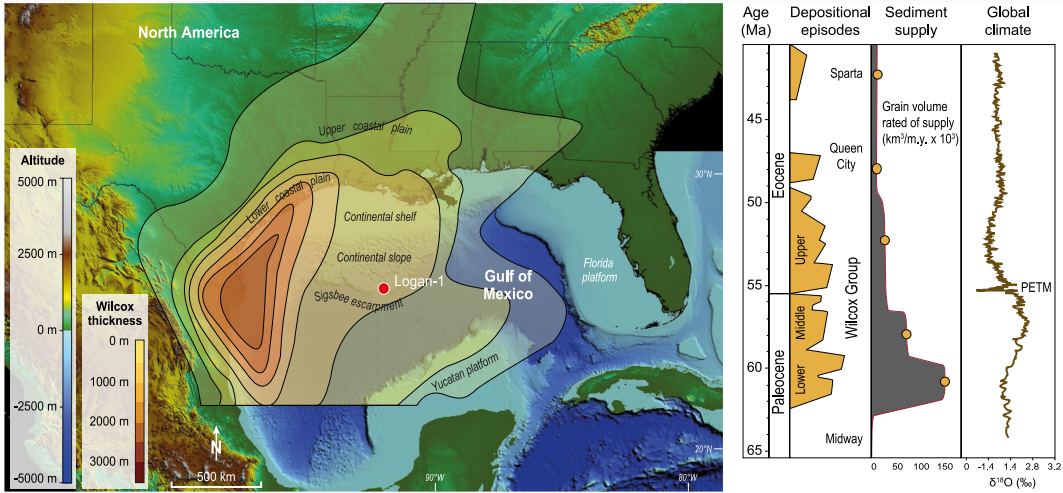
Topobathymetric elevation model of North America showing the Logan-1 well location (drilled in 2011 on Walker Ridge Block 969, ID WR 969 ST0 #1) and present main geographic features. Depositional context during the Paleocene-Eocene transition is represented by Wilcox Group thickness and key tectono-stratigraphic events in the Gulf of Mexico sediment routing system. PETM; Palaeocene–Eocene Thermal Maximum. Vimpere et al. (2023).

Examination of palynomorphs and calcareous nanofossils identified the Palaeocene–Eocene Thermal Maximum interval as being present between  8181 and 8001 m within the Logan-1 core, and the  Palaeocene-Eocene boundary as lying between the NP9 and NP10-0 horizons of the calcareous nannofossil assemblage. The carbon-isotope excursion can also be identified within the core, at 8196–8001 m, with an onset 15 m below the Palaeocene-Eocene boundary, and no hiatus in sediment deposition. This pattern has been observed at a variety of locations, and suggests a link between the onset of the Palaeocene–Eocene Thermal Maximum and late Palaeocene volcanism on the e North Atlantic volcanic province, the Caribbean, and mid-ocean ridge areas. The main body interval of the carbon-isotope excursion is found between  8196 and 8108 m, and the recovery phase between 8108 and 8101 m. This gives a Palaeocene–Eocene Thermal Maximum deposit with a thickness of 195 m, making it the thickest Palaeocene–Eocene Thermal Maximum deposit yet discovered. This contrasts with other well cores sunk in the Gulf of Mexico, in which the Palaeocene–Eocene Thermal Maximum sequence has been truncated. A marked increase in the abundance of Dinoflagellate cyst Apectodinium spp. was observed at 8169 m, while glauconite concentrations increased at 8172 m. Both of these are thought to represent sediments having become condensed, and a shift in the shoreline to landward, caused by deepening sealevels associated with the global temperature rise. 

Carbon isotope, glauconite concentration, chronostratigraphic, and lithostratigraphic data and correlations with Gulf of Mexico standard stratigraphy for the section studied in the Logan-1 well (drilled in 2011 on Walker Ridge Block 969, ID WR 969 ST0 #1). δ13Corg measurements and three-point averages are illustrated by the circles and the curve, respectively. GR, gamma ray; Sh, shale; Slt, silt; Snd, sand; YS, Yoakum Shale; CIE, carbon isotope excursion; PETM, Palaeocene–Eocene Thermal Maximum. Nannofossils: Bomolithus aquilus, Discoaster araneus, Discoaster mahmoudii, Discoaster diastypus, Fasciculithus tympaniformis, Rhomboaster cuspis, Rhomboaster bitrifida, Tribrachiatus bramlettei, Discoaster mahmoudii, Coccolithus bownii, Bomolithus supremus, Tribrachiatus bramlettei, Thomsonipollis, Fasciculithus richardii, Caycedoae megastypus, Discoaster multiradiatus, Fasciculithus lillianiae, Fasciculithus richardii, Discoaster acutus. Vimpere et al. (2023).

These results suggest that, in this part of the Gulf of Mexico, sedimentation rates were significantly increased during the Palaeocene–Eocene Thermal Maximum. If the Palaeocene–Eocene Thermal Maximum is assumed to have lasted 170 000 years, then this part of the Gulf of Mexico apparently had an average sedimentation rate of 1.15 m per 1000 years during this interval. The main body of the event comprises 88 m of sediment, thought to have been laid down in 80 000 years, giving a sedimentation rate of 1.1 m per 1000 years, while the recovery period is represented by 107 m of sediment laid down in 118 000 years, giving a sedimentation rate of 1.18 m per 1000 years, although distinguishing the main body from the recovery period is difficult, leading to a substantial margin of error in these calculations.

The Yoakum Shale is considered to represent a maximum flooding surface, created when the Palaeocene–Eocene Thermal Maximum caused the shoreline to retreat by 150 m. In the submarine deposits of the Gulf Coastal Plain this corresponds with a drop in the amount of terrestrial sedimentary material arriving, and the formation of an number of submarine canyons, most notably the Yoakum Canyon off the coast of Texas. These canyons tended to funnel sediments down into the ocean basin, bypassing much of the continental shelf, which became starved of sediment. The sediments of the shelf show a higher proportion of marine palynomorphs (which settle out of the water column) than terrestrial palynomorphs (which are carried out to sea with sediment) during this interval, and are also enriched in glauconite (which only forms in marine settings) relative to the rest of the sediment column. 

Palaeographic map of the northern Gulf of Mexico showing evolution of the depositional systems throughout the Paleocene–Eocene Thermal Maximum. Vimpere et al. (2023).

It could be presumed that the heating and increase in sealevel associated with the Palaeocene–Eocene Thermal Maximum led to the transgression onto the shores of the Gulf of Mexicoby itself, however Vimpere et al.'s findings suggest that this was at least in part due to subsidance of the coastal margins associated with the formation of the submarine canyons, although there is not sufficient data to make an absolute assessment of the influence of the two phenomena.

During the Early Eocene, uplift associated with the second pulse of the Laramide Orgeny forced the waterways carrying sediments into the Gulf of Mexico to shift towards the southwest. This is recorded in the Upper Wilcox deposits, where several major fluvio-deltaic systems are rejuvinated. This in turn led to stabilization of the system, with less wandering by channels, enabling sediments to build up and prograde out over the shelf margin. This prograding of the delta sediments is matched by the development of a sandy apron in the deep sea basin, probably formed as the prograding sediments reached the head of the submarine canyons.

Schematic representation of the evolution of the sediment-routing system of North America throughout the Palaeocene–Eocene Thermal Maximum. Increased channel mobility and floodplain reworking led to preferential transport of clays into the basin (i.e., Yoakum Shale) through bypass of the shelf within submarine canyons. Upper Wilcox corresponds to resuming of preferential transport of coarse material into basin-floor aprons due to progradation of deltaic sands onto the shelf and the mud removal by waves. Vimpere et al. (2023).

Within the Logan-1 drill core the Yoakum Shale is overlain by a series of sandy beds which reach from the top of the Yoakum at 8120 m up to 8007 m. This is thought to be linked to the development of a more extreme climate, which switched periodically between intense drought phases and intervals of heavy precipitation. This created periodic heavy flows within the river basins, washing out to see accumulated sands, derived from rocks uplifted by the Laramide Orogeny. The inshore environment is also likely to have suffered an increase in storm and wave action, washing sediments from the delta lobes down into the deep ocean basin. 

Vimpere et al. were able to use a multi-disciplinary approach to locate the Palaeocene-Eocene boundary, Palaeocene–Eocene Thermal Maximum, and the associated carbon isotope excursion, in sediments about 400 km away from the nearest coast. The carbon isotope excursion here is 195 m thick, and confirmed to represent the Palaeocene–Eocene Thermal Maximum by palynological and microfossil analysis, making it the longest Palaeocene–Eocene Thermal Maximum section known. This implies that sedimentation rates in this part of the basin were extremely high during this interval, which in turn implies a strong sedimentological response to the changing hydrological conditions associated with the Palaeocene–Eocene Thermal Maximum. Since other fan deposits of equivalent age are known at many locations around the world, it is reasonable to assume that this was a global, rather than a regional, response to the Palaeocene–Eocene Thermal Maximum.

See also...
Follow Sciency Thoughts on Facebook.

Follow Sciency Thoughts on Twitter.


Friday, 10 April 2020

Microfossils from the Palaeoproterozoic Hutuo Group of Shanxi Province, China.

Geological and geochemical evidence has revealed that the Neoarchean–Paleoproterozoic period was vitally important for Earth’s evolution. The earliest ‘snowball event’ and major glaciation occurred during this period. This was followed by a great oxidation event, which caused an abnormal positive shift in global carbon isotopes and is referred to as the Lomagundi Event. The emergence of oxygen-producing photosynthetic organisms that led to the sudden increase in atmospheric oxygen has been the focus of several studies. However, until now, convincing fossil records from this key geological time interval (i.e. latest Neoarchean to Palaeoproterozoic) are scarce. During this period, the biosphere experienced multiple geological events, but little is known about it and what is known is dependent on molecule clock dating analyses and estimates. To better understand the biosphere during this time, the metamorphosed Palaeoproterozoic deposits of the Hutuo Group at Wutai Mountain in Shanxi Province, China provide an excellent stratigraphic sequence in which to study well-preserved fossil records of this key period in Earth’s evolution.

In a paper published in the journal Precambrian Research on 5 February 2020, Leiming Yin and Fanwei Meng of the Nanjing Institute of Geology and Palaeontology, Fanfan Kong of the School of Resource and Earth Science at the China University of Mining and Technology, and Changtai Niu, also of the Nanjing Institute of Geology and Palaeontology, describe the results of a study of the microfossils of the Hutuo Group, and describe a number of these.

The Wutai Mountains are located in the Xinzhou area of Shanxi Province, China, between 38°50′ North and 39°05′ North, and between 113°29′ East and 113°44′ East. The Wutai Mountains of the central Trans-North China Orogen are a typical region for the investigation of Precambriansequences. The Precambrian strata in the Wutai Mountains can be divided into the Neoarchean Wutai Group, and the overlying Palaeoproterozoic Hutuo Group, separated by an unconformity.

Geology of Wutai Mountains showing the sample localities. Yin et al. (2020).

The Hutuo Group is distributed in an area of about 1500 km², from northernmost Taihuai-Sijizhuang on the south slope of Wutai Mountain to southernmost Shizui-Dingxiang, and from the upper Taishan River in the east, to Yuanpingqi village in the west. Although the Hutuo Group underwent a major tectonic movement (the ‘Lulianng Movement’) to show strong fold, which has still completely reserved many primary deposited structures, such as cyclothems (alternating stratigraphic sequences of marine and non-marine sediments), wavemarks, cross-bedding, etc. The Hutuo Group is characterised by thick carbonate and silicified rocks and has been divided into three subgroups. At the base is the Doucun Subgroup, which is dominated by terrigenous clastic sediments. This is overlain by the Dongye Subgroup, which is characterised by claret sandstone or slate in the lower part, and transitions upward into interbedded sandstone and carbonate with Stromatolites. It is dominated by dolomitic carbonate in its upper part. This is unconformably overlain by the Goujiazhai Subgroup, which consists of sandstone and local conglomerates. 

The Hutuo Group was previously determined to be more than 2366 million years old, based zircon Uranium-Lead ages (when zircon forms it often contains trace amounts of uranium, which decays into, amongst other things, lead at a known rate; since lead  will not have been present in the original crystal matrix, it is possible to calculate the age of a zircon from the ratio between these elements) from metamorphosed basic volcanic lava. More recent zircon age estimates made with more sensitie techniques are significanty younger, typically between 2150 and 1950 million years old.

Yin et al. investigated the Wenshan, Hebiancun, and Tianpengnao Formations of the Dongye Subgroup of the Hutuo Group for microfossils. The Wenshan Section is located 17.6 km southwest of Wutai County (38°36′ North and 113°7′ East). It comprises the lowermost Wenshan Formation, which is about 500 m thick and composed of metamorphic slate, and in consideration lithology of the single; 7 rock samples of slate were collected from the upper part of this section. The overlying Hebiancun Formation, which is about 1400 m thick and contains well-developed silicified carbonates containing Stromatolites and chert-like concretions. In order to obtain more possible preservation of fossil material from this deposited sequence, especially those of silicified Stromatolites and chert-like concretions, 59 rock samples were collected from middle-upper part of the Hebiancun Formation. In addition, and 76 phyllite rock samples from the uppermost Tianpengnao Formation of the Dongye Subgroup were collected from the Geziling Section, which is about 4 km east of Wutai County (38°44′ North, 113°17′ East).

Stratigraphic column of the Palaeoproterozoic Hutuo Group and sampling horizons of the Dongye Subgroup. Yin et al. (2020).

Standard palynological maceration was mainly used to obtain organic-walled microfossils from 12 slate samples of the Wenshan Formation and 76 phyllite samples from the Tianpengnao Formation. Samples of 50 g were cleaned and macerated with hydrocholric acid (37%) and hydrofluric acid (40%). Organic residues were either concentrated by heavy liquid with a specific gravity of 2.1–2.2, or poured through a 10 μm nylon mesh, and fixed slices were prepared with Canada balsam for the mounting medium of slices and sealed by paraffin. To obtain more fossil material and checking out possible contamination, which was mainly aimed at the phyllite of the Tianpengnao Formation, repeated macerations were performed. In result, total 14 samples including 2 slate samples of the Wenshan Formation and 12 phyllite samples of the Tianpengnao Formations produced organic-walled microfossils.

Additionally, 5 rock thin sections of phyllite of the Tianpengnao Formation (at least 6 mm in thickness) were cleared in distilled water were etched in dilute 8% hydrofluoric acid for 2–3 min, then cleared with distilled water, which were repeated processing in six times. Such etched rock thin sections were observed under scanning electron microscope to show preserved specimens in situ.

Outcrop photographs of the Tianpengnao Formation in the Geziling section and the Hebiancun Formation in the Wenshan section. (A), (B) Black phyllite or greyish-green phyllite interbedded with carbonates in the lower (A) and upper (B) parts of the Tianpengnao Formation. (C) Siliceous concretions in dolostone of the Hebiancun Formation. Yin et al. (2020).

The Tianpengnao Formation (at least 1.95 billion years old), which is the the uppermost formation of the Dongye Subgroup contains a higher diversity of organic-walled microfossils than the underlying formations. Organic-walled microfossils from the Tianpengnao Formation were mostly obtained through palynological preparation of phyllite. They were strongly carbonized and appeared as opaque vesicles. Individual specimen showed wall folds with a few fine spines under the scanning electron microscope. Similar opaque specimens in situ also found in thin sections. of fuchsia phyllite from the lower part of the Tianpengnao Formation. However, greyish-green phyllite from the upper part of the Tianpengnao Formation yielded much better preserved organic-walled microfossils. 

The microfossils found by Yin et al are all considered to be Acritarchs or Cyanobacteria.

Acritarchs are unicellular Eukaryotic organisms (organisms with cells with a discrete nucleus) that appear in the fossil record from about 3200 million years ago until the end of the Permian, and possibly later (depending on what is classified as an Acritarch). They're affinities are unclear, and the group is probably paraphyletic (not all members sharing a common ancestry), though the majority are thought to have been unicellular planktonic Algae or the resting cysts of other unicellular organisms.

Cyanobacteria are filament-forming photosynthetic Bacteria found across the globe and with a fossil record dating back over 3.5 billion years. They are thought to have been the first organisms on Earth to obtain carbon through photosynthesis, and it is also thought that the chloroplasts (photosynthetic organelles) of eukaryotic plants and algae are descended from Cyanobacteria that lived symbiotically within the cells of ancient eukaryotes. Cyanobacteria are often known as Blue-Green Algae, but this is somewhat misleading, as the term Algae is otherwise restricted to photosynthetic eukaryotes (no other group of photosynthetic Bacteria are referred to as Algae), and because not all Cyanobacteria are blue-green in colour; many are dark green or even black.

The first Acritarch described by Yin et al. is assigned to the genus Dictyosphaera, but not to species level. A single specimen was obtained from a siliceous lens in a dolostone containing Stromatolite from the Hebiancun Formation, at the Wenshan Section. This is a spheroidal vesicle, thin-walled, with very fine net-like ornamentation on its surface, forming a polygonal or subrounded mesh with 3–6 μm in diameter; the vesicle diameter is about 52 μm; no excystment structure was observed.

The Achritarch Dictyosphaera sp., in a in thin sections of siliceous material obtained from the Wenshan Section of the Hebiancun Formation. Scale bar is 10 μm. Yin et al. (2020).

The second Acritarch described is placed on a new species and genus, and given the name Dongyesphaera tenuispina, where 'Dongyesphaera' means 'sphere from Dongye' and 'tenuispina' means 'fine-spined'. Six specimens of this Acritarch were obtained by palynological maceration of material from the upper part of the Tianpengnao Formation. They are spheroidal to sub-spheroidal vesicles, the walls of which are psilate (lacking in ornamentation) and prominently wrinkled; with fairly short, conical processes or protrusions of varying length (0.5–4.2 μm, typically 0.8–1.5 μm), their termination showing as round; vesicles are 30–35 μm in diameter; no excystment opening was observed.

Dongyesphaera tenuispina, obtained from the upper greyish-green phyllite of the Tianpengnao Formation in the Geziling Section by palynological maceration. Scale Bars are 10 μm. Yin et al. (2020).

Acritarchs of the genus Leiosphaeridia were found in both palynological maceration and thin section from phyllite of the Tianpengnao Formation, siliceous lenses in dolostone containing Stromatolites of the Hebiancun Formation, and slate of the Wenshan Formation. spp. were obtained by palynological maceration and thin section. Most are strongly carbonized and even opaque. Some specimens obtained from phyllite of the upper part of the Tianpengnao Formation are less carbonized. None of these are assigned to species level by Yin et al. The specimens are spheroid vesicles, with a circular outline in compressed specimens; the wall surface typically is psilate or with inconspicuous ornament; some specimens show irregular folds; the vesicle diameter is 33–65 μm; no excystment structure was observed.

Leiosphaeridia spp., (A) obtained by palynological maceration from the upper greyish-green phyllite; (C) and (F) obtained by palynological maceration from the lower amaranth phyllite; (J) found in a thin section of the lower amaranth phyllite. Yin et al. (2020).

A single specimen is assigned to the genus Satka. This is a spherical colony-like specimen aggregated with many cell-like spheroids that has been compressed and appears to be enveloped by a thin outer membrane. The included spheroids are deformed and show different shapes and sizes. Single spheroids are 3–7 μm in diameter, and the whole vesicle about 40 μm in diameter. This specimen comes from a greyish-green phyllite of upper part of the Tianpengnao Formation, from the Geziling location.

Satka sp., from the upper greyish-green phyllite. Yin et al. (2020).

The first Cyanobacteria described by Yin et al. are assigned to the species Eoentophysalis belcherensis. These are irregular clusters that contain small and large spheroidal to sub-spheroidal cell-like units singly or in pairs; they are in a crowded arrangement, with a common thin envelope. Cell-like units are typically 1.8–2.5 μm in diameter; irregular clusters are 15–25 μm across and are frequently stuck together. These were foiund in thin sections of siliceous lenses in dolostone containing Stromatolites from the Hebiancun Formation.

Eoentophysalis belcherensis, from the Hebiancun Formation. Scale bar is 10 μm. Yin et al. (2020),

Seven specimens found in thin sections of two samples from siliceous concretions in dolostone of the Hebiancun Formation are assigend to a new species of Eoentophysalis; which is given the specific name hutuoensis, meaning 'from Hutuo', in reference to the Hutuo River in the Wutaishan area of Shanxi Province, China. Eoentophysalis hutuoensis comprises cell-like units spheroidal, ellipsoidal or deformed by compression, and 2.5–12 μm in diameter; mostly single, a few in possible pairs and irregular clusters; characteristically crowded in colonies which are enveloped by a thick sheath-like material. Therse are several hundred cell-like units arranged in clusters or extensive colonies, that are enveloped by an opaque sheath-like material (about 5–8 μm thick) and characterized by suborbicular holes (at least 1 μm in diameter); nearly all cell-like units are single, and more distinct in laser scanning confocal microscope images. Some of show ‘lining structure’ (or remains of plasmolysis). Clusters or colonies 78–126 μm across.

Eoentophysalis hutuoensis under laser scanning confocal microscope. Yin et al. (2020).

The third Cyanobacterium described by Yin et al. is assigned to the species Sphaerophycus medium. A single specimen from a siliceous lens in a dolostone containing Stromatolite of the Hebiancun Formation comprises an irregular clump of cells about 135 μm long and 86.5 μm wide; the cells generally not mutually deformed. Individual cells are spheroidal and ellipsoidal and 4.5–12.5 μm in diameter; cell walls are about 0.5 μm thick.

Sphaerophycus medium, from a siliceous lens in a dolostone containing Stromatolite of the Hebiancun Formation. Yin et al. (2020).

The fourth Cyanobacterium described is placed in the genus Pseudodendron, but not assigned to species level. This comprises a single compressed organic carbon specimen that has two short branches connected with a single, main ‘tube-like’ filament along two sides; the surface is nearly psilate and no preserved cellularity or outer enveloped material is observed. The ends of both branches and the main filament are truncated. The main filament 140 μm long, and 5–8 μm wide; the branches 20–48 μm long and 4–4.5 μm wide. Since only one incomplete specimen was found, its placement in Pseudodendron is tentative. The specimen was observed in a thin sections of siliceous lens from a dolostone containing Stromatolite of the Hebiancun Formation from the Wenshan Section.

Pseudodendron sp., from a thin sections of siliceous lens from a dolostone containing Stromatolite of the Hebiancun Formation from the Wenshan Section. Yin et al. (2020).

The final Cyanobacteria described is Siphonophycus kestron. Many specimens of this were found in thin sections of dolostone containing Stromatolites of the Hebiancun Formation. They are single filamentous microfossils, unbranched, nonseptate, surface smooth; only preserved as carbon membrane-like remains due to degradation; and 5–8 μm across.

Specimen of Siphonophycus kestron, from a thin section of dolostone containing Stromatolite of the Hebiancun Formation. Yin et al. (2020).

The Paleoproterozoic (2.5-1.6 billion years ago) was a critical period in  Earth’s evolution. During it, important global events, such as glaciation, atmospheric oxygenation over the early period, and the following Lomagundi-Jatuli isotopic event occurred. 

The Hutuo Group, as a typical Palaeoproterozoic sequence in the North China Craton, is distributed through the Wutai and Luliang mountains in Shanxi Province, China. The lithological character of the group is characterized by metamorphic deposits and volcanic rocks. Based on recent uranum-lead isotopic age dating, the Hutuo Group is constrained to the period between 2.14 and 1.95 billion years ago. Carbon isotope excursions in the Hutuo Group have been documented as a response to the Palaeoproterozoic global glaciation. Glaciogenic diamictite (a type of lithified sedimentary rock that consists of nonsorted to poorly sorted terrigenous sediment) has also been discovered in the Shijiazhuang Formation of the Hutuo Group at Wutai Mountain, North China which suggests a locally protracted glacial event could have extended to the Wutaishan area. Based on the uranium-lead isotopic ages and chronological framework of the Hutuo Group, a three-stage evolution in the Carbon¹³ isotope curve has been recognized in carbonates of the Hutuo Formation. The lower to middle part of the Dongye Subgroup shows oscillating positive and negative Carbon¹³ values that range between −5.2 and +2.7 parts per thousand relative to the Pee Dee Belemnite Standard (an increase in the proportion of Carbon¹³ relative to Carbon¹² is often indicative of an increase in photosynthesis, as photosynthetic organisms preferentially extract Carbon¹² from the atmosphere, whereas carbonate forming ones incorporate both in in a proportion reflecting atmosphere composition). 

The microfossils from the Wenshan and Hebiancun Formations would be the fossil records of the geological period manifested by the aftermath of a positive excursion of Carbon¹³ (the Lomagundi-Jatuli isotopic event). The transition from an abnormally high organic carbon burial rate to massive oxidation of organic matter. The microfossils from the uppermost part of the Dongye Subgroup, (i.e. the Tianpengnao Formation), would represent the remains of Microphytoplankton during the geological period characterized by fluctuating Carbon¹³ levels.

The Palaeoproterozoic Hutuo Group was deposited in supra-tidal to sub-tidal environments. Furthermore, the Dongye Subgroup was followed by a remarkable transition of geochemical environments. In such palaeoenvironments, phosphates deposited on the continental margin of North China during late early Palaeoproterozoic. In the middle of the Hebiancun Formation, phosphatic deposits developed in association with dolomitic carbonates and a few terrigenous clasts in the studied Wenshan section. Several phosphatized specimens of spheroidal and filamentous Cyanobacteria and Leiosphaeridia-like forms were found in the phosphatic horizon. Typically, these specimens are poorly preserved, possibly due to late oxidation. Some specimens of Eoentophysalis hutuoensis were preserved as compressed carbon membranes. Such well-preserved Palaeoproterozoic microfossils, especially Eoentophysalis as multicellular colonies, have rarely been reported before. To understand their detailed morphological structure and elemental composition, scanning electron microscope associated with energy spectrum test was used for individual specimen of Eoentophysalis hutuoensis. Many sub-spherical individual cells were embedded within or enveloped by a Carbon membrane. The main elements detected were Carbon, Silicon, Calcium and Magnesium. This could suggest that Cyanobacteria colonies were primitively buried in the dolomitic carbonate and silicification during diagenesis resulted in their preservation. Common early diagenetic silicification was observed in the carbonates as distinct chert layers or concretions intercalated within dolostones of the Hebiancun Formation.

Eoentophysalis belcherensis, from the Hebiancun Formation. Scale bar is 10 μm. Yin et al. (2020),

A few degraded coccoid and filamentous cyanobacteria microfossils have previously been reported from the Hebiancun Formation. Some poorly preserved organic-walled microfossils obtained by palynological maceration have been described from the Doucun Subgroup. Some of those specimens that showed triangular, polygonal and boat-shaped forms that were plausibly interpreted as being like Eukaryotic Protists. In morphological feature discrimination, those specimens probably resulted from taphonomic alteration or were contaminants. Eukaryotic microfossils, except multicellular forms, are normally characterized by a Eukaryotic cytoskeleton and endomembrane system, morphogenetic characters like a multilayered wall, distinct surface ornamentation, and excystment by partial rupture or a circular opening. The oldest fossil evidence for Eukaryotic Protists (e.g. Tappania and other ornamented forms) have been documented from about 1.41 billion years ago elsewhere in the world. The new genus Dongyesphaera described by Yin et al. from the Tianpengnao Formation has a distinct fine spinous ornament on the vesicle wall, which would be recognized as eukaryotic protist. Additionally, a specimen identified as Dictyosphaera sp. was found in the Hebiancun Formation. The morphological genus Dictyosphaera has mostly been described from Late Palaeoproterozoic to Mesoproterozoic sediments in China, Australia and America. It is characterised by a multilayered vesicle wall, polygonal network ornamentation and possible excystment structure and is interpreted as a Eukaryotic Protest. At present, just one specimen identified as Dictyosphaera sp., by displaying network ornamentation on its vesicle surface, was found in the Hebiancun Formation, with an age of approximately 2010 million years. This suggests that the Eukaryotic Protist exercised metabolic activities rarely observed to have occurred in the early Palaeoproterozoic ocean. Up to the middle Palaeoproterozoic sequence, more specimens ornamented with fine conical spines, named as Dongyesphaera tenuispina, occurred in the greyish-green phyllite of the upper part of the Tianpengnao Formation (aged at about 1950 million years). Additionally, in siliceous lenses of dolostone containing stromatolite in the Hebiancun Formation, many Coccoid Cyanobacteria, such as Eoentophysalis and Eogloeocapsa were preserved, and some squashed Leiosphaerids, typically over 50 μm in diameter, have been preserved in situ. No obvious surface ornament was observed. However, the occurrence of the individual specimen of Dictyosphaera in the Hebiancun Formation implies that possible Eukaryotic organisms already existed around 2026 million years ago. Therefore, the microfossil evidence from Yin et al.'s study suggests that Eukaryotic organisms occurred earlier than, at least 2000 million years ago and quite lower morphological diversity of Eukaryotic organisms at the geological epoch. The recent discovery of early Precambrian microfossils, e.g. fungus-like mycelial fossils from 2.4 billion-year-old basalts of the Ongeluk Formation in South Africa, could suggest that Eukaryotic organisms may have occurred earlier than previously thought.

Photomicrographs of microfossils from the Hebiancun and Wenshan Formations in the Wenshan section. (A), (B) Leiosphaeridia sp., (A) broken specimen in thin section of silicified slate; (B) obtained by palynological maceration. (C) Degraded Coccoidal Cyanobacterium-like aggregation in a thin section of flint within crystalline dolostone, (D), (E) Eoentophysalis hutuoensis, in a thin section of a siliceous concretion in dolostone. Yin et al. (2020).

On the basis of microfossils found in samples from the Dongye Subgroup of the Palaeoproterozoic Hutuo Group in the Wutai Mountains of Shanxi Province, China, Yin et al. conclude the following: (1) Based on published geological data, there was an increased influence of oxygen on the carbon cycle during deposition of the Dongye Subgroup. For instance, phosphatised microfossils in phosphatic deposits of the Hebiancun Formation underwent stronger oxidation and show indistinct morphological aspects. (2) Owing to a remarkable increase in oxygen during the early Palaeoproterozoic, Eukaryotic Protists exercised metabolic activities rarely occurred in suitable environment, although Cyanobacteria were dominant in the early Palaeoproterozoic ocean. (3) The morphological diversity of Cyanobacteria appears to increase after about 2.0 billion years ago, especially the occurrence of many colonylike forms, such as the morphological genera Eoentophysalis and Sphaerophycus. Follow on research of microfossil records obtained from terrestrial clastic sediments of lower part of the Hutuo Group and greenschist of Neoarchean ‘Gaofan Subgroup’ is a potential project to reveal evolution of Earth’s life before and after global glaciation event.

See also...

https://sciencythoughts.blogspot.com/2020/01/understanding-influence-of-large-bolide.htmlhttps://sciencythoughts.blogspot.com/2019/07/acritarchs-from-ediacaran-of-camaqua.html
https://sciencythoughts.blogspot.com/2019/06/evaluating-possibility-that-iron-oxides.htmlhttps://sciencythoughts.blogspot.com/2019/02/petalonema-alatum-distinctive-northern.html
https://sciencythoughts.blogspot.com/2018/03/microbial-biodiversity-around-garga-hot.htmlhttps://sciencythoughts.blogspot.com/2017/10/algal-bloom-covers-much-of-western-lake.html
Follow Sciency Thoughts on Facebook.

Wednesday, 1 April 2020

Cutting the Gordian Knot of tree-ring timelines in the East Mediterranean Bronze Age, and looking for a date for the Santorini/Thera eruption that destroyed the Minoan civilization.

Tree-ring records constructed from ancient wooden timbers can provide calendar-dated frameworks to underpin archaeological and palaeoenvironmental chronologies beyond the reach of written evidence. They can provide securely dated records of construction, abandonment, and trade across different cultural regions while simultaneously providing calendar-dated, annual resolution records of contemporary climatic variability. As such, they represent an invaluable resource for studies of past human and environmental interactions and for the resolution of complex chronological issues. However, for certain key geographic regions and time periods, the only tree-ring records preserved are not calendar dated to the exact year but rather, 'float' in time, dated with less precision and accuracy by radiocarbon wiggle-match dating (a dating method that uses the non-linear relationship between Carbon¹⁴ age and calendar age to match the shape of a series of closely sequentially spaced Carbon¹⁴ dates with the Carbon¹⁴ calibration curve). While this approach can produce excellent results for certain time periods, limitations of the method include multiyear error ranges and the fact that calibrated date ranges may shift forward or backward in time depending on which iteration of the international radiocarbon calibration curve is used for calibration. The full benefits of the annually derived tree-ring record for establishing rigid archaeological chronologies for cultural interaction plus the impacts of climatic or geological events on ancient civilizations can be fully realized only by securely fixing such records in a precise and accurate calendar-dated range.

In a paper published in the Proceedings of the National Academy of Sciences of the United States of America on 30 March 2020, Charlotte Pearson of the Laboratory of Tree-Ring Research, Geosciences, and the School of Anthropology at the University of Arizona, Matthew Salzer, also of the Laboratory of Tree-Ring Research at the University of Arizona, Lukas Wacker of Ion Beam Physics at Eidgenössische Technische Hochschule Zurich, Peter Brewer, again of the Laboratory of Tree-Ring Research at the University of Arizona, Adam Sookdeo, also of Ion Beam Physics at Eidgenössische Technische Hochschule Zurich, and of the Chronos ¹⁴Carbon-Cycle Facility at the University of New South Wales, and Peter Kuniholm, once again of the Laboratory of Tree-Ring Research, and the School of Anthropology at the University of Arizona, present the results of an attempt to resolve a Bronze Age floating tree-ring record in the Eastern Mediterranean, using using timbers taken from a chamber surrounding the grave of a predecessor of King Midas in the Phrygian capital city of Gordion (modern day Yassihöyük, Turkey).

Map to show the proximity of the Gordion site to Thera, the main direction of fallout of the Thera ash, and other locations. Pearson et al. (2020).

This record is one of a group of interlocking tree-ring series from the ancient East Mediterranean, which when first published as a dated sequence, ncluded wooden timbers from 22 archaeological sites in central Anatolia (Turkey) spanning the years from approximately 2220 to 718 BC. The Gordion part of this sequence was subsequently redated multiple times, with each redate necessitating a reevaluation of the associated archaeological evidence. Aside from being the key to dating a number of critical archaeological sites in the East Mediterranean, the tree-ring series from Gordion has an extra relevance in that it is the only tree-ring record from the ancient Mediterranean that fully spans the period during which all scholars would agree that the Minoan eruption of Thera occurred. This event provides a pivotal marker horizon through which the chronologies of ancient Egypt, the Levant, Greece, and Anatolia could be linked. Dating this tree-ring series to a fixed point in time rather than a shifting calibrated range would, therefore, offer significant new opportunities for dating the eruption and the synchronization point that it offers because it is possible that the tree rings hold an anatomical or chemical marker for the event, which could be used to further refine the dating. This is particularly important as radiocarbon dating for Thera is impeded by a plateau in the radiocarbon calibration curve between about 1620 and 1540 BC.

In particular, if a chemical response related to environmental changes brought about by the eruption could be identified in the wood, as has been observed in both the lake environment at Gölhisar and in the Speleothem record (deposits of secondary minerals that can be dated from their isotope content) in Sofular cave on the Black Sea coast, then it might be possible to suggest a more exact date for the event. While there are many factors that can lead to disturbances in the anatomy of tree rings, there are only a few that can lead to major chemical changes in the environment.

In an earlier attempt to trace the Thera eruption, Pearson et al., published in a paper in the Journal of Archealogical Science in 2009, conducted elemental analysis on a wide growth-ring anomaly from one of the tree-ring site chronologies overlapping with the Gordion record (Porsuk in southern central Turkey). In that study, they found significant changes in elemental chemistry associated with a wide growth-ring anomaly, which was then dated to about 1650 BC; at the time, this was within the possible radiocarbon range suggested for the Thera eruption, at odds with certain lines of archaeological evidence. The elemental response was consistent with what might be expected from a volcanic event but as noted at the time, also consistent with what might be expected following a forest fire. The date for this elemental change and growth response is now outside the possible range for the Thera eruption, although it may originate from some other unidentified eruption; such as the Yali-Nisyros volcano, at the eastern edge of the Aegean volcanic arc. The revised radiocarbon ranges for Thera-relevant materials suggested by Pearson et al. in the earlier study indicate that the majority of the 16th century BC should now be searched for evidence of the eruption.

Left: The 854 anomaly in sample C-TU-POR-3, from Porsuk in southeast Turkey; right: a similar (though extended) growth-ring anomaly from a tree which grew about 30 km from Katmai Volcano, Alaska. The tree in question was inundated with a few feet of pumice following the 1912 AD eruption of Novarupta, attributed to Katmai. The pumice killed or suppressed low vegetation cover, enhancing conditions for established trees. Inset: a short growth anomaly from a single application of fertilizer to a tree in an experimental forest. Pearson et al. (2009).

In the new study, a combination of two approaches was used for improving and securing the date range for the floating tree-ring series from Gordion. First, Pearson et al. compared a sequence of annual Carbon¹⁴ measurements from single rings of the Gordion series with a contemporary time series of annual Carbon¹⁴ from absolute, calendardated Bristlecone Pine, Pinis spp., and Irish Oak, Quercus spp., across the period 1700 to 1500 BC.

Similar applications have relied on detecting the presence of significant rapid excursions in the annual tree-ring Carbon¹⁴, in particular the largest of these discovered so far an approximate 1.2% change between the years 774 and 775 AD. This event has also been used to provide an independent verification of the calendar dating for established multiregional tree-ring records and to synchronize tree-ring Carbon¹⁴ with Berylium¹⁰ (which forms by spallation of nitrogen and oxygen in the atmosphere and precipitates onto and into surface layers) in the ice cores. In the case of the 774/775 AD marker event, the potential is clear, but for time periods where no such dramatic markers are present, like 1700 to 1500 BC, a different strategy has to be applied. Pearson et al. make use of less pronounced and consequently, less secure Carbon¹⁴ time markers for a proposed annual Carbon¹⁴ pattern-matching approach..

Second, this is tested using an anticorrelation between tree growth response to the same volcanic forcing events in both the Mediterranean Juniper, Juniperus spp., trees and calendar-dated North American Bristlecone Pine. This test uses a well-established temporal association between high-elevation Bristlecone Pine frost rings and large-scale volcanic eruptions. It has been clearly demonstrated that latewood frost rings in Bristlecone Pine occur the year of or the year following a volcanic event, and this causal connection has been strongly confirmed across the last 2500 years. Beyond this period, Bristlecone tree-ring chronologies are accurately dated to the calendar year for over 5000 years, and therefore, the record of precisely dated Bristlecone response to volcanism covers the period across which the Juniper sequence lies according to both conventional radiocarbon wiggle matching and the annual Carbon¹⁴ pattern-matching approach used by Pearson et al.

In western Turkey, the years of or following many of the same major volcanic eruptions that affected Bristlecone growth in the more recent period are marked by wide growth rings in Austrian Pine, Pinus nigra. This indicates that an increase in May–June precipitation caused more favorable growth in this region as part of a chain of climatic disturbances associated with Northern Hemisphere cooling following major mid- or northern latitude volcanic eruptions. Assuming that similar climatic forcing prevailed during the Bronze Age and knowing that Pine and Juniper tree-ring chronologies from this region show strong interspecies correlation, Pearson et ai. hypothesised that wide rings in the floating Juniper sequence should correlate with calendar-dated frost events in Bristlecone Pine and that, if so, this could provide a means to test the annual Carbon¹⁴-matching approach and to refine to a fixed tree-ring date based on synchronization with the calendar-dated Bristlecone record (in a similar approach to previous studies that used Bristlecone Pine frost rings as fixed date volcanic markers to refine dating for volcanic acidity layers in ice cores).

Finally, Pearson et al. report the chemical study of this newly secured tree-ring sequence with the objective of seeing if any chemical indicator could be found that might help to further constrain the dating possibilities for the Thera eruption.

Annual Carbon¹⁴ measurements were made on 186 consecutive years (relative years 834 to 1019) of the 1028-year Gordion Juniper sequence (which starts with relative year 737). These measurements into the IntCal13 Radiocarbon Age Calibration Curve using the OxCal 4.3 radiocarbon calibration program to provide an end date for the entire calibrated tree-ring chronology, within an 8-year range: 758 to 751 BC at 95.4% confidence level. This was in good agreement with previous wiggle matching of 128 decadal or 11-year blocks spaced over 987 years of the same Juniper sequence, which placed the end of the tree-ring sequence at 751 BC +6/–8 at a 95.4% confidence level. A chi-squared (χ²) test (used to determine whether there is a statistically significant difference that is unlikely to be due to chance alone between expected frequencies and observed frequencies) for the Mediterranean Carbon¹⁴ time series vs. the weighted mean of the annually resolved combined Oak and Pine data placed the last ring of the Mediterranean sequence at a more precise date of 745 ± 4 BC (95.4% confidence level); this is statistically slightly younger (10 ± 6 years) than when the same data are wiggle matched to IntCal13. Pearson et al. considered the position using the annual Carbon¹⁴ data as significantly more reliable as it is a result of comparing fine structure that is not available in IntCal13, which is primarily based on decadal data. Using the fine structure yields dating results free from the regional or laboratory offsets that may be combined in the coarser-resolution calibration data. The reasonably close agreement of the results via the different methods does, however, demonstrate that, for wiggle matches spanning multiple decades, the improved curve shape offered by the annual Carbon¹⁴ data may have a relatively small effect on the final calibrated date range.

Positioned relative to an end date of 745 ± 4 BC the visual correlation of the annual data around the increased production event of circa 1528 BC is clearly evident. The Gordion data more closely agree with the annual Oak and Pine data than with IntCal13 and show the same offset from the curve as shown by the other annual data between 1650 and 1540 BC. They are also valuable in providing an annually based record of Carbon¹⁴ fluctuation from the Mediterranean region in this time period relevant for the Thera eruption. While no large-scale localized offsets in Carbon¹⁴ are evident, for the years where contemporary Oak, Pine, and Juniper measurements from the same laboratory can be directly compared (1680 to 1580 BC), the Mediterranean Juniper is offset from the Irish oak by +9.0 ± 3.5 Carbon¹⁴ years, whereas they are only +3.4 ± 2 Carbon¹⁴ years different from the North American Pine. While this slight difference is within the stated measurement errors, it is possible that the closer agreement between the Pine and Juniper may reflect a shared, more southerly latitude than the Irish Oak. These data agree with previous findings that there is no major regional offset in the period. Pearson et al. also note that the data indicate that, around the period of lower solar activity (around 1600 BC) and during the period of more rapid Carbon¹⁴ production (roughly 1540 to 1528 BC), there is no significant difference between the multiregional annual Carbon¹⁴ data, which might be related to growth season. Pearson et al. do, however, note the possibility of a localized excursion in Carbon¹⁴ around 1548 BC. This requires further investigation as, if it is not an analytical outlier, it could represent an influx of  'old carbon' into the environment, potentially consistent with a volcanic eruption such as Thera.

The validity of the dated position produced by chi squared analysis (745 ± 4 BC at a 95.4% confidence level) and supported by annual Carbon¹⁴ pattern matching around the 1528 BC Carbon¹⁴ excursion was then independently tested using the previously described correlation between years of known eruptions, calendar-dated Bristlecone Pine frost-ring years, and wide tree rings in Mediterranean sequences. Pearson et al. hypothesised that, if their temporal placement of the Juniper chronology was correct at 745 ± 4 BC, then it should show wide rings in the year of or following a Bristlecone Pine frost ring. On this basis, superposed epoch analysis (a statistical tool used in data analysis either to detect periodicities within a time sequence or to reveal a correlation, usually in time, between two data sequences) was used to test the significance of the effects of a mean tree-ring response to the proxy record of volcanic forcing across the full Bronze–Iron Age Juniper chronology in the adjusted position suggested by this study. In this position, the superposed epoch analysis analysis showed significantly wider rings than would be expected by chance in the Mediterranean chronology in the year following a Bristlecone frost ring. This nonrandom association provides strong corroborative evidence for the annual Carbon¹⁴ position to, in fact, be correct to the year. Within the 4 years on either side of the 745 BC dating placement, no other positions provide this strong association. This provided additional support that the position of the Gordion chronology determined by the chi-squared analysis is indeed correct to within 1 year and allowed Perason et al. to derive an exact calendar-dated position for the tree-ring series.

Having arrived at a secure date range for the tree-ring series, Pearson et al. made multiple scans using a desktop ATLAS Micro-X-ray Fluorescence unit across the transverse surface of a subsample of GOR-76. The scans covered the period from circa 1630 to 1500 BC. These revealed a single major disturbance of the element Calcium around 1560 BC. The exact onset of the change may be as early as 1562/1 BC, and the effect appears to last until around 1557 BC. Other analytical techniques will be used to refine this temporal association. Calcium is an essential element in wood that is needed to support fundamental biological functions, including cell membrane stability and stress response. Declines in tree-ring Calcium have previously been associated with drought; however, in this case, the growth rings that feature the depletion are not unusually narrow (as would indicate drought). A forest fire response is also a possible explanation, and this can manifest as either an increase of Calcium as it becomes more available for uptake after burning or as a depletion where areas of the sample are scarred but again, the tree-ring growth pattern does not indicate a growth release or scar typical of fire impact.

A high-resolution X-ray fluorescence scan of the transverse section of GOR-76 featuring an unusual depletion of the element Calcium. The mapped area was identified as the only significant elemental anomaly in the 16th century BC growth rings from this sample. This scan shows that a calcium depletion occurs from around 1562 to 1558 BC and is centered on an unusually wide, slightly pale in colour growth ring at 1560 BC. A similar wide, pale ring occurs in 1550 BC but does not indicate the same degree of depletion. Pearson et al. (2020).

Alternatively, Calcium can be reduced in tree rings following foliar exposure to acid mist or other such precipitation. Therefore, the finding of a Calcium depletion is consistent with the impact of volcanically induced acid deposition [reported in lake sediments as a result of the Thera eruption. On its own, this Calcium response in a single tree might not be worth reporting; however, the date around which it occurs makes it worthy of further discussion because 1560 BC also coincides with evidence for volcanic impact indicated in two other records. Subfossil Pine trees from a calendar-dated record in Finnish Lapland indicate a possible eruption immediately preceding 1560 BC in the form of a negative departure in Carbon¹³ (drop in the proportion of Carbon¹³ relative to Carbon¹²), which has been shown to correlate with periods of reduced visibility due to volcanic acid fog. The high-altitude Bristlecone pine record also includes an indicator year at 1560 BC along with 4 other years in the 16th century BC when unusually narrow growth or frost-damaged cells are recorded. These dates (1597, 1560, 1546, 1544, and 1524 BC) are all indicative of major volcanic eruptions, the origins of which are not yet known. The coincidence of these two additional records around 1560 BC makes further investigation essential. The apparent increase in old carbon around 1558 BC also requires further exploration as, although the tree grew several 100 km from the eruption, this too could hypothetically connect with the Thera eruption, and all potential indicators should be explored. We note, however, that 1560 BC is more recent than indicated likely for the chemical change associated with the Thera eruption at Sofular cave and older than is indicated likely for the event via certain lines of archaeological evidence Nevertheless, these findings clearly merit further careful investigation to define better the onset and duration of the response and to see if it can be replicated in other trees and expanded via the detection of other more clearly volcanogenic (or otherwise) elemental markers.

Pearson et al.'s study shows that, even in the absence of a large-scale interannual Carbon¹⁴ excursion (such as at 774/775 AD), comparing the fine structure in annually derived Carbon¹⁴ time series via a range of approaches can offer a way to improve the dating precision and accuracy possible for floating tree-ring sequences previously dated by conventional radiocarbon wiggle matching to the IntCal calibration curve. First, critically, matching based on two annual Carbon¹⁴ time series (one of which is calendar dated via dendrochronology) offers a dated position for the floating sequence, which is fixed. This differs from modeled dates via conventional radiocarbon wiggle matching, which may change with new iterations of the calibration curve. Second, chi-squared testing of longer annually based time series can refine dating for floating tree-ring sequences to a precise year within a ± 4-year range, and this can be visually tested and confirmed across small-scale Carbon¹⁴ features (such as at 1528 BC). Third, as is the case in this study, additional proxy information can be used to refine the dating further. We found that other tree-ring associations strongly suggested that the dating indicated by the annual Carbon¹⁴-matching approach yielded a result that was in fact accurate to within 1 year. This combination of methods opens up opportunities to anchor floating tree-ring sequences in time outside the capacity of standard dendrochronological techniques, demonstrating potential to fill in a range of critical temporal and geographic gaps in the tree-ring record.

Anchoring the Gordion tree-ring series more securely in time is an important contribution to improving timelines in the ancient East Mediterranean and maximizing the potential of this record as a paleoenvironmental resource. The first step toward this is the identification of the calcium anomaly around 1560 BC, which while clearly requiring replication and much further substantiation, opens up potential that may now be pursued toward finding an exact date for Thera.

See also...

https://sciencythoughts.blogspot.com/2020/03/deciphering-metal-content-of-objects.htmlhttps://sciencythoughts.blogspot.com/2019/07/london-auction-house-sells-busk-of.html
https://sciencythoughts.blogspot.com/2015/06/interpreting-life-history-of-egtved-girl.htmlhttps://sciencythoughts.blogspot.com/2014/05/the-death-of-ramesses-iii.html
https://sciencythoughts.blogspot.com/2012/02/new-study-of-santorini-eruption-that.html

Follow Sciency Thoughts on Facebook.