Saturday, 29 December 2018

Seven dead and four missing in two landslides on Luzon Island, the Philippines.

Seven people have died and four more are missing following a series of landslides on southern Luzon Island in the Philippines on Friday 28 and Saturday 29 December 2018. The first event happened in the city of Legazpi in Albay Province, late on Friday, and resulted in the deaths of Mauro Alegre, 25, his wife Mia, 20, and their son Marco, 3, when a landslip destroyed their house; a further ten people were injured in the event. A further two incidents happened the next day, the first at bout 2.00 am local time, in the town of Lagonoy in Camarines Sur, when part of a hillslope collapsed onto a house, killing Charles Las Penas, 51, and his son, also Charles, 11. In a third incident a landslide in the village of Osiao in Sorsogon Province is known to have killed two people, Gilbert Desunia and Gerald Despabiladeras, with four more missing, Dominador Esquivel, Leonel Diaz, Magno Diaz, and Franklin Olavere, and another four requiring hospital treatment, Mark Diolata, John Carlo Lorill, John Robert Marcaida, and Arjay Dulpina.

The aftermath of a landslide in Legazpi City in Albay Province, the Philippines, on Friday 28 December 2018, which killed three people and injured ten more. Luence Burce Barcena/CNN Philippines.

The landslips occurred as southern Luzon was battered by rains associated with the passage of Tropical Depression Usman across the island. Landslides are a common problem after severe weather events, as excess pore water pressure can overcome cohesion in soil and sediments, allowing them to flow like liquids. Approximately 90% of all landslides are caused by heavy rainfall. 

The path and strength of Tropical Depression Usman. Thick line indicates the past path of the storm (till 6.00 pm GMT on Saturday 29 December 2018), while the thin line indicates the predicted future path of the storm, and the dotted circles the margin of error at 12, 24, 36, 72, 96 and 120 hours ahead. Colour indicated the severity of the storm. Tropical Storm Risk.

Tropical depressions are caused by the warming effect of the Sun over tropical seas. As the air warms it expands, causing a drop in air pressure, and rises, causing air from outside the area to rush in to replace it. If this happens over a sufficiently wide area then the inrushing winds will be affected by centrifugal forces caused by the Earth's rotation (the Coriolis effect). This means that winds will be deflected clockwise in the northern hemisphere and anti-clockwise in the southern hemisphere, eventually creating a large, rotating Tropical Storm.

Despite the obvious danger of winds of this speed, which can physically blow people, and other large objects, away as well as damaging buildings and uprooting trees, the real danger from these storms comes from the flooding they bring. Each drop millibar drop in air-pressure leads to an approximate 1 cm rise in sea level, with big tropical storms capable of causing a storm surge of several meters. This is always accompanied by heavy rainfall, since warm air over the ocean leads to evaporation of sea water, which is then carried with the storm. These combined often lead to catastrophic flooding in areas hit by tropical storms.

See also...

https://sciencythoughts.blogspot.com/2018/10/landslides-kill-at-least-nine-as.htmlhttps://sciencythoughts.blogspot.com/2018/10/philippine-police-arrest-four-for.html
https://sciencythoughts.blogspot.com/2018/09/landslides-at-limestone-quarries-kill.htmlhttps://sciencythoughts.blogspot.com/2018/09/three-known-deaths-as-typhoon-mangkhut.html
https://sciencythoughts.blogspot.com/2018/08/three-dead-and-one-missing-as-flash.htmlhttps://sciencythoughts.blogspot.com/2018/07/landslides-kill-four-children-in.html
Follow Sciency Thoughts on Facebook.

Magnitude 7.0 Earthquake to the southeast of Mindanao Island, the Philippines.

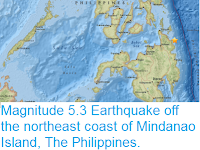
The United States Geological Survey recorded a Magnitude 7.0 Earthquake at a depth of 60.1 km about 83 km off the southeast coast of Mindanao Island, Philippines, slightly before 3.40 am local time on Saturday 29 December 2018 (slightly after 7.40 pm on Friday 28 December GMT). There are no reports of any damage or casualties associated with the event, but it was felt across Mindanao, as well as on the Indonesian islands of Sangihe and Talaud, and a tsunami alarm was briefly put in place, as the region is prone to such events.

The approximate location of the 29 December 2018 Mindanao Earthquake. USGS.

The geology of the central Philippines is Complex. The west of Mindanao Island is located on the Banda (or Sunda) Microplate, and the east on the Philippine Plate, which is being subducted beneath the Sunda (or Banda) Microplate along the central part of the island. Immediately to the east of the Island the Pacific Plate is being subducted along the Philippine Trench, and passes beneath eastern Mindanao as it sinks into the Earth. This is not a smooth process, an the plates constantly stick together then break apart again as the pressure builds up, resulting in Earthquakes.

Subduction beneath the Philippines. Yves Descatoire/Singapore Earth Observatory.

Earthquakes along subductive margins are particularly prone to causing tsunamis, since these often occur when the overlying plate has stuck to the underlying plate, being pulled out of shape by its movement.. Eventually the pressure builds up to far and the overlying plate snaps back, causing an Earthquake and a tsunami. 

Simplified graphic showing tsunami generation along a convergent margin.NASA/JPL/CalTech.


Witness accounts of Earthquakes can help geologists to understand these events, and the structures that cause them. The international non-profit organisation Earthquake Report is interested in hearing from people who may have felt this event; if you felt this quake then you can report it to Earthquake Report here.
 
See also...
 
https://sciencythoughts.blogspot.com/2018/02/landslides-and-flooding-kill-five-as.htmlhttps://sciencythoughts.blogspot.com/2018/01/landslides-kill-six-in-philippines.html
https://sciencythoughts.blogspot.com/2017/12/flash-flood-destroys-village-on.htmlhttps://sciencythoughts.blogspot.com/2017/05/magnitude-69-earthquake-off-south-coast.html
https://sciencythoughts.blogspot.com/2017/04/magnitude-53-earthquake-off-northeast.htmlhttps://sciencythoughts.blogspot.com/2017/02/magnitude-65-earthquake-off-north-coast.html
Follow Sciency Thoughts on Facebook.

Pterosaurs from the End Cretaceous of Morocco.

Pterosaurs first appeared in the Triassic, and were the first vertebrate group to achieve powered flight, long before the appearance of Birds. They had membranous wings supported on their elongated fourth digits, and moved on all fours when on the ground. The Pterosaurs underwent a major radiation at the beginning of the Jurassic, then a second radiation at the beginning of the Cretaceous when a more advanced group of short-tailed Pterosaurs appeared and became dominant. Despite their earlier success, the group appears to have begun to decline in the Middle Cretaceous, possibly as a result of increased competition with Birds, with only a single group known from the Maastrichtian (the last six million years of the Cretaceous), the gigantic Azhdarchidae, which often weighed over 200 kg and achieved wingspans in excess of ten metres. However, this picture may be misleading, as Pterosaurs, like Birds, had fragile, hollow bones, with limited preservational potential, and most Pterosaur fossils come from fossil Lagerstätten (sites with exceptional fossil preservation), none of which is known from the last 15 million years of the Cretaceous.

In a paper published in the journal PLoS Biology on 13 March 2018, Nicholas Longrich of the Department of Biology and Biochemistry and Milner Centre for Evolution at the University of Bath, David Martill of the School of Earth and Environmental Sciences at the University of Portsmouth, and Brian Andres of the Vertebrate Paleontology Laboratory at the University of Texas at Austin, describe a diverse Pterosaur assemblage from the latest Cretaceous Ouled Abdoun Phosphate deposits of Morocco.

The Ouled Abdoun Phosphate deposits are commercially exported from a sedimentary basin to the west of the Atlas Mountains. They were laid down in a near-shore marine environment and produces numerous Marine Reptile, Pterosaur and Mammal fossils, which range from Late Cretaceous to Eocene in age. These strata have not been formally split into stratigraphic divisions by geologists, but instead have been divided into a series of couches (beds) for mining purposes, with one of these, Couche III, being dated through carbon and oxygen isotope chemostratigraphy to the last million years of the Cretaceous.

The first Pterosaur described by Longrich et al, is a new species of Pteranodontid, a group not previously recorded from after the Campanian (83.6-72.1 million years ago). It is given the name Tethydraco regalis, where 'Tethydraco' means 'Tethys Dragon', in reference to the ancient Tethys Sea, in which these deposits were laid down, and 'regalis' means 'royal'. The species is described from a left humerus, two ulnas, two femurs and a tibia. The humerus is 231 mm in length without the head, which is missing (this equates to a wingspan of about 5 m) and has a trapezoidal deltopectoral crest, considered to be a reliable indicator of a specimen belonging to the Pteranodontidae.

Tethydraco regalis,left humerus. In (A), ventral view, (B) dorsal view, (C) anterior view, (D) distal view, and (E) proximal view. Abbreviations: dpc, deltopectoral crest; ect, ectepicondyle; ent, entepicondyle; lc, lateral condyle; mc, medial condyle; pf, pneumatic fossa/foramen; scpr, supracondylar process; uc, ulnar crest; ut, ulnar tubercle. Longrich et al. (2018).

The second Pterosaur described is a small Nyctosaurid a member of a group known from earlier in the Maastrichtian, but not this close to the Cretaceous-Palaeocene boundary, and not previously from anywhere on the African continent. It is named Alcione elainus, from Alcyone of Trachis, who in Greek mythology was turned into a Kingfisher as a punishment for comparing her husband to Zeus, and  'elainus' which derives from the Greek 'elaino', meaning 'to wander'. This species is described from a partial skeleton including humerus, sternum, scapulocoracoid, and femur, with a fourth metacarpal, a mandible, a partial wing including the humerus, radius, ulna, parts of metacarpal IV and phalanx IV-1, and some other material also referred. 

Alcione elainus, partial skeleton and metacarpal IV. (A) Right humerus in anterior view, (B) right ulna and radius in anterior view, respectively, (C) sternum in left lateral view, (D) metacarpal IV, (E) distal end of left metacarpal IV and left scapulocoracoid, and (F) right femur in posterior view. Abbreviations: co, coracoid; cr, cristospine; dc, distal condyle; dpc, deltopectoral crest; ect, ectepicondyle; fh, femoral head; gl, glenoid; gt, greater trochanter; hh, humeral head; hum, humerus; mcIV, metacarpal IV, pc, proximal cotyle; pf, pneumatic foramen; rad, radius; scpr, supracondylar process; ste, sternum; uln, ulna. Longrich et al. (2018).

The third Pterosaur described is also a Nyctosaurid, and is named Simurghia robusta, where 'Simurghia' refers to the Simurgh, a giant mythical Bird from Persian mythology, and 'robusta' means 'robust'. This species is described from a single humerus roughly 165 mm in length, with a hatchet-shaped deltopectoral crest, a feature considered to be diagnostic of Nyctosaurids. This represents an animal 5.6 times the size of Alcione elainus, raising the posibility that this may represent an adult specimen of the same species. However, Longrich et al. reject this hypothesis on the basis that all of the specimens referred to Alcione elainus show dense, avascular surface textures on their bones, which is indicative of maturity in Pterosaurs, indicating that all of these specimens were at least close to their full size.

Right humerus, Simurghia robusta. In (A), dorsal view, (B) ventral view, and (C) posterior view. Abbreviations: dpc, deltopectoral crest; msc, muscle scar; scpr, supracondylar process of the ectepicondyle; vp, ventral pillar; vt, ventral tubercle of the deltopectoral crest. Longrich et al. (2018).

The fourth Pterosaur described is also a Nyctosaurid and is named Barbaridactylus grandis, where 'Barbaridactylus' is a combination of Barbary, as in Barbary Coast, an old name for North Africa, and 'dactylo', Greek for finger, and 'grandis' means 'great' in Latin. This species is described from twelve humeri, one with an associated left radius and ulna, right femur, left scapulocoracoid, and partial right mandible. This species has a humerus up to 225 mm in length, but more slender than that of Simurghia robusta, with a deltopectoral crest that is short, broad, and subrectangular, with a weak constriction. 

Skeleton of Barbaridactylus grandis. (A) Left humerus in anterior view, (B) right femur in anterior view, (C) right radius and ulna in posterior view, (D) cervical vertebra in ventral view, (E) left scapulocoracoid in medial view, and (F) posterior ramus of the right mandible in medial view. Abbreviations: co, coracoid; cot, cotyle of mandible; cvr, cervical ribs; dm, dorsal margin of mandible; dpc, deltopectoral crest; gl, glenoid; fh, femoral head; gt, greater trochanter; hh, humeral head; hyp, hypapophysis; olp, olecranon process; pex, postexapophysis; pn, pneumatopore; rad, radius; sca, scapula; scp, supracondylar process of the ectepicondyle; uc, ulnar crest; uln, ulna; vm, ventral margin of mandible. Longrich et al. (2018).

The fifth Pterosaur described is the Azhdarchid Phosphatodraco mauritanicus, previously described from the Ouled Abdoun Phosphate, of which Longrich et al. describe two new cervical (neck) vertebrae.

Phosphatodraco mauritanicus cervical vertebra. In (A), dorsal view, (B) ventral view, (C) left lateral view; (D) anterior view; (E) posterior view. Abbreviations: cot, cotyle; hyp, hypapophysis; nsp, neural spine; pex, postexapophysis; poz, postzygapophysis; prz, prezygapophysis. Longrich et al. (2018).

The sixth specimen described is another Azhdarchid cervical vertebrae, which Longrich et al. do not assign to a specific species, but suggest it shows some affinities to the giant Quetzalcoatlus, though it is clearly from a much smaller animal, with a total length of 153 mm. 

Azhdarchid cervical vertebra. In (A), dorsal view, (B) ventral view; (C), left lateral view, and (D), anterior view. Abbreviations: dlr, dorsolateral ridge; hyp, hypapophysis; nsp, neural spine; pex, postexapophysis; poz, postzygapophysis; prz, prezygapophysis; pzl, prezygapophyseal laminae; vfo, ventral fossa. Longrich et al. (2018).

The final specimen described is another unidentified Azhdarchid, this time a fragment of ulna measuring 362 mm, with a missing proximal end (the end closest to the body), which may have measured up to 700 mm when complete, with a diameter that varies from 40 to 65 mm, indicative of a very large animal, with a wingspan of around 9 m.

Giant Azhdarchid ulna. Middle shaft and distal end of the left ulna, in posterior view. Abbreviations: ut, ulnar tubercle; vp, ventral process. Longrich et al. (2018).

Longrich et al. suggest that the discovery of Pterosaurs from three different families at the very end of the Cretaceous undermines the theory that they had been declining due to competition with Birds before the End Cretaceous Extinction Event. However, they do note that all known Late Cretaceous Pterosaurs are rather large animals, suggesting that some degree of niche partitioning was occurring at this time, with Birds occupying the small flying animal niche while Pterosaurs occupied the large flying animal niche. They suggest that in this sense, Birds could be seen as being responsible for the extinction of the Pterosaurs, since the End Cretaceous Extinction is known to have wiped out groups of large bodied animals, such as Pterosaurs or non-Avian Dinosaurs, while smaller animals, such as Birds or Mammals, scraped through.

Size disparity of late Maastrichtian Pterosaurs and Birds. Maastrichtian Pterosaurs are larger than coeval birds in Both marine (blue) and terrestrial/ freshwater (orange) ecosystems. Longrich et al. (2018).

See also...

https://sciencythoughts.blogspot.com/2017/11/versperopterylus-lamadongensis-new.htmlhttps://sciencythoughts.blogspot.com/2015/11/preserved-eggs-within-body-of-late.html
https://sciencythoughts.blogspot.com/2015/04/azhdarchid-pterosaur-cervical-vertebra.htmlhttps://sciencythoughts.blogspot.com/2014/12/a-three-dimensionally-preserved.html
https://sciencythoughts.blogspot.com/2014/05/a-fossil-pterosaur-from-early_8.htmlhttps://sciencythoughts.blogspot.com/2014/05/a-fossil-pterosaur-from-early.html
Follow Sciency Thoughts on Facebook.

Mawenzhangia thamnobryoides: A new species of Moss from Shangri-la.

Mosses (Bryophytes) are simple plants which lack vascular systems to pump water and nutrients from a root system, instead relying on what they can absorb through their leaves, and generally only reaching a few cm in height. This means that they are at their most diverse in moist habitats, though some species are surprisingly drought-tolerant. Despite their simple nature, Mosses are an important part of ecosystems the world over, creating a water-holding layer which covers soil, rocks, trees and some animals, inside which entire miniature communities of organisms thrive. Mosses also differ from vascular plants in that they are haploid (have one set of chromosomes) rather than diploid (have paired chromosomes); though they have a diploid spore stage used to propagate the species in the same way that the (haploid) pollen of vascular plants is.

In a paper published in the journal Phytotaxa on 6 April 2018, Johannes Enroth of the Department of Biological Sciences and Botany Unit at the Finnish Museum of Natural History, James Shevock of the Department of Botany at the California Academy of Sciences, and Michael Ignatov of the Main Botanical Garden of the Russian Academy of Sciences, describe a new species of Moss from the Niru River watershed in the Hengduan Mountains of Shangri-la County in Yunnan Province, China.

The Hengduan Mountains form the southeastern tip of the Himalayas, stretching from eastern Sichuan Province through northern Yunnan and southeaster Tibet into southern Myanmar. The range comprises a series of parallel north-south mountain ridges with south-flowing rivers between. The area is considered to be one of the world's biodiversity hotspots, with sharp divisions in flora and fauna both between the valleys of the range and at different altitudes on the mountains, leading to a very high number of endemic species.

The new species is placed in a new genus, Mawenzhangia, named in honour of Wen Zhang Ma, the Curator of Bryophytes at the Kunming Institute of Botany, and given the specific name thamnobryoides, in reference to the thickened dendroid erect shoots and branches of younger plants. The species was found growing on metamorphic boulders along the banks of the Niru River in a Pine/Oak forest. The individual plants grow up to 5 cm in height, and are yellowish green or brownish-grey and slightly glossy, with branching fronds.

 Mawenzhangia thamnobryoides. (1)−(2) Habit. (3) Portion of flagelliform branch. (4) Portion of leafy flagella. (5) Portion of leaf stipe. (6)−(8) Main branch leaves. (9)−(10) Secondary branch leaves. (11)−(12) Stipe leaves. (13) Perichaetium. (14) Inner perichaetial leaf. (15) Innermost perichaetial leaf with archegonia. (16) Perigonium. (17) Inner perigonial bract. (18) Innermost perigonial bract with antheridia. Scale bars: (a) 0.5 cm (3); (b) 1 mm (14)−(15), (17)−(18); (c) 1 mm (11)−(12); (d) 1 cm (1)−(2) and 1 mm (13), (16); (e) 1 mm (6)−(10); (f) 1 mm (5); (g) 100 μm (4). Enroth et al. (2018).

See also...

https://sciencythoughts.blogspot.com/2018/11/macrobiotus-hannae-new-species-of.htmlhttps://sciencythoughts.blogspot.com/2016/06/didymodon-novae-zelandiae-new-species.html
https://sciencythoughts.blogspot.com/2016/06/didymodon-novae-zelandiae-new-species.htmlhttps://sciencythoughts.blogspot.com/2014/08/a-new-species-of-liverwort-from-new.html
https://sciencythoughts.blogspot.com/2014/07/mosses-from-late-eocene-rovno-amber.htmlhttps://sciencythoughts.blogspot.com/2012/12/two-new-species-of-moss-from-permian-of.html
Follow Sciency Thoughts on Facebook.

Friday, 28 December 2018

An Enantiornithine Bird Chick from the Early Cretaceous Las Hoyas Lagerstätte of eastern Spain.

Understanding the way in which animals develop is key to understanding the way in which they evolve, as changes in adult morphology are inevitably the result of changes in the way in which the young animal develops. This is well studied in modern animals, but much harder to study in extinct animals, as juveniles are often less readily available. This is particularly true for groups like Birds, where even the adults have rather fragile skeletons, making intact specimens very rare in the fossil record. 

In a paper published in the journal Nature Communications on 5 March 2018, a group of scientists led by Fabien Knoll of the Fundación Conjunto Paleontológico de Teruel-Dinopolis and the School of Earth and Environmental Sciences at the University of Manchester, describe an Enantiornithine Bird Chick from the Early Cretaceous Las Hoyas Lagerstätte of eastern Spain.

The Las Hoyas is a Konservat-Lagerstätten (deposit producing numerous excellently preserved fossils) of Barremian age (125-130 million years old) formed in a stagnant, microbe rich lake. It is noted for its excellently preserved vertebrate fossils, including Fish, Crocodiles, Dinosaurs and Birds.

Birds derived from small Theropod Dinosaur ancestors in the Middle Jurassic, and appear to have reached similar levels of diversity in the Cretaceous to that seen today. However the dominant group of Birds in the Cretaceous were the Enantiornithines, a group of mostly toothed Birds, related to but not ancestral to modern Birds (Ornithuromorpha), which died out in the end Cretaceous extinction event.

The specimen, MPCM-LH-26189, is not described as a new species, which can be problematic with juvenile animals, as it is hard to ascertain whether they belong to the same species as adults found separately. The specimen is preserved as part and counterpart on a split slab, and comprises a nearly complete and largely articulated skeleton, missing only the tips of the tail and limbs.

Overview photographs of the slab and counterslab of MPCM-LH-26189. Slab (a) is on the left, slab (b), on the right. The two red boxes indicate the localisation of the areas analysed histologically. Abbreviations: An: angular, Ar: articular, CaV: caudal vertebrae, CeV: cervical vertebrae, Co: coracoid, De: dentary, DoV: dorsal vertebrae, Fe: femur, Fr: frontal, Ga: gastralium, Hu: humerus, Hy: hyoid, Is: ischium, Ju: jugal, MiMC: minor metacarpal, Pu: pubis, Qu: quadrate, Ra: radius, Ri: rib, Sa: surangular, Sp: splenial, SaV: sacral vertebrae, SR: sclerotic ring, St: sternum, Ti: tibia, Ul: ulna. Knoll et al. (2018).

One of the distinctive structures of Enantiornithine Birds is their sternal complexes, which are made up of four-to-six ossified elements, and are different from those of both modern Birds and non-Avian Dinosaurs. In modern Birds, bones from the tail are recruited into the sternal complex as the individual grows, an ongoing process hard to spot in the fossil record. However, no known adult Enantiornithine Bird has more than eight free tailbones, whereas MPCM-LH-26189 has ten, strongly suggesting that more would have been recruited into the sternal complex as it grew.

Hypothetical fleshed-out reconstruction of MPCM-LH-26189. The fact that MPCM-LH-26189 is so well preserved and conserves some soft tissue associated chemistry, while showing no feathers or chemical evidence for plumage suggest that the baby bird might have been largely featherless when it died. However, this cannot be confirmed, and so the individual was reconstructed with juvenile plumage hypothesised for perinate Enantiornithines. The silhouettes inset are those of the juvenile Bird and an unspecified sympatric Cockroach to give a sense of scale. Raúl Martín in Knoll et al. (2018).

See also...

https://sciencythoughts.blogspot.com/2017/06/an-enantiornithine-bird-hatchling.htmlhttps://sciencythoughts.blogspot.com/2015/06/preserved-feathers-in-enantiornithine.html
https://sciencythoughts.blogspot.com/2015/01/bird-eggs-from-late-cretaceous-colonial.htmlhttps://sciencythoughts.blogspot.com/2014/07/two-new-species-on-enantiornithine.html
https://sciencythoughts.blogspot.com/2014/06/a-subadult-enantiornithine-bird-from.htmlhttps://sciencythoughts.blogspot.com/2014/06/preserved-ovarian-follicles-in-mesozoic.html


Follow Sciency Thoughts on Facebook.

Looking for extra-Solar objects in the Solar System.

Whilst astronomers have known for a long while that our Solar System was likely to contain objects of extra-Solar origin (i.e. from outside the system), but since the passage of interstellar object `Oumuamua (or 1I/2017 U1, or A/2017 U1) through the Inner Solar System in 2017, interest in the subject has grown. This has led to a search for other extra-Solar objects within the Solar System, with one more object, asteroid (514107) 2015 BZ509, having been suggested as to be a possible candidate object, on the basis of an orbit unlikely to have originated within the Solar System.

In a paper published on the  arXiv database at Cornell University Library on 23 November 2018, and submitted for publication in the Monthly Nottices of the Royal Astronomical Society, Amir Siraj and Abraham Loeb of the Department of Astronomy, Harvard University, describe a method for looking for new extra-Solar objects within our Solar System, and suggest four more candidate objects.

Siraj and Loeb estimate that about twelve extra-Solar objects enter the Solar System each century, and that there are about 6000 such objects in the Solar System at any given time. In order to determine where to look for such objects they used a computer model of the Solar System to plot the course of simulated extra-Solar objects through the system, finding that 2.571% of such objects were captured due to gravitational interactions with the Sun and Jupiter.

These objects became captured in orbits with average distances from the Sun of between 0.49 AU (i.e. 49% of the distance of the distance at which the Earth orbits the Sun) and 2000 AU, with 25%  of objects orbiting at an average distance of less than 6.9 AU, 50% at less than 13 AU, and 75% at less than 28 AU. Furthermore, the objects had aphelion distances (furthest points from the Sun on their orbits) of up to 4000 AU, with an average of 21 AU from the Sun, with 25% of objects having aphelions of less than 9.6 AU and 75% at distances of less than 50 AU. The objects had an average perihelion (closest point on their orbit to the Sun) of 4.0 AU, with 25% having perihelions of less than 2.6 AU and 75% having a perihelion of less than 4.9 AU.

The objects had an avarage orbital eccentricity of 0.74 (where 0.00 is a circular orbit and 1.00 is a straight line), with 50% of objects having an eccentricity of between 0.54 and 0.89. The objects had an average inclination to the plain of the Solar System of 33 °, and 50% of objects orbiting at inclinations of between 24 ° and 47 °, and a maximum inclination of 160°. Finally these objects had an average orbital period of 42 years, with  25% of objects having orbital periods of less than 17 years and 75% of objects having orbital periods of less than 140 years.

In order to look for candidate extra-Solar objects, Siraj and Loeb concentrated on the Centaurs, a population of Solar System bodies on paths that cross the orbits of the major planets of the Outer Solar System (a body is defined as a Centaur if its orbit brings it no closer to the Sun than the planet Jupiter, but its average distance from the Sun is less than that of Neptune). They searched previously published records for Centaurs with average distances from the Sun of between 6.9 AU and 28 AU, and eccentricities of between 0.54 and 0.89, and concentrated on objects with inclinations to the Solar plain of greater than 77° (the majority of extra-Solar objects are predicted to have inclinations lower than this, however the majority of non-extra-Solar objects also have lower inclinations, and objects with such high inclinations are thought to be more likely to have an extra-Solar origin, since the the majority of Centaurs are thought to have a common origin, having been pulled inwards from the Scattered Disk by the gravitational pull of the planet Neptune, and it is very difficult for such objects to reach highly inclined orbital paths).

They found four objects that matched these criteria, 2018 TL6, which has an orbit that takes it from 1.72 to 14.8 AU from the Sun, with an average of 8.26, an inclination of 170.9° (or an inclination of 9.1° and a retrograde orbit, an orbit in the opposite direction to almost everything else in the Solar System), and an eccentricity of 0.79, 2017 SV13, which has an orbit that takes it from 2.01 to 17.3 AU from the Sun, with an average of 9.65, an inclination of 113.2°, and an eccentricity of 0.79, 2011 SP75, which has an orbit that takes it from 2.27 to 36.8 AU from the Sun, with an average of 19.54, an inclination of 109.1°, and an eccentricity of 0.88, and 2017 RR2, which has an orbit that takes it from 2.63 to 44.7 AU from the Sun, with an average of 23.65, an inclination of 89.1°, and an eccentricity of 0.89.

The orbit and current position of asteroid 2018 TL6, a Centaur and potential extra-Solar object. JPL Small Body Database Browser.

Siraj and Loeb further note that the previously nominated candidate extra-Solar object, (514107) 2015 BZ509, falls within the possible candidate extra-Solar object range established by their model, but does not fall within the most likely part of the distribution range, having an average distance from the Sun and an average eccentricity lower than 75% of the simulated objects (though they do note that these parameters would do make it much easier to spot, and therefore what might be expected of one of the first such objects detected).

The orbit and current position of asteroid 2017 RR2, a Centaur and potential extra-Solar object. JPL Small Body Database.

See also...

https://sciencythoughts.blogspot.com/2018/12/looking-for-colour-changes-on-surface.htmlhttps://sciencythoughts.blogspot.com/2018/10/looking-for-origin-of-asteroid-514107.html
https://sciencythoughts.blogspot.com/2017/10/asteroid-a2017-u1-passes-earth.htmlhttps://sciencythoughts.blogspot.com/2016/02/deciphering-rings-of-10199-chariklo.html
https://sciencythoughts.blogspot.com/2012/11/four-more-asteroids-found-to-be-co.htmlhttps://sciencythoughts.blogspot.com/2012/05/neptunes-trailing-trojans.html
Follow Sciency Thoughts on Facebook.