Monday, 2 November 2015

Asteroid 2015 TF passes the Earth.

Asteroid 2015 TF passed by the Earth at a distance of 11 550 000 km (30.0 times the average distance between the Earth and the Moon, or 7.72% of the average distance between the Earth and the Sun), slightly after 4.45 am GMT on Tuesday 27 October 2015. There was no danger of the asteroid hitting us, though had it done so it would have presented a genuine threat. 2015 TF has an estimated equivalent diameter of 68-220 m (i.e. a spherical body with the same mass would be 68-220 m in diameter), and an object towards the upper end of this range would pass through the atmosphere and directly impact the ground with a force of about 300 megatons (about 17 650 times the explosive energy of the Hiroshima bomb), causing devastation over a wide area and creating a crater over 3 km across, and resulting in global climatic problems that could last for years or even decades.

The calculated orbit of 2015 TF. JPL Small Body Database.

2015 TF was discovered on 2 October 2015 (25 days before its closest approach to the Earth) by the University of Arizona's Kitt Peak-Spacewatch Project at the Steward Observatory in the Catalina Mountains north of Tucson. The designation 2015 TF implies that it was the sixth asteroid (asteroid F) discovered in the first half of October 2015 (period 2015 T).

2015 TF has a 421 day orbital period and an eccentric orbit tilted at an angle of 10.8° to the plane of the Solar System, that takes it from 0.55 AU from the Sun (i.e. 55% of the average distance at which the Earth orbits the Sun, and between the orbits of Venus and Mercury) to 1.65 AU from the Sun (i.e. 165% of the average distance at which the Earth orbits the Sun, slightly over the distance at which the planet Mars orbits the Sun). It is therefore classed as an Apollo Group Asteroid (an asteroid that is on average further from the Sun than the Earth, but which does get closer).  

This also means that 2015 TF has occasional close encounters with the planets Mars and Venus. Its most recent close approach to Venus is calculated to have occurred in May 1943, with the next predicted for February 2054, and the most recent close encounter with Mars happened in November 1986 with the next predicted for August 2037. Asteroid orbits that have close encounters with multiple planets are considered to be quite unstable, as any perturbations can quickly become magnified, throwing the astroid onto a new orbital path.

See also...

Eyewitnesses across much of northern Europe reported seeing a bright fireball in the sky moving southwest to northeast at about 6.05 pm GMT on Saturday 31 October 2015. The event was seen from the Netherlands, Germany, Denmark, southern Sweden...


Asteroid 1998 XN2 passed by the Earth at a distance of 11 610 000 km (30.2 times the average distance between the Earth and the Moon, or 7.76% of the average distance between the Earth and the Sun), slightly before 2.55 pm GMT on Sunday 25 October...


Asteroid 2015 TA206 passed by the Earth at a distance of 18 560 000 km (48.3 times the average distance between the Earth and the Moon, or 12.4% of the average distance between the Earth and the Sun), slightly after 4.20 pm GMT on Friday 23 October...


Follow Sciency Thoughts on Facebook.

Magnitude 5.4 Earthquake beneath central North Island, New Zealand.

The GeoNet project, which monitors quakes in New Zealand, recorded a Magnitude 5.4 Earthquake at a depth of 39 km in the central part of North Island, slightly after 6.40 pm local time (slightly after 5.40 am GMT) on Monday 1 November 2015. There are no reports of any damage or injuries associated with this event, though it was felt locally.

The approximate location of the 1 November 2015 North Island Earthquake. Google Maps.

New Zealand is located on the boundary beneath the Australian and Pacific Plates. Beneath the islands the Pacific Plate is being subducted beneath the Australian Plate. This causes a great deal of friction which causes Earthquakes where the boundary between the two plates is close to the surface; this is to the east of North Island, but onshore on South Island, where it can lead to strong Earthquakes such as the ones felt in Christchurch recently. Technically such quakes also occur where the plate margin is deeper, but these are felt less strongly as the rocks between the boundary and the surface absorb much of the energy, making strong tremors much less frequent on North Island. As the Pacific Plate sinks deeper into the Earth it is partially melted by the friction and the heat of the planet's interior. Some of the melted material then rises through the overlying Australian Plate, fueling the volcanoes of New Zealand.

The subduction zone beneath New Zealand, and how if fuels Earthquakes and volcanos. Te Ara.

Witness reports of Earthquakes can help scientists to understand these events, and the underlying geologic processes that cause them. If you felt either of these quakes then you can report it to the GeoNet here.

See also...

The GeoNet project, which monitors quakes in New Zealand, recorded a Magnitude 6.0 Earthquake at a depth of 5 km in the Southern Alps to the northwest of...

Pumice forms when hot lava from submarine volcanic eruptions encounters seawater and cools rapidly, simultaneously crystalizing and degassing to form a lightweight volcanic rock with many gas filled...


Nineteen homes near Lyttelton Port, roughly 5 km southeast of Christchurch on New Zealand's South Island, have been evacuated after a landslide breached a storage tank containing aviation fuel and dented a second container, at about 2 pm local time...


Follow Sciency Thoughts on Facebook.

Sunday, 1 November 2015

Pentecopterus decorahensis: A Eurypterid 'Sea Scorpion' from the Middle Ordovician of Iowa.

The Eurypterids were a curious group of Chelicerate Arthropods (the group that also includes Horseshoe Crabs, Trilobites and Arachnids). They were often formidable in size (the largest were over two meters in length) had clawed forelimbs and sported a spiked tail, which it has been suggested may have been use to inject venom (though there is no evidence of this), which has led to them being given the popular name 'Sea Scorpions' or 'Giant Sea Scorpions'. The group are well recorded from Silurian and Devonian deposits, where they form a major part of the fauna of both marine and freshwater ecosystems, but are rarer in Ordovician deposits. Despite this the group are believed to have originated and diversified largely within this period, as the group appears to have divided into numerous lineages prior to becoming numerous in the fossil record in the Silurian.

In a paper published in the journal BMC Evolutionary Biology on 1 September 2015, James Lamsdell of the Department of Geology and Geophysics at Yale University, Derek Briggs of the Department of Geology and Geophysics and Yale Peabody Museum of Natural History at Yale University, Huaibao Liu of the Iowa Geological Survey, Brian Witzke of the Departmentof Earth and Environmental Sciences at the University of Iowa, and Robert McKay, also of the Iowa Geological Survey, describe a new species of Eurypterid from the Middle Ordovician Winneshiek Lagerstätte of Winneshiek County in northeastern Iowa.

The Winneshiek Lagerstätte is a 18-27 m laminated greenish brown and dark grey shale laid down in a circular depression 5.6 km in diameter, thought to have been formed by a meteorite impact, the Decorah Impact Structure. The shale outcrops only at a single location, but has been found in boreholes across the basin. The deposits have been interpreted as having formed in a tidal nearshore environment with low oxygen levels and brackish water in a tropical climate. The outcrop has produced numerous Arthropods and Conodonts, Plants, Algae and possible Jawless Fish. From the Conodonts it has been assigned an age of 467.3-458.4 million years, at least nine million years older than the oldest Eurytripid-bearing deposits known from elsewhere, though possible Eurytripids from the Early Ordovician Fezouata Formation of Morocco are currently under investigation.

Portion of a Eurypterid from the Middle Ordovician Winneshiek Lagerstätte of Iowa. Rostrum and linguoid posterior projection underlain by left and right prosomal appendages II and III. (a) Specimen. (b) Interpretive drawing: red = ventral plate, green = appendage II, and blue = appendage III, II-2–II-4 = appendage II podomeres 2–4, III-2 = appendage III podomere 2. The coxa are angled anteriorly and covered by the ventral plate, which can be peeled back to reveal their position. Scale bar is 10 mm. Lamsdell et al. (2015).

These deposits produce a large amount of (largely disarticulated) Eurytperid material, preserved as organic cuticle remains. These have been reconstructed to construct the complete external morphology of the living animal, which is formally described and named Pentecopterus decorahensis, where 'Pentecopterus' means 'penteconter-wing', the penteconter being an early Greek warship with a profile similar to that of the Eurypterid and '-pterus' (-wing) being a common suffix for Eurypterid genera, and 'decorahensis' means 'from Decorah'.

Reconstruction of Pentecopterus decorahensis in dorsal view. Scale bar is 10 mm. Lamsdell et al. (2015).

Pentecopterus decorahensis is interpreted as having reached at least 144 mm in length, based upon the reconstruct specimens. A phylogenetic analysis suggests that it is a member of the Megalograptidae, a group of mostly large Eurypterids with small claws, and that within this group it is closest to the common ancestor of all members. However the Megalograptidae are not considered to be among the earliest Eurypterids, suggesting that the origin of the group as a whole occurred considerably earlier than the Mddle Ordovician.

See also...

Trilobites dominated the seas of the early Palaeozoic, but suffered a major loss of diversity in the Devonian...
 
http://sciencythoughts.blogspot.co.uk/2014/11/reconstructing-extinct-arachnid-orders.htmlReconstructing extinct Arachnid orders in three-dimensions.                                           There are currently sixteen recognized orders of Arachnids, twelve of which are extant (have living relatives) and four extinct, the Trigonotarbids...
 
 
http://sciencythoughts.blogspot.co.uk/2014/10/a-new-species-of-horseshoe-crab-from.htmlA new species of Horseshoe Crab from the Late Jurassic Owadów-Brzezinki Lagerstätte of Central Poland.                                     Horseshoe Crabs, Xiphosurida, first appeared in the fossil record during the Ordovician, at least 480 million years ago, and are still found today in Southeast...
Follow Sciency Thoughts on Facebook.

Fireball over northern Europe.

Eyewitnesses across much of northern Europe reported seeing a bright fireball in the sky moving southwest to northeast at about 6.05 pm GMT on Saturday 31 October 2015. The event was seen from the Netherlands, Germany, Denmark, southern Sweden, northern Austria, the Czech Republic and Poland. A fireball is defined as a meteor (shooting star) brighter than the planet Venus. These are typically caused by pieces of rock burning up in the atmosphere, but can be the result of man-made space-junk burning up on re-entry. On this occasion the object ended its visible journey over western Poland, when it probably fragmented several tens of kilometers above the ground. The bright lights seen in fireballs are caused by airbursts in which rocky meteorites explode due to friction induced heating high in the atmosphere, and any fragments reaching the ground usually do so several minutes later. On this occasion Anton Norup Sørensen of the Niels Bohr Institute in Copenhagen estimates that the visible fireball occurred between 70 and 80 km above the ground.

The 31 October 2015 fireball meteorite seen from Poland. Powiat Suski 24.

Objects of this size probably enter the Earth's atmosphere several times a year, though unless they do so over populated areas they are unlikely to be noticed. They are officially described as fireballs if they produce a light brighter than the planet Venus. It is possible, though unlikely, that this object will have produced meteorites that reached the surface (an object visible in the sky is a meteor, a rock that falls from the sky and can be physically held and examined is a meteorite), though most meteorites come from larger objects that penetrate further into the atmosphere before exploding, and therefore have a better chance of producing fragments that reach the surface.

Map showing areas where sightings of the meteorite were reported. American Meteor Society.

See also...

When atoms join together to form molecules of more than two atoms they adopt fixed shapes, as the molecular bonds are held at set angles to...


Witnesses have reported seeing a bright fireball over Perth and the Gidgegannup Hills in Western Australia at about 8.30 am local time on Monday 9 March 2015.  A fireball is defined as a meteor (shooting star) brighter than the planet Venus. These are typically caused by pieces of rock burning up in the atmosphere, but can...


At three minute past eleven pm on 7 May 1991 the brightest fireball (large meteor) ever recorded was observed over the Czech Republic. This was recorded by four all-sky and two spectral cameras at three...


Follow Sciency Thoughts on Facebook.

Evidence for sexual transmission of the Ebola Virus.


In December 2013 cases of Ebola, a viral haemorrhagic fever with an extremely high mortality rate, began to emerge in Guinea, West Africa, marking the beginning of the most severe outbreak of the disease ever recorded. The epidemic rapidly spread to several neighbouring countries, including Sierra Leone and Liberia where if became established and killed large numbers of people before being eradicated. Liberia was officially declared free of Ebola on 3 September 2015, though cases were still being reported in Guinea and Sierra Leone, albeit at a much lower rate than during the peak of the epidemic.

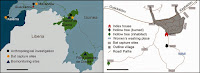
Areas affected by the 2013-5 West African Ebola Virus outbreak. Digital Data Services.

Sexual transmission of the Marburg Virus, which is related to the Ebola Virus, has been known to occur at least once, and Ebola has been detected in other bodily fluids after blood samples have been shown to be clear of the Virus. For this reason Ebola survivors are advised to abstain from unprotected sex for at least three months after being diagnosed clear of the Virus.

In a paper published in the New England Journal of Medicine on 14 October 2015, a team of scientists led by Suzanne Mate and Jeffrey Kugelman of the Center for Genome Sciences at the U.S. Army Medical Research Institute of Infectious Diseases, Tolbert Nyenswah of the Ministry of Health and Social Welfare of the Republic of Liberia and Jason Ladner, also of the Center for Genome Sciences at the U.S. Army Medical Research Institute of Infectious Diseases report the first known case of sexual transmission of the Ebola Virus.

On Friday 20 March 2015 a 44-year-old woman from Montserrado County, Liberia, was diagnosed to be infected with the Ebola Virus. The woman died a week later on 27 March. Before dying she reported having had unprotected virginal sex with an Ebola survivor on 7 March 2015. This man had been diagnosed clear of the Virus (a test based upon blood samples) on 3 October 2014, and discharged from the unit where he was treated on 7 October. This man was contacted and voluntarily provided blood and semen samples on 27 March 2015. The blood was tested and shown to be clear of the Virus, but the semen sample proved to be Ebola positive, 175 days after after the patient’s blood was found to be clear. Subsequent tests of the male patients semen collected on 28 April and 2 May 2015 were shown to be clear of the Virus.

Electron micrograph of an Ebola Virus particle. Frederick Murphy/Centers for Disease Control and Prevention/Wikimedia Commons.

A genetic analysis of Virus samples taken from the two patients showed that they were very closely related, and no other plausible cause of transmission could be identified, leading Mate et al. to conclude that in this case the Ebola Virus had been transmitted sexually.

See also…

The first known cases of Heartland Virus, a form of Phlebovirus in the Family Bunyaviridae, were reported in northwest Missouri in 2009, were two agricultural workers were struck down with an illness that causes fever, leukopenia (a decrease in...


In late spring 2014 a previously healthy man in his 50s was admitted to a hospital in Bourbon County, Kansas, suffering from Tick bites and a fever. Despite...

In December 2013 cases of the haemorrhagic Virus...


Follow Sciency Thoughts on Facebook.

Eruptions on Mount Fuego, Guatemala.

The Instituto Nacional de Sismologia, Vulcanologia, Meteorologia, e Hidrologia in Guatemala has reported a series of small eruptions on Mount Fuego a stratovolcano (cone shaped volcano made up of layers of ash and lava) that forms part of La Horqueta volcanic complex in the southern part of the country. These began on Wednesday 21-Thursday 22 October 2015 with a seres of small explosions which generated plumes rising 350-650 m above the summit of the volcano, and were followed by the production of a lava flow that ran to the west. On 25-26 October sharp increase in seismic activity (small Earthquakes) was recorded beneath the volcano, followed by a series of lava plumes that reached 200 m in height and led to lava flows running up to 850 m to the south. On 27 October a series of eruptions produced a plume that rose 1 km above the summit of the volcano, as well as lava fountains reaching 300 m and lava flows 1.5 km to the south of the caldera.

Plume emerging from Mount Feugo on 21 October 2015. Le Chaudron de Vulcain.

Fuego has been more-or-less constantly active at some level since records in the area began (circa 1524). It forms part of La Horqueta volcanic complex, which also includes the Acatenango volcano to the north, a complex volcano with at least five separate vents, the complex siting on the site of the ancient Meseta volcano, which is thought to have collapsed following a major volcanic episode about 8500 years ago, causing a debris flow that reached the sea, 50 km away.

The approximate location of Mount Fuego. Google Maps.

The volcanoes of Guatemala, and Central America in general, are fed by the subduction of the Cocos Plate beneath the Caribbean Plate along the Middle American Trench, which runs roughly parallel to the southwest coast of the isthmus. As the Cocos Plate sinks into the Earth, it passes under Central America, which lies on the western margin of the Caribbean Plate. As this happens it is heated by the friction and the heat of the planet's interior, causing the sinking plate to partially melt. Some of the melted material then rises through the overlying Caribbean Plate as magma, fueling the volcanoes of Central America.

See also...

Twenty-six people have been confirmed dean and another thirty-six people are known to have been injured following a landslide which struck the town of Santa Catarina Pinula in southern Guatemala late...


The United States Geological Survey Recorded a Magnitude 4.3 Earthquake at a depth of 78 km in the west of Esculinta Department in southern Guatemala...


The Instituto Nacional de Sismologia, Vulcanologia, Meteorologia, e Hidrologia in Guatemala has ordered an evacuation of communities close to Mount Fuego, an active volcano in the south of the country...


Follow Sciency Thoughts on Facebook.

J160421.7-213028: A young star in the Upper Scorpius Association with a possible massive planet within a protoplanetary disk.

J160421.7-213028 is a young star roughly 145 parsecs (473 light years) from Earth, which forms part of the Upper Scorpius Association, making it five to ten million years old. Observations of the star with the SubmillimeterArray and Atacama Large Millimeter/submillimeter Array have shown that the star is surrounded by a protoplanetary disk (disk of dust and gas around a young star from which planets are thought to form) with a radius of 63 AU (63 times the distance at which the Earth orbits the Sun) positioned almost face-on to us.

In a paper published in the journal Astronomy &Astrophysics on 22 October 2015 and on the online arXiv database at Cornell University Library on 1 October 2015, a group of astronomers led by Paola Pinilla of the Leiden Observatory at Leiden University discuss new observations of J160421.7-213028 made in June 2015 using the SPHERE instrument of the Very Large Telescope at a wavelength of 0.626 µm (observations of remote objects at different wavelengths tend to reveal different features, as different molecules reflect light at different wavelengths, so it is important to make observations at precise wavelengths).

The Very Large Telescope observations show J160421.7-213028 to have a disk extending to 120 AU from the star, with an inner disk reaching to 15 AU, a gap between 15 and 40 AU, and a bright ring between 40 and 120 AU, which reaches peak brightness at 59 AU. This outer ring has a distinct dip in brightness, also at 59 AU.

Very Large Telescope image of J160421.7-213028 at a wavelength of 0.626 µm. Pinilla et al. (2015).

A gap in the outer ring of J160421.7-213028 was previously seen in an image taken with the High Contrast Instrument on the Subaru Telescope of the system taken in April 2012. If these two features are the same object then it appears to be moving around the disk in a clockwise direction at a rate of 12.3º per year, though it is possible that the dips represent two different temporary features, or that the object is in fact moving much faster and has completed one or more revolutions about the star in addition to its apparent movement in the time between the two images.

An object orbiting a star at a distance of 59 AU would be expected to travel at a rate of ~0.8º per year, considerably slower than the observed feature. However a dip in the brightness of the ring does not necessarily imply an object within the ring; all the light seen in the ring is in fact produced by the star and only reflected by objects in the ring, so it is quite likely that any dimming of the light seen coming from the ring actually reflects an object closer to the star casting a shadow onto the ring.

J160421.7-213028 has a gap in its disk between 15 and 40 AU from the star. A gap this large would could be caused by a very large planet forming within the disk. Such a planet would be expected to have a mass 5-10 times that of Jupiter (still to small to be directly observed at the distances involved) and to orbit at a distance of 20-40 AU. However such a body would still be to far from the star to move at a speed of 12.3º per year.

Calculating from the speed of the perceived movement of the dark area, if it is a shadow then it would need an object orbiting the star at a distance of 9.6 AU (within the inner disk of the system) to cast a shadow moving at the appropriate speed.

Pinella et al. suggest that future observations of the J160421.7-213028 system (which are planned) should reveal whether the feature seen in the two images is the same and is moving on a predictabel trajectory, or alternatively unrelated temporary features.


See also...

Many young stars are surrounded by extensive disks of dust and gas. These disks are thought to be where planets are formed, and are therefore known as protoplanetary disks. Recent discoveries of large planets orbiting young stars at tens or even hundreds of AU (i.e. tens or hundreds of times the distance at which the Earth orbits the Sun) has led astronomers...
T Chamaeleontis is a T Tauri star (a very young star which has not yet began to generate heat by hydrogen fusion, but which produces considerable energy through gravitational heating) estimated to be about 7 million years old, roughly 350 light years from Earth in the constellation of Chamaeleontis. It is known to be surrounded by two transition disks (disks of dust and gas surrounding very young stars, thought to be...
http://sciencythoughts.blogspot.co.uk/2014/07/protoplanetary-disks-around-class-i.htmlProtoplanetary disks around Class I Protostars in the ρ Ophiuchi Star Forming Region.                                                          Stars are thought to form from the aggregation of material from vast clouds of molecules known as Stellar Nurseries or Star Forming Regions. The initial protostars (Class 0 Protostars) are embedded in envelopes of gas and dust up to 0.1 parsecs (0.3...
Follow Sciency Thoughts on Facebook.