Thursday, 8 January 2015

The Antarctic Summer Monsoon.


The Eocene palaeoflora of the Antarctic Peninsula and neighbouring islands has been studied  since the early twentieth century, with fossil sites on the Peninsula itself as well as on Seymour, Alexander and King George islands yielding a large number of wood fossils, plus lesser amounts of leaves, pollen, seeds and fruit. This flora is dominated by Myrtles, Arals, Podocarps, Cypresses and Southern Beeches, showing strong taxonomic affinity for the flora of the modern Valdevia Region of Chile, and suggesting a warm temperate climate with high rainfall. However global climate models for the Early-to-Middle Eocene, a period of extreme global warming when these fossils were deposited, do not suggest such a climate for the area, implying there is a problem with either the plant based regional palaeoclimate reconstruction, or with the global climate models.

In a paper published in the journal Gondwana Research in May 2014, Frédéric Jacques of the State Key Laboratory of Palaeobiology and Stratigraphy at the Nanjing Institute of Geology and Palaeontology and the Key Laboratory ofTropical Forest Ecology at the Xishuangbanna Tropical Botanical Garden of the Chinese Academy of Sciences, and Gongle Shi, Haomin Li and Weiming Wang, also of the State Key Laboratory of Palaeobiology and Stratigraphy, examine a series of fossil leaves collected from Fossil Hill on the Fildes Peninsula on King George Island by Chinese expeditions.

The Fossil Hill flora has been dated to about 52 million years ago (close to the Early Eocene Climatic Maximum), by Potassium-Argon and Rubidium-Strontium dating techniques.

Potasium-Argon dating relies on determining the ratio of radioactive Potasium⁴⁰ to Argon⁴⁰ within minerals from igneous or metamorphic rock to determine how long ago the mineral cooled sufficiently to crystalize. Potasium⁴⁰ is often incorporated into cooling volcanic rocks, whereas any inert Argon present will escape as a gas. No further Potasium⁴⁰ or Argon⁴⁰ will enter the mineral from this point, but Argon⁴⁰ is produced by the decay of radioactive Potassium⁴⁰ at a steady rate, enabling scientists to establish a precise date for the crystalization of the minerals containing the two elements.

Rubidium-Strontium dating is similar, but relies on the decay of Rubdium87 to Strontim87. Rubidium does not readily form minrals by crystalizing with other elements as the magma cools, remaining in the liquid phase that surrounds the forming minerals until it finally solidifies as a volcanic glass. Strontium, on the other hand, readily forms minerals with a variety of other elements, and is theresfore very rare in this glass, so that it is likely that any appreciabe amount of Strontim87 present will be due to the decay of radioactive Rubdium87, making it possible to determine the age of the rocks from the ratio of the two isotopes in the melt matrix.

The flora has produced 25 different Angiosperm (Flowering Plant) leaves, and is dominated by the Southern Beech family (Nothofagaceae).

Selected morphotypes of the Fossil Hill flora. (A) Dicotylophyllum elegans; (B) Dicotylophyllum sp. 1; (C) Dicotylophyllum sp. 2; (D) Dicotylophyllum latitrilobatum; (E) Dicotylophyllum sp. 9; (F) Dicotylophyllum sp. 3; (G) Lomatia mirabilis; (H) Dicotylophyllum sp. 10; (I) Pentaneurum dusenii; (J) Nothofagofolia multinervis; (K) Nothofagofolia betulifolia; (L) undescribed species; (M) Dicotylophyllum sp4; (N) Rhoophyllum nordenskjoeldi; (O) Nothofagofolia carpinoides; (P) Nothofagofolia zastawniakiae. Scale bar is 1 cm. Jacques et al (2014).

Previous attempts to reconstruct the early Eocene climate of the Antarctic Peninsula have relied upon the Nearest Living Relative method, which relies upon the assumption that most fossil plants will have had similar environmental requirements to their nearest living relatives, so that where a large number of plants from different taxonomic groups are found together, all of which have nearest living relatives with similar climatic requirements, then it is highly likely that the plants occupied a similar climate zone to their modern relatives. The Eocene Antarctic flora is very close to the modern Valdevia region of Chile, which has led to the assumption that the climate would be similar. However the modern Valdevian region is also the only floristic region close to the Antarctic Peninsula, so it is unsurprising that its flora is similar, and the Nearest Living Relative model is usually only considered accurate for Neogene and Quaternary floras, making its application to the Early Eocene flora of the Antarctic Peninsula questionable.

Instead Jacques et al. used a technique called Climate Leaf Analysis to interpret the climate that produced the Fossil Hill leaves. This technique relies on an analysis of the shape of leaves without reference to their taxonomic affinities, in order to interpret the climate that the plants were living in.

The Climate Leaf Analysis for the leaves from Fossil Hill suggests a highly seasonal warm temperate climate, with a mean annual temperature of 11.5°C, and freezing occurring in winter. The climate is predicted to have been wet, with 1259.3 mm of rainfall per year, of which 60% would have fallen within three months, when rainfall would have averaged 6.4 mm of rain per day. This is comparable to the climate in parts of modern Japan, where the climate is driven by the Southeast Asian Summer Monsoon.

See also…

http://sciencythoughts.blogspot.co.uk/2014/11/supplejack-leaves-from-early-eocene-of.htmlSupplejack leaves from the Early Eocene of Patagonia.                                                                    Australia and Antarctica are remote from one-another today, but share many common floral and faunal elements. This is because they are both former parts of the ancient continent of Gondwana, and along with Antarctica were the final parts of the ancient supercontinent to break apart. Antarctica today is a frozen continent, with life only...
http://sciencythoughts.blogspot.co.uk/2014/10/mammal-remains-from-early-eocene-of.htmlMammal remains from the Early Eocene of Seymour Island, Antarctica.                               Modern Antarctica lacks any permanent Mammal fauna, being visited by only a few marine Mammals for breeding purposes. However this has not always been the case. During the Eocene the last parts of the...
http://sciencythoughts.blogspot.co.uk/2011/10/reconstructing-cloud-cover-for-ancient.htmlReconstructing cloud cover for ancient Earth, with a view to spotting a new one.    Four the past four billion years or so the continents have ambled back and forth across the face of the Earth...
Follow Sciency Thoughts on Facebook.

Wednesday, 7 January 2015

Magnitude 6.0 Earthquake on South Island, New Zealand.

The GeoNet project, which monitors quakes in New Zealand, recorded a Magnitude 6.0 Earthquake at a depth of 5 km in the Southern Alps to the northwest of Christchurch, slightly before 6.50 am local time on Tuesday 6 January 2015 (slightly before 5.50 pm on Monday 5 January, GMT). This was a large event, and potentially dangerous, though there are no reports of any damage or casualties. The area has been hit by several aftershocks since the initial event.

 The approximate location of the 6 January 2015 Southern Alps Earthquake.  Google Maps.

New Zealand is located on the boundary beneath the Australian and Pacific Plates. Beneath the islands the Pacific Plate is being subducted beneath the Australian Plate. This causes a great deal of friction which causes Earthquakes where the boundary between the two plates is close to the surface; this is to the east of North Island, but onshore on South Island, where it can lead to strong Earthquakes such as the ones felt in Christchurch recently. Technically such quakes also occur where the plate margin is deeper, but these are felt less strongly as the rocks between the boundary and the surface absorb much of the energy, making strong tremors much less frequent on North Island. As the Pacific Plate sinks deeper into the Earth it is partially melted by the friction and the heat of the planet's interior. Some of the melted material then rises through the overlying Australian Plate, fueling the volcanoes of New Zealand.

Witness reports of Earthquakes can help scientists to understand these events, and the underlying geologic processes that cause them. If you felt either of these quakes then you can report it to the GeoNet here.

See also...

http://sciencythoughts.blogspot.co.uk/2013/11/magnitude-46-earthquake-near.htmlMagnitude 4.6 Earthquake near Christchurch, New Zealand.                                        A Magnitude 6.6 Earthquake at a depth of 8 km hit New Zealand's South Island, 10 km southwest of Christchurch, slightly after 11.35 pm local time (slightly after 10.35 am GMT)...
http://sciencythoughts.blogspot.co.uk/2013/10/magnitude-47-earthquake-under-cook.htmlMagnitude 4.7 Earthquake under Cook Straight, New Zealand.                                               New Zealand's GeoNet Project, which monitors geohazards in the country, recorded a Magnitude 4.7 Earthquake at a...
http://sciencythoughts.blogspot.co.uk/2013/08/eruption-on-white-island.htmlEruption on White Island.                                          White Island, or Te Puia o Whakaari, an island volcano in New Zealand's Bay of Plenty, began to erupt  suddenly at about 10.20 am local time on Monday 20 August 2013, producing a...
Follow Sciency Thoughts on Facebook. 


Two new species of Katydids from Pakistan.


Katydids (or Buschcrickets), Tettigonioidea, are Members of the Insect Order Orthoptera, which also includes Crickets and Grasshoppers. They are voracious eaters and can consume a wide variety of plant (and sometimes animal) material; as such many species are considered to be serious agricultural pests.

In a paper published in the journal ZooKeys on 18 December 2014, Riffat Sultana, Waheed Ali Panhwar and Muhammad Saeed Wagan of the Department of Zoology at the University of Sindh and Imran Khatri of the Department of Entomology at Sindh Agricultural University describe two new species of Katydids from Rawalakot Province (check) in Pakistan. Both are placed in the genus Sathrophyllia.

The first new species is named Sathrophyllia saeedi, in honour of Muhammed Saeed Wagan of the Department of Zoology at the University of Sindh. The species is described from a single female specimen, 29 mm in length and light brown in colour. The specimen was collected from agricultural land between dunes in valleys with highly diverse plant communities.

Sathrophyllia saeedi, adult female. Sultana et al. (2014).

The second new species is named Sathrophyllia irshadi, in honour of Muhammad Irshad of the National Agricultural Research Council in Islamabad, for his contributions to entomology. This species is also described from a single female specimen, 38 mm in length and light brown in colour. It was collected from high-nutrient grasslands, again in an area of high plant biodiversity.

Sathrophylliairshadi, adult female. Sultana et al. (2014).

See also…

http://sciencythoughts.blogspot.co.uk/2014/10/three-new-species-of-katydid-from-china.htmlThree new species of Katydid from China. Katydids of the genus Xizicusand its close relatives are found across eastern Asia, though the taxonomy of the group is currently somewhat confused, in part due to publications being published in different languages...
Katydids (or Bush Crickets) are members of the Cricket and Grasshopper Order, Orthoptera, noted for their exceptionally long antennae and the way in which they...

Bush Crickets, or Katydids, are large Insects in the Order Tettigoniidae, related to Grasshoppers and True Crickets. The are distributed widely around the globe, but reach their maximum diversity in the tropics and in temperate North America. The males of each species attract their mates with a distinctive call, made by...
Follow Sciency Thoughts on Facebook.

Asteroid 1999 JV6 passes the Earth.

Asteroid 1999 JV6 passed by the Earth at a distance of about 12 460 000 km (32.42 times the average distance between the Earth and the Moon, or 8.3% of the average distance between the Sun and the Earth), slightly after 11.15 am GMT on Moday 5 January 2015. There was no danger of the asteroid hitting us, though were it to do so it would have presented a serious threat. 1999 JV6 has an estimated equivalent diameter of 190-590 m (i.e. it is estimated that a spherical object with the same volume would be 190-590 m in diameter), and an object of this size would be predicted to be capable of passing through the Earth's atmosphere relatively intact, impacting the ground with an energy equivalent to about 200-10 000 megatons of TNT (roughly 11 800-588 000 times the energy of the Hiroshima bomb). Such an event would result in a crater between 2.5 and 8 km across, cause devastation on a global scale and would have the potential to affect the climate globally for decades or even centuries after the impact event.

 The calculated orbit of 1999 JV6. JPL Small Body Database Browser.
1999 JV6 was discovered on 13 May 1999 by the Massachusetts Institute of Technology's Lincoln Near Earth Asteroid Research Laboratory in Socorro, New Mexico. The designation 1999 JV6 implies that it was the 171st asteroid (asteroid V6) discovered in the first half of May 1999 (period 1999 J).

1999 JV6 has a 369 day year orbital period and an eccentric orbit tilted at an angle of 5.3° to the plane of the Solar System, which takes it from 0.69 AU from the Sun (i.e. 69% of the average distance at which the Earth orbits the Sun, slightly inside the orbit of Venus) to 1.32 AU from the Sun (i.e. 1.32% of the average distance at which the Earth orbits the Sun). It is therefore classed as an Apollo Group Asteroid (an asteroid that is on average further from the Sun than the Earth, but which does get closer). This means that close encounters between the asteroid and Earth areextremely  common, with the last having occured in January 2014 this year and the next predicted in January 2016 (it will continue to pass us each January until 2022, then not come close to Earth again till May 2077). As an asteroid larger than 150 m in diameter that occasionally comes within 0.05 AU of the Earth, 1999 JV6 is also classified as a Potentially Hazardous Asteroid.

See also...

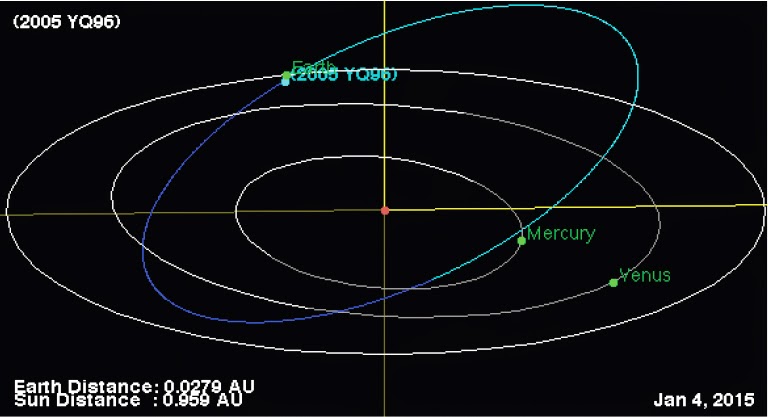
http://sciencythoughts.blogspot.co.uk/2015/01/asteroid-2005-yq96-passes-earth.htmlAsteroid 2005 YQ96 passes the Earth.     Asteroid 2005 YQ96 passed by the Earth at a distance of about 3 967 000 km (10.32 times the average distance between the Earth and the Moon, or 2.7% of the average distance between the Sun and the Earth)...
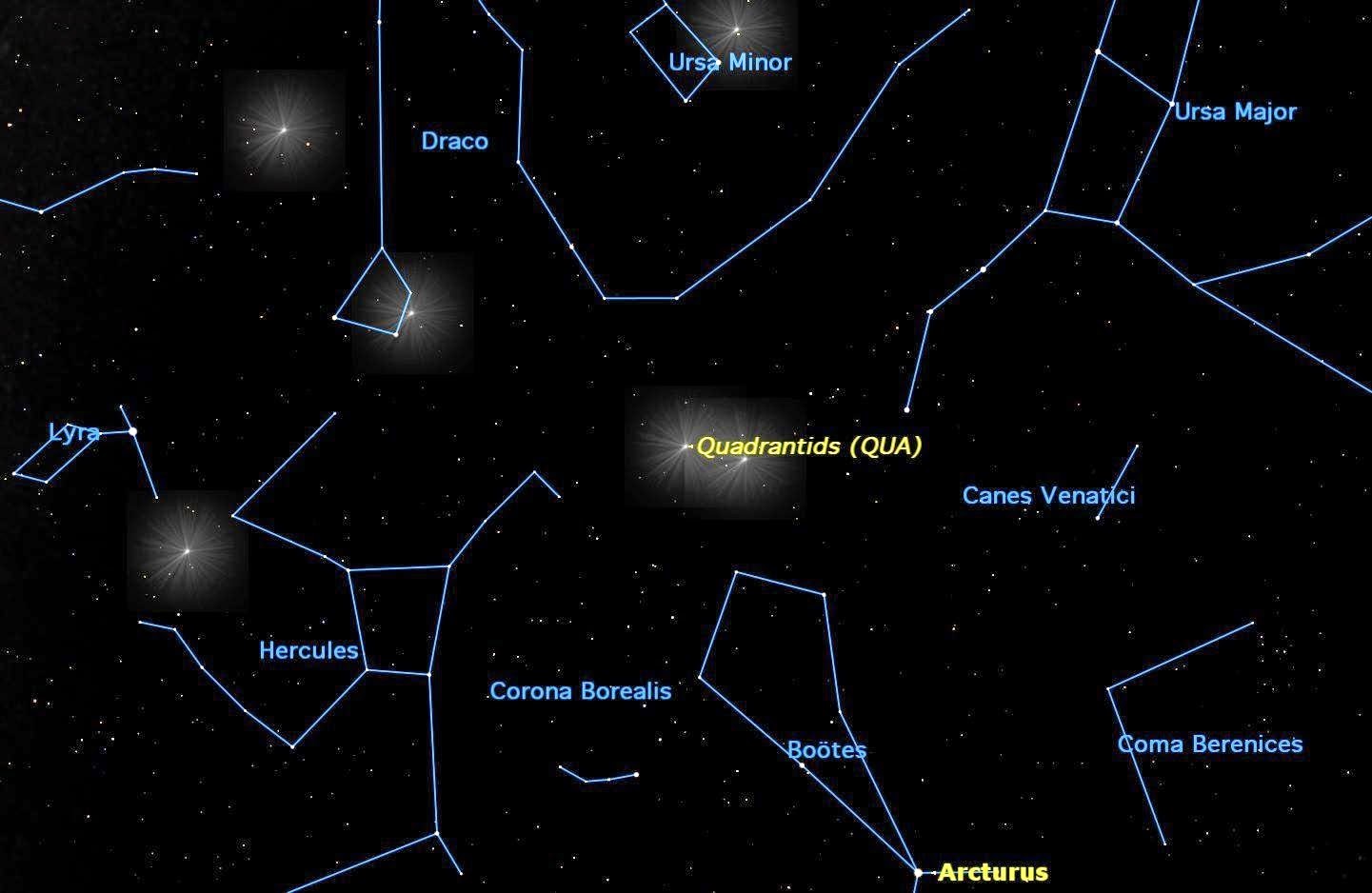
The Quadratid Meteor Shower is one of the brightest meteor showers of the year, often producing over 100 meteors per hour at its peak, which falls on the night of 3-4 January each year, and is predicted to peak at 2.00 am GMT on Sunday 4 January 2015. The meteor...
 
http://sciencythoughts.blogspot.co.uk/2014/12/asteroid-2001-xy10-passes-earth.htmlAsteroid 2001 XY10 passes the Earth.       Asteroid 2001 XY10 passed by the Earth at a distance of about 18 540 000 km (48.22 times the average distance between the Earth and the Moon, or 12% of the average distance between the Sun and the Earth), at...
 Follow Sciency Thoughts on Facebook.
 

An Allodaposuchian Crocodylian from the Late Cretaceous of the southeast Pyrenees.


All modern Crocodylomorphs are assigned to a single suborder, the Eusuchia, which appeared in the Early Cretaceous in Europe and North America (which were then connected), and underwent a major radiation in the Late Cretaceous, when the modern Crocodylians (defined as all living Crocodiles, Alligators and Gavials, there most recent common ancestor, and everything descended from that ancestor) appeared and rapidly diversified. The Late Cretaceous of Europe had a highly diverse Crocodylomorph diversity, includingCrocodiles, Alligators, Gavails, the non-Crocodylian Eusuchian Hylaeochampsids and non-Eusuchian groups such as Dyrosaurids, Pholidosaurids, Notosuchians, Atoposaurids and Goniopholidids. This fauna also includes a number of enigmatic taxa, of uncertain affinities, such as the genus Allodaposuchus, which currently contains two described species, Allodaposuchus precedens, which is known from fragmentary material from Romania, France and Spain (some of which is disputed and assigned to other taxa by some experts) and Allodaposuchus subjuniperus, which is known from a single, almost complete, skull from Huesca in northeast Spain. Allodaposuchus is considered to be a Eusuchian, but its position within that group is unclear.

In a paper published in the journal PLoS One on 31 December 2014, Alejandro Blanco of the Institut Català de Paleontologia Miquel Crusafont at the Universitat Autònomade Barcelona, Eduardo Puértolas-Pascual of the Área de Paleontología at the Universidadde Zaragoza, Josep Marmi, also of the Institut Català de Paleontologia Miquel Crusafont at the Universitat Autònoma de Barcelona, Bernat Vila also of the Área de Paleontología at the Universidad de Zaragoza and Albert Sellés, again of the the Institut Català de Paleontologia Miquel Crusafont at the Universitat Autònoma de Barcelona describe a new species of Allodaposuchus from the Late Cretaceous Tremp Formation in the southeast Pyrenees.

The new species is named Allodaposuchus palustris, from the Latin ‘palus’, meaning ‘swamp’, the specimen was recovered from a layer of grey organic mudstones interpreted as having been laid down in a swampy lagoon environment. The species is described from a fragmentary and disarticulated skull and jaw, plus numerous isolated vertebrae and limb bones. While the remains are disarticulated, they were all found in close association, often touching, and were in approximately the correct life position (i.e. head at one end, tail at the other etc.), were all from an animal or animals of similar size, and there were no duplicate bones, leading Blanco et al. to conclude that this was the disarticulated remains of a single animal rather than a bone assemblage, and that they had probably been disarticulated due to exposed decomposition rather than transportation or scavenging.

Mapping of the Crocodylian bones at the Fumanya Sud locality and their anatomical location. (A) Distribution of the fossils along a 2.3 m-long accumulation with indication of the type of bone. Grid square is 10 centimeters. (B) Anatomical location of the recovered bones. Abbreviations: a, astragalus; ar, articular; ca, calcaneum; cdv, caudal vertebra; cr, cervical rib; cv, cervical vertebra; d, dentary; dr, dorsal rib; dv, dorsal vertebra; eo, exoccipital; ept, ectopterygoid; f, frontal; fi, fibula; fm, femur; h, humerus; il, ilium; lv, lumbar vertebra; ost, osteoderm; pa, parietal; pf, prefrontal; ph, phalanx; q, quadrate; r, radius; rb, rib; sf: skull fragment; sq, squamosal; t, tooth; ti, tibia; ul, ulna. Blanco et al. (2014).

All of the remains are black in colour, indicative of a high hydrocarbon content in the sediments which buried them, which is typical of swampy environments. A layer of coal was located about 60 cm below the remains, suggesting a peat-forming environment, and the deposits also contained remains of the Cheirolepidiaceous Conifer Frenelopsis, the Palm Sabalites longirhachis and a variety of Ferns, all of which are typical of wetlands with shrubby vegetation; Turtle remains have also been found nearby, as have Oysters, Saccostrea, which are typical of brackish environments, and Unionid Bivalves (Freshwater Mussels) which are found in freshwater. Blanco et al. interpret this as representing a system of freshwater lakes and marshes near the edge of a system of brackish mudflats.

Mandibular bones and teeth of Allodaposuchus palustris from the Fumanya locality. (A, C, E)Anterior tip of the left dentary in occlusal, lingual and ventral views; (B, D, F) interpretative drawings of (A, C and E); (G) articular; (H) interpretative drawing of (G); (I) a tooth in labial, lingual and lateral views and a detail of the ornamentation of the crown surface (scale 1 mm). Abbreviations: an, angular; dt1-7, tooth alveoli1-7; de, dentary; fim, foramen intermandibularisoralis; fo, foramen; glfo, glenoid fossa; mc, Meckelian canal; re pro, retroarticular process; spcs, splenial scar; sym, symphysis. Blanco et al. (2014).

The large size of the lumbar vertebrae of Allodaposuchus palustris combined with the well-developed ligament attachments on its limb-bones suggests that it was a powerful muscular animal. Its teeth are robust but pointed rather than bulbous, indicative of a generalist predator. The living animal is calculated to have weighed about 211 kg, and to have been capable of biting down with a force of 6788.63 Newtons, comparable to large modern Crocodiles. Small Sauropod Dinosaurs have been found in nearby, associated deposits, which would have made ideal prey for such an animal.

While the remains of Allodaposuchus palustrisare somewhat fragmentary, they do add considerably to our understanding of the morphology of the genus, and its relationships to other Eusuchians. Blanco et al. conclude that these were members of the Crocodylia, more closely related to Crocodiles and Alligators than to Gavials. They also suggest that Allodaposuchus is closely related to another enigmatic European Crocodylian, Arenysuchus gascabadiolorum, known from Late Cretaceous fluvial (river) deposits in the Pyrenees, and erect the name ‘Allodaposuchians’ to include the three species of Allodaposuchus plus Arenysuchus gascabadiolorum.

See also…

http://sciencythoughts.blogspot.co.uk/2014/12/a-baurusuchidcrocodyliforme-with.htmlA Baurusuchid Crocodyliforme with preserved stomach contents from the Late Cretaceous of Brazil.                                                     The Adamantina Formation from the Late Cretaceous of southern Brazil produces a wide variety of Crocodyliformes, including semi-aquatic...
The Tethysuchians were a group of largely marine Crocodyliforms that are reasonably well known from the Middle and Late Cretaceous, with one group, the Dyrosauridae surviving the End Cretaceous extinction...
The Rosso Ammonitico Veronese is a red nodular limestone found on the Trento Plateau in northern Italy, and Middle to Late Jurassic in age. It is noted for its numerous Ammonite fossils, but also produces occasional Marine Reptiles, notably Thalattosuchian Crocodylomorphs and Plesiosaurians. The earliest recorded discovery of such a Reptile is a Crocodylian...

Follow Sciency Thoughts on Facebook.

Tuesday, 6 January 2015

Two new species of Ichneumon Wasps from Fennoscandia and Hungary.


Ichneumon Wasps are parasitoids whose larvae develop on or in the bodies of other Arthropods, typically Insects or Spiders. Since Insect species are always described from adult specimens, species of parasitoid Wasps are generally named from specimens taken from the wild as adults, and the larval host of often unknown. However some scientists have developed an alternative method, in which members of host species infected with larval wasps are found, then kept in captivity as the larvae develops into an adult.

In a paper published in the journal Zootaxa on 11 December 2014, Niclas Fritzén of the Zoological Museum and Department of Biology at the Universityof Turku described two new species of Ichneumon Wasps from specimens reared from larvae living on Theridiid Spiders collected in Fennoscandia (Finland plus Scandinavia) and Hungary. Both the Wasps belong to the Polysphincta genus-group in which the larval Wasp develops as an ectoparasite, on the outside of the hosts body, making them particularly suitable for this method, as it is possible to detect infection with a simple visual inspection.

The first new species described is placed in the genus Flacopimpla, and given the specific name barathrica, in reference to the habitat where it was found, in caves rock clefts or similar spaces on manmade structures; the Barathrum was a pit in ancient Athens into which criminals were cast. The species is described from specimens raised from larvae found growing on Spiders of the species Thymoites bellissimus, collected from caves and rock clefts in Finland, Norway and Sweden, from pupae found in or close to the webs of the same species of Spiders, and from a single specimen adult specimen from a Malaise trap (expand) in a Pine forest in Sweden , though Fritzén notes that this wild-caught adult specimen had swellings on either side of its thorax not seen in any other specimens, making its taxonomic status slightly uncertain.

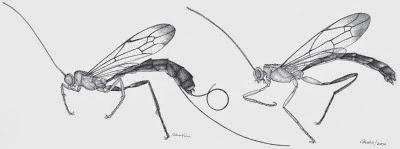
Flacopimpla barathrica in lateral view (slightly straightened) and head in anterior view. Fritzén (2014).

Adult wasps range from 3.6-5 mm in length in females and 3.0-4.5 mm in males. All are dark brown with pale legs. Larvae seemed to orientate themselves predominantly with their heads orientated towards the rear of the spider, though three (of 31 examined) were orientated the other way round. Pupae were loosely woven and spongy in appearance, and frequently (~60% of the time) infested with the larvae of the pseudohyperparasitoid (expand) Ichneumon Wasps Gelis sp.

(7) An adult female of the host Thymoites bellissimus with the larva of Flacopimpla barathrica.(8) A subadult male of the same host species infested with both the larva of Flacopimpla barathricaand an Iphidosoma physogastris Mite. (9) Cocoon with pupa in situ (Oulanka National Park), attached to the upper rock surface in the web of the host. (10) The newly emerged holotype in vitro, still resting on the cocoon. Scale bars 1 mm. Fritzén (2014).

This is the first species of Flacopimpla to be described from Europe; all previously known species have come from North and Central America. It is also the first known species of the genus to inhabit caves, and while it cannot be considered a true deep cave dweller, living in the dark zones of cave systems away from sunlight, it does live far enough in to be inhabiting a distinct micro-climate, more stable (i.e. less prone to extremes of temperature or strong fluctuations in temperature) than that of the surrounding boreal forests. The host species, Thymoites bellissimus, is found in boreal forests across the Arctic Circle, so it is likely that Flacopimpla barathrica is also more widely distributed than has been discovered to date; in particular it was found in Finland close to the border with Russia, and it is highly likely that it extends at least some way into Russian territory.

The first location where Flacopimpla barathrica was first discovered, in the Pirunpesä ravine in Kuopio, Finland. Fritzén (2014).

The second new species described is placed in the genus Zatypota, and given the specific name flamma, meaning ‘flame’, in reference to the colour of the adult. The species is described from a single female specimen raised from a Spider of the genus Parasteatoda, probably Parasteatoda lunata, found in mixed Beech/Oak woodland in Brennbergbánya in northwest Hungary. The specimen is 3.7 mm in length and brown and yellow in colour.

Zatypota flamma in lateral view (slightly straightened) and head in anterior view. Fritzén (2014).

Members of the genus Zatypota has previously been recorded from Europe, Asia, North America and Central America.

Zatypota flamma. (11) The cocoon and (12–13) the larva on its host Parasteatoda?lunata. Scale bars 1 mm.Fritzén (2014).

See also…

http://sciencythoughts.blogspot.co.uk/2014/12/two-new-species-of-ichneumon-wasps-from.htmlTwo new species of Ichneumon Wasps from Africa.                                                   Ichneumon Wasps are large parasitoid Wasps (the largest species can exceed 5 cm) closely related to Braconids. They are noted for their reproductive behaviour, in which the females sting another Insect or...
Ichneumon Wasps are a group of highly specialized...

Ichneumon Wasps are a group of highly specialized...
 
 
Follow Sciency Thoughts on Facebook.

Two new species of cave-dwelling Pseudoscorpions from northern Arizona.


The Grand Canyon-Parashant National Monument lies in northwestern Arizona, covering 4,451 km2 of deep canyons, mesas, and mountains. It has typical a Mojave Desert flora dominated by the Creosote Bush and Joshua Tree at its lower elevations, giving way to Pinyon and Juniper woodlands then Colorado Plateau grasslands and Pine and Aspen forest at higher altitudes. It also has a series of cave systems, which have been found to host a distinctive Arthropod fauna with many unique species of Book Lice, Beetles, Centipedes, Millipedes, Isopods and Crickets.


The cave is located in Juniper scrubland at an altitude of 1585 m on the north side of the lower Colorado River along the western extent of the Grand Canyon. It is set in the Kaibab Limestone Formation, with a south facing entrance at the bottom of a large sinkhole, and is 76.2 m long and 10.4 m deep. The deeper parts of the cave are considered to be a true cave deep-zone, with constant complete darkness, a stable temperature and an atmosphere with water at near saturation point with little-or-no through-flow. This cave has produced the second most diverse biological community in the Grand Canyon-Parashant National Monument, with the largest known Cricket roost in northern Arizona.

The first new species described is placed in the genus Hesperochernes, which has nineteen previously described species from caves and woodland across North America, from Mexico and the Dominican Republic in the south to Canada in the North, and one previously described species from under tree-bark in Japan. It is given the specific name Hesperochernes bradybaughi in honour of Jeff Bradybaugh, the former superintendent of Grand Canyon-Parashant National Monument for his advocacy of cave research, conservation and management.

Hesperochernes bradybaughi, male (left) and female (right) in dorsal view. Harvey & Wynne (2014).

Hesperochernes bradybaughi is described from three specimens, one male and two females. The male is 3.11 mm in length, the females 2.82 mm and 4.21 mm, all are reddish brown and yellow in colour. The species is eyeless, and has long slender limbs.

The second new species is placed in the genus Tuberochernes, which to date contains only two other species, both from cave-systems in the southwestern United States. It is given the specific name Tuberochernes cohni, in honour of the late Theodore ‘Ted’ Cohn, a distinguished orthopterist (scientist studying Crickets and Grasshoppers) who passed away in November 2013 at the age of 82, and who identified a new genus of Crickets from the same cave.

Tuberochernes cohni, male in dorsal (left) and ventral (right) views. Harvey & Wynne (2014).

Tuberochernes cohniis described from a single male specimen, 3.38 mm in length and reddish brown in colour. This species is also eyeless with elongate, slender limbs.

See also…

http://sciencythoughts.blogspot.co.uk/2012/12/a-new-species-of-pseudoscorpion-from.htmlA new species of Pseudoscorpion from Hainan Island, south China.            Pseudoscorpions (or False Scorpions) are small Arachnids with flattened oval or pear-shaped bodies; they have pincers resembling those of true Scorpions, but lack stinging tails. The largest species reach 12...
http://sciencythoughts.blogspot.co.uk/2012/09/two-new-species-of-pseudoscorpion-from.htmlTwo new species of Pseudoscorpion from China.                                              Pseudoscorpions, or False Scorpions, are small carnivorous Arachnids resembling Scorpions without the stinging tail. Most species are between two and eight millimeters in length, although the largest can...
False Scorpions are Arachnids related to Camel Spiders, Harvestmen and True Scorpions; they resemble Harvestmen with enormous, Scorpion-like claws, but are very small (the largest known species is...
Follow Sciency Thoughts on Facebook.